Direct water-technology investment for family offices means taking a private-equity stake or providing growth capital directly to commercially credible companies developing water-treatment, wastewater, reuse, purification or digital water technologies. Investors should assess customer demand, technical validation, defensible intellectual property, deployment economics, regulation, recurring revenue, margins, scalability, risk and exit potential rather than relying on environmental impact claims alone.
Direct investment in water technology gives family offices access to private companies that meet vital industrial and infrastructure needs. The best opportunities offer more than technical innovation. They show proven results, paying customers, strong intellectual property, scalable costs and a clear path to profit or a strategic exit.
This guide explains how to assess private water-treatment and water-technology companies. It covers industrial wastewater, purification, reuse, membranes, desalination, resource recovery, digital monitoring and water security. It also looks at customer demand, regulation, energy use, operating efficiency, revenue quality, commercial progress and barriers to adoption. Finally, it outlines key due diligence issues across the UK, Europe and GCC markets.
What Does Direct Water-Technology Investment for Family Offices Involve?
Direct investment means buying an ownership stake in a private company. The company may develop, own or use solutions for treating, monitoring, reusing or recovering value from water and wastewater. Targets may include industrial wastewater firms, membrane and purification specialists, desalination providers, digital monitoring platforms and resource-recovery companies.
Commercial value usually comes from solving a clear customer problem. This may mean reducing freshwater purchases, lowering discharge or disposal costs, improving compliance, protecting production or recovering useful materials. Environmental benefits can strengthen the case. However, they do not replace proof that customers are willing to pay.
Companies may earn revenue from equipment sales, licensing, engineering and integration. Other sources include maintenance, consumables, monitoring software and treatment-as-a-service. Investors should separate repeatable, higher-margin revenue from bespoke projects. Bespoke projects often need more working capital and carry construction or performance risk.
Due diligence should cover paid deployments, customer concentration and contract length. It should also review renewal rates, gross margins after service and warranty costs, intellectual-property ownership, freedom to operate, future funding needs and possible exit routes. Direct private holdings may provide closer access to management and negotiated rights. However, they usually have limited liquidity, less public information and greater execution risk than listed investments.
UK, European and GCC opportunities need separate legal, procurement and permitting reviews. The UAE, Saudi Arabia, Qatar, Kuwait, Bahrain and Oman each have their own industrial rules.
Water Investment Network is an invitation-only network. It gives eligible investors access to selected private water-treatment and water-technology opportunities. It does not manufacture equipment, provide engineering services, offer regulated financial advice or guarantee returns.
What Is Water Tech?
Water tech includes equipment, biological and chemical processes, digital systems, and service models. These solutions treat, move, monitor, reuse, or recover value from water and wastewater. Key areas include filtration, disinfection, biological treatment, reverse osmosis, nanofiltration, advanced oxidation, resource recovery, leak detection, and industrial Internet of Things platforms.
For investors, the key question is whether a solution can be deployed many times at an acceptable total cost. Assess the quality and variability of the water source. Also review output quality, energy and chemical use, maintenance, waste management, and links to existing infrastructure. Intellectual-property protection and customer results also matter.
Digital platforms can earn revenue through subscriptions, monitoring, or performance management. They may reduce downtime, chemical use, leaks, or maintenance costs. However, a dashboard alone is not a strong advantage. Defensibility depends on data quality, system integration, cybersecurity, customer retention, and proven savings.
Water security applications include water reuse, desalination, brine reduction, decentralised treatment, and network efficiency. GCC opportunities may be strong where water scarcity, saline supplies, or industrial growth create urgent demand. However, each country and project needs its own approval and procurement review.
Which Water Technologies Offer the Strongest Commercial Cases?
Advanced treatment, purification and reuse
Advanced treatment uses processes such as membranes, activated carbon, ultraviolet light, advanced oxidation and ion exchange. These processes are used when conventional treatment cannot meet discharge or reuse standards. Commercial value may come from lower freshwater purchases, lower disposal costs, compliance and protection of production.
Investors should test performance in conditions that reflect real operations. Tests should cover energy use, fouling, chemical demand, replacement cycles, residual streams and monitoring needs. Reused water may support industrial processes, cooling, irrigation or other permitted uses. The business case should compare lifetime costs with the customer’s current water supply and disposal options.
Industrial wastewater and resource recovery
Industrial wastewater may offer strong commercial potential when it contains difficult contaminants, valuable materials or risks that could affect production. Applications include pharmaceuticals, food and beverage, chemicals, mining, semiconductors and energy-intensive industries. Revenue may come from equipment, system integration, monitoring, maintenance and treatment-as-a-service.
Resource recovery aims to produce reusable water, nutrients, biogas, salts or minerals. Investors should check product quality, offtake agreements, processing costs and market demand. They should not assume that recovered products have value.
Membranes, desalination and zero-liquid discharge
Reverse osmosis uses pressure to remove many dissolved salts and contaminants. Nanofiltration usually works at lower pressure and provides more selective separation. Established membrane markets often favour better energy efficiency, fouling control, recovery and reliability over novelty alone.
Desalination and zero-liquid discharge can improve supply resilience or support sites with strict discharge limits. Their economics depend on energy prices, feedwater quality, recovery rates, residuals handling, capital costs and performance guarantees. Zero-liquid discharge can reduce liquid discharge, but it may also increase energy use and operating complexity.
Micropollutants, PFAS, nutrients and digital efficiency
Technologies that address micropollutants, PFAS and nutrients may benefit from regulation-driven demand. However, removal claims need support from representative testing. They also need a credible plan for managing residuals. Requirements vary across the UK, EU member states and each GCC jurisdiction.
Leak detection, smart meters and industrial IoT can reduce non-revenue water, pumping energy, downtime and emergency repairs. The investment case should identify the budget owner and set a baseline for savings. It should also assess integration needs and confirm that the customer can act on alerts.
How Do Customer Demand and Regulation Influence Investment Cases?
Industrial buyers generally purchase these solutions for operational reasons: reliable production, lower disposal costs, reduced freshwater exposure or compliance. Investors should distinguish mandatory purchases from discretionary efficiency projects and examine budgets, procurement stages, paid deployments, repeat orders and customer concentration.
- Pharmaceuticals: high-purity process water, wastewater segregation and validation requirements can create barriers to entry.
- Food and beverage: variable organic loading, cleaning chemicals and reuse needs favour robust effluent solutions.
- Chemicals: changing feedwater and chemical compatibility require specialist process control.
- Mining: metals, salinity, solids, remote sites and permitting can create demand but extend project cycles.
- Agriculture, data centres and energy-intensive industry: reuse and efficiency depend on site-specific water balances, energy costs, quality requirements and approvals.
UK environmental permitting and discharge requirements differ across England, Wales, Scotland and Northern Ireland. [1] EU rules, including the revised Urban Wastewater Treatment Directive, require review of national transposition and project-level obligations. [2] GCC requirements must be mapped separately for the UAE, Saudi Arabia, Qatar, Kuwait, Bahrain and Oman.
Regulation can accelerate adoption but does not guarantee sales, margins or returns. Investors should identify the precise rule, permit condition or deadline driving a purchase, the responsible party and the customer’s funded implementation plan.
How Should Family Offices Assess Water-Technology Companies?

A disciplined review should connect technical performance with commercial value.
- Traction: separate invoices, paid pilots, recurring contracts, renewals, pipeline and letters of intent.
- Customers: examine concentration, contract terms, reference calls, repeat orders and the role of engineering contractors or distributors.
- IP: review patents, licences, trade secrets, data, process know-how and freedom to operate; a patent alone does not prove defensibility.
- Economics: model capital expenditure, energy, chemicals, replacement parts, labour, residuals, warranties and working capital.
- Scale: test manufacturing, supply chain, installation, commissioning, service coverage and regulatory acceptance.
- Evidence: verify uptime, throughput, removal rates, operating costs and customer acceptance at relevant sites.
- Capital structure: review the fully diluted cap table, investor rights, use of funds, future financing and dilution scenarios.
- Exit: consider strategic buyers, customer access, technology fit, recurring revenue and liability exposure without treating an exit as assured.
Technical novelty should be compared with incumbent alternatives on total cost of ownership. A product that performs well in a pilot may still be commercially weak if integration, energy, maintenance or residuals costs erode customer savings.
What Are the Principal Risks of Water-Technology Investment?
Principal risks include scale-up failure, variable feedwater, fouling, corrosion, unreliable sensors, residuals obligations and underperforming energy economics. A successful laboratory or pilot result does not establish repeatable commercial performance.
Long procurement cycles, public tenders, site approvals, project finance and construction obligations can delay revenue and increase working-capital needs. Investors should distinguish qualified opportunities from funded projects, signed contracts and recognised revenue, and identify who bears performance and payment risk.
Regulatory, permitting and liability exposure must be assessed by jurisdiction. UK, EU and GCC rules are not interchangeable. Review discharge, reuse, product-quality, data, cybersecurity, environmental-liability and performance-guarantee obligations with appropriate local advisers.
Competitive risk comes from established engineering groups, chemical suppliers, membrane manufacturers, utilities, system integrators and simpler incumbent processes. Differentiation should be demonstrated through whole-life cost, validated performance, switching costs, approvals, proprietary data or process know-how.
Model downside cases for slower adoption, lower utilisation, higher energy or consumables costs, weaker feedwater quality, delayed maintenance and additional financing. Staged capital and milestone-based funding may help align the investment with technical and commercial evidence.
How Can Investors Compare Water-Technology Opportunities?
Use a consistent framework across treatment, reuse, industrial wastewater, resource recovery and digital platforms:
- Customer need: documented compliance, production, scarcity, disposal or efficiency problem.
- Differentiation: independently supported performance and lifecycle-cost advantage.
- Traction: paid deployments, renewals, expansion and credible references.
- Deployment: installation, energy, operating, residuals and maintenance economics.
- Scalability: repeatable design, supply chain, commissioning and service delivery.
- Outcome: funding requirements, profitability milestones, dilution and plausible strategic value.
Before progressing, request contracts, invoices, site data, independent testing, bills of materials, warranties, IP documents, regulatory maps, forecasts, downside scenarios and the cap table. Separate verified facts from forecasts and investment opinion. The relevant evidence should be proportionate to the company’s stage: commercially credible seed, Series A/B, growth capital or patient infrastructure-linked capital.
Where Do Private Opportunities Sit Across the Water Market?
Early-stage companies may offer new purification, wastewater, resource-recovery or digital systems but carry the highest technical, dilution and scale-up risk. Milestone-based financing can link capital to validation, paid pilots and customer conversion.
Series A and B businesses with validated deployments may offer stronger evidence, although manufacturing, working capital, project delivery and customer concentration remain important. Paid, relevant and continuously operating installations are more informative than a high number of subsidised demonstrations.
Growth-capital businesses may have established revenue in industrial wastewater, reuse, membranes, monitoring or integrated services. Investors should distinguish repeatable product and service revenue from bespoke projects and assess margin progression as deployments increase.
Patient capital may suit infrastructure-linked companies operating assets or delivering treatment as a service. Longer contracts can support visibility but introduce construction, refinancing, counterparty, permit and utilisation risk.
Capital type should match evidence quality, funding needs, holding period and liquidity expectations. No stage guarantees investment returns.
What Is Advanced Water Purification?
Advanced water purification uses additional treatment barriers to produce water for a defined application, such as industrial process use, cooling, agricultural reuse or other permitted purposes. Processes may include ultrafiltration, reverse osmosis, activated carbon, ultraviolet treatment, advanced oxidation and ion exchange. [3]
Commercial assessment should cover contaminant removal, consistency under changing feedwater, energy and chemical use, cleaning, replacement, residuals, integration and monitoring. The key question is whether the additional treatment creates sufficient value through reuse, compliance, reliability or avoided disposal costs.
What Is Considered Advanced Wastewater Treatment?
Advanced wastewater treatment goes beyond primary and secondary processes to address nutrients, micropollutants, pathogens, dissolved contaminants or reuse specifications. Examples include tertiary filtration, nutrient removal, membrane systems, ultraviolet disinfection, ozone, activated carbon and advanced oxidation. [2]
Investors should assess validated performance, uptime, energy, chemicals, residuals, integration, permitting, customer economics and service capability. Useful impact measures include water reused, freshwater avoided, pollutant mass removed, energy per cubic metre and residual waste generated. A pilot demonstrates interest or feasibility; repeat paid deployments provide stronger evidence of scalable demand.
How Can Family Offices Access Direct Water-Technology Opportunities?
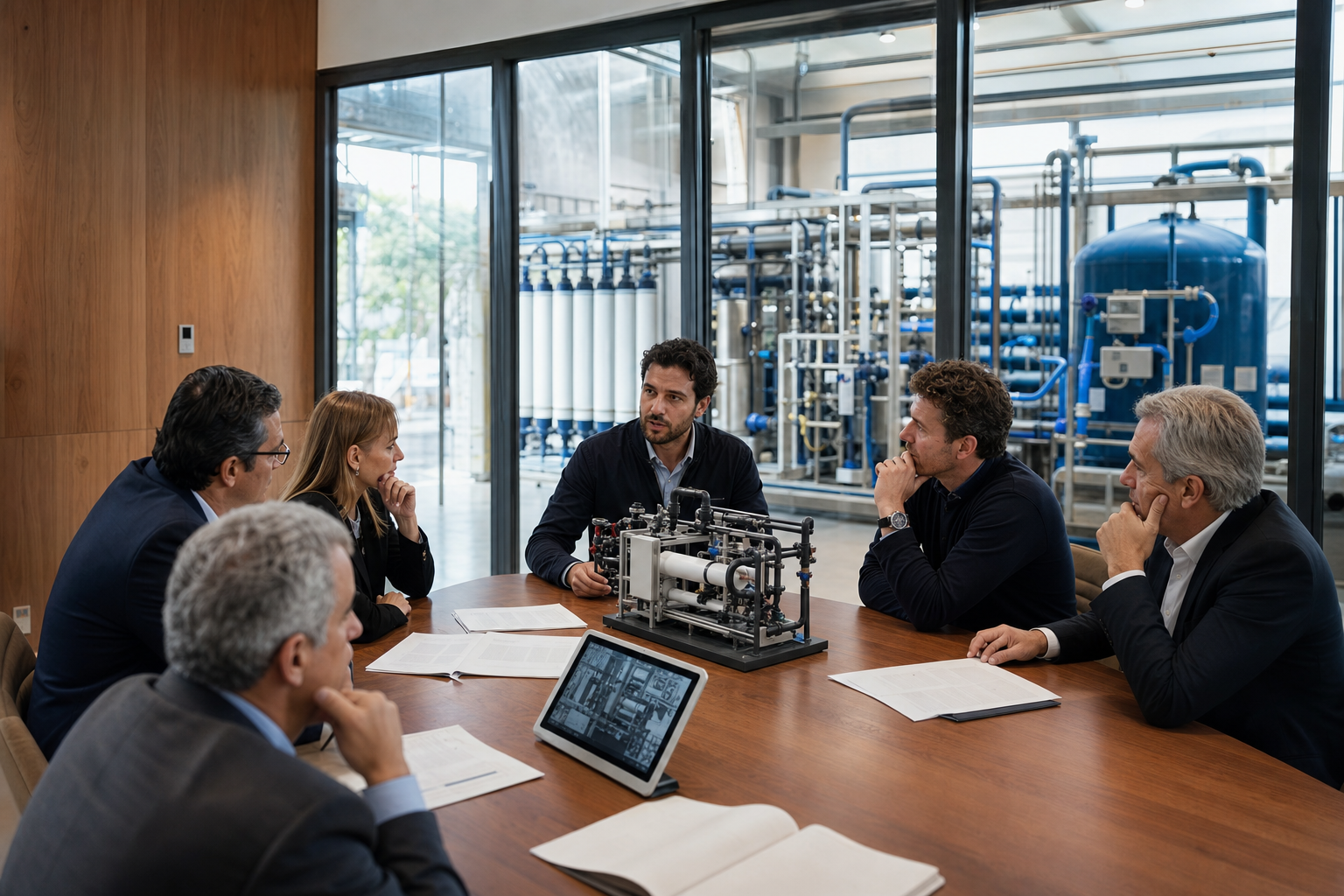
A credible opportunity brief should state the company’s ownership, stage, customer problem, technology, paid traction, IP, target sectors, deployment economics, revenue model, funding requirement, measurable impact, risks and possible strategic value. Verified facts should be clearly separated from forecasts and opinion.
Water Investment Network is an invitation-only network connecting UK, European and GCC family offices, high-net-worth individuals and sophisticated impact investors with selected private companies in water treatment, industrial wastewater, reuse, resource recovery, digital monitoring and related technologies. It is a curated access point, not an engineering provider, manufacturer or source of regulated financial advice.
Eligible investors may request the investor report or enquire about joining the network. Any opportunity should then pass through the investor’s own commercial, technical, legal, tax and financial diligence and investment-committee process.
Frequently Asked Questions
What are water technologies?
They are products, processes and digital systems that treat, monitor, reuse, move or recover value from water and wastewater. Investable businesses typically link technical performance to a defined customer cost, recurring revenue or repeatable deployment model.
What technologies are involved in water management?
Water management includes physical and chemical treatment, biological processes, membranes, desalination, resource recovery, sensors, software, leak detection and automation. Investors should examine lifecycle cost, integration, cybersecurity, residuals and customer adoption.
What is advanced water purification?
It is a treatment train using additional barriers such as membranes, activated carbon, ultraviolet treatment or advanced oxidation to meet a defined quality or reuse requirement. Its investment case depends on reliable performance and acceptable whole-life economics.
What is advanced wastewater treatment?
It refers to processes beyond primary and secondary treatment that target nutrients, micropollutants, pathogens or reuse standards. Commercial maturity is demonstrated through representative operating data, paid customer deployments and repeatable economics.