Private markets in water are investments in private companies, projects or funds that solve water problems. The case rests on customer demand, operating evidence, risk and a realistic holding period.
Private markets give investors access to businesses and assets that are not traded on public exchanges. In water, that can mean taking a closer look at companies that solve industrial water, wastewater, reuse, monitoring or resilience problems before they become large institutional assets.
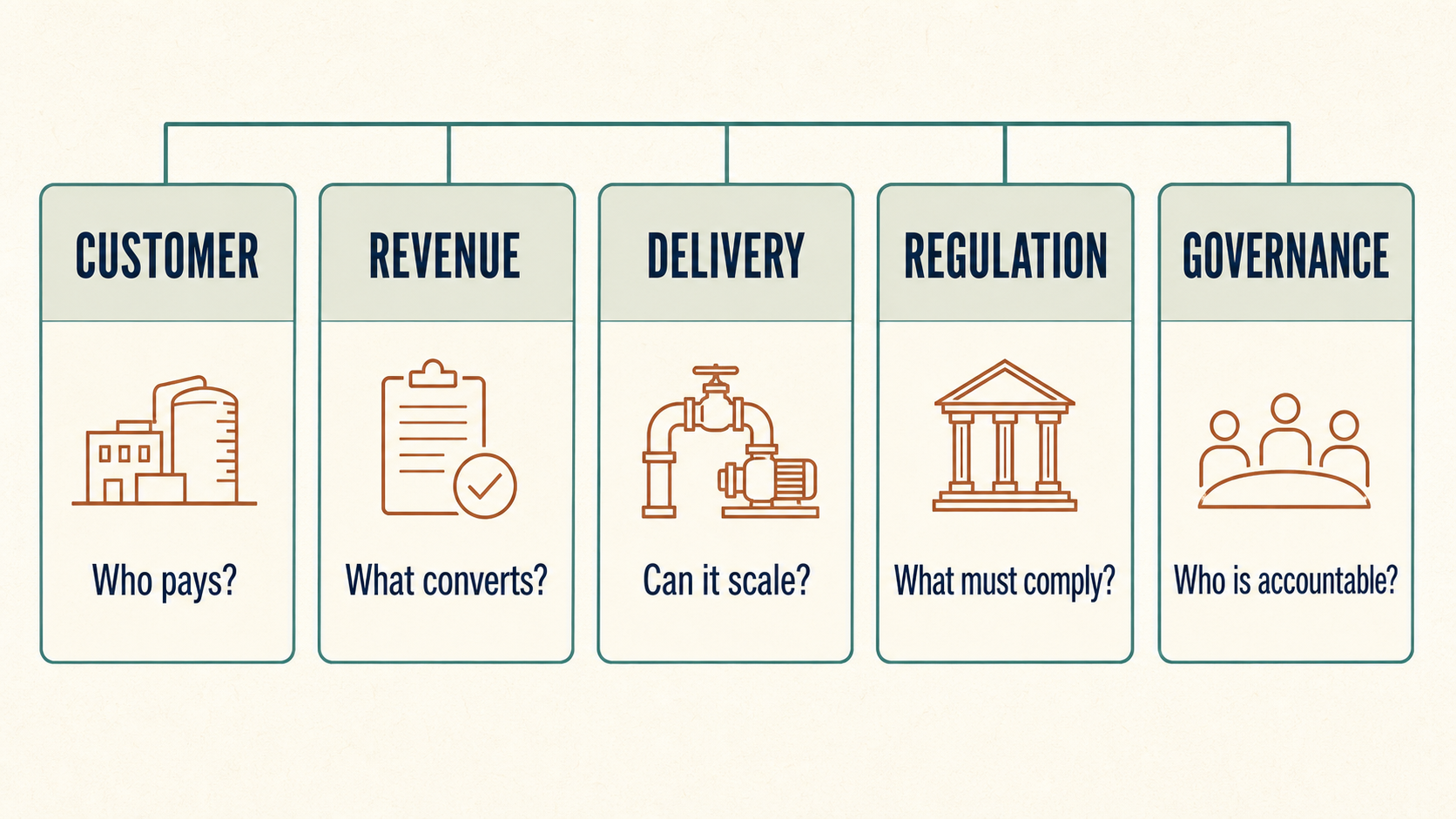
That opportunity needs discipline. A good water story is not enough. An investor needs evidence of a paying customer, a repeatable revenue model, credible unit economics, a route to scale and a realistic path to liquidity. Water Investment Network focuses on direct private-company opportunities where those questions can be tested against commercial proof and measurable impact.
This guide explains what private markets mean in a water context, where capital can enter the value chain and which diligence questions matter most. It is general information, not regulated financial advice. Private investments can be illiquid and may involve a loss of capital.
What private markets mean for water investors
The term private markets covers investments that are not traded on public exchanges. CFA Institute describes private equity as one part of this wider group, alongside areas such as private credit, infrastructure and real estate.[1]
In practice, a water-focused private-market opportunity may involve equity in a technology company, growth capital for a proven operator, project finance for a treatment asset or a fund that owns several water-related businesses. These are different exposures. They should not be assessed as if they have the same cash flows, risks or holding period.
Private market investments can therefore range from company equity to asset-backed projects and specialist funds. The label describes the ownership setting, not the quality of the underlying opportunity.
The first change in mindset is from a product story to an ownership case. The question is not simply whether a technology works. It is whether the company can win customers, deliver reliably, collect revenue, protect its margin and fund the next stage of growth.
The second change is from visible daily pricing to evidence-led valuation. Private companies do not offer a continuous market price. Investors therefore need stronger information rights, clearer reporting and a realistic liquidity plan before committing capital.
Why water is becoming a private-market question
Water is linked to the performance of many parts of the real economy. Agriculture, manufacturing, energy, health and urban development all depend on reliable water systems. The World Bank’s Joint MDB Water Security Financing Report shows that water finance is being treated as a major development and infrastructure question, with public and private capital playing different roles.[2]
The financing challenge is not the same as a simple shortage of demand. Some water projects have weak revenue visibility, fragmented buyers, long approval cycles or benefits that are difficult to monetise. That creates a gap between a clear public need and an investable private-company case.
Investors who want to invest in private markets need to test that gap directly. A strong theme is only a starting point; the evidence must show how a specific business earns, delivers and grows.
Private capital can help close part of that gap when the business model is clear. A manufacturer may pay to reduce process-water risk. A utility may buy monitoring that improves operating decisions. An industrial customer may pay for treated reuse water where the service is more reliable than securing another supply source.
The World Bank’s Joint MDB Water Security Financing Report recorded USD 19.6 billion of water-related financing approved by the participating multilateral development banks in 2024, including USD 14.4 billion for low- and middle-income countries. It also describes the use of non-sovereign finance and other instruments to crowd in private capital.[2] This does not mean every water company is investable. It does show why project preparation, risk allocation and private-sector participation remain active financing questions.
For a family office or sophisticated impact investor, the useful question is narrower: which businesses can turn a real water problem into durable customer revenue without relying on an unsupported market forecast?
Where private capital can enter the water value chain
Water is not one market. The investable case changes according to who pays, what is delivered and which risks sit with the company. Four broad entry points are useful for an initial screen.
- Technology companies: These businesses sell equipment, treatment processes, software, sensors or integrated systems. The main questions are proof of performance, sales cycle, gross margin, service burden and repeatability.
- Operating businesses: These companies run treatment, reuse, monitoring or water-management services. Investors should examine contract length, renewal rates, asset intensity, maintenance responsibility and customer concentration.
- Project and infrastructure platforms: These structures may develop or own water assets. The focus shifts to permits, construction risk, offtake terms, financing structure, counterparty strength and long-term operations.
- Enabling services: Data, testing, engineering software and compliance tools can support a wider water ecosystem. Their scalability may be stronger than a physical asset, but the company still needs a clear route from user adoption to recurring revenue.
These categories can overlap. A technology company may later add a managed service. An operator may develop proprietary process controls. The change in model affects working capital, margin, governance and exit options, so it should be visible in the investment case.
Investment thesis at a glance
A private-market water opportunity should be easy to explain without relying on a slogan. The table below gives an initial committee frame. It is a diligence structure, not a forecast or a return expectation.
| Investment question | Evidence to request | Why it matters |
|---|---|---|
| What demand is being solved? | Named customer problem, buying trigger and evidence of budget ownership | Need is not the same as willingness to pay |
| Who pays? | Customer profile, contract structure, sales pipeline and renewal evidence | Revenue quality depends on the buyer and the terms |
| Can delivery scale? | Deployment process, supply chain, installation burden and service capacity | Growth can consume cash if each sale needs bespoke work |
| What can damage the case? | Technical, regulatory, customer, funding and concentration risks | A credible downside view improves decision quality |
| How can value be realised? | Potential strategic buyers, sponsor interest, refinancing or other routes | Illiquidity makes the exit plan part of the entry decision |
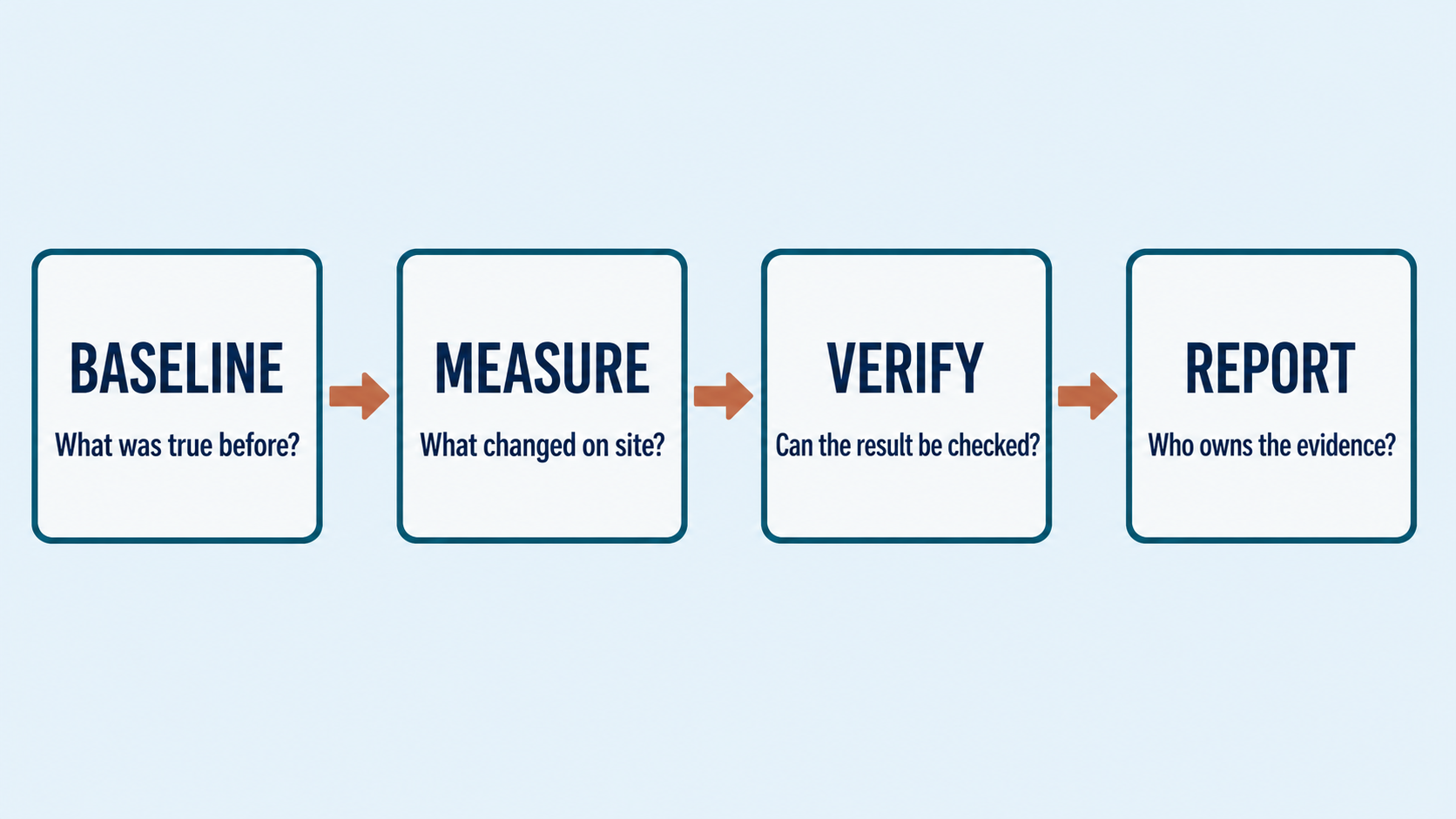
| What impact can be measured? | Baseline, measurement method, verification and reporting owner | Impact claims need the same discipline as financial claims |
How water companies create revenue and scale
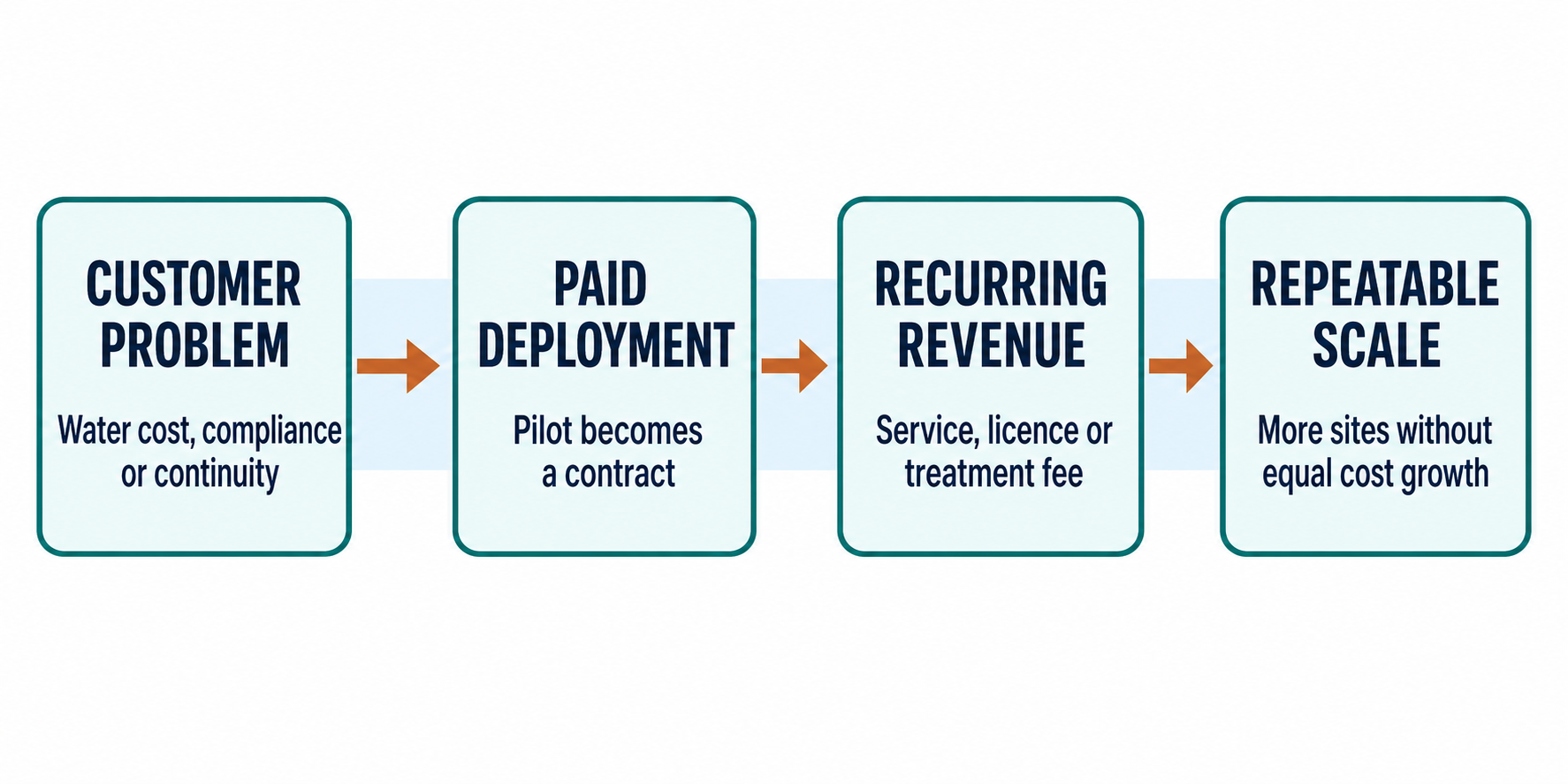
Water companies can earn revenue through equipment sales, licensing, long-term service contracts, treatment fees, software subscriptions, performance arrangements or a mix of these models. The label matters less than the actual cash cycle.
Start with the first invoice. Is it for a feasibility study, pilot, capital equipment, installation, ongoing operations or measured performance? Each stage has a different margin profile and a different risk of delay. A business that reports a large pipeline but cannot convert pilots into paid contracts may still be early-stage in commercial terms.
Next, test repeatability. A solution may be technically repeatable but commercially bespoke. Every site can have different water chemistry, permits, integration needs and procurement rules. That does not make the business unattractive, but it can increase sales cost, deployment time and working-capital needs.
Unit economics should follow the customer journey. A useful model separates customer acquisition cost, engineering time, hardware input, installation, commissioning, maintenance, energy, consumables, financing and warranty exposure. Gross margin can look healthy before these costs are allocated properly.
Scalability also depends on people and partners. The company may need qualified operators, local delivery partners, laboratory capacity or specialist manufacturing. An investor should know which capability is owned, which is contracted and where a single supplier could constrain growth.
IFC describes water as a sector where project preparation, financing, partnerships, technical standards and local-market knowledge can all affect whether a project launches. Its Scaling ReWater programme also highlights the value of standardised preparation and balanced agreements in lowering transaction costs and perceived risk.[3][4] For a private company, that reinforces one practical test: can the business reduce the friction between a technical solution and a financeable customer contract?
The diligence questions that matter most
Private-market water diligence should combine commercial, technical, regulatory and operational review. No single presentation can replace evidence from customers, contracts, accounts and independent specialists where needed.
Customer and contract evidence
- What problem caused the customer to start a buying process?
- Which budget pays for the solution, and who can delay or stop the purchase?
- How long is the sales cycle from first test to revenue?
- Which contracts are signed, which are pilots and which are only pipeline?
- What happens if a major customer does not renew or expands more slowly?
Technology and delivery evidence
Define the technology in plain language first. For example, membrane filtration separates substances by passing water through a selective barrier. The investor consequence may be energy use, membrane replacement, cleaning frequency, downtime or product quality. That consequence should be measured in the company’s operating data, not left as a general claim.
Ask for performance across more than one site where possible. Check the test conditions, feedwater, operating hours, maintenance history and any customer acceptance criteria. A laboratory result can be useful, but it is not the same as reliable performance in a live industrial environment.
Financial and governance evidence
Request management accounts that reconcile to filed accounts or an independent review where available. Separate recurring revenue from project revenue. Review gross margin by product or service, receivables ageing, customer concentration, warranty provisions, capital expenditure and cash conversion.
Governance matters because private markets rely on information and alignment. ILPA’s private-equity principles place emphasis on alignment of interests, governance and transparency.[5] Direct investors should apply the same logic to board rights, reporting frequency, conflicts, related-party transactions, reserved matters and the treatment of future funding rounds.
Regulatory and market evidence
Water regulation can create demand, but the relevant rule depends on the jurisdiction, customer and use case. The investor should identify the exact permit, quality standard, discharge obligation or procurement condition that affects the business. Avoid treating UK, EU and GCC rules as interchangeable.
For opportunities linked to a specific country, confirm the local rule with a current primary source or qualified adviser. WIN’s water regulation resources can provide context, but they do not replace transaction-specific legal or regulatory advice.
Liquidity, valuation and exit risk
Illiquidity is not a footnote in private-market investing. It affects how capital is committed, how performance is reported and how an investor may respond when circumstances change. CFA Institute notes that private-market investments are generally less liquid and require investors to understand the related time horizon and valuation questions.[1]
A water company may need time to secure reference customers, pass qualification processes, build delivery capacity and reach a scale that attracts strategic buyers. A long holding period can be reasonable when it matches the commercial plan. It becomes a risk when the plan relies on a short exit window that the business cannot control.
Valuation should therefore be tested against operating evidence. Use the company’s revenue quality, margins, cash needs, customer concentration, technology risk and comparable transactions where reliable data exists. Do not treat a headline valuation or a forecast multiple as proof of value.
Potential exit routes may include a strategic acquisition, a sponsor-backed transaction, a later growth round, refinancing or a secondary transfer. These are possibilities, not promises. The right question is what future buyer would have a reason to pay for the company, and what milestones would make that buyer more likely to engage.
How UK, European and GCC context changes the analysis
Water opportunity is local even when the investment theme is international. Customer procurement, permitting, tariffs, infrastructure ownership, energy cost, currency and financing conditions can differ by country. A business that works in one market may need a different partner, contract or operating model elsewhere.
In the UK, an investor may focus on industrial discharge, water efficiency, wastewater compliance, infrastructure condition and the buying behaviour of regulated or industrial customers. The exact regulatory path depends on the service and site.
Across Europe, the analysis should distinguish EU-level requirements from national implementation and local enforcement. A company may benefit from a common direction of travel but still face different approval, procurement and customer conditions in each market.
In the GCC, water security, desalination, reuse, industrial development and energy intensity can be important themes. However, the investment case must be tied to a named market, customer type and delivery route. A regional label is not evidence of demand.
For cross-border private markets, currency and repatriation risk deserve the same attention as technology. Investors should ask which entity signs the contract, where cash is collected, which currency costs are paid in and how local rules affect ownership or distributions.
What impact evidence should measure
Impact should be specific enough to audit. “Helping water security” is a useful mission statement, but it is not a measurement framework. The company should identify a baseline, define the relevant metric, explain the boundary of measurement and assign responsibility for reporting.
Depending on the business, useful measures may include water treated, water reused, pollutant load reduced, leakage avoided, energy used per unit of water, operating uptime or customer continuity. The correct metric depends on the asset and the customer outcome. More metrics do not automatically mean better evidence.
Financial and impact measures should be read together. A project that saves water but cannot operate at a sustainable cost may struggle to scale. A profitable service with no credible impact boundary may not support an impact mandate. The investment case should state the trade-offs clearly.
How to decide whether a private water opportunity belongs in your pipeline
A first screen should reduce uncertainty, not create a false sense of precision. The following sequence keeps the discussion focused.
- Define the asset or company. State exactly what the investor would own or finance. Avoid broad labels such as “water technology” without a product, service or project boundary.
- Validate the buyer. Identify the paying customer, budget owner, procurement path and reason the purchase cannot be postponed indefinitely.
- Test commercial proof. Separate signed revenue, live pilots, qualified pipeline and management targets. Ask what evidence supports each category.
- Model delivery economics. Include installation, energy, consumables, maintenance, working capital and customer support. Make the assumptions visible.
- Map the risks. Record technical, regulatory, customer, funding, currency, supply-chain and governance risks. Add a mitigation owner and a date for the next evidence check.
- Set the holding-period test. Decide what liquidity the investor may need and whether the opportunity can be held through its commercial milestones.
- Define impact evidence. Choose a small set of material measures that can be repeated and verified.
This process will reject some attractive stories. That is a feature of disciplined private-market investing. It keeps capital allocation tied to evidence rather than to the size of the water challenge alone.
For investors who want to compare the types of opportunities WIN assesses, the Water Investment Network portfolio provides the relevant context. It should be read alongside the specific company materials, terms and risk disclosures for any opportunity under review.
Private markets and water: the practical conclusion
Private markets can give investors a direct view of water businesses, projects and operating models that are not available through a simple public-market screen. That access comes with a higher need for diligence, information rights, patience and a realistic view of liquidity.
The strongest water investment cases connect four things: a paying customer, a repeatable delivery model, evidence of financial quality and a measurable water outcome. They also make the risks visible. A large market need can support the conversation, but it cannot replace a contract, operating data or governance.
Water Investment Network is designed for eligible family offices, high-net-worth individuals, sophisticated impact investors and advisers who want to review direct private-company opportunities in commercial water technology. Join the network to request access and discuss whether the opportunity set fits your investment criteria.
Sources
- CFA Institute, Private Markets Certificate FAQs. Definition of private markets and private equity, accessed 26 August 2026.
- World Bank, Joint MDB Water Security Financing Report 2024.
- IFC, Water. Water-sector investment, mobilisation and project-development context.
- IFC, Scaling Re-Water. Project preparation, transaction costs and private-finance mobilisation.
- Institutional Limited Partners Association, Private Equity Principles and Best Practices. Governance, alignment and transparency principles.