Natural capital investment is most useful when it turns a broad environmental idea into a testable commercial case. For water investors, that means asking what natural asset is involved, which ecosystem service it supports, who pays for the benefit and how the result will be measured.
The phrase does not make a project investable. A river, wetland or aquifer can have real value without producing a dependable cash flow. The investment question is whether a company, service or project can protect or improve that value while earning revenue from a clear counterparty.
This guide is for family offices, high-net-worth investors, private-equity investors and advisers assessing direct water opportunities. It explains the natural-capital framework, the routes to revenue and the evidence needed before an opportunity reaches an investment thesis for water.
Natural capital investment in water connects a natural asset to a measurable customer benefit, a paying counterparty and a credible route to repeatable revenue.
What natural capital investment means for water investors
Natural capital is a way to describe the stocks of nature that create benefits for people and the economy. Defra’s Enabling a Natural Capital Approach guidance includes rivers, biodiversity, land, minerals and other living and non-living elements of the natural environment.
Those stocks produce flows called ecosystem services. Water quality regulation, flood reduction, groundwater recharge, water supply and recreation are examples. The service depends on the asset’s quality, quantity and location. It may also need land management, monitoring, treatment or other forms of capital before a customer receives a benefit.
For an investor, this framework helps separate four questions:
- What natural asset is being protected, restored, managed or used?
- What service does that asset provide, and to whom?
- What action creates a measurable customer or environmental outcome?
- Which contract, fee, saving or market mechanism can support revenue?
Natural capital investment can therefore involve a technology company, a managed water service, a land-based programme or an investment vehicle. It is not automatically a purchase of land or a claim on a future environmental credit. Each structure needs its own ownership, revenue, measurement and liquidity analysis.
This distinction also protects against a common mistake. A project may produce a valuable ecosystem service but still have no investable business model. Conversely, a water-technology company may earn revenue from improving water quality while its investors still need to understand the company’s dependence on the natural system.
Why water is central to natural-capital value
Water connects natural assets to daily production and public welfare. Rivers, wetlands, soils, groundwater and catchments influence the quantity, quality and timing of water available to households, farms, utilities and industry.
The connection is physical before it is financial. Poor catchment condition can increase treatment needs, flood exposure, abstraction pressure or operational uncertainty. Better management can support water quality, infiltration, storage and resilience. None of these statements proves a return, but each can shape a customer’s operating costs and capital plan.
The Environment Agency’s 2026 position statement on nature-based solutions for sustainable water resources describes measures such as wetland restoration, soil improvements, run-off attenuation and river restoration. It says these measures can improve water quality, slow run-off and support water-resource resilience, while also warning that baseline and post-implementation monitoring are needed.
That balance matters to investors. The water case may include an ecological benefit, but it must also explain the service delivered, the responsible party, the maintenance requirement and the point at which a customer pays. A natural-capital thesis is stronger when the environmental function and the commercial mechanism are visible at the same time.
Water also creates a useful test for impact quality. An investor can often trace a chain from a site condition to a treatment or management action, then to a measured change. The chain may be complex, but it is more meaningful than a broad label such as green, sustainable or nature positive without site-level evidence.
Follow the asset-to-revenue pathway
A natural-capital investment case should show how value moves through the system. Start with the asset, identify the ecosystem service, describe the customer benefit and then test the revenue mechanism.
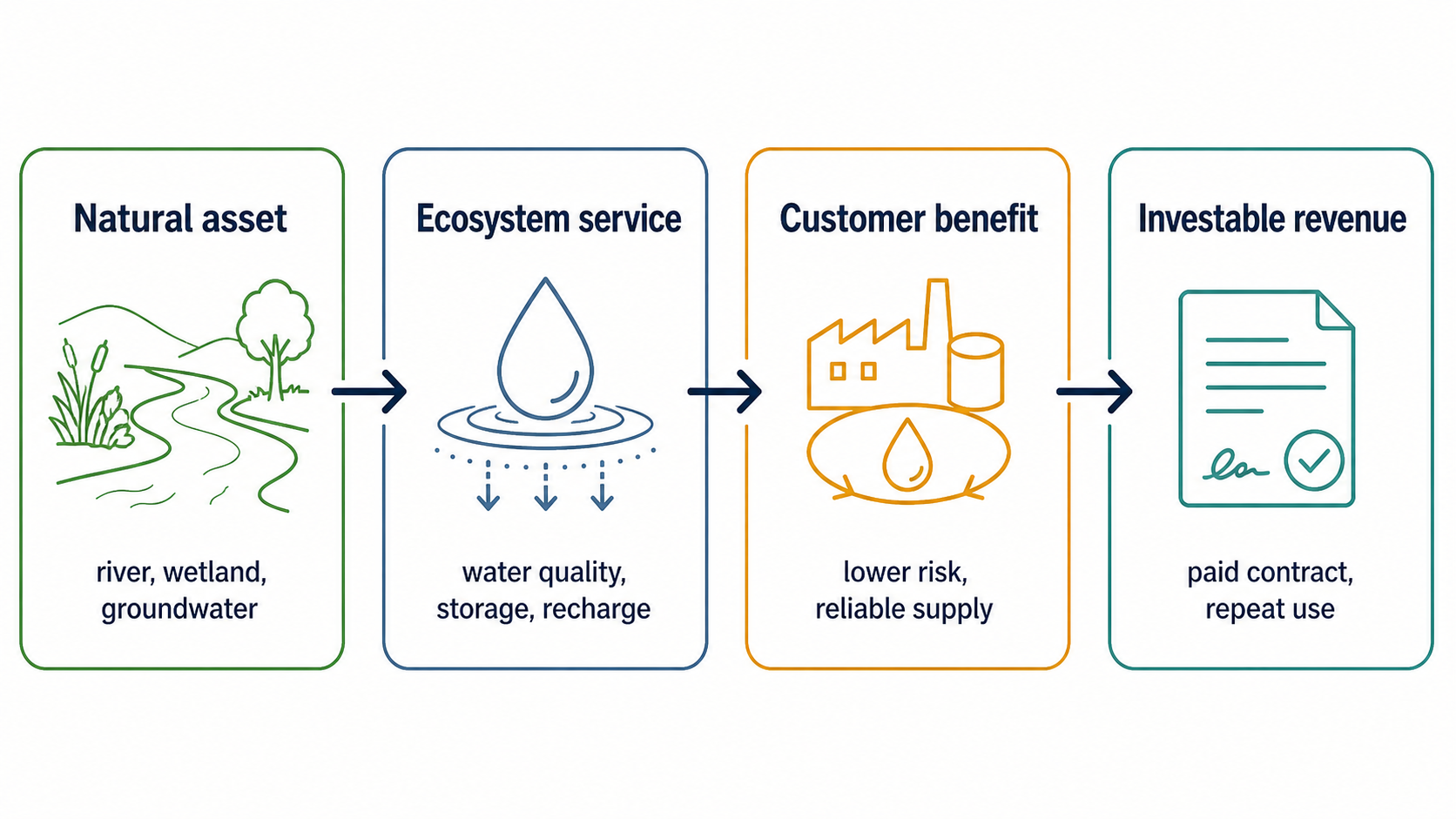
Consider a catchment with a wetland and a downstream industrial user. The wetland may slow run-off and support water quality. A managed programme might then reduce the user’s exposure to poor-quality raw water or help a utility meet a water-resource objective. The customer benefit could be lower treatment pressure, more reliable supply or reduced operational risk.
That example still needs proof. The investor must establish the baseline condition, the intervention’s boundary, the party responsible for delivery and the contract that links the service to payment. If the customer cannot identify a budget or a decision that the service improves, the pathway stops at environmental value rather than reaching revenue.
For a technology business, the pathway may run through monitoring, treatment or reuse. The natural asset is part of the operating context. The company creates value by helping a customer measure, protect or use water more effectively. Its defensibility may come from field data, integration, service quality or a repeatable deployment model.
Investors should not force every opportunity into one template. Nature-based programmes can have long establishment periods and complex land arrangements. Equipment businesses may have clearer invoices but higher manufacturing, installation or working-capital needs. The pathway is a map for questions, not a promise that all routes have the same risk.
Compare routes to investable natural-capital value
There are several ways to connect water outcomes to a business model. The labels below describe operating routes, not fixed asset classes or expected returns.
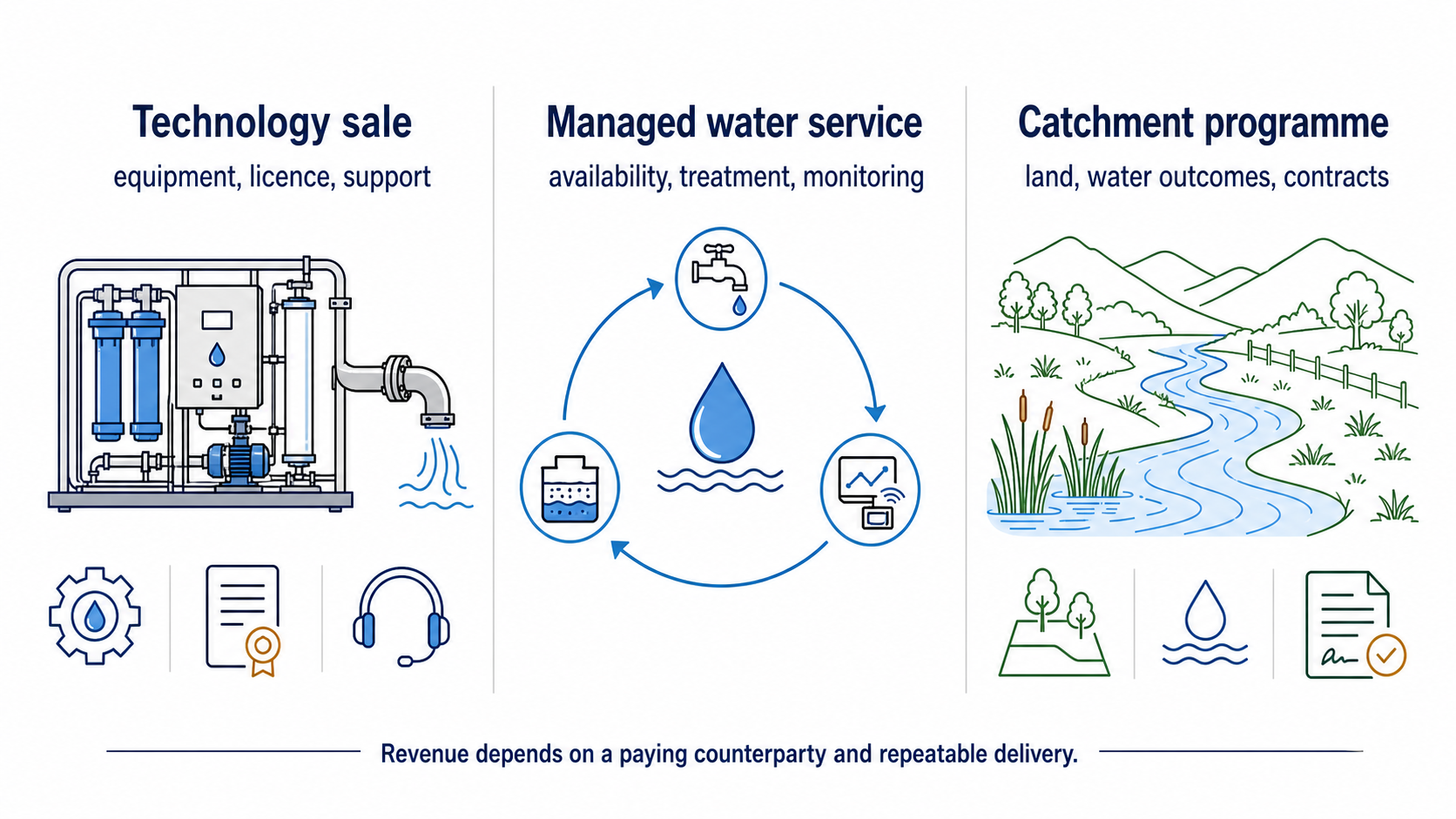
| Route | What the customer buys | Questions for investors |
|---|---|---|
| Technology sale | Equipment, software, licensing or support linked to a defined water problem. | Can the product be deployed repeatedly, with credible gross margin and manageable delivery risk? |
| Managed water service | Availability, treatment, monitoring or performance support over an agreed period. | Who carries operating risk, how is service quality measured and how much capital does growth require? |
| Catchment programme | Land management, water outcomes, monitoring or coordination across a defined area. | Who owns the land or intervention, who pays for the outcome and how are maintenance and additionality controlled? |
A technology sale can produce a clear purchase order, but one-off sales may not create a durable revenue base. A managed service can support recurring revenue, but the provider may carry performance, staffing and replacement obligations. A catchment programme can create several benefits, yet it may depend on multiple landowners, public bodies and funding sources.
Natural-capital investment therefore needs a model of cash timing as well as environmental value. Ask when the first invoice is issued, when the company pays suppliers, how long a site takes to become operational and what happens when a customer delays approval. The answer affects margins, working capital and the amount of capital needed to scale.
Start with funded customer demand
The most reliable starting point is a customer problem with a budget. Water businesses can serve utilities, industrial operators, developers, landowners, infrastructure owners or public bodies, but the buyer and procurement route will vary by project.
Demand can arise from water quality, supply reliability, compliance, flood exposure, treatment cost, capacity constraints or a need to report measurable environmental outcomes. A natural-capital opportunity should show which problem is urgent enough to justify a purchase, not only why the problem matters to society.
The Environment Agency says planners and investors should prioritise water-stressed catchments where evidence indicates that nature-based solutions are likely to be cost-effective. It also says that evidence should be proportionate to the proposed investment. For a private investor, that supports a practical diligence question: is the evidence strong enough for the price, scale and risk being proposed?
Useful demand tests include:
- Is there a named buyer with a defined operational or regulatory problem?
- Is the proposed solution inside an approved capital plan, operating budget or procurement process?
- Can the customer compare the solution with treatment, maintenance, abstraction, disposal or delay costs?
- Does the sales cycle match the company’s cash runway and funding plan?
- Can the first deployment become a referenceable and repeatable sale?
A letter of interest is not the same as a contracted revenue stream. A pilot is not the same as repeatable adoption. A policy objective is not the same as a customer budget. Those distinctions are central to natural capital investment because environmental urgency can make weak commercial evidence sound stronger than it is.
Measure condition, outcome and additionality
Measurement should begin before the intervention. A baseline describes the site’s condition, the water system, relevant pressures and the data available. The intervention then needs a defined boundary, owner and operating plan. The outcome should be expressed in terms that the customer and an independent reviewer can understand.
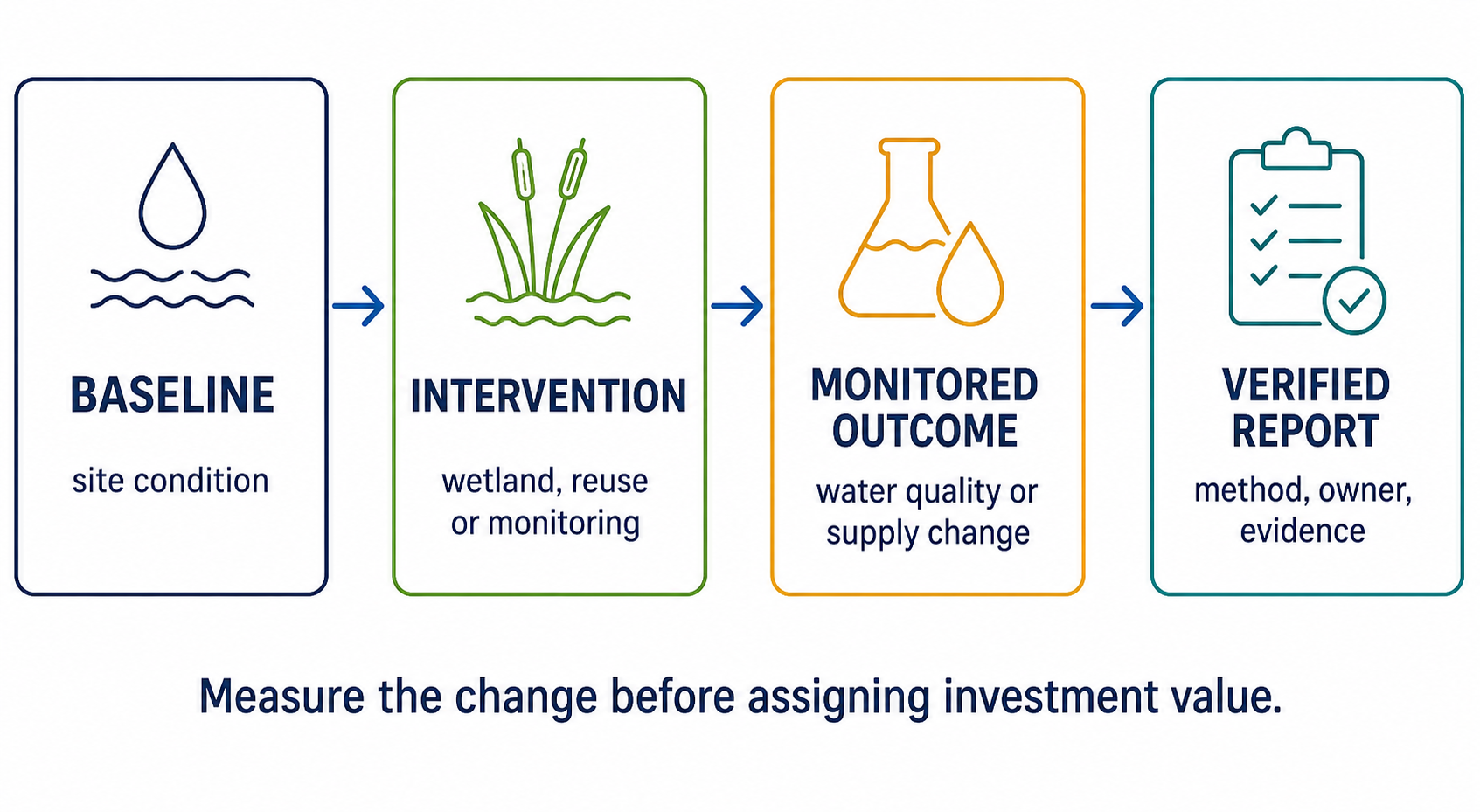
For example, an investor may examine water quality, flow, infiltration, abstraction pressure or treatment demand. The right measure depends on the service being delivered. Do not select a metric because it is easy to count. Select it because it reflects the customer’s decision and the environmental outcome.
Additionality asks what the investment changes that would not otherwise happen. It does not mean that every benefit must be caused by one investor. It means the claim should explain the investor’s contribution, the counterfactual and the limits of the evidence.
TNFD’s water utilities and services guidance gives organisations a way to examine nature-related dependencies, impacts, risks and opportunities. For investors, the practical lesson is to review both sides of the relationship. A portfolio company may depend on reliable water or land functions, while its own operations may affect those systems.
Keep four layers separate:
- Condition: what was present at the start, and how was it recorded?
- Action: what changed, who delivered it and what ongoing maintenance is required?
- Outcome: which water or ecosystem measure moved, over what period and at what site?
- Verification: who checked the method, data quality and reporting boundary?
A strong impact record does not remove investment risk. It makes the risk easier to see. Data gaps, seasonal variation, site differences and uncertain attribution should be recorded rather than hidden behind a single score.
Underwrite the operating model
Natural-capital investment still requires normal company analysis. The environmental purpose does not replace revenue quality, margin analysis, working capital, customer concentration or management assessment.
For a water-technology company, review the route from product design to installation, commissioning, operation and support. A technical result in a controlled setting may not translate to a mixed feed stream, a remote site or a customer’s maintenance regime. The investor should see field evidence and understand who carries performance risk.
For a catchment or land-based model, examine tenure, access, consent, maintenance and the duration of the intervention. A benefit that depends on a wetland, soil practice or monitoring network can decline if ownership changes or maintenance funding ends. The contract must say what happens in that case.
For a managed service, the key issue may be the gap between contracted availability and actual delivery cost. Check response times, replacement obligations, energy use, treatment inputs and the cost of adding each new site. Recurring revenue is useful only when the service can be delivered at a sustainable margin.
The World Bank’s natural-capital work treats water, soil, forests and biodiversity as assets that support economic activity, and points to natural-capital accounting as a way to bring stocks, flows and ecosystem services into decision-making. For water businesses, that framing is useful only when it is connected to a customer, a contract and a repeatable delivery model. A pipeline is not investable if every project needs a new contract structure, a new measurement method and a new delivery team.
Ask management to show:
- the repeatable part of the product or programme;
- the site-specific work that cannot be standardised;
- the gross-margin effect of installation, maintenance and monitoring;
- the funding needed before customer cash is received;
- the evidence that turns one successful site into a credible sales reference.
Price regulation, consents and regional market access
Water projects operate inside permits, planning rules, environmental standards, procurement processes and land arrangements. A natural-capital label does not create permission to abstract, discharge, build, alter a watercourse or claim an environmental benefit.
The Environment Agency’s position statement is specific to England. It advises early checks for permits and consents and refers planners to the Environment Agency, local planning authorities, lead local flood authorities and Natural England where relevant. This is a useful diligence pattern, but it should not be copied into another jurisdiction without local review.
For UK opportunities, separate England, Wales, Scotland and Northern Ireland where the responsible bodies and rules differ. For European opportunities, check the relevant national implementation, local permit and customer requirements rather than treating EU-level policy as a complete route to market. For GCC opportunities, confirm the jurisdiction-specific water, land, environmental, procurement and ownership rules with qualified local advisers.
Regulation can support demand, but it can also delay revenue. A rule may create a need for treatment or monitoring while the customer waits for funding, tender approval or a permit. Investors should model the timing and cost of compliance rather than treating regulation as a guaranteed sales driver.
Review at least these points:
- Which permits, consents or environmental assessments are required?
- Who is responsible for compliance if the site or operating method changes?
- Does the contract allocate liability for non-performance or environmental harm?
- Can the project operate through land-access, maintenance and monitoring changes?
- Are any environmental claims subject to a separate standard, register or approval?
Investors should also distinguish policy support from regulated financial advice. A natural-capital opportunity needs commercial and legal diligence. It should not be presented as a recommendation to any individual investor or as a promise of performance.
Test portfolio fit, governance and exit
Natural-capital opportunities can sit across venture, growth equity, private infrastructure or project-style exposure. That range can help a family office build a focused water allocation, but it can also hide concentration in the same customer, catchment, technology or regulator. Review the existing water portfolio with that concentration risk in mind.
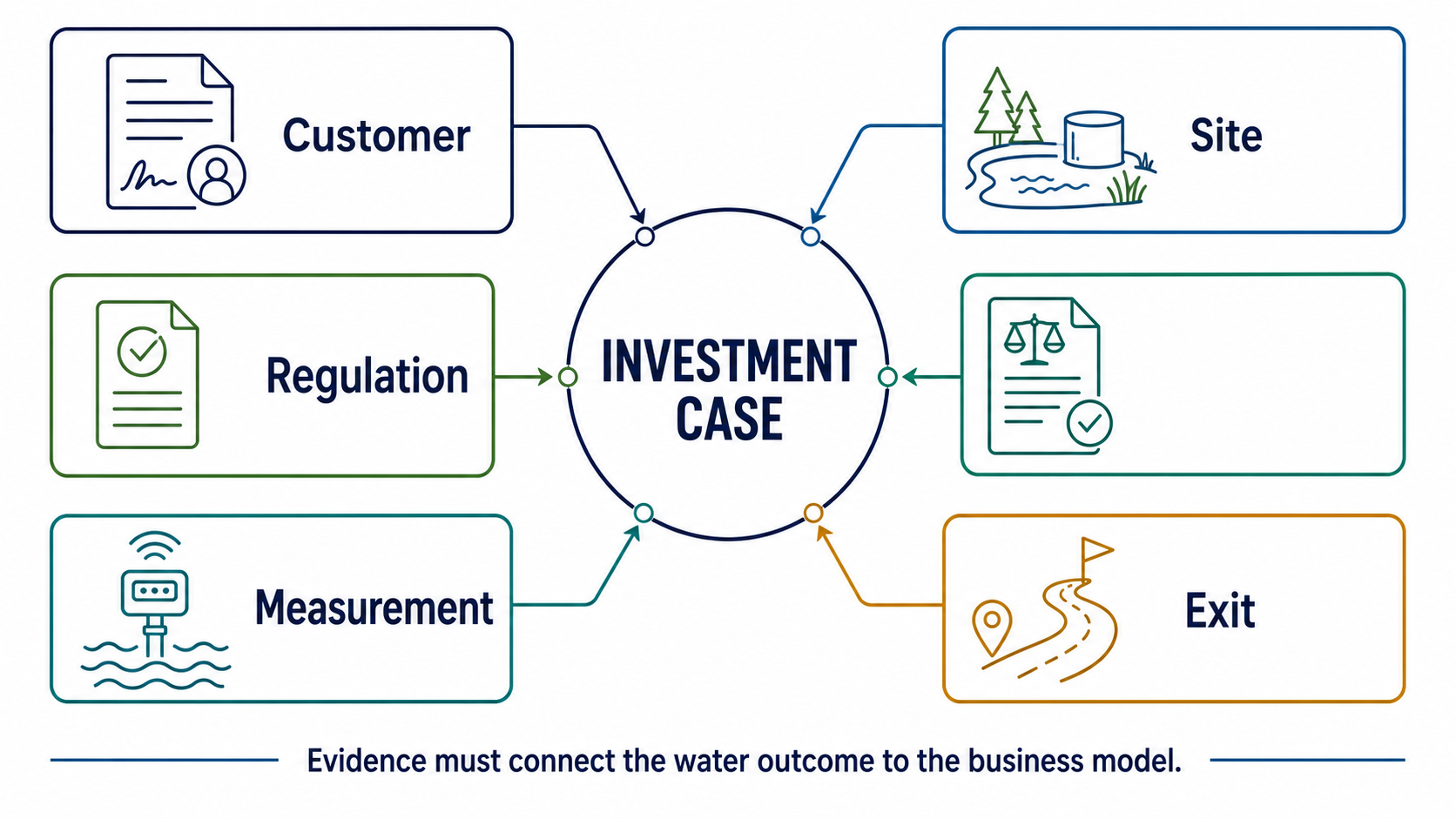
Governance should cover both money and impact. Set the reporting cadence, the person responsible for data, the trigger for corrective action and the process for revising a claim when new evidence appears. If the business cannot explain who owns the outcome, it cannot give investors a dependable monitoring process.
Portfolio fit also means understanding time. A technology sale may support a shorter growth path than a catchment programme that needs land agreements and ecological establishment. A service business may generate recurring revenue but remain exposed to renewal decisions. A project may have a contracted cash flow but limited transferability.
Exit analysis should start early. Potential routes can include a strategic acquisition, a later private-market transaction, a refinancing or a sale to another long-term owner. The relevant buyer will care about customer contracts, verified performance, management depth, maintenance obligations and the portability of the business model.
Use a simple committee test:
- Can we identify the paying customer and the decision being improved?
- Can we verify the water outcome without relying on a marketing label?
- Can the company deliver more sites without matching every new sale with equal bespoke effort?
- Can we explain downside cases such as delay, non-performance, consent failure or weak renewal?
- Can we see how governance, ownership and a future buyer would work?
A negative answer does not always end the process. It may indicate that the opportunity belongs in a smaller pilot, a staged investment or a watchlist. The point is to match capital and control rights to evidence rather than to the emotional appeal of the environmental theme.
Frequently asked questions about natural capital investment in water
What is natural capital investment?
Natural capital investment directs capital towards businesses, services or projects that protect, restore or use natural assets while creating a credible economic benefit. In water, the case may involve treatment, reuse, monitoring, catchment management or infrastructure. The investment still needs a paying counterparty, a workable model and evidence of delivery.
Is water itself a natural capital asset?
Water bodies and freshwater resources can form part of natural capital. The investment analysis should also consider the wider assets and processes that support water services, including soils, wetlands, rivers, groundwater and catchments. Value depends on condition, quantity, location and the way benefits reach people or businesses.
How can investors measure natural-capital outcomes?
Start with a site-level baseline. Define the intervention, the expected outcome, the measurement method, the reporting owner and the verification process. The measure should connect to the customer problem and should disclose uncertainty, trade-offs and any limits on attribution.
Does a natural-capital project guarantee financial returns?
No. Natural-capital investment can carry technology, operating, regulatory, land, customer, financing and liquidity risks. Environmental value does not remove those risks, and no opportunity should be described as guaranteeing a return.
What should a family office check first?
Check the customer, contract, site, evidence, revenue model, capital need and governance before relying on the theme. Then test portfolio fit, geographic exposure and a realistic exit route. Professional legal, tax and financial advice may be appropriate for a specific transaction.
Explore selected private water opportunities
Natural capital investment in water becomes clearer when the physical asset, customer problem and evidence chain are reviewed together. The best next step is a structured conversation about the investor’s mandate, time horizon, risk tolerance and interest in direct private-company opportunities.
Sources and further reading
- Defra: Enabling a Natural Capital Approach guidance
- Environment Agency: Nature-based solutions for sustainable water resources
- TNFD: Additional sector guidance for water utilities and services
- World Bank: Natural Capital
- World Bank: Investing in nature-based solutions
Eligible investors can join the Water Investment Network to request information about selected direct water-technology opportunities. Water Investment Network does not provide regulated financial advice or guarantee investment returns.