Global impact investing in water sits where a measurable environmental outcome meets a real private-market business. The opportunity is not simply that water matters. The investable question is whether a company can solve a specific water problem, earn revenue from the solution, deliver it repeatedly and show what changed.
That distinction matters for family offices, high-net-worth investors, private-equity investors and advisers assessing direct opportunities. A strong mission can open a conversation, but it cannot replace evidence on customers, contracts, margins, technical performance, regulation, governance or liquidity. The Water Investment Network focuses on this direct-company perspective.
This guide sets out a practical way to assess global impact investing through water companies. It explains what the category means, where the commercial opportunity can sit, how to measure outcomes and which questions should be answered before capital is committed. It is educational material, not regulated financial advice or a promise of performance.
What global impact investing means in water
Global impact investing means allocating capital with an intention to contribute to positive social or environmental impact alongside a financial return. The word “contribute” is important. A company may operate in a useful sector, yet the investor still needs a credible link between the capital, the company’s activity and the outcome.
The International Finance Corporation’s explanation of impact investing describes this combination of measurable impact and financial return. It also points to processes for assessing expected impact, monitoring results and making information more transparent. For a private investor, the process is as important as the label.
In water, the link can take several forms. A company might provide treatment equipment to an industrial customer. It might operate a reuse plant, monitor water quality, reduce losses or provide software that helps a site make better operating decisions. Each model creates a different path to revenue and a different set of impact metrics.
There is no single global impact investing score that can settle the review. A treatment supplier and a monitoring business may both support water resilience, but their buyers, contracts, cost bases and failure modes will differ. The assessment should follow the actual product and customer relationship.
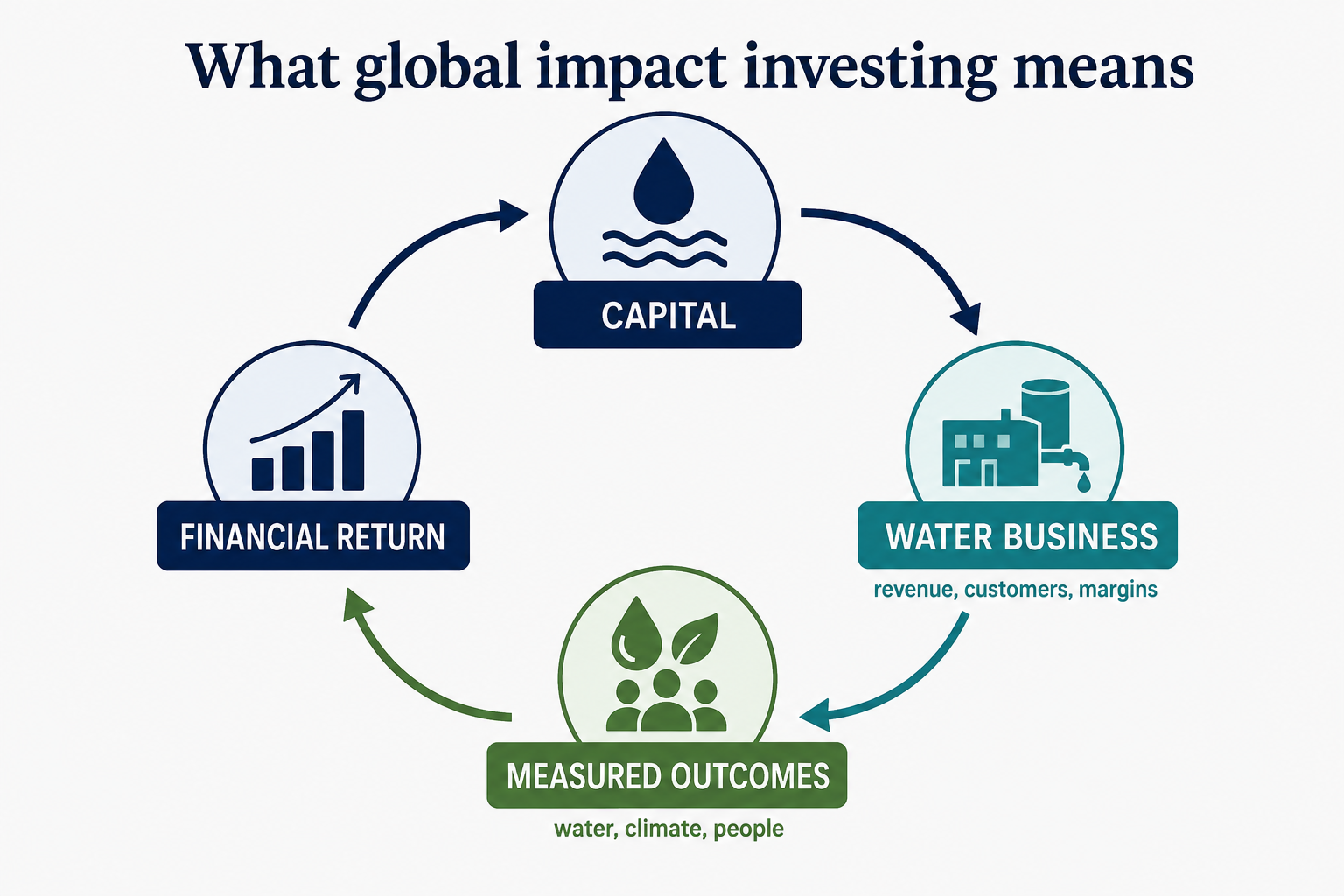
A useful starting record has five parts: the intended outcome, the people or systems affected, the company’s mechanism of change, the investor’s contribution and the risks that could prevent the result. This record should be specific enough to test during diligence and update after investment.
The Impact Principles’ guidance on contribution is helpful here. It frames impact management as an end-to-end discipline that includes strategy, origination, portfolio management and exit. It also separates process alignment from proof that a particular result has already been achieved.
That separation protects the investment case from two common errors. The first is treating a water theme as proof of impact. The second is treating an impact framework as proof that a company will deliver its forecast or that an investment will make money.
Why water is a distinctive impact investing theme
Water is both essential infrastructure and a direct input into many commercial activities. Production, food systems, buildings, energy, health and communities all depend on reliable water services. When water quality, availability or treatment fails, the effect can reach operations, compliance, reputation and customer continuity.
This creates a broad opportunity set, but a broad theme is not yet a thesis. “Water is important” does not identify a buyer or a revenue line. An investable thesis should state the water problem, the decision owner, the product boundary, the value recognised by the customer and the reason the company can deliver repeatedly.
The wider Impact Investing in Water guide provides the parent theme. This article narrows the question to the evidence an investor should expect from an individual opportunity.
Current research supports the need for capital without removing the need for company-level diligence. The World Bank’s Water Security Financing Report 2024 says ten multilateral development banks approved USD 19.6 billion of water-related financing in 2024, including USD 14.4 billion for low- and middle-income countries. The report also discusses financing gaps, reforms and ways to crowd in private capital.
That evidence is useful for understanding system need and the role of finance. It does not prove that a particular supplier will win a contract, that a financing programme will reach a company’s revenue line or that a market estimate belongs in a valuation. The investor must trace the route from need to budget, procurement, delivery and cash collection.
The category is also developing. The Global Impact Investing Network’s State of the Market 2025 research reports a 21% compound annual growth rate in the impact investing market over the six years covered by its study and an 11% increase in the most recent year. Its survey covered 429 organisations in 54 countries, and a majority of respondents planned to increase investment in climate solutions, water and sanitation, and sustainable agriculture.
These figures describe market research, not a forecast for one water company. They do show why investors should expect a more disciplined conversation about allocation, evidence and impact management. Capital may be interested in water, but it will still ask whether the individual business can convert interest into durable economics.
Local conditions shape the opportunity. A business selling into the UK may encounter a different procurement route and compliance process from one entering continental Europe or the GCC. Water chemistry, tariffs, energy costs, public-sector involvement, currency, permitting and customer concentration may change by market. Regional relevance should be researched for the actual opportunity, not added as a list of countries.
Identify the water businesses investors can underwrite
Global impact investing becomes more practical when the investor moves from a theme to a business model. Start by describing what the company sells in one sentence. Then describe the customer’s problem, the decision that triggers a purchase and the evidence that the product works in the conditions where it will be used.
The Water Investment Network portfolio is a useful context for the type of direct water-company opportunity the network reviews. A portfolio view cannot replace company-level diligence on demand, contracts, delivery or risk.
Common water-company models include equipment, services, software and infrastructure operations. These categories can overlap, but they produce different revenue quality and capital needs.
- Treatment and reuse equipment: revenue may arise from design, equipment supply, installation, commissioning and maintenance.
- Monitoring and control: revenue may arise from sensors, data services, monitoring contracts and support.
- Operations and maintenance: revenue may be linked to recurring service, performance, availability or treated volume.
- Industrial water management: value may come from reducing losses, improving process reliability or helping customers use water more efficiently.
- Project development and ownership: the company may build, finance or operate an asset, which can change the balance between project risk and operating revenue.
The World Bank’s research on scaling water reuse illustrates why the opportunity can be material while remaining specific. It estimates that water reuse could represent up to USD 340 billion of investment by 2040 and says reuse volumes could grow eightfold to 430 million cubic metres per day. These are potential and forecast figures for a broad system, not revenue guidance for an individual company.
The label “technology company” can hide a large installation and support burden. Conversely, a service business may have strong recurring revenue but depend on field labour, replacement parts and customer access. A software layer may improve evidence and workflow but still need reliable physical data from the site.
The first diligence question is therefore not “How large is the water market?” It is “What event makes this customer buy?” The event might be an operating loss, a new production line, a water-quality requirement, an unreliable supply, a discharge issue, an asset failure or a customer requirement passed through the supply chain.
Next identify the buyer and the budget. The person who experiences the problem may not control procurement. Operations, engineering, finance, compliance, procurement and a site owner may have different priorities. A long sales cycle is not automatically a weakness, but the company should explain its stages, conversion rates, decision gates and cash timing.
Then define the operating unit. It could be one installed site, one treatment module, one monitoring location, one service contract or one volume of water treated. Measure price, direct materials, engineering hours, installation, energy, field labour, replacement cycles, warranty, freight, support and working capital for that unit.
A company is more investable when it can show how a first deployment becomes a repeatable delivery process. Investors should ask what remains standard, what must be redesigned, how suppliers are qualified, who performs commissioning and how the support model changes as the installed base grows.
Connect impact to revenue and customer value
A water problem becomes commercial when a customer can recognise a value that is large enough, urgent enough and owned by someone with authority to act. The value may include reduced freshwater demand, better quality control, fewer interruptions, improved discharge management, lower operating exposure or better evidence for a decision.
The outcome and the customer value can be related without being identical. A reuse system may reduce abstraction and help a customer manage supply risk. A monitoring system may improve early warning without immediately reducing water use. A treatment solution may protect an ecosystem while also supporting a permit or a production process. The company should state which benefit is measured and which benefit is a commercial hypothesis.
Revenue quality depends on the contract. Equipment sales can create a meaningful order but may be lumpy. Service agreements can support repeat revenue but require staff and operating discipline. Consumables and replacement parts can strengthen retention, while performance-based structures may align payment with an agreed result and transfer more delivery risk to the supplier.
Do not accept “recurring” as a complete description. Review contracts, renewal terms, invoice history, payment timing, customer reasons to renew and the service scope included in the price. Ask who owns the asset, who pays for energy, who carries warranty risk, which events trigger a change order and what happens if a performance threshold is missed.
Customer concentration needs equal attention. One large reference customer can validate a product, but it can also create dependency. Review the share of revenue, receivables, backlog and product learning connected to the largest customers. Test what happens if one customer delays a project, changes its procurement policy or chooses a different supplier.
Working capital can grow before profit. Equipment businesses may pay suppliers before collecting from the customer. Projects may require deposits, bonds, retention or commissioning support. Service businesses may need technicians and inventory before a new contract becomes cash generative. The model should show the timing, not only the annual margin.
The World Bank’s analysis of funding a water-secure future estimates that developing countries spend USD 164.6 billion each year on water, with about 91% coming from public sources and less than 2% from private sources. It also identifies a large annual shortfall for water supply and sanitation and discusses risk pooling, guarantees, catalytic capital, cost recovery and better data.
The figures apply to developing countries and should not be presented as a universal company market size. Their investment lesson is that finance, public budgets, risk allocation and customer ability to pay often interact. A private company may have an important solution and still face a slow route from need to bankable contract.
Use impact measurement as an investment process
Impact measurement should begin before the investment decision. Define the baseline, the boundary, the intended outcome, the data source and the review cadence. The boundary might be one site, one process, one customer group, one catchment or one portfolio company. A broad claim with a narrow boundary can mislead even when the site data is accurate.
Choose a metric that matches the product. Possible measures include reduced freshwater abstraction, increased reuse, improved effluent quality, reduced losses, monitoring coverage, service reliability or a change in access for a defined stakeholder group. The right metric depends on what the company controls and what the customer experiences.
Measure the water outcome separately from customer value and financial return. A result can support all three, but one should not be used as proof of another. For example, a company may report water treated, but the investor should also ask whether the equipment operated reliably, whether the customer paid and whether the measured volume changed the relevant risk.
The IFC’s impact investing framework emphasises assessing expected impact before investment and monitoring results afterwards. It also discusses common impact indicators and transparency. The practical point is that the metric should inform underwriting, milestones and governance, not sit in a separate report after the decision.
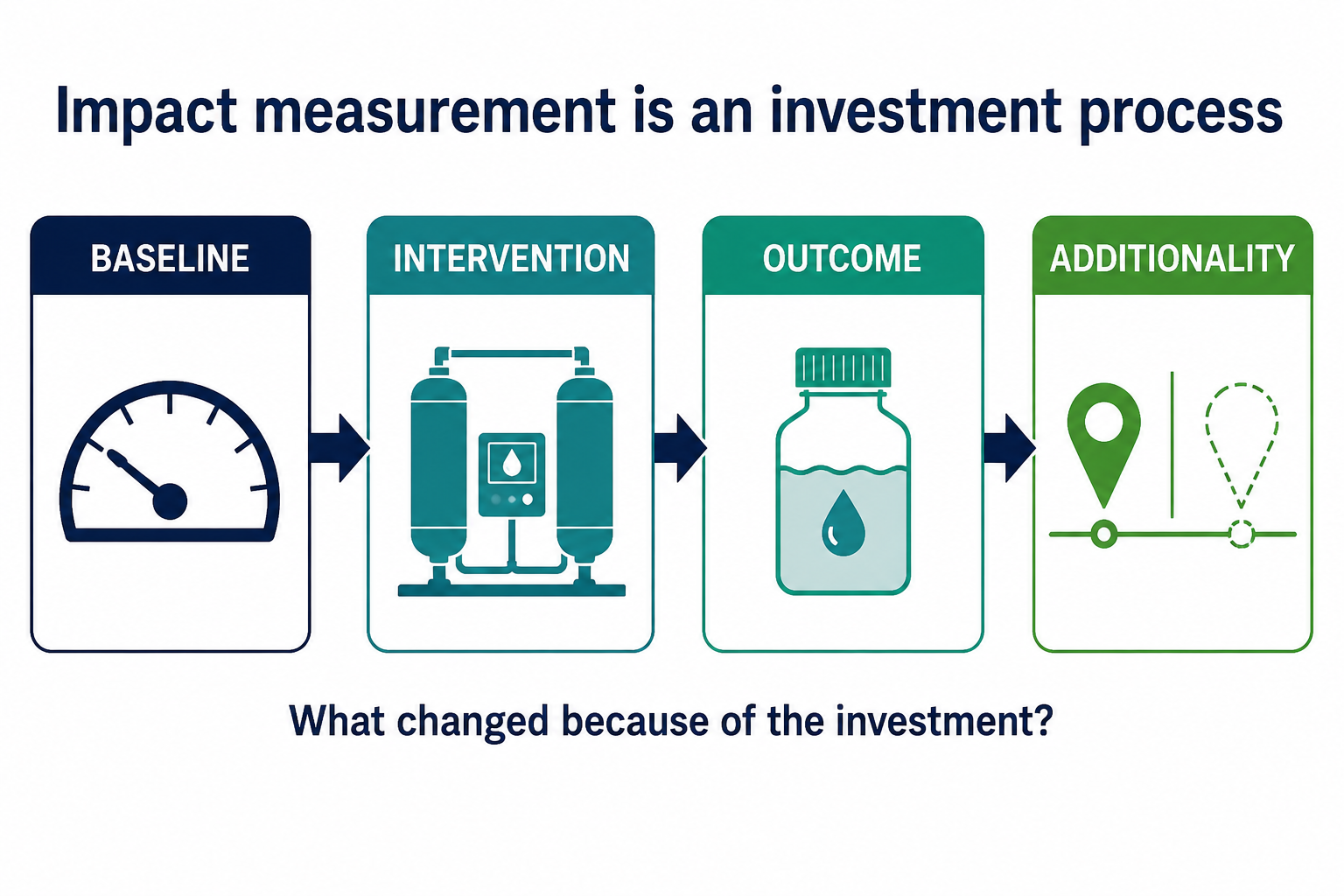
Record how the result is calculated. State the period, exclusions, assumptions, data owner and quality checks. If a number is modelled, call it a modelled estimate. If it depends on customer behaviour, say so. If the baseline is incomplete, treat that as an evidence gap rather than smoothing it away.
Positive and negative effects both matter. A project can reduce one water pressure while increasing energy use, creating a waste stream or shifting risk to another community. The review does not need to assume that every effect cancels another. It needs to identify material effects, decide how they will be monitored and give the investment committee a way to respond.
Data quality is part of the investment risk. Ask whether meters are calibrated, whether readings are comparable, whether the customer owns the data and whether an independent party can reproduce the calculation. If the company cannot explain a number, it should not carry the same weight as a verified operating record.
Avoid claiming that a site-level project solved a basin-level problem. Avoid describing a company as sustainable without stating the activity, boundary and evidence. Avoid counting an installation as an outcome when the relevant outcome is reliable operation over time.
Test additionality and the investor contribution
Additionality is the question of what the investment or investor contribution changed. The relevant counterfactual may be that a deployment would not have happened, would have arrived later or would have been delivered at lower quality. It is not a claim that one investor created every positive outcome, so the contribution must be stated and checked against evidence.
Capital can contribute in several ways. It may fund deployment, extend the runway needed for customer trials, support working capital for a repeatable installation model or help a company enter a market. An investor may also contribute governance, customer access, commercial expertise or the structure needed to bring in other capital.
Contribution needs a counterfactual. If the company would have completed the same project with another investor on the same terms, the capital contribution may be limited. If the investment changes the timing, scale, reach or quality of delivery, describe that difference carefully. A plausible role is not the same as a guaranteed causal claim.
Ask the management team for a short contribution record. It should state the decision, the capital or non-financial support provided, the expected change, the evidence available at entry and the point at which the contribution will be reviewed. The record can be concise, but it should not be written only after the outcome is known.
The counterfactual also applies to an investor’s influence. A minority investment with weak information rights may create less ability to manage impact risk than a structured investment with clear reporting and engagement rights. Control is not necessarily required, but influence, access and escalation should be explicit.
Additionality is not a marketing word. It is a discipline for separating what the company does, what the investor contributes and what the wider market or public system contributes. That separation makes both the impact claim and the financial case easier to challenge.
Apply a practical diligence framework
A committee can move from theme to evidence in a repeatable sequence. Start with the problem and the affected stakeholders. Then test the buyer, the product, the delivery model, the cash cycle and the impact record. Finally decide whether the proposed structure, valuation, governance and holding period match what is actually known.
Demand and customer authority
Ask what event creates urgency and how the company knows it is present. Review the customer segment, decision owner, procurement route, buying criteria and sales cycle. Separate signed contracts, paid pilots, purchase orders, qualified pipeline and early conversations. They do not carry the same evidential weight.
Customer references should confirm more than satisfaction. Ask what problem existed before the product, what was purchased, how the project was accepted, what support was required and why the customer would renew or expand. A reference that cannot discuss those points may be useful for reputation but weak for underwriting.
Unit economics and margin quality
Build economics around the work that the company actually performs. Include materials, engineering, installation, commissioning, energy, labour, freight, warranty, data hosting, replacement cycles and support. Compare quoted margin with delivered margin across several completed jobs.
Review cash conversion and receivables ageing separately from reported revenue. A profitable project can create pressure if the customer pays late or if retention is released only after a long acceptance period. Test one delayed project, one warranty issue and one lost customer in the downside case.
Technical performance and operating limits
Technical diligence should answer a commercial question: where does the system work, how consistently does it work and what does it cost to keep working? A test result without flow, water chemistry, operating hours, maintenance conditions and acceptance criteria has limited value.
Ask about fouling, scaling, contaminants, temperature, pressure, sensor drift, power quality, operator practice and spare parts. Review what happens outside the best case. Clarify who bears the cost when an agreed threshold is missed and whether the company has the capacity to respond.
A pilot is evidence, not proof of scale. A successful pilot may depend on close supervision, favourable conditions or a customer willing to absorb extra work. Before relying on a growth forecast, test whether the company can repeat the result with a standard process, trained staff and a support model that fits the margin.
Regulation, delivery and counterparty risk
Do not treat regulation as a single approval. Map the permits, treatment standards, discharge requirements, health and safety obligations, procurement rules and data responsibilities relevant to the actual location and product. Confirm who holds each responsibility and which approvals are conditions to revenue.
For UK, European and GCC opportunities, the investor should confirm the jurisdiction-specific position with qualified advisers. Water rules, tariffs, public procurement and technical requirements can change by country, sector and site. A regional narrative is not a substitute for a permit register and a contract review.
Counterparty risk can be as important as technical risk. Review customer credit, public payment cycles, parent guarantees, currency exposure, local partners and the enforceability of service terms. Model a delay in commissioning or payment without assuming that a new financing round will arrive on time.
Scalability, defensibility and exit
Scalability means more than a large addressable problem. It means the company can acquire customers, deliver projects, support the installed base and preserve economics as volume grows. Ask which parts of the process are standard, which depend on scarce people and which require new capital each time.
Defensibility may come from data, integration, service capability, customer relationships, approvals, switching costs, specialist know-how or a proven delivery network. A patent or technical claim alone does not explain why a customer will stay or why a competitor cannot replicate the offer.
Exit planning should start early. A trade buyer may value customer access, installed assets, data, service capacity or a route into a market. Another investor may value growth, impact evidence and governance. A strategic buyer may change priorities, so the investor should consider whether customer commitments, reporting and the intended outcome can survive a change of ownership.
The Impact Principles guidance on exit and verification reinforces this point. A process can be aligned with an impact framework without proving that every outcome is high quality. Independent verification is useful evidence about systems and processes, not a guarantee of impact results or investment performance.

Use a regional lens without inventing certainty
Global impact investing does not mean applying one assumption to every market. It means comparing opportunities while respecting the local system in which a water company operates. The same product can have a different sales cycle, customer mix, cost structure and regulatory path in the UK, Europe or the GCC.
For a UK opportunity, review the customer’s procurement process, site requirements, funding source and compliance responsibilities. For a European opportunity, identify the country, sector and operating context before relying on a regional statement. For a GCC opportunity, test the economics of energy, water supply, industrial demand, local partnerships, project delivery and public-sector involvement.
Regional analysis should be tied to a company decision. Does the location improve customer access? Does it create a technical advantage? Does it add currency or political exposure? Does the company need a local operator, distributor, licence or working-capital facility? These questions are more useful than listing countries in an investment deck.
The regional lens should also include negative scenarios. A policy change, tariff movement, delayed public payment, import restriction, extreme weather event or change in customer production can affect both impact and revenue. Scenario analysis should identify who carries the risk and how quickly management can respond.
Match capital structure to the risk being taken
The right structure depends on the company’s stage, contract profile, asset ownership, cash cycle and delivery risk. Equity may support product development, team building and market entry. Debt may suit contracted cash flow but can create pressure when projects are delayed. Asset finance, guarantees, milestone funding or blended structures may shift risk between parties.
The World Bank’s funding analysis discusses risk pooling, guarantees, catalytic capital, cost recovery and transparency as ways to improve water finance. These are tools to evaluate, not automatic solutions. The company should show what remains viable when a grant, concessional facility or special programme ends.
Review the relationship between capital and impact milestones. A deployment tranche may depend on a customer acceptance test. A follow-on investment may depend on repeatable margin and data quality. A service expansion may depend on trained operators and spare-parts availability. Milestones should be observable and connected to the risk they are meant to manage.
Portfolio construction matters as well. Two companies may serve a similar theme but have different customer, technology, geography and liquidity risks. An investor may value one for diversification, another for stronger influence and another for a clearer route to cash generation. The portfolio role should be explicit rather than assumed from the impact label.
Liquidity remains a core private-market risk. An exit scenario is not an exit promise. The company may need more capital, a secondary transaction, a trade sale or a longer holding period than the initial model assumes. Impact language should never be used to hide financial pressure or a weak route to liquidity.
Recognise impact-washing warning signs
Impact-washing often begins with a true statement that is too broad to underwrite. A company may operate in water, have a positive mission or sell a useful product. None of those facts alone proves additionality, measurable outcomes, scalable economics or responsible risk management.
Be cautious when a presentation relies on a market-size number without showing the customer and product boundary. Be cautious when a pilot is presented as repeatability, a pipeline as revenue or a framework badge as proof of results. Be cautious when an impact metric has no baseline, data owner, period, calculation or negative-effect review.
Other warning signs include:
- Revenue described as recurring without contract terms, renewal evidence or service costs.
- Water volumes reported without explaining the measurement boundary or operating period.
- Customer value and environmental outcome combined into one unsupported number.
- Growth assumptions that require every project to be delivered perfectly.
- Regulatory claims that name a market but not the actual permit, standard or responsibility.
- Additionality written as a conclusion rather than a counterfactual.
- Exit language that assumes a buyer, valuation or liquidity without evidence.
The answer is not to reject every early-stage opportunity. It is to price uncertainty honestly and manage it through structure, milestones, information rights, reporting and follow-up diligence. An evidence gap can be acceptable when the investment case says how it will be closed and what happens if it is not.
Turn the theme into an investment decision
A practical committee paper can end with five clear statements. First, state the water problem and the stakeholders affected. Second, name the paying customer and the value recognised in its budget. Third, explain the product, delivery process, economics and principal risks.
Fourth, state the baseline, outcome metric, data quality and investor contribution. Fifth, describe the proposed structure, governance, milestones, downside case and potential exit without presenting any of them as certain.
Ask what would change the decision. It might be a missed performance threshold, a customer concentration limit, weak baseline data, a permit condition, a slower installation, a financing gap or a service cost that does not fall with scale. Pre-agreed decision points reduce the temptation to defend a thesis after the evidence has weakened.
The Water Investment Network connects eligible UK, European and GCC family offices, high-net-worth investors, sophisticated impact and private-equity investors, and relevant advisers with selected direct water-company opportunities. Eligible investors can request access to Water Investment Network, subject to its invitation-only process.
Water Investment Network is not a provider of regulated financial advice and makes no promise about returns. Every opportunity requires independent legal, financial, tax, technical, commercial, regulatory and impact diligence. A water investment can support a useful outcome and still lose money, remain illiquid or require more capital than expected.
Frequently asked questions about global impact investing in water
What is global impact investing in water?
It is investment into a water-related company or project with an intention to contribute to measurable positive environmental or social impact alongside a financial return. The investor should be able to explain the customer, the mechanism of change, the evidence, the contribution and the risks.
What should investors assess first?
Start with the water problem, the affected stakeholder, the paying customer and the reason to buy. Then test revenue quality, delivery evidence, technical limits, impact measurement, governance, capital needs and liquidity.
How can a water investor measure impact?
Begin with a baseline and a defined boundary. Choose an outcome metric that fits the product, record its source, period, assumptions and owner, and keep the water result separate from customer value and financial return as progress is reviewed.
What does additionality mean for a direct investment?
Additionality is the credible difference the investment or investor contribution makes compared with what would otherwise have happened. It should be described with a counterfactual and reviewed against evidence, rather than claimed from the sector label.
Does Water Investment Network provide investment advice?
No. Water Investment Network is an invitation-only network and does not provide regulated financial advice or guarantee returns. Eligible investors and advisers must complete their own independent diligence before making a decision.
Sources and further reading
- Global Impact Investing Network, State of the Market 2025.
- International Finance Corporation, Impact Investing at IFC.
- World Bank, Water Security Financing Report 2024.
- World Bank, Funding a Water-Secure Future.
- Operating Principles for Impact Management, Principle 9 guidance.
- World Bank, Scaling Water Reuse.