
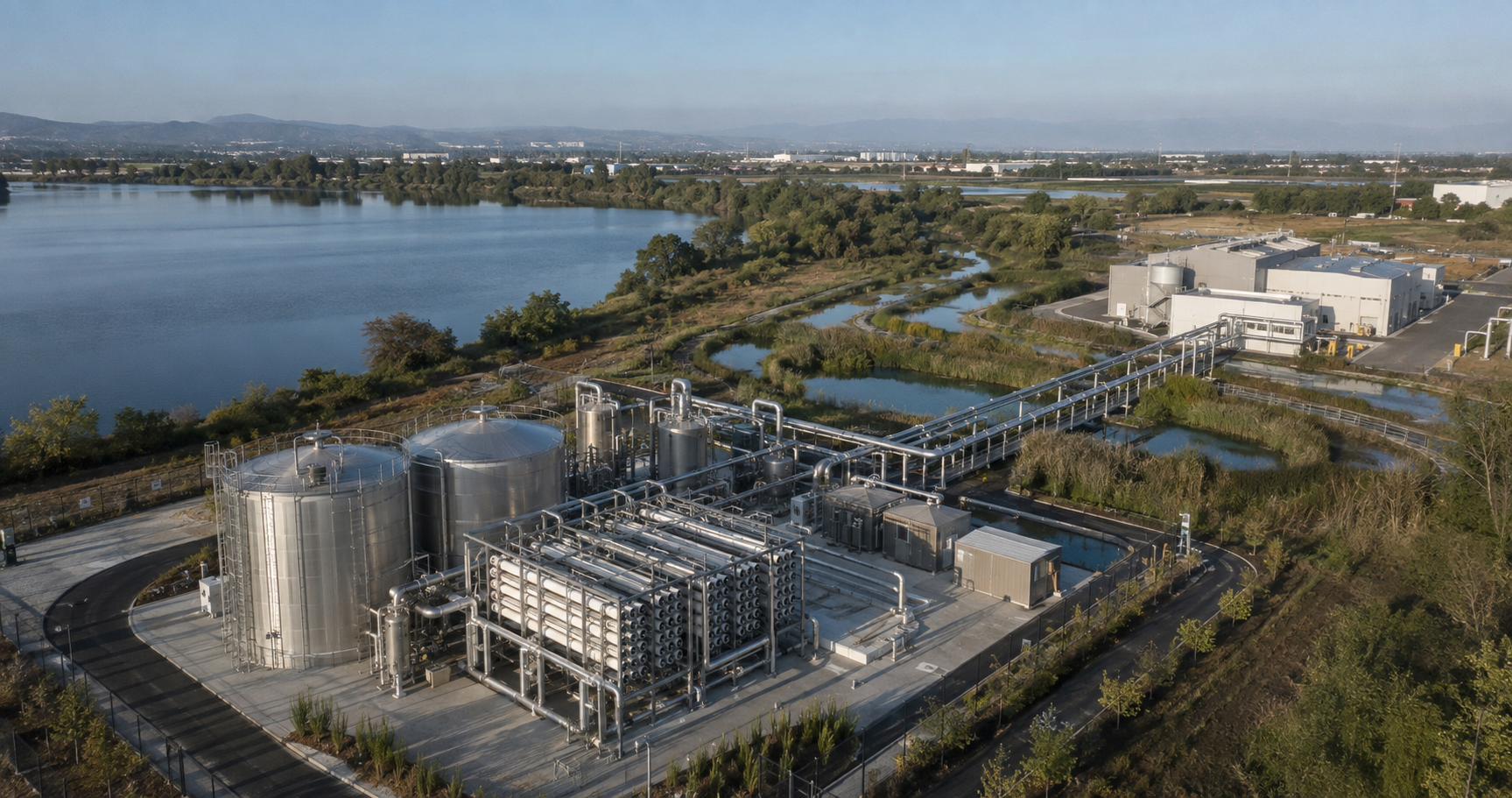
Social and environmental investing is useful when it turns a broad purpose into a testable investment case. In water, the social side may relate to reliable service, public health, livelihoods or the resilience of a customer community. The environmental side may relate to water quality, resource efficiency, reduced pollution, healthier catchments or better ecosystem protection.
Those outcomes do not make an opportunity investable by themselves. A serious case still needs a paying customer, a workable revenue model, credible delivery evidence and a clear view of downside risk. That is the focus of this guide for family offices, high-net-worth investors, sophisticated impact investors, private-equity investors and advisers.
Searchers may also use the shorter phrase social environmental investing. The same discipline applies: define the outcome, test the evidence and connect the claim to the operating model.
The article sits alongside the Impact Investing in Water guide, but takes a narrower view. It asks how social and environmental claims can be connected to company economics, operating data, governance and an investment decision. It does not offer public-market commentary, fundraising advice, regulated financial advice or return forecasts.
What social and environmental investing means in water
Social and environmental investing combines two questions. What positive change is the capital intended to support, and can the investment still meet its financial and risk requirements? The two questions should inform one another, but they should not be collapsed into one vague score.
Social outcomes concern people and the systems that support them. In water, a company might improve the continuity of a service, reduce exposure to unsafe water, support productivity for a water-dependent customer or make a treatment process more reliable. The relevant beneficiary may be a household, worker, farm, industrial site, utility customer or local community.
Environmental outcomes concern the natural system and the resource boundary. Examples include lower abstraction, cleaner discharge, higher reuse, less leakage, reduced contaminant load or more resilient catchment management. The outcome depends on the site, the baseline, the technology and the way the result is measured.
A useful investment definition therefore has six parts:
- Intent: the social or environmental outcome is part of the reason for investing.
- Problem: the water dependency, impact, risk or opportunity is clearly described.
- Customer: a buyer or user has a reason to adopt and pay for the solution.
- Evidence: the company can show what changes, where, and against which baseline.
- Contribution: the investor can explain what its capital or ownership adds.
- Decision discipline: financial return, liquidity, downside and suitability remain visible.
This is different from adding a social or environmental label after an investment has already been chosen. A credible thesis starts before selection, sets expectations before capital is deployed and creates a process for learning when results differ from the plan.
Why water can deliver both social and environmental value
Water is a distinctive investment theme because the same operating problem can affect people, nature and a customer’s economics. A reliable supply can support production and jobs. Better treatment can protect receiving waters while helping a site meet its discharge duty. Reuse can reduce pressure on a source while improving resilience for the buyer.
The World Bank describes water as essential to jobs, productivity, livelihoods and economies, and notes that water-dependent sectors support around 1.7 billion jobs worldwide. That is context for demand, not a forecast for any individual company. An investor still needs to identify the customer, contract, price, cost base and evidence of delivery.
Water also exposes the limits of simple impact claims. A lower volume of abstraction may require more energy. A treatment solution may improve water quality but create a difficult residuals problem. A project may benefit one customer while shifting cost or risk to another user. Social and environmental investing should make those trade-offs easier to see.
The UK’s National Framework for Water Resources 2025 provides a current example of the planning challenge. It describes long-term action for resilient supplies and an improved water environment, and its executive summary says that England could need up to an additional 5 billion litres of water a day for public supply by 2055 under its modelled scenarios. The framework applies to England and Wales and is a policy context, not a company order book.
For an investor, the commercial question is where a defined pressure creates a paying use case. That may be a manufacturer seeking process reliability, a utility managing supply and quality, a data provider improving decisions or a service company taking responsibility for treatment performance. The more specific the use case, the easier it is to test adoption, price, margins and risk.
Turn dual outcomes into an investable opportunity
The first practical step is to draw a line from the problem to the investment. Start with the customer rather than the impact label. Ask who pays, what decision the customer is making, what failure costs, and why the proposed solution is better than the current option.
Next, describe the delivered service in plain language. It might be treatment capacity, a monitored water-quality service, a reuse installation, a leak-detection system or a specialist operating contract. Explain what the company controls and what remains with the customer, regulator, contractor or supplier.
Then map the outcome. A social outcome should identify who benefits, through what change and over what period. An environmental outcome should define the resource or receiving environment, the operating boundary and the metric. Avoid claiming that installed capacity equals achieved impact. Capacity is a potential; an outcome depends on actual use and performance.
Finally, connect the outcome to commercial proof. A customer benefit may support renewal, lower downtime, better compliance or a stronger procurement case. It may not translate into higher margin automatically. Test how the benefit affects sales cycles, pricing power, implementation cost, working capital and repeatability.
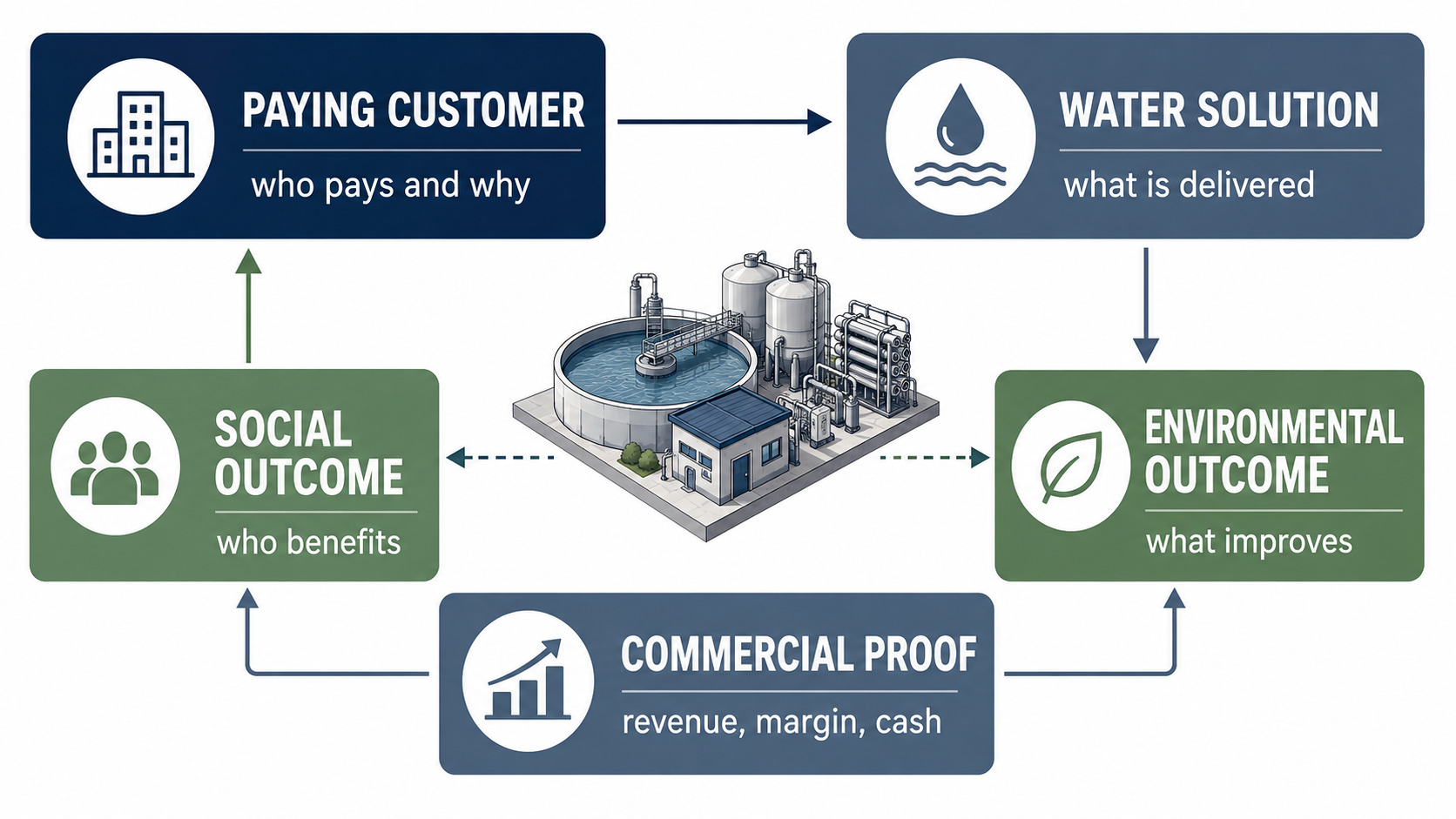
UNEP FI’s Impact Centre describes impact management as a way to connect social, environmental and economic factors with strategy and operations. Use that logic as an operating checklist, not as a substitute for company diligence. The investor still needs to verify the customer problem and the economics of solving it.
Investment thesis at a glance
A short thesis table can help an investment committee see where the impact argument depends on operating evidence. It should expose questions rather than create a false sense of precision.
| Thesis element | Question to answer | Evidence to request |
|---|---|---|
| Demand driver | What customer pressure makes the solution worth buying? | Customer interviews, tender evidence, contracts, renewal history and lost-deal analysis |
| Paying customer | Who pays, who uses the system and who bears operating risk? | Contract structure, procurement route, decision rights and service obligations |
| Revenue model | How does the company convert delivery into collected cash? | Pricing, gross margin, billing milestones, working capital and concentration data |
| Social outcome | Which people benefit, and what changes for them? | Baseline, beneficiary definition, outcome measure and feedback process |
| Environmental outcome | What changes in water use, quality, pollution or resilience? | Site boundary, operating data, method, frequency and independent checks |
| Scalability | What must be repeated across sites or customers? | Installation time, service capacity, supply chain, maintenance and customer references |
| Key risks | What can stop delivery or weaken the claim? | Permit route, technical limits, customer dependence, data gaps and downside cases |
| Potential exit routes | Who might own the company later, and why? | Strategic buyer logic, revenue quality, governance, transferability and market depth |
The table is a starting structure for diligence. It is not a scorecard that can be completed with generic statements. The quality of the thesis depends on whether the evidence is specific to the site, customer and business model being considered.
It is also useful to separate facts, forecasts and investment judgements. A signed contract is a fact if the agreement is verified. A plan to win similar contracts is a forecast. A view that the company has a defensible position is a judgement supported by evidence. Keeping those categories separate helps a committee debate the right uncertainty.
Before the committee assigns a rating, ask what would change its mind. For demand, that might be a delayed procurement, a customer concentration limit or a lower willingness to pay. For impact, it might be a baseline that cannot be reproduced, a metric that excludes indirect effects or a result that depends on customer behaviour outside the company’s control. A thesis becomes more useful when those disconfirming facts are written down in advance.
Also distinguish evidence that travels from evidence that does not. A repeatable installation process, verified data method or service contract may transfer to another site. A local permit, a founder relationship or a single unusually favourable customer may not. This distinction is central to assessing whether growth creates a reliable business or simply repeats bespoke project risk.
Test social outcomes and additionality
Social outcomes are often described too broadly. An investor should name the people affected and the change that is expected. Better water reliability for an industrial site may protect jobs and production, but it does not prove a wider community benefit. A service that improves access may still need evidence on affordability, continuity and actual use.
Start with the baseline. What was happening before the company’s solution was adopted? Which people were exposed to the problem? What decision, investment or operating change is attributable to the customer, and what would probably have happened without the company?
Additionality means more than being present in a useful market. It asks what the investor or investee contributes to the outcome. New capital may fund a deployment that would not otherwise happen. Patient ownership may improve governance, commercial reach, data systems or operating capacity. The claim should be proportionate to the evidence.
There can be negative or uneven effects. A project may shift water availability between users. A higher service price may exclude a smaller customer. A digital monitoring system may improve a decision while creating new data-ownership concerns. A treatment project may protect one part of a catchment while moving residual risk downstream.
Ask the company to make the trade-offs visible. Define who is included, who may be excluded, the limits of the claim and the feedback channel. Where direct beneficiary feedback is difficult, explain why and state what other evidence is being used. A clean narrative is not a substitute for a clear boundary.
The strongest social case is linked to the operating model. If the company earns revenue by delivering reliable service, maintaining performance or reducing customer disruption, the social thesis can be monitored alongside the contract. If the social claim sits outside the revenue model, the investor should understand who funds it, how long it can continue and whether the company has the capability to deliver it.
Beneficiary evidence should be handled with the same care as customer evidence. A customer may report better uptime while the people affected by a price change, service interruption or site decision experience something different. Where appropriate, use complaints, service levels, user interviews, affordability checks or independent stakeholder evidence to test that gap. The aim is not to make every outcome directly attributable; it is to prevent a convenient customer proxy from being treated as the whole social result.
Measure environmental outcomes at the operating boundary
Environmental measurement starts with a defined boundary. Identify the source, site, process, discharge point, receiving environment, period and data owner. A company-wide claim can hide a material difference between customers or operating conditions.
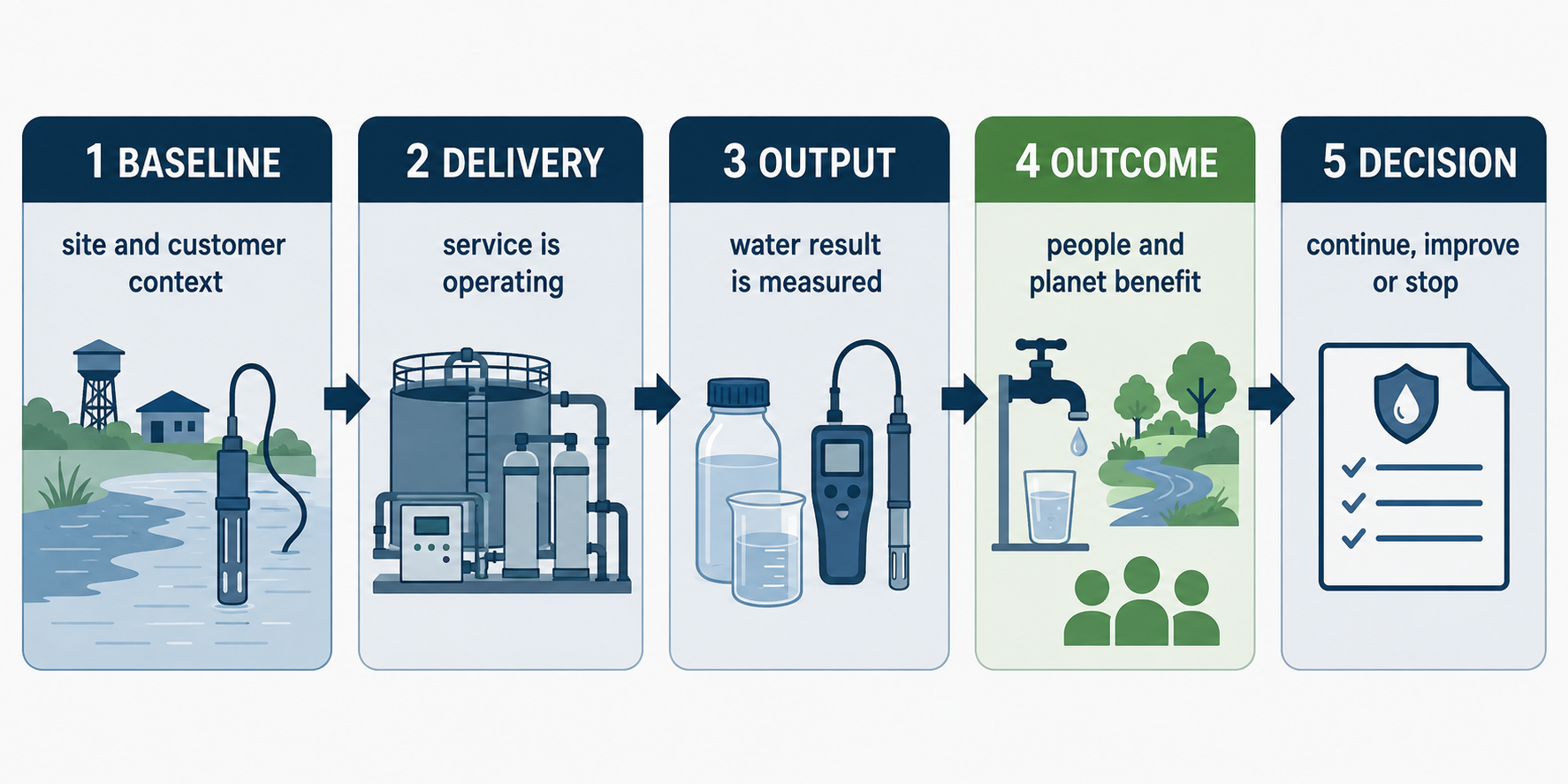
Separate inputs, outputs and outcomes. Water purchased, treated or reused is an input or activity measure. A change in discharge quality, abstraction pressure or customer resilience may be an outcome. Each can matter, but they answer different questions. Do not present equipment capacity, modelled savings or avoided losses as measured environmental improvement.
Trade-offs should be tested in the same unit economics discussion. A reuse system may reduce freshwater demand but increase energy use, chemicals, maintenance or residuals handling. A monitoring product may improve decisions but only if the customer has the authority and budget to act on the data. These factors affect both the environmental result and the margin.
The World Bank’s water work links water security with jobs, productivity, livelihoods and economic growth, while also describing the need for better policy, institutions and regulation. That combination matters for private investors. A water outcome can be commercially important, but its durability depends on the wider operating system around the company.
Use a measurement plan with a baseline, target, frequency, method, responsible owner and response threshold. Record whether data is direct, estimated, modelled or independently verified. The purpose is not to create a perfect dashboard. It is to make the next decision better than the last one.
Write the boundary in a way that another reviewer can reproduce. State whether the measure covers the company’s equipment only, the customer’s full process, a catchment or a downstream receiving environment. Record the comparison period and any material exclusions. If a result is normalised by production, rainfall, occupancy or another variable, explain why that adjustment is appropriate and whether it changes the conclusion.
Underwrite commercial proof and scalability
Social and environmental investing remains private-market investing. The company must win customers, deliver a reliable service and collect cash. The impact case should improve underwriting by showing why the customer buys and why the solution may remain valuable, not by hiding financial risk.
Review the sales cycle first. Water customers may have long procurement paths, site testing, budget approvals and regulatory dependencies. Ask which stage each opportunity has reached and what evidence supports the next stage. A strong pilot is not the same as a repeatable deployment.
Then examine unit economics. Track the cost to install, commission, operate, maintain and replace the solution. Compare gross margin by product, service line, customer type and project phase. A company can show attractive average margin while a new use case consumes cash or requires more support than planned.
Scalability has a physical side and an organisational side. The company may need specialist installers, reliable component supply, local service capacity, data integration or working capital. Defensibility may come from performance records, customer integration, operating know-how, approvals, recurring service or a trusted channel. State which of these is proven and which is still a hypothesis.
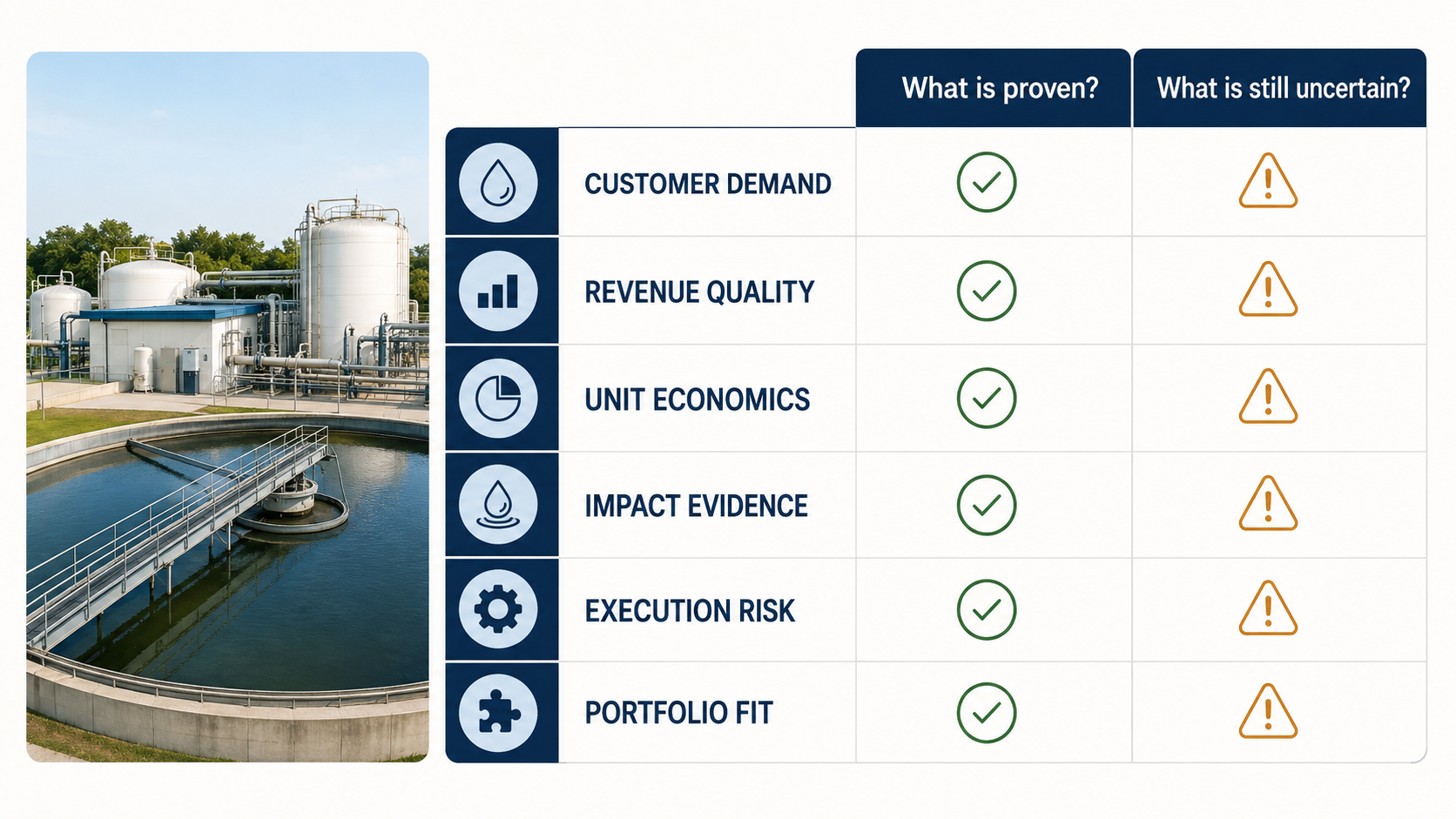
The Water Investment Network portfolio is a useful context page for eligible investors reviewing the type of direct water-company opportunity the network considers. It is not evidence of performance, suitability or a future return.
Capital structure should match the proof still required. Equity can absorb uncertain expansion but dilutes ownership. Debt can preserve ownership but adds repayment and covenant pressure. Equipment finance, customer deposits or supplier terms may support delivery, while also creating obligations that need to be modelled in a slower sales and collection case.
The World Bank’s Water for Shared Prosperity material links water security with livelihoods, economic production, ecosystems and inclusive service delivery. Apply the same discipline to commercial claims. Ask what the company knows from operating history, what it expects from a forecast and what the investor still needs to verify.
Commercial proof should be reviewed in sequence. First confirm that the customer has a real problem and an authority with budget. Then test whether the proposed solution works in the customer’s conditions. Finally test whether the company can deliver repeatedly at a margin after support, warranty, financing and compliance costs. This sequence prevents a technically impressive pilot from carrying more weight than its revenue evidence deserves.
Build governance around evidence
Good governance connects impact data to the investment process. Decide who owns each metric, who can challenge the data, how often the board or investment committee reviews it and what happens when the result is below target.
A useful reporting pack can combine customer performance, financial performance, operating incidents, regulatory status and impact indicators. Keep the pack short enough to use. One reliable measure tied to a decision is more useful than a large set of unsupported estimates.
Agree the response before capital is deployed. A variance may require technical support, a change to the operating plan, a revised target, a customer discussion, a staged drawdown or a decision not to provide follow-on capital. The response should be proportionate to the cause and the materiality of the result.
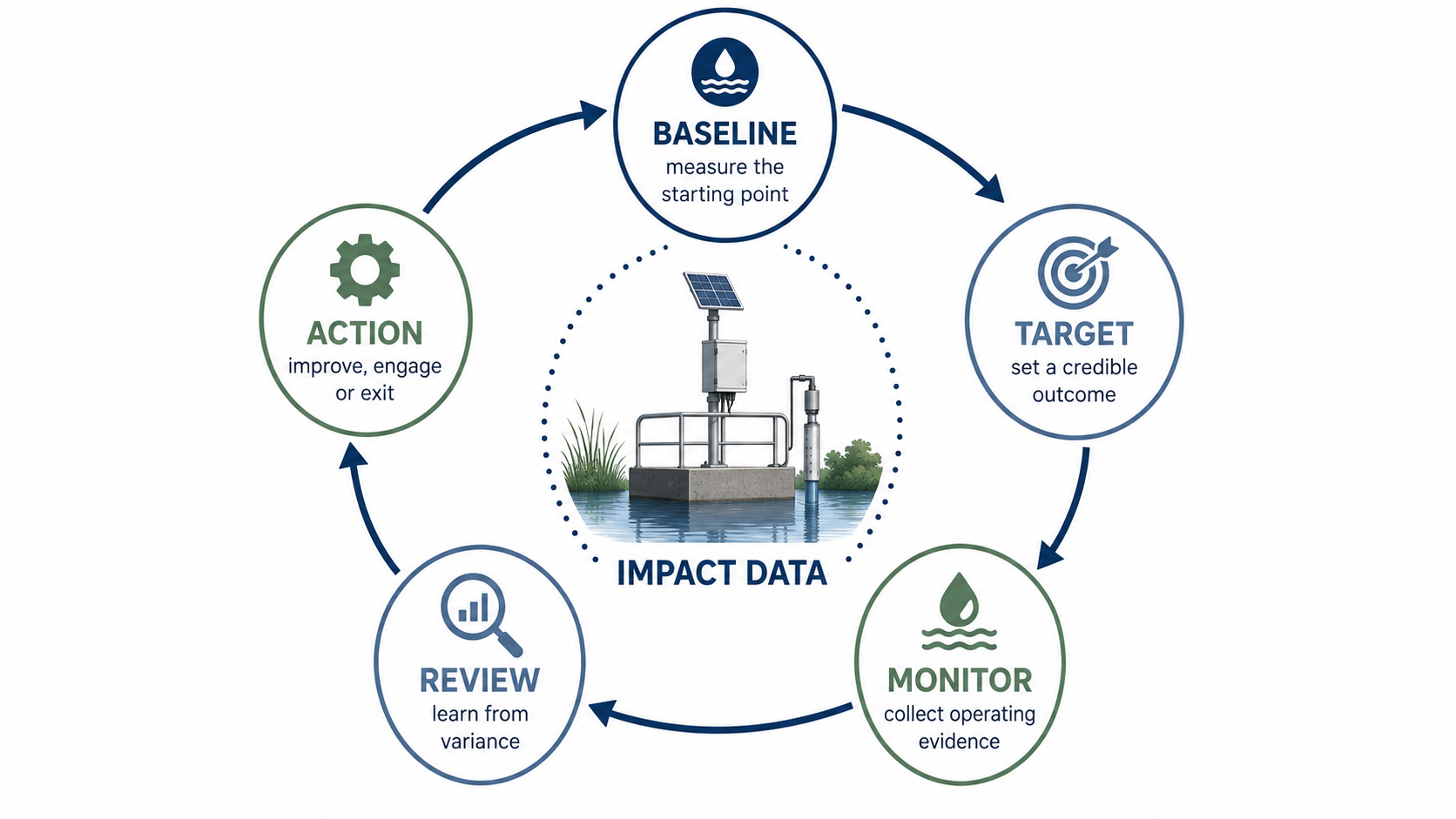
The Impact Principles provide a framework for integrating impact through the investment lifecycle and for supporting transparency, discipline and credibility. They do not certify a particular opportunity. Investors should still review the company’s data systems, management capability, stakeholder process and independent checks.
Exits deserve the same attention. A sale can preserve, improve or weaken an outcome depending on the buyer, the contract, the operating model and the governance arrangements. Record what must be protected after exit, what data must transfer and which claims can no longer be made if the business changes hands.
Price regional, regulatory and portfolio risk
Water is local even when the investment thesis is global. Source conditions, permits, customer procurement, energy cost, grid reliability, currency, insurance and enforcement can change by jurisdiction. A social or environmental label does not remove those differences.
For UK opportunities, the National Framework for Water Resources 2025 is useful context for long-term supply, environmental needs and regional planning. It applies to England and Wales. An investor should still check the specific abstraction, discharge, planning, environmental assessment, construction and operating requirements for the target site.
For European and GCC opportunities, avoid treating the region as one market. Compare the exact country, customer, water source, permit route, import or localisation requirement, payment practice and political or currency exposure. If the evidence is not available, mark the assumption as open rather than filling the gap with a regional generalisation.
Regulation can support demand, but a policy direction is not a purchase order. Underwrite the time and cost required to reach approval, the party responsible for compliance and the consequence of delay. Also test whether the company’s marketing claims are narrower than the legal, technical or customer evidence behind them.
Portfolio fit is another form of risk. A water company may add exposure to industrial capex, construction delivery, infrastructure, emerging markets, founder-led execution or long working-capital cycles. It may not diversify a family office if those risks already sit elsewhere in the portfolio.
Use a downside case that combines a slower sales cycle, a delayed site, weaker customer collections, higher service cost and a missed impact milestone. The result should show what capital is required, what governance rights matter and when the investment case should be revisited.
Regional risk should also be linked to an owner and a trigger. Name who monitors the permit, customer credit, water availability, energy exposure or policy change. Set a date or threshold for escalation. This converts a broad risk register into an operating control that can inform valuation, reserves, follow-on capital and the decision to pause deployment.
Frequently asked questions about social and environmental investing in water
What is social and environmental investing?
Social and environmental investing directs capital towards a defined social or environmental outcome while also testing the financial return, risk and suitability of the investment. In water, that may involve services or technologies that improve reliability, health, resource efficiency or ecosystem condition.
How is it different from ESG investing?
ESG can be used to assess risks and business practices across an investment universe. Social and environmental investing places more emphasis on the intended outcome, the evidence behind it, the investor contribution and how performance will be managed over time.
What should a water investor measure first?
Start with the customer and site baseline. Then define the delivered service, the output, the social or environmental outcome, the measurement boundary, the data owner and the action that follows if performance is off track.
Can water investments create both social and environmental outcomes?
They can, but the claim must be specific. A solution may improve water reliability for a customer or community while reducing abstraction, pollution, leakage or resource use. Each outcome still needs its own baseline, evidence and risk assessment.
Does Water Investment Network provide investment advice?
No. Water Investment Network is an invitation-only network and does not provide regulated financial advice or guarantee returns. Eligible investors and advisers must complete their own independent legal, financial, technical, commercial, regulatory and impact diligence.
Explore social and environmental water opportunities
Social and environmental investing in water is strongest when the purpose and the business case can be tested together. Ask who pays, who benefits, what changes in the water system, what the company controls, and what the evidence does not yet prove.
Water Investment Network connects eligible UK, European and GCC family offices, high-net-worth investors, sophisticated impact and private-equity investors, and relevant advisers with selected direct water-company opportunities. Eligible readers can request access to Water Investment Network, subject to its invitation-only eligibility process.
The network does not provide regulated financial advice and does not guarantee investment returns or environmental outcomes. Any opportunity requires independent legal, financial, tax, technical, commercial, regulatory and impact diligence before a decision is made.