Family office impact investing in water works best when two questions stay connected. What measurable water outcome can the company create? Can the company earn, retain and grow revenue while creating it?
That link matters because a serious water problem does not automatically produce a good private investment. A company may reduce water use, improve treatment or make reuse possible, yet still face weak pricing, long procurement, high working-capital needs or difficult exits.
This guide sets out a practical framework for impact investing family offices assessing direct water-technology and water-service opportunities. It covers intentionality, customer economics, measurement, investment routes, governance, regional context and private-market risk.
Water Investment Network is an invitation-only network for eligible investors considering selected direct opportunities. This article is educational. It is not regulated financial advice and does not promise any outcome.
What family office impact investing means in water
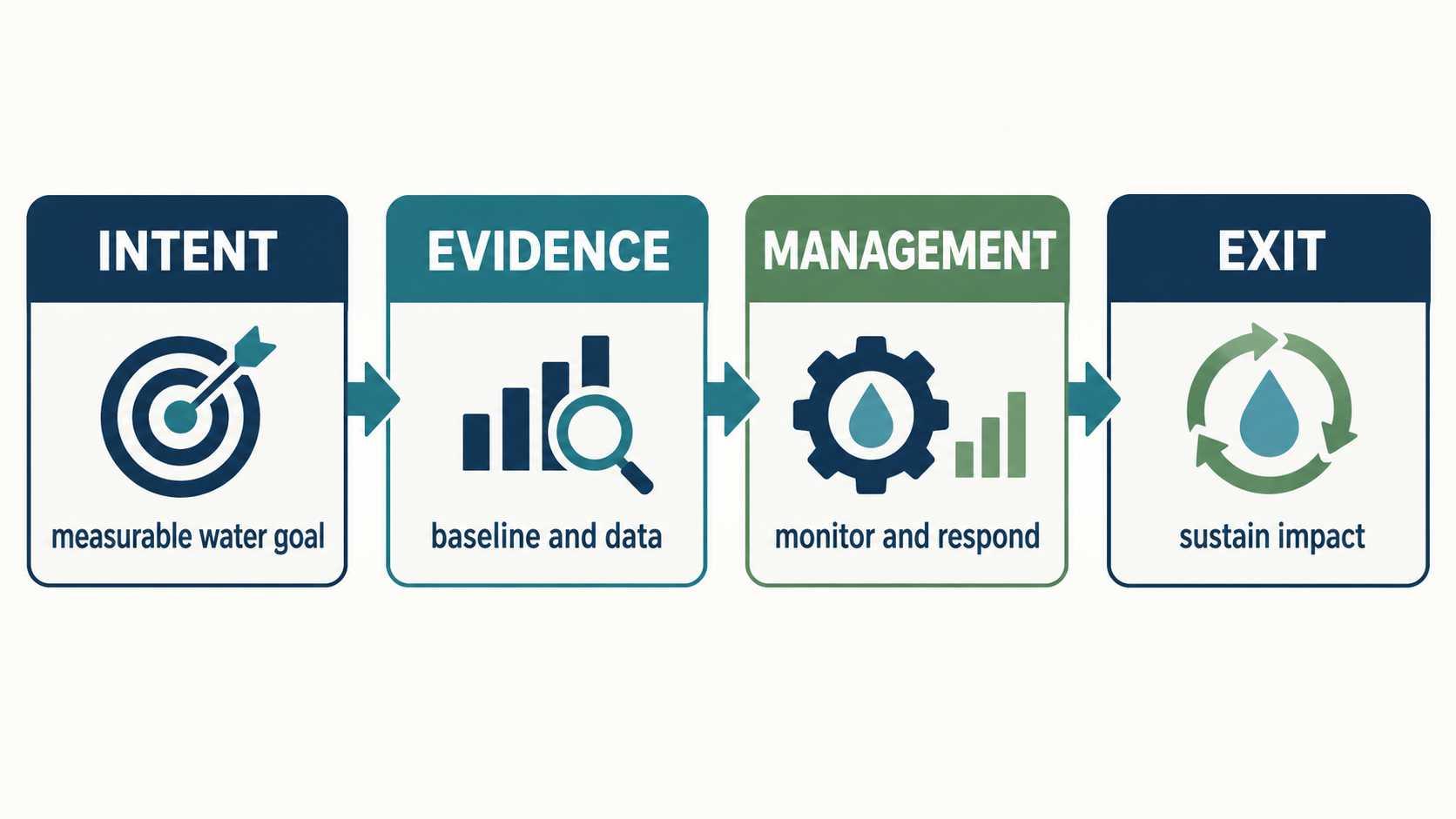
Impact investing is more specific than choosing a company with a positive image. The International Finance Corporation’s Operating Principles for Impact Management set out an end-to-end process covering strategy, origination and structuring, portfolio management, exit and independent verification.
For a family office, that definition creates an underwriting discipline. The investment paper should state the intended water outcome before it describes the company. It should then explain how the company contributes to that outcome, what evidence exists today and what the investor can influence after completion.
Water companies can work in very different places. One may provide monitoring for an industrial site. Another may treat wastewater for reuse. A third may sell a service that reduces losses, improves compliance or increases the reliability of a process. Those businesses have different buyers, cash cycles, margins and technical risks.
The family office should therefore define the role of the investment in its own portfolio. It might seek long-term growth, a measurable environmental outcome, direct access to a private-company theme, strategic learning or a combination of these aims. The role sets the holding period, reporting burden, governance expectations and acceptable loss.
The two-ledger approach is useful. The commercial ledger records customer demand, revenue, costs, cash, capital needs and exit conditions. The impact ledger records the baseline, intended outcome, measurement method, negative effects and progress. Neither ledger proves the other.
That separation helps avoid two common errors. A large water problem is not proof of a defensible company. A strong return forecast is not proof of positive impact. Both claims need their own evidence and their own review.
The existing Impact Investing in Water guide provides the wider theme. This article focuses on the family office decision process, where portfolio fit, patient ownership and oversight matter as much as the headline opportunity.
Why water is a credible impact theme for family offices
Water is an investable impact theme because the outcome can often be tied to a physical system and a paying customer. Examples include a site using less freshwater, a plant reusing treated water, a utility improving monitoring or an industrial buyer reducing the risk of a discharge failure.
The World Bank’s water reuse analysis describes reuse as a way to create fit-for-purpose supply for municipal and industrial users. It identifies the strongest business cases where used water is close to the point of use and says that supportive regulation, programme-based delivery and bankable structures are needed to bring in private capital.
The same report presents a modelled potential for reuse to grow eightfold by 2040 and for up to US$340 billion of investment to be unlocked. These are scenario-based estimates, not a forecast for a particular company. Their value for an investor is to frame the scale of the market question, not to replace company-level diligence.
A family office can make the theme more precise by asking what the customer is buying. A buyer may pay for supply resilience, compliance, production continuity, lower operating cost, new capacity or a measurable environmental improvement. The company must capture enough of that value to support delivery, service and growth.
| Question | What to examine | Why it matters |
|---|---|---|
| Impact objective | Baseline, intended outcome and boundary | Shows what the investment is meant to change |
| Paying customer | Buyer, budget, contract and acceptance test | Shows whether need has become funded demand |
| Revenue model | Price, repeat revenue, direct cost and cash timing | Shows how impact can be financed and scaled |
| Evidence | Operating data, customer records and independent checks | Shows whether claims work outside a pilot |
| Portfolio fit | Holding period, liquidity, governance and follow-on capital | Shows whether the risk suits the family office |
This is why a water theme can be useful without being sufficient. It narrows the search to a real need. It does not tell the investment committee which business has the best execution, valuation or downside protection.
Test intentionality before choosing a company
Intentionality should appear in the investment strategy, not only in the presentation. Ask which outcome the family office wants to support, why the company can contribute to it and what would count as progress over the holding period.
A useful objective is narrow enough to measure. “Improve water resilience” is a direction. “Increase the volume of treated process water reused at contracted industrial sites, while meeting the agreed quality and safety standard” gives the team something to test.
The objective should also describe the investor’s contribution. Capital may fund production capacity, a monitoring platform, certification, a service team or the working capital needed to deliver signed contracts. Advice, introductions or governance can contribute too, but none should be counted as a result before it changes the operating evidence.
Use a simple theory of change:
- Capital and investor support enable a defined operating change.
- The operating change helps a customer solve a measurable water problem.
- The customer pays, renews or expands because the solution creates value.
- The company grows while the water outcome remains measurable and within its stated boundary.
Each step can fail. Capital may fund capacity that customers do not use. A technically successful system may not meet procurement or operating requirements. A customer may value the outcome but refuse a price that covers delivery. Growth may also reduce impact quality if the company expands into sites it cannot support.
The IFC impact-management framework makes a practical screen for these risks. A family office should ask whether the intention is explicit, whether evidence shaped the decision, whether performance will be managed after investment and whether the company is willing to share useful learning rather than only positive case studies.
Intentionality is not a marketing label. It is a set of choices about capital allocation, measurement, management attention and what happens when progress falls short.
Link the impact case to customer economics
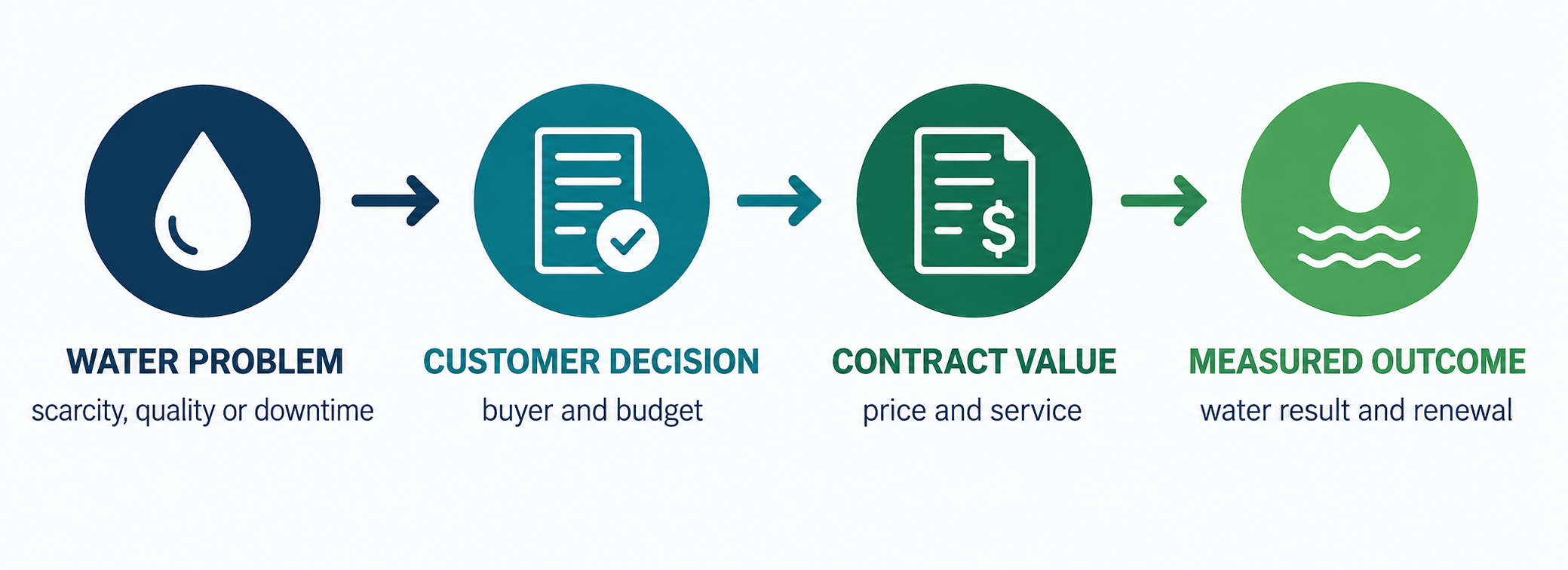
Customer economics are the bridge between a water outcome and a commercial company. Start with the event that makes a buyer act. It may be a production constraint, a consent condition, unreliable supply, a discharge risk, a new site or a cost that has become visible.
Then identify the decision owner. The person who specifies the technology may not control the budget. Operations, procurement, finance, compliance and the site owner can each influence the purchase. A long sales cycle is not automatically a weakness, but the company must show how it moves through that cycle.
Review the contract boundary. Is the company selling equipment, a project, a licence, a monitoring subscription, a treatment service or a performance agreement? The answer determines who pays for installation, energy, maintenance, replacement parts, downtime and warranty work.
Use a unit that matches the business. It might be one monitored site, one treatment module, one service contract, one cubic metre treated or one unit of installed capacity. The company should show price, direct cost, field labour, energy, consumables, service time and cash timing for that unit.
Do not accept “recurring” without testing the reason for repeat revenue. A renewal based on measured value is different from a second order caused by an unfinished deployment. A consumable or replacement part may recur, but the investor should understand its margin, customer choice and substitution risk.
Working capital deserves the same attention as gross margin. A business may buy equipment, fund mobilisation and wait for acceptance before receiving payment. Model delayed sign-off, a disputed invoice, an extra site visit and a higher warranty rate. The impact may remain attractive while the company still needs more capital than planned.
Impact investing family offices should ask whether the company captures a fair share of the value it creates. If a solution saves a customer money but the supplier cannot price for that saving, a good outcome may coexist with a weak investment case.
Build an impact measurement and management loop
Measurement starts before the investment. Record the baseline, the time period, the site or portfolio boundary and the data source. State whether the number is measured, modelled or estimated.
Choose a metric that matters to the customer and the impact thesis. Depending on the company, that could be freshwater withdrawn, water reused, discharge quality, leakage reduced, treatment reliability or avoided downtime linked to water conditions. One broad water statistic should not stand in for company-level evidence.
The International Finance Corporation describes the Impact Principles as an end-to-end discipline covering strategy, origination and structuring, portfolio management, exit and independent verification. That structure is relevant to family offices because impact should be considered at entry, during ownership and at exit.
A workable management loop has five parts:
- Set the intended outcome and the baseline.
- Agree who collects the data and how it is checked.
- Review progress with commercial and operational results.
- Respond when the outcome or the business case moves off plan.
- Record lessons before the next investment or exit.
Negative effects belong in the same loop. Treatment can use energy and chemicals. A monitoring system can create data-security or maintenance obligations. A reuse project can shift risk to a customer if quality controls fail. A credible impact paper makes these effects visible instead of presenting only the benefit.
Keep the impact ledger separate from the return model. Revenue growth, margin expansion and a sale are financial questions. The water outcome may support customer demand, but it does not guarantee a return. Likewise, a financial gain does not prove that the water outcome was material or sustained.
Reporting should be proportionate. A family office does not need a complex dashboard for every early-stage company. It does need a repeatable method, clear responsibility and enough evidence to challenge a claim before it becomes part of the portfolio story.
Compare direct, fund and co-investment routes
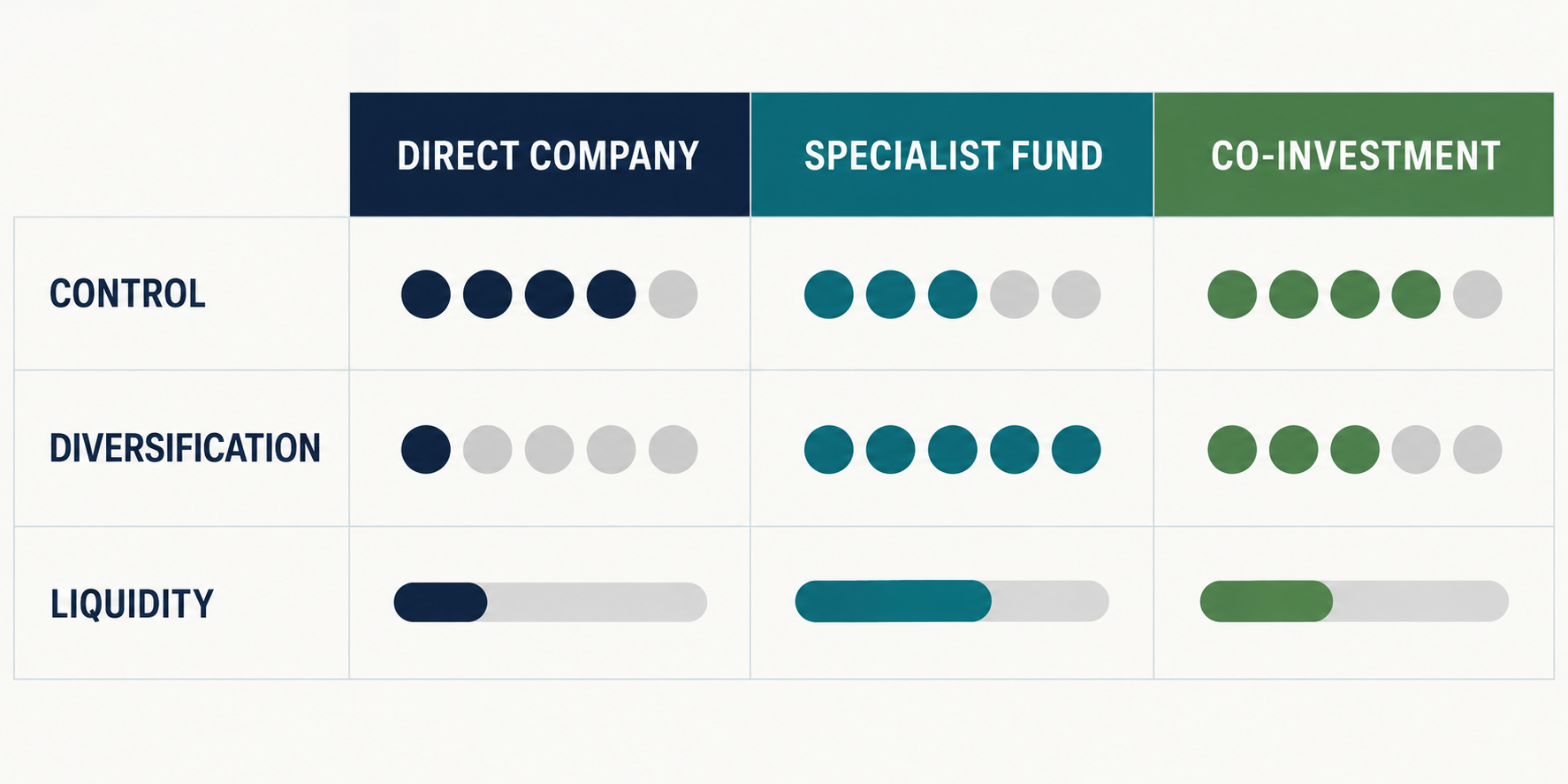
Family offices can reach water impact opportunities through direct company investment, a specialist fund or a co-investment alongside another lead. The choice changes control, diversification, fees, information access and the work required from the family office team.
Direct investment can provide a close view of the operating company and more influence over milestones, reporting and governance. It also concentrates technical, customer, management and liquidity risk in fewer holdings. The family office needs enough time and expertise to review the company after completion.
A fund can spread exposure across businesses, stages or regions and may provide specialist underwriting. The family office gives up some company-level control and must assess the manager’s impact process, fees, reserves, valuation practice and exit discipline. Fund-level impact claims should be traced to underlying assets.
Co-investment can combine a lead investor’s diligence with direct exposure. It can also create ambiguity about who owns the relationship, who makes follow-on decisions and how conflicts are handled. Those points should be settled before capital is committed.
The route should match the family mandate. A family office seeking learning and influence may accept more direct work. One seeking diversified exposure may prefer a fund. One with sector knowledge but limited sourcing capacity may use co-investment. None of these routes removes the need to test customer evidence and impact measurement.
Ask the same core questions across routes:
- What is the actual water outcome and who verifies it?
- What customer or portfolio evidence supports the commercial case?
- Who controls follow-on capital and responds to underperformance?
- How are valuation, fees, liquidity and conflicts reported?
- What does the investor know at exit that it did not know at entry?
The route is a portfolio decision, not a shortcut around diligence.
Use a diligence framework for water companies
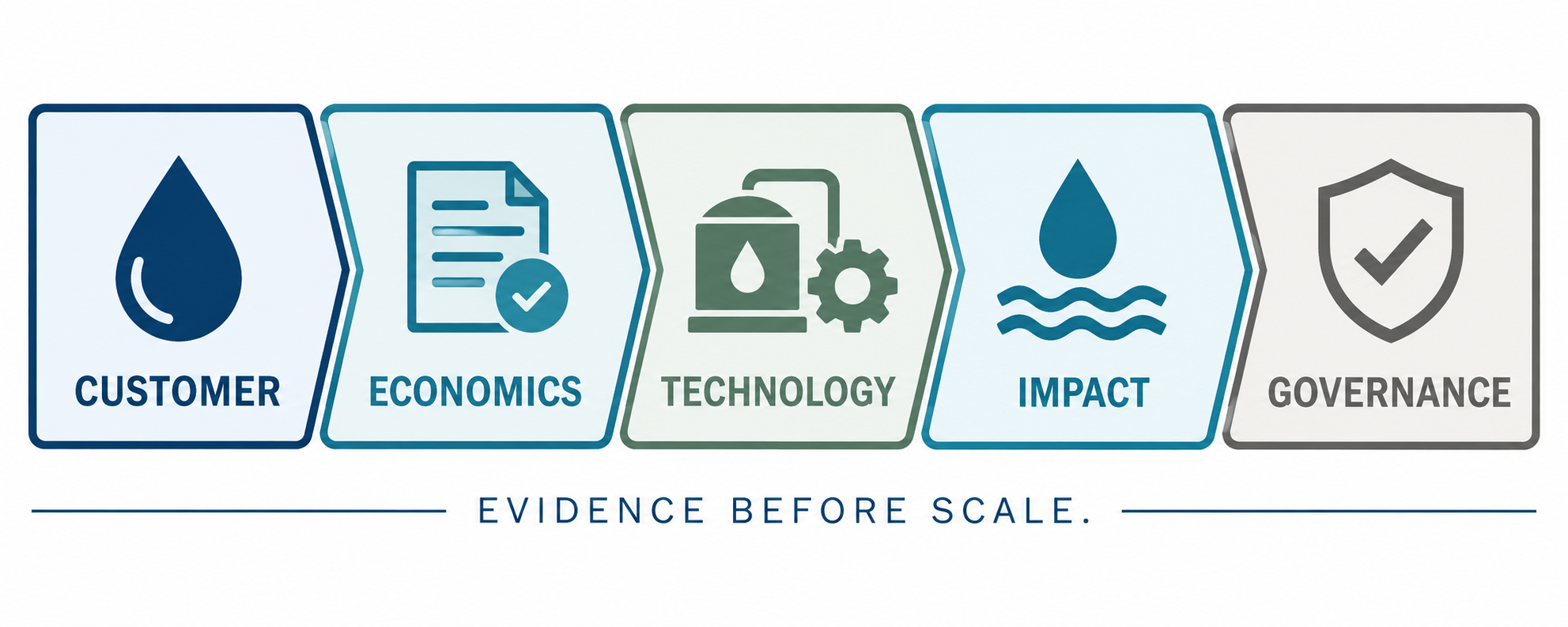
Water diligence should move from the problem to the contract, then from the contract to the operating evidence. This order stops a strong theme or impressive technology from hiding weak adoption.
Review five evidence areas:
- Customer demand: contracts, budgets, procurement status, acceptance tests, renewals and references.
- Commercial model: revenue by type, delivered margin, payment terms, receivables, customer concentration and working capital.
- Technical boundary: feed conditions, operating range, performance data, maintenance, failure records, warranties and replacement cycles.
- Impact evidence: baseline, method, data ownership, materiality, negative effects, reporting and any independent check.
- Governance and capital: decision rights, reporting, key-person risk, supplier exposure, follow-on needs and exit options.
The OECD’s work on finance and investment for water highlights the importance of an enabling environment, strategic investment planning, project bankability, risk allocation and financial materiality. Those points help a family office distinguish a technology problem from a market-structure problem.
For example, a treatment product may work technically but depend on unclear permits or a customer that cannot finance the installation. A monitoring service may have strong data but weak renewal control. A company can have a real impact and still need a different contract, partner or capital structure.
Ask for the evidence behind each forecast. A pipeline is not revenue. A pilot is not a repeatable deployment. A patent is not a moat. A policy ambition is not a customer contract.
The diligence file should state what remains unknown. Missing water-quality data, unclear ownership of monitoring data, untested service costs or a weak cash forecast may be conditions to resolve, reasons to stage capital or reasons not to proceed.
Read UK and European policy signals without overreaching
Policy can shape demand, but it should be treated as a market condition rather than a guaranteed sales forecast. Investors need to ask how a policy direction reaches a named customer, budget and contract.
The current National Framework for Water Resources 2025 applies to England and Wales. It calls for more joined-up planning across sectors and describes investment in new supplies, desalination and water recycling alongside demand management. It also says that water planning is not exclusive to water companies.
For an investor, the consequence is a wider set of possible customers and partners. It does not mean that every technology will qualify for a programme or that a company will win a contract. The company still needs to show its route through planning, procurement, installation and payment.
The European Commission’s Water Resilience Strategy actions tracker places finance, infrastructure, digitalisation, research and innovation within its priority areas. It also tracks support for water reuse, efficiency and investment pipelines. This creates a useful European context for sourcing and market development, while leaving each jurisdiction’s rules and customer decisions separate.
GCC markets can have different water systems, procurement routes, energy conditions and public-private structures. A family office should not copy a UK or EU case into the UAE, Saudi Arabia, Qatar, Kuwait, Bahrain or Oman without local evidence. The regional question is whether the company’s solution fits the buyer, water conditions, financing route and operating partner in that market.
Policy diligence should therefore record four things: the stated objective, the responsible institution, the stage of implementation and the company-specific path to revenue. That is enough to identify a tailwind without turning policy language into a promise.
Design governance, staging and follow-on capital
Patient capital is useful only when patience has rules. A family office can support a company through a longer sales cycle while still setting milestones, information rights and a limit on further capital.
Milestones should describe evidence, not activity. Hiring a sales manager is an action. A defined customer segment producing paid orders at the expected margin is evidence. Building a pilot is an action. A signed acceptance record, repeat deployment and controlled service cost are stronger evidence.
Governance should cover monthly or quarterly reporting, material contracts, related-party transactions, borrowing, acquisitions, senior appointments and changes to the impact method. A minority investor may not control the company, but it should understand what information and consent rights it has.
Set follow-on rules before the first investment. Further funding may depend on paid demand, cash collection, delivered margin, operational reliability and impact progress. A family office should not feel obliged to invest again simply because it made the first cheque.
Capital structure also matters. Equity can support uncertain expansion but dilutes ownership. Debt preserves ownership but requires repayment. Customer deposits, equipment finance and supplier terms can help, but each adds conditions or concentration. Model the structure under a slower sales case and a higher warranty case.
Governance protects both ledgers. A board that only reviews revenue can miss a material environmental or customer issue. A board that only reviews impact can miss cash pressure, margin erosion or a loss of control over the operating plan.
The best governance pack is decision-ready. It shows what changed, what evidence supports the change, what is off plan and which decision is needed next.
Manage risk, liquidity and the decision to proceed
Family office impact investing does not remove private-market risk. A water company can face long procurement, technical failure, project overruns, customer concentration, supplier dependence, working-capital pressure, regulation, currency exposure, further funding needs and an uncertain exit.
Liquidity should be stated plainly. A direct company may not have a ready secondary market. A fund may have a long term and limited transfer options. A co-investment may depend on a lead investor or strategic buyer. The holding period should be agreed before the opportunity becomes emotionally important.
Review the downside in the same detail as the impact case. What happens if the next customer takes twice as long to sign? What happens if a system needs extra maintenance? What happens if a policy is delayed, a partner leaves or a new round is not available?
Use structure to manage risk where it can. Staged drawdowns, milestone funding, information rights, board observation, warranties, reserved matters and a smaller initial position may improve oversight. They cannot compensate for a company with no clear buyer or a technology that has not been tested at its promised boundary.
An investment committee paper should separate three types of statement:
- Verified fact: a signed contract, measured result or historical cash record.
- Management forecast: a plan for future sales, margins, impact or capacity.
- Investor judgement: a view about defensibility, valuation, portfolio fit or exit.
The Water Investment Network portfolio gives eligible investors a practical view of the direct water-company opportunities the network reviews. It is useful context for research, but it cannot replace independent diligence or establish that any company will meet a target.
Eligible investors who want to understand the network can request access to Water Investment Network. The network does not provide regulated financial advice or guarantee returns. Any opportunity requires independent legal, financial, tax, technical, commercial, regulatory and impact diligence.
A family office should proceed when the impact objective is clear, the customer evidence is real, the company economics are understandable, the measurement method is workable and the risk fits the portfolio. If one of those conditions is missing, the right answer may be a smaller position, staged review or no investment.
Sources reviewed: IFC Operating Principles for Impact Management; IFC impact investing guidance; World Bank water reuse analysis; OECD finance and investment for water; GOV.UK National Framework for Water Resources 2025; and the European Commission Water Resilience Strategy actions tracker.
Frequently asked questions about family office impact investing in water
What does family office impact investing mean in water?
It means investing in a water company or fund with an intentional, measurable environmental or social objective alongside a financial objective. The investor still needs evidence of customer demand, revenue quality, technical performance, governance, liquidity and risk.
Why might family offices consider water impact investing?
Water companies can address paid needs such as reuse, treatment, monitoring and supply resilience. The opportunity depends on the company, its customer economics and its evidence. The importance of water alone does not make an investment suitable.
How should impact investing family offices measure a water outcome?
Start with a clear baseline, define the outcome, record the data source and set a review process. Keep measured results separate from management forecasts and investment returns. State any estimates, assumptions and limits.
Is direct water investment better than investing through a fund?
Neither route is automatically better. Direct investing can offer more control and company-level access, while a fund may offer diversification and specialist underwriting. The right route depends on the family office mandate, resources, risk tolerance and liquidity needs.
Does Water Investment Network provide investment advice?
No. Water Investment Network is an invitation-only network and does not provide regulated financial advice or guarantee returns. Eligible investors and advisers must complete their own legal, financial, tax, technical, commercial, regulatory and impact diligence.