The impact investing market is no longer a niche conversation for specialist funds. It now spans family offices, asset managers, development finance institutions and private companies. For water investors, the useful question is not only how large the market has become. It is whether a water company can turn a clear environmental or social need into durable customer value, measurable outcomes and investable cash flow.
The Global Impact Investing Network (GIIN) estimated that more than 3,907 organisations managed US$1.571 trillion in impact assets in 2024, using a market-sizing method that removed duplicates and indirect holdings. Its 2025 market survey also found that most respondents planned to increase allocations to climate solutions, water and sanitation, and sustainable agriculture. Those figures show momentum. They do not remove the need for company-level diligence.
This article explains what the impact investing market measures, why water has a credible place within it, and how investors can test the commercial case. It is educational content, not regulated financial advice. No investment outcome is guaranteed.
Why market size is only the starting point
Market-size figures help an investment committee understand scale. They can show that a strategy has a recognised capital base, a growing peer group and a developing body of practice. They cannot tell you whether a particular water company has repeatable sales, sound margins or reliable impact data.
The GIIN’s 2024 estimate is a useful reference point because it reports both the number of organisations and the assets they manage. Its estimate also reflects a defined research process. The report is not a forecast of future returns, and it does not mean every asset described as impact has the same risk, liquidity or impact quality.
The 2025 GIIN survey adds a different form of evidence. It covers 429 organisations across 54 countries and reports a 21% compound annual growth rate in impact assets over six years, with an 11% increase in the latest year. Survey responses describe investor behaviour and intention. They are not a guarantee that every planned allocation will happen.
Investors should therefore treat the market number as context. The underwriting question starts one level lower. Which customers are paying, what problem are they funding, and why will the company keep its place in that budget?
What the impact investing market actually measures
Impact investing has a stricter meaning than using environmental language in a presentation. The PRI defines it as investing with the intention to generate positive, measurable social or environmental impact alongside a financial return. It also stresses the need to distinguish the investor’s contribution from the investee’s wider effect.
That distinction matters in water. A company may sell useful equipment into a large market without proving that its capital contributed to a better outcome. A credible impact case should explain the starting position, the intended change, the company’s role and the method used to measure progress.
IFC describes impact investing as an approach that aims to contribute to measured positive social and environmental impacts alongside financial returns. It also describes a market that is moving towards common systems for managing and measuring impact. Those systems help investors ask better questions. They do not replace commercial analysis.
For a water opportunity, a practical impact record may include:
- the volume of water treated, reused, saved or made available for a defined use;
- the change in pollutant load, discharge quality or process-water demand;
- the customer site, baseline period and measurement boundary;
- the company’s contribution to the result, rather than a claim over every outcome in the system; and
- the limits, assumptions and unresolved data gaps in the measurement process.
Investors should not reject a company because its early data is incomplete. They should ask whether the gaps are visible, fixable and assigned to a named owner. A confident claim without a baseline is weaker than a limited claim supported by a clear improvement plan.
Why water creates a credible impact-investing theme
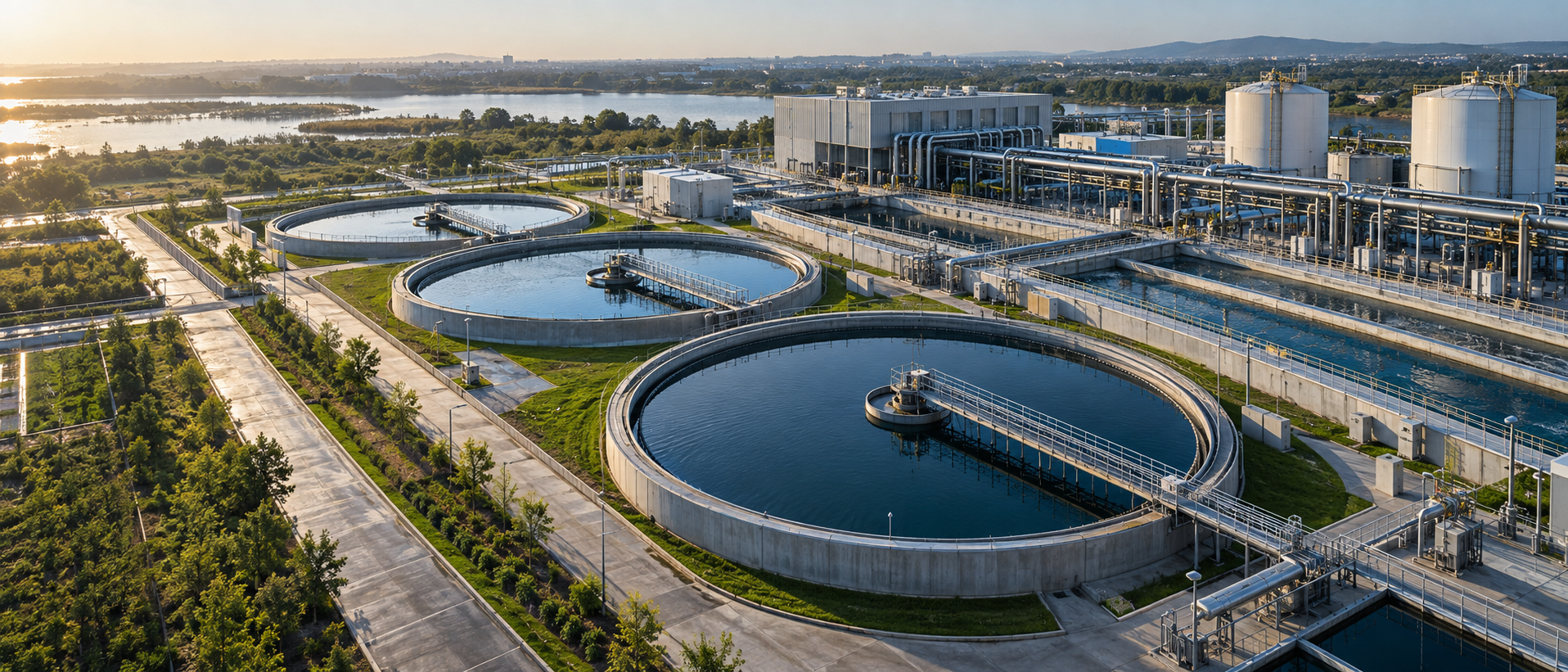
Water connects impact to a physical operating need. Utilities must deliver safe services. Industrial sites must manage quality, discharge, production continuity and local water pressure. Municipalities and manufacturers may also need new supply options where existing sources are unreliable or expensive to expand.
The World Bank’s 2025 report on scaling water reuse identifies treatment and reuse as a route to create fit-for-purpose supply for cities and industry. It says potable and industrial reuse could grow eight-fold by 2040 under enabling conditions, and estimates up to US$340 billion of potential investment by 2040, including private capital. These are potential outcomes, not a guaranteed market size.
The same report says the business case is strongest where used water is close to the point of use. That observation has a direct investor consequence. Transport, collection and network costs can shape the economics as much as the treatment technology.
The World Bank’s water-finance framework says private capital has a key role in bridging the sector’s financing gap. It also points to reforms, stronger service providers, bankable project pipelines and a wider mix of financing instruments as conditions for greater private participation.
Water is therefore not a theme because it sounds socially valuable. It is a theme when an investee company addresses a funded customer problem and can show how the solution improves water outcomes while supporting a viable business.
For a broader overview of how the sector connects to private opportunities, see the Water Investment Network impact-investing overview.
Investment thesis at a glance
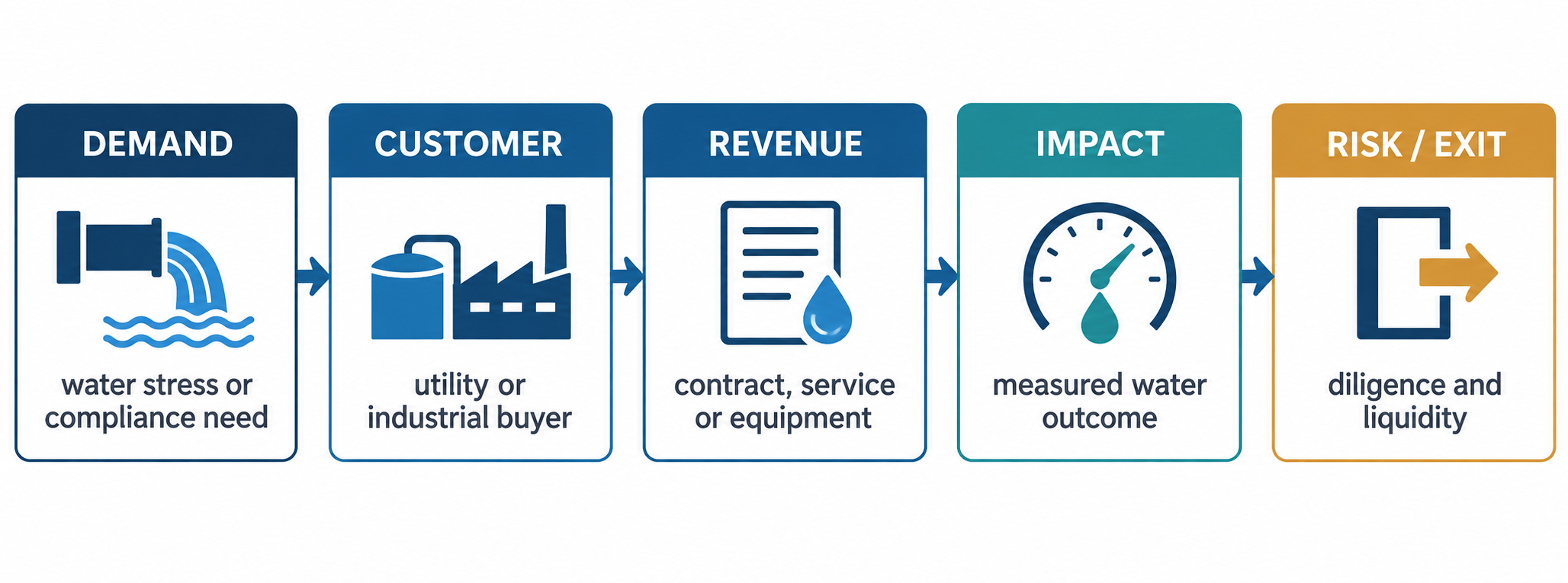
A water impact thesis should fit on one page before it becomes a long model. The aim is not to simplify the risks away. It is to make the chain of reasoning visible and testable.
| Thesis element | Question for the investment committee | Evidence to request |
|---|---|---|
| Demand driver | What funded problem makes the buyer act now? | Budget owner, procurement route, regulation or operating constraint |
| Paying customer | Who signs, pays and renews? | Customer list, contract terms, pipeline quality and concentration |
| Revenue model | How does the company capture value? | Equipment, service, software or performance revenue by customer |
| Scalability | What can repeat without a matching rise in complexity? | Deployment process, gross margin, delivery capacity and partners |
| Impact evidence | What changes, for whom and against which baseline? | Measurement method, data owner, boundary and result |
| Principal risks | What could delay adoption or reduce cash generation? | Technical, regulatory, customer, supply-chain and financing analysis |
| Liquidity path | Who could buy or fund the next stage? | Strategic buyer logic, sponsor fit and realistic transaction routes |
The table should remain honest when evidence is missing. “Large market” is not evidence of demand for a specific product. “Positive impact” is not evidence of additionality. “Exit potential” is not evidence of a buyer.
This approach also prevents impact and financial analysis from becoming two separate workstreams. The impact result may strengthen retention or regulatory acceptance. The same result may add reporting cost or create liability if the method is weak. Both effects belong in the investment case.
How the market is moving from labels to evidence
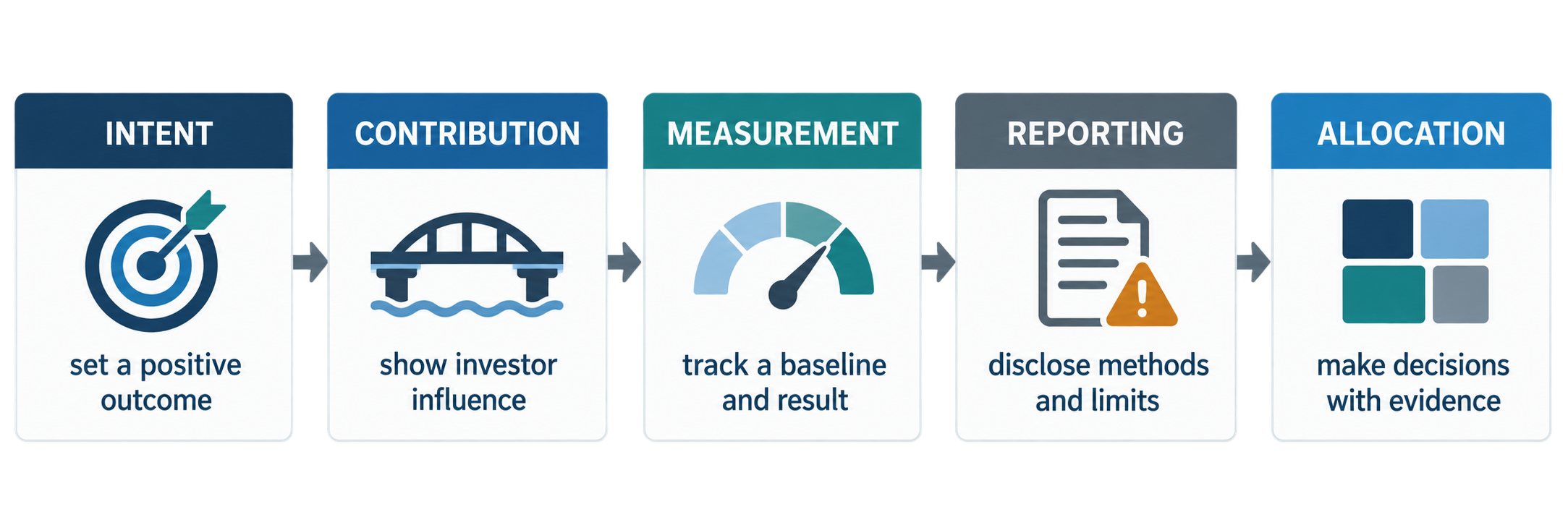
The next impact investing trend is not simply more products with sustainability language. It is a stronger demand for evidence that links an investment decision to an outcome. The market is still developing, but the direction is clear across industry frameworks and regulation.
The FCA’s Sustainability Disclosure Requirements regime aims to improve trust and reduce greenwashing in sustainable investment products. For firms in scope, it includes rules on naming, marketing and disclosures. The FCA also says the term “impact”, and variations of it, must not be used in a product name unless the product uses a relevant label.
Those rules do not turn every water company into a regulated investment product. They do show why investors and managers need precise language. A company’s water benefit, a fund’s investment objective and an adviser’s communication are different claims with different responsibilities.
In the EU, the European Commission proposed amendments to the Sustainable Finance Disclosure Regulation in November 2025. The Commission said its review found disclosures too long and complex, and that the framework had been used as a de facto labelling system. A proposal is not the same as an adopted rule, so investors must check the current requirements that apply to their product, manager and jurisdiction.
For water companies, the practical response is to build an evidence pack that can survive scrutiny. It should state what is measured, how often, by whom, with what uncertainty and with what commercial consequence.
Where private capital can capture value in water
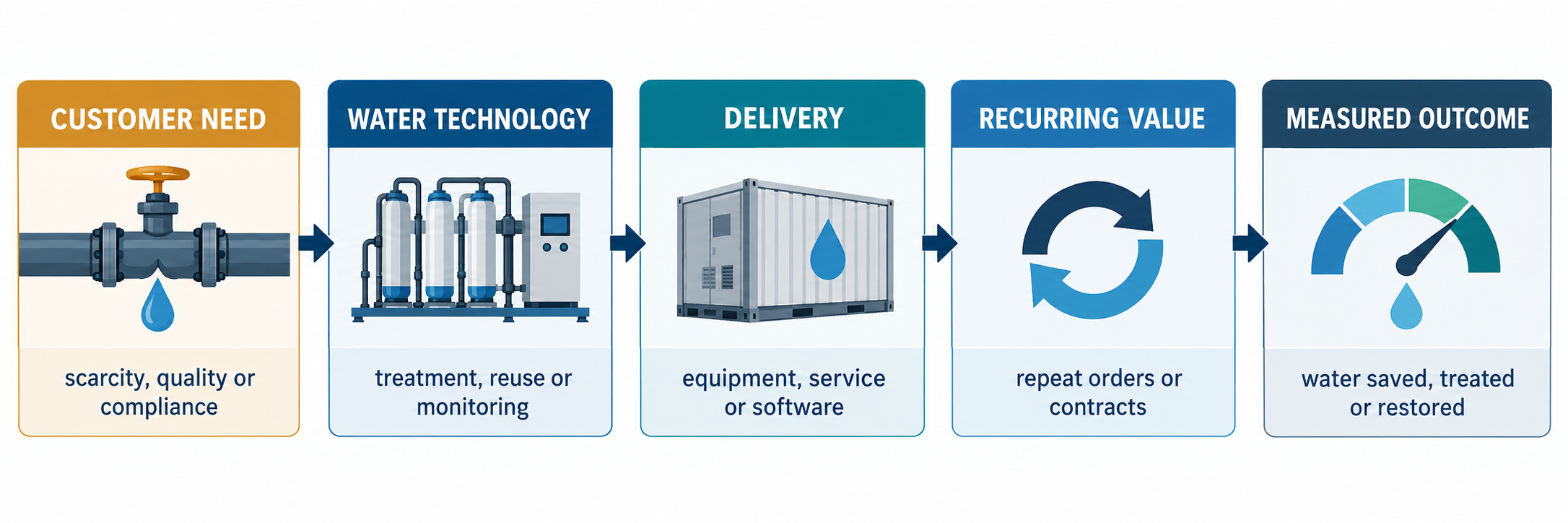
Water is a broad market, not a single product category. The private opportunity may sit in technology, services, software, components, project delivery or a combination of these. The investor’s job is to identify where the company earns its margin and where the customer receives value.
Equipment businesses can generate revenue through system sales, integration and replacement parts. They may scale through standardised designs, but working capital and project delivery can make cash conversion uneven. A healthy order book does not automatically mean healthy cash flow.
Service companies may earn recurring income from operation, maintenance, monitoring or compliance support. Their strengths can include customer knowledge and retention. Their risks include labour intensity, service-level obligations and dependence on a small number of specialist staff.
Software and monitoring companies may sell subscriptions, data services or decision support. Their value depends on the customer action that follows the data. A dashboard that does not reduce losses, improve compliance or protect production may struggle to retain its budget.
Project or performance arrangements can align payment with a measured outcome. They can also transfer more delivery and financing risk to the company. Investors should model working capital, contract enforceability, performance tests, insurance and the timing of payment.
The World Bank’s water-finance framework highlights instruments such as commercial debt, bonds, public-private partnerships and equity, with the right mix depending on local conditions. For private-company investors, this supports a broad view of the value chain. The most attractive company is not always the asset owner. It may be the specialist provider that makes a larger project financeable or repeatable.
Investors can compare these routes with the companies and opportunities described on the Water Investment Network portfolio page, while keeping independent diligence in place.
Match the market trend to company economics
A positive impact investing trend can improve access to capital. It cannot rescue a weak business model. Investors should translate the trend into a set of commercial tests that can be answered with company data.
First, test the budget. A customer may agree that water matters while still lacking authority, tariff support or capital to buy. Ask which budget pays, who approves the purchase and what event could delay it.
Second, test the sales cycle. Water projects can involve technical validation, procurement, permits, financing and site integration. A long cycle is not automatically a problem. The company needs enough cash, evidence and process discipline to survive it.
Third, test gross margin by offer. Separate hardware, installation, service, software and consumables. A blended margin can hide a low-margin project that is needed to win a high-margin service contract, or a service promise that absorbs more labour than expected.
Fourth, test repeatability. Ask whether the next deployment uses the same bill of materials, commissioning process, data connection and contract terms. If every project is bespoke, the company may be a consultancy or contractor rather than a scalable technology business.
Fifth, connect the impact measure to customer value. Water saved may lower purchasing costs. Better treatment may protect a discharge permit. Higher reuse may reduce exposure to supply interruption. The relevant link varies by customer and must be evidenced rather than assumed.
Useful operating indicators may include customer retention, renewal rate, average contract value, gross margin, installation time, backlog conversion, cash conversion and customer concentration. They should be read alongside technical performance and impact data, not used as a substitute for them.
Underwrite policy, regulation and geography
Policy can create demand for water technology, but a regulation-led thesis needs more detail than a reference to “tighter rules”. Investors should identify the jurisdiction, the regulated entity, the compliance duty, the enforcement path and the buyer’s response.
UK, EU and GCC markets do not operate under one water rulebook. A UK customer may face a different permitting or procurement process from an EU industrial site. A GCC project may depend on a utility structure, offtake agreement, desalination economics or public-sector framework that is specific to its jurisdiction.
The FCA’s SDR regime is relevant to in-scope UK products and communications, not a universal rule for every company using the word impact. The European Commission’s 2025 SFDR proposal is an example of policy change, not a basis for promising future demand. This distinction protects the investment case from overstating regulation.
Geography also changes the economics of water. Energy prices, land, network access, treatment standards, industrial concentration, currency and political risk all affect adoption. A technology that works technically may still fail commercially if the customer cannot secure a tariff, permit or long-term contract.
Investors should request a country and customer map. It should show where revenue is generated, where assets are installed, which laws apply, how cash is collected and what happens if a project is delayed. This is particularly important when a company presents a global market narrative from a small operating base.
Build a portfolio role for water exposure
Water can play different roles in a private portfolio. A family office may seek a direct company investment with governance influence. An investor may prefer a specialist fund, a co-investment or a project-related route. Each path changes concentration, access to information, fees, control and liquidity.
A direct investment can give the investor closer contact with the board, customer evidence and value-creation plan. It can also demand more time, technical support and governance capability. A smaller company may have limited reporting systems, so the investor must agree what will be measured after closing.
A fund route may spread exposure across technologies, markets and management teams. It adds manager selection and portfolio-construction questions. Investors should understand whether the fund’s definition of impact matches its reporting, strategy and underlying holdings.
Water exposure can also diversify a portfolio by customer end market rather than by a simple label. Industrial demand, municipal services, agriculture, data centres, food production and pharmaceuticals have different cycles and regulations. Diversification is not automatic. Several companies may still rely on the same utility buyer, public budget or energy input.
The portfolio question should therefore be specific. What risk is the water allocation meant to add, reduce or balance? Which holding period fits the company’s sales cycle? What evidence would show that the thesis is working, even before a liquidity event?
Diligence checklist and red flags
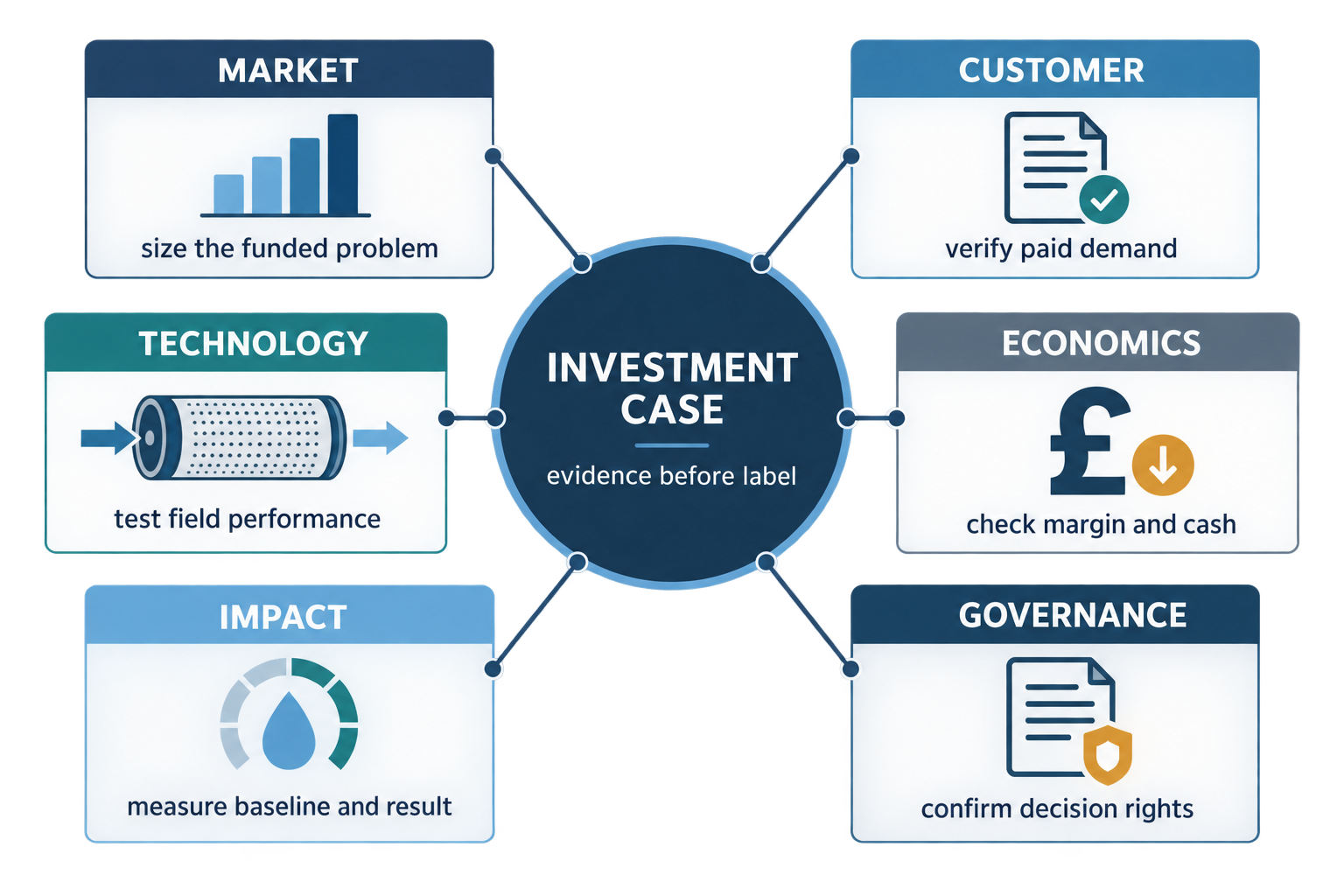
The market story should become a short list of decision gates. The gates make it easier to stop, renegotiate or request more evidence before capital is committed.
- Market: Is the problem funded, urgent and large enough for the company’s chosen route to market?
- Customer: Are references supported by signed contracts, invoices, renewal data or other evidence of payment?
- Technology: Has performance been tested in the conditions where the company sells, including feed quality, energy use and maintenance?
- Economics: Do margins, working capital and cash conversion remain acceptable when projects are delayed?
- Impact: Is there a baseline, a defined boundary and a credible link to the company’s contribution?
- Governance: Are reporting rights, reserved matters, management incentives and responsibility for impact data clear?
Red flags often appear at the joins between these categories. A strong pilot may not convert into a paid contract. A large pipeline may contain unfunded tenders. A high treatment rate may depend on laboratory conditions that do not match the customer site.
Other warning signs include one customer representing most revenue, unclear ownership of intellectual property, repeated changes to impact definitions, weak after-sales support and a forecast that assumes faster procurement than the company has achieved. None is an automatic rejection. Each needs a response that can be tested.
Investors should also ask what the company does not measure. Missing data can be more informative than a polished impact dashboard. The decision is whether the company can establish a reliable system without damaging margins or distracting management from customers.
Frequently asked questions about the impact investing market in water
What is the impact investing market?
The impact investing market consists of investments intended to create positive, measurable social or environmental impact alongside a financial return. It includes different asset classes, investor types, geographies and return objectives. Market estimates are not directly comparable unless their definitions and methods match.
How large is the impact investing market?
The GIIN estimated that more than 3,907 organisations managed US$1.571 trillion of impact assets worldwide in 2024. IFC presents a broader set of figures for assets with an intent for impact and for assets with clear impact-management processes. Investors should read the methodology before comparing estimates.
Why is water relevant to impact investing?
Water companies can address measurable needs such as treatment, reuse, quality, efficiency and resilience. The investment case is strongest when the company serves a paying customer, shows technical and commercial proof, and measures the result against a defined baseline. Water need alone does not prove investability.
What is the main impact investing trend for water?
A notable trend is stronger interest in evidence, measurement and reporting. The GIIN’s 2025 survey reported that most respondents planned to increase investments in water and sanitation, while UK and EU policy work continues to focus on clear disclosures and lower greenwashing risk. These signals do not guarantee future allocation or company performance.
Does Water Investment Network provide investment advice?
No. Water Investment Network provides information about selected direct private-company opportunities. It does not provide regulated financial advice or guarantee returns. Eligible investors should carry out independent diligence and obtain professional advice where needed. Eligible investors who want to explore selected opportunities can request access to the Water Investment Network, or contact the network team with a general question.
Sources
- GIIN, State of the Market 2025: Trends, Performance and Allocations
- GIIN, Sizing the Impact Investing Market 2024
- International Finance Corporation, Impact Investing at IFC
- PRI, Definitions for responsible investment approaches
- World Bank, Scaling Water Reuse: A Tipping Point for Municipal and Industrial Use
- World Bank, Scaling Up Finance for Water: A Strategic Framework and Roadmap for Action
- FCA, Sustainability Disclosure Requirements regime
- European Commission, Commission simplifies transparency rules for sustainable financial products