
Early stage impact investing sits at the point where a water technology has a clear problem to solve, but has not yet earned the right to be called a mature business. The company may have a working prototype, early pilot data or a first customer. It may still need capital to prove repeatable performance, convert pilots into contracts and build the operating base needed for scale.
For investors, this is not a softer version of venture capital. It is a higher-risk form of private-market underwriting where technical evidence, customer behaviour, impact evidence and capital needs must be tested together. The strongest opportunity is not the most impressive claim. It is the company that can show why a defined water problem creates paying demand, how the technology performs in real conditions and what the next round of capital should unlock.
This guide explains how to assess early stage impact investing in water technology. It is an educational framework for private investors and advisers. It is not regulated financial advice, a recommendation or a promise of returns.
Early Stage Impact Investing in Plain English
What the term means
Early stage impact investing means providing equity or another risk-bearing form of capital to a young company whose product or service is designed to create a measurable positive outcome as well as financial value. The company may be pre-revenue, generating initial revenue or moving from pilots into commercial contracts.
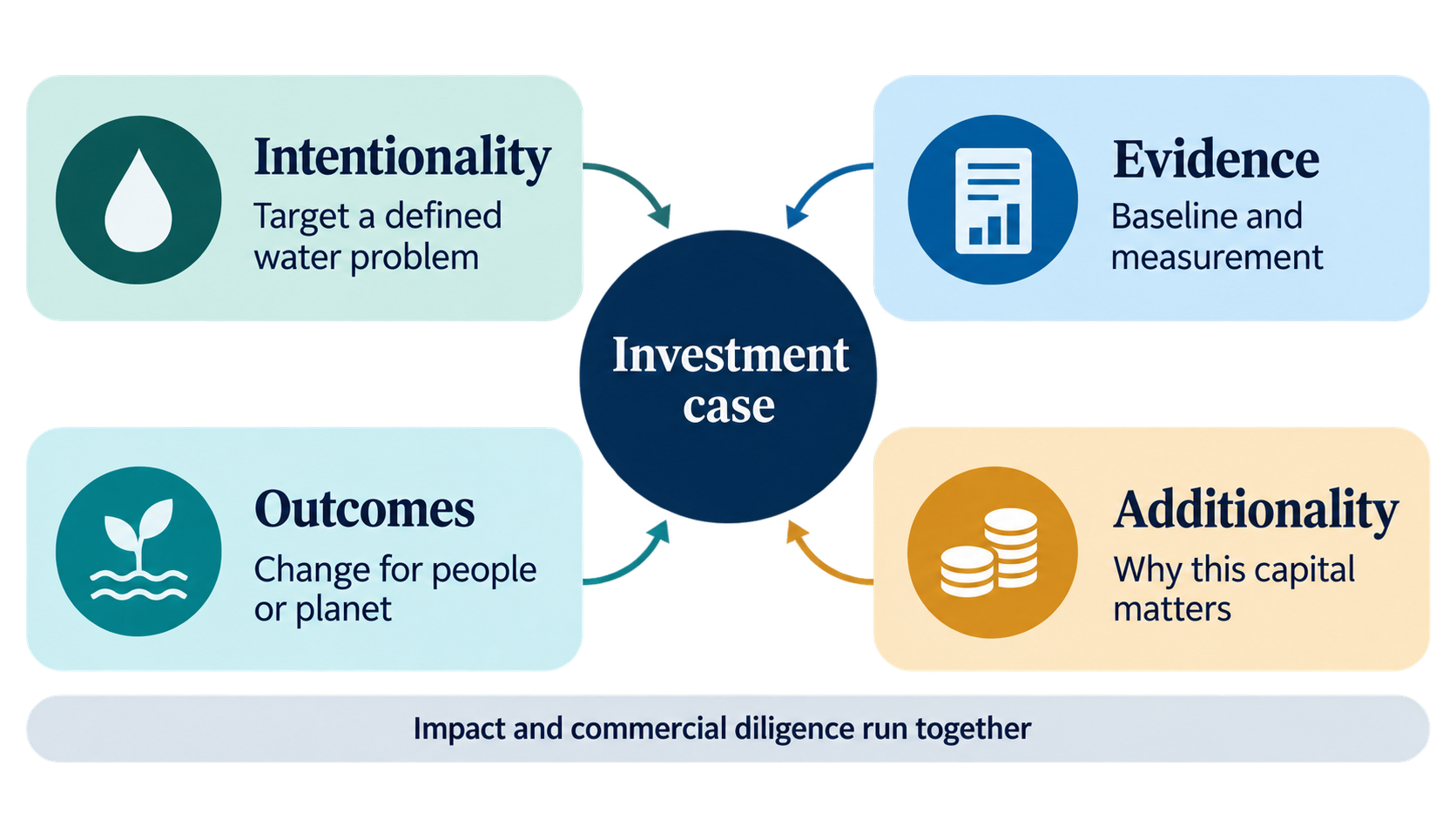
The word impact should change the diligence process. An investor should be able to state the intended water outcome, identify who experiences it and explain how the change will be measured. A general statement that a product is “green” is not enough. The investment case needs a link between the problem, the intervention, the customer and the result.
Why stage matters
At an early stage, the main question is usually not whether the company can grow quickly. It is whether the next evidence milestone is achievable with the capital being raised. A pilot that proves a treatment process can work in a laboratory is different from a contracted installation that performs across changing feedwater, operating hours and customer constraints.
The International Finance Corporation’s impact investing framework describes impact investing as targeting measurable positive social, economic or environmental impact alongside financial returns. That definition makes room for commercial discipline. The impact case and the financial case should strengthen one another, not sit in separate sections of a pitch deck.
Why Water Start-Ups Can Be Investable
Water problems have paying customers
Water technology can address treatment cost, supply reliability, discharge compliance, water reuse, energy use, leakage, monitoring and industrial continuity. The buyer may be an industrial site, utility, developer, operator or public body. Each buyer has a different procurement process, budget owner and tolerance for operational change.
That makes customer discovery central to early stage impact investing. A technology can be valuable in theory but difficult to sell if the user who feels the pain cannot approve the purchase. Investors should ask who signs the contract, who operates the system, who carries performance risk and what budget pays for the solution.
Water creates a commercial context for impact
The World Bank’s Water Forward overview links water systems with jobs, productivity, food and energy security. It also notes that private investment is held back by weak sector fundamentals, policy uncertainty and a lack of bankable projects. This is useful investor context, but it is not a reason to assume every water company will scale.
The investable question is narrower. Can this company help a defined customer reduce a cost, protect production, meet a requirement or secure a more resilient supply? If so, can it do that with a delivery model that produces reliable revenue and manageable service obligations?
The Market Need Is Large, Yet Bankability Is Hard
Need is not the same as an investable market
Water stress and ageing infrastructure can create strong need without creating a quick sales cycle. A customer may need a solution but lack a tariff, procurement route, permit, balance-sheet capacity or internal sponsor. A young company must navigate those constraints while protecting cash and product quality.
The World Bank’s report on scaling water reuse points to four conditions that matter for private participation: integrated planning, programmatic approaches, clear pricing and regulation, and bankable delivery and financing models. For an early-stage company, those conditions become commercial questions. The investor must test whether the target market is ready to buy, not just whether the technology is relevant.
Readiness changes by water segment
An industrial reuse product may reach a customer through a direct equipment sale, a service contract or a performance-based model. A monitoring platform may start with a small site and expand across a portfolio. A decentralised treatment system may depend on a local operator, maintenance partner or long-term offtake arrangement.
Each route creates a different revenue model, gross-margin profile and working-capital need. A business that sells hardware may need manufacturing and installation capacity. A service model may need a larger operating team before revenue catches up. A software layer may look light on capital but still face long integration and data-validation cycles.
What the First Cheque Should Achieve
Fund a defined evidence milestone
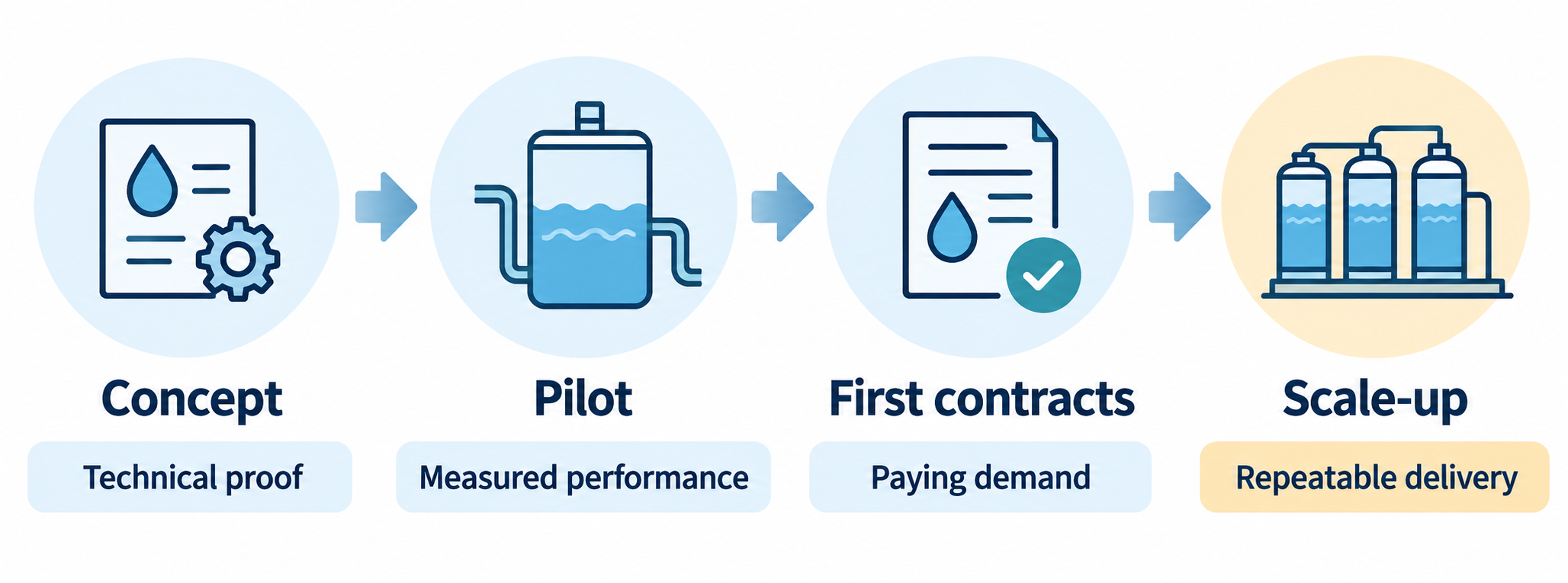
A first round should be tied to a small number of measurable milestones. Those could include completing a field pilot, achieving a defined operating period, securing a paid trial, converting a reference customer or reaching a repeatable installation cost. The milestone should be specific enough that an investor can decide what has changed after the round.
Capital can support product development, field testing, certification, customer integration, early hiring, working capital and commercial development. It should not be described as a general pool for growth. The more uncertain the technology, the more important it is to separate technical proof from sales ambition.
Match financing to the risk being retired
Early-stage impact investors should ask whether equity is funding a risk that equity should carry. A long engineering cycle, uncertain customer adoption and unproven gross margin can all require patient capital. A signed order with clear payment terms may support a different funding mix later, but that transition should be earned through evidence.
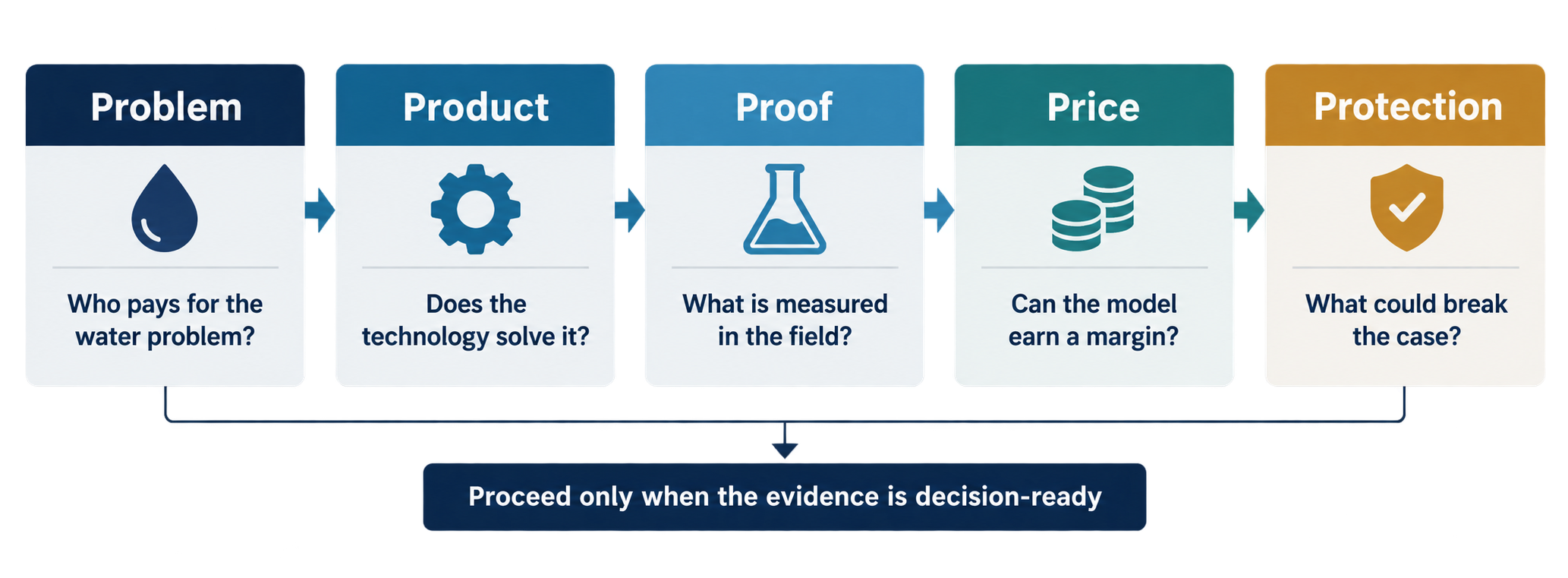
The pathway in the figure above is useful because each stage asks for a different proof point. The goal is not to force every company into the same timetable. It is to see whether the amount raised is proportionate to the next decision that management and investors need to make.
A Readiness Test for Water Technology
Start with the customer problem
Ask what the customer does today, what that approach costs and what happens if the problem is not solved. A problem statement should include the operating setting. “Water is scarce” is too broad. “A food plant needs a dependable source of process water without expanding its freshwater intake” is more useful because it points towards a buyer, a use case and a measurable outcome.
Test the technical claim in the field
Laboratory results are valuable, but they do not answer every deployment question. Field evidence should show performance under the conditions that matter to the customer, including feedwater variation, uptime, cleaning, consumables, operator input and maintenance.
Investors should look for the test design, baseline, measurement method, failure events and limits of the evidence. A single successful trial can support a learning milestone. It should not be presented as proof of broad commercial readiness.
Map adoption and delivery
A promising water technology can still fail if it cannot be installed without disrupting the customer. Diligence should cover site surveys, integration, permitting, commissioning, service response and responsibility for performance after handover.
Defensibility may come from process know-how, data, integration capability, customer references, intellectual property or a hard-to-replicate operating model. It should be connected to the buying process. A patent that does not protect the commercial system may matter less than a delivery capability that reduces customer risk.
Measure Impact Alongside Commercial Progress
Separate activity from outcome
Installing a treatment unit is an activity. Reducing a customer’s freshwater withdrawal, improving discharge quality or increasing reliable water availability may be an outcome. The investor should define the relationship between the two and state what could weaken it.
The Impact Principles provide a common framework for integrating impact through the investment lifecycle. Their emphasis on disclosure and verification is a useful reminder that an impact claim should survive review by someone who was not involved in the original sale.
Build a simple measurement plan
A practical plan can set a baseline, identify the affected stakeholders, record the operating period and measure the intended result. It should also consider negative effects, such as energy use, chemical demand, waste streams or a shift of risk from one community or ecosystem to another.
The IFC’s impact investing material describes the value of assessing impact before investment and monitoring it after investment. For an early-stage company, the plan may be simple at first. It should become more reliable as the technology moves from a pilot to repeated customer deployments.
Use impact data in the investment decision
Impact data should influence the decision, not only the annual report. If the intended outcome cannot be measured at a reasonable cost, the investor may need to reduce the claim, change the product design or pause the investment. If impact improves the customer’s economics or reduces operating risk, that link should be visible in the financial model.
Due Diligence Questions for Investors
Team and governance
Can the founding team explain the technical claim, customer problem and cash plan in the same meeting? Does the company have enough operational depth to deliver the next milestone? Are reporting lines, board rights, conflicts and related-party arrangements clear?
Technology and data
What has been tested, where and for how long? Which variables have not been tested? Who owns the data? Can the company reproduce the result, and can an independent customer or engineer review the method?
Customers and contracts
Separate letters of interest from paid orders. Review contract scope, payment timing, acceptance tests, warranties, service levels, exclusivity and termination rights. A reference customer can be valuable, but it should not be counted as repeatable revenue until the commercial terms support that conclusion.
Regulation and responsibility
Water products can sit inside a regulated or safety-sensitive operating environment. The company should identify the permits, standards, testing and customer responsibilities that apply to its actual use case. Investors should obtain specialist legal or technical advice where the diligence requires it.
Capital structure and follow-on risk
Review the cap table, option pool, preference rights, previous instruments, liquidation terms and expected future rounds. Early-stage investors can face dilution even when the company performs well if the next capital requirement is larger than expected. The relevant question is not only whether the first cheque is affordable. It is whether the whole financing path is credible.
Unit Economics, Follow-On Funding and Dilution
Find the cost to serve
For a water technology, unit economics may depend on equipment cost, installation, energy, chemicals, labour, maintenance, replacement parts, monitoring and financing. The correct unit may be a site, a treatment line, a service contract or a volume of water processed. Investors should choose a unit that matches how the customer buys.
Gross margin can look attractive before field service, warranty and commissioning costs are included. A young company should show what is known, what is estimated and what changes at larger scale. The model should also show how cash is affected by deposits, payment terms, inventory and project delays.
Plan for the next round before this round closes
Follow-on capital may fund manufacturing, sales, certification, deployment teams or a larger working-capital base. The company should state the next milestone, the likely timing and the assumptions that would make the round larger or smaller.
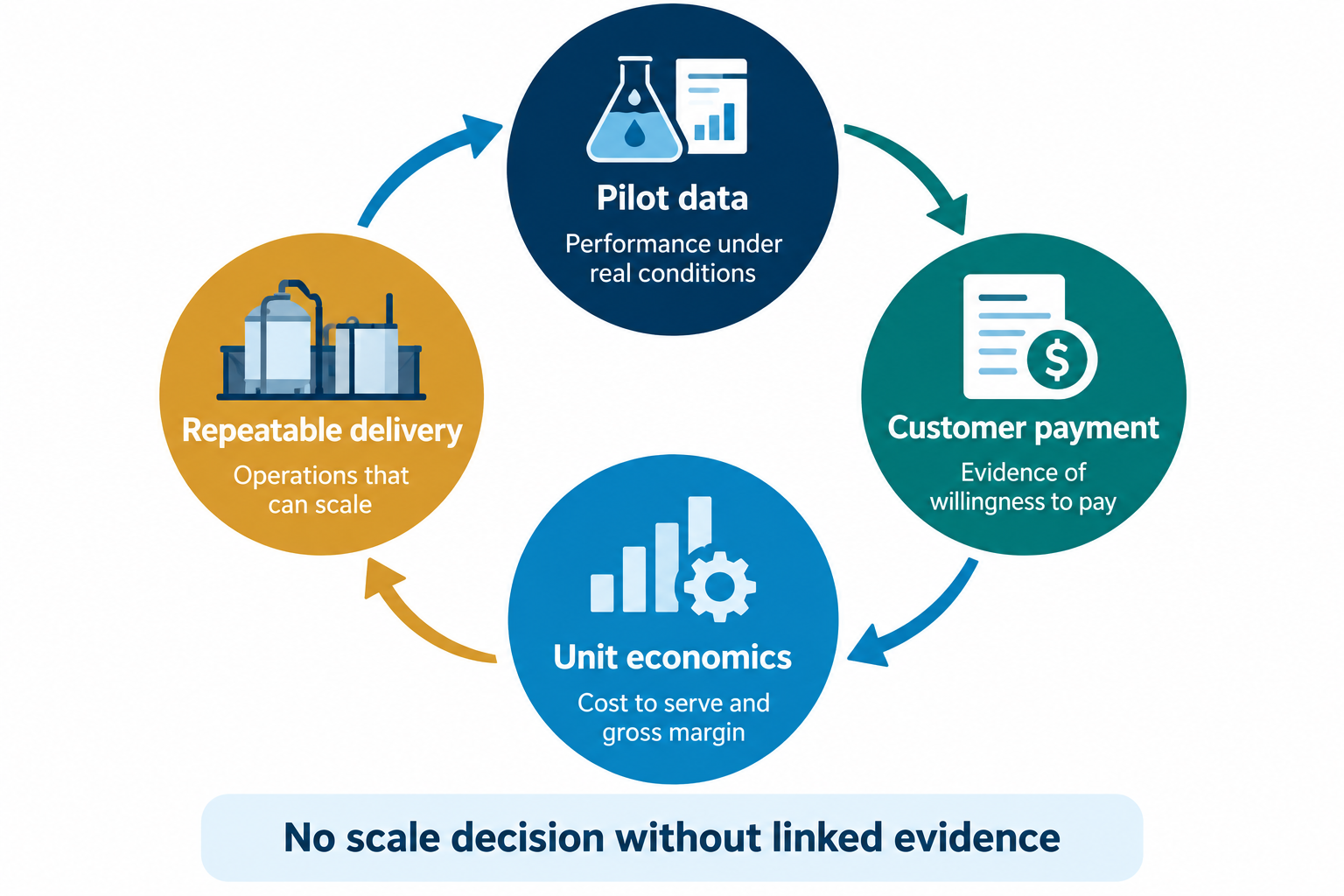
The visual below captures the connection between data, payment, margins and delivery. None of the four proves the investment alone. Together, they create a stronger basis for deciding whether a business is ready to move from learning capital to scale capital.
Keep dilution visible
Dilution is not automatically negative. It can be the price of funding a valuable milestone. It becomes a risk when the company raises repeatedly without converting capital into better evidence, stronger revenue or a lower cost to serve.
Build a Portfolio That Can Survive Delays
Expect technical and commercial variance
Early-stage water companies can face long procurement cycles, site delays, changes in regulation, difficult feedwater, failed pilots or slower customer adoption. Portfolio construction should acknowledge that several companies may need more time or more capital than the original plan suggested.
The HM Revenue and Customs evaluation of the Seed Enterprise Investment Scheme found evidence of an early-stage funding gap and reported that first-round capital could help companies prove a product and attract later finance. It also records a risk of business failure. The lesson for an investor is to treat early-stage impact investing as risk capital, not as a substitute for cash or as a guaranteed route to follow-on funding.
Use stage gates and reserves
A portfolio can use stage gates for technical proof, paid demand, repeatability and scale. The gates should be agreed before the next cheque is requested. Reserves should be allocated with discipline, so that additional capital follows new evidence rather than habit.
Geography and customer type can also matter. A portfolio concentrated in one procurement system, one industrial segment or one funding route may share the same hidden risk. Exposure should be assessed at the level of customer, technology, regulation and capital intensity.
Investment Committee Scorecard and Decision Rules
A practical five-gate review
An investment committee can keep early-stage impact investing focused by asking five questions in order. The questions do not create a mechanical score. They create a record of which evidence is strong, which is provisional and which would stop the investment.
| Gate | Evidence to review | Stop condition |
|---|---|---|
| Problem | Defined buyer, operating pain and budget owner | No credible customer or payment route |
| Product | Technical claim, test design and deployment requirements | Performance cannot be tested in the target setting |
| Proof | Field data, baseline, limits and independent checks | Evidence is anecdotal or not reproducible |
| Price | Revenue model, cost to serve and margin path | Scale requires economics the customer will not accept |
| Protection | Regulatory, execution, financing and impact risks | One unmitigated risk can destroy the case |
Record what would change the decision
The committee should write down the evidence that would move the opportunity from watchlist to investment, or from investment to follow-on. This may include a paid customer, an operating dataset, a certification, a repeat installation, a gross-margin bridge or a revised capital plan.
The UK government’s 2026 announcement on expanded early-stage venture access shows that public initiatives can influence the availability of capital. It does not remove company-specific technology, customer, governance or execution risk. A committee should underwrite the company and its evidence, not a headline about the wider funding environment.
FAQs and Next Steps
What is early stage impact investing?
It is risk-bearing investment in a young company that aims to create measurable positive social or environmental outcomes alongside financial value. In water, the company may be developing treatment, reuse, monitoring, resilience or efficiency solutions.
Is early stage impact investing the same as venture capital?
It can use similar equity structures and carries similar high business risk. The difference is that the investor must also underwrite the intended impact, the measurement plan and the link between the product and the outcome.
What should an investor test first?
Start with the customer problem and payment route. Then test the technology in the real operating setting, review the measurement method and connect the result to cost, revenue and delivery requirements.
How can impact be measured in a water technology deal?
Set a baseline, define the affected stakeholder or ecosystem, measure the outcome over a stated period and record negative effects. The method should be proportionate to the stage and improve as the company gains operating data.
What is the main risk in follow-on funding?
The company may need more capital than planned before reaching repeatable revenue or acceptable margins. Investors should understand the next milestone, likely financing need, dilution path and the evidence required before committing further capital.
Sources and method
This article uses the Impact Principles for lifecycle discipline, the IFC impact investing framework for impact alongside financial returns, the World Bank water reuse report and World Bank Water Forward overview for water-sector bankability and investment context, and the HMRC SEIS evaluation and UK government venture access announcement for early-stage finance context. The sources were opened and checked before publication.
Explore the next conversation
Investors who want to understand the wider water impact investing landscape can review the parent guide and the Water Investment Network portfolio context. Eligible investors can join the Water Investment Network to discuss direct opportunities. For a general enquiry, contact the network.