

Additionality in impact investing is one of the most useful tests for private-market investors. It asks a simple question: what will this investor add that would not otherwise be available? In water, the answer may be patient capital, a better financing structure, commercial discipline, operating expertise or access to customers. It should never be assumed from the label “impact”.
This matters because water opportunities can look attractive at a sector level while remaining difficult to finance at company level. A treatment business may have real demand but need time to prove a new process. A reuse project may have a credible customer but need a structure that matches construction risk to long-term service payments. An investor’s contribution can affect whether the opportunity happens, how quickly it scales and how well it performs.
This additionality impact investing lens is especially useful when a water opportunity has a clear need but several possible sources of capital.
For private-market investors, additionality is therefore both an impact question and an investment-committee question. It helps separate a credible contribution from a claim that the capital is automatically catalytic. This guide explains how to test additionality in water opportunities without confusing it with impact, financial return or good intentions.
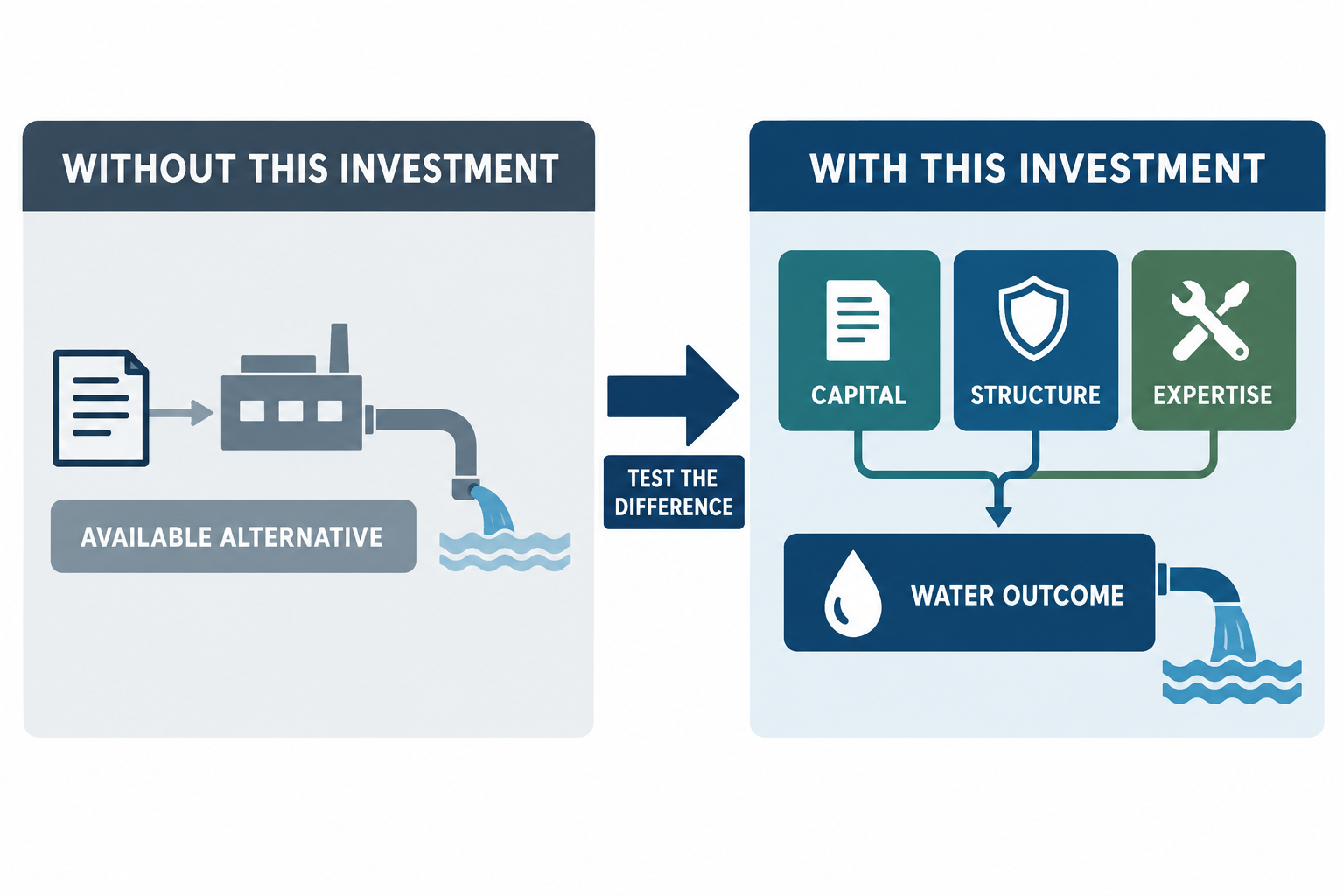
Why additionality matters in water investment
Water is a large and varied investment universe. It includes treatment companies, monitoring systems, reuse infrastructure, resource-recovery businesses, network services and enabling software. The commercial case differs across each model, but many businesses face similar barriers: long sales cycles, complex procurement, high validation costs, fragmented customers and regulation that varies by location.
That creates a risk of broad claims. An investor may say that any capital invested in water is additional because water is underfunded. That does not prove that the investor’s capital changes the outcome for the company, customer or end user. The relevant comparison is the opportunity’s realistic counterfactual: what would happen, on what timetable and with what quality of financing if this investor did not participate?
The IFC summary of the MDB Harmonised Framework describes additionality as a contribution beyond what is available in the market, while avoiding the displacement of private-sector actors. Although the framework is written for multilateral development banks, the discipline is useful for private investors too. It directs attention to market context, evidence and the investor’s role.
The water context makes the test practical. The Joint MDB Water Security Financing Report 2024 records USD 19.6 billion of water-related MDB approvals in 2024, including USD 14.4 billion for low- and middle-income countries. Those figures show the scale of institutional finance, but they do not tell an investor whether a particular water company needs this specific capital, structure or expertise.
What additionality means in practice
Additionality is not a promise that an investment will succeed. It is a reasoned account of the investor’s contribution. The contribution may be financial, non-financial or a combination of both. It should be specific enough for an investment committee to test and for the investor to review after closing.
The EBRD’s explanation of additionality focuses on support or input that is not available from commercial sources of finance. It gives examples such as longer-term finance, risk mitigation, better project design, corporate-governance support and environmental or inclusion standards above normal market practice.
For a private water investor, this may mean helping a company move from a pilot to a repeatable commercial offering. It may mean funding a sales and validation period that ordinary growth capital will not tolerate. It may also mean bringing a customer network, technical adviser or governance process that reduces execution risk. The claim must match the investor’s actual rights, resources and behaviour.
A useful definition for an investment file is:
Additionality is the measurable financial or non-financial contribution an investor makes beyond what the company could reasonably obtain or achieve without that investor, in a way that supports a defined impact outcome without crowding out suitable market capital.
This wording contains three safeguards. “Could reasonably obtain” avoids treating every unavailable preference as a market failure. “Could reasonably achieve” recognises that expertise and networks can matter as much as money. “Defined impact outcome” prevents a contribution claim from becoming detached from the water service or environmental result.
Additionality is not the same as impact
Impact describes the positive or negative effects associated with an investment. Additionality describes the investor’s contribution to making those effects happen, happen sooner or happen with better quality. The two ideas are linked, but they answer different questions.
The IFC Operating Principles for Impact Management ask managers to establish their contribution to impact and support the narrative with evidence. The same document separates contribution from the assessment of expected impact. A company may deliver a positive water outcome, but that does not show that one investor caused or enabled it.
Consider a water-quality monitoring company with a product already widely financed by banks. The product may generate useful environmental data. If the company could raise the same capital on similar terms without a new investor, the new investor should be careful about claiming financial additionality. It may still provide non-financial additionality through customer introductions, measurement systems or governance support. The evidence needs to identify that channel.
The distinction also protects against overclaiming. Investors should not present avoided pollution, improved water efficiency or new treatment capacity as their own contribution unless they can show how their capital or actions affected the result. Attribution is rarely absolute in a private-market transaction. A credible contribution narrative is more useful than a large unsupported claim.
| Question | What it tests | Evidence to seek |
|---|---|---|
| What changed? | The impact outcome | Baseline, output, outcome and negative-impact data |
| Why did it change? | The causal pathway | Company actions, customer adoption and operating records |
| What did this investor add? | Additionality and contribution | Financing alternatives, terms, investor actions and decision records |
Four forms of additionality for private water investors
Additionality can take several forms. It is useful to separate them because the evidence, risks and investor responsibilities differ.
1. Capital availability
Capital additionality exists when the company cannot obtain sufficient financing for the relevant purpose on reasonable commercial terms. The issue may be ticket size, tenor, security, risk appetite, stage, geography or the lack of a financing product that fits the business.
Investors should test this against credible alternatives. Request evidence of declined or delayed financing, term sheets, lender requirements, existing facilities and the timing of the funding need. A company’s preference for equity over debt is not, by itself, proof that equity capital is additional.
2. Risk sharing and financial structure
An investor may make a project possible by taking a different risk position from other funders. Examples include longer duration, staged equity, a first-loss position, a working-capital facility or a structure that matches repayments to contracted customer revenue. The additionality lies in the risk-bearing function, not in the label attached to the instrument.
Structures can also introduce new risks. A concessional or subordinated position may crowd out commercial finance if it is priced or allocated without a clear market rationale. Model the downside case, the exit rights and the effect on later investors. Ask whether the structure unlocks private capital or merely makes the current transaction look easier.
3. Non-financial contribution
Water companies often need more than cash. An investor may bring procurement expertise, commercial introductions, impact measurement, board support, project preparation, regulatory understanding or help with a new market. This contribution can reduce the time or cost needed to reach repeatable revenue.
Non-financial claims should be written as actions, not adjectives. “Strategic support” is weak. “Introduced three qualified industrial customers, funded an independent validation study and added a board member with utility-contract experience” is testable, provided those actions actually occur. The investor should record the work, not only the intention.
4. Market-building contribution
Some investments support market formation. A company may need an early reference customer, a bankable performance record or a common measurement approach before larger buyers will engage. An investor can help create those conditions through patient ownership, customer access and credible reporting.
Market building is not a licence to ignore commercial discipline. The company still needs a paying customer, a route to margin and a plan to operate at scale. The investor should show how its contribution can be replicated without creating a permanently subsidised business.
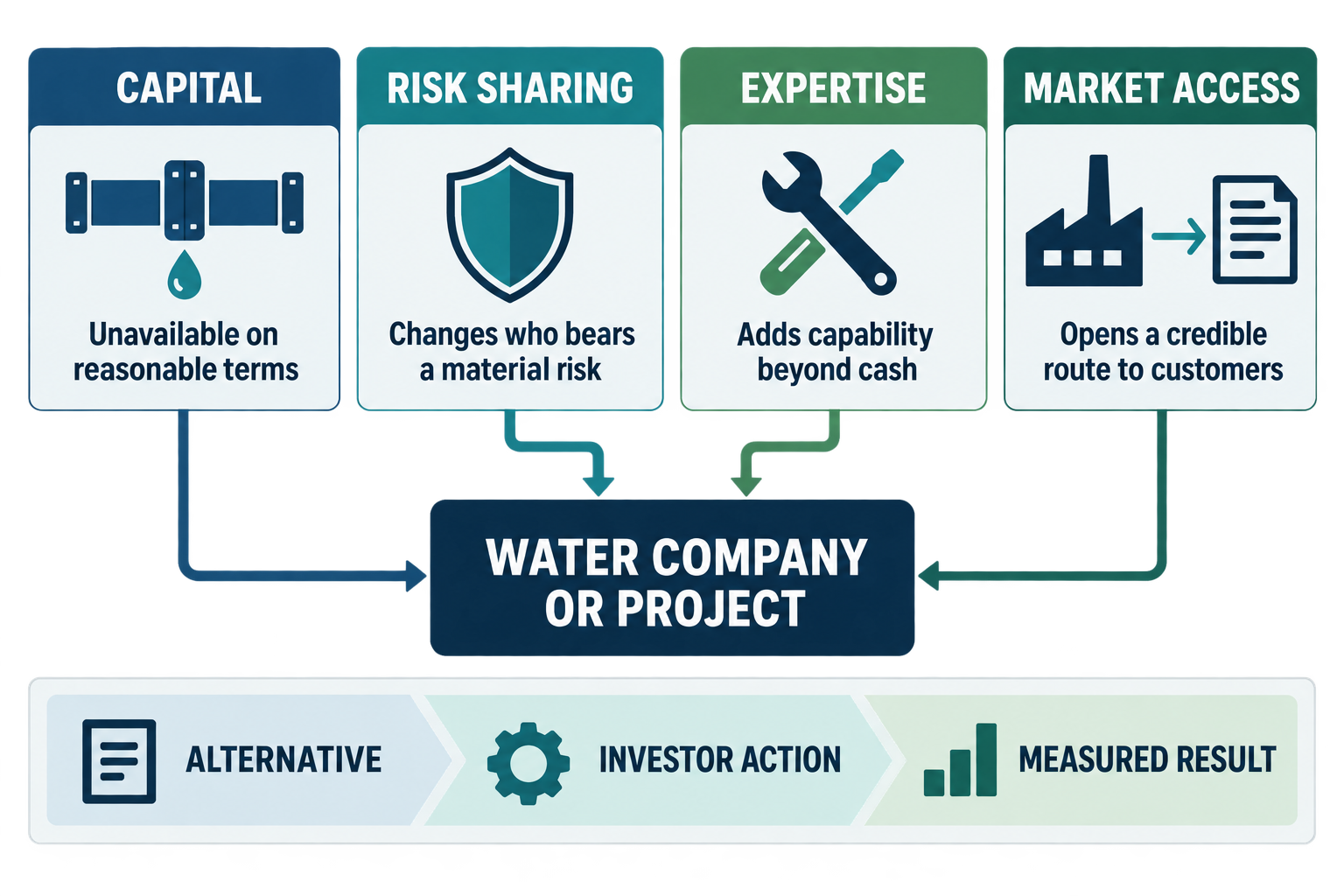
Test the counterfactual before claiming additionality
The counterfactual is the most important part of the analysis. It asks what the company, project or customer would do without the proposed investor. A useful answer should describe the likely alternative, its timing, its cost and its effect on the intended water outcome.
Start with the company’s funding need. Is the money for equipment, inventory, certification, customer acquisition, project preparation, acquisitions or general working capital? Then ask which sources could meet that need: bank debt, existing shareholders, strategic customers, grants, public finance, another fund or retained cash.
Next, compare the alternatives. A slower funding route may delay a plant or contract. A more expensive route may reduce the company’s ability to invest in sales. A more restrictive lender may limit the technology or customer segment. These effects are relevant, but they need evidence from the company’s actual circumstances.
Finally, state what would happen without the investment. The answer may be “the company could proceed with no material change”, “the project would proceed later”, “the company would scale a less effective configuration” or “the opportunity would not proceed”. These are different claims and should not be blended together.
| Area | Question | Decision evidence |
|---|---|---|
| Funding | Could the required amount be raised elsewhere? | Alternative terms, lender feedback and financing history |
| Timing | Would another route change the delivery timetable? | Contract milestones, procurement lead times and cash runway |
| Quality | Would the alternative change the design or operating result? | Technical scope, safeguards and performance assumptions |
| Scale | Would the business reach repeatable sales? | Customer pipeline, unit economics and capacity plan |
The MDB Harmonised Framework for Additionality stresses that additionality is assessed with evidence available at the time of the decision. That is a helpful discipline for private investors. Do not rewrite the counterfactual after the outcome is known. Keep the original assumptions, then review them against what actually happened.
Why water reuse creates a useful additionality test
Water reuse shows why additionality must be connected to a physical service. The World Bank’s Scaling Water Reuse report says cities and industries generate nearly one billion cubic metres of used water each day. It also reports that potable and industrial reuse remains a small share of current use and identifies a role for programmatic investment, enabling regulation and private capital.
Those facts establish a sector opportunity. They do not prove that every reuse company or project is additional. An investor still needs to ask whether the proposed capital addresses a specific barrier: customer pre-financing, plant expansion, performance validation, long-term debt, connection infrastructure or a measurement gap.
For a technology company, the additionality case may sit between product and market. The company may have a working system but lack the capital to certify it for a new industrial customer. For a project company, it may sit in the contract. The project may have demand but need a structure that shares construction and performance risk before long-term finance is available.
Investors should also examine the full water system. Reuse can reduce pressure on freshwater sources, but the result depends on source quality, treatment performance, energy use, residuals management, customer demand and safe operation. A contribution that accelerates deployment without addressing those interfaces may create an output without a durable outcome.
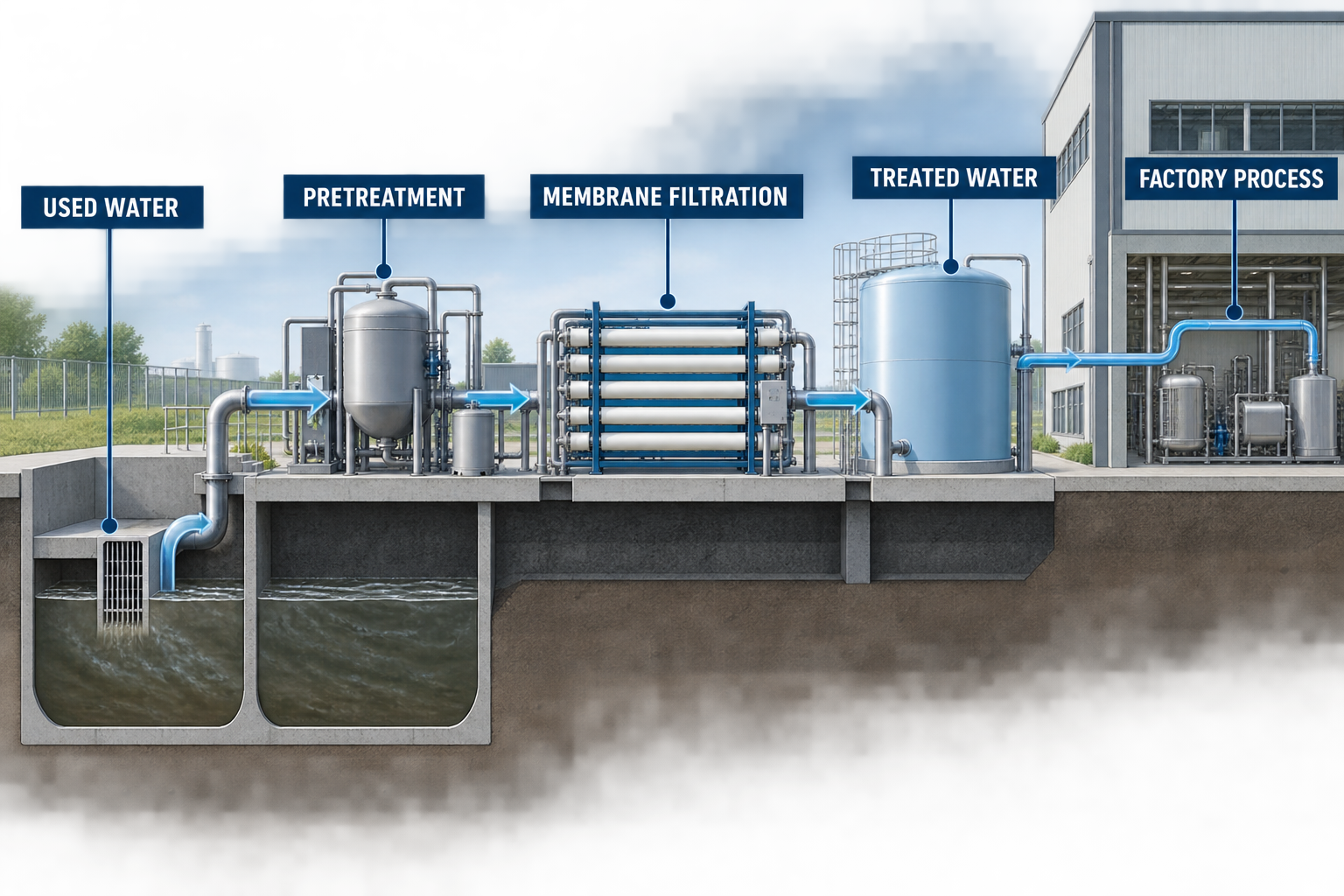
Build additionality into commercial diligence
Additionality should sit beside revenue, margin, cash flow and risk analysis. It should not be a separate impact paragraph added after the financial model. The investor needs to understand how the contribution affects the company’s ability to win customers, deliver the service and protect capital.
For technology businesses, review the relationship between the contribution and the commercial model. Does the financing extend runway until a signed order? Does technical support reduce the cost of deployment? Does a reference customer improve the sales cycle? Does the company earn enough gross margin after installation, maintenance, energy and warranty costs?
For infrastructure or service businesses, map the asset and the contract. Identify the payer, payment basis, operating obligations, renewal needs and downside protections. A structure that makes construction finance available may still leave the investor exposed to demand, counterparty or performance risk.
For both models, link the contribution to a small number of decision metrics. These may include time to certification, contracted capacity, repeat sales, customer retention, gross margin, plant availability, treated volume or verified water-quality performance. Do not select metrics only because they are easy to report.
The commercial test should include the possibility that additionality is not needed. If a company can obtain comparable capital and support from the market, an investor may still choose to invest. It should then describe its role honestly, without claiming that the transaction is additional.
Turn the claim into an evidence and monitoring plan
A good additionality case begins before investment and remains open after it. At approval, record the market context, alternative financing, contribution channels, intended water outcome, risks and success measures. During ownership, track whether the promised capital and support were actually deployed.
The IFC Principles provide a useful structure. They ask managers to define impact objectives, assess expected impact, monitor progress, consider exits and publicly disclose alignment with the principles. They also call for a credible narrative on the manager’s contribution to impact through financial or non-financial channels.
For a water investment, the monitoring file might include:
- the original funding alternatives and the reason they were insufficient;
- the capital actually drawn and the use of proceeds;
- investor actions such as customer introductions, technical support or governance changes;
- commercial measures such as contracted revenue, deployment time, gross margin or retention;
- water measures such as treated volume, reuse, service continuity or quality, with a clear boundary;
- negative effects, unresolved risks and changes to the counterfactual; and
- the effect of refinancing, follow-on capital or exit on sustained impact.
Monitoring should allow the investor to reduce or revise its claim. If another fund later provides the same capital on normal terms, the original financial additionality may no longer be relevant. If the company’s product fails to reach customers, the intended impact may not materialise even if the investor’s contribution was genuine.
Investors looking at a specific opportunity can use the Water Investment Network portfolio as a starting point for the opportunity context, while the wider water impact investing guide provides the parent investment context. The individual company file remains decisive. The relevant question is not whether water is important. It is whether the investment has a credible, documented route from contribution to commercial delivery and water outcome.
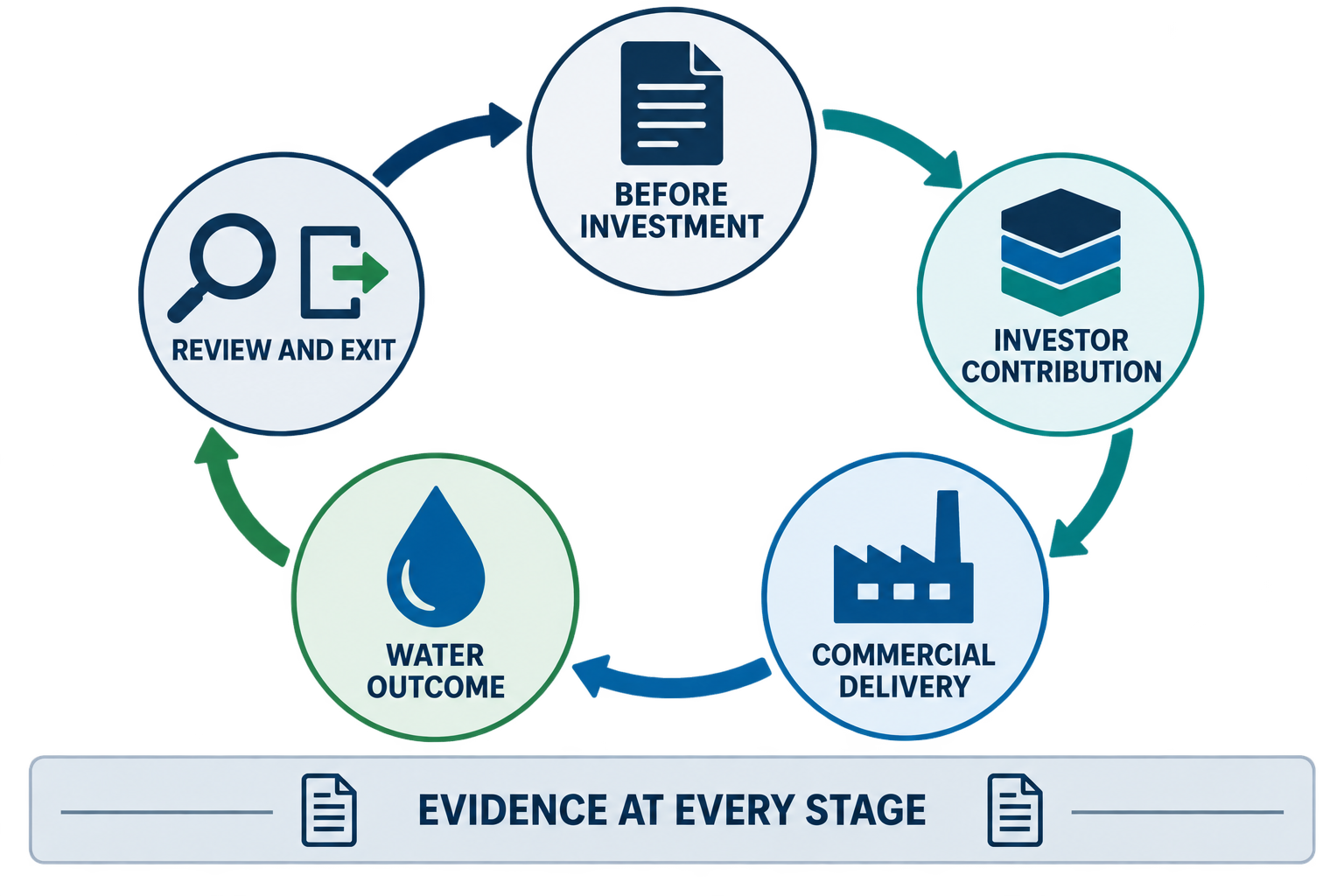
Common additionality claims that need stronger proof
Several claims appear often in impact materials but are too weak on their own.
- “Water is underfunded, so all water capital is additional.” This describes a sector condition, not the investor’s contribution to a specific opportunity.
- “The company creates impact, so our investment is additional.” Impact and additionality are related but separate. The investor still needs a counterfactual.
- “We were an early investor.” Timing may matter, but the company could have had another early funder. Show what changed because of this investor.
- “We provided strategic value.” Name the action, the recipient, the timing and the result. Keep the claim proportionate to the evidence.
- “Our capital is catalytic.” Explain which later capital, customer, standard or market condition was unlocked, and test whether the effect lasted.
These checks are not designed to make every claim impossible. They make the claim useful. A narrow, well-supported contribution is stronger than a sweeping statement that cannot be separated from the company’s own work or from market demand.
Frequently asked questions
What is additionality in impact investing?
Additionality is the financial or non-financial contribution an investor makes beyond what the market would otherwise provide or achieve. It should be linked to a clear counterfactual, a defined investment action and a measurable impact pathway.
Is additionality the same as impact?
No. Impact describes the effects of an investment on people or the environment. Additionality describes the investor’s contribution to making those effects happen, happen sooner or happen with better quality. A positive outcome does not prove that one investor caused it.
Can a private investor demonstrate additionality in a water company?
Yes, if the investor can show a specific contribution. Examples include funding that is not available on reasonable terms, a structure that shares a material risk, or practical support that helps the company reach customers, improve measurement or strengthen operations.
What evidence supports an additionality claim?
Useful evidence includes alternative financing terms, lender feedback, the company’s funding timetable, signed customer or project documents, records of investor actions, operating data and impact measurements. The evidence should be available at approval and updated during ownership.
Does additionality guarantee financial returns?
No. Additionality is not a return guarantee, risk waiver or substitute for financial diligence. An investment can be genuinely additional and still face market, technology, execution, regulatory, counterparty or liquidity risk.
Make additionality a testable part of the investment case
Additionality gives investors a practical way to ask what their capital and capabilities add to a water opportunity. The answer should be grounded in alternatives, timing, terms, investor actions and measured outcomes. It should also remain open to revision as the company, market and financing base change.
For water investors, the strongest cases connect the contribution to a paying customer, a credible revenue model, operating performance and a defined water outcome. That combination helps an investment committee assess both commercial quality and impact integrity without treating either as guaranteed.
Water Investment Network focuses on direct private-market opportunities in water technology and related infrastructure. Eligible investors can join the Water Investment Network to learn more about the network and its current investor community. Review each opportunity independently and seek regulated professional advice where appropriate.