
Blended finance impact investing is often described as a way to bring public and private capital together. That is true, but it is not enough for an investment decision. For water investors, the real question is whether a blended structure removes a defined barrier and leaves behind a business that can stand on commercial terms.
Water assets sit close to essential services. They can also be capital intensive, locally regulated and slow to scale. A good structure can make a viable project investable. A weak structure can hide poor demand, unclear accountability or an uneconomic tariff.
The water impact investing landscape therefore needs a disciplined bridge between measurable outcomes and commercial proof. This guide explains how to assess that bridge. It is written for family offices, HNW investors, private-equity investors and advisers considering direct opportunities.
Blended finance impact investing and water
Blended finance combines concessional or development finance with commercial finance. The concessional layer may accept a lower return, longer tenor or higher risk than a private investor would accept alone. The commercial layer still needs a credible path to repayment, value creation or both.
The structure is not the same as a grant. It is also not a promise that risk has disappeared. It is a way to allocate different risks to capital providers with different mandates, while improving the chance that a water business or project can reach a durable market.
The OECD review of blended finance for water and sanitation takes a commercial investment perspective. It finds that blended models can help mobilise commercial finance, but that they have not reached scale across the water and sanitation sector. That distinction matters. A financing label does not prove bankability.
For an investor, the first test is simple: what is the barrier, who bears it today and what changes after the blended capital is deployed?
How blended finance works
Blended structures use layers because water investments face different types of risk. A grant may fund early project preparation. A guarantee may absorb a defined credit or political risk. A subordinated loan may sit below senior debt. Equity may fund growth while contracts and operating evidence mature.
These layers do not have the same rights or economics. They should not be described as if they do. Investors need to understand ranking, security, tenor, covenants, currency, governance and the circumstances in which a support instrument pays out.
The International Finance Corporation describes blended concessional finance as combining concessional funds with development finance or commercial finance to develop private markets and mobilise private resources. Its principles include additionality, minimum concessionality, commercial sustainability, market reinforcement and high standards.
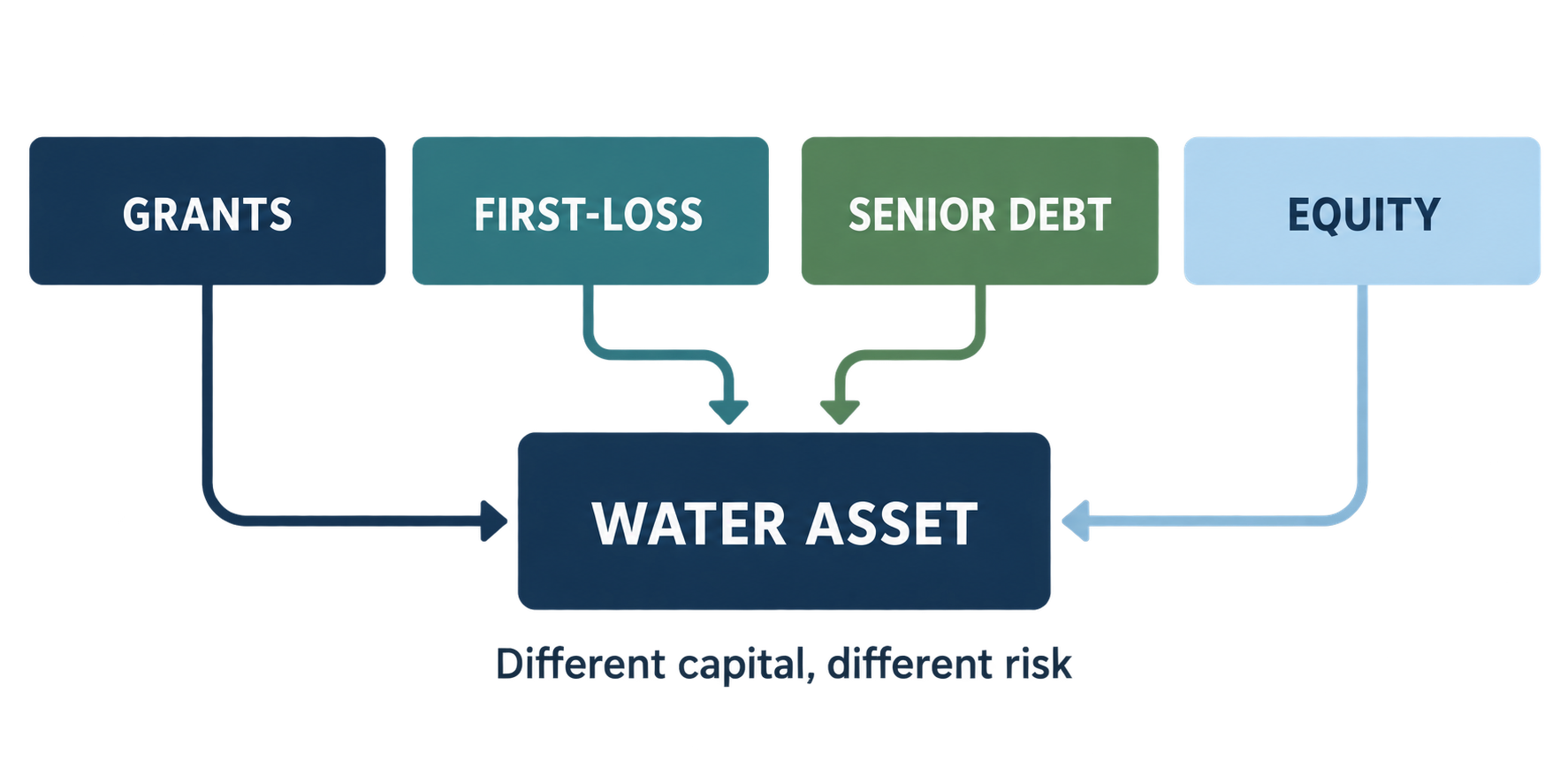
The capital stack above is a way to ask better questions. It does not imply that every project needs four layers. If one risk can be priced and managed by normal commercial finance, adding a concessional layer may create cost and complexity without improving the outcome.
Why water projects often need a blended structure
Water businesses earn revenue in different ways. A technology company may sell equipment, software or services to an industrial customer. A utility may earn regulated or contracted revenue. A project company may receive availability payments, treatment fees or payments linked to water delivered.
Those models have different risk profiles. The customer may delay a procurement decision. A long-term contract may depend on public credit. A facility may face construction risk before it produces cash flow. Foreign exchange may sit between local revenue and hard-currency debt.
The World Bank’s Water Forward programme identifies guarantees, blended finance and risk-sharing instruments as tools to crowd in investment. It also links finance to government ownership, institutional strengthening and investment planning. This is a useful reminder that capital cannot replace the local systems needed to operate water infrastructure.
The case for blending is strongest when a project has a clear customer need but a temporary or specific financing obstacle. It is weaker when the project lacks a paying customer, a workable contract, reliable operating data or a credible route to scale.
Investors should also separate a company from a project. A technology company may scale through repeat sales and service revenue. A project company may depend on one site, one contract or one public counterparty. The appropriate instrument and exit route will differ.
Geography changes the analysis as well. A UK or European investor may be looking at a technology company with cross-border sales. A GCC investor may be looking at a local deployment, a strategic water-security need or a project with imported equipment. The same technology can therefore face different payment, currency, procurement and operating risks.
Do not use the phrase emerging market as a substitute for diligence. Identify the exact country, customer, currency, contract and operating environment. A regional thesis is useful only when it leads to a specific source of demand and a specific way to manage risk.
Investment thesis at a glance
A blended water opportunity should be explainable in commercial terms before its impact case is considered. The following framework keeps the two cases connected without treating impact as a substitute for diligence.
| Investment question | Evidence to request | Why it matters |
|---|---|---|
| Demand | Named customer problem, buyer, budget and procurement route | Shows whether the water need can become revenue |
| Revenue | Contract terms, pricing logic, renewal history or paid pilots | Tests visibility, margin and counterparty risk |
| Scalability | Deployment time, operating requirements and repeatable sales process | Shows whether growth needs a new bespoke structure each time |
| Impact | Baseline, measurement method, boundary and reporting owner | Prevents broad claims from replacing evidence |
| Blending | Defined barrier, instrument terms and exit or graduation plan | Tests additionality and avoids permanent subsidy |
This is not a scoring model. It is a compact map of the evidence an investment committee should expect. A strong opportunity may still be too early, too small or too complex for the proposed fund structure.
Match the instrument to the bottleneck
Blended finance works best when the instrument matches the problem. A guarantee should cover a defined risk. Technical assistance should solve a defined preparation or capability gap. Subordinated debt should improve the financing profile without creating an unmanageable repayment burden.
Guarantees and risk sharing
A guarantee can protect a lender or investor from a specified loss. The coverage, trigger, cap, exclusions and claim process matter more than the word guarantee. Investors should ask whether the instrument covers payment default, political events, currency issues or another named risk.
Subordinated capital
Subordinated debt ranks below senior debt. It may provide a longer runway for construction or early operations. The investor still needs to test cash flow, repayment priority, interest burden and the conditions that allow senior lenders to be repaid.
Technical assistance and project preparation
Technical assistance may pay for feasibility work, contract preparation, measurement systems or management support. It can reduce transaction risk, but it should not be used to disguise a lack of commercial demand. The work should have a clear owner, deliverable and decision point.
The World Bank’s blended finance resource lists concessional loans, guarantees, equity and grants as possible instruments. It also stresses the role of development banks in addressing market failures and risk aversion. The right instrument depends on the project, not on a standard template.
Test the customer and revenue model
Revenue quality is the centre of water investment diligence. Start with the customer. Who pays for the outcome, who signs the contract and who carries the cost if the system underperforms?
For an industrial water-technology company, the buyer may value lower water costs, reduced discharge risk, more reliable production or a faster permit pathway. The investment case depends on the buyer’s willingness to pay, not only on the technology’s environmental benefit.
For a project, review the full payment chain. A treatment fee may be contracted, but the investor should still understand the payer’s credit, the service standard, indexation, termination rights and renewal process. For a utility-linked structure, distinguish tariff revenue from transfers, grants or contingent public support.
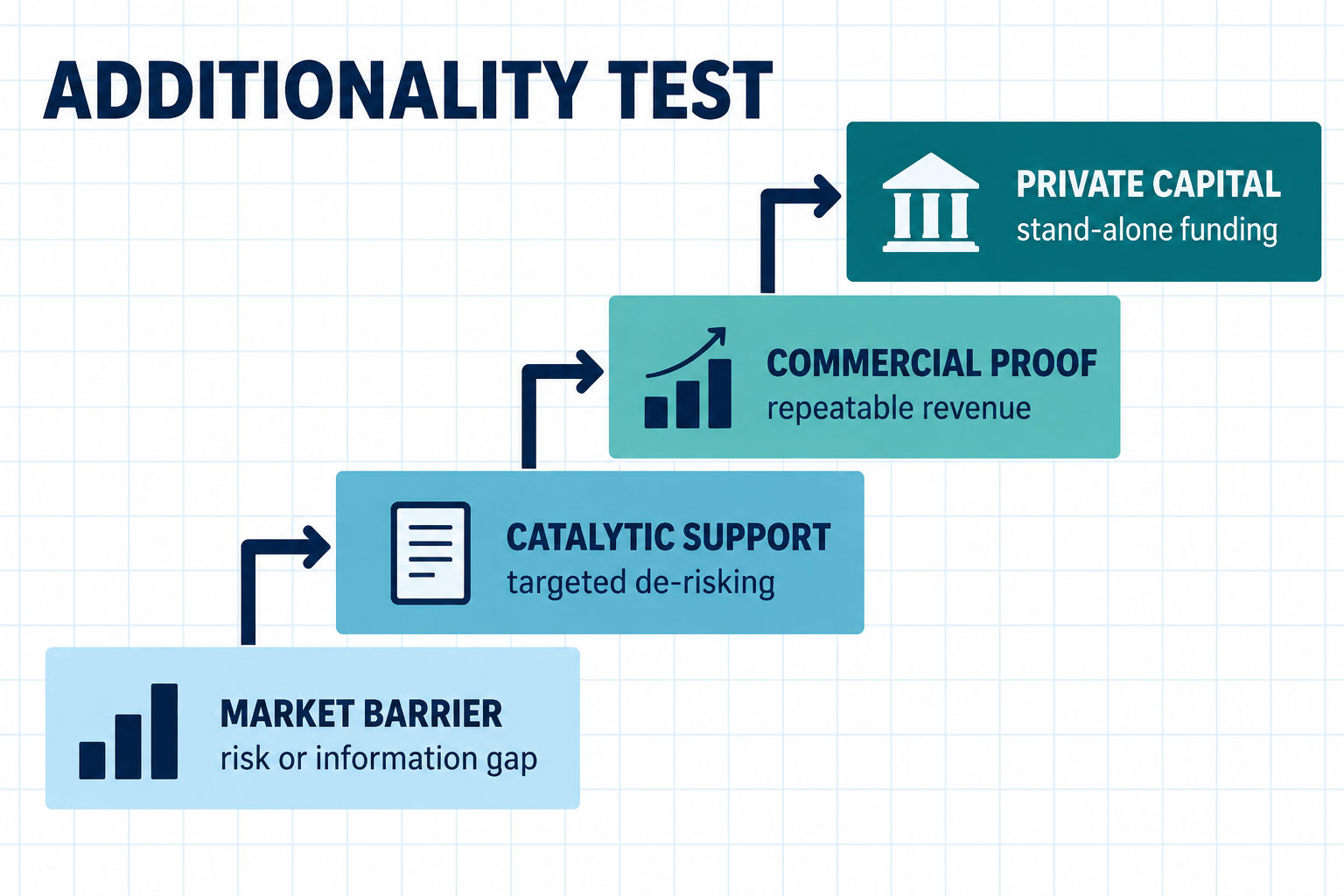
Look for evidence across the sales funnel. A paid pilot is stronger than an expression of interest. A repeat order is stronger than a single pilot. A portfolio of customers is stronger than one contract, unless the concentration is deliberate and properly priced.
The OECD’s 2026 private finance mobilisation report notes that water supply and sanitation received an average of about USD 1.3 billion of mobilised private finance a year between 2021 and 2024. It also points to structural limits where revenue models are weak. The figure is a sector statistic, not a forecast for any company or project.
That caution is central to blended finance impact investing. A catalytic layer can improve timing, risk allocation or affordability. It cannot create a customer budget where none exists.
Review unit economics at the point where the customer experiences value. For a reuse system, that may be the cost of freshwater avoided, discharge reduced or production downtime prevented. For a monitoring business, it may be recurring software or service revenue linked to installed sites. The metric should connect to a real budget owner.
Then test the downside. What happens if installation takes twice as long, energy costs rise, a customer delays payment or a project runs below design capacity? The blended structure should make those sensitivities clearer, not hide them behind an attractive headline return.
Diligence technology and execution
Investors do not need to become process engineers. They do need to understand what the technology does, where it sits in the customer’s operation and what can cause performance or margin to fall.
Ask what happens when the feedwater changes, the system is run below design capacity or a key component needs replacement. Ask how much commissioning support is required. Ask which parts are standard and which are bespoke. These answers affect working capital, gross margin, sales cycle and the ability to scale.
Operational evidence should be time-stamped and tied to a baseline. It should show the measured output, the measurement method and the boundary of the claim. A single favourable sample is not the same as a stable operating record.

Check the delivery model as well as the equipment. A business that sells a system but cannot support installation may struggle to convert a pipeline into cash. A service business with recurring monitoring revenue may have a different margin profile from an equipment seller. Both can be investable, but the diligence questions differ.
Scale should be tested in stages. First, can the system work at one customer site? Next, can it be deployed repeatedly with similar cost and time? Finally, can the company support a larger installed base without a matching increase in bespoke engineering effort?
Supplier concentration is part of this test. A company may depend on one membrane supplier, one specialist installer or one software integration. That dependency may be manageable, but it should appear in the risk register and the plan for service continuity.
Investors should also ask how performance is governed after commissioning. Clear service levels, maintenance obligations, spare-parts access and escalation rights can protect the revenue model. They can also reveal whether the company has built a repeatable operating capability or is relying on founder-led intervention.
Measure impact without lowering commercial standards
Water impact can include water reused, pollution avoided, treatment reliability, resource recovery or improved service access. Each claim needs a defined unit, baseline, boundary, measurement period and responsible data owner.
Investors should separate outputs from outcomes. A system installed is an output. A verified reduction in freshwater intake or discharge load is an outcome. An outcome claim should explain the counterfactual, or what would likely have happened without the investment.
Impact data also belongs in the operating model. If the company must collect data from several sites, who pays for the monitoring? If the result depends on customer behaviour, how is that behaviour observed? If a project reports several benefits, are they measured at the same boundary?
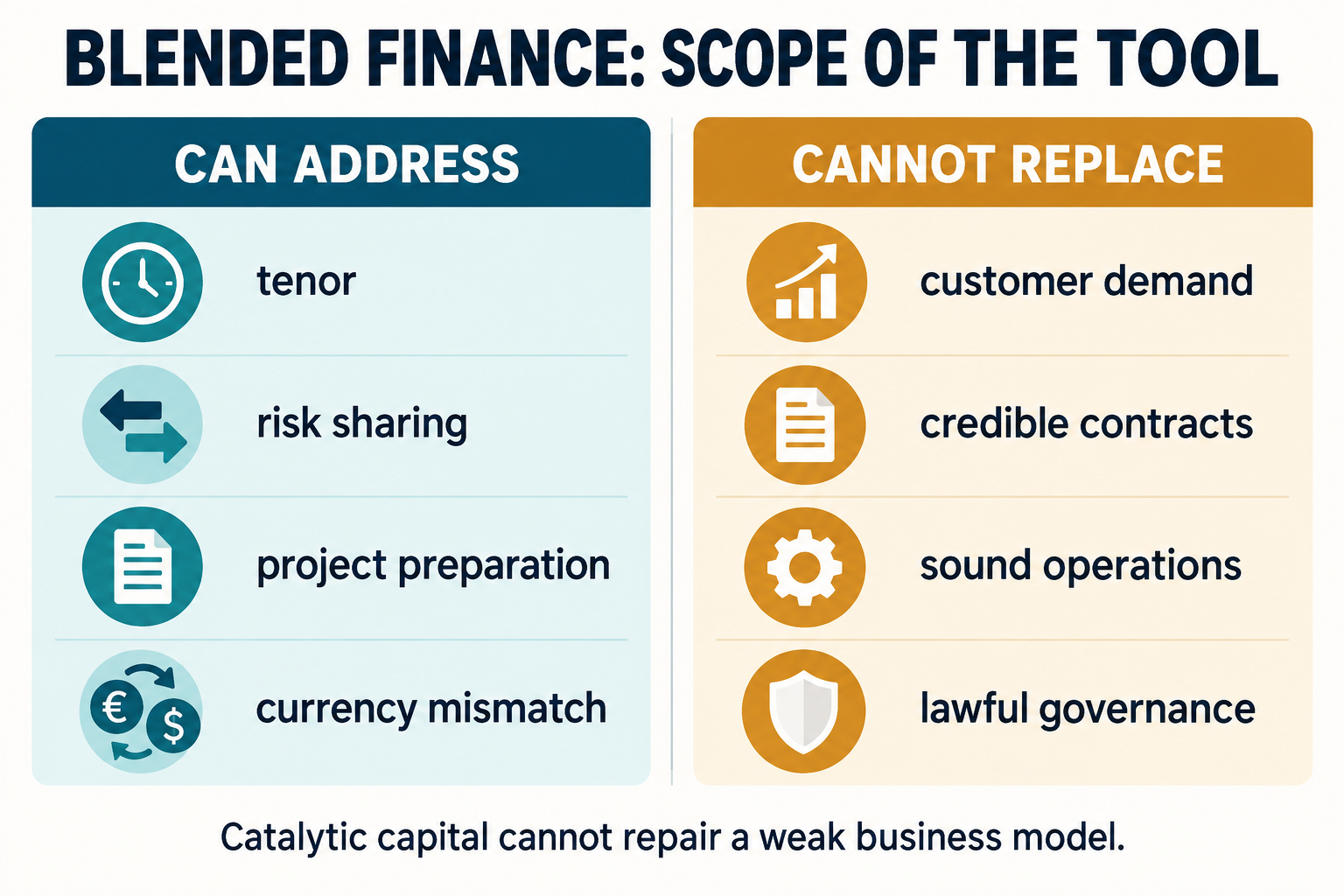
Do not treat a broad impact label as evidence of additionality. The question is whether the impact would be less likely, slower or smaller without the proposed capital structure. The answer should be supported by transaction evidence, not only by the project’s intention.
Additionality, governance and the exit path
Additionality asks what the blended capital changes. It can relate to the availability of finance, the terms, the timing, the investor group or the ability to enter a market. It should be specific enough to test after closing.
Minimum concessionality is the other side of the test. If a project can raise commercial finance on reasonable terms, a subsidy may not be needed. If support is required, the structure should explain why that amount and form are proportionate.
Governance must cover conflicts, reporting, procurement, related-party transactions, use of funds and changes to the capital stack. A project with several funders can have better resilience, but it can also have slower decisions and more complex consent rights.
Currency deserves its own line in the model. Water services are local, while debt, equipment and investor returns may be denominated in different currencies. Hedging costs, indexation, convertibility and repatriation rules can change the risk profile. These questions must be tested for the specific jurisdiction.
Finally, define the graduation or exit path. A blended facility may expect refinancing, a sale to a commercial lender, a strategic acquisition, a later equity round or cash distributions from an operating asset. If no later capital provider can be identified, the initial structure may be absorbing a permanent commercial gap.
For a family office, the exit path does not need to be short term. It does need to be intelligible. Patient capital can accept a longer route while still requiring a clear source of value and a credible governance framework.
Ask who owns the decision to graduate the project. It may be the board, a facility committee, a lead investor or a public partner. The documents should explain what evidence triggers a refinancing or a change in capital ranking. Without that clarity, the structure can become difficult to manage when performance diverges from plan.
A practical investor process
A disciplined review can move through six questions.
- Define the asset. Is this a company, project, fund vehicle or utility-linked contract?
- Name the customer. Who pays, who signs and what business problem is solved?
- Map the risk. Separate construction, technology, demand, counterparty, currency, policy and operating risk.
- Test the instrument. Does the guarantee, grant, debt or equity layer address the named barrier?
- Verify the outcome. Can commercial and impact results be measured from a defined baseline?
- Plan the next capital. What evidence would allow the project to refinance, scale or exit?
This process keeps the conversation grounded. It also helps an investment committee decide whether it is reviewing an impact opportunity, a project-finance opportunity, a growth company or a combination of these.
The final decision should record both the commercial case and the impact case. It should state the assumptions that matter most, the evidence still missing and the point at which the investment thesis would be reconsidered. That discipline is valuable even when the capital is patient and the impact goal is strong.
Water Investment Network connects eligible investors with selected direct opportunities in water technology and treatment. Review the portfolio context first, then consider whether the commercial model, risk allocation and impact evidence fit your mandate.
If the opportunity fits your remit, the next step is to join the Water Investment Network. This is an information and access step for eligible investors, not regulated financial advice or a promise of returns. For a general enquiry, use the WIN contact page.
Sources used
- OECD, Making Blended Finance Work for Water and Sanitation.
- International Finance Corporation, How Blended Finance Works.
- World Bank, Water Forward.
- World Bank Public-Private Partnership Resource Center, Blended Finance.
- OECD, Private Finance Mobilisation Report 2026.
Blended finance impact investing FAQs
What is blended finance impact investing?
It is an investment approach that combines concessional or development finance with commercial capital to support a measurable development or environmental outcome. The structure should address a defined market barrier and preserve a credible commercial case.
Does blended finance remove investment risk?
No. It changes who bears a defined risk and may improve the terms or timing of private capital. Investors still need to assess demand, contracts, operations, governance, currency and exit conditions.
Which water businesses may suit blended finance?
Potential candidates include water-reuse projects, treatment services, monitoring businesses and infrastructure with clear customers but a specific financing or market-entry barrier. Suitability depends on evidence, structure and jurisdiction.
What should investors ask about concessional capital?
Ask why it is needed, how much is necessary, what risk it addresses, whether it crowds in rather than replaces private capital and how the project can become commercially sustainable.
Can blended finance support a family-office investment strategy?
It can fit a patient private-market strategy when the mandate accepts the relevant risk, time horizon and reporting requirements. The family office should still review the structure independently and obtain its own professional advice where required.