
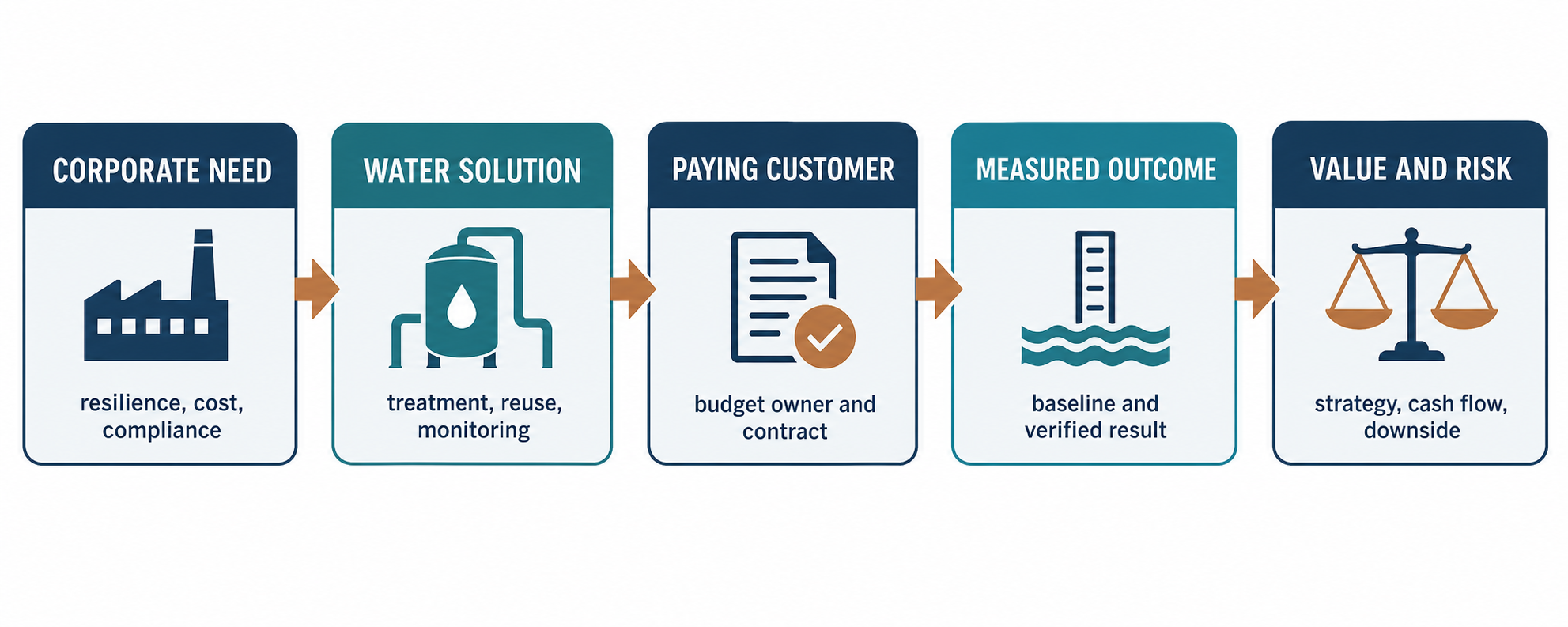
Corporate impact investing in water starts with a practical question: can a company use capital to solve a water problem while creating measurable strategic or financial value? The answer depends on the customer, the contract, the operating model and the evidence.
Water can affect production, public health, resource security and the resilience of whole supply chains. That makes it relevant to corporate investors, family offices, high-net-worth investors and private-equity teams. It does not make every water project a good investment.
The water impact investing landscape is broad. This guide narrows the question to corporate capital and private opportunities in water technology, treatment, reuse, monitoring and related services. It explains how to test strategic fit without confusing a sustainability budget with a commercially investable business.
Corporate impact investing and water
Corporate impact investing means that a company, corporate venture team or strategic investment arm allocates capital to an opportunity with an intended social or environmental outcome and a financial or strategic case. The capital may support a water-technology company, a project, a service platform or a wider infrastructure partnership.
The term needs a clear boundary. A company may invest in water because it needs reliable supply, lower treatment costs, better compliance or a more resilient supplier. It may also seek financial return, access to innovation or a route into a new market. Those motives can coexist, but the investment committee should record each one separately.
UNEP Finance Initiative provides impact-analysis tools for investors, banks and corporate clients. Its Corporate Impact Analysis Tool is designed to help users assess impact status and opportunities across investee companies. That is a useful starting point for corporate impact investing. A positive result that appears by accident is not the same as an outcome designed into the investment thesis.
For a private-market investor, the same distinction protects decision quality. A strategic rationale can support a valuation or a partnership, but it should not replace a review of revenue, margins, capital needs, governance, liquidity and downside risk.
Why water matters to corporate investors
Water is both an operating input and a public resource. A factory, data centre, food processor, mine or utility may depend on a reliable volume and quality of water. A failure can create lost production, extra treatment cost, regulatory exposure or a delay to expansion.
The World Bank’s Water for Shared Prosperity work links water security with jobs, productivity, livelihoods and economic growth. It also notes that water-intensive sectors support a large share of employment in lower-income countries. For an investor, this is a demand context rather than a forecast for a particular company.
The corporate opportunity often sits inside a defined operating problem. A buyer may need to reuse more water, remove a contaminant, monitor a process in real time, cut leakage or manage a site with less reliable supply. The solution must then show why the buyer will pay and how the provider will deliver it.
The UK has a clear planning example. The Environment Agency’s National Framework for Water Resources 2025 sets out pressure from population growth, climate change, environmental needs and demand from sectors such as energy and business. It describes long-term investment in supply options, demand management, reuse and monitoring.
That framework applies to England and Wales. It is not evidence that a particular company has a contract. It does show why corporate water resilience is moving closer to capital planning, procurement and operational risk management.
Separate impact investing from CSR, ESG and philanthropy
Corporate social responsibility, or CSR, covers a wide set of voluntary activities and commitments. Philanthropy gives money for a social or environmental purpose without requiring a financial return. ESG, meaning environmental, social and governance, is often used to assess risks and practices across an investment or company.
Corporate impact investing is narrower. The investment has an intended outcome, a financial or strategic rationale and a way to manage performance over time. A grant can sit beside an investment, but the grant and the investment should not be presented as the same instrument.
This distinction matters when a corporate investor reviews a water company. A community project may have strong social value but no repeatable revenue. A treatment technology may have a strong customer case but weak evidence of the claimed environmental outcome. Both need an honest classification.
Impact language should also be proportionate. It is safer to say that a solution is designed to reduce freshwater use than to claim that it secures water for a whole region. The measured boundary, customer behaviour and operating conditions determine what can be supported.
For family offices and private-equity investors, corporate participation can be useful evidence. A strategic buyer may understand a customer problem well. It may also have a conflict, a narrow time horizon or a reason to overstate the strategic value. Independent diligence remains necessary.
Investment thesis at a glance
A concise thesis helps an investment committee see whether the corporate case is real. It should show the link between the water problem, the buyer, the business model and the outcome. It should also show where evidence is still missing.
| Thesis element | Question to answer | Evidence to request |
|---|---|---|
| Strategic fit | Which operating, supply-chain or market problem matters to the corporate investor? | Risk register, procurement priorities, site plans and board-approved objectives |
| Paying customer | Who signs, who uses the service and who owns the budget? | Contracts, tender records, buyer interviews and renewal history |
| Revenue model | How does the water company turn delivery into collected cash? | Pricing, gross margin, billing terms, working capital and customer concentration |
| Impact intent | What outcome is intended, for whom and over what period? | Baseline, beneficiary or environmental boundary, metric and reporting owner |
| Scalability | What must be repeated across sites, customers or jurisdictions? | Installation time, service capacity, supply chain, maintenance and sales process |
| Governance | How will conflicts, data, procurement and underperformance be managed? | Reserved matters, reporting rights, escalation rules and independent review |
| Exit or continuation | What creates value for the next owner or the long-term holder? | Strategic buyer logic, later funding, cash generation and transferability |
The table is a decision map, not a scoring shortcut. If the corporate rationale is the only strong point, the opportunity may be a partnership or procurement pilot rather than an investable asset.
Choose the right corporate water opportunity
Corporate capital can enter the water value chain in several ways. The choice affects risk, control, cash flow and impact evidence.
- Direct company investment: an equity investment in a technology, monitoring or treatment business can provide exposure to growth and commercial adoption.
- Project investment: a corporate investor may fund a defined reuse, treatment or supply asset with a specific site and payment structure.
- Strategic partnership: a pilot, distribution arrangement or joint development agreement can test fit before a larger capital commitment.
- Fund or platform exposure: a family office or private-equity investor may gain diversification across water businesses rather than take one operating exposure.
These routes should not be blended into one generic water thesis. A company investment depends on product-market fit, sales execution and future financing. A project depends more heavily on construction, permits, counterparty strength and long-term operations.
Strategic value can be real when a corporate partner reduces sales friction, provides a test site or shares distribution capability. It can also create customer concentration or limit the company’s freedom to work with other buyers. The investment documents should state the value and the constraint.
Test customer demand and revenue quality
Customer demand is the centre of water investment diligence. Start with the person or organisation that pays. A sustainability department may support a project, but a plant manager, procurement team or finance function may control the budget.
Ask what failure costs the customer. It may be downtime, a discharge problem, a permit delay, higher freshwater purchases, energy use or a lost production slot. The answer should be specific enough to connect the solution to a budget line.
Review the sales evidence in order of strength. A customer interview shows interest. A signed pilot shows commitment. A paid pilot shows willingness to allocate budget. A repeat order or multi-site rollout provides stronger evidence of repeatability.
Revenue quality also depends on contract design. Review service levels, performance tests, acceptance criteria, payment milestones, indexation, termination rights and renewal history. If the company receives a fee for operating equipment, check who pays for maintenance and consumables.
Corporate impact investing can fail when a strategic pilot is mistaken for a scalable market. One corporate sponsor may have unusual procurement power or a special need. Test whether another buyer would pay a similar price without the same relationship.
Then connect revenue to unit economics. For a monitoring company, recurring software or service revenue may depend on installed sites and support cost. For a treatment provider, margin may depend on energy, chemicals, labour, replacement parts and commissioning time. For a project, cash flow may depend on uptime and the credit of one counterparty.

Use downside cases early. What happens if a deployment takes twice as long, the customer delays payment, energy prices rise or the site operates below design capacity? A credible model makes these sensitivities visible.
Diligence technology and delivery
Investors do not need to become water engineers. They do need a clear explanation of what the technology does, where it sits in the customer process and what can cause performance or margin to fall.
Define the input, the process and the output. For a treatment system, that may mean the quality and volume of the incoming water, the treatment steps and the quality or use of the water leaving the system. Avoid treating design capacity as achieved performance.
Ask which parts are standard and which are bespoke. Bespoke engineering may improve fit but increase sales time, working capital and commissioning risk. Standardised modules may support scale but still need site-specific integration.
Check the operating burden. Who monitors the system? Who handles alarms? How often are components replaced? Can the company support a larger installed base without adding the same number of specialists for every site?
Supplier concentration belongs in the risk register. A single membrane, sensor, software or specialist installer may be manageable, but the dependency should be priced and governed. Ask about alternatives, lead times and service continuity.
IFC describes water investment as requiring project preparation, financing, risk management, local-market knowledge and work with cities and utilities. Its water-sector material is a reminder that a technically sound product still needs the institutions, contracts and delivery partners around it.
Measure impact and additionality
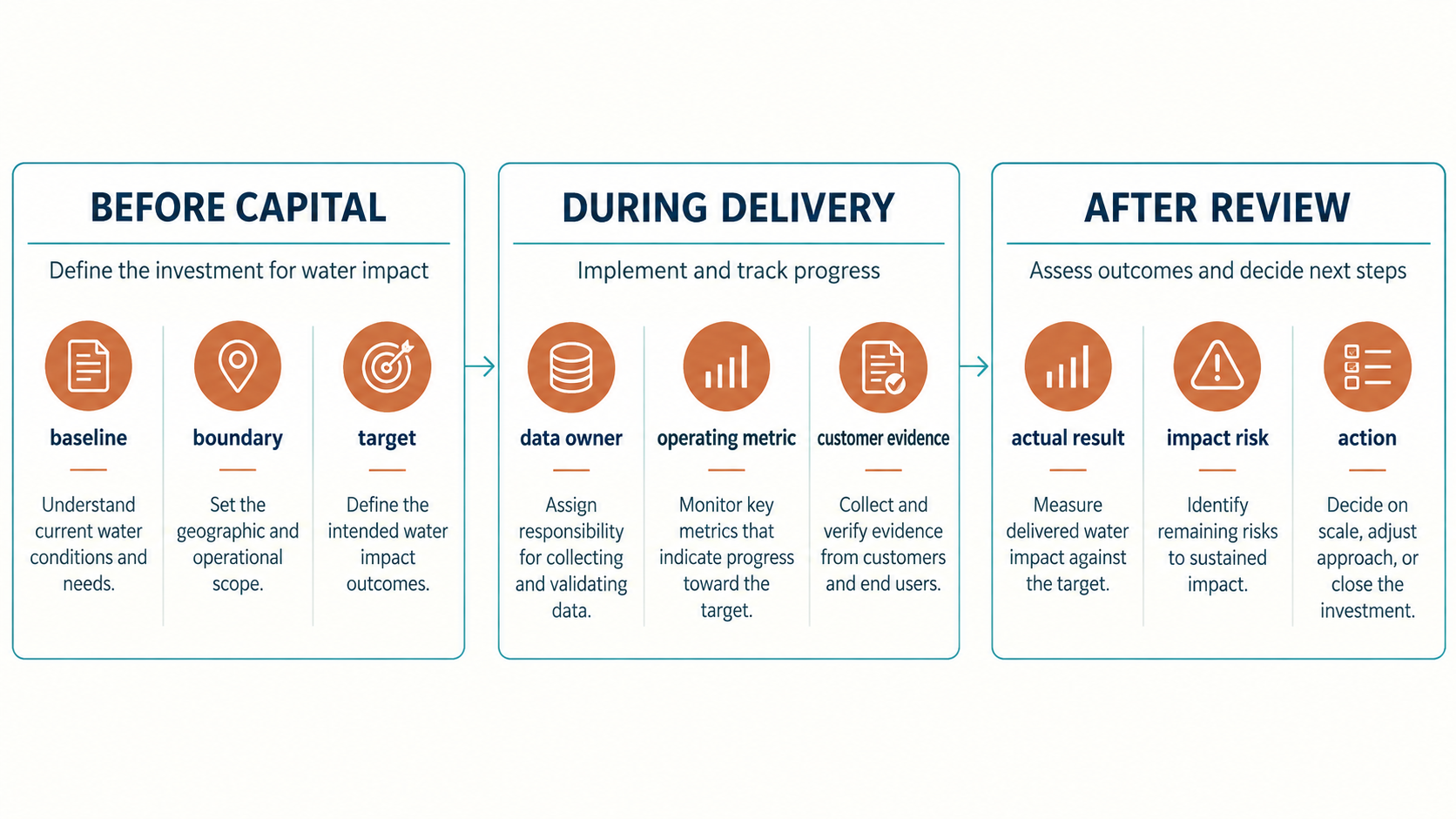
Impact measurement should start before the investment closes. Define the baseline, the boundary, the affected people or environment, the period and the person responsible for the data.
Separate outputs from outcomes. Equipment installed is an output. A verified reduction in freshwater intake, pollution load, leakage or service interruption is an outcome. The outcome depends on operation and should be measured at the site where the change occurs.
The Operating Principles for Impact Management state that investors should assess expected impact before committing capital. Their guidance asks investors to consider intended impact, who experiences it, significance, likelihood and the risks that may change the result. A corporate investor can use that logic to build a practical reporting plan without pretending that one metric captures the whole result.
Additionality asks what the investment changes. The investor may provide growth capital, a customer site, procurement access, operating expertise or a longer time horizon. The claim should be specific. If the project would happen in the same form without the investment, the contribution may be smaller than the headline suggests.
Do not count the same benefit twice. A reduction in water use and a reduction in water purchased may describe the same change. A company should explain the measurement boundary and any material trade-off, such as higher energy use or a residuals problem.
Good impact data also improves commercial decisions. It can show whether a product supports renewal, lowers downtime, reduces treatment cost or helps the customer meet a requirement. It can also show when an attractive impact claim is not translating into adoption.
Governance, regulation and regional context
Water is regulated locally, even when the investment thesis is international. The relevant rules may cover abstraction, discharge, water quality, public health, construction, land use, data, procurement or utility operations.
Do not treat UK, European and GCC markets as one legal market. A corporate investor should identify the exact jurisdiction, regulator, permit route, customer and currency. The same technology can face different approval times, tariff structures and payment risks.
In England and Wales, the National Framework for Water Resources 2025 describes the need for resilient supplies, environmental protection, demand reduction, reuse and long-term infrastructure investment. That is useful context for demand. It does not remove the need to verify a project’s approvals or customer commitments.
Governance should cover conflicts between a corporate investor and the target company. Review related-party transactions, exclusivity, data ownership, procurement rights, board seats, reserved matters and the treatment of underperformance.
Corporate investors should also decide who owns the impact data. A target may collect data from the customer’s site, while the customer controls access and the corporate investor needs reporting rights. The investment agreement should set out data quality, privacy, verification and escalation.
Currency and funding risk need the same care. Water revenue is often local. Equipment, debt and investor capital may be priced in different currencies. Hedging, indexation, convertibility and repatriation rules can change the downside case for a specific country.
Build a portfolio and exit view
A single corporate investment can be strategically useful but still carry concentration risk. Review customer, geography, technology, supplier, currency and regulatory concentration across the wider portfolio.
Portfolio construction can also improve learning. Several investments may share customer types or measurement methods. That can help an investor compare sales cycles, deployment cost and impact data. It can also reveal correlated risks, such as one regulatory change affecting several assets.
Exit does not always mean a short-term sale. A corporate investor may hold for strategic access, recurring cash flow or long-term resilience. The committee should still understand who could own the asset later and what evidence would support that transfer.
Potential routes may include a strategic acquisition, a later private-equity round, refinancing, a management-led continuation or distributions from an operating project. These are possibilities, not promises. A credible view names the value driver and the conditions required for it.
Corporate impact investing can create tension between strategic control and financial optionality. Exclusivity may help a pilot but reduce the target’s addressable market. A board seat may improve oversight but create conflicts. Longer holding periods may suit water assets but require patient governance and reliable reporting.
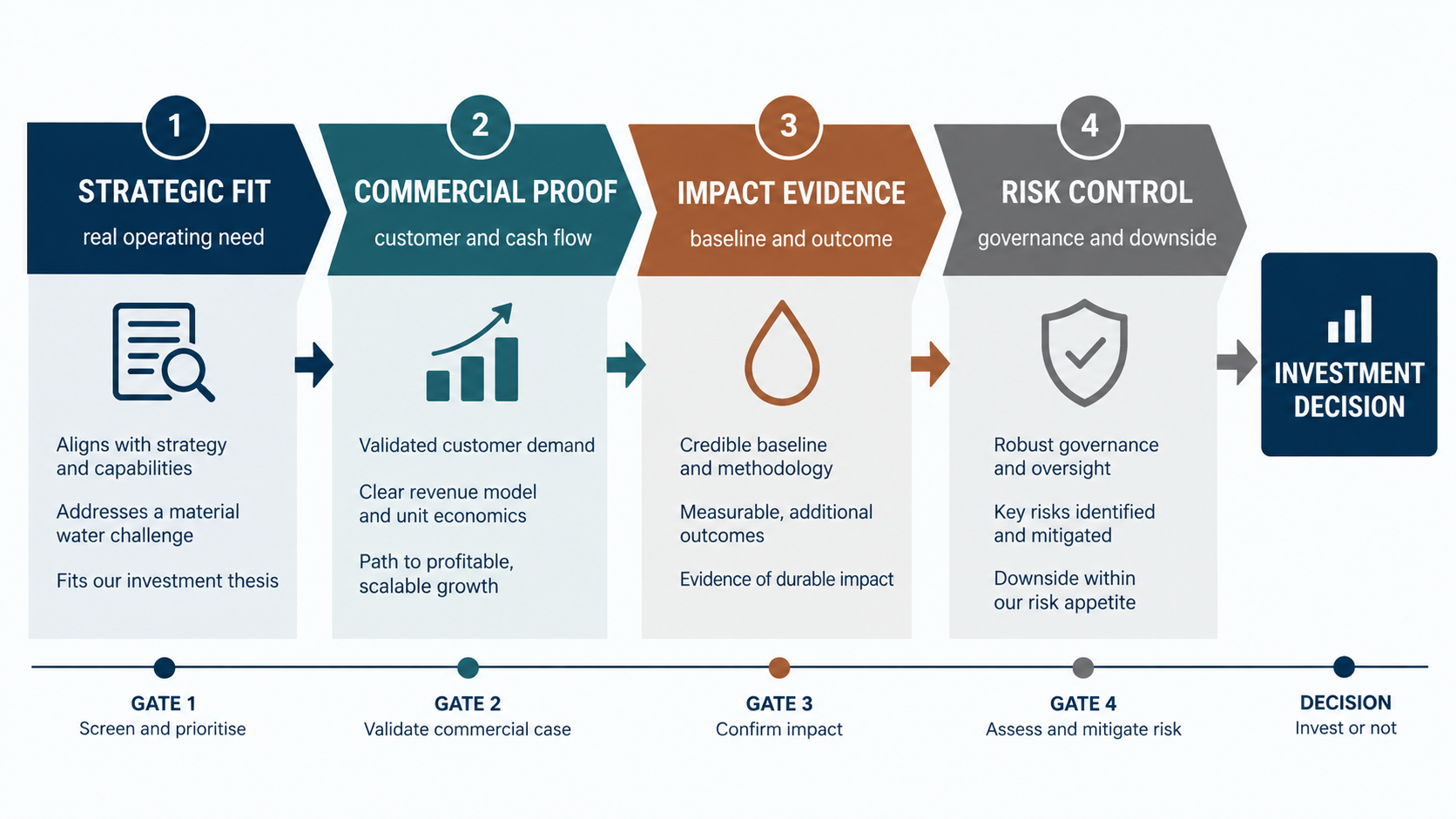
Review the portfolio context to see how a water opportunity should sit alongside the wider direct-investment case. The question is not whether water sounds strategic. It is whether the asset can deliver customer value, measurable outcomes and a risk profile that fits the mandate.
A practical corporate impact investment process
A disciplined review can move through seven questions:
- Define the problem. What water risk, cost or opportunity is the investment addressing?
- Name the buyer. Who pays, who signs, who uses the service and who bears failure risk?
- Choose the route. Is this a company investment, project, partnership, fund position or pilot?
- Test the economics. Review price, gross margin, working capital, capital needs and downside cases.
- Verify delivery. Check technology limits, commissioning, maintenance, suppliers, data and deployment capacity.
- Measure the outcome. Set a baseline, boundary, metric, owner and review point before closing.
- Set governance and exit. Agree reporting, conflicts, underperformance actions and the conditions for scale or exit.
This process helps an investment committee decide what it is actually approving. It may be a strategic procurement pilot, a growth investment in a water company, a project-finance position or a broader impact mandate. Each route needs different evidence.
Water Investment Network is an invitation-only network connecting eligible investors with selected direct opportunities in water technology and treatment. Join the Water Investment Network if this type of opportunity fits your investment remit.
This is an information and access step. It is not regulated financial advice and it does not guarantee returns. Investors and advisers must complete their own legal, financial, technical, commercial, regulatory and impact diligence.
For a general enquiry, use the WIN contact page.
Sources used
- UNEP Finance Initiative, Tools for Holistic Impact Analysis.
- Operating Principles for Impact Management, Principle 4: Ex-Ante Impact Assessment.
- International Finance Corporation, Water.
- International Finance Corporation, Towards Water Sustainability and Beyond.
- World Bank, Water for Shared Prosperity.
- Environment Agency, National Framework for Water Resources 2025.
Corporate impact investing in water FAQs
What is corporate impact investing?
Corporate impact investing directs company or strategic investment capital towards an intended social or environmental outcome alongside a financial or strategic case. In water, the thesis should connect the outcome to a real customer, operating model, evidence plan and risk assessment.
How is it different from corporate social responsibility?
Corporate social responsibility covers a broad set of commitments and activities. Corporate impact investing is an investment decision with defined capital, an intended outcome, a financial or strategic rationale and a plan to manage performance.
What should a corporate investor check first?
Start with the water problem and the paying customer. Then check the revenue model, contract, technology limits, operating evidence, impact baseline, governance and downside case before relying on the strategic rationale.
Can a water investment have strategic and financial value?
It can. A corporate investor may gain operating resilience, procurement access, innovation or market knowledge while the target creates revenue and cash flow. Each benefit should be described separately and supported by evidence.
Does Water Investment Network provide investment advice?
No. Water Investment Network is an invitation-only network and does not provide regulated financial advice or guarantee returns. Eligible investors and advisers must complete their own independent diligence.