Family office investing in water is not simply a choice between an impact theme and a financial return. It is a company-level decision about how an essential service becomes a defensible commercial opportunity. The investable question is whether a water business can solve a paid customer problem, produce reliable evidence and grow without taking on more risk than the family office intends.
Water companies can sit across treatment, reuse, monitoring, leakage reduction, industrial process water and related services. Their markets are shaped by physical assets, long approval cycles, regulation and local operating conditions. Those features can create durable demand, but they can also make revenue slow, capital intensive and difficult to compare with a conventional software or consumer investment.
This guide explains how a family office can assess direct water-technology and water-service opportunities. It covers the investment thesis, commercial proof, technical diligence, impact measurement, governance, regional context, liquidity and the questions that should remain open before a decision.
What family office investing means in water
A family office is not one type of investor. Some offices manage a diversified portfolio for one family. Others combine investment staff, operating businesses, charitable activity and a long-term succession plan. A single family office investment may be made directly, through a fund, alongside a specialist manager or through a strategic relationship with an operating company.
That flexibility is useful in water because the opportunity set is broad. A family office may review a technology company selling monitoring hardware, a treatment provider with recurring service revenue, a manufacturer of equipment modules or a business that helps industrial customers reuse water. These models have different customers, margins, capital needs and failure modes.
The starting point should be the role of the investment in the family portfolio. Is the objective long-term growth, a measurable water outcome, access to a private-company theme, strategic learning, a future operating relationship or a combination of these? The answer affects the acceptable holding period, level of control, reporting requirement and liquidity expectation.
Water importance alone is not a thesis. The thesis must explain who pays, what changes for that customer, how the business captures value and why the result can be repeated. A company may be solving a serious problem but still have weak pricing power, high installation cost or a sales process that depends on one public tender.
The wider family-office market context is relevant but not a substitute for underwriting. UBS surveyed 317 single family offices for its 2025 report. It reported that private markets represented 21% of average allocations in 2024, including direct private equity and funds, while many family offices still expect private-market exposure to grow over a five-year horizon. That tells an investor that the asset class remains part of the conversation. It does not show that a particular water company deserves capital. [1]
A useful internal brief therefore states the portfolio role in one sentence. For example, the investment may provide exposure to a direct water-technology company with commercial traction and measurable operational outcomes, while accepting private-company illiquidity and technical diligence risk. A clear sentence makes it easier to challenge the deal when the evidence does not fit.
The Impact Investing in Water guide provides a broader view of the parent theme. This article narrows that view to the family office process. The objective is not to make water sound safer than it is. It is to make the risks and evidence easier to see.
Why water can fit a long-term private portfolio
Water can fit a long-term portfolio because customers need reliable supply, treatment and compliance over more than one budget cycle. A good business may benefit from replacement demand, service requirements and a growing need to use existing water more efficiently. Those features can support repeat revenue, but only where the company has a practical route to customer adoption.
The financing gap is real. The Joint MDB Water Security Financing Report says ten multilateral development banks approved USD 19.6 billion of water-related financing in 2024, including USD 14.4 billion for low- and middle-income countries. The report also describes significant financing gaps and the need for reform, financial sustainability and instruments that can crowd in private capital. [2]
This is useful context for family office investment management. It suggests that water will require more than public budgets alone. It does not mean that every private company in the sector will capture that funding. The route from a financing need to company revenue still depends on procurement, customer credit, project structure, regulation and execution.
Water is also connected to other operating risks. A manufacturer may need dependable process water. A data centre may need cooling and resilience. A food producer may need reliable quality and discharge control. A property owner may need lower losses or a new reuse source. The buyer may pay for continuity, compliance, lower operating cost or capacity, rather than for an environmental label.
The investment case is stronger when the business can show which budget pays for the solution. A water manager may approve the technical specification, but the economic decision may sit with operations, finance, procurement or a site owner. The sales process should explain how these interests align and where approval can slow.
Long-term demand does not remove short-term risk. A business can wait twelve months for a contract, fund equipment before acceptance and then face a disputed invoice. Family offices should value the resilience of the cash cycle, not only the size of the market.
Water also requires patience with evidence. An early deployment may show a credible route to a wider market, but the next customer can have different water chemistry, operating rules or procurement constraints. The investment committee should treat each expansion step as a new evidence question, not as an automatic continuation of the first success.
The strongest portfolio fit is therefore specific. It combines a long-term water need with a company that has a defined customer, repeatable delivery and transparent limits. A large theme can open the review. It should not close it.
Separate a water theme from an investable company
Many water opportunities begin with a persuasive theme. Water scarcity, industrial pollution, leakage and reuse are easy to understand as important problems. The work for an investor is to identify whether the company solves one part of that problem well enough for a customer to buy it.
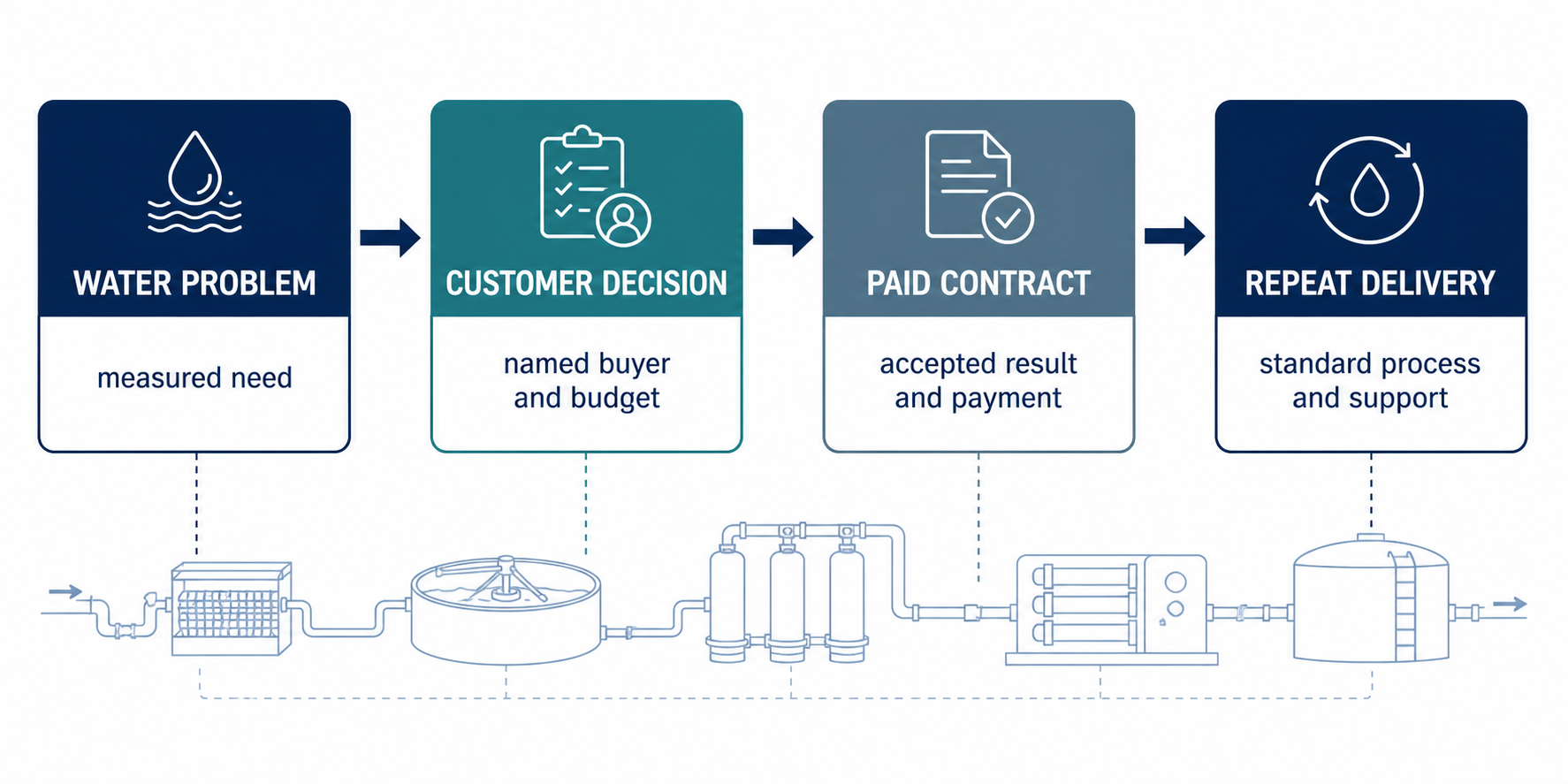
Start with the customer event. What made the customer search for a solution? Was there a production constraint, a consent requirement, a new site, a supply interruption, a cost problem or a measured loss? A general statement about sustainability is weaker than an event linked to a budget and a decision owner.
Then define the product boundary. Is the company selling equipment, a service, a licence, a monitoring subscription, a performance contract or a combination? The boundary determines who carries installation risk, who owns the equipment, who pays for maintenance and how revenue is recognised.
The European Commission describes water resilience as a priority linked to security, economic competitiveness and innovation. Its strategy calls for public and private investment, digital solutions, water efficiency and research. It also reports that Europe holds 40% of global water-technology patents and that its water industry generates EUR 107 billion and supports 1.7 million jobs. [3]
These figures explain why family offices may find the sector relevant. They do not prove that a company owns useful intellectual property, has a defensible position or can earn attractive margins. Ask for the actual patent, data, integration knowledge, service record or customer access that supports the company claim.
A short investability test can use five questions:
- Is the customer problem measurable before the company is hired?
- Does a named buyer have authority and budget to act?
- Can the customer accept the result using a defined test?
- Can the company deliver again without rebuilding the whole solution?
- Does the price leave enough margin after delivery and support?
The answers need evidence from contracts, invoices, site records, cost data and customer references. A presentation can describe a market. A customer file can show whether the market has become revenue.
Investors should also challenge the word “recurring”. A service renewal, replacement part, consumable or monitoring fee may recur. A project that has a second phase only because the first phase was incomplete is different. Classify each revenue stream by customer reason, renewal control and direct cost.
Finally, test what happens if one assumption is removed. If a single grant, customer, distributor, licence, regulation or founder relationship carries the thesis, the risk is concentrated. Concentration may be manageable. It must be priced, reported and reduced where possible.
Read the revenue model before the impact story
Impact can help a water business win attention, but revenue quality determines whether it can fund itself. A family office should understand the contract before it celebrates the metric. The review should cover price, term, payment milestones, installation scope, service obligations, warranty, renewal and any performance deductions.
Water businesses can earn revenue in several ways. Equipment sales may create a large initial order. Service contracts may create a steadier relationship. Consumables and replacement parts may add repeat sales. A treatment-as-a-service model may align payment with volume or performance, but it can also place more operating and working-capital risk on the supplier.
Each model needs its own unit of analysis. The unit might be one treatment module, one monitored site, one service contract, one cubic metre treated, one installed capacity unit or one customer location. The company should state revenue, direct cost, field labour, energy, replacement cycle and cash timing for that unit.
Gross margin should be tested after a job is delivered. Compare the quoted margin with actual freight, subcontracting, engineering changes, commissioning, consumables, support and warranty cost. If a business claims scale, the data should show which costs fall, stay stable or rise with each additional installation.
Payment terms can matter more than the headline contract value. A supplier may fund design, inventory and mobilisation for months before a customer accepts the result. Review deposits, milestone invoices, retention, disputes, credit notes and receivables ageing. A fast order book can weaken the balance sheet if collections lag delivery.
Customer concentration deserves a separate view. One large customer can prove that the product solves a real problem. It can also negotiate price, delay payment or stop buying. A distributor can lower customer-acquisition cost while reducing control over the relationship. Neither model is automatically better. The investor needs the actual economics and dependency.
The [4]IFC notes that private investment in water remains relatively low because of issues such as non-cost-reflective tariffs, difficult-to-collateralise assets, limited long-term local-currency finance and weak policies or institutions. These are not reasons to reject the sector. They are reminders that commercial structure, credit quality and regulation affect the path from need to revenue.
Forecasts should separate standard product, custom engineering, installation, service and other income. A single blended margin can hide a shift towards lower-quality project revenue. Model delayed acceptance, lower utilisation, one lost customer and a higher warranty rate. The result will often tell the investment committee more than a top-down market estimate.
The final question is simple. Does the company capture a fair share of the value it creates? If the customer saves cost or avoids a loss but the supplier cannot price for that result, the impact may be real while the investment case remains weak.
Diligence the technology and the operating boundary
Technical diligence should answer a commercial question: where does the system work, how consistently does it work and what does it cost to keep working? A test result without its water chemistry, flow, temperature, operating hours and maintenance conditions has limited value.
Water technology often changes performance when conditions change. Fouling, scaling, sensor drift, flow variation, pressure, contaminants and operator practice can all affect an installation. The company should explain its operating range and the evidence outside the best-case point.
Ask how the customer accepts the outcome. Is there a measured baseline? Is the test performed by the company, the customer or an independent party? What happens if the threshold is missed? Is payment held back? Does the supplier have to add equipment or service at its own cost? These questions connect proof to contract risk.
A pilot is useful but incomplete. It may demonstrate performance under close supervision and a carefully selected feedwater. It may not show installation time, site integration, operator training, spare parts or the economics of a second and third deployment. Request the full pilot protocol, data set, limitations, customer sign-off and invoice.
The World Bank’s water-reuse analysis says the business case is strongest when wastewater is close to the point of use, such as urban centres and industrial parks. It also highlights programmatic approaches, pricing signals, regulation and bankable delivery models as conditions for scale. [5] This helps frame a diligence conversation, but it does not validate an individual supplier.
Commercial repeatability can be measured in recent jobs. Compare design hours, installation time, change orders, commissioning duration, service visits, warranty cases and delivered gross margin. If every site is a new engineering project, the company may need a project-risk valuation even when the product is technically strong.
Defensibility should be concrete. It may come from application data, a qualified supply chain, a trusted service network, software that improves operating decisions, integration knowledge or intellectual property. A patent can support a claim, but it does not guarantee adoption, margin or protection from substitution.
Data also needs diligence. Who owns the operating data? Can the customer export it? How is it checked? What happens when the connection fails? If the business relies on a dashboard, review the installed base and service records rather than assuming that software creates recurring revenue.
Failures deserve as much attention as success. Review blocked membranes, broken pumps, inaccurate sensors, delayed parts, customer complaints and missed service-level commitments. A company that reports failure clearly may be easier to govern than one that only presents successful case studies.
Connect impact measurement to customer economics
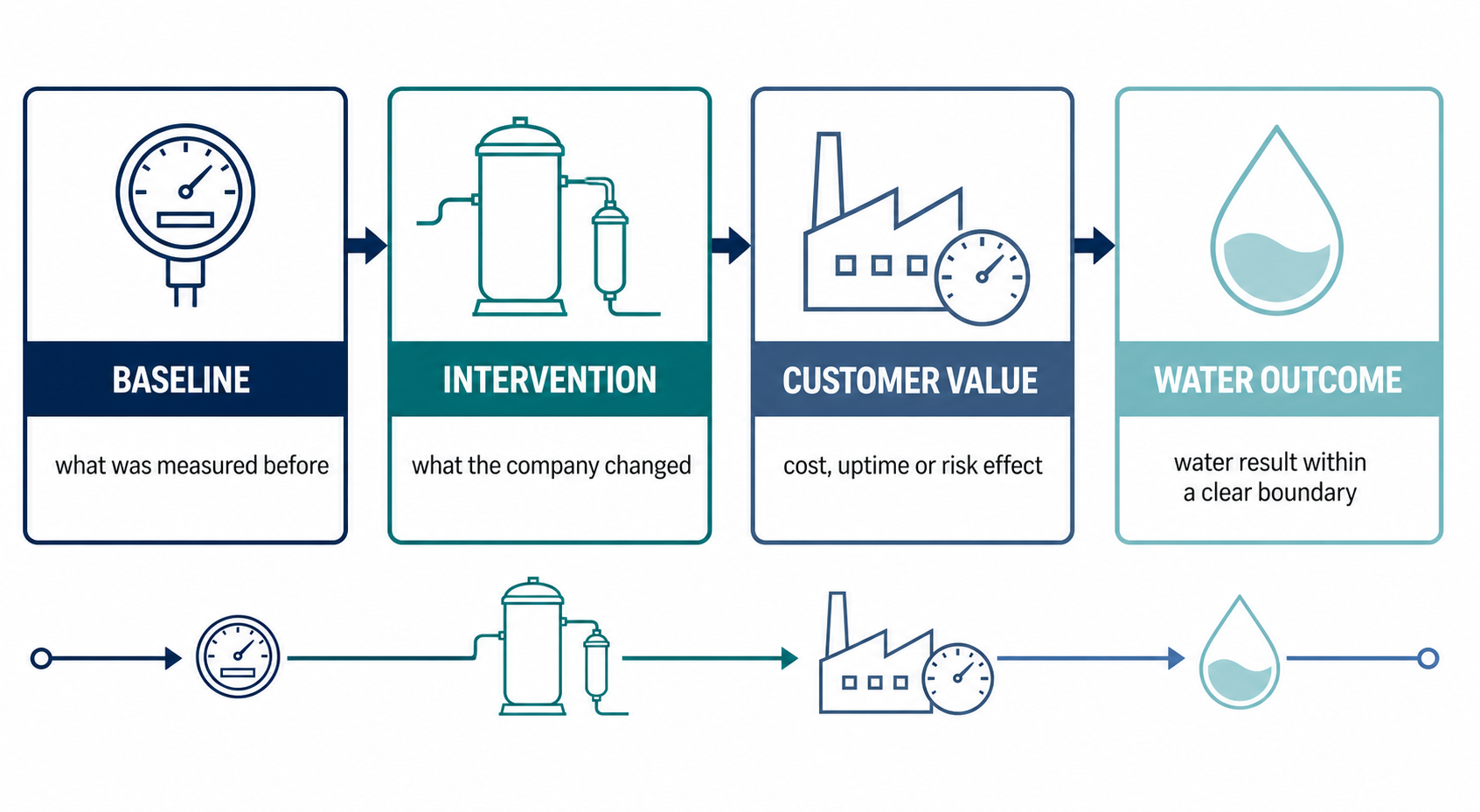
A credible impact case begins with a baseline. It should state what the customer was doing before the intervention, what changed, how the change is measured and which boundary applies. This might involve lower abstraction, reduced discharge, better water quality, lower losses, more reuse or improved reliability.
The metric should matter to the customer as well as to the investor. A reduction in freshwater use may protect production. Better treatment may reduce a discharge risk. Monitoring may find a leak before it becomes a costly failure. A water outcome becomes commercially useful when the buyer can recognise the value in a budget, operating decision or risk process.
The impact claim should be kept separate from a return forecast. The company may create a useful water outcome without achieving the projected margin. An investment may produce a financial result while the impact evidence remains weak. Keeping the ledgers separate improves honesty and makes the investment committee less likely to accept one as proof of the other.
Measurement needs a repeatable method. Define the data source, period, calculation, exclusions and responsibility for checking. If the number is estimated, label it as an estimate. If the outcome depends on customer behaviour, state that dependency. If the comparison is against a scenario rather than a measured baseline, explain the scenario.
The family office can choose an impact framework that fits its portfolio and governance. It does not need to force every company into the same metric. It does need consistent questions about materiality, evidence, unintended effects and reporting frequency.
Water claims can also have regulatory and reputational consequences. Avoid statements that imply a company has solved a basin-level problem when it has improved one site. Avoid turning a policy ambition into a company certification. A narrow claim supported by data is more valuable than a broad claim that cannot be checked.
The World Bank reports that water reuse could expand with targeted investment and enabling regulation, and identifies clear pricing, programme approaches and bankable delivery models as important conditions. [5] For an investor, the implication is practical. Impact measurement should sit alongside the policy and price conditions that make the service adoptable.
Review negative effects too. Treatment can require energy, chemicals, maintenance and disposal. Digital monitoring can create cybersecurity and data obligations. A new process can shift risk to another part of the site. The investment committee should ask what the company measures, what it does not measure and who pays when the boundary is exceeded.
Good impact reporting supports customer retention, diligence and future financing. It should not be treated as a substitute for an audited margin, a signed contract or a clear cash forecast.
Use a UK, European and GCC lens without making assumptions
Water demand is local, so regional context matters. A UK company may sell into industrial compliance, leakage reduction, resilience or treatment performance. A European buyer may respond to water efficiency, pollution controls, reuse policy and industrial competitiveness. A GCC buyer may prioritise supply reliability, reuse, desalination integration, operating performance and resilience in a water-stressed environment.
These are research starting points, not facts about every customer. A company should identify the exact jurisdiction, buyer, approval path and commercial reason for adoption. A regional label cannot replace evidence from contracts and operating sites.
The European Commission’s water resilience strategy calls for water efficiency, modernised infrastructure, public and private funding, digital solutions, research and innovation. [3] A family office can use this to map potential demand drivers. It should then test whether the company is eligible for the relevant market, can meet local standards and can support customers after installation.
Regulation can support a business and slow it down. A new standard may create demand for monitoring or treatment. It may also increase certification cost, change the product specification or delay a sale. Review the actual rule, the implementation timetable and the customer obligation. Do not assume that a policy announcement creates near-term orders.
Currency and financing also matter. A company selling across the UK, Europe and the GCC may quote in several currencies while purchasing components in another. A long contract can expose it to exchange-rate movements, freight changes or local working-capital cost. The investment model should show who carries that risk.
Public-private delivery can be important in water. The customer may be a utility, industrial group, developer, operator or public authority. Each has different procurement, credit and acceptance rules. IFC describes the need for private-sector expertise and capital while also highlighting the policy and institutional barriers that can keep private investment low. [4]
Family offices with a GCC connection should be especially careful not to treat regional relevance as a sales pipeline. Ask for local partners, completed references, service coverage, approvals and payment history. A technology can be valuable in a water-stressed market while still failing to gain a contract there.
The same discipline applies in the UK and Europe. A company may have a strong home market but need new certification, a different distributor or a larger service team before entering another jurisdiction. Geographic expansion should be staged against evidence, not added as a simple percentage in a forecast.
A regional lens is most useful when it improves the questions. It should not be used to create a story that the company cannot support.
Make governance and portfolio fit part of the thesis
Family offices often have a longer view than a conventional growth fund, but patience is not the same as an open-ended commitment. Governance should define what information the investor receives, which decisions require approval and how the company will respond when milestones move.
A monthly reporting pack can include order intake, qualified pipeline, backlog quality, delivered margin, cash collection, inventory, warranty cases, customer concentration, supplier exposure and selected water outcomes. The exact measures should match the business. A monitoring company needs service availability and data quality. An equipment manufacturer needs production yield, lead time and installation performance.
Board rights, information rights, reserved matters and follow-on decisions should be understood before completion. A minority investor may not control the company, but it should know how significant borrowing, related-party transactions, acquisitions, new markets and major contract risks are approved.
Family office investment management also needs a clear boundary between portfolio support and operating control. A family may have useful contacts or industrial knowledge. Those connections should not be treated as guaranteed customers. If the company depends on an introduction, the investment committee should identify the conversion risk and the appropriate valuation.
Key-person risk is common in technical businesses. A founder may hold product knowledge, customer trust and supplier relationships. Review how that knowledge is documented, who can make technical decisions and whether the company can hire or train successors. Succession is part of value protection, not a separate family-office issue.
Portfolio fit includes liquidity, concentration and time. A direct water company may require a long holding period and follow-on capital. It may not suit a family vehicle that needs distributions, a near-term exit or low management involvement. A genuine opportunity can still be unsuitable for the portfolio.
Independent valuation work should test the company against its revenue quality, margins, capital needs and comparable transactions where usable. Avoid valuing a water company only by applying a high multiple to a large market. A valuation can recognise the potential of a defensible business while discounting execution and liquidity risk.
Governance should protect the impact thesis too. Agree what outcomes will be tracked, who signs off the method and what happens when a target is missed. A board that only reviews revenue can overlook a material environmental or customer issue. A board that only reviews impact can miss a cash problem.
The goal is not to make the company bureaucratic. It is to create enough information for the next decision. Strong governance lets a family office stay patient without becoming passive.
Stage capital and plan for private-market risk
A staged investment can connect capital to evidence. The first tranche may fund a defined production improvement, a limited number of deployments, a certification process or a service capability. Later capital can depend on paid orders, acceptance, delivered margin, collection and repeat use.
Milestones should describe outcomes rather than activity. Hiring a sales manager is an action. A defined target segment producing qualified opportunities and paid orders is stronger evidence. Building a new facility is an action. Capacity delivered at the expected quality, cost and utilisation is the relevant result.
Cash planning should include the delay between purchase order, delivery and collection. Test a late customer decision, a component shortage, a higher warranty cost and a slower renewal. The company may need more cash even when the long-term customer case remains sound.
Capital structure affects the operating plan. Equity can support uncertain expansion but dilutes ownership. Debt can preserve ownership but requires repayment. Customer deposits, equipment finance or supplier terms may help, but each can add conditions or concentration. The family office should understand how the funding package behaves under a downside case.
Private-market risk also includes information gaps. A family office may receive quarterly reports rather than daily market prices. Valuation can remain uncertain between transactions. A sale may depend on company performance, buyer appetite, financing conditions and a workable transfer process. These are not reasons to avoid the asset class. They are reasons to set the holding period and liquidity expectation before investing.
UBS reports that family offices have continued to review private-market exposure while weighing low exits, acquisition activity and financing costs. It also reports that many expect private markets to grow over a five-year period. [1] The message for a water investor is balanced. Long-term demand for private companies can be compatible with a family-office horizon, but the entry decision still needs a credible path to value creation and eventual liquidity.
Exit routes should be discussed without promising one. A strategic buyer may value customer relationships or technology. A larger water platform may value service revenue. Another private investor may provide a later round. A management buyout or trade sale may be possible. Each route depends on the quality of records, contracts, margins, governance and market conditions.
Follow-on capital should also have rules. A family office should not feel obliged to support every round because it made the first investment. New capital should be assessed against the updated company evidence and the portfolio’s current needs.
Staging is therefore a decision tool. It does not remove risk or guarantee returns. It can limit the amount of capital exposed before the company proves the next part of its operating model.
Risks and a practical decision framework for family offices
Water can be a long-term opportunity and a difficult private investment. The main risks may include long procurement, customer concentration, project overruns, technical failure, warranty claims, supplier dependence, regulatory change, working-capital pressure, currency exposure, further funding and illiquidity.
Technical risk remains after a product has paying customers. The installed base may not represent the full range of water conditions. A component may fail at a higher duty cycle. A maintenance process may depend on one specialist. Ask which limits are known, which are being tested and how the contract allocates the cost of failure.
Commercial risk can hide behind a large pipeline. Review the definition of each stage, the historic conversion rate, budget status, sales-cycle length and share of opportunities dependent on one tender or partner. A forecast should not treat every possible project as revenue.
Financial risk often appears between delivery and cash collection. Model delayed acceptance, disputed invoices, higher inventory, a lost customer and a slower service renewal. Review whether the company has enough liquidity for the downside without assuming the next funding round arrives on time.
Policy and regulatory risk need precise handling. A government strategy can support a direction of travel, but it can change in scope, timing or enforcement. A company should win on customer value and execution, not on an unconfirmed incentive. The European Commission strategy itself combines regulation, investment, digitalisation, research and preparedness, which shows why several conditions can influence adoption. [3]
Impact risk includes weak baselines, double counting, narrow system boundaries and unintended effects. A credible claim should state what is measured and what is outside the claim. Investors should be wary of a report that uses a global water statistic to imply a company-level result.
People and governance create another layer. The loss of a founder, engineer, distributor or customer champion may slow growth. A family office should review succession, documentation, approvals and related-party arrangements before relying on a relationship.
Liquidity risk should be explicit in the approval paper. The company may grow while the investor still has no easy exit. The correct response may be a smaller position, staged capital, stronger information rights, a different security or a decision not to proceed.
Every material risk should have a response. That response can be a condition before completion, a milestone, a reporting rule, a reserved matter, a pricing adjustment or a decision to stop. Naming the risk without changing the investment structure is not enough.
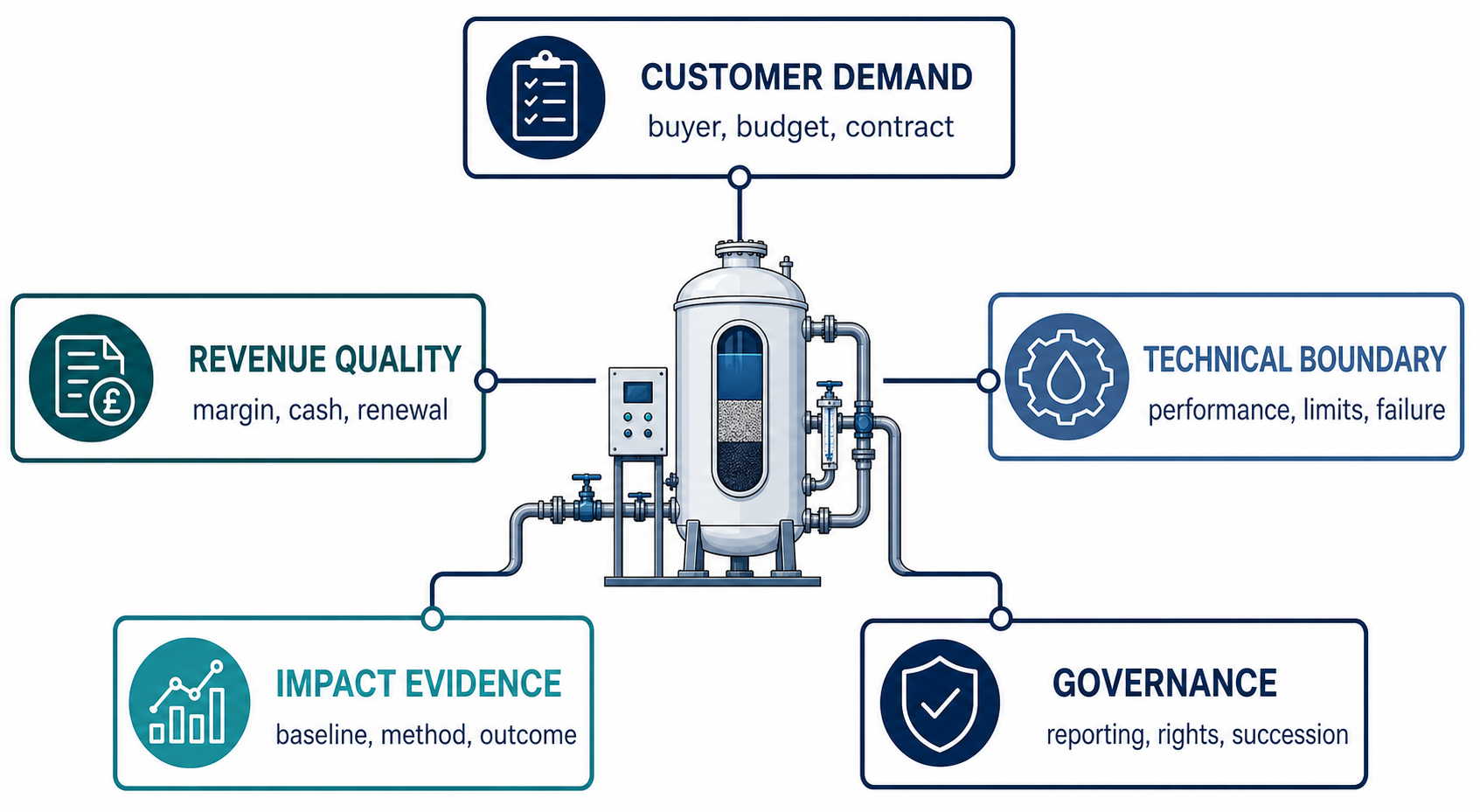
A useful investment committee paper can fit the opportunity into six linked questions. First, what customer problem is being paid to solve? Second, what evidence shows that the company solves it in real operating conditions? Third, how does the company earn and collect revenue? Fourth, what does new capital change? Fifth, how will the family office measure progress and risk? Sixth, what could make the investment unsuitable?
| Question | Evidence to request | Decision use |
|---|---|---|
| Customer demand | Contracts, budgets, acceptance tests and references | Tests whether interest has become funded demand |
| Commercial model | Invoices, delivered margin, renewals and cash forecast | Tests revenue quality and capital needs |
| Technical boundary | Operating data, failure records and maintenance evidence | Tests performance and warranty risk |
| Impact | Baseline, method, boundary and review process | Tests whether claims are measurable and material |
| Governance | Reporting pack, decision rights and succession plan | Tests whether growth can be controlled |
The committee should separate verified fact, management forecast and investor judgement. A signed contract is a fact about a contract. A forecast of repeat orders is a forecast. A view that the company has a defensible position is an investment judgement supported by evidence, not a verified fact.
The paper should also state what is not known. Missing customer data, incomplete testing, uncertain regulation or a weak cash forecast should remain visible. Uncertainty is not automatically a blocker. Hidden uncertainty is a risk to decision quality.
Portfolio fit should be written in plain English. State the proposed holding period, expected liquidity, capital-at-risk, follow-on policy, governance role and impact reporting burden. Compare these with the family’s actual objectives and existing exposure. Do not assume that a water label creates diversification if the portfolio already has similar industrial or infrastructure risk.
Terms can help align the plan. Staged drawdowns, information rights, board observation, warranties, milestone reporting or a reserved matter may improve oversight. They cannot replace a company that has no clear customer or a technology that has not been tested at the promised boundary.
The Water Investment Network portfolio can help eligible investors understand the type of direct water-company opportunity the network reviews. It is a starting point for research, not a substitute for independent diligence or a promise that any company will meet a target.
Family office investing works best when the family can explain why it is willing to own the risk. It may value direct access, a long horizon, measurable outcomes or the chance to support a useful company. Those reasons are valid, but they should sit beside a clear view of valuation, cash, governance and exit.
Water Investment Network connects eligible UK, European and GCC family offices, high-net-worth investors, sophisticated impact and private-equity investors, and relevant advisers with selected direct water-company opportunities. Readers who want to examine the network can request access to Water Investment Network, subject to its invitation-only eligibility process.
The network does not provide regulated financial advice. Any opportunity requires independent legal, financial, tax, technical, commercial, regulatory and impact diligence. Water may be essential, but a private investment in a water company remains company-specific, illiquid and capable of loss.
Frequently asked questions about family office investing in water
Why might a family office consider water investing?
Water companies can address recurring needs such as treatment, reuse, monitoring, resilience and industrial process performance. The investment case depends on a specific company’s paid customer demand, revenue quality, technical evidence, governance and risk. The importance of water alone is not enough.
What is the difference between a family office and a single family office investment?
A family office is the organisation that manages a family’s wealth and related responsibilities. A single family office investment is one investment decision made within that structure. It may be direct, fund-based or made alongside another investor, depending on the family’s mandate and governance.
What should family office investment management review first?
Start with the customer problem, buyer, contract, payment route and delivered economics. Then review technical performance, operating limits, impact evidence, governance, capital needs and liquidity. This order keeps the commercial case visible before a broad theme dominates the discussion.
Is water reuse automatically a good investment?
No. Water reuse may have strong demand drivers, but each company still needs a defined application, customer acceptance, reliable delivery, viable pricing, suitable regulation and enough cash to scale. Investors should test performance and economics at the actual site and contract boundary.
Does Water Investment Network provide investment advice?
No. Water Investment Network is an invitation-only network and does not provide regulated financial advice or guarantee returns. Eligible investors and advisers must conduct their own legal, financial, tax, technical, commercial, regulatory and impact diligence.
Sources
- https://www.ubs.com/content/dam/assets/wma/static/documents/ubs-gfo-report.pdf
- https://www.worldbank.org/en/topic/water/publication/water-security-financing-report-2024
- https://commission.europa.eu/topics/environment/water-resilience-strategy_en
- https://www.ifc.org/en/stories/2024/water-towards-sustainability-and-beyond
- https://www.worldbank.org/en/topic/water/publication/scaling-water-reuse