
Family office private equity can give long-term investors a direct way to back companies solving costly water problems. The opportunity is not a water-themed label. It is an ownership case built around paying customers, repeatable deployment, credible margins and measurable outcomes.
For investors considering water technology, the key question is simple: can the business turn a real customer need into durable cash generation while managing technical, regulatory and execution risk? This guide explains how to assess that question through a private-equity lens. It is written for family offices, sophisticated private-market investors and advisers reviewing direct opportunities in the UK, Europe and the GCC.

What family office private equity means in water
Family office private equity usually means taking an ownership position in a private company, rather than buying a listed security or a broad public fund. The family office may invest directly, alongside a lead investor or through a private-equity manager. The structure changes, but the underwriting question remains the same: what can make this company more valuable over time?
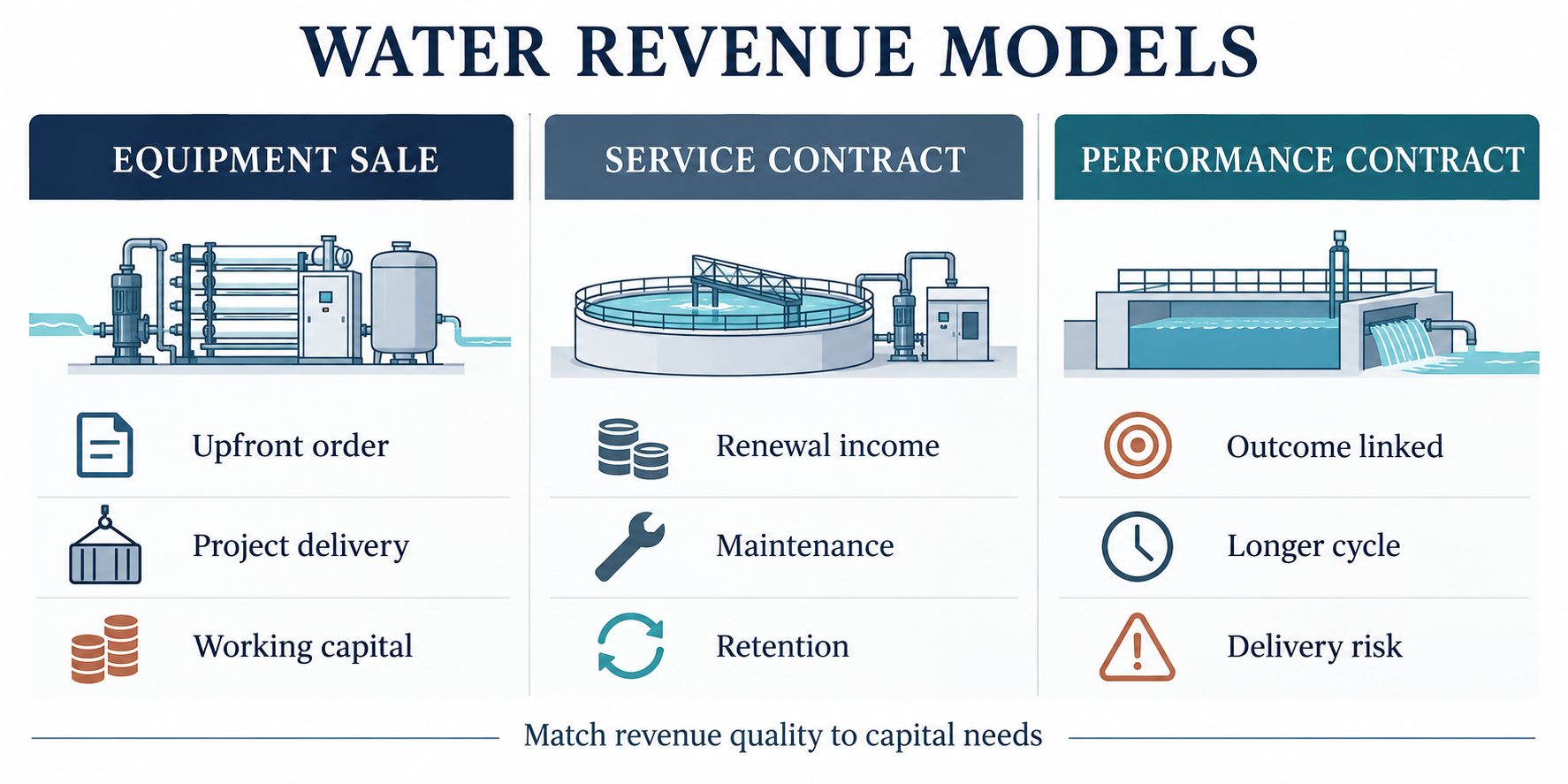
In water, that question must be answered at the level of the business and its customers. A membrane supplier may earn from equipment, consumables, service contracts or licensing. A monitoring company may sell sensors, software and support. A treatment provider may earn through design, installation, operation or a longer-term performance contract. These models carry different working-capital, sales-cycle and delivery risks.
The phrase private equity does not mean every deal uses high leverage or a short holding period. A family office may prefer patient growth capital, minority protection rights or a staged investment. The correct structure depends on the company’s maturity, cash needs, governance and route to a future liquidity event.
That distinction matters because direct ownership creates both access and responsibility. The investor may see more information and have more influence. The investor may also face concentrated exposure, limited liquidity and a greater need for technical and commercial diligence.
The Water Investment Network impact-investing overview gives useful context for the wider water opportunity. This article narrows the question to ownership, operating improvement and transaction discipline. Those are the issues that determine whether a private company can turn a good water idea into investable enterprise value.
Why private equity can fit the water market
Water is not one market. It is a set of customer problems linked to regulation, resource efficiency, industrial continuity, public health and infrastructure resilience. The most relevant private companies often sit between a technical solution and a customer with a measurable cost or compliance problem.
The capital need is also real. The International Finance Corporation says private investment in water remains constrained by issues such as weak policy, limited long-term finance, assets that are difficult to collateralise and tariffs that do not reflect costs. For an investor, those are not reasons to assume an opportunity is attractive. They are prompts to test whether a company has solved a specific part of the market problem.
The World Bank’s Water Security Financing Report 2024 records USD 19.6 billion of water-related financing approved by multilateral development banks in 2024. It also highlights financing gaps and the need for reform, governance and instruments that can crowd in private capital. Public and development finance may create market conditions, but it does not remove company-level risk.
Private-equity ownership can be useful when the business needs more than money. It may need help with pricing, sales discipline, procurement, management reporting, governance, international distribution or a repeatable installation model. The investment case becomes stronger when that value creation plan is specific and measurable.
It can also suit a patient owner when adoption follows a long industrial sales cycle. A customer may need testing, permitting, site integration and internal approval before a contract becomes material. That timing is not automatically attractive. It must be matched with enough cash, a realistic sales process and management capacity to carry the company through the cycle.
Investment thesis at a glance
A family office should be able to explain the water investment thesis in a few connected statements. The table below is a decision structure, not a promise of performance.
| Investment question | Evidence to request | Risk if weak |
|---|---|---|
| Who pays? | Named customer type, budget owner and buying trigger | Interest may not convert into revenue |
| How does revenue recur? | Contract terms, renewal history, service or consumables mix | Growth may depend on one-off projects |
| Can delivery scale? | Installation process, supplier capacity and operating data | Sales growth may create losses or delays |
| What creates defensibility? | Performance evidence, integration, switching cost or know-how | Competitors may copy the offer |
| What is the impact? | Baseline, measurement method and customer-verified outcome | Impact claims may exceed evidence |
| What is the route to liquidity? | Strategic buyers, secondary options and company maturity | Capital may remain illiquid for longer |
This framework keeps the environmental case connected to the commercial case. A water saving is valuable to an investor only when the company can deliver it, the customer recognises its value and the business can capture an appropriate share of that value.
It also gives the investment committee a way to separate evidence from narrative. The demand driver may be strong while the company’s route to revenue remains unproven. A clear table makes that gap visible before valuation, ownership rights or capital structure dominate the discussion.
Start with the customer contract, not the technology
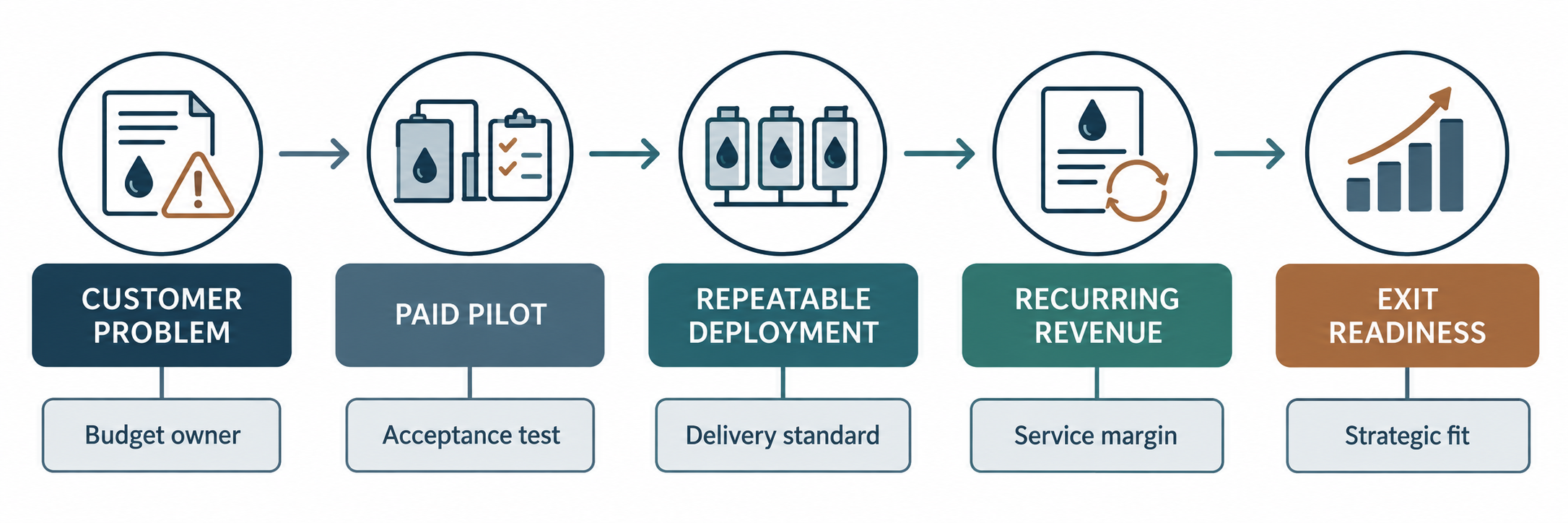
Technical performance is necessary, but it is rarely enough to support a private-equity investment. Begin with the customer. Identify the operational problem, the person who owns the budget and the event that makes action urgent.
For an industrial customer, the trigger could be discharge compliance, water availability, production downtime, rising treatment cost or a need to reuse water close to the point of use. For a utility or public-sector customer, it could be service quality, leakage, resilience or a regulatory requirement. The company should show where its product fits into that decision.
Ask for the path from first conversation to paid contract. How long does the process take? Which approvals are required? Does the customer run a pilot first? Who pays for testing? What makes a pilot become a repeatable deployment? A strong answer includes evidence from completed projects, not only a pipeline presentation.
Look at the contract language as well as the sales story. Check acceptance tests, service levels, warranties, payment milestones, change-control rights and responsibility for operating the system. These details show whether the company is selling a repeatable product or quietly taking open-ended project risk.
The World Bank’s water-reuse work notes that the business case is strongest where used water is close to the point of use, such as urban centres and industrial parks. That is a useful market lens, not a company forecast. The company still needs to prove that its target customers can approve, finance and operate the proposed solution.
Test revenue quality, margins and capital needs
Family office private equity should distinguish reported sales from high-quality revenue. A business that sells a treatment unit may show a large contract value but carry heavy project, warranty and working-capital exposure. A business with recurring monitoring, maintenance or consumables revenue may be more predictable, but only if retention and service costs are understood.
Build a revenue bridge by customer, product and contract type. Separate new sales, repeat orders, renewals, expansion and one-off engineering work. Review gross margin by project and by recurring service. Then test the cash conversion cycle. A company can report growth while using more cash because customers pay late, inventory rises or projects run beyond plan.
Water technology often sits inside a wider project. The investor should know which parts the company controls and which depend on partners, contractors or customer site conditions. A strong technical product can still produce weak returns if every deployment requires bespoke engineering.
Do not fill gaps with a market-size headline. The Invest Europe 2025 private-equity activity report describes renewed European private-capital activity, but broad sector activity does not validate one water company. Company-level evidence remains the centre of the investment case.
Review the downside case with the same care as the base case. Ask what happens if a major customer delays a project, a component remains unavailable, performance falls below the contract standard or a site needs more engineering than expected. The answer should show how much cash the company needs, which costs are variable and what management can change.
Assess governance and the value-creation plan
Private-equity ownership works best when governance is clear before the investment closes. The family office should understand board rights, reserved matters, reporting cadence, information rights and the responsibilities of management. A minority investment still needs a practical way to identify problems early.
The UBS Global Family Office Report 2026 describes a growing use of formal performance measurement and investment committees, while also noting uneven governance and succession practices. That is relevant to both sides of a transaction. The family office needs an internal process for decisions. The portfolio company needs reporting that makes performance and risk visible.
Turn the value-creation plan into a short list of operating changes. It might include reducing installation time, improving service attachment, moving from founder-led sales to account management, qualifying distributors or building management dashboards. Each action should have an owner, a measure and a time frame.
Be careful with the idea that a family office can add value simply through networks. Introductions are useful only when they lead to qualified customer conversations, better suppliers, stronger governance or a credible future transaction. The company still has to earn adoption.
Board involvement should stay proportionate to the ownership position. A minority investor may need consent rights on major borrowing, related-party transactions, new share issues and a sale of the business. It should also agree how technical incidents, customer concentration and cash pressure are reported. Good governance protects the relationship before a problem becomes a valuation dispute.
Use regulation as market evidence, not a promise
Regulation can create a customer need, but it does not guarantee that a particular company will win. A private-equity review should map the rule, the affected customer, the compliance action and the budget. It should then test timing, enforcement, permitting and the possibility that customers choose a different response.
Water reuse shows why this matters. The World Bank says supportive regulation, clear pricing signals and suitable delivery models can help mobilise private participation. That does not remove the need to prove site access, treatment performance, approvals, operating responsibility and customer willingness to pay.
For UK and European opportunities, ask how the company tracks the relevant national or EU requirements. For GCC opportunities, test each jurisdiction separately. Water, environmental and procurement rules differ between countries. A regional label is not a substitute for a documented route to market.
Regulatory diligence should include the customer’s own timetable. A rule may be real but still produce slow adoption if permits, procurement frameworks or financing approvals take years. The company’s sales plan should show how it manages that timing without assuming every policy change becomes immediate revenue.
Also separate compliance revenue from voluntary sustainability spending. A mandatory need may support urgency, but it can bring price pressure. A voluntary project may offer more design freedom, but the budget may be less durable. Both can work. They require different underwriting.
Compare direct company routes and portfolio fit
A family office can access private water opportunities through a direct company investment, a managed fund, a co-investment or a structured growth round. The choice changes control, diversification, fees, information needs and time commitment.
A direct position can provide clearer exposure to one company and more influence over governance. It also creates concentration and diligence demands. A fund can spread exposure across companies and managers, but the family office may have less control over individual assets. A co-investment may sit between the two, but the investor must understand allocation, rights and timing.
The UBS report records private assets as a meaningful part of family-office portfolios while showing that families are paying close attention to liquidity, valuation uncertainty and concentration risk. Those risks should be considered at the whole-portfolio level. A water deal can be attractive and still be unsuitable if it adds too much exposure to one customer base, geography or technology.
The decision should also reflect the family office’s operating capacity. Direct deals need time for data-room review, technical specialists, board work and follow-on decisions. If that capacity is not available, a managed route may offer better process control even when it provides less direct influence.
Use the Water Investment Network portfolio to understand the type of direct water-technology opportunity under review. That page is a starting point for access and context. It is not a substitute for independent diligence or personal investment advice.
Define diligence red flags and decision gates
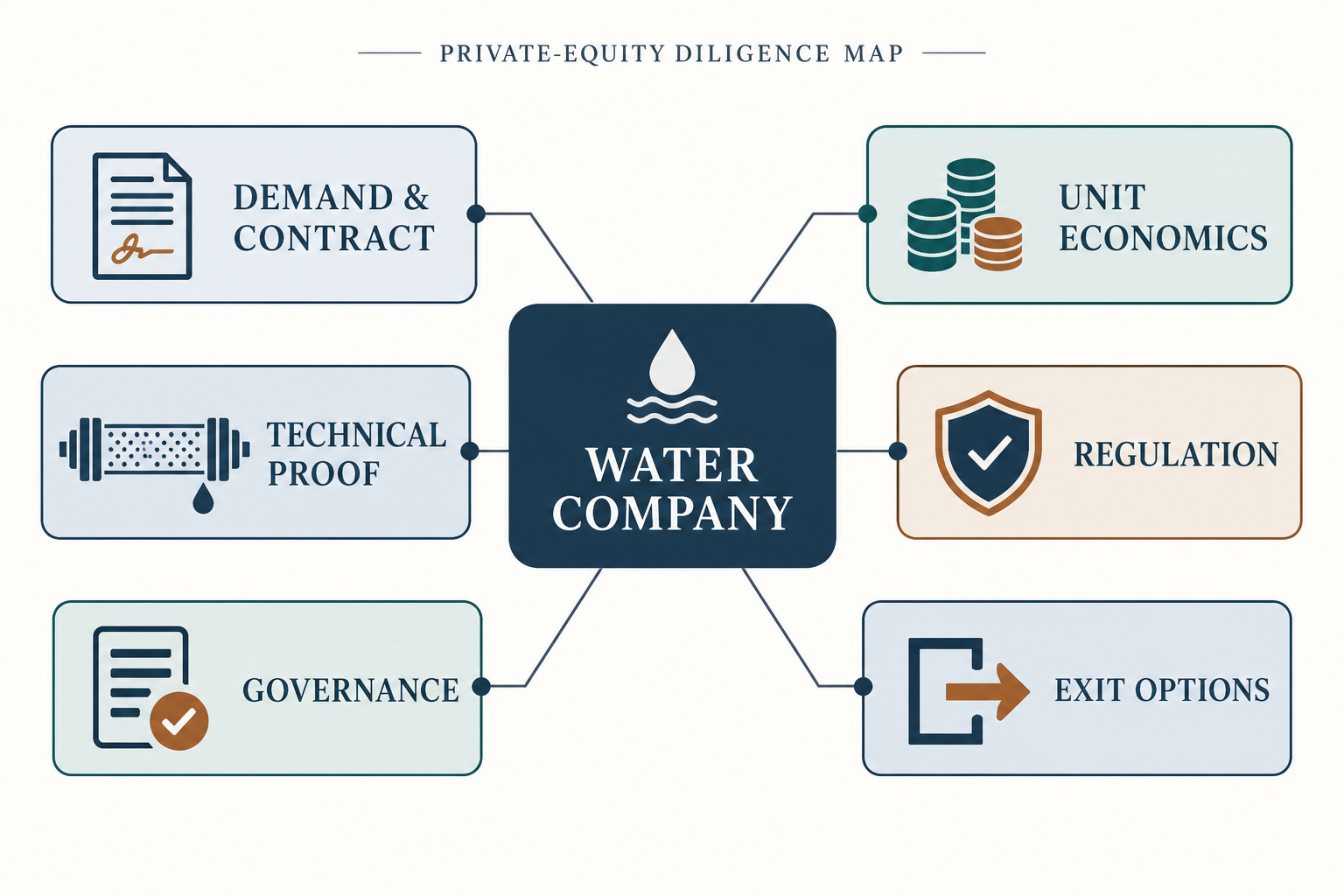
A disciplined family office does not ask only whether the company can grow. It asks what must be true for growth to create value and what evidence would disprove the thesis.
- Customer proof: the pipeline is large, but paid deployments, renewals or repeat orders are limited.
- Technical proof: results come from controlled trials and do not show performance across real customer conditions.
- Margin proof: gross margin improves only when founder time, warranty cost or project overruns are excluded.
- Scale proof: every project needs bespoke engineering, scarce suppliers or heavy customer support.
- Impact proof: the company reports equipment delivered but cannot show the customer outcome or baseline.
- Governance proof: management reporting is late, definitions change or related-party arrangements are unclear.
- Exit proof: the plan assumes a large buyer without identifying strategic fit, comparable transactions or buyer requirements.
Turn the red flags into gates. For example, the investment committee might require a defined customer reference set, reconciled management accounts, an independent technical review, a signed governance schedule and a written downside case. The gates should support a decision. They should not become a checklist that creates false confidence.
Ask who owns each unanswered question. Commercial diligence may need a customer call. Technical diligence may need a site test or independent engineer. Legal diligence may need a review of permits, intellectual property and warranties. The best process records the evidence, the remaining uncertainty and the action required before close.
Plan reporting and realistic exit routes
Water investments need reporting that speaks to both business value and water outcomes. Commercial reporting may include contracted revenue, gross margin, customer concentration, backlog quality, renewal rates, cash conversion and installation cycle time. Impact reporting may include water reused, pollutant load reduced, availability improved or a customer-verified efficiency measure.
Set the measurement boundary before investment. Decide what the company can control, what the customer must verify and what cannot be attributed to the company. This protects the impact case from becoming a marketing statement and helps management act on the data.
Exit planning should start with the business model. A strategic buyer may value installed customer relationships, treatment know-how, recurring service revenue or a monitoring data layer. Another investor may value predictable cash generation and a professional management team. A secondary transaction may be possible, but it depends on the company, rights, valuation and market conditions.
Do not underwrite a guaranteed return or a fixed exit date. Private equity is illiquid and outcomes vary. A good family office private equity process makes the uncertainty explicit, stages capital when appropriate and preserves the ability to stop when evidence weakens.
That discipline is especially important when an opportunity has a strong mission narrative. Water outcomes can matter deeply, but they do not replace an honest view of customer concentration, technical failure, working capital, governance or exit timing. Commercial rigour is what allows a family office to stay engaged through a long ownership period.
Frequently asked questions about family office private equity in water
What is family office private equity?
It is an ownership investment by a family office in a private company, either directly or through a private-equity structure. In water, the company may sell treatment equipment, monitoring systems, software, services, consumables or integrated projects. The investment case should connect ownership value to customer demand, revenue quality and operational improvement.
Why might family offices consider water technology?
Water technology can address customer problems linked to production, compliance, water availability and resource efficiency. The case is strongest when a company shows paid demand, repeatable delivery, measurable performance and a clear route to scale. A large social or environmental need alone is not enough.
Is direct private equity in water lower risk than investing through a fund?
No. Direct investment may provide more information and influence, but it can increase concentration, technical diligence and governance demands. A fund may diversify exposure, but it introduces manager selection, fees and less control over individual companies. The right route depends on the family office’s resources, objectives and portfolio.
Which metrics should investors request?
Request customer-level revenue, gross margin by offer, backlog quality, renewal or repeat-order data, cash conversion, project delivery performance, customer concentration and technical performance evidence. Also request a clear impact baseline and measurement method. Definitions should remain consistent across reporting periods.
Does Water Investment Network provide regulated investment advice?
No. Water Investment Network provides access to information about selected direct private-company opportunities. It does not provide regulated financial advice or guarantee returns. Eligible investors should carry out their own diligence and obtain independent professional advice where needed.
Family office private equity in water should be approached as a commercial underwriting exercise with a long-term operating view. The strongest opportunities connect a defined customer problem to a repeatable solution, credible revenue, measurable outcomes and disciplined governance.
Eligible investors can request access to the Water Investment Network to review selected direct opportunities or contact the network team with a focused question. Before making any decision, assess the company, transaction documents, risks, liquidity and suitability independently.
Sources