
Growth equity is capital for a company that has moved beyond an idea and needs to expand a proven commercial model. In water, that usually means more than a successful pilot. It means a product, service or operating model has been bought by real customers and can be deployed again without rebuilding the company each time.
That distinction matters. Water businesses often sit between physical assets, long customer approval cycles and essential service expectations. A technology can work well and still be hard to scale if installation is too bespoke, procurement is slow, working capital is heavy or the customer value is not captured in the contract.
For a private investor, the central question is not whether water is important. It is whether a specific company can turn a measured customer problem into repeatable, defensible revenue. This guide explains how growth equity private equity can assess that transition in direct water technology and service businesses.
What growth equity means in a water business
Growth equity normally sits between early venture funding and a mature buyout. The company has evidence of demand, but it still needs capital and operational discipline to expand. The investment may fund sales capacity, manufacturing, service delivery, product certification, working capital or carefully selected geographic expansion.
In water, the evidence threshold should be practical. A promising treatment process is not enough. Investors need to know who pays, what problem is being solved, how performance is accepted, how long revenue takes to collect and who carries operating risk once equipment is installed.
A direct water company may sell equipment, recurring monitoring, treatment-as-a-service, maintenance, consumables or a blended offer. Each model can be investable. Each needs a different view of margin, cash conversion and customer retention. A business that sells a standard sensor package should not be assessed in the same way as a business that designs and operates a site-specific treatment plant.
The difference between growth equity and an early-stage investment is the quality of the evidence. Early capital may support a product while the buyer and delivery model are still being tested. Growth capital should be tied to a narrower question: can the company take what has worked and deliver it repeatedly at a return that justifies the operational risk?
The private-market guide to impact investing in water sets the wider investment context. Growth equity narrows that lens to the moment when commercial proof must become repeatable delivery. The water need may be large, but the underwriting still belongs at company level.
This is also why a growth equity investment should have a clear boundary. It should identify which part of the business is being funded, what evidence already exists, what the next milestones are and what could make the plan require more capital. A broad claim about a large addressable market does not answer those questions.
For family offices, high-net-worth investors and advisers, this discipline helps keep the opportunity comparable with other private-company investments. The water theme can provide a useful lens for demand and impact. It cannot replace a review of contracts, management controls, cash needs, technical limits and terms.
Start with funded customer demand
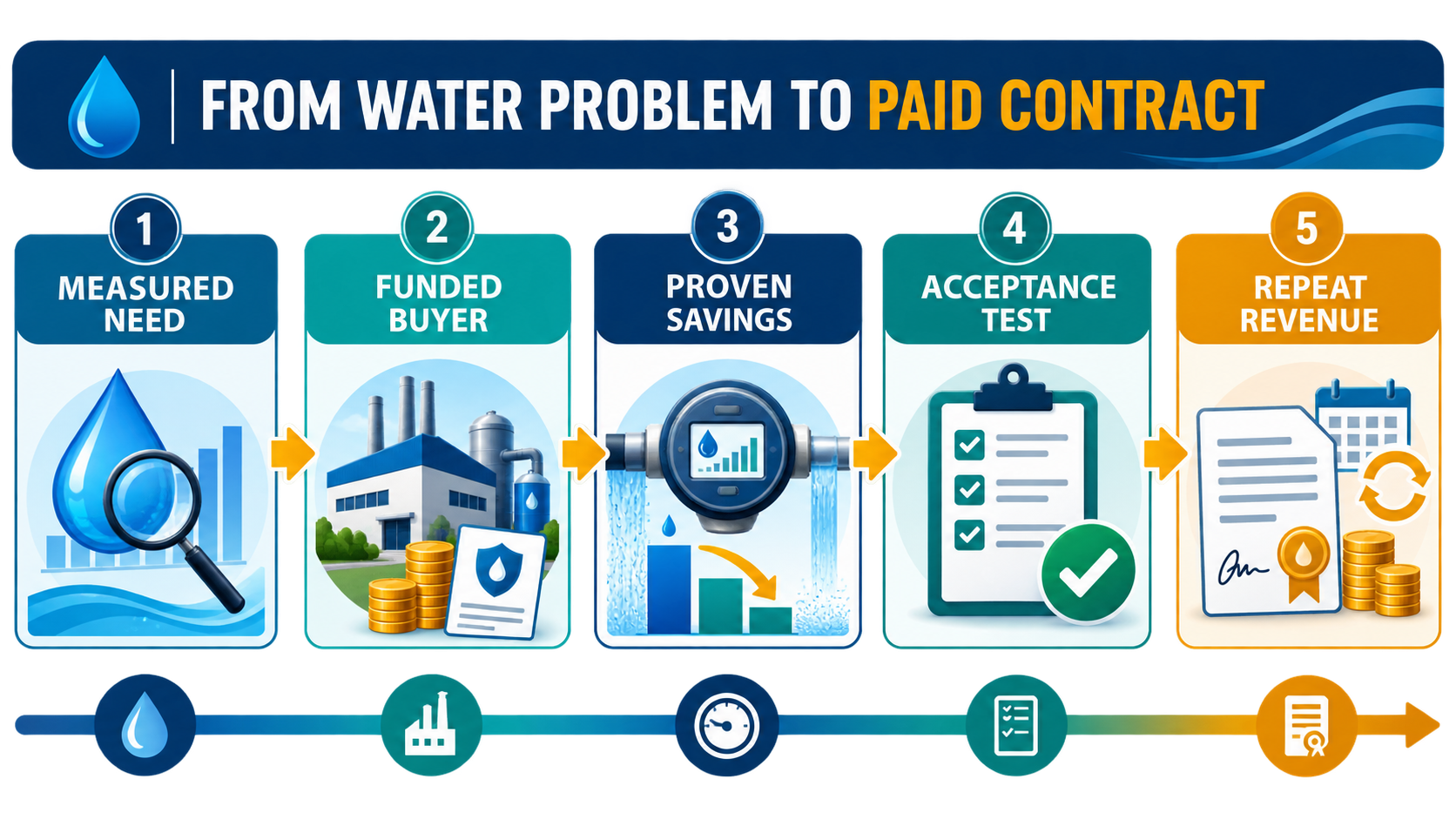
Growth capital should follow a funded customer problem. Water stress, compliance pressure or a sustainability target may create interest, but interest is not an order. The investable case starts with a named buyer, an approved budget, a decision process and a measurable reason to change.
Industrial reuse is one useful example. The World Bank says that the strongest business case is often where wastewater is close to the point of use, such as industrial parks and urban centres. It also highlights programme approaches, clear pricing and enabling regulation as conditions that can help make investments bankable. [1]
That does not make every reuse supplier a growth company. It gives investors a way to test demand. Ask whether the customer pays to reduce freshwater exposure, discharge cost, production interruption, energy use or a compliance risk. Then examine whether the supplier captures part of that value through a price that supports delivered margin.
A demand review should separate the user from the economic buyer. The plant operator may specify the system, the procurement team may negotiate the contract, the finance team may release the budget and a board or public authority may approve the wider programme. A company that cannot explain this chain may have technical interest but not yet have reliable commercial traction.
- What event makes the customer act now?
- Who signs the contract and funds it?
- What baseline is measured before installation?
- What happens if performance is delayed or lower than expected?
- Which part of the offer is bought again after the first deployment?
Investors should also examine the buying pattern. A company may have several letters of intent but few purchase orders. It may have a strong first customer but no second application. It may win tenders but carry a long gap between award and mobilisation. Each fact changes the cash plan and the confidence that growth capital will produce repeatable revenue.
Regional context can help when it is specific. A UK industrial customer may be focused on discharge controls and production resilience. A European customer may be responding to water efficiency and reuse policy. A GCC customer may prioritise reliable supply, process water and operating performance in a water-stressed environment. These are useful starting points, not assumptions about every buyer or project.
The strongest demand evidence usually shows a problem before the supplier arrives, the customer decision that follows, the measurable outcome and the commercial terms. Investors should ask for the original baseline, not only a case-study summary. They should also check whether the reported result was accepted by the buyer and whether the supplier was paid on the expected timetable.
Separate technical proof from commercial repeatability

Water technology often passes a technical test before it has passed a commercial one. A pilot can show that a system treats a given water stream under supervised conditions. It does not automatically show that installations can be configured, commissioned and supported repeatedly at an acceptable cost.
Commercial repeatability needs its own evidence. Look for paid deployments, a clear application boundary, documented operating conditions, customer acceptance criteria, repeat orders and a delivery process that does not depend on the founder or a small group of specialists.
The first question is whether the test resembles the customer environment. Water chemistry, temperature, flow variation, fouling, maintenance access and operator capability can change the result. A controlled demonstration may be useful, but investors need to know which conditions were held constant and which were allowed to vary.
The second question is whether the product can be installed with a defined process. A company may have a strong core technology and still lose margin through repeated site redesign. Review drawings, installation time, commissioning records, change orders and the share of revenue that comes from custom work.
This is where growth equity investment can be more useful than a generic sector story. The diligence question becomes specific: how much engineering changes from site to site, who owns the interface with the client, what is included in the warranty and when does cash arrive?
A business may still be attractive with a project element. The investor simply needs to separate standard product revenue from site-specific engineering and construction revenue. Mixing them can hide pressure on gross margin and working capital. It can also make a forecast look scalable when it is actually dependent on a small number of complex jobs.
Evidence should cover failure, not only success. Ask how the company handles a missed performance threshold, blocked membrane, sensor drift, failed pump, delayed replacement part or customer complaint. The answer shows whether the service model is mature enough for a larger installed base.
Independent testing can be valuable, but independence should be described accurately. A report paid for by the company may still be useful if its method, data and limitations are clear. It should not be presented as a regulator approval or customer validation when it is neither. Investors need a fact-led view of what has been tested and by whom.
Repeatability also includes information. A system that produces reliable operating data can improve maintenance, customer reporting and future sales. A system that depends on manual spreadsheets and undocumented settings creates key-person risk. The company should show who owns the data, how it is checked and how it is used in decisions.
Read the revenue model before the market narrative
A large water need does not create a strong revenue model by itself. For growth equity private equity, contract mechanics usually matter more than a broad market estimate. Review price, installation scope, service obligations, payment milestones, renewal terms, consumables, warranty exposure and any performance deductions.
Recurring revenue deserves careful definition. A multi-year service agreement can be valuable, but only if the customer has a clear reason to renew and the supplier can deliver it without an unplanned rise in field cost. Equipment sales may produce good margins, but they can create uneven order intake and cash needs.
Gross margin should be reviewed after delivery, not only in a proposal. Compare quoted margin with installed margin. Track freight, rework, subcontractors, consumables, commissioning time and customer-specific adaptations. If a company says it is scalable, the data should show which costs fall, remain stable or rise with each new site.
Unit economics are not limited to software metrics. In a water business, the relevant unit may be a treatment module, monitored site, service contract, operating hour, installed capacity or recurring customer location. The company should be able to explain revenue, direct cost, support cost, replacement cycle and cash timing for that unit.
Within a growth capital private equity mandate, concentration deserves its own case. A small number of good customers can prove demand, but one buyer, distributor or supplier can still change the risk profile quickly. Private equity growth capital should be released against evidence that the dependency is reducing or is properly controlled.
Payment terms deserve special attention. A contract with a strong headline value may still require the supplier to fund design, inventory and installation for months. Check deposits, milestone payments, retention, acceptance language, disputed invoices and the history of collections. Working capital can become the main use of new capital even when the operating margin is sound.
Revenue quality also depends on who owns the relationship. A distributor can speed market access, but the company may lose pricing information and customer data. A direct model may produce better control but require more sales and service cost. The right answer depends on application, geography, buyer structure and the company’s own ability to support customers.
Investors should be cautious with forecasts that apply one margin percentage to every future contract. A more useful model has separate lines for standard product, custom engineering, installation, service, consumables and other income. It then tests what happens when the sales mix changes or a large project is delayed.
Commercial quality is visible in the contract archive. Sample signed agreements, change orders, service records and invoices can show whether the model described in the investment case matches the model customers actually buy. This is often more informative than a single market-size slide.
Understand why scale needs capital
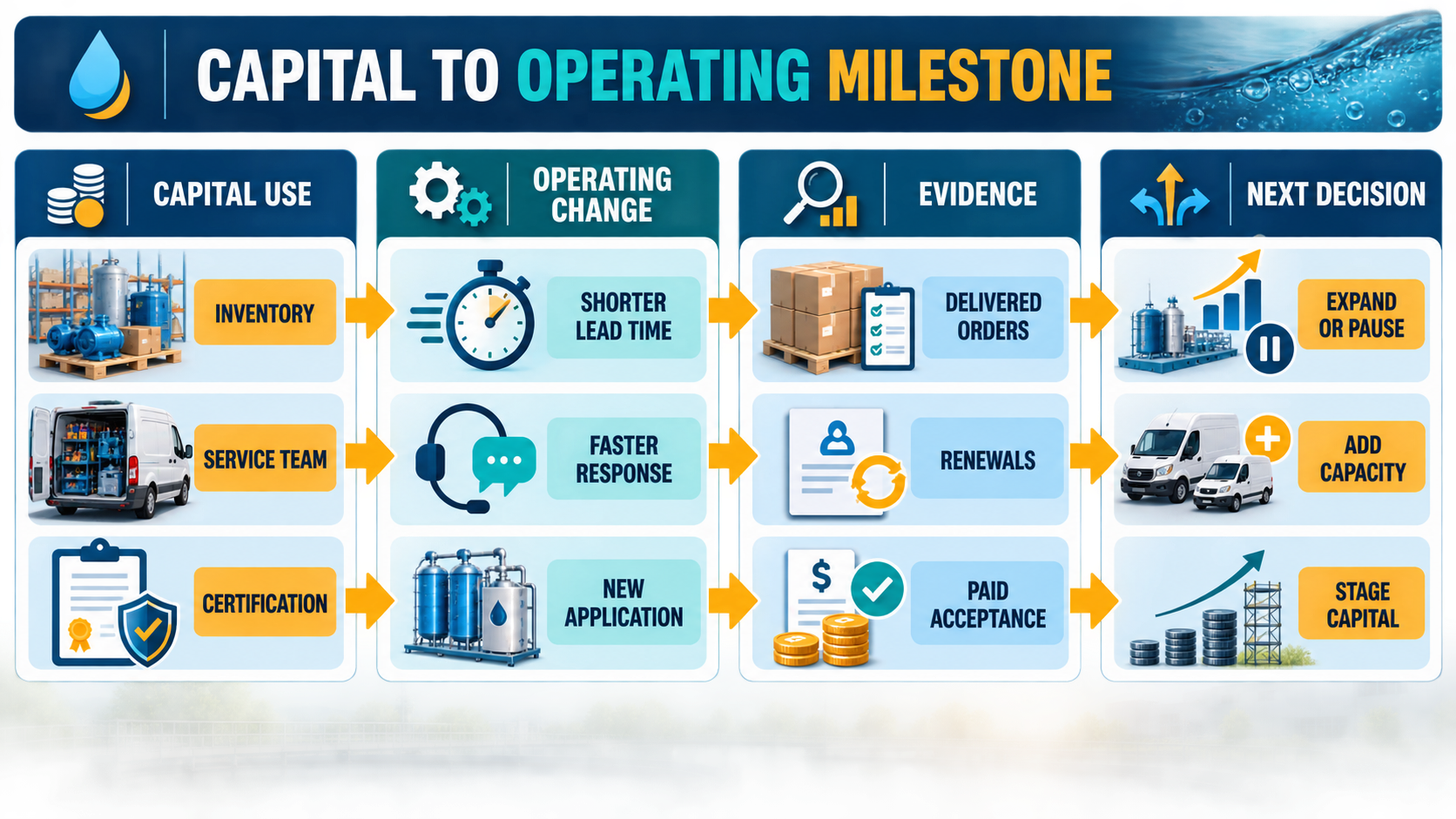
Growth capital is not simply money for faster sales. In water businesses, cash can be absorbed before revenue is recognised. Inventory may be needed before shipment. Equipment may be built before acceptance. Service teams may be hired before a regional base is profitable. Certification and customer qualification can also take time.
A sensible plan links each use of capital to an observable milestone. A new production cell should reduce lead time or improve capacity at a defined quality level. A sales hire should be tied to a target application, pipeline stage and expected sales cycle. A service hub should show how response time, utilisation and renewal support will improve.
The European Investment Bank states that its Water Resilience Programme supports infrastructure, loss reduction, pollution control and water-sector innovation. That policy direction can strengthen the operating backdrop, but it is not a substitute for company-level underwriting. [2]
Investors should model downside timing. What happens if a customer acceptance test slips, a component lead time extends or a regulatory decision is delayed? A company can have a sound long-term proposition and still require more capital than the original plan assumes.
Capital planning should distinguish growth from repair. Replacing obsolete equipment, paying overdue suppliers or covering historic losses may be necessary, but those uses should be stated plainly. A new investor needs to know how much capital reaches the planned expansion and how much protects the existing operation.
Funding structure is part of the risk review. Equity can support uncertain expansion, but it dilutes ownership and may come with governance rights. Debt can reduce dilution, but scheduled repayment can increase pressure while contracts are still being won. Supplier credit, customer deposits or equipment finance may help in some models, but each has terms that affect resilience.
Growth equity private equity should therefore examine the next funding point, not only the current round. What evidence would make the company self-funding? What event would make more capital necessary? What is the minimum cash balance under a delayed-sales scenario? Clear answers help investors judge whether the plan is staged or simply optimistic.
A staged plan can improve discipline. The first tranche may fund a limited number of deployments, a production change or a defined service capability. A later tranche can depend on customer acceptance, delivered margin or repeat orders. This does not remove risk. It makes the link between capital and evidence easier to monitor.
Working capital controls are especially important when the company grows quickly. Purchase orders, inventory ownership, supplier lead times, warranty reserves and receivables should be visible in one cash forecast. A business that sells more but collects later can become less resilient unless management plans for that gap.
Test scalability at the operating level
Scalability in water is rarely abstract. It can be seen in a bill of materials, a commissioning checklist, remote monitoring, a repeatable maintenance programme, a channel partner agreement or a narrower product configuration. The task is to identify what becomes easier as volume rises and what remains site-specific.
Ask management to map the order-to-cash process. Where does a qualified lead become a signed order? When is design frozen? Which parts are standard? Who approves a change? What evidence is needed for customer acceptance? When is the final payment due? This map often reveals the real growth constraint.
European policy is also pushing water efficiency, reuse, innovation and a competitive water economy. The European Commission’s Water Resilience Strategy provides relevant context for demand and regulation, while leaving individual technology and company claims to be tested separately. [3]
Defensibility should be equally concrete. It may come from validated application data, hard-won integration knowledge, a qualified supply chain, service records, trusted operating performance or intellectual property. A patent can help, but it does not remove adoption, delivery or pricing risk.
Capacity is more than factory space. It includes design review, procurement, quality assurance, installation, commissioning, customer training and after-sales service. A company may be able to manufacture ten units but support only four new customer sites. That difference can create a hidden bottleneck.
Standardisation should not be treated as an all-or-nothing goal. Some variation is normal in water because source quality, site layout and customer processes differ. The question is whether the company knows which variation is acceptable and has a price, process and margin rule for it.
Technology can help with scale, but software does not solve every operating issue. Remote monitoring may reduce site visits and improve evidence. It may also create data security, connectivity and support requirements. Investors should review the actual installed base and service records rather than assume that a dashboard automatically creates a recurring business.
People and partners matter even when the featured asset is physical. A growth plan should show who can install, maintain and approve the system as volume rises. If the company relies on one engineer, one distributor or one specialist subcontractor, the risk should be visible in the plan and the capital use.
A practical scale test uses recent jobs. Compare the first and most recent deployments. Did design hours fall? Did installation become faster? Did warranty cases decline? Did gross margin improve? Did customer reporting become clearer? If not, management should explain why the next capital round is expected to change the pattern.
Build diligence around evidence, not optimism
A useful diligence process joins technical, commercial and financial work rather than treating them as separate reports. The technical reviewer needs to understand the promised customer outcome. The commercial reviewer needs to understand the operating limits. The financial model needs the real delivery cycle, not an idealised sales plan.
| Area | Evidence to request | Investor consequence |
|---|---|---|
| Customer value | Baseline, contract and acceptance criteria | Tests willingness to pay and revenue quality |
| Delivery | Installed margin, lead time and rework record | Tests scalability and cash needs |
| Technology | Operating range, failure modes and independent data | Tests warranty and adoption risk |
| Governance | Reporting, controls and decision rights | Tests ability to manage growth pressure |
Do not confuse an impact metric with commercial proof. A credible water outcome needs a baseline, a method and a clear boundary. It can strengthen customer relevance and reporting, but it should not conceal weak margins or uncertain collections.
The request list should include customer contracts, invoices, order history, pipeline definitions, delivered cost records, test data, warranty cases, supplier terms, intellectual property ownership, regulatory correspondence and the management accounts. The purpose is not to collect documents for their own sake. Each item should answer a risk question.
Technical claims should be tied to application. A removal rate or energy figure may be meaningful only within a defined flow, water chemistry and operating range. Investors should ask what happens outside that range and whether the customer contract reflects the same boundary. If the claim is broader than the evidence, the commercial risk is higher.
Customer references can add useful context when questions are precise. Ask what was promised, what was delivered, how acceptance worked, what support was needed and whether the customer would buy again. A positive reference that cannot discuss performance, payment or repeat use is less informative than a detailed reference that describes limitations plainly.
Financial diligence should reconcile the story with bank movements, invoices and costs. Review revenue recognition, deferred income, deposits, receivables ageing, inventory, warranty provisions and related-party payments. In a growing company, small errors in these areas can change the cash requirement materially.
Legal and regulatory review should be proportionate but real. Check title to intellectual property, distributor and exclusivity terms, product liability, environmental obligations, data handling and required approvals. The article does not provide regulated financial advice, and investors should obtain their own specialist advice for the opportunity under review.
Finally, document uncertainty. Diligence does not need every issue to be resolved before a decision. It does require a clear record of what is known, what is assumed, what remains unverified and how the terms or milestones respond. That record is more useful than a clean-looking conclusion built on missing evidence.
Use governance to protect the scale-up
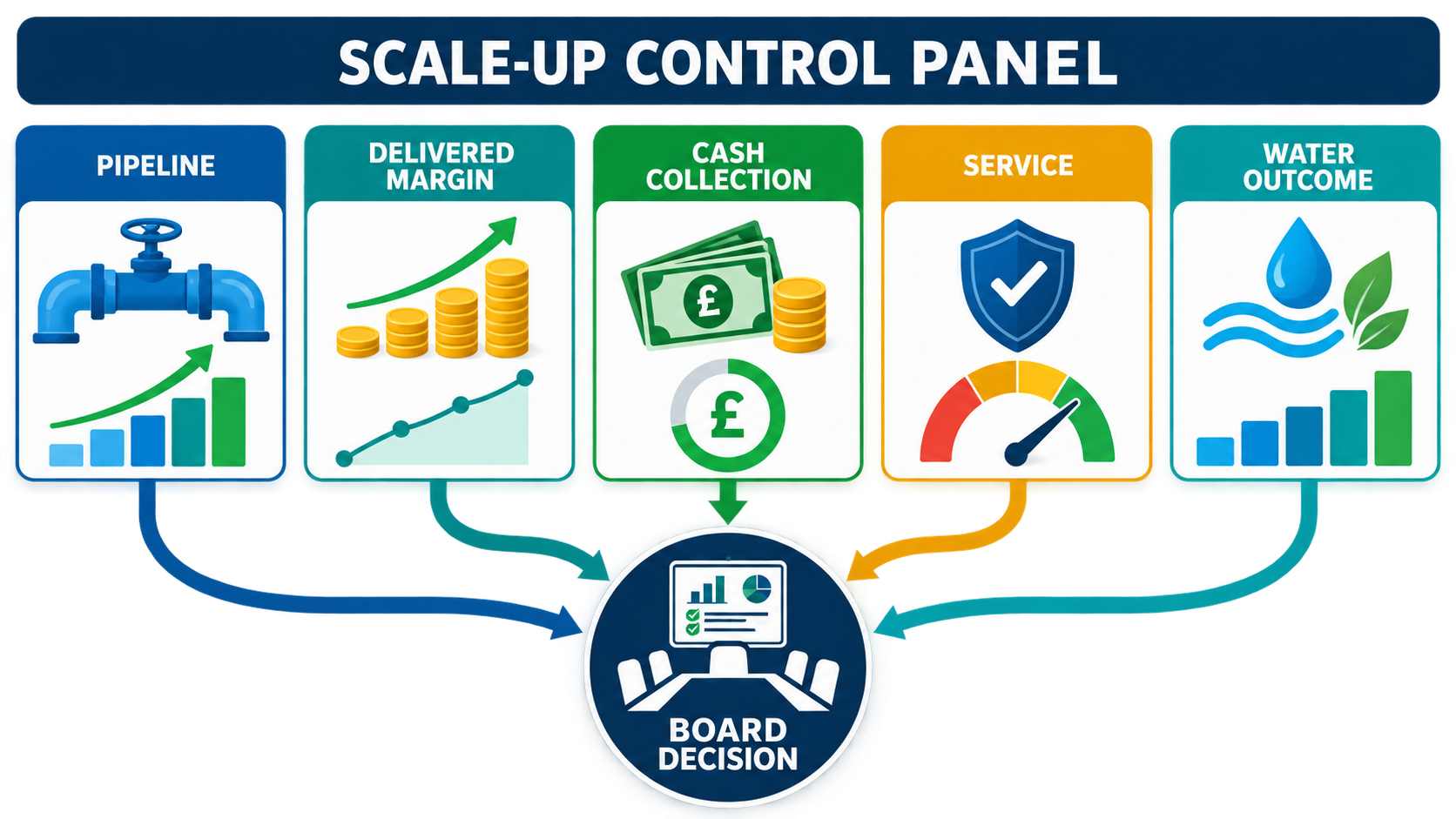
Growth equity private equity often adds value through governance as much as capital. The board should agree what management reports each month before the investment completes. A short, reliable pack is more useful than a large presentation that arrives too late.
Typical measures include qualified pipeline, order intake, backlog quality, delivered gross margin, installation progress, cash collection, warranty cases, customer concentration, supplier exposure and selected water-outcome indicators. The exact measures should match the company model. A recurring monitoring business will need different service measures from a manufacturer of packaged treatment units.
Decision rights also need to be clear. Expansion into a new application, a large custom contract, a material warranty promise or a major hire can change capital requirements. A growth plan is safer when those choices have evidence thresholds and approval paths.
Information continuity matters. In technical companies, critical facts may sit in personal spreadsheets, site reports and informal customer knowledge. A controlled data room, versioned performance data and documented product controls reduce key-person risk and improve future financing or exit readiness.
The first 100 days after an investment should focus on evidence that protects the thesis. Priorities may include contract-margin reporting, a reliable order-to-cash forecast, customer-reference tracking, a regulatory map, a warranty register and a small set of outcome indicators. These tasks are operational, but they influence the quality of later investment decisions.
Milestones should describe completed evidence, not activity. Hiring a sales director is an action. A defined application producing paid orders through a documented sales process is closer to an outcome, although the result still needs margin and collection context. A new facility is an action. Capacity delivered at the expected quality and cost is the relevant evidence.
A scale-up needs pre-agreed responses to ordinary setbacks. If a site acceptance date moves, a margin test fails, a certification takes longer or a major customer pauses, the board should know which milestone changes, which cost is paused and which customer evidence is required before more capacity is added.
Governance should also protect customer trust. A company expanding into more sites must keep consistent data, maintenance and incident reporting. If the product serves an essential process, a weak support response can damage adoption and future sales. The board should see operational incidents before they become a reputation problem.
Good governance is not a promise of success. It is a way to make the next decision with better information. For a family office or sophisticated private-equity investor, this can be part of the investment case, but only when the company is willing and able to adopt the controls.
The risks growth investors should price
Growth equity does not remove the risks of direct private-company investment. It changes them. The main risks may include long procurement, uncertain customer acceptance, bespoke engineering, supplier reliance, margin dilution, working-capital pressure, regulatory change, further funding needs, limited liquidity and weak performance evidence.
Each risk should have an explicit response. That may mean a smaller initial investment, staged drawdowns, a condition before completion, tighter reporting, more working capital, a slower expansion plan or a decision not to proceed. The response should fit the risk, not the narrative.
Technical risk can remain after a product has paid customers. The installed base may not cover the full range of water conditions. A component may fail more often at a higher duty cycle. A maintenance practice may work at one site and not another. Investors should distinguish a known operating limit from a problem that management has not yet measured.
Commercial risk can be hidden by a strong pipeline. A long list of opportunities is not the same as a forecast of signed orders. Review pipeline stages, conversion history, sales-cycle length, budget status and the share of opportunities that depend on one procurement event. Growth capital should not be sized against every possible project.
Financial risk often appears in the gap between delivery and collection. If a company must buy inventory, pay subcontractors and retain service staff before the customer pays, a sales increase can consume cash. Test delayed acceptance, slower collections, higher rework and a supplier interruption. Then examine how the company would respond.
Regulatory and policy risk should be handled with care. A policy direction can support demand, but it may change in timing, scope or implementation. A company should earn revenue from a customer problem it can serve, not depend entirely on one incentive or one unconfirmed future rule.
Concentration risk includes customers, suppliers, channels and people. A large customer can be useful evidence, but it may also have strong negotiating power. A specialist supplier can provide quality, but its failure can halt delivery. A small expert team can be valuable, but key-person dependency should be mitigated over time.
Liquidity risk is central to private investments. A company may grow and create real water outcomes without offering a clear near-term exit. Investors should consider holding period, transfer restrictions, governance rights, future funding, valuation uncertainty and the relationship between the company plan and their own portfolio needs.
Family offices and advisers should remain careful about portfolio fit. A company can have genuine potential yet be unsuitable for a particular liquidity need, governance preference or risk tolerance. The Water Investment Network portfolio gives a view of direct opportunities across water treatment, membranes and monitoring. It is a starting point for research, not a substitute for independent legal, financial, commercial, technical, tax, regulatory and impact diligence.
How to judge the next stage of growth
The best growth equity investment cases make the next stage easy to describe. The company has a defined customer use case, a delivery model, a set of operating metrics and a reason that additional capital should improve the result. The plan may be ambitious, but it is still traceable from evidence to action.
Start by writing the growth thesis in one paragraph. State the customer problem, the buyer, the company solution, the proof already achieved, the constraint holding back expansion and the milestones that would show progress. If the thesis needs a long market narrative before it can explain how revenue is earned, it needs more work.
Then map the route to repeat revenue. Does the second sale use the same product? Does it use the same buyer? Does it use the same installation partner? Does the same support team cover it? The more answers are yes, the more useful the scale evidence may be. If the answers are no, the company may still be attractive, but it should be underwritten as a series of new risks.
Growth capital investments should also have a clear stopping rule. What evidence would show that an application is not working? What margin or collection result would slow expansion? What customer feedback would trigger a product change? A company that only describes upside may not be ready to manage a larger capital base.
Impact should sit beside commercial measurement. A water outcome might be lower abstraction, reduced discharge, improved quality, reduced water loss or more reliable reuse. The measure should have a baseline and a boundary. It should be reported without claiming more than the data shows.
For UK and European investors, the policy context can help frame resilience, efficiency and industrial competitiveness. For GCC investors, the relevance may include reliable supply, reuse, treatment capacity and operating performance in water-stressed settings. The same company still needs customer-level proof in each market. Regional language should not stand in for a route to revenue.
The decision should end with a balanced view. Set out what the company does well, what remains unproven, what the capital is expected to change, what controls will be added and what could make the investment unsuitable. That is a better basis for a private-market decision than a claim that water growth is inevitable.
Water Investment Network reviews access requests from eligible UK, European and GCC family offices, high-net-worth investors, sophisticated impact and private-equity investors, and relevant advisers. Readers who want to examine selected direct water-company opportunities can request access to Water Investment Network, subject to the network’s eligibility process.
The network is invitation-only and does not provide regulated financial advice. Any opportunity still requires independent work on valuation, terms, liquidity, legal position, technical evidence, customer contracts, commercial performance, regulation, tax and impact. Growth equity can support a company with traction, but it does not remove company-specific risk.
Frequently asked questions about growth equity in water
What is growth equity?
Growth equity is capital for a company with commercial traction that needs funds and operational support to expand a proven model. It is usually later than an idea-stage investment and earlier than a mature buyout. In water, the evidence should include paying customers, a defined use case and a credible plan for repeat delivery.
What makes a water company ready for growth capital?
Useful evidence includes paid customers, repeatable delivery, a defined application, sound unit economics and a plan for working capital and governance. The company does not need to be mature, but it should be clear about what has been proved, what remains uncertain and what the new capital is expected to achieve.
Is a pilot enough to support growth equity?
No. A pilot can prove technical performance, but investors also need proof of paid adoption, delivery margin, acceptance and repeatability. A pilot is more useful when its operating conditions, customer role, payment status and route to a second deployment are documented.
What should investors measure after completion?
Order quality, delivered margin, cash collection, installation progress, customer concentration, service performance and relevant outcome evidence are common measures. The right set depends on the company model. Measures should show whether the company is becoming easier to operate and more reliable to underwrite.
What are the principal risks?
Risks include long sales cycles, bespoke delivery, working capital, warranty exposure, customer or supplier concentration, regulation, further funding and illiquidity. These risks should be tested against company evidence and reflected in the investment terms, milestones and portfolio decision.