
Impact investing companies aim to solve a defined social or environmental problem while building a business that can deliver a financial return. In water, that combination can include treatment, reuse, monitoring, efficiency and resilient infrastructure.
The label alone does not make a company investable. Investors need to see a paying customer, a workable revenue model, evidence that the solution performs, and a credible way to measure impact. They also need to understand what could prevent the business from scaling.
This guide explains how UK, European and GCC family offices, high-net-worth investors, private-equity investors and advisers can assess impact investing companies in water. It focuses on direct private-company opportunities, not public-market products or regulated investment advice.
What impact investing companies actually are
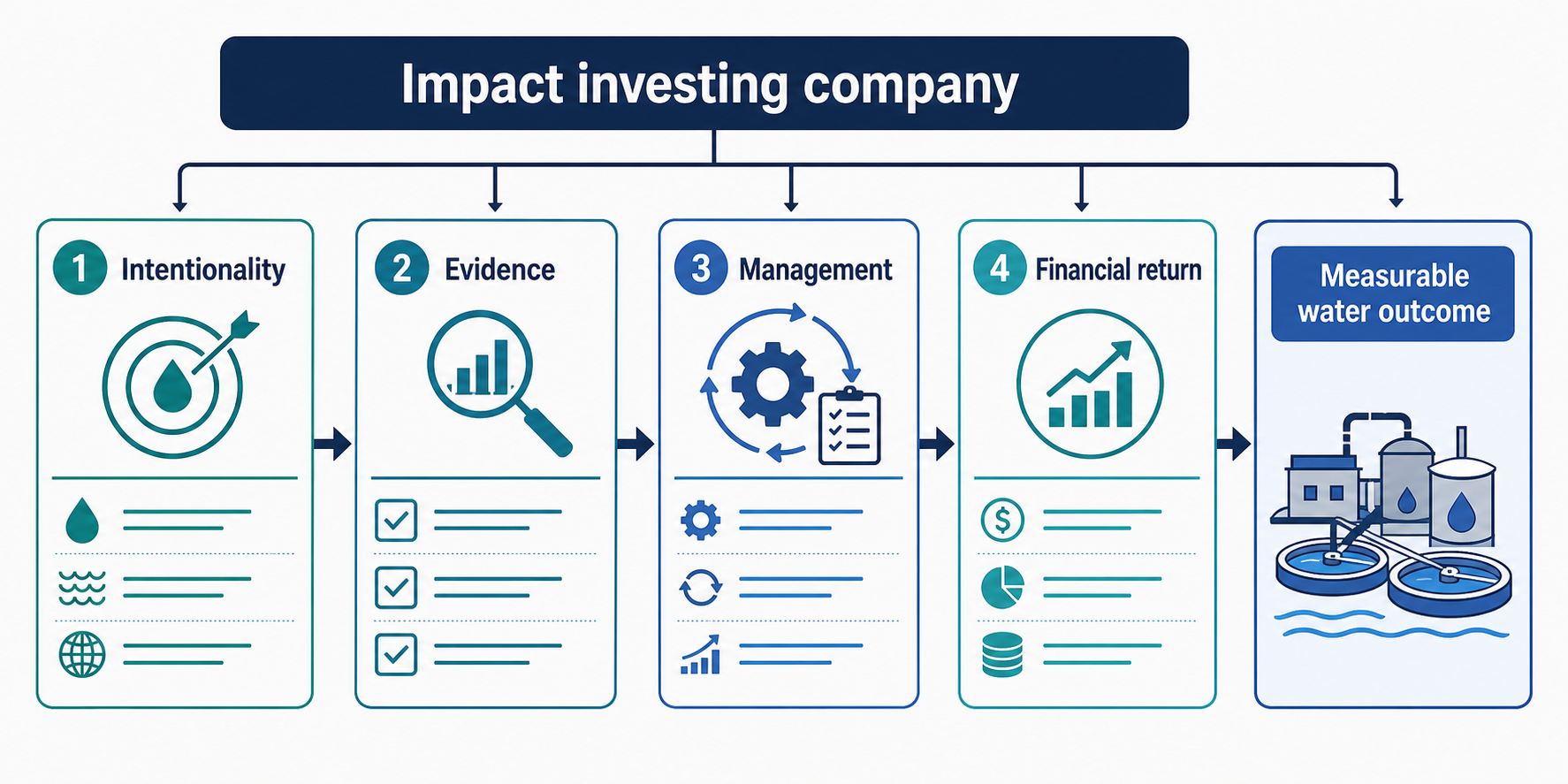
The Global Impact Investing Network (GIIN) defines impact investments as investments made with the intention of generating positive, measurable social or environmental impact alongside a financial return. That definition has two parts. The outcome must be intentional and measurable, while the investment still has a financial objective. [1]
An impact investing company is therefore more than a business with a useful product. A company can reduce water use or remove pollution without being an impact investment. The investor needs to show how capital contributes to a defined outcome and how the outcome will be managed over time.
GIIN sets out four core practices: intentionality, the use of evidence and impact data in investment design, management of impact performance, and contribution to the growth of the market. These practices give investors a useful starting point for reviewing a company’s claims. [1]
In practical terms, ask four questions:
- Which water, environmental or social problem is the company trying to address?
- What changes because the company’s product or service is used?
- What evidence shows that change is taking place?
- How does management respond when results fall below the intended outcome?
These questions also protect against a common category error. A company may sell into a water market but create limited impact. Another may create a strong outcome but lack a defensible commercial model. Investors must assess both dimensions together.
Impact investing can use different asset classes and return expectations. A private-equity investment in a water-technology business may have a different risk and liquidity profile from a concessionary project or a listed company. The impact label does not remove the need to assess valuation, terms, dilution, governance and downside.
The Water Investment Network’s guide to impact investing in water sets out the wider investment theme. This article narrows the focus to company-level evidence. The relevant question is not whether water matters. It is whether a particular company can convert a real need into durable value and measurable outcomes.
Why water companies can fit an impact thesis
Water is connected to public health, food production, industrial output, ecosystems and climate resilience. A company that improves water quality, lowers freshwater demand or makes treatment more efficient may therefore sit at the intersection of environmental and economic needs.
That broad relevance is not an investment case on its own. The company must identify who pays, what budget pays, and why the buyer will adopt the solution now. Investors should avoid treating every water problem as immediate commercial demand.
The financing context is significant. The Joint MDB Water Security Financing Report 2024 states that ten multilateral development banks approved USD 19.6 billion of water-related financing in 2024, including USD 14.4 billion for low- and middle-income countries. The report also highlights financing gaps and the role of instruments that can crowd in private capital. [2]
Those figures describe multilateral development bank activity. They are not a forecast for a private company, and they do not show that a particular market is ready to buy. They do show why investors should separate the system-level financing need from the company-level route to revenue.
IFC describes water as a sector where private capital and expertise can improve performance, innovation and efficiency. It also reports that it has committed and mobilised more than USD 5 billion in water projects since 1994. This demonstrates institutional activity in the sector, not a guarantee of private-company returns. [3]
For an impact investing thesis, the strongest water companies usually connect three things:
- A customer problem that has a measurable operational or environmental consequence.
- A solution that can be deployed within the customer’s technical and procurement constraints.
- A commercial model that allows the company to support more sites without losing control of cost or quality.
The link between these elements matters. A monitoring company may produce useful data, but the customer must act on that data. A treatment technology may deliver good results, but the customer must be willing to fund installation, maintenance and replacement. An investor should follow the chain from outcome to buyer to cash.
Water can also be a difficult sector for private capital. IFC identifies barriers including tariffs that are not cost-reflective, assets that are difficult to collateralise, limited long-term local-currency finance, and weak policies and institutions. These conditions affect customer budgets, payment risk and the route to scale. [4]
Start with the paying customer
A review of impact investing companies should begin with demand, not with a mission statement. The company must show which customer experiences the problem, who owns the budget, and who can approve a purchase. The same test applies when comparing impact investing firms.
The end user, economic buyer and contract approver may be different people. A plant manager may operate a treatment system. A finance director may approve capital expenditure. Procurement may control the tender. A regulator, utility board or public authority may influence the project. The company should map these roles for its target market.
Next, define the problem in operational terms. It may be freshwater consumption, discharge quality, production downtime, energy use, chemical cost, compliance exposure or the cost of moving water. A clear baseline lets the company explain why a buyer would pay and how impact can be measured.
Customer evidence has different strengths:
- A conversation or memorandum of understanding shows interest, but not a funded purchase.
- A paid pilot shows more commitment, but the investor should check its duration, success criteria and renewal path.
- A purchase order proves a transaction, but not necessarily a profitable delivery.
- A repeat order, renewal or expansion shows stronger evidence that the value survives the first deployment.
Review evidence by customer type. Industrial buyers may care about uptime, discharge obligations and production risk. Utilities may focus on service reliability, affordability and procurement rules. A food or pharmaceutical customer may require validation and documentation before a solution can enter the process. These are commercial differences, not interchangeable demand signals.
Geography can change the buyer’s priorities. A UK customer may have a formal procurement route and a strong focus on compliance. A European buyer may operate within a different national implementation of EU requirements. A GCC customer may prioritise reliable supply, reuse or operating performance in a water-stressed setting. The company must support each claim with its own customer and market evidence.
Investors should ask for a pipeline that separates stages. Open conversations, qualified opportunities, trials, contracted deployments and renewals should not sit in one forecast line. The conversion rate between stages should come from the company’s history where possible. If there is little history, the forecast is an assumption that needs a downside case.
A useful test is to ask what would make a buyer delay adoption. The answer may be installation risk, integration work, budget timing, site shutdowns, internal approval or uncertainty about performance. A company that understands adoption friction can design a better sales process. A company that dismisses friction may overstate its route to revenue.
Compare the revenue model and unit economics
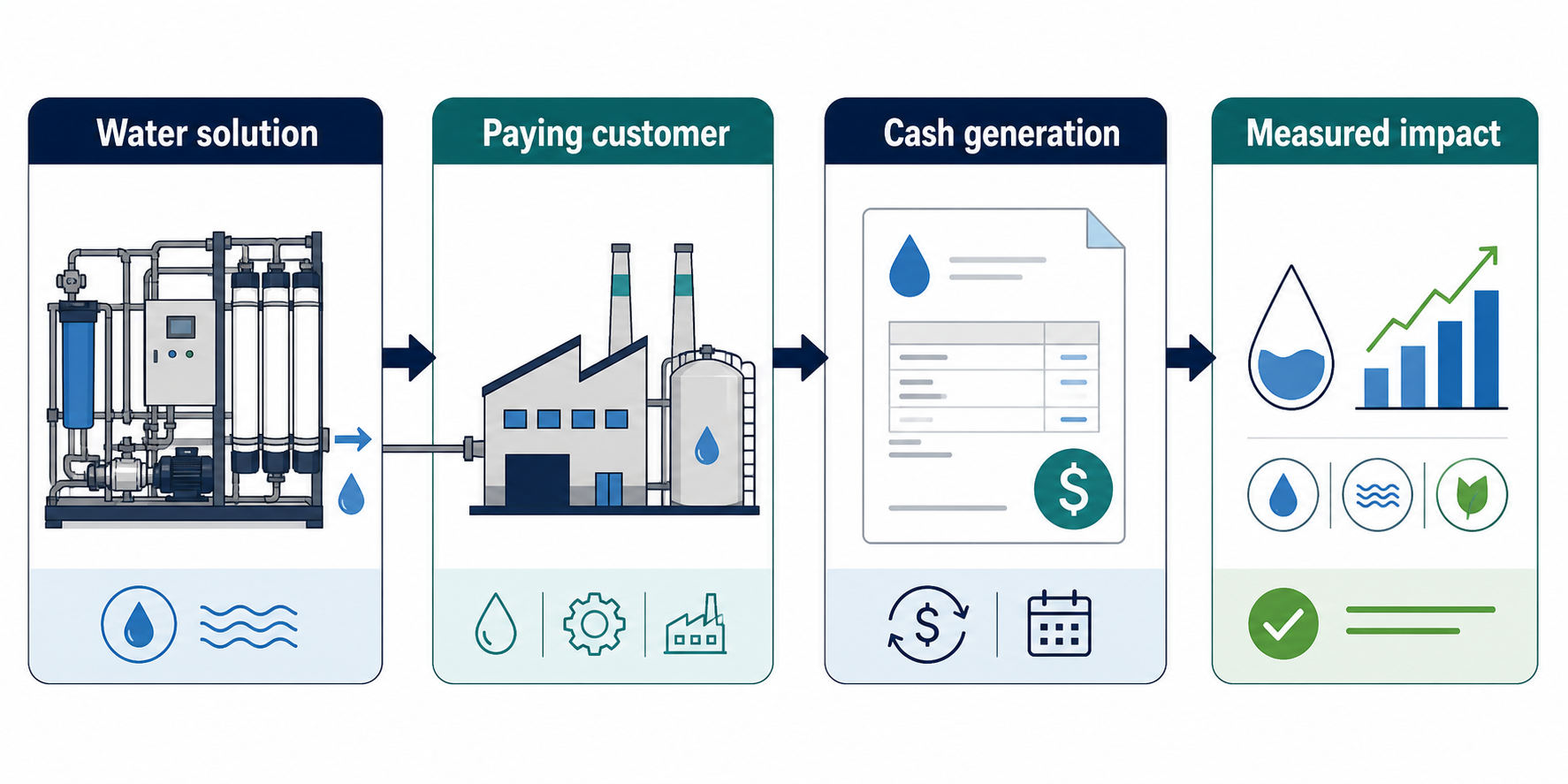
Impact investing companies can earn revenue in different ways. A water business may sell equipment, deliver a project, charge for monitoring, provide a service contract, supply consumables, or combine these models. Each model changes cash timing, margin, working capital and customer retention.
Equipment revenue can create a large order but may be uneven. Project delivery can deepen the customer relationship but expose the company to site changes and commissioning delays. Monitoring can create recurring revenue but still require hardware, data quality and field support. Treatment-as-a-service may align payment with performance, but it can require more capital and operational control.
Assess the model at the level of a real commercial unit. That unit might be a monitored site, treatment module, installation, service contract, operating hour or customer location. For each unit, the investor should understand price, direct cost, installation effort, support cost, replacement cycle and cash collection.
| Revenue model | Commercial strength to test | Investor risk to test |
|---|---|---|
| Equipment sale | Repeatable product, delivery margin and reorder potential | Working capital, warranty exposure and uneven order flow |
| Project delivery | Customer value, reference sites and ability to standardise delivery | Site changes, delays, subcontractors and cost overruns |
| Monitoring or software | Retention, useful decisions and low-cost deployment across sites | Hardware support, data quality and customer adoption |
| Service or treatment fee | Contract duration, renewal and measurable performance | Capital intensity, service levels and counterparty payment |
The table is a framework, not a scorecard. A company may use more than one model. Investors should identify the primary model and understand whether another revenue line is a real extension or only a forecast assumption.
Delivered margin matters more than quoted margin. Include freight, commissioning, site changes, subcontractors, training, warranty work and support calls. A solution may have attractive product margin but weak project margin. Growth can destroy value if every additional site requires bespoke engineering.
Recurring revenue also needs careful definition. A multi-year contract may include termination rights, performance deductions, price limits or heavy service obligations. Review invoices and collections, not just signed contract value. Ask whether the company can renew the customer at a margin that covers the installed base.
Working capital can absorb impact capital quickly. A company may pay suppliers and staff months before a customer accepts performance. Model delayed commissioning, slower collections, higher support cost and a lower sales conversion rate. The investor should know whether growth strengthens cash resilience or increases dependence on another funding round.
Test technical proof and commercial adoption
Technical proof and commercial proof answer different questions. Technical proof asks whether a process, device or system performs under stated conditions. Commercial proof asks whether a customer will buy it, use it, renew it and accept the result at a sustainable price.
Start with the operating boundary. Review water characteristics, flow range, temperature, maintenance, power, consumables, data quality and failure limits. Ask which conditions were controlled during testing. If the technology only works with a narrow water profile, the company must show how it identifies suitable sites.
Then review the deployment record. How many sites are live? How long have they operated? Which deployments were paid? Who accepted the performance? How often has the system required intervention? A short pilot may prove feasibility, but it may not prove reliability, support economics or repeatable delivery.
Look for evidence that the company can move from one site to several. A repeatable bill of materials helps, but it is not enough. Investors should examine design time, procurement, installation partners, commissioning, training, remote support and spare parts. The company’s ability to manage this process can become a source of defensibility or a limit on growth.
Failure data deserves equal attention. Ask how management handles off-specification water, fouling, sensor drift, delayed components, missed performance tests, warranty claims and customer complaints. A transparent failure process is often more useful than a list of perfect pilot results.
Independent reports can strengthen a case when their method, funding and limits are clear. A report paid for by the company may still be useful. It should not be called regulatory approval or independent customer validation unless it meets that standard. Precise language reduces diligence risk.
IFC’s water work highlights the importance of project preparation, financing structures, risk management and market conditions in water infrastructure. For a private company, the practical lesson is to remove avoidable friction from the path between a working solution and a financeable deployment. [3]
Technology risk does not disappear because the intended impact is valuable. Investors should price the gap between laboratory results, paid pilots, repeated operations and scaled deployment. Patient capital may help close that gap, but each stage still needs evidence and a funding limit.
Measure impact without relying on labels
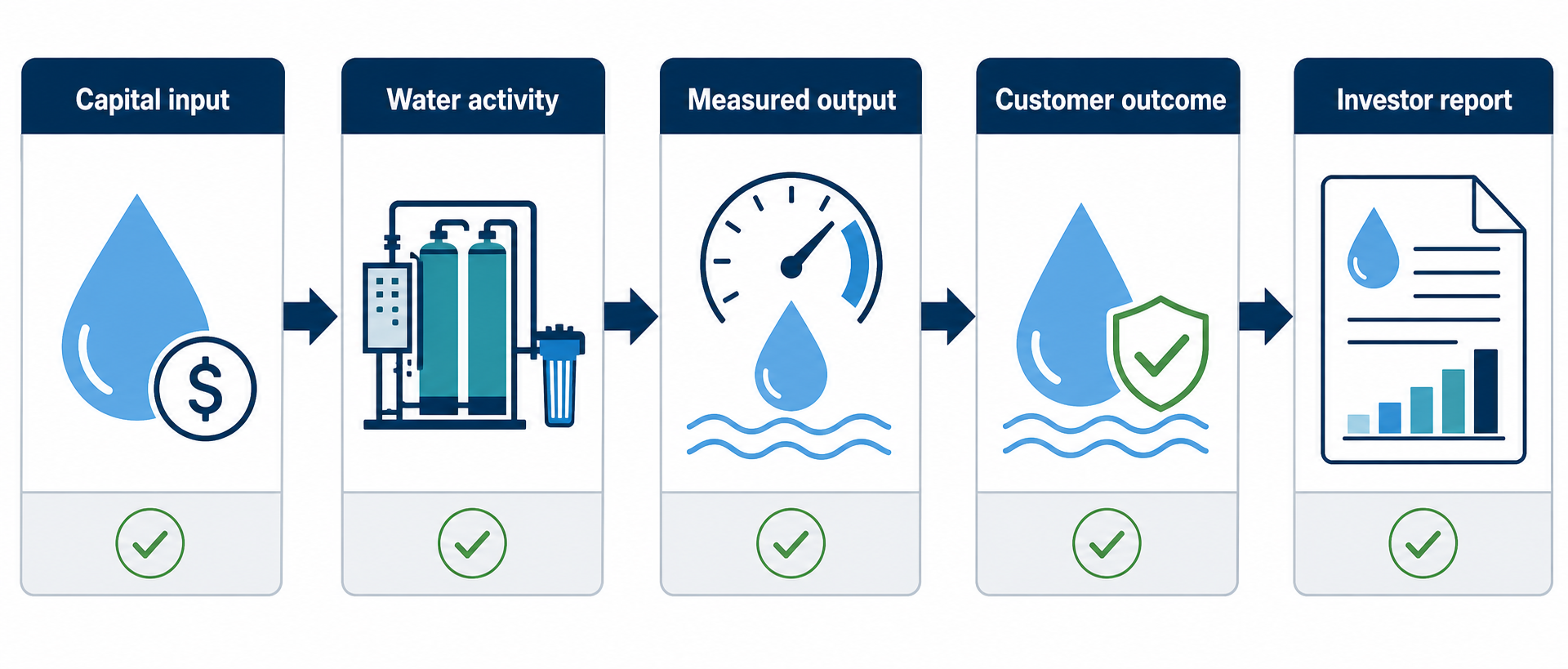
Impact measurement should show what happens because the company’s product or service is adopted. It should not simply repeat the customer’s existing activity or count equipment sold without checking use and outcomes.
Build a short impact chain. State the input, the activity, the output and the outcome. For example, capital may fund a monitoring system. The system may produce reliable data. The customer may use that data to reduce leaks or improve treatment. The outcome might then be lower freshwater use or better discharge performance. Each link needs a defined measure and a responsible owner.
Choose measures that fit the business model. A treatment company may track treated volume, discharge quality, energy use, chemical use and operating time. A monitoring company may track active sites, data completeness, alerts acted upon and verified operational change. An infrastructure company may need measures for service reliability, access, affordability and resilience.
Avoid false precision. If the company has estimated a water saving, state the baseline, period, method and assumptions. Separate measured performance from a forecast. Do not convert a modelled benefit into a verified impact figure without evidence from the operating site.
GIIN’s core characteristics call for evidence and impact data in investment design, management of impact performance and clear communication of progress. This implies a feedback loop. Management should use results to change product design, customer selection, pricing, deployment or capital allocation. [1]
Independent verification can be useful where the outcome is material, complex or easy to overstate. The Institutional Limited Partners Association highlights tools for transparency, impact management, standardised metrics and independent verification across private markets. These resources can help an investor assess the quality of an impact process. [5]
Materiality matters. A small water saving may be real but not central to the company’s value proposition. A company should identify which outcome is most important and which risks could undermine it. It should also consider negative effects, such as additional energy use, waste streams, chemical handling or displacement of an existing solution.
Investors should ask who owns the data. Confirm access rights, calculation methods, reporting frequency and the process for correcting errors. If the customer controls the baseline, the company may need a clear data agreement. If the company controls the measurement, the investor should understand the risk of biased reporting.
Impact reporting should support an investment decision. It should help the committee assess customer value, retention, regulation, reputation, operating risk and exit quality. A glossy impact claim with no link to the business model is weak evidence.
Check additionality, governance and integrity
Additionality asks what changes because this investor, this company or this form of capital is involved. It is different from claiming that a company operates in a useful sector. The investor should explain the contribution without overstating it.
A company may need capital to complete a pilot, hire delivery staff, build inventory, certify a product or enter a new market. Those uses can be relevant to additionality when the company can show why the capital is needed and what outcome it unlocks. A vague claim that investment will accelerate growth is not enough.
Review governance at the level expected for a private-company investment. Check board composition, reporting, conflicts, related-party transactions, shareholder rights, financial controls, data protection and the process for handling incidents. The right level of formality depends on the company’s stage, but the core controls should be visible.
Impact governance should sit inside operating decisions. Ask who can change the impact targets, who receives the data, what happens when a target is missed, and whether incentives reward volume at the expense of outcomes. A company that treats impact as a marketing function may struggle when commercial pressure increases.
GIIN’s recent work also notes that regulators have introduced product labels, taxonomies, anti-greenwashing standards and other sustainable-finance frameworks, while gaps remain around impact investing. Investors should therefore use clear evidence and avoid assuming that an impact label has one universal legal meaning. [6]
Check the company’s public language against its evidence. Words such as “sustainable”, “climate-positive” or “water-secure” may cover different claims. The investment committee should distinguish a verified company result from a stated intention, a customer estimate and a future target.
Integrity also includes commercial honesty. Review revenue concentration, unpaid invoices, customer references, pipeline quality, warranty liabilities and historic capital use. An impact company is still a company. Weak disclosure in the financial case can undermine confidence in the impact case.
Assess regulation and regional exposure
Regulation can create demand for water technology, but it can also delay projects, change specifications or raise compliance costs. Investors should identify the rule, jurisdiction, affected customer and commercial mechanism. Do not treat a broad policy goal as a contract forecast.
For a UK opportunity, review the relevant national regulator, environmental requirements, procurement route and customer obligations. For a European opportunity, identify the country implementing the relevant EU framework and check how the customer is affected. A statement about Europe is rarely precise enough for diligence.
GCC opportunities also need country-specific review. The UAE, Saudi Arabia, Qatar, Kuwait, Bahrain and Oman have different institutions, procurement processes, tariffs, ownership structures and project economics. Water stress may support a customer conversation, but it does not prove a bankable contract.
IFC notes that policy and institutional weakness can limit private water investment, while stronger regulation and better financial terms can reduce risk. The investor should therefore assess not only the rule, but also the customer’s ability and willingness to act under it. [4]
Ask how the company monitors regulatory change. Does it sell into a compliance requirement, support a voluntary efficiency goal, or benefit from a customer’s internal risk policy? Each route has a different level of urgency and price sensitivity.
Cross-border exposure includes currency, tax, ownership, data, import rules, contracting, warranties and enforceability. These questions need qualified legal, tax and regulatory advice. The investment memo should identify them as diligence work, not present a general overview as a completed conclusion.
Regulation can be part of defensibility when the company has trusted approvals, validated data, specialist integration knowledge or a track record with demanding customers. It can also be a barrier that slows sales and increases cost. The investor needs evidence of both effects.
Build a complete investment diligence case
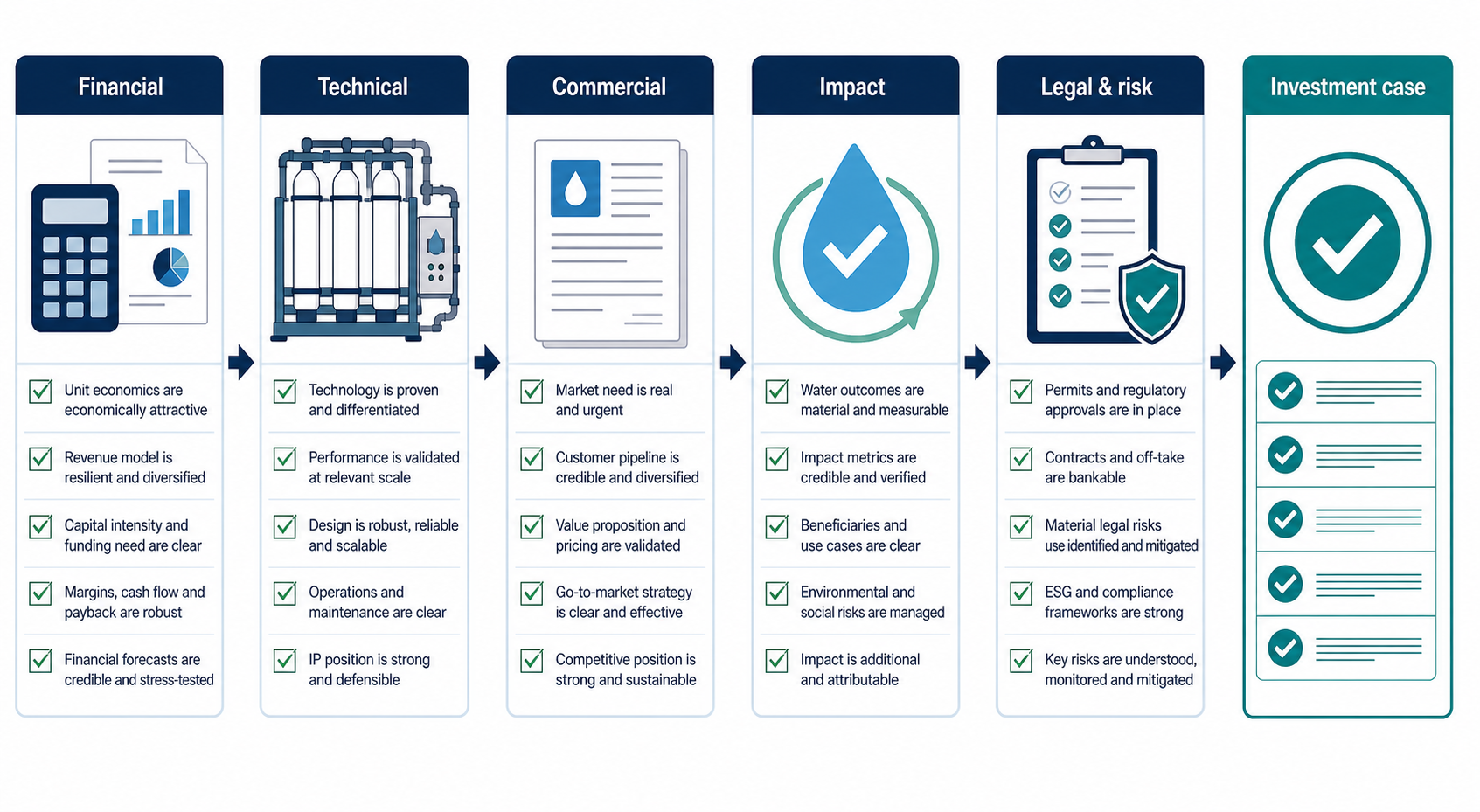
Impact investing companies should be reviewed through the same commercial discipline applied to other private-company investments. The impact thesis adds a set of questions. It does not replace financial, legal, technical, tax, regulatory or operational diligence.
Start with the company’s history. Review monthly revenue, gross margin, cash balance, working capital, customer concentration, overdue invoices, capital expenditure and previous funding. Reconcile the figures to bank records, contracts, invoices and management accounts where appropriate.
Then test the forecast from the bottom up. Count customers, deployments, average price, delivery cost, sales cycle, renewal rate and support load. Separate signed revenue from pipeline. Show what happens if the largest opportunity slips, the gross margin falls, or the next funding round takes longer.
Technical diligence should match the company’s current stage. Review test methods, site records, performance data, maintenance logs, intellectual property, suppliers, product roadmap and failure history. If performance depends on a third party, that dependency should appear in the risk register.
Commercial diligence should include customer calls where possible. Ask what problem was solved, what alternatives were considered, what the customer paid, what was difficult, and whether the customer would buy again. A positive reference is more useful when it includes the limits of the solution.
Impact diligence should check the baseline, method, data owner, frequency, verification and negative effects. The investor should be able to trace one reported outcome back to a customer site or a documented calculation. If that trace is not possible, classify the claim as unverified.
The ILPA impact investing resources emphasise informed decision-making, transparency, consistent impact management and practical evaluation questions for limited partners. The same habits are useful for direct investors reviewing impact investing companies. The Water Investment Network portfolio is a starting point for reviewing direct water opportunities, not a substitute for independent diligence. [5]
Risk should be linked to a mitigation and an owner. For example, a long sales cycle may require milestone funding and a stronger channel strategy. Customer concentration may require a diversification plan. Technical failure may require independent testing, warranty reserves and better site selection. A risk list without a response plan is not a diligence framework.
Finally, decide what evidence would change the investment decision. Set conditions for the next tranche, reporting rights, information access and a review date. Clear conditions let the investor support growth while retaining the ability to reassess when evidence changes.
Decide portfolio fit, terms and next steps
A strong impact investing company can still be unsuitable for a particular portfolio. The investor should assess holding period, liquidity, concentration, follow-on capital, governance workload and the relationship between impact risk and financial risk.
Private water companies may need time to convert technical proof into repeatable revenue. That can suit a family office or sophisticated private-market investor with a long horizon. It may not suit an investor who needs near-term liquidity or cannot support follow-on decisions.
Terms should reflect the evidence gap. Review valuation, dilution, preference rights, information rights, board rights, reserved matters, founder vesting, option pools and transfer restrictions. A strong mission does not justify weak documentation or an unclear route to ownership.
Exit logic should follow the company’s value creation. A future buyer may value a contracted customer base, validated technology, recurring service revenue, specialist data, manufacturing capability or a difficult-to-replace application. The company should explain the asset a buyer would acquire, not simply list possible acquirers.
Portfolio fit also includes impact integrity. Decide how the investment will be monitored, which measures matter, how often the investor receives them, and what happens if the intended outcome weakens. Impact management should remain active after the initial investment decision.
World Bank reporting shows that public and development finance can work with private capital to address water-security needs. This wider ecosystem may create partnership or financing routes, but it does not remove company-level risk. Investors should treat external finance as a possible enabler, not as an assumed source of demand. [2]
The decision should state what has been proved, what remains uncertain, what capital will change, how progress will be measured and what would make the opportunity unsuitable. That is the difference between an impact story and an investable case.
Water Investment Network is an invitation-only network for eligible family offices, high-net-worth investors, sophisticated impact and private-equity investors, and relevant advisers. Eligible investors can request access to Water Investment Network, subject to the network’s eligibility process. Any opportunity still requires independent legal, financial, commercial, technical, tax, regulatory and impact diligence. Water Investment Network does not provide regulated financial advice or guarantee investment returns.
Frequently asked questions about impact investing companies
What are impact investing companies?
Impact investing companies aim to solve a defined social or environmental problem while building a business that can deliver a financial return. A credible assessment needs intentionality, evidence of outcomes, impact management and a workable commercial model.
What makes a water company an impact investment?
The company should connect a water or environmental outcome to a paying customer, a deployable product or service, and measurable performance. The label alone is not enough. Investors should test the baseline, evidence, revenue quality and risks.
How should investors measure impact in water?
Use measures that fit the business model, such as treated volume, discharge quality, freshwater use, operating reliability, energy use or verified customer outcomes. Record the baseline, method, assumptions, data owner and reporting period.
What are the main risks in impact investing companies?
Risks can include slow adoption, technical underperformance, bespoke delivery, weak cash conversion, customer concentration, regulatory change, currency exposure, future funding needs and illiquidity. The relevant risks depend on the company and its market.
Are impact investing companies suitable for every investor?
No. Direct private-company investments may require a long holding period, follow-on capital, active oversight and tolerance for loss or illiquidity. Investors should assess suitability independently and obtain qualified advice where needed.
Sources
- https://thegiin.org/publication/post/core-characteristics-of-impact-investing/
- https://www.worldbank.org/en/topic/water/publication/water-security-financing-report-2024
- https://www.ifc.org/en/what-we-do/sector-expertise/infrastructure/water
- https://www.ifc.org/en/stories/2024/water-towards-sustainability-and-beyond
- https://ilpa.org/industry-guidance/impact-investing/
- https://thegiin.org/publication/research/expanding-the-investor-toolbox-mobilizing-private-capital-for-measurable-outcomes/