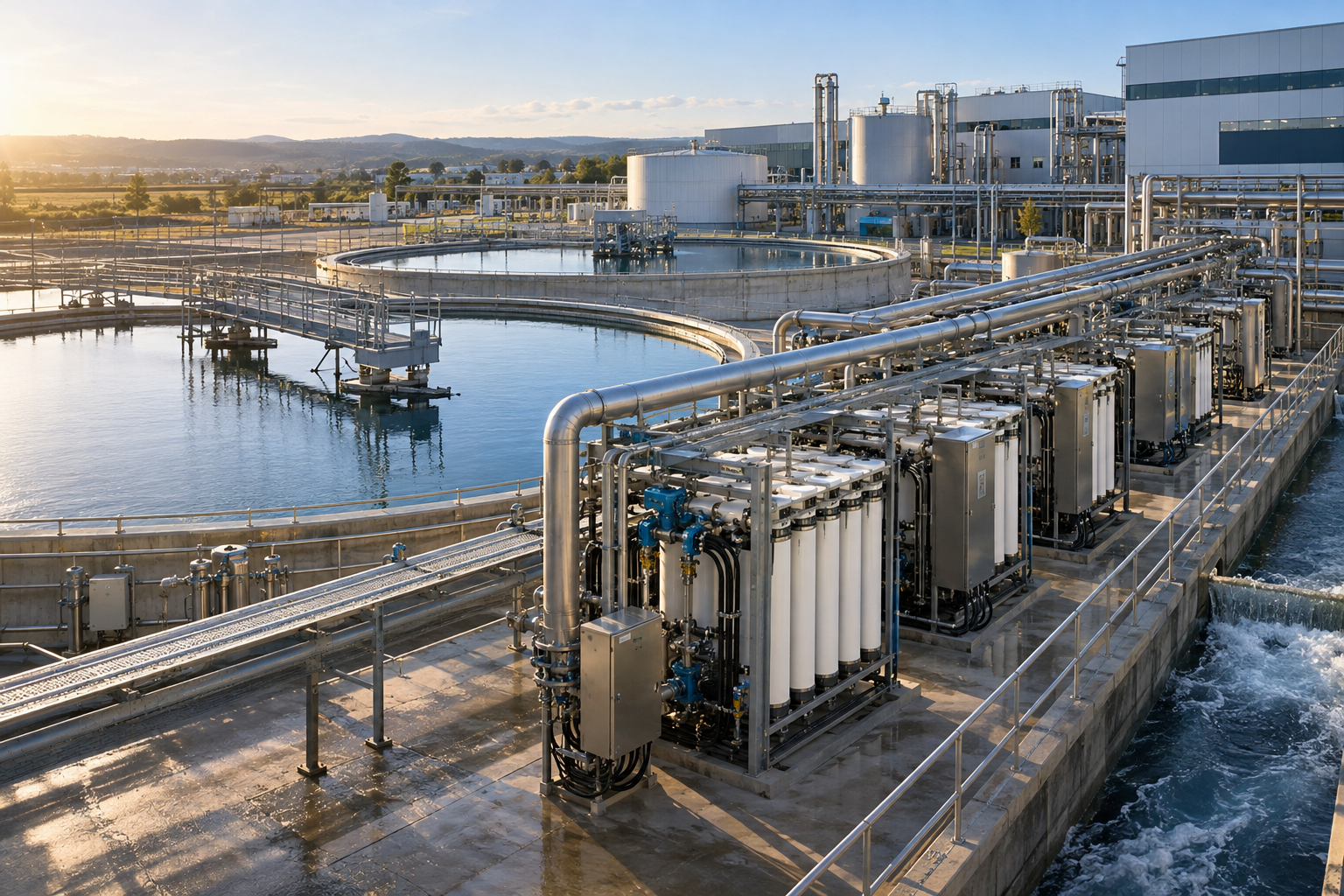
Impact investing due diligence in water starts with a simple test: can a real water problem become a durable customer need, a workable business model and a measurable outcome?
The question matters because a strong impact story can hide weak revenue, difficult deployment or uncertain data. Water investors need to test all of these points before they treat an opportunity as investable.
This guide is for family offices, high-net-worth investors, private-equity teams and advisers assessing direct private-market opportunities. It connects impact evidence with customers, contracts, margins, scalability, governance and downside risk.
The wider Impact Investing pillar on Water Investment Network provides the broader context. This article focuses on the work that happens before a committee decides whether an opportunity deserves capital, a pilot or more evidence.
What impact investing due diligence means in water
Impact investing due diligence is the structured review of an investment’s commercial case and intended social or environmental outcome. In water, the review may cover treatment, reuse, monitoring, resource recovery, water security or services that help customers manage quality and supply.
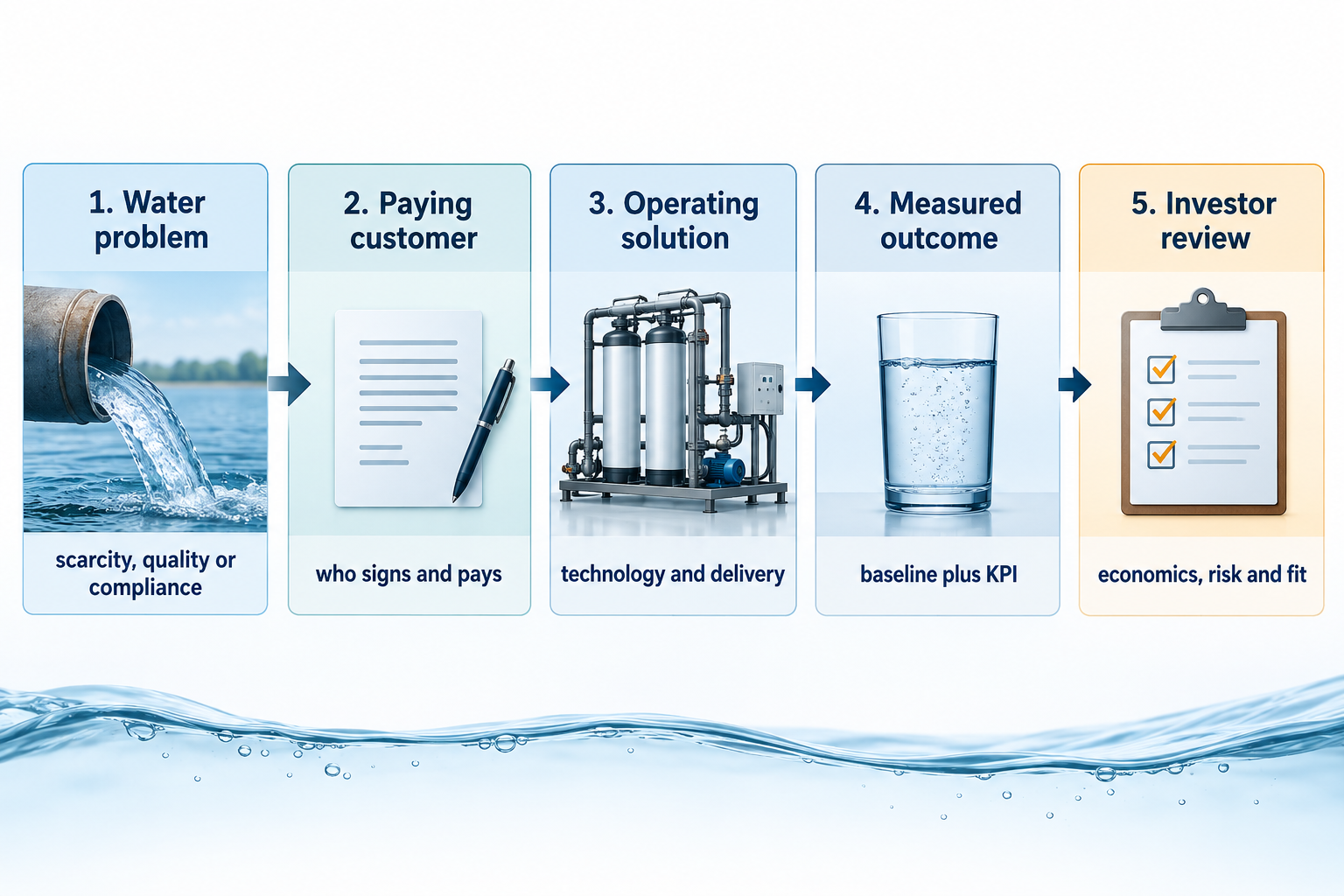
The investment should have a clear chain from problem to result. A water company may promise lower freshwater use, cleaner discharge or better resilience. The investor must ask which customer experiences the change, what the baseline is, how the result is measured and what the company contributes.
The Operating Principles for Impact Management describe ex-ante impact assessment as a review made before capital is committed. Their framework asks investors to consider intended impact, who experiences it, significance, likelihood and risks that could change the result.
That approach does not require one universal score. It requires a repeatable decision process. The same discipline also improves the commercial review because it forces the investor to identify assumptions rather than rely on a compelling label.
Start with the water problem and the paying customer
Begin with the site or system where the problem occurs. It may be a factory that needs to reuse process water, a utility that must improve treatment, or an industrial customer facing a quality or discharge constraint.
Then identify the buyer. The person who understands the water problem may not control the budget. A site manager may sponsor a pilot, while procurement, finance or a central engineering team approves the contract.
Ask what failure costs the customer. The answer could involve downtime, lost production, extra treatment, freshwater purchases, a delayed expansion or a compliance response. A solution with no clear economic consequence may struggle to become a repeatable sale.
The World Bank’s Water for Shared Prosperity work links water security with productivity, jobs and economic growth. That is useful demand context. It is not evidence that a particular company has a contract, a margin or a route to market.
The Environment Agency’s National Framework for Water Resources 2025 describes long-term pressure on water resources and the need for resilient, joined-up planning in England and Wales. It supports the case for diligence on water resilience. It does not replace project-level approvals, customer evidence or financial analysis.
Investment thesis at a glance
A short thesis should make the decision test visible before the model becomes complex. It should state who pays, how value is delivered, what impact is intended and what can break the case.
| Thesis element | Question to answer | Evidence to request |
|---|---|---|
| Problem | What water cost, risk or constraint is the customer solving? | Site data, operating records, customer interviews and current alternatives |
| Buyer | Who signs, pays, uses the service and bears failure risk? | Contract map, procurement route, decision rights and renewal history |
| Revenue | How does delivery become collected cash? | Pricing, gross margin, billing terms, working capital and concentration |
| Scalability | What must repeat across sites, customers or jurisdictions? | Installation time, service capacity, suppliers and sales process |
| Impact | What changes, for whom and over what period? | Baseline, boundary, KPI, data owner and verification method |
| Risk | Which technical, commercial, regulatory or funding assumption is weakest? | Downside case, mitigation owner, trigger and decision rule |
| Exit or continuation | Why could the next owner or long-term holder value the asset? | Cash generation, strategic logic, transferability and funding path |
This is a decision map, not a scoring shortcut. If the impact narrative is strong but the buyer, contract and cash path are unclear, the right next step may be a defined pilot rather than an investment.
Test commercial demand, revenue and margins
Commercial diligence should follow the customer journey. Start with the problem, then review the buying process, contract, delivery cost and renewal or expansion evidence.
Move from interest to paid use
A customer conversation shows interest. A technical trial shows that a solution can be tested. A paid pilot shows willingness to allocate budget. A repeat order, multi-site rollout or contracted recurring service offers stronger evidence of a repeatable market.
Ask what makes the customer renew. It may be lower treatment cost, fewer interruptions, reliable quality, easier reporting or a reduced need for freshwater. The company should know which benefit is paid for and which benefit is an additional outcome.
Build a customer evidence ladder
Put customer evidence into a clear order. A problem statement shows relevance. A technical assessment shows that the proposed route is plausible. A pilot shows whether the system can perform in the target setting. A paid contract shows budget commitment. Repeat deployment shows that the company can sell and deliver again.
This ladder helps investors avoid two common errors. A long list of pilot discussions is not the same as contracted demand. One large contract is not proof of a broad market if it depends on a special relationship, a grant or an unusual procurement route.
For each customer, record the decision maker, budget source, buying stage, expected value, next condition and reason the deal could stop. This turns a pipeline into evidence that can be tested rather than a sales forecast that is accepted at face value.
Read the revenue quality
Review service levels, acceptance tests, payment milestones, indexation, termination rights and renewal history. If the company operates equipment, check who pays for energy, chemicals, consumables, maintenance and replacement parts.
Then test gross margin by customer type and deployment stage. A product can appear attractive at the equipment level while commissioning, integration and support absorb the margin. A service model can create recurring revenue while also creating a large field-support burden.
Working capital can be just as important as gross margin. Long equipment lead times, milestone billing, retention payments and slow customer acceptance can force the company to fund growth before it collects cash. Model those timing gaps separately from the headline margin.
Customer concentration deserves special attention. A large corporate buyer may validate the problem, but it may also have unusual bargaining power. Test whether an independent customer would buy at a similar price without the same strategic relationship.

Assess technology, deployment and operating risk
Investors do not need to become process engineers. They do need a plain explanation of the input, the treatment or monitoring step, the output and the conditions that affect performance.
Separate design capacity from achieved performance. A system may be capable of treating a stated flow under defined conditions. That does not prove the same result at every customer site or across a full operating year.
Ask which parts are standard and which are bespoke. Bespoke integration may improve fit but can increase sales time, working capital and commissioning risk. Standard modules may support scale but still require site-specific permissions, pipework, software or operator training.
Review the operating burden. Who monitors alarms? Who responds to a failed sensor? How often are membranes, filters or other components replaced? Can the provider support a larger installed base without adding the same level of specialist labour to every site?
Supplier concentration belongs in the investment case. A single component or installer may be manageable, but the dependency should be visible. Check alternatives, lead times, warranty terms and the effect of a shortage on delivery dates and margin.
IFC’s water-sector material highlights project preparation, financing, risk management, local-market knowledge and delivery partnerships. The wider lesson is practical: a technically sound product still needs the institutions, contracts and operating capability around it.
Measure impact before capital is committed
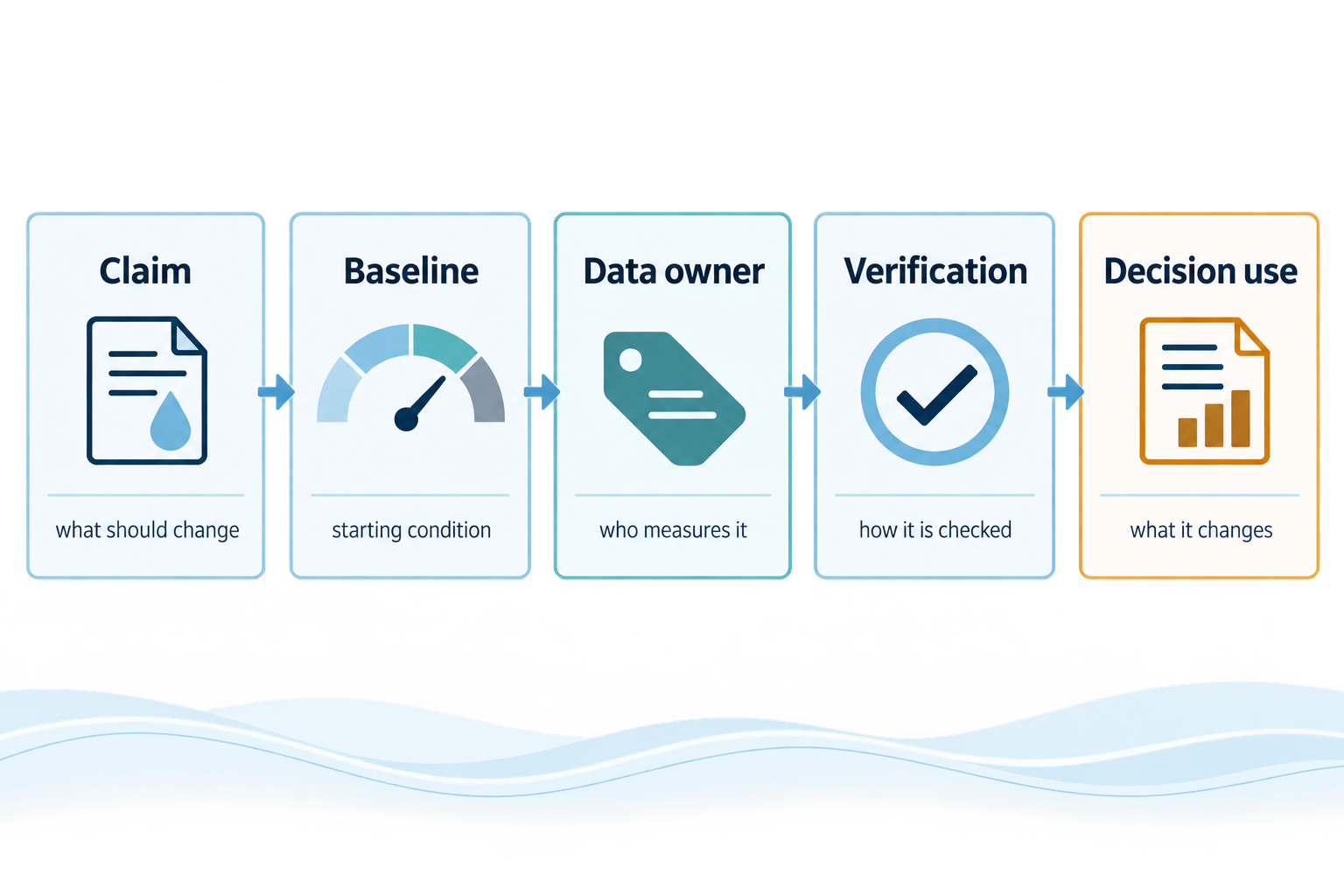
Impact measurement should begin during diligence, not after the first annual report. Define the baseline, boundary, affected people or environment, period and data owner before the investment committee decides.
Separate outputs from outcomes. Equipment installed is an output. A verified change in freshwater intake, discharge quality, leakage, energy use or service reliability is an outcome. The outcome depends on operating conditions and should be measured where the change occurs.
The UNEP Finance Initiative’s impact-analysis tools are designed for investors and investee companies. They include uses such as decision-making, due diligence, portfolio review, impact target-setting and reporting. The tool is not a substitute for company-specific evidence, but it shows why impact analysis belongs in the investment process.
Use a small number of useful KPIs. A good KPI has a clear definition, a baseline, a measurement boundary, a responsible owner and a review date. It should help the investor make a decision, not merely create a longer report.
Check the counterfactual
Impact claims need a counterfactual. Ask what would happen without the company, the capital or the proposed operating change. A project may improve a site, but the investor should understand how much of the change is attributable to the investment.
Do not count the same benefit twice. A reduction in water use and a reduction in water purchased may describe one change. A lower discharge load may also depend on a separate process improvement. The reporting boundary should make these relationships clear.
Check additionality and the investor contribution
Additionality asks what the investment adds that would not otherwise happen. In private water markets, the contribution may be patient growth capital, a customer site, technical expertise, distribution access, a better financing structure or help with governance.
The answer should be specific and testable. If the project would proceed on the same terms without the investor, the capital contribution may be limited. If a strategic partner opens a market but demands exclusivity, the value and the constraint should both appear in the investment documents.
Additionality is not the same as impact. A company can create a positive water outcome without the investor being decisive. An investor can contribute capital without proving that the expected outcome will occur. The two questions belong beside each other, not in place of each other.
Build the claim into the monitoring plan. Record the contribution, expected change, owner, evidence source and review point. If the contribution is commercial rather than financial, define what success looks like and what happens if the partnership does not deliver it.
Review regulation, data and sustainability claims
Water regulation is local and can affect timing, cost, customer demand and liability. Identify the jurisdiction, regulator, permit, abstraction or discharge issue, construction requirement and operating responsibility that matter to the opportunity.
Do not treat UK, European and GCC markets as one legal market. A company may need different approvals, local partners, contract terms or reporting controls in each country. The investment case should show where the evidence is established and where it remains a hypothesis.
In England and Wales, the National Framework for Water Resources 2025 describes the need for resilient supplies, environmental protection, demand management, reuse and investment across sectors. It is useful context for market demand. It is not proof of a contract or permission for a particular project.
Data governance matters when a target collects information from a customer’s site. Confirm who owns the data, who can access it, how it is checked and what happens when a reading is missing or disputed. Impact reporting that cannot be audited can become a reputation risk.
For UK-authorised firms, the FCA’s Sustainability Disclosure Requirements include an anti-greenwashing rule and requirements for accurate sustainability-related terms. The exact scope depends on the firm and product. The diligence lesson is broader: claims should match the evidence, the boundary and the activity that creates the outcome.
Review related-party transactions, exclusivity, data rights, board seats, reserved matters, procurement rights and the treatment of underperformance. Governance should protect both commercial value and the integrity of the impact claim.
Underwrite portfolio fit, governance and exit options
A single water investment can look attractive in isolation and still create concentration risk. Review customer, geography, technology, supplier, currency and regulatory exposure across the wider portfolio.
Portfolio fit is not only about correlation. An investor may gain useful learning across several water assets, such as common customer types, deployment barriers or measurement methods. That benefit should be recorded as a hypothesis with an owner, not treated as automatic value.
Exit analysis should begin with transferability. Who could own the business or asset later? Which evidence would a strategic buyer, growth investor or infrastructure owner need? Does the company have a route to cash generation, follow-on capital or a larger platform?
Possible routes can include a strategic acquisition, a later private-equity round, refinancing, a continuation structure or distributions from an operating project. These are possibilities, not promises. The case should name the value driver and the conditions required for it.
Use the Water Investment Network portfolio as context for how a direct water opportunity may sit beside other private-market exposures. It does not replace investor-led legal, financial, technical, commercial or regulatory diligence.
Use decision gates and a reporting plan
A decision gate turns a long diligence file into a sequence of questions. It also shows what the investor must verify before moving from one stage to the next.
- Demand: confirm a real buyer, a defined problem and a route to budget.
- Delivery: confirm that the technology works in the target setting and can be supported at scale.
- Economics: test price, gross margin, working capital, capital needs and the downside case.
- Impact: agree the baseline, intended outcome, measurement boundary, KPI and data owner.
- Risk: record the main technical, commercial, regulatory, governance and funding risks with decision triggers.
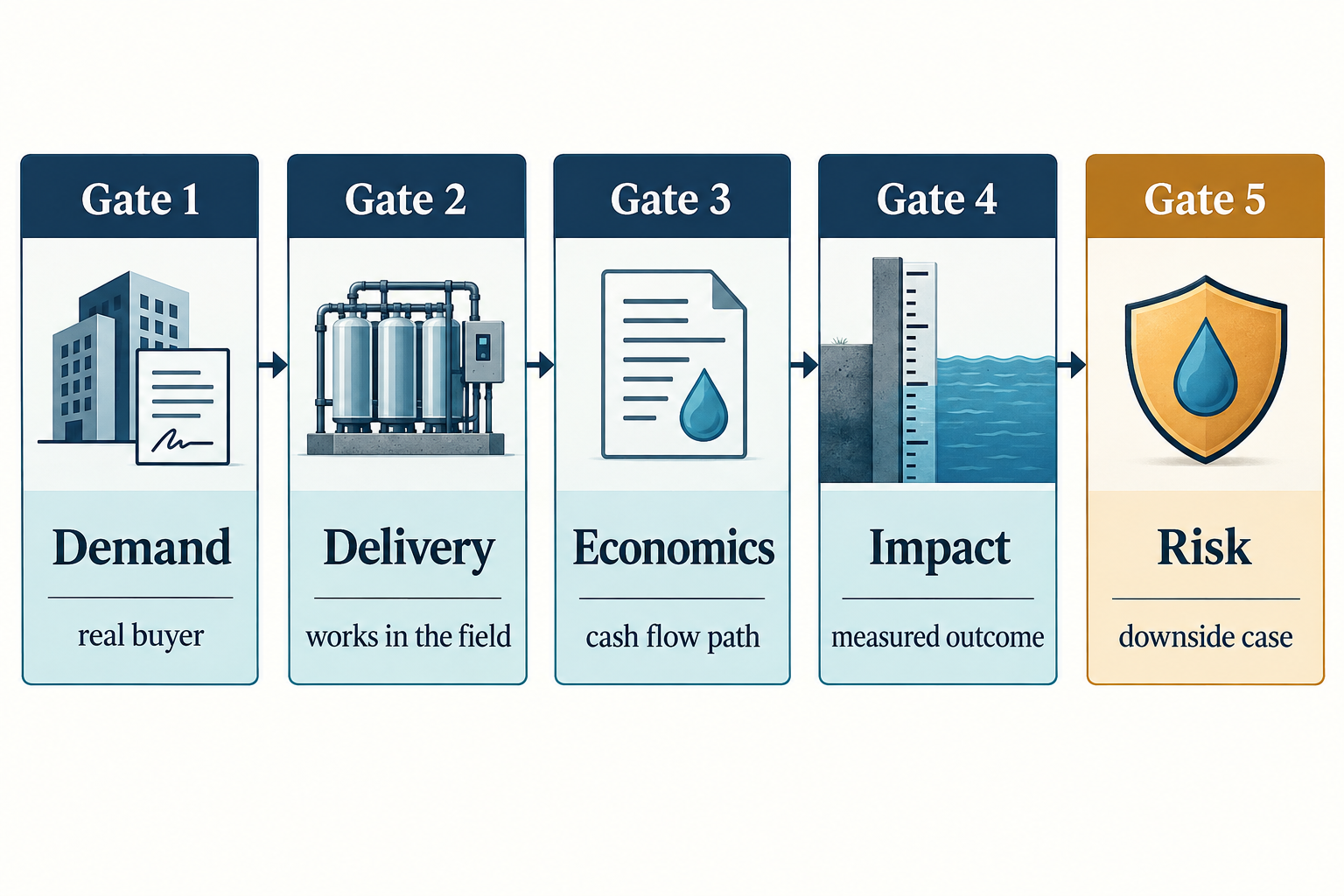
The reporting plan should follow the gates. A customer KPI may need monthly operating data. A portfolio-level impact measure may be reviewed quarterly. A governance or funding risk may need an immediate escalation trigger.
Set out what would change the investment decision. Examples include a failed performance test, a delayed permit, a lost customer, a material cost overrun, a missing baseline or a claim that cannot be independently supported.
A disciplined process does not remove risk. It helps an investor decide which risks are understood, which can be managed and which should stop the deal.
Impact investing due diligence FAQs and next step
What is impact investing due diligence?
It is the review of an investment’s commercial case and intended social or environmental outcome before capital is committed. In water, it should cover customers, revenue, technology, delivery, impact evidence, regulation and downside risk.
Why does water need a specific diligence approach?
Water businesses operate within local systems, physical assets and customer processes. Performance can depend on site conditions, permits, operating discipline, energy, maintenance and counterparty strength.
What impact evidence should investors request?
Request a baseline, clear boundary, intended outcome, KPI, data owner, verification method and review period. Also ask what would happen without the investment and whether any trade-offs are material.
How should investors test a water technology company?
Start with the paying customer and the cost of the problem. Then test paid use, contract quality, achieved operating performance, gross margin, deployment capacity, suppliers, regulation and follow-on capital needs.
Does Water Investment Network provide investment advice?
No. Water Investment Network is an invitation-only network connecting eligible investors with selected direct opportunities. It does not provide regulated financial advice or guarantee returns. Investors and advisers must complete their own independent diligence.
Eligible investors who want to explore selected direct water opportunities can join the Water Investment Network. For a general enquiry, use the WIN contact page.
This article is for information and access. It is not regulated financial advice. Any investment decision requires independent legal, financial, technical, commercial, regulatory and impact diligence.
Sources used
- Operating Principles for Impact Management, Principle 4: Ex-Ante Impact Assessment.
- UNEP Finance Initiative, Tools for Holistic Impact Analysis.
- International Finance Corporation, Water.
- World Bank, Water for Shared Prosperity.
- Environment Agency, National Framework for Water Resources 2025.
- Financial Conduct Authority, Sustainability Disclosure Requirements and investment labels.