
Impact investing in water is more than putting capital behind a serious environmental problem. It is a test of whether a private company can create a measurable water outcome while building a durable commercial model. The strongest opportunities connect a real customer need to revenue, margin, adoption and evidence.
Water gives investors a clear reason to look beyond a broad label. Treatment, reuse, monitoring and water-efficiency businesses sit close to physical operations. Their products can reduce freshwater demand, improve discharge control, protect production or make water systems more resilient. Those outcomes may matter to customers before they matter to an impact report.
This guide explains how private-market investors can assess impact investing in water. It covers the investment thesis, additionality, customer economics, measurement, technical risk, regulation, governance and exit. It is educational content, not regulated financial advice or a promise of performance.
What impact investing means in water
Impact investing means investing with an intention to contribute to positive social or environmental impact alongside a financial return. The distinction is the word “contribute”. A company may operate in a useful sector, but the investor still needs a credible link between its capital, the company’s activity and the outcome.
The Impact Investing in Water guide sets out the wider parent theme. This article focuses on the narrower question that matters in a deal review: what evidence would show that a water company is both impactful and investable?
Water companies can work across very different models. One may sell a treatment module to a manufacturer. Another may provide monitoring as a service. A third may help a customer reuse process water or reduce losses across a site. These companies should not be assessed with one generic environmental score because their customers, contracts, operating costs and routes to scale differ.
The Operating Principles for Impact Management define impact investments as investments into companies or organisations with an intent to contribute to measurable positive social or environmental impact alongside a financial return. The Principles describe an end-to-end process covering strategy, origination and structuring, portfolio management, exit and independent verification. [1]
For an investor, this creates a useful discipline. Start with the intended outcome, then ask who experiences it, how material it is, how the company contributes and what could prevent it. Do not begin with a logo, a market-size slide or an appealing sustainability statement.
Impact investing criteria should therefore combine financial and non-financial evidence. The financial side includes customer demand, pricing, cash conversion, capital intensity, governance and liquidity. The impact side includes the baseline, the affected stakeholders, the mechanism of change, negative effects and the reliability of the data.
The same discipline applies whether an investor uses the terms social impact investing, sustainable and impact investing, environmental investment or sustainable impact investment. The label may change, but the evidence still needs to connect capital, company activity and outcome.
This approach does not make every question quantitative. It makes each claim testable. A company can have an early-stage evidence base, but the investor should know which facts are measured, which are estimated and which remain a hypothesis.
Why water creates a distinctive impact thesis

Water is unusual as an investment theme because it is both essential infrastructure and an input into many commercial activities. The World Bank describes water as supporting people, jobs, food, industry and ecosystems. It also links water investment to productivity, resilience and economic growth. [2]
That breadth creates opportunity, but it can also make a thesis vague. “Water is important” is not an investment argument. An investable thesis should identify the water problem, the paying customer, the decision owner, the product boundary and the way the company captures value.
For example, a manufacturer may pay for a reuse system because freshwater supply is unreliable or because process quality affects production. A food business may pay for treatment because discharge requirements and operating continuity affect its licence to operate. A utility or industrial site may buy monitoring because a failure is expensive to discover after the event.
The outcome and the customer value may be related without being identical. Less abstraction can support water security. It can also reduce a customer’s exposure to supply disruption. Better treatment can protect a river and reduce compliance risk. A monitoring system can improve evidence quality before it produces a visible cost saving.
Water needs are also shaped by local systems. A company selling into the UK may face one procurement and regulatory environment. A business entering the EU or GCC may encounter different tariffs, standards, public-sector processes, water chemistry, currencies and customer expectations. Regional relevance should be researched for the actual opportunity, not added as a list of markets.
The Joint MDB Water Security Financing Report says ten multilateral development banks approved USD 19.6 billion of water-related financing in 2024, including USD 14.4 billion for low- and middle-income countries. It also describes financing gaps, reform needs and instruments intended to crowd in private capital. [3]
That evidence supports the need for capital and reform. It does not prove that a particular company will receive a contract or that a large financing pool will flow to its revenue line. The investor must trace the route from system need to customer budget, contract, delivery and cash collection.
A strong water thesis is therefore concrete. It says what changes at the customer site, what the customer pays for, why the company can deliver repeatedly and how the outcome will be measured. The water theme opens the review. The operating model must carry it.
Move from a water problem to a commercial model
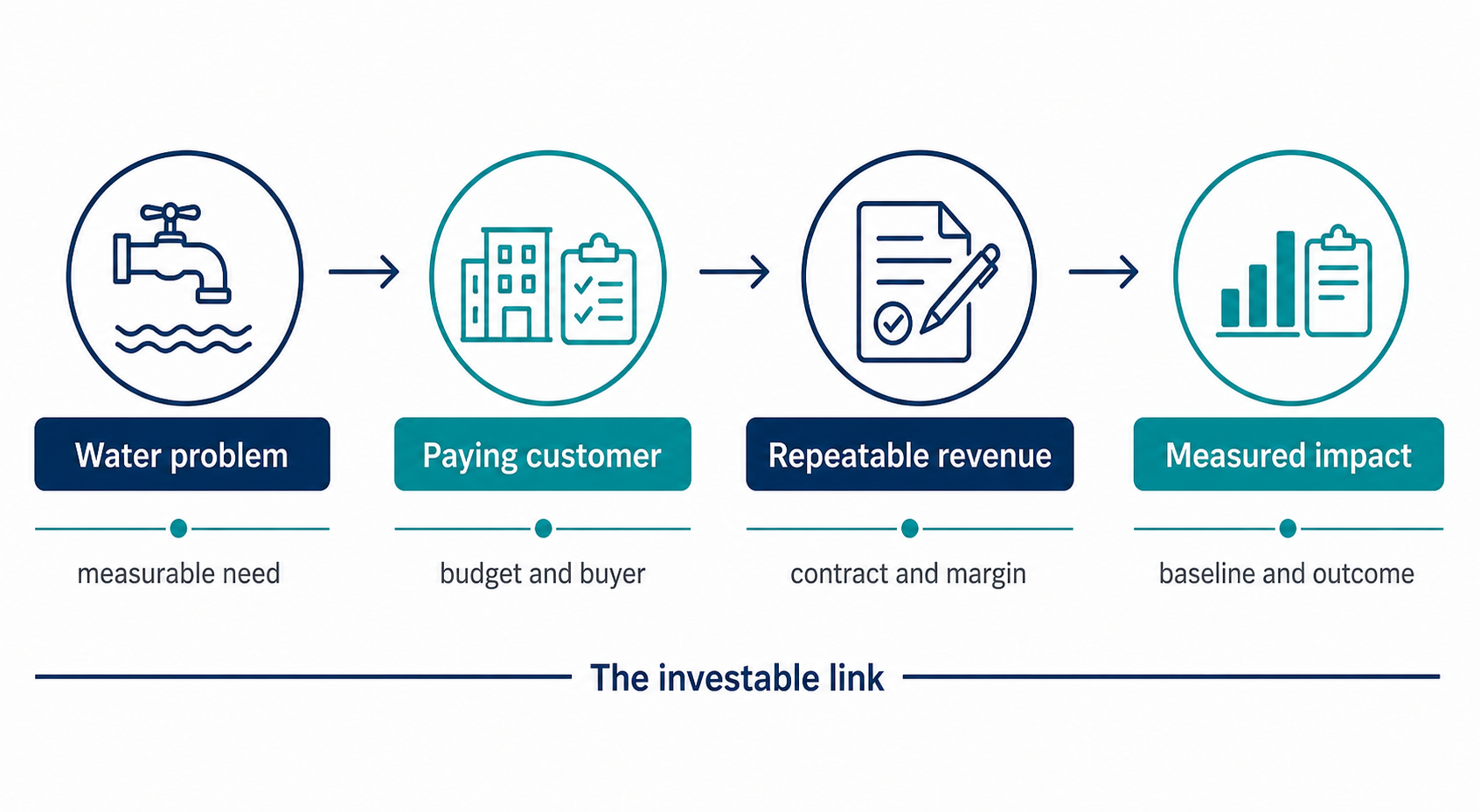
The first commercial question is not whether the problem is large. It is whether a named customer has a reason and authority to buy. Map the event that creates urgency. It might be a production limit, water-quality failure, discharge risk, new capacity, rising operating cost, customer requirement or an identified loss.
The Water Investment Network portfolio is the relevant place to understand the type of direct water-company opportunity the network reviews. A portfolio page can show the sector focus, but it cannot replace company-level diligence on demand, contracts, delivery and risk.
Then identify the budget. The person who feels the problem may not control the purchase. Operations, engineering, finance, procurement, compliance and a site owner may all influence approval. A long sales cycle is not automatically a weakness, but the company should explain its stages and conversion rates.
Revenue quality depends on what the company sells. Equipment sales can create a large order but may be lumpy. Service contracts can create repeat revenue but may require field labour. Consumables and replacement parts can support retention, while performance contracts may align payment with a result and transfer more operating risk to the supplier.
Review each revenue stream separately. Ask who owns the asset, who installs it, who carries warranty risk, who pays for energy and maintenance, what triggers renewal and what happens if performance misses the agreed threshold. Do not accept “recurring” as a description without a contract, invoice history or customer reason to renew.
The unit economics should match the work. A useful unit may be one installed site, one treatment module, one monitoring location, one service contract or one volume of water treated. Measure price, direct materials, installation time, field labour, energy, replacement cycles, support, warranty, freight and cash timing for that unit.
The OECD’s 2026 report on financing water security stresses that investment quality, structure and risk allocation matter as much as the amount of capital mobilised. It also notes that water-related investments can have different capital intensity, repayment periods, credit risks and revenue profiles. [4]
This is especially relevant to direct impact investing. The company may be attractive because it sells into a durable need, but the investment still depends on the contract structure and cash cycle. Model delayed acceptance, one lost customer, a slower installation and a higher warranty rate before relying on a growth forecast.
Commercial adoption should be visible in recent jobs. Compare quoted and delivered margin, design hours, installation time, change orders, commissioning, service visits, customer references and payment history. If every site requires a new engineering project, the company may need more capital and a different valuation approach than its headline software language suggests.
A water problem becomes a commercial opportunity only when the customer can recognise the value, the supplier can deliver it at a workable cost and the contract allocates risk clearly. That is the link an investment committee should test.
Investment thesis at a glance
The table below is a diligence frame, not a template for inventing facts. Each row should be completed from company evidence for the opportunity under review.
| Question | Evidence to request | Investor consequence |
|---|---|---|
| What demand is changing? | Customer problem, baseline and decision trigger | Shows whether demand is urgent or only thematic |
| Who pays? | Named buyer, budget owner and procurement route | Tests sales access and cycle length |
| How does revenue recur? | Contracts, renewals, service scope and invoice history | Tests visibility and customer retention |
| Can delivery scale? | Site data, installation process, capacity and support model | Tests margin, working capital and execution risk |
| What is the measurable outcome? | Baseline, metric, boundary, data owner and reporting cadence | Tests impact credibility and learning |
| What can go wrong? | Technical limits, negative effects, regulatory issues and dependencies | Tests downside, governance and capital needs |
| What could an exit preserve? | Customer continuity, data access and impact commitments | Tests whether impact can last beyond ownership |
This frame helps separate a sector narrative from a company thesis. A business can score well on demand and still fail on revenue. It can show impact and still lack a credible route to scale. It can have an attractive product and still be exposed to one customer, one grant or one regulatory assumption.
The purpose is not to reduce a complex opportunity to seven boxes. It is to make missing evidence visible early. A gap can be acceptable in an early-stage company if the investment structure, milestones and governance reflect it. It is harder to justify when the valuation assumes the gap is already solved.
Test additionality and the investor contribution
Additionality asks what would not have happened, or would have happened later or at lower quality, without the investment or investor contribution. It does not mean claiming that one investor created every positive outcome. It means setting out a credible contribution and checking it against evidence.
Capital can contribute in several ways. It may fund a product deployment, extend the runway needed to complete customer trials, support working capital for a repeatable installation model or help a company enter a market. An investor may also contribute governance, customer access, commercial expertise or the structure needed to bring in other capital.
Contribution needs a counterfactual. If the company would have completed the same project with another investor on the same terms, the capital contribution may be limited. If the investment changes the timing, scale, reach or quality of delivery, describe that difference carefully. Do not turn a plausible role into a guaranteed causal claim.
The Impact Principles ask managers to establish and document a credible narrative about their contribution for each investment. They also ask investors to assess expected impact systematically, identify material risks and monitor progress against expectations. [1]
For a direct investment, ask for a simple contribution record. It should state the decision, the capital or non-financial support provided, the expected change, the evidence available at entry and the point at which the contribution will be reviewed. This record can be short. It should not be written after the outcome is known.
Additionality is also relevant to portfolio construction. Two companies may serve the same impact theme, but the investor may have more influence in one. A minority investment with weak information rights may create less ability to manage impact risk than a structured investment with clear reporting and engagement rights.
That does not make control a requirement. It makes influence a diligence topic. Ask what the investor can see, what it can challenge, what it can change and what happens if impact performance falls below the agreed expectation.
Measure water outcomes without overclaiming
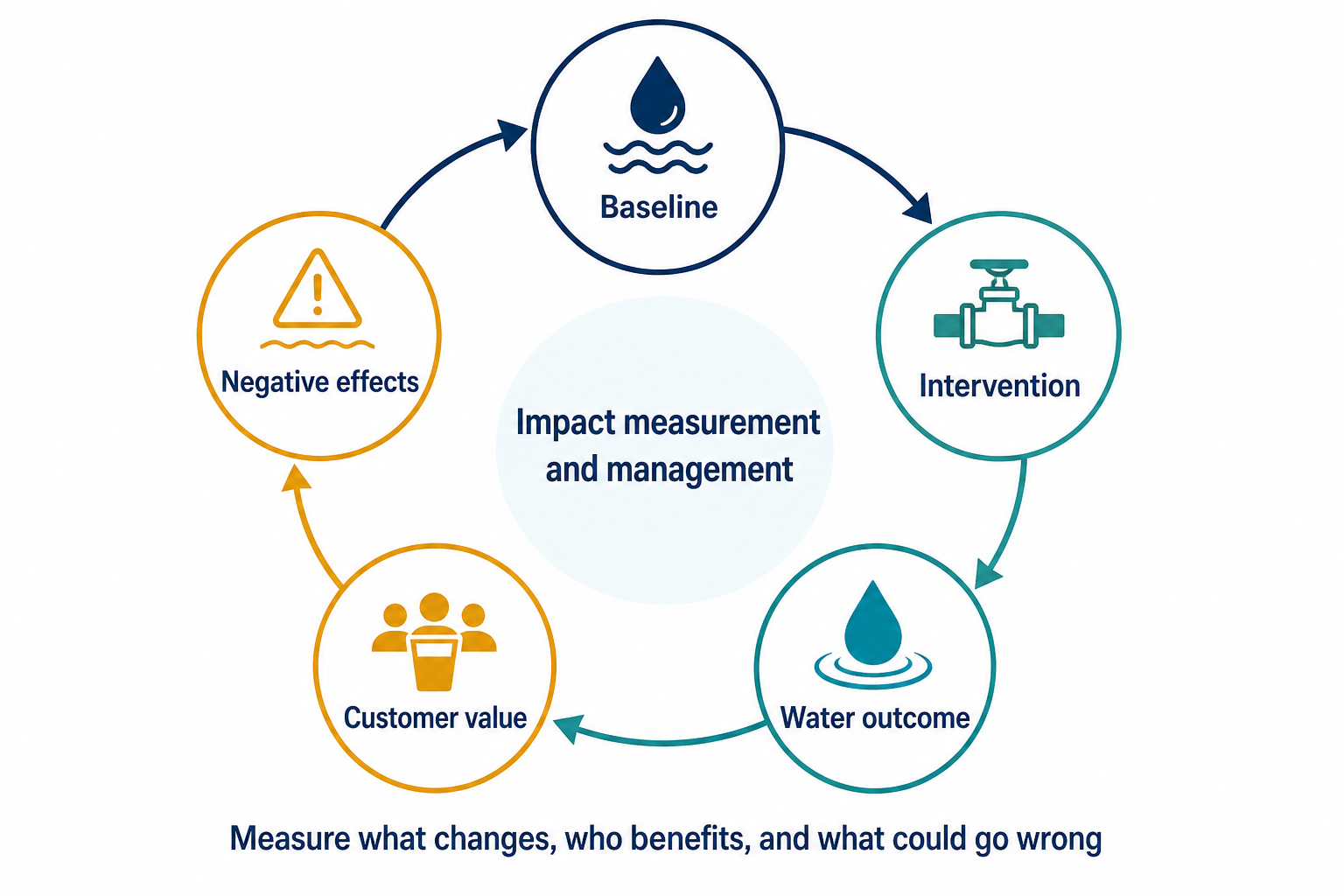
Good impact measurement starts before the investment. Set the baseline, define the boundary and specify the outcome. The boundary might be one site, one process line, one customer group, one catchment or one portfolio company. A broad water claim with a narrow boundary can mislead even when the site data is correct.
Useful water outcomes can include reduced freshwater abstraction, increased reuse, improved effluent quality, reduced losses, better monitoring coverage or more reliable service. The right metric depends on the product and customer. A monitoring company should not be judged only by litres saved if its value is earlier detection and better operating decisions.
Measure the outcome and the customer value separately. The same intervention may create an environmental benefit, a compliance benefit, a continuity benefit or an operating benefit. These can reinforce each other, but one should not be used as proof of another without evidence.
Impact measurement and management should cover both positive and negative effects. Record the data source, period, calculation, exclusions, assumptions and person responsible for review. If a result is modelled, label it as a modelled estimate. If the result depends on customer behaviour, say so.
IRIS+ describes impact measurement and management as a process that includes setting goals, defining strategies, selecting metrics and using data to manage decisions. It also frames impact through questions about what happened, who experienced it, how much occurred, the investor’s contribution and the risk that it may not happen as expected. [5]
The source above also explains that IFC uses impact frameworks to assess expected impact before investment and monitor results afterwards. For a private investor, the practical lesson is simple: the metric should inform underwriting, not sit in a separate report after the decision.
Avoid claiming that a site-level project solved a basin-level problem. Avoid describing a company as “sustainable” without stating the activity, the boundary and the evidence. Avoid counting an installation as an outcome when the relevant outcome is reliable operation over time.
Data quality is part of the investment risk. Check whether meters are calibrated, whether the baseline is comparable, whether the customer owns the data and whether the calculation can be repeated. If the company cannot explain its number, the number should not carry the same weight as a verified operating record.
Underwrite technology, adoption and scalability
Technical diligence should answer a commercial question: where does the system work, how consistently does it work and what does it cost to keep working? A test result without its flow, water chemistry, operating hours and maintenance conditions has limited value.
Water technology can change performance when conditions change. Fouling, scaling, pressure, contaminants, temperature, sensor drift, operator practice and power quality may affect delivery. The company should show its operating range and the evidence outside the best case.
Ask how the customer accepts the outcome. Is there a measured baseline? Is the test performed by the company, the customer or an independent party? What happens if the agreed threshold is missed? Does the supplier pay for remedial work? Is payment held back? These questions connect technical proof to contract risk.
A pilot is useful but incomplete. It may demonstrate performance under close supervision and a carefully selected site. It may not show installation time, operator training, spare parts, service response, working capital or the economics of the next three deployments.
Scalability should be measured in delivered work. Compare design hours, installation time, change orders, commissioning duration, support visits, warranty cases and gross margin across recent projects. If every customer needs a new solution, the business may be a capable engineering service rather than a repeatable technology company. That can still be investable, but the model and valuation must reflect it.
Defensibility should also be specific. It may come from application data, integration knowledge, a qualified service network, a difficult-to-replace process, intellectual property or trusted customer access. A patent or technical claim is not proof of adoption, pricing power or a protected margin.
Technology risk includes failure and replacement. Review blocked membranes, inaccurate sensors, delayed parts, missed service levels, customer complaints and changes made during commissioning. A company that records failure clearly may be easier to govern than one that presents only successful case studies.
The World Bank highlights the role of private-sector innovation and financing in water, while also pointing to the need for better governance, regulation and risk reduction. [2] That is a useful sector context, not a substitute for the company’s own evidence.
Price regulation, funding and regional risk
Water investment risk is partly technical and partly institutional. Tariffs, public budgets, procurement rules, permits, utility performance, land access, energy cost, currency and local financing can affect whether a solution is adopted and paid for.
Regulation can create demand, but a rule is not revenue until a customer has the budget and ability to comply. Investors should identify the relevant authority, implementation timetable, enforcement practice and route from the requirement to the company’s product or service.
The OECD notes that water benefits are often difficult to quantify and monetise. It also highlights weak enabling environments, unclear revenue streams and risk allocation as barriers to finance. [4]
This is why private impact investing in water often needs a different underwriting approach from a typical recurring-revenue software company. A customer may have a strong need but weak credit. A utility may have a large service area but limited tariff recovery. A project may create public benefits while the private supplier receives payment under a narrow contract.
Regional analysis should be practical. In the UK, an investor may focus on procurement, environmental compliance, utility investment and industrial demand. In the EU, the opportunity may depend on cross-border standards, local implementation and customer investment plans. In the GCC, water security, desalination, reuse, industrial development, local partnerships, currency and Islamic-finance structures may matter in different combinations across jurisdictions.
Do not generalise the GCC as one market. The UAE, Saudi Arabia, Qatar, Kuwait, Bahrain and Oman have different institutions, buyers and financing conditions. An opportunity should state the country, customer and contract route that support its case.
Funding structure matters as well. The OECD’s 2026 report examines bond finance, public-private partnerships, results-based finance and Islamic finance instruments. It stresses that risk allocation and incentives influence whether water investments last. [4]
For a company investor, this means reviewing grants, concessional capital, public guarantees, milestone finance and customer payment support without treating them as permanent commercial demand. The company should show what remains viable when a subsidy, pilot programme or special funding window ends.
Governance, portfolio monitoring and exit
Impact investing criteria should continue after the investment closes. Agree the reporting frequency, key financial measures, impact indicators, data owner, escalation route and decision rights before capital is deployed. A metric that nobody reviews will not protect the thesis.
Financial monitoring may include revenue by customer and product, gross margin after delivery, cash conversion, receivables ageing, customer concentration, backlog quality and capital needs. Impact monitoring may include the agreed water outcome, data quality, negative effects, customer dependence and progress against the original contribution record.
Keep the financial and impact views connected but separate. A company can miss its margin target while meeting an impact target. It can also grow revenue while failing to achieve a water outcome. The board and investor should understand both variances and decide whether the investment plan needs to change.
The Impact Principles state that managers should monitor progress against expected impact, respond when achievement is no longer expected and consider the effect of an exit on sustained impact. They also require public disclosure and regular independent verification of alignment for signatories. [1]
Independent verification is not a guarantee of impact quality or investment performance. The Impact Principles explain that verification addresses alignment of systems and processes, not necessarily the quality of the impact data or the results reported. That distinction is important for investors who may otherwise treat a framework label as a complete diligence answer. [1]
Exit planning should start early. A trade buyer may value customer access, data, service capacity or installed assets. Another investor may value growth, impact evidence and governance. A strategic buyer may change the product’s priorities. The investor should consider what could happen to the water outcome after a sale and whether reporting or customer commitments can survive the change.
Liquidity is a core private-market risk. An exit route is not an exit promise. The company may need more capital, a secondary transaction, a trade sale or a longer holding period than the initial model assumes. Governance should leave room to respond without using impact language to hide financial pressure.
The best monitoring system is proportionate. A small company may not need a large reporting department, but it does need clear ownership, repeatable data and honest escalation. Good governance makes uncertainty visible early enough for an investor to act.
A practical decision framework for private investors
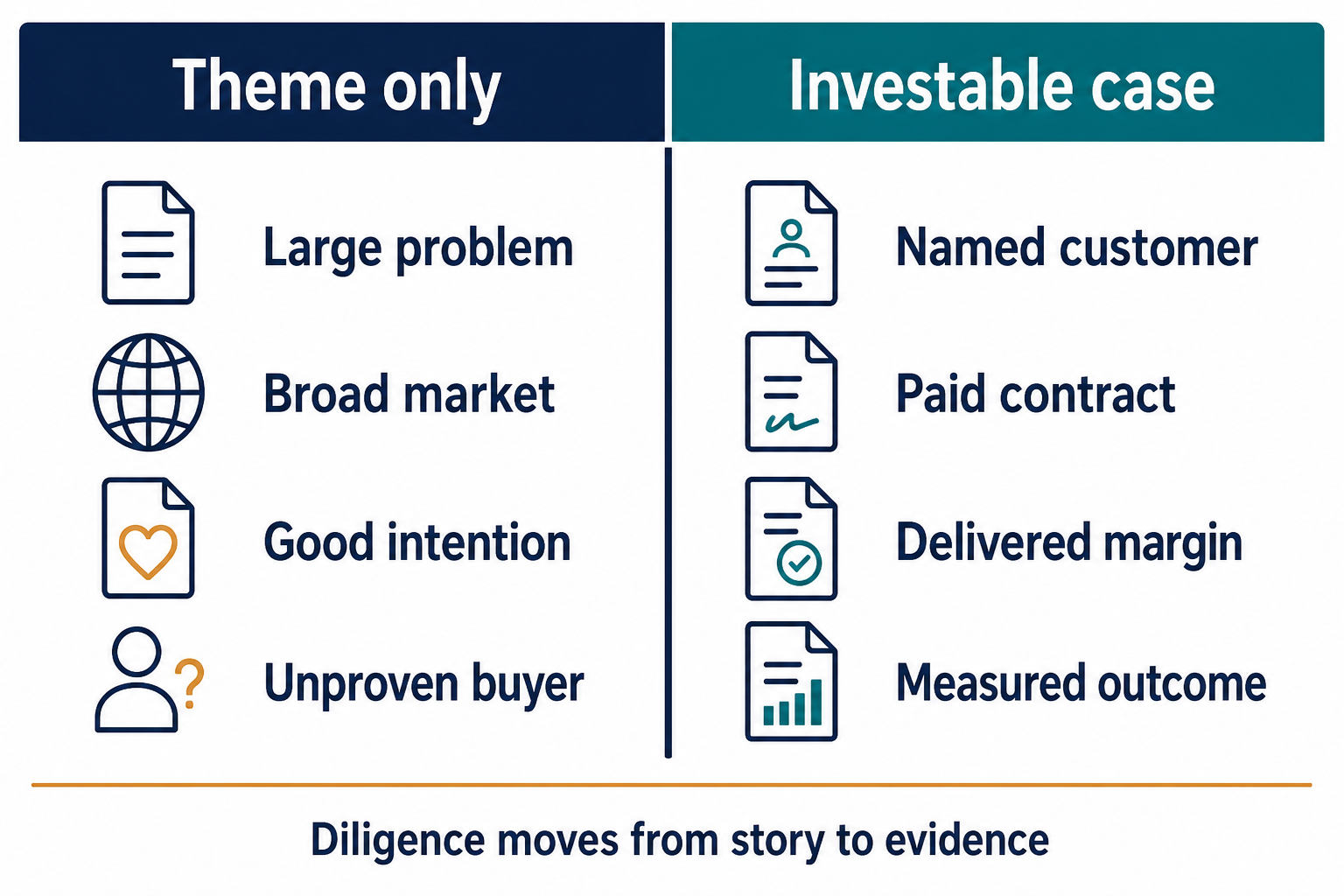
A useful committee process can move from theme to evidence in five stages. First, define the problem and the people, businesses or ecosystems affected. Second, identify the paying customer and the value recognised in its budget. Third, test the product, delivery model, cash cycle and technical limits.
Fourth, build the impact record. Set the baseline, define the metric, check the data source, state the investor contribution and record negative effects. Fifth, decide whether the structure, governance, valuation, holding period and exit assumptions match the evidence.
At each stage, name the unresolved question. “More customer proof needed” is useful. “Strong market” is not. A clear open item can become an investment condition, a milestone, a reporting requirement or a reason to wait.
Challenge the common shortcuts:
- A large water problem does not prove a large addressable revenue pool for one supplier.
- A strong pilot does not prove repeatable delivery across different sites.
- A recurring contract does not prove good cash conversion or margin.
- An impact metric does not prove additionality or long-term outcome.
- A policy announcement does not prove enforcement, budget or procurement.
- An exit scenario does not prove liquidity or a buyer’s willingness to pay.
The committee should also ask what would change its mind. It may be a missed performance threshold, a customer concentration limit, a weak baseline, a change in regulation, a financing gap or a service cost that does not fall with scale. Pre-agreed decision points reduce the temptation to defend a thesis after evidence has weakened.
Impact investing in water can be a credible private-market category when the investment case stays specific. The company must solve a paid problem, capture value, deliver repeatedly, measure the result and manage the downside. The impact is part of the underwriting, not a replacement for it.
Water Investment Network connects eligible UK, European and GCC family offices, high-net-worth investors, sophisticated impact and private-equity investors, and relevant advisers with selected direct water-company opportunities. Eligible investors can request access to Water Investment Network, subject to its invitation-only process.
Water Investment Network does not provide regulated financial advice or guarantee returns. Any opportunity requires independent legal, financial, tax, technical, commercial, regulatory and impact diligence. A water investment can support a useful outcome and still lose money, remain illiquid or require more capital than expected.
Frequently asked questions about impact investing in water
What is impact investing in water?
It is investment into a water-related company or project with an intention to contribute to measurable positive environmental or social impact alongside a financial return. The investor should be able to explain the customer, the mechanism of change, the evidence and the risks.
What are useful impact investing criteria for a water company?
Review the water problem, customer demand, revenue model, delivery evidence, scalability, impact baseline, measurement method, negative effects, governance, capital needs and liquidity. A broad environmental label is not enough.
How can investors measure water impact?
Set a baseline, define the boundary, choose a relevant outcome metric and record the data source, period, assumptions and owner. Measure the water result separately from customer value and financial return, then review progress over time.
Is social impact investing the same as environmental investment?
No. Social impact investing focuses on outcomes for people or communities, while environmental investment focuses on the natural environment. Water opportunities can involve both, but the specific outcomes and affected stakeholders should be stated.
Does Water Investment Network provide investment advice?
No. Water Investment Network is an invitation-only network and does not provide regulated financial advice or guarantee returns. Eligible investors and advisers must conduct their own independent diligence before making a decision.
Sources
- https://www.impactprinciples.org/common-and-emerging-practices/principle9/
- https://www.worldbank.org/ext/en/topic/water
- https://www.worldbank.org/en/topic/water/publication/water-security-financing-report-2024
- https://www.oecd.org/en/publications/financing-water-security_7cf3f5bd-en.html
- https://www.ifc.org/en/our-impact/impact-investing-at-ifc