
Impact investing private equity in water combines an ownership position in a private company with an intentional, measurable water or environmental objective and a financial return objective. The investment case depends on customer demand, commercial proof, investor contribution, governance and evidence of outcomes. It does not guarantee impact, returns or liquidity.
Impact investing in private equity sounds like a simple combination of two familiar ideas. One is ownership in a private company. The other is a deliberate attempt to create a measurable social or environmental benefit. In water, the connection is practical: a company may help an industrial customer reuse water, monitor quality, reduce pollution or manage a scarce resource.
The investment question is not whether water is important. It is whether a specific private company can turn a defined water problem into repeatable customer value, revenue and measurable outcomes. Private equity adds another test. The investor must understand how ownership, active support and governance could improve the company without assuming that capital alone creates impact.
The Global Impact Investing Network (GIIN) describes impact investing through intentionality, evidence and data, impact performance management, and shared learning. Its definition covers positive, measurable social and environmental impact alongside a financial return. [1]
This gives water investors a useful discipline. Start with the company and its operating boundary. Identify who pays, what changes in the customer operation, how the outcome is measured and what the investor can contribute. Then underwrite the ordinary private-equity questions: growth, margin, cash, governance, valuation, downside and exit.
This article explains how to assess that combination. It is written for family offices, private-equity investors, high-net-worth investors and advisers who want a clear framework for reviewing direct private water opportunities. It is not regulated financial advice, an offer, or a promise of performance.
Private equity changes the impact-investing question
Private equity usually means an investor takes an ownership interest in a company that is not traded on a public exchange. The investor may provide growth capital, strategic support, governance oversight or access to networks. The exact rights depend on the legal structure and investment documents.
For impact investing, ownership creates a question beyond selection. What can the investor influence after completion? That influence might involve hiring, sales discipline, measurement systems, production capacity, customer deployment or a responsible expansion plan. The answer should be specific. “We invested in water” is not an impact mechanism.
The distinction matters because a private company can sell a useful product without being an impact investment. A water-treatment supplier may have a positive effect, but the investor still needs an intentional objective and a credible contribution to that result. The GIIN treats intentionality as the feature that separates impact investing from strategies that only consider impact as one risk factor. [1]
Private-equity ownership can make that contribution more visible. An investor may help a company move from founder-led sales to a repeatable commercial process, or from informal impact claims to customer-level evidence. It can also expose conflicts. Pressure for fast growth may encourage overpromising, weak customer selection or expansion before the operating model is ready.
A sound thesis therefore states four items at the start:
- The water or environmental outcome the company is intended to support.
- The paying customer and the economic problem being solved.
- The investor actions that could contribute to progress.
- The financial return, risk and liquidity objectives that remain separate from the impact claim.
That is the right starting point for the wider impact-investing case in water. It keeps the article focused on an investable company rather than a broad theme.
Why water can suit an ownership-led impact thesis
Water problems often sit inside operating budgets. A factory pays for incoming water, treatment, discharge, energy, compliance and downtime. A property owner may pay for reliable supply, efficient systems or better monitoring. A utility, developer or infrastructure operator may pay for capacity, resilience or asset performance.
This makes water different from a purely abstract impact theme. The company can sometimes connect an environmental outcome to a buyer with a real operational reason to act. That connection is not automatic. It must be tested through contracts, usage data, renewal behaviour, gross margin and customer references.
The World Bank’s strategic framework for water finance describes the private sector’s role in bringing innovation, expertise and capital into a sector that has historically relied heavily on public and concessional finance. That is relevant to private equity, but it does not remove the need to test the company’s own revenue, risk and delivery model. [2]
For private-equity investors, this points to a broad but useful opportunity set. It may include treatment systems, reuse services, monitoring hardware and software, resource recovery, compliance tools, or specialist infrastructure services. The investable unit is not “water” by itself. It is the company, its customers, its contracts, its delivery model and its evidence.
Water can also require patience. A company may need time to validate a system at a customer site, complete procurement, secure permits, build a service team or prove performance across different conditions. That does not make every water business suitable for private equity. It means the funding horizon must match the sales cycle and operating work.
The risk is confusing a long-term need with a strong company. Persistent demand can coexist with slow sales, weak pricing power, poor working-capital control or public-sector procurement risk. An ownership thesis should show how the investor will distinguish a durable customer problem from a business that cannot capture value.
Build the thesis around additionality and contribution
Additionality asks what would be different because the investment happened. In practice, the answer can involve new customer deployments, a product improvement, a new market, better evidence or increased delivery capacity. It should not imply that the investor caused every outcome the company later reports.
A private-equity impact thesis should define the baseline before the investment. The baseline might describe the customer’s water use, untreated discharge, monitoring gap, service reliability or exposure to a defined operational risk. It should identify the boundary of the claim and the people, ecosystems or assets affected.
IFC’s Operating Principles for Impact Management describe impact management as a discipline for investments that seek measurable positive social or environmental impact alongside financial returns. IFC says the Principles support transparency through annual disclosure of impact-management processes and periodic independent verification. [3]
That discipline is relevant even when a direct private-company investment is not a signatory. It suggests a practical sequence:
- Set the impact objective and the relevant stakeholders.
- Assess the expected impact and material negative effects.
- Explain the company and investor contribution.
- Monitor the results through useful operating data.
- Review what changed, what did not and what should happen next.
Contribution may be commercial rather than technical. An investor might help improve reporting, recruit a senior operator, open a customer channel or fund a repeatable installation process. If the company would have achieved the same result without that involvement, the contribution claim should be narrower.
This is where private equity can add value and risk at the same time. A board seat and a capital plan can support impact delivery. Incentives that reward only revenue can weaken it. The investment committee should therefore approve both the financial plan and the impact-management responsibilities.
Map private-equity value creation to the water business
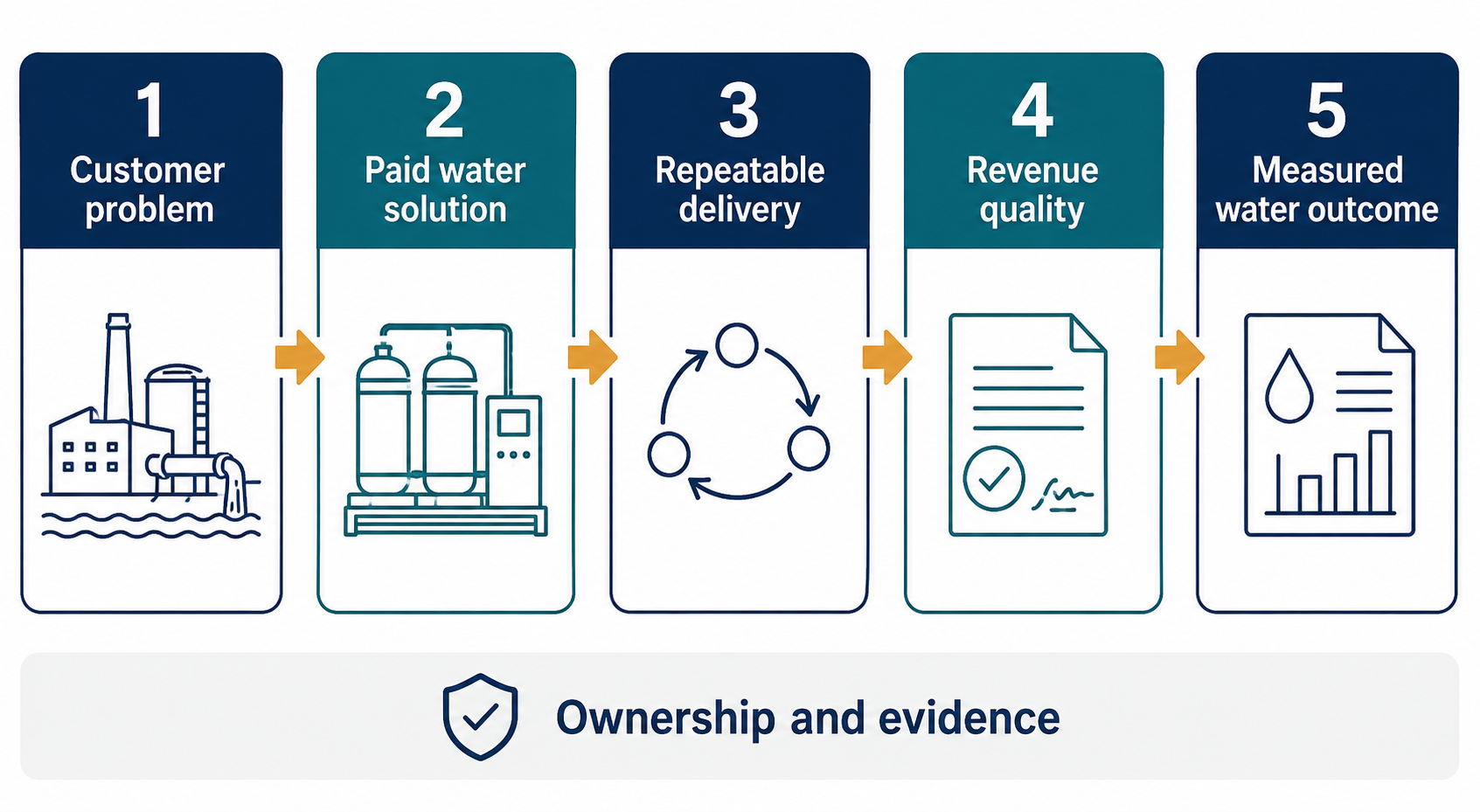
Value creation is the bridge between an impact story and a private-equity case. It should explain how the company can become more valuable while the water outcome improves or remains protected. The bridge may include more customers, higher retention, better delivery margins, lower installation cost or stronger recurring service revenue.
Consider a water-technology company that sells a system and a monitoring service. Its value may improve when the system becomes easier to deploy, the service team can support more sites, the sales pipeline converts more predictably and customers renew the monitoring contract. The associated impact may be better measured water reuse or earlier detection of a quality problem. Both sides need their own evidence.
Do not use a generic “scale creates impact” assumption. Growth can increase impact, but it can also expand failure. A weak installation process can create more service calls. A poor measurement method can spread an unreliable claim. A customer segment with low willingness to pay can consume capital without creating a viable market.
Customer problem → paid solution → repeatable delivery → stronger revenue quality → measured water outcome
The company should be able to show which stage is proven and which stage still needs capital. This keeps the plan honest. A pilot may prove technical performance but not a repeatable sales process. A signed contract may prove demand but not delivered margin. A measured result may show an outcome but not the investor’s contribution.
The most useful private-equity plan links each value-creation action to a named owner, a time period, a leading indicator and a downside response. That is more useful than a large market estimate with no route to customers.
Underwrite the customer contract and revenue quality
Customer demand is the first commercial proof. Identify the buyer, the user, the budget owner and the reason for purchase. They may be different people. A sustainability team may support a project, while the plant manager owns the operating budget and procurement controls the process.
Review the customer path from first conversation to paid deployment. How long is the sales cycle? What technical or regulatory evidence is required? Who carries integration risk? What happens when the system underperforms? These questions affect cash needs, liability, gross margin and future reference value.
Revenue quality depends on more than reported sales. Separate one-off equipment revenue, installation income, consumables, software subscriptions, monitoring fees, maintenance and performance-linked payments. Each type has a different margin profile, working-capital need and renewal risk.
Private equity investors should request evidence for:
- Signed contracts, order history and customer concentration.
- Revenue recognition and the timing of cash collection.
- Gross margin by product, project or service line.
- Renewal, expansion and churn patterns where a recurring service exists.
- Customer references that confirm the operational result and not only the purchase.
Do not treat a letter of intent as equivalent to recurring revenue. Do not treat a grant-funded trial as proof of an enduring budget. Water-related investment can benefit from public or blended finance, but the company still needs a clear route to paying demand and sustainable delivery.
For a direct private-company opportunity, the strongest evidence often comes from a small number of detailed customer files. They show the original problem, buying process, delivery cost, measured result, service burden and renewal decision. This is where the impact case meets ordinary commercial diligence.
Test growth capital against operating bottlenecks
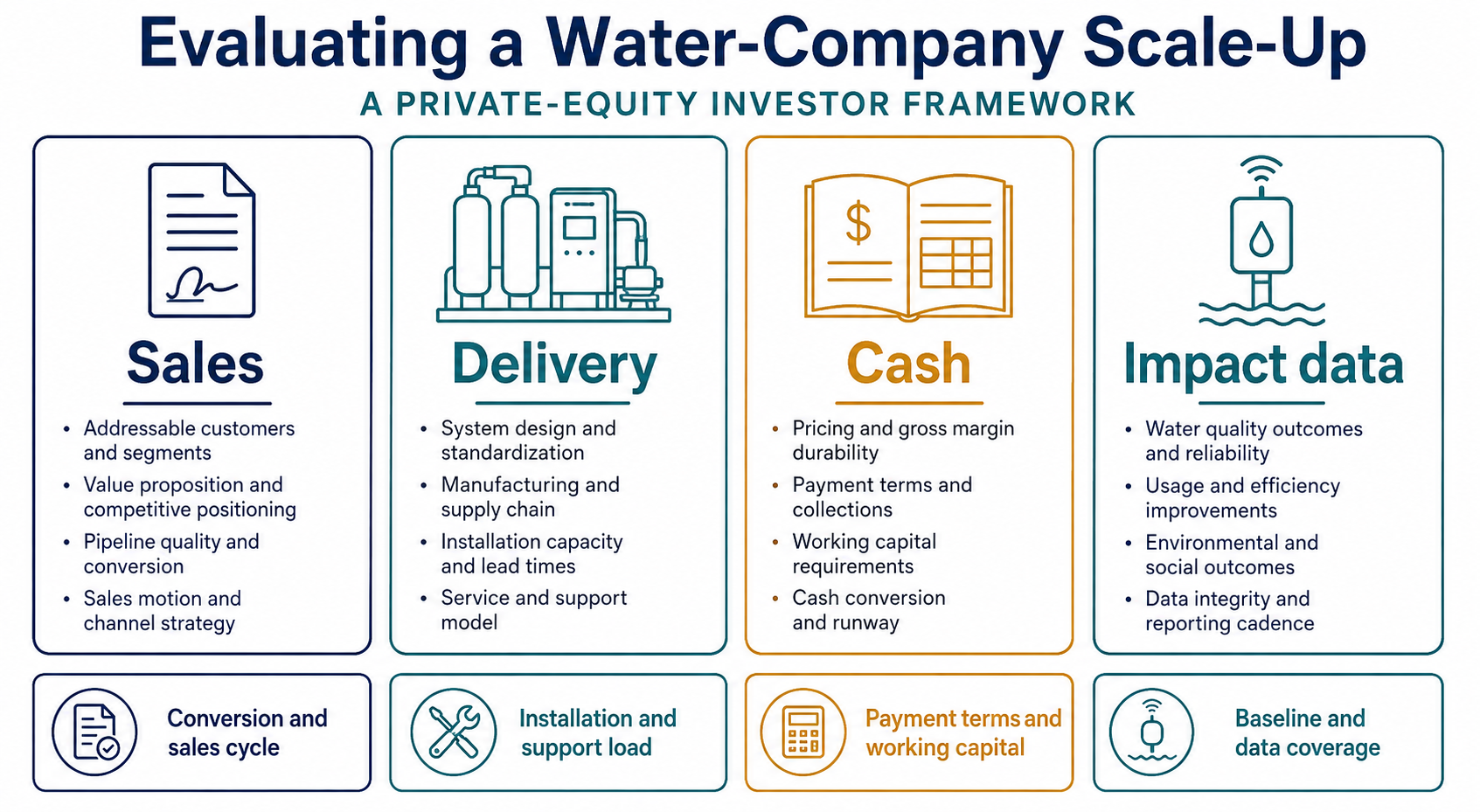
Private-equity capital should solve a known constraint. It might fund additional production capacity, a service team, customer implementation, product certification, sales coverage or working capital. A capital plan that simply says “grow faster” is not an operating plan.
Start with the unit of delivery. For a system company, that may be a commissioned site. For a monitoring company, it may be an active customer location with a defined data service. For a specialist service, it may be a completed intervention that meets a contract standard.
Then calculate the resources needed for each unit. Consider equipment, staff time, subcontractors, energy, maintenance, logistics, insurance, customer support and warranty exposure. Unit economics should be based on delivered cost, not only the bill of materials or an early pilot.
| Scale-up area | Evidence to review | Investor consequence |
|---|---|---|
| Sales | Conversion by customer type and sales-cycle length | Sets cash runway and forecast confidence |
| Delivery | Installation time, rework, uptime and support load | Tests margin and repeatability |
| Cash | Deposits, payment terms, inventory and warranty reserves | Defines funding need and downside |
| Impact data | Baseline, measurement method and review frequency | Protects the claim as deployment grows |
Scaling can also change the impact profile. A system that performs well at one site may need different energy, chemicals, land or maintenance at another. The company should identify those changes before they become a portfolio-level surprise.
The investment committee should release growth capital against milestones that combine finance and impact. Examples include paid deployments with verified customer results, improved delivered margin, lower rework, complete data coverage or repeat orders. Milestones should not encourage the business to accept unsuitable sites merely to meet a count.
Measure water impact as an operating KPI
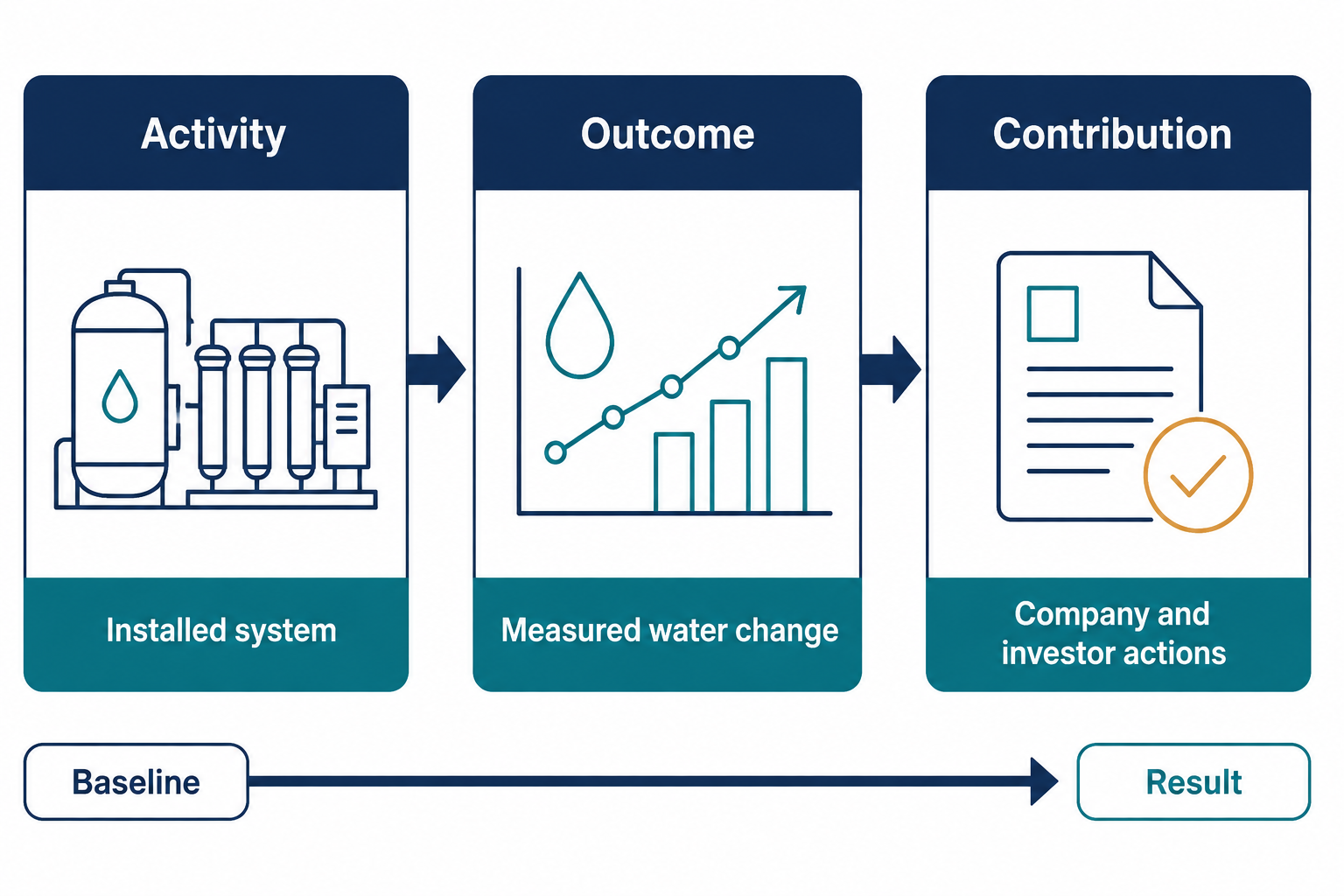
Impact measurement should be part of the operating model, not a report written after the financial results. A useful measure has a clear definition, a baseline, a time period, a measurement boundary and a responsible owner.
Possible measures depend on the company. They may include water treated, water reused, pollutant load reduced, leakage detected, service reliability improved or customer exposure reduced. These terms need context. “Water saved” could mean a measured reduction in abstraction, a process change, avoided demand or a modelled estimate. The boundary should be stated.
The GIIN calls for evidence and impact data in investment design and for managing impact performance through feedback loops. [1] For a private-equity investor, that means the board pack should contain impact data alongside sales, margin, cash and risk. It should show negative effects and data gaps as well as positive results.
Separate three levels of evidence:
- Activity: what the company installed, delivered or operated.
- Outcome: what changed for the customer, resource or affected stakeholder.
- Contribution: what the company and investor did to help create that change.
These levels stop a company from claiming a customer outcome merely because a product was sold. They also stop an investor from claiming the full effect of a company’s work. A credible report may say that an installation operated for a period, a customer measured a change and the investor supported the deployment plan. That is stronger than a broad sustainability label.
Measurement has a cost. The right system is proportionate to the company’s stage and risk. The objective is not to create a perfect dashboard. It is to create decision-useful evidence that can influence deployment, customer success, governance and capital allocation.
Price regulation, claims and geography
Water businesses operate inside public policy, permits, customer standards and environmental rules. Regulation can support demand, but it can also delay projects, constrain claims or change the addressable market. An investor should identify the exact rule, jurisdiction, responsible authority and company obligation.
The World Bank’s water-sector overview highlights how regulatory reform, stronger governance and lower investment risk can attract private finance and international capital. For an investor, that makes the operating environment part of the underwriting case rather than a background assumption. [4]
That matters for a network serving UK, European and GCC investors. “Europe” is not one permitting system. The UK has its own regulators and disclosure context. EU member states apply EU frameworks through national systems. GCC markets also differ by country, authority, procurement practice and water infrastructure model. Regional exposure should be reviewed as a set of specific markets.
Marketing language needs the same care. The UK Financial Conduct Authority says its Sustainability Disclosure Requirements regime includes anti-greenwashing rules for FCA-authorised firms, plus naming, marketing and disclosure requirements for in-scope asset managers. The FCA also says that “impact” and related terms cannot be used in product names in certain circumstances without the relevant label. [5]
This article does not apply those rules to every private company or investor. It makes a narrower point: sustainability claims should match evidence, audience and legal scope. A water company should not imply a regulatory approval, a guaranteed environmental outcome or a financial result that it cannot support.
Due diligence should therefore include permits, discharge obligations, product claims, data protection, health and safety, insurance, subsidy dependence, public procurement and customer liability. A useful risk register names the trigger, owner, potential cost and mitigation. It should also show which risks cannot be mitigated by the company alone.
Use governance to protect both value and impact
Ownership influence is only valuable when it is converted into decisions. Confirm the board composition, reserved matters, information rights, reporting calendar, management incentives and conflict process. The documents should make it possible to challenge a weak forecast or an unsupported impact claim.
Management incentives deserve close attention. A bonus based only on bookings can encourage poor-fit customers. A target based only on impact units can encourage uneconomic delivery. A balanced scorecard can include cash collection, delivered margin, customer retention, safety, data completeness and a defined outcome measure.
Governance should also protect the operating boundary. If a company supplies technology but does not control customer operations, it should not claim every downstream environmental benefit. If a customer provides the baseline data, the company should make the data source and limitations clear.
Investor reporting can be simple and still useful. A quarterly pack might cover:
- Revenue by customer and type, gross margin and cash position.
- Pipeline stage, contract quality, renewals and concentration.
- Deployment status, uptime, service incidents and safety events.
- Impact baseline, results, negative effects, data gaps and corrective actions.
- Regulatory, legal, insurance and financing changes.
The purpose is not to turn a private company into a public reporting machine. It is to create enough visibility for an owner to act. A missed customer milestone should change the plan. A measurement gap should affect the claim. A margin shortfall should affect capital release.
This discipline is especially important when several investors share a private company. Clear roles reduce the chance that impact responsibility is assumed by everyone and owned by no one.
Plan an exit without weakening the impact case
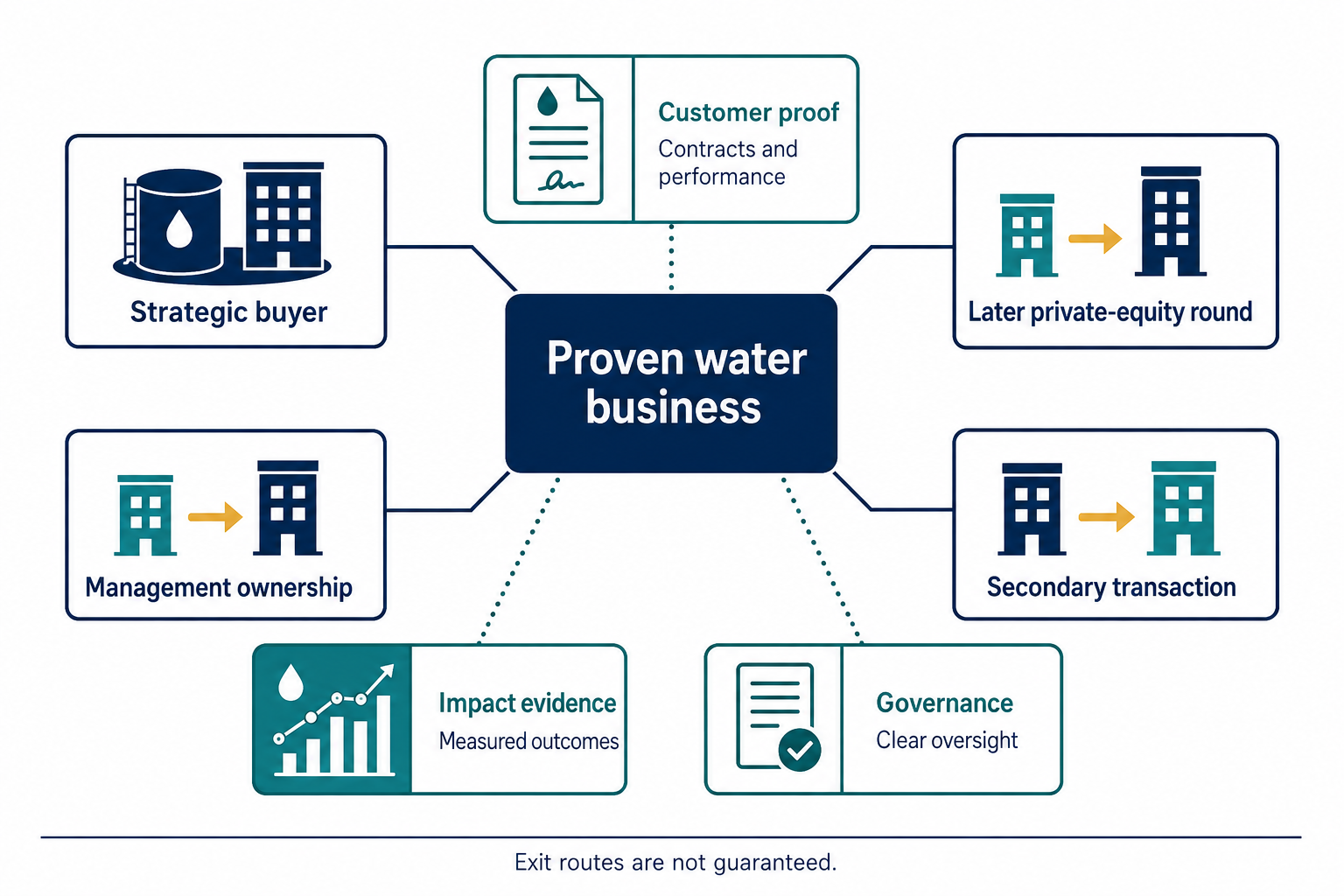
Private equity has a liquidity question from the first investment committee meeting. The route may involve a strategic buyer, a later private-equity round, management ownership, a secondary transaction or another agreed structure. There is no guarantee that a route will be available when needed.
Exit analysis should identify likely buyer types and the evidence each buyer would need. An industrial technology buyer may focus on product reliability, installed base and integration. A services buyer may value recurring revenue, customer retention and delivery density. An infrastructure or utility buyer may focus on permits, contract length, asset performance and risk transfer.
Impact evidence can strengthen the quality of a business, but it does not replace commercial proof. A buyer may ask whether the outcome is repeatable, whether the data is trusted, whether the company can defend its position and whether the impact survives a change of ownership.
Investors should test that last point directly. Is impact embedded in customer contracts, product design, governance, reporting and incentives? Or does it depend on one founder’s language? An exit that removes the operating discipline may reduce both impact quality and business value.
Scenario work should include delayed sales, a failed deployment, lower margins, a lost customer, a permit delay, higher working capital and a slower exit. The aim is not to predict one outcome. It is to understand which assumptions matter and what an owner can do if they fail.
A patient approach can support a better build-out when the business needs time to prove customer value. It can also lock up capital for longer than expected. Private-market investors should assess that liquidity trade-off against their own portfolio, cash needs and mandate. Investors can review the network’s selected water-technology portfolio as a separate context for this kind of company-level review.
Frequently asked questions about impact investing private equity in water
What is impact investing in private equity?
Impact investing in private equity means taking an ownership position in a private company with the intention to support measurable positive social or environmental impact alongside a financial return. The investor must be able to explain the company value, the impact objective and the investor contribution.
Why can private equity suit water impact investing?
Private equity can provide ownership influence and longer-term support while a water company improves its product, sales process, delivery capacity and impact measurement. It does not remove technical, commercial, regulatory, liquidity or execution risk.
What should investors measure in a private water company?
Investors should measure the customer problem, solution use, water-related outcome, negative effects, data quality, revenue quality and the company contribution to the result. The metric set should fit the company and its operating boundary.
Does an impact label prove a private-equity opportunity is credible?
No. A label or stated theme is only a starting point. Investors still need evidence of intentionality, customer demand, commercial delivery, measurable impact, governance, risks and a credible route to liquidity.
How can eligible investors review direct water opportunities?
Eligible investors can request access to selected direct private-company opportunities through Water Investment Network. Each opportunity remains subject to its own legal, tax, financial, technical and commercial review, and no return or liquidity outcome is assured.
Eligible investors can request access to Water Investment Network to review selected direct private-company water opportunities. Membership is invitation-only, and every opportunity remains subject to its own legal, tax, financial, technical and commercial review. No return, timing or liquidity outcome is assured.
Sources
- https://thegiin.org/publication/post/core-characteristics-of-impact-investing/
- https://www.worldbank.org/en/topic/water/publication/scaling-up-finance-for-water-a-world-bank-strategic-framework-and-roadmap-for-action
- https://www.ifc.org/en/our-impact/impact-investing-at-ifc
- https://www.worldbank.org/ext/en/topic/water
- https://www.fca.org.uk/firms/climate-change-and-sustainable-finance/sustainability-disclosure-requirements-sdr-regime