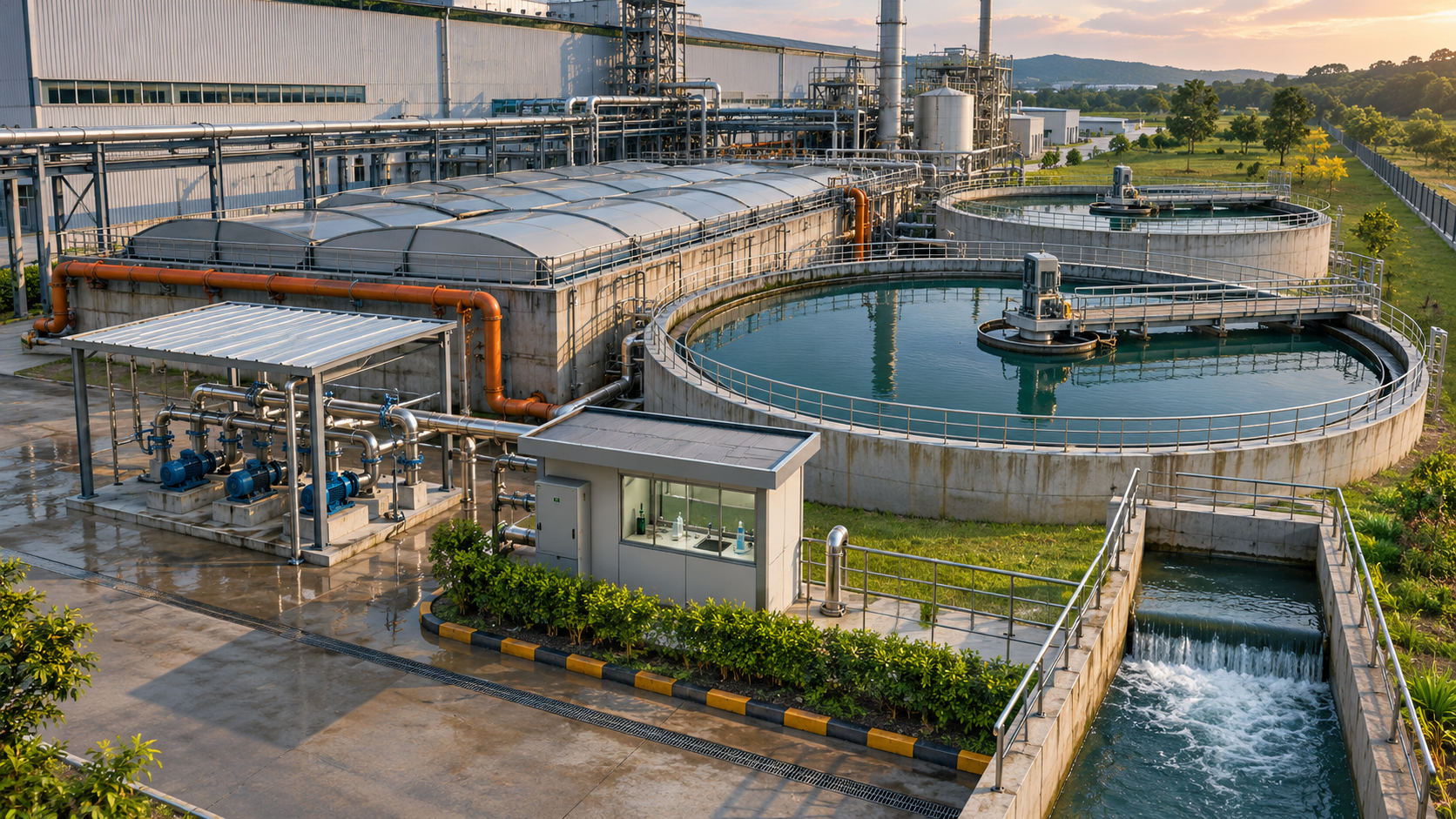
Industrial waste water treatment is a process-control and compliance business, not a single piece of equipment. A customer may need to control pH, suspended solids, organic load, metals, salts, oils, temperature or other contaminants before discharge, reuse or further treatment.
The commercial requirement is therefore broader than removing a pollutant. The provider must understand the production process, characterise the incoming stream, select a treatment train, prove the target, manage residuals and keep the plant within its operating envelope.
This article examines the sector for private-market investors. It covers customer demand, treatment design, revenue models, margins, adoption, regulation and diligence. For the wider investment case, see the industrial wastewater treatment investment pillar. The Water Investment Network is an access and research network, not a provider of regulated financial advice.
Industrial waste water treatment is a process-control business, not a single machine
Industrial wastewater is produced by manufacturing, mining, food and drink, chemicals, power generation, metals, textiles and other activities. The flow may come from cleaning, production, cooling, washdown, dewatering, raw material handling or a combination of sources.
The same industry label can conceal very different wastewater profiles. A food site may produce a biodegradable organic load, while a metal-finishing site may produce a stream containing metals, acids, oils or suspended solids. A treatment design that works for one site can be unsuitable for another.
Source characterisation sets the commercial brief
Source characterisation means measuring what enters the treatment system, when it arrives and how it changes. It can include flow, temperature, pH, conductivity, chemical oxygen demand, biological oxygen demand, suspended solids, nutrients, oils, metals, salts and other site-specific parameters.
The investor consequence is important. A company that can turn process data into a reliable design basis is more likely to price the work correctly. A company that quotes from a generic sample may win an order and still lose margin when production changes during commissioning.
The treatment train is a chain of linked decisions
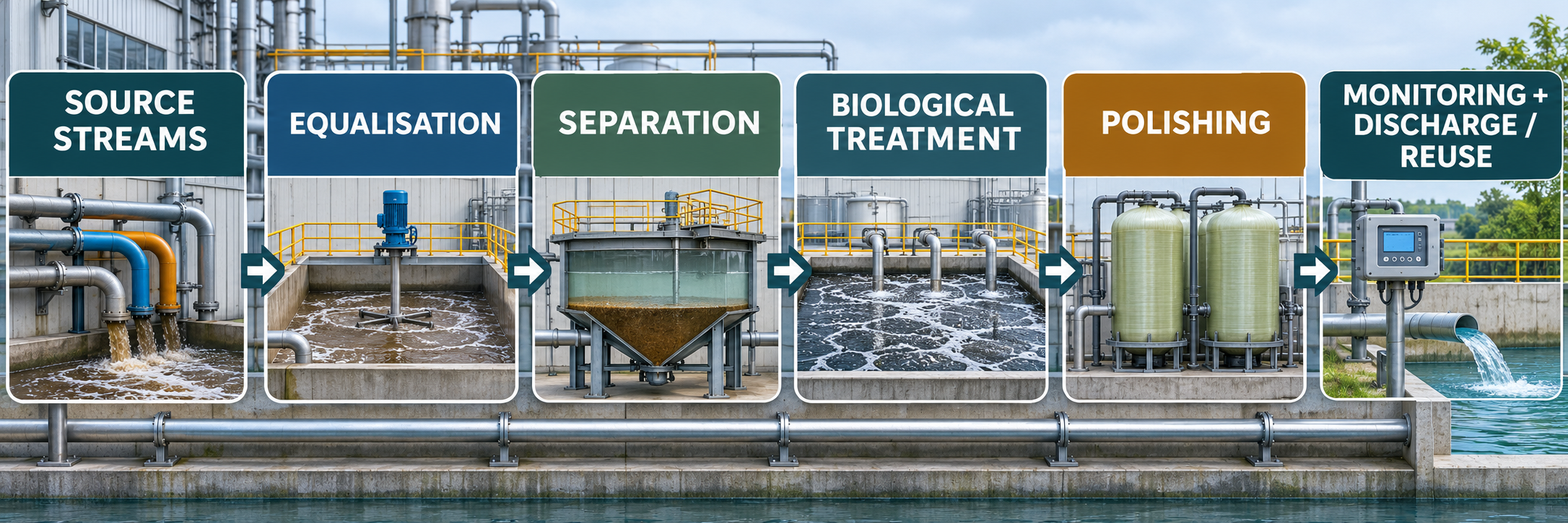
A treatment train is a sequence of physical, chemical and biological steps. Depending on the stream, it may include screening, equalisation, neutralisation, dissolved air flotation, clarification, biological treatment, filtration, adsorption, membranes, oxidation or another polishing step.
Equalisation means holding and blending flows so that the downstream process sees a more stable load. That can protect biological or membrane stages, but it adds tanks, pumps, controls, space and operating cost. The value comes from fewer shocks, more predictable performance and better use of installed capacity.
Evidence is part of the product
A customer is not only buying a tank or a reactor. It is buying an operating result that can be sampled, reported and defended. Monitoring points, laboratory methods, calibration, alarms, records and corrective actions can determine whether the solution remains commercially useful after installation.
Why industrial wastewater creates durable customer demand
Industrial wastewater creates a recurring customer problem because production creates a recurring flow. The customer must either treat that flow, pay for an external treatment route, obtain consent for discharge, reuse water safely or manage the cost of non-compliance and interruption.
In England, GOV.UK guidance says an industrial facility that could pollute may need an environmental permit, and a stand-alone discharge of polluting liquid to surface water or groundwater may also require a permit. The exact requirement depends on the activity, discharge route, location and regulator.
Production growth can expose treatment bottlenecks
A manufacturer may have demand for more output but limited treatment capacity. A new product, additional shift, recipe change or expanded washdown regime can alter the flow and contaminant load before the customer has expanded its treatment footprint.
This creates several entry points for a provider. They may include a site survey, a debottlenecking project, a modular extension, a retrofit, a monitoring upgrade or a managed operation. The commercial question is whether the provider can solve the constraint without taking on an unpriced integration burden.
Discharge control protects more than the receiving water
The consequences of an unstable treatment system can include production delays, emergency tankering, additional disposal, failed discharge tests, remedial engineering and a damaged customer relationship. The risk is not limited to an environmental line item.
GOV.UK risk-assessment guidance asks operators to identify sources, receptors, pathways and controls. For an investor, that creates a useful diligence lens. A credible supplier should explain the customer’s source, the pathway to harm, the treatment control and the evidence that the control works.
Water reuse can add a second customer value proposition
Treatment can be designed for discharge, reuse or both. The World Bank says the business case for reuse is strongest when wastewater is available close to the point of use, including industrial parks and other concentrated customer settings.
That does not mean every industrial site should pursue reuse. Reuse can introduce additional quality targets, monitoring, storage, distribution and operating obligations. It can nevertheless create a more valuable proposition where the customer has a reliable nearby demand for fit-for-purpose water.
Investment thesis at a glance
The investable opportunity sits across engineering, equipment, monitoring, operations, residual management and reuse. The strongest businesses connect a clear customer constraint to a treatment outcome that can be repeated across a defined segment.
Demand is anchored to an operating obligation
Industrial sites cannot simply stop producing wastewater because a project has been delayed. They need a route to meet their discharge or reuse requirement while keeping the production process running. That can create a budget with a direct operational owner.
Defensibility comes from process knowledge and evidence
Defensible value can come from treatability data, process models, proven modules, controls expertise, integration experience, monitoring records and a service organisation that understands the installed base. It is weaker when the offer is only a catalogue of standard equipment available from several suppliers.
Scale depends on repeatable delivery
Industrial sites are specific, but a provider can still standardise the way it works. Reusable engineering blocks, known suppliers, commissioning procedures, controls libraries and service protocols can reduce the cost of adapting a system to a new site.
Investors should distinguish a repeatable method from a claim that every project is identical. Industrial waste water treatment is often customised at the process level. A scalable company reuses the architecture, information and delivery discipline around that process.
Risk is technical, regulatory and commercial
Technology risk includes shock loads, fouling, toxicity, energy use, chemical consumption, residuals and incomplete removal. Commercial risk includes long sales cycles, customer concentration, working capital, subcontractor dependence and service obligations that exceed the contract price.
What customers actually buy
The buyer may describe the requirement as an industrial effluent treatment plant or an industrial wastewater treatment plant. The purchased package usually includes several layers, each with its own margin and execution risk.
Assessment, sampling and water balance
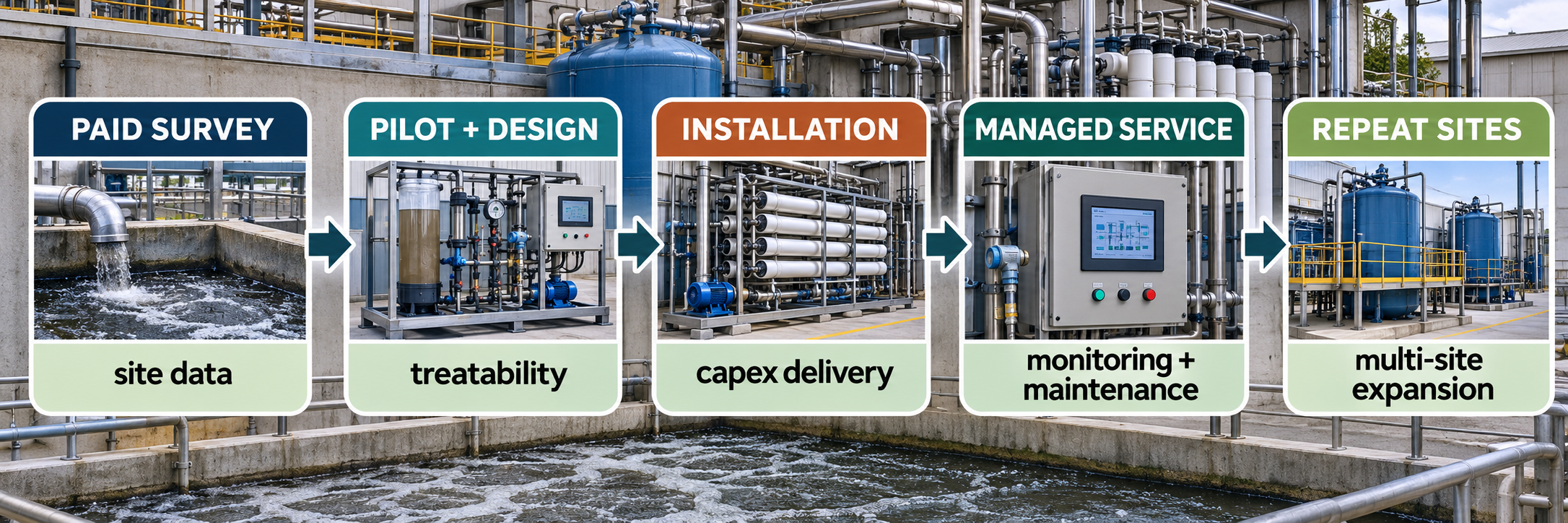
The first engagement may include a site survey, drainage map, source register, sampling plan, laboratory analysis and water balance. A water balance compares incoming water, process uses, losses, discharge and possible reuse streams.
This work can be sold as a paid diagnostic, included in a project-development package or used to qualify an opportunity. Investors should ask whether the company is paid for this work and whether its findings improve later conversion or simply subsidise proposals.
Pilot testing and design basis
A pilot can test treatability, retention time, chemical dose, biological response, membrane performance, energy use or residual generation. It should be linked to the customer’s actual operating range rather than a single convenient sample.
The design basis then states what the full-scale system must receive and what it must deliver. The more clearly the assumptions are recorded, the easier it is to price changes when the customer’s influent moves outside that range.
Installation, integration and commissioning
Installation may include tanks, pumps, pipework, dosing, instruments, control panels, sampling points and discharge or reuse connections. Integration can require planned shutdowns, civil works, hazardous-area controls, operator training and data-system connections.
Commissioning is where technical and commercial promises meet. A company with strong commissioning records can protect its margin and create reference sites. A company that relies on informal fixes may carry hidden warranty exposure.
Operations, monitoring and reporting
Some customers need routine sampling, remote monitoring, maintenance, laboratory coordination, consumables and compliance reporting. These services can create recurring revenue when the scope is clear and the provider has a realistic response model.
They can also consume margin. Travel, callouts, specialist labour, calibration, laboratory costs, spare parts and emergency work should be visible in the service economics rather than treated as incidental support.
How industrial waste water treatment companies make money
Revenue models range from project-led equipment sales to long-term managed treatment. The appropriate model depends on the customer’s risk, the treatment complexity, the provider’s capital base and how much control it retains after commissioning.
Project-led equipment and engineering revenue
Under a project-led model, the provider sells design, procurement, construction, installation and commissioning. Revenue may be collected through deposits, milestones and acceptance, which makes contract terms and working capital important.
Project revenue can be attractive when the company has a strong sales pipeline and disciplined change control. It can also be uneven. Investors should inspect gross margin by project, order-to-cash timing, liquidated damages, variations, backlog quality and the share of work that is subcontracted.
Technology, components and licensing
A company may supply a proprietary process, a control layer, a membrane module, a sensor package or another component into a larger installation. This can lower delivery exposure and expand reach through integrators.
The trade-off is less control of the end customer and less operating data. Licensing economics depend on enforceable rights, validation evidence, partner capability, support obligations and the ability to show that the component creates value within the full treatment train.
Managed treatment and compliance services
A managed service can combine equipment, monitoring, maintenance, reporting and operator support for a recurring fee. Pricing may be per site, per operating period, per treatment volume or under a service-level contract.
Recurring revenue is useful only when the contract covers delivery cost and the customer has a reason to renew. Diligence should test renewal rates, service gross margin, callout frequency, consumables, laboratory costs and the share of revenue from the largest account.
Industrial park and multi-site expansion
Centralised effluent treatment can create a route to several industrial customers within one park or cluster. The World Bank notes that industrial parks can use treatment systems to remove contaminants, reuse treated water or recover materials, while the treatment choice depends on the waste profile and operating conditions.
Cluster economics still require proof. Investors should ask who owns the common plant, who contracts with the tenants, how capacity is reserved, how influent variability is controlled and who pays when one tenant changes the shared stream.
Where margins and unit economics are won
Industrial waste water treatment margins are shaped by engineering hours, equipment content, energy, chemicals, commissioning, residual handling and service intensity. The headline contract value is not a reliable proxy for economic quality.
Standardisation reduces engineering drag
Reusable modules, control architectures, supplier relationships and documented procedures can reduce design effort. Standardisation does not mean imposing one treatment solution on every site. It means reusing the building blocks and the decision process.
Investors should compare estimated and actual engineering hours by project. A business that grows revenue only by adding bespoke engineering labour may have less operating leverage than its pipeline suggests.
Energy and consumables affect lifecycle value
Aeration, pumping, heating, oxidation, filtration and membranes can have materially different energy profiles. Chemicals, replacement media and laboratory testing can also change with flow and loading.
A low-capital solution with high operating cost may fail the customer’s lifecycle test. A higher-capital solution can be credible when it reduces operating risk, improves reuse or avoids an expensive external treatment route. The provider must show the calculation rather than rely on a generic payback claim.
Residuals and concentrate need a defined pathway
Treatment may move contaminants into sludge, spent media, concentrate or another residual stream. The residual is a second operational problem with its own transport, storage, treatment, disposal and regulatory cost.
Investors should ask whether the system removes the customer’s problem, transfers it to another route or creates a new obligation. The answer should be included in the design basis and service scope.
Warranty and commissioning exposure must be priced
Performance guarantees usually contain assumptions about flow, concentration, temperature, availability, sampling and operator behaviour. If the assumptions are vague, the provider can carry unpriced remedial work.
Unit economics should include commissioning time, remote support, site visits, replacement parts, laboratory work, warranty provisions and the cost of responding to an influent event. The question is not only what the plant costs to build, but what it costs to keep credible.
What the treatment and validation stack must prove
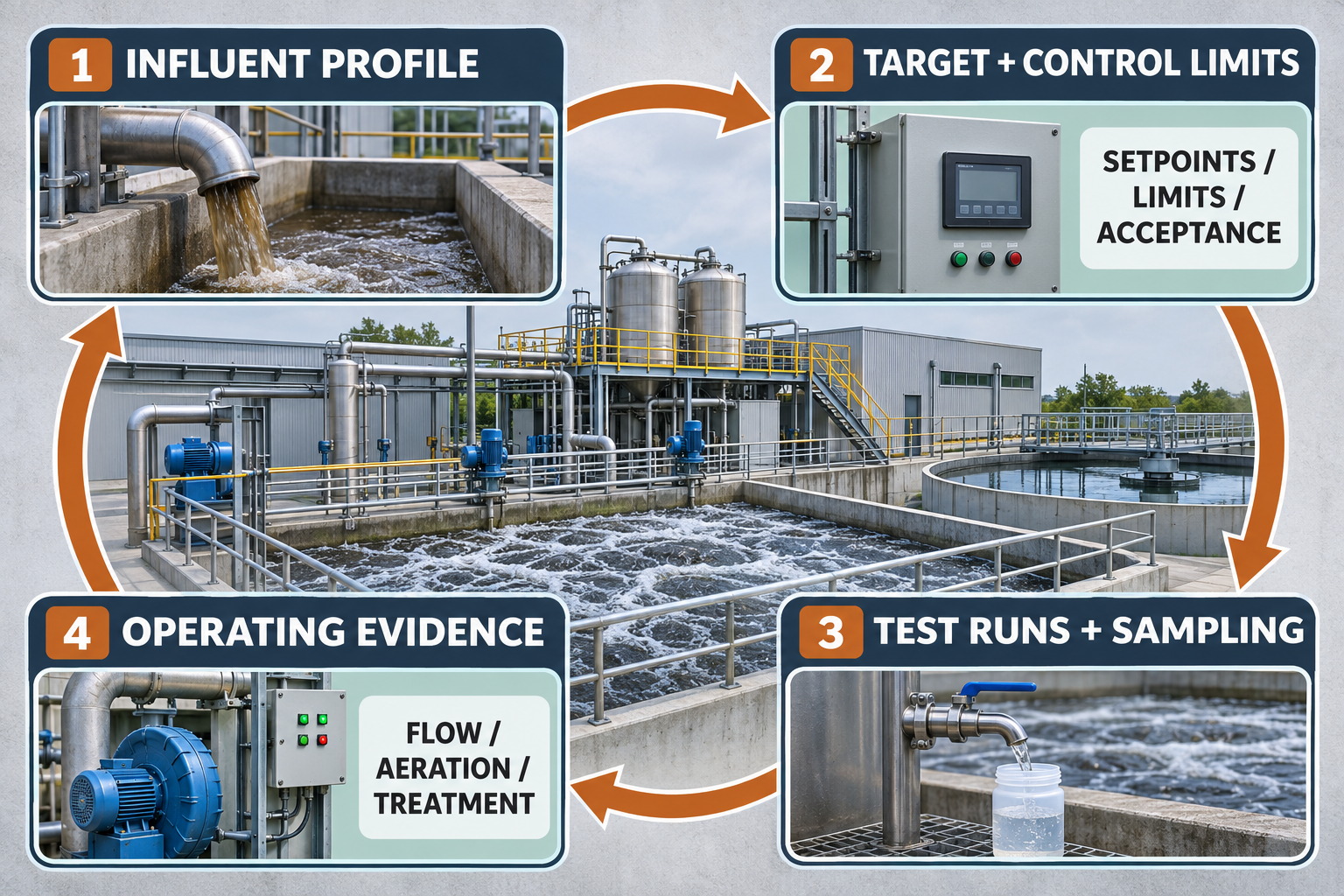
A credible treatment stack connects process control to a defined performance claim. It should explain the source, the target, the treatment steps, the monitoring plan, the residual pathway and the action taken when conditions change.
Segregation and equalisation protect the system
Segregating unusual or high-strength streams can stop a small contaminant load from destabilising a larger treatment process. Equalisation can then reduce peaks and provide a more stable feed to downstream stages.
These steps can improve reliability, but they need space, instrumentation, mixing, level control and an operating procedure. A drawing that includes a tank without explaining how it is controlled is incomplete evidence.
Biological treatment needs operating discipline
Biological treatment uses microorganisms to reduce biodegradable load. The process may be sensitive to loading, pH, temperature, toxicity, oxygen transfer and sludge behaviour.
It can be efficient for suitable streams, but it is not a universal answer. The provider should explain the feed range, upset response, oxygen demand, sludge management and evidence that the biology remains stable when production changes.
Polishing needs a specific removal claim
Polishing may use filtration, adsorption, oxidation, membranes or another technology. The commercial claim should state which parameter or contaminant group is being addressed, under what conditions and with what monitoring method.
Terms such as advanced treatment or high-quality effluent are not enough on their own. Investors should look for an acceptance criterion that links the technology to the customer’s discharge or reuse need.
Validation must reflect the real operating range
Validation means showing that the treatment performs under defined operating conditions. It can include sampling, control runs, laboratory analysis, trend review, alarms, deviation handling and repeat testing.
UNEP notes that industrial wastewater data are often poorly monitored and seldom aggregated at national level. It also warns that a treatment plant may produce effluent that does not meet standards because of improper design or loading. For an investor, this supports a practical question: can the company prove performance with site-level evidence, not only a technology description?
Which industrial customers can adopt first
Adoption is more likely where wastewater creates a clear operating or compliance constraint and the customer can define the value of solving it. The best early customer is not necessarily the largest site.
Food, drink and ingredients
Food and drink sites can produce organic loads, fats, oils, grease and variable washdown flows. The treatment requirement may change with product mix, cleaning schedules and seasonal production.
A provider can create value through equalisation, biological treatment, solids management, energy optimisation and reuse. The diligence question is whether the company understands the process timetable and can price variability rather than assuming a constant flow.
Metals, chemicals and manufacturing
Metals and chemical manufacturers may generate streams containing salts, acids, alkalis, oils, solvents or metals. The regulatory and treatment requirements can be more sensitive to concentration, pH and discharge route.
These customers may pay for strong process knowledge and monitoring. They may also create higher technical risk. The provider should show treatability evidence, residual handling and the limits of its claims.
Mining, energy and infrastructure sites
Mining and energy sites can have large flows, variable chemistry, remote locations and complex logistics. Treatment may be linked to dewatering, process water, produced water, cooling or site restoration.
The contract may be valuable, but delivery can require mobile plant, local support, power, access roads and contingency capacity. Investors should separate project size from repeatability and test how the company manages remote service economics.
Industrial parks and shared facilities
A shared industrial wastewater treatment plant can aggregate demand from several tenants. It can also create a better base for centralised monitoring and reuse when the park has suitable demand.
The risk is shared influent. One tenant’s chemical change or production surge can affect the whole system. Investors should ask about pretreatment standards, tenant contracts, capacity allocation and governance of the common asset.
Regulation, governance and environmental risk
Regulation is a commercial variable. It shapes the required treatment outcome, the information in the permit application, the monitoring process and the consequences of a breach.
Discharge route changes the obligation
A direct discharge to surface water, an indirect discharge to a public sewer, on-site reuse and off-site waste treatment can involve different permissions and authorities. GOV.UK guidance says a permit may not give an operator a right to discharge over land it does not own and that other arrangements may be needed.
Investors should avoid turning a UK rule into a global claim. A provider serving the UK, Europe or GCC needs a jurisdiction-specific compliance process that identifies the authority, the discharge route, the permit, the monitoring obligation and the responsible operator.
Best available techniques affect European projects
The EU Industrial Emissions Directive sets a framework in which emission limit values and related technical measures are based on best available techniques, without prescribing one specific technology. It also recognises that indirect releases through a water treatment plant can be considered where equivalent environmental protection is maintained.
That supports an investor diligence point. A technology is not valuable merely because it is novel. It must fit the site’s permit conditions, monitoring approach, environmental outcome and operating economics.
Management systems convert rules into operating practice
GOV.UK management-system guidance says a permitted operator must implement its management system and identify infrastructure such as treatment plants, monitoring points and discharge points. The guidance also notes that accredited certification is not a guarantee that every permit condition will be met.
This distinction matters. A certificate can support confidence in a process, but it does not replace site evidence, operating records or responsibility for compliance. Investors should review how the provider handles incidents, deviations, maintenance and customer handover.
Environmental risk includes data quality
Weak sampling, incomplete records or a poorly chosen monitoring point can make a treatment result hard to defend. A plant may appear to perform well while the evidence does not represent the real discharge or reuse stream.
Good governance defines ownership for alarms, sampling, calibration, reporting, corrective action and permit communication. These controls protect both the receiving environment and the commercial relationship.
Investor diligence questions
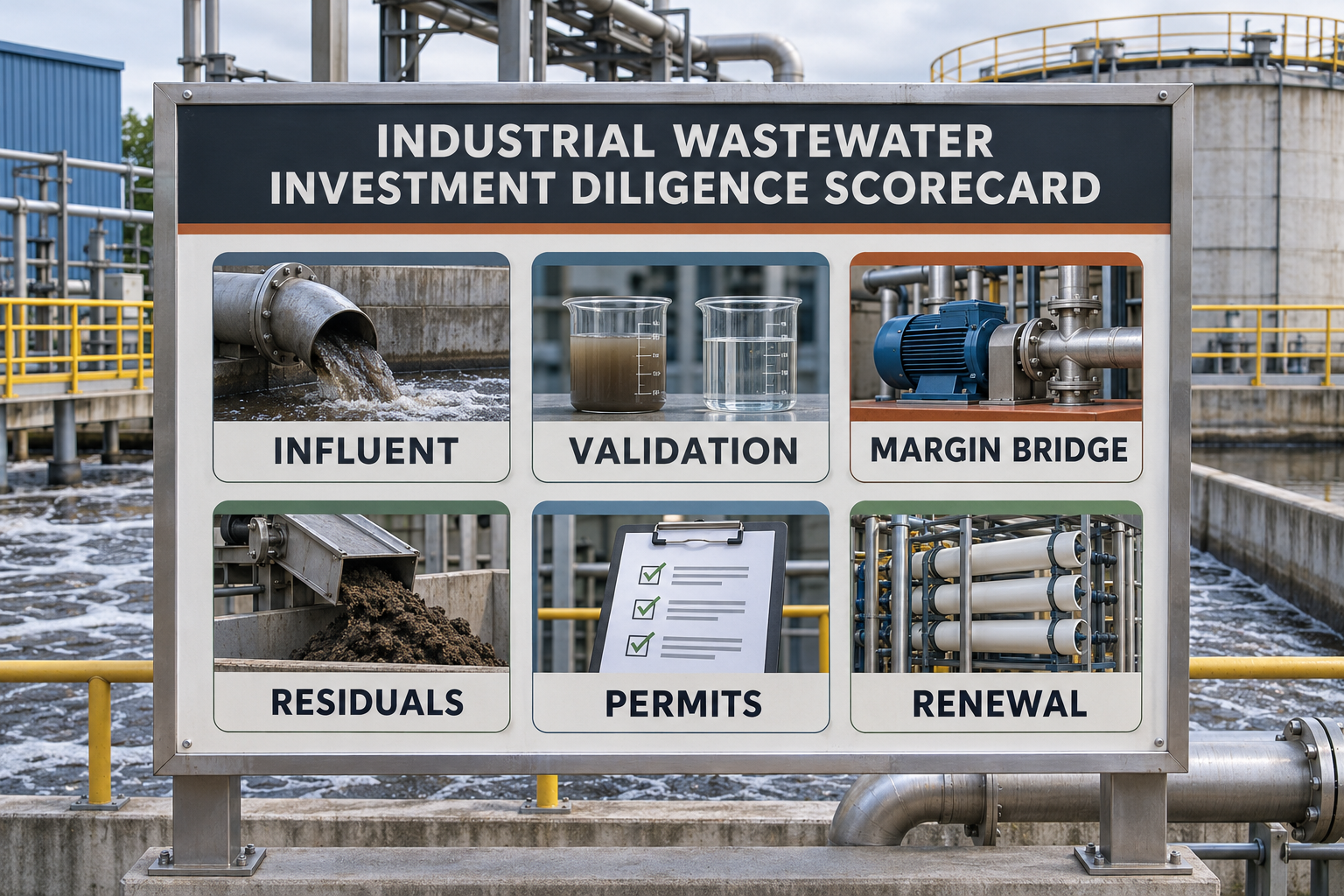
Investors should test the complete commercial chain. The goal is to understand whether the company can repeat the result with acceptable risk, not only whether one pilot produced a good sample.
Customer and demand questions
- Which customer problem starts the buying process: discharge risk, capacity, water cost, production continuity or reuse?
- Who owns the budget and who accepts the treatment result?
- How long is the sales cycle from survey to purchase order?
- What share of current revenue comes from repeat sites, renewals or service contracts?
Technical and validation questions
- Which wastewater profiles have been treated in the field, and how variable were they?
- What were the sampling points, design assumptions, control limits and acceptance criteria?
- What happens when the customer’s production changes outside the design basis?
- Where do sludge, concentrate, spent media and other residuals go?
Economic and delivery questions
- What is gross margin by equipment, engineering, commissioning and recurring service?
- How much work is standardised, subcontracted or dependent on one specialist?
- What are the energy, chemical, laboratory, travel and callout costs at each site?
- What warranty, performance guarantee and working-capital exposure remains after contract signature?
Regulatory and governance questions
- Which permit and discharge authorities apply to the installed base?
- Does the company distinguish treatment performance from monitoring performance?
- How are deviations reported, investigated and priced?
- Can the company prove that each claim matches the customer’s jurisdiction and intended use?
Industrial waste water treatment FAQs and next steps
What is industrial waste water treatment?
Industrial waste water treatment is the controlled treatment, monitoring and management of water produced by industrial processes before discharge, reuse or further handling. The treatment target depends on the source, contaminant profile, discharge route and applicable requirements.
Is industrial wastewater the same for every factory?
No. Industrial wastewater changes with the production process, raw materials, cleaning regime, flow, temperature and operating schedule. A defensible design begins with site-specific characterisation rather than a generic industry label.
Can industrial waste water treatment create recurring revenue?
It can create recurring revenue through monitoring, maintenance, laboratory coordination, managed operations, reporting, consumables and expansion to additional sites. The investment case depends on contract scope, renewal behaviour and service gross margin.
What is the main investor risk?
A central risk is the gap between a successful pilot and repeatable full-scale delivery. Variable influent, energy use, residuals, permitting, integration and support costs can reduce margins if they are not included in the commercial model.
Is this regulated investment advice?
No. This article is sector analysis for private-market research. It is not regulated investment advice, a recommendation, a forecast of returns or an offer to invest. Eligible investors can review the portfolio and join the network to discuss access and conduct their own diligence.
Industrial waste water treatment can be an investable water technology theme when the company links a real customer constraint to validated treatment, reliable evidence and repeatable delivery. The next step is to test the influent, contract, margin bridge, residual pathway and compliance proof separately before treating a project pipeline as scalable growth.
Sources
- GOV.UK and Environment Agency, Check if you need an environmental permit
- GOV.UK and Environment Agency, Risk assessments for your environmental permit
- GOV.UK and Environment Agency, Develop a management system: environmental permits
- GOV.UK and Environment Agency, Discharges to surface water and groundwater: environmental permits
- US EPA, Industrial Effluent Guidelines
- European Union, Directive 2010/75/EU on industrial emissions
- World Bank Group, Scaling Water Reuse: A Tipping Point for Municipal and Industrial Use
- UNEP, Total discharges to water bodies and share of total discharges safely treated