
To invest in water is to choose among very different businesses. A company may sell treatment equipment, monitoring software, replacement components, engineering services or a managed water service. Each can address a real need, yet each has a different route to revenue, margin, cash generation and scale.
That is why water investing should begin with the customer and the contract, not with a broad shortage narrative. Water can be essential while a particular company remains difficult to finance. The investable question is whether the business solves a funded problem in a repeatable way and can keep enough of the value it creates.
This guide is written for UK, European and GCC family offices, high-net-worth investors, sophisticated impact and private-equity investors, and relevant advisers considering direct private-company opportunities. It explains how to define an investable route, assess customer demand, test unit economics, match deal terms to evidence and monitor both commercial and water outcomes. It is not a personal investment recommendation.
Define your route before you invest in water
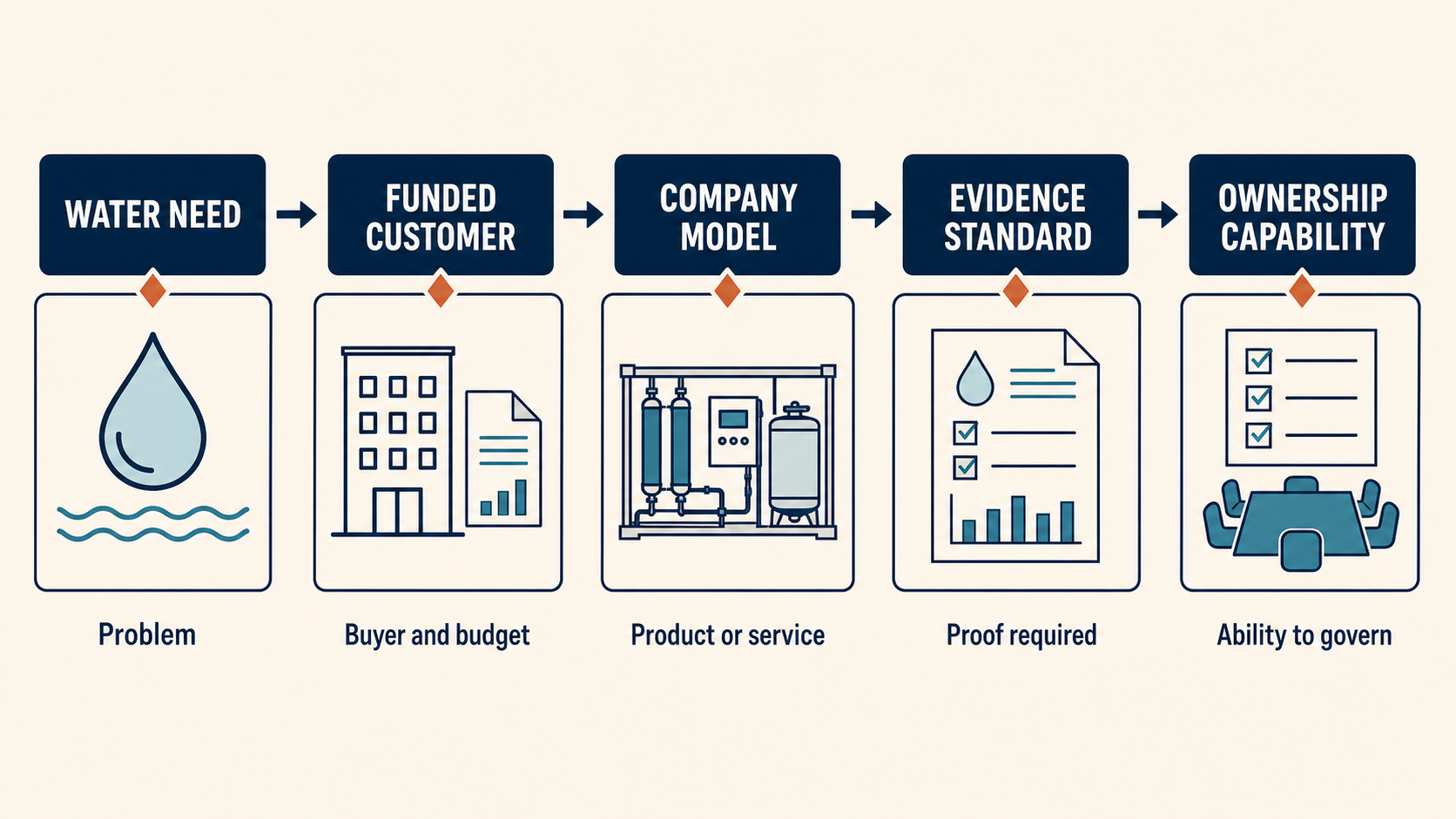
Water investment is not one asset class or one business model. It includes physical infrastructure, regulated service providers, project companies, specialist equipment manufacturers, digital platforms and service-led technology businesses. A direct private-company mandate needs a clear boundary because the evidence required for each route is different.
The World Bank’s framework for scaling water finance looks across programme-level and project-level opportunities and the roles of public bodies, private companies, intermediaries and development institutions. It also makes enabling conditions and a credible project pipeline part of the financing problem. [1]
For a family office or private-equity investor, the first decision is where the mandate sits in that broad system. A practical direct-company mandate might focus on businesses that sell technology or services to industrial sites, utilities, commercial facilities or infrastructure operators. This boundary is narrower than the whole water system, but it can make commercial comparison more useful.
Write the mandate as a set of operating rules:
- Customer: Which buyers should fund adoption, such as industrial operators, utilities or commercial property owners?
- Problem: Is the company reducing treatment cost, water loss, discharge risk, energy use, downtime or demand for fresh water?
- Stage: Is the mandate designed for proven growth, early commercial deployment or a deliberately limited technology-risk allocation?
- Business model: Will it accept equipment sales, recurring service, software, consumables or asset-backed delivery?
- Geography: Which regulatory systems, currencies, customer practices and ownership jurisdictions are understood?
- Impact: Which water result is intended, and what evidence must the company produce?
This discipline helps separate attractive water investment opportunities from opportunities that simply carry a water label. It also prevents the mandate from drifting when a persuasive presentation appears.
The next question is which investments in water sector companies fit those rules. A company should not enter the opportunity set merely because it sells into water. Its customer, application, maturity and economic model should match the mandate that the investment committee can actually govern.
The route should reflect the investor’s own capabilities. A team experienced in industrial technology may be able to assess equipment reliability, channel partners and factory economics. A team experienced in contracted infrastructure may be better placed to assess utilisation, counterparties, availability guarantees and long-duration cash flows. Sector interest is useful, but relevant diligence and ownership capability determine whether that interest can become a controlled investment process.
The private-market guide to impact investing in water provides the parent framework for commercial and impact discipline. This article narrows the question to selecting and underwriting direct water-technology companies.
Start with funded customer demand
The best starting point is not a projection of global water need. It is a specific buyer with a problem, a budget and a decision process. A factory may need to comply with a discharge permit. A utility may need to reduce leakage or improve treatment. A commercial site may need reliable monitoring across many locations. The company must connect its solution to one of those funded priorities.
The World Bank’s framework for scaling finance for water says private participation can contribute innovation, expertise and capital, but it also highlights enabling conditions, sector reform, project pipelines and appropriate financing structures. For a company investor, the practical lesson is that need becomes demand only when responsibility, economics and authority to buy are clear. [1]
Ask who owns the problem inside the customer. An environmental manager may care about compliance, an operations director about uptime, a finance director about payback and a procurement team about supplier risk. A sale that depends on all four may take longer than a technically enthusiastic pilot suggests.
Then identify the budget source. Useful categories include:
- Mandatory spend: expenditure needed to meet a permit, operating licence, safety standard or contractual requirement.
- Cost-saving spend: a project funded by lower water, energy, chemical, labour, waste or maintenance cost.
- Capacity spend: technology that allows a site to expand despite water or discharge constraints.
- Resilience spend: investment that reduces exposure to supply interruption, drought, flood or unreliable infrastructure.
- Strategic spend: expenditure connected to customer sustainability commitments, supplier requirements or operational transformation.
Mandatory demand can be durable, but regulation does not guarantee that a particular technology wins. Customers may delay, seek a cheaper substitute or choose an established vendor. Cost-saving demand can move faster when the baseline is trusted and the payback is visible, but it weakens if water prices, disposal costs or utilisation differ from the sales case.
Evidence of demand should move from conversation to commitment. A useful progression is problem confirmation, budgeted evaluation, paid pilot, full commercial deployment, repeat purchase and multi-site rollout. Letters of intent and unpaid trials can inform diligence, but they should not be treated as contracted revenue.
Review lost sales as carefully as won contracts. The reasons may expose installation disruption, slow procurement, poor integration, excessive payback periods or customer concern about supplier scale. A company that records and learns from losses usually provides better evidence than one that explains every delay as timing.
Finally, test concentration. Several contracts with one corporate group may still represent one economic customer. Demand is more resilient when the company can show that different buyers, applications and regions adopt for comparable reasons without requiring a new product each time.
Map where water technology creates and captures value
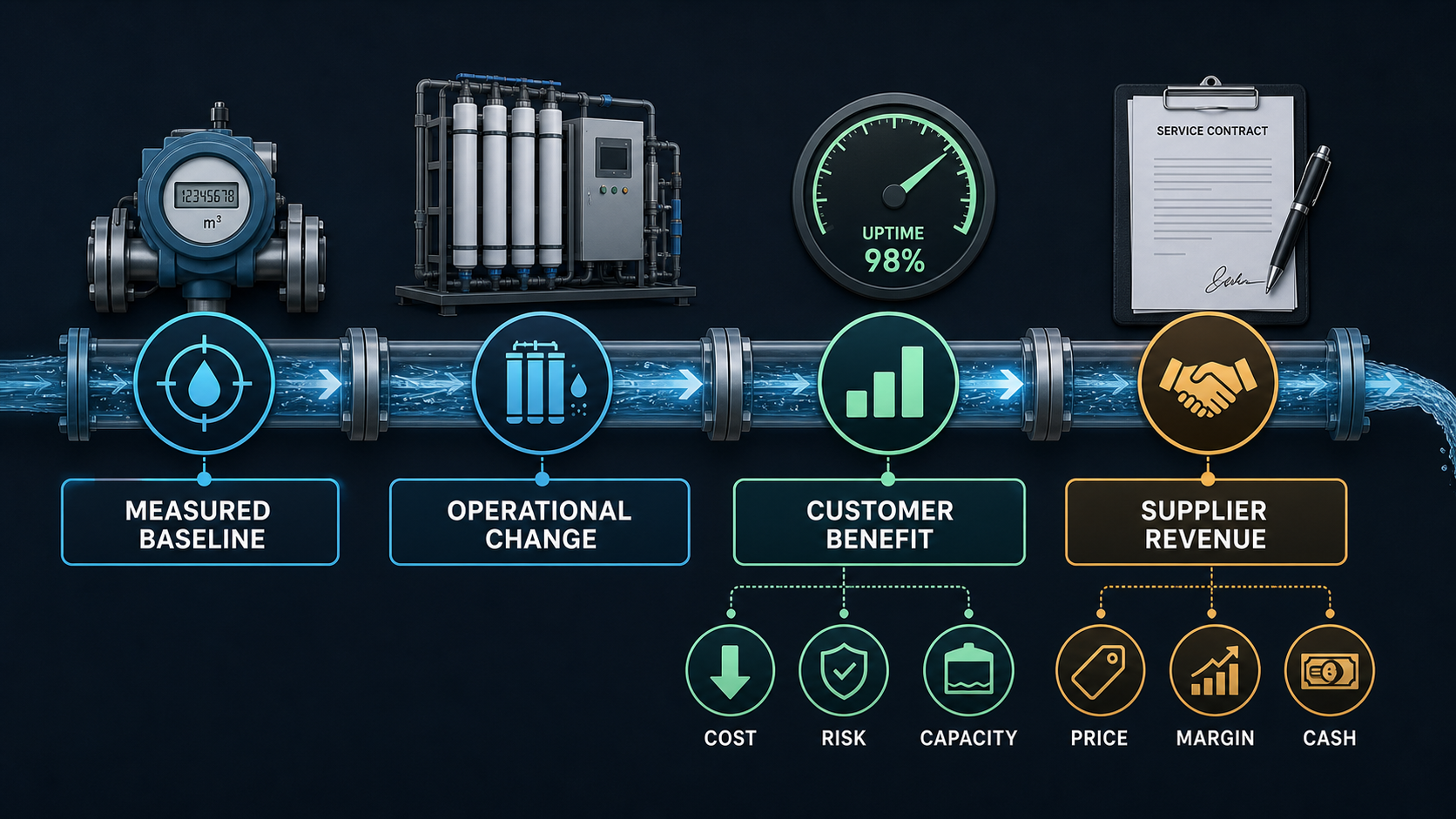
A company creates value when its solution changes a customer’s operating or risk position. It captures value when the contract allows some of that benefit to become revenue and margin. Both sides matter. A technically effective system can still be a weak business if customers receive most of the benefit while the supplier absorbs engineering, installation and performance risk.
Common value drivers include lower water purchases, reduced discharge fees, lower energy or chemical use, higher product yield, fewer shutdowns, longer equipment life, reduced labour and avoided compliance events. The company should quantify the relevant drivers at site level and show which assumptions came from measured data.
The European Commission’s Water Resilience Strategy links water efficiency, infrastructure modernisation, digital solutions, research, innovation and both public and private investment. It also places competitiveness alongside resilience. This supports a commercial lens: adoption is more credible where better water performance also improves cost, reliability or productivity. [2]
The EIB’s Water Resilience Programme covers infrastructure, water-loss reduction, pollution control and innovation. It illustrates the breadth of the system in which private companies operate, from reservoirs and pipelines to digital management and specialist technologies. [3]
Water industry investment can therefore reach a company through several commercial models:
| Model | Revenue trigger | Attraction | Investor question |
|---|---|---|---|
| Equipment sale | Delivery or acceptance | Clear order value and customer ownership | How variable are engineering, installation and warranty costs? |
| Consumables and parts | Use, replacement or service interval | Potential repeat revenue after installation | Is the installed base active, retained and difficult to substitute? |
| Software or monitoring subscription | Site, device or data subscription | Recurring revenue and low incremental delivery cost | Does the software remain valuable after hardware installation? |
| Service contract | Availability, treatment volume or agreed scope | Closer alignment with customer outcome | Who funds assets and carries performance and maintenance risk? |
| Licence or channel model | Territory, unit, royalty or partner sale | Potentially lighter capital and local reach | Can partners sell, install and support the technology to standard? |
Many businesses combine these models. Equipment may open a recurring parts and monitoring relationship. A managed service may include technology, operations and financing in one contract. Blended revenue can be attractive, but diligence should separate each stream. Revenue quality should not be inferred from a single headline percentage.
For each stream, reconstruct the customer value bridge. Start with the measured baseline. Apply the proposed technical change. Deduct implementation, downtime, finance and operating costs. Then compare the customer’s net benefit with the supplier’s price and obligations. If the case depends on an unverified tariff, unusually high utilisation or avoided cost that is not controlled by the buyer, the company may struggle to repeat the sale.
The strongest value proposition is often operational rather than abstract. A water purification investment may succeed because it keeps a production line running, reduces expensive waste hauling or creates reusable process water at a site with constrained supply. The environmental result matters, but the buying case usually becomes clearer when it is tied to the customer’s own economics and accountability.
Test technical proof and commercial adoption separately
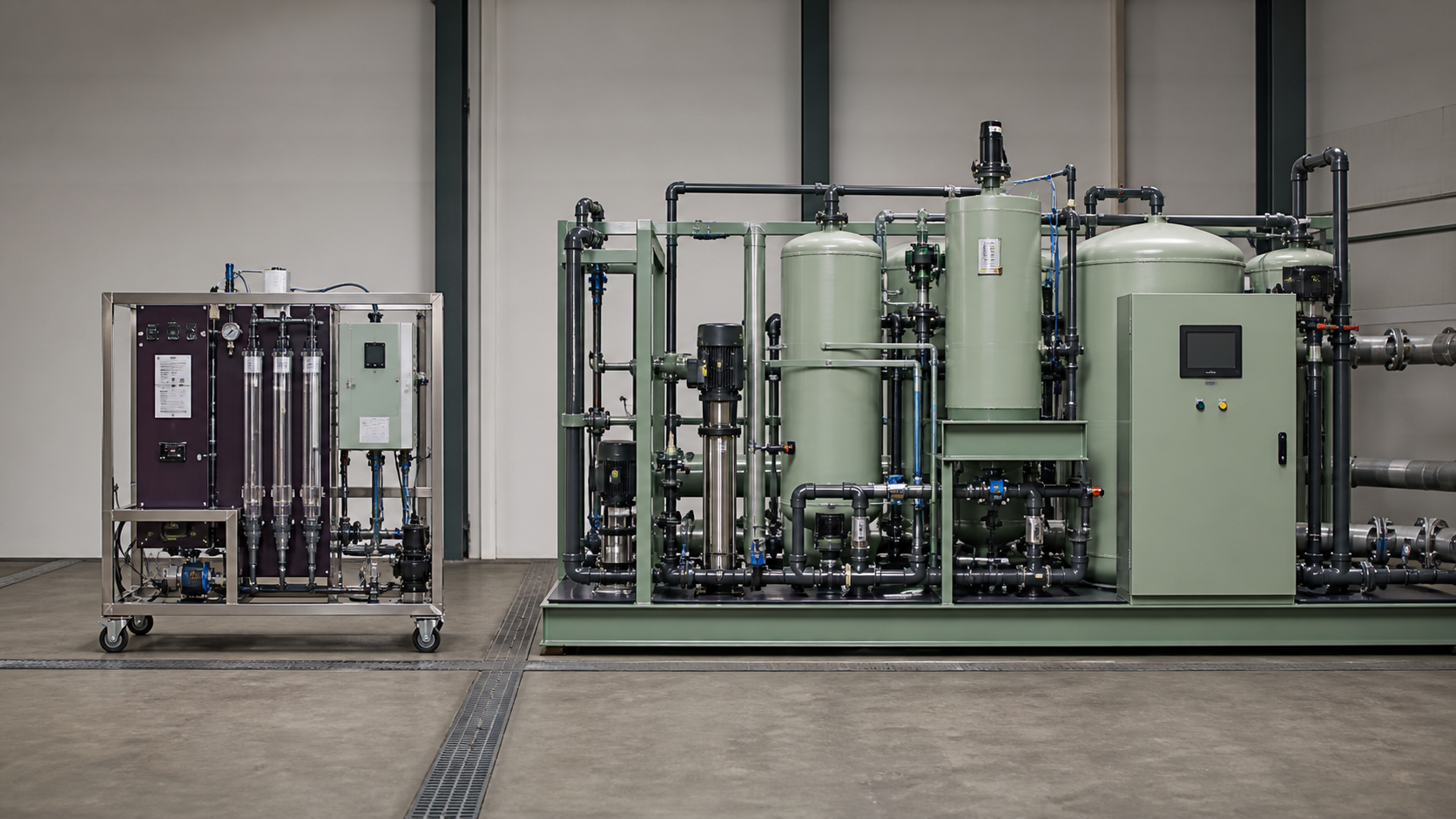
Investing in water technology requires two evidence files. The first asks whether the technology works within a defined operating envelope. The second asks whether customers will buy, install, use and renew it on acceptable commercial terms. A company can pass one test and fail the other.
Technical diligence should define the feed water, contaminants, flow, temperature, pressure, duty cycle and required output. Average performance is not enough. Investors need ranges, exceptions, maintenance history and the conditions under which the system stops meeting specification.
Ask for a traceable evidence hierarchy:
- laboratory results with methods, samples and controls;
- pilot results under representative conditions;
- independent or customer-verified operating data;
- full-scale commercial performance over a relevant period;
- repeat performance across different sites and operators.
The evidence should include failures. Membranes foul, sensors drift, pumps wear, biological systems respond to changing conditions and remote connections fail. The question is not whether a slide can show a successful run. It is whether failure modes are known, detectable, recoverable and reflected in warranty reserves, maintenance plans and pricing.
Commercial adoption has its own tests. Check sales-cycle length by customer type, pilot-to-order conversion, time from order to commissioning, acceptance criteria, renewal behaviour and expansion at existing customers. Separate a paid pilot from a recurring deployment. A pilot may be a genuine commercial milestone, but it is not proof of repeat scale until the next decision is made.
Reference calls should reach the person responsible for operations and the person responsible for budget. Ask what changed after installation, what required more support than expected, whether the original business case was achieved and what would prevent a second purchase. A supportive innovation contact may not know whether the solution survived procurement or daily operations.
Product configuration is another signal. If each site needs substantial redesign, the company may behave like a project engineering firm even if it describes itself as a product company. Configuration is not automatically bad, especially in industrial water. The investment question is whether the variable work is priced, documented and delivered without consuming the margin expected from the standard product.
Water technology investment becomes more defensible when the company accumulates proprietary operating knowledge, validated application data, integration capability, certifications, trusted customer relationships or a service network that competitors cannot quickly reproduce. Patents may contribute, but they should be assessed alongside freedom to operate, practical enforceability and the speed at which alternative methods can reach the same customer outcome.
Read revenue, margins and cash needs together
Revenue growth can conceal weak economics. Water companies often carry hardware, installation, commissioning, inventory, warranty and receivable exposure. An investor needs to understand when cash leaves, when revenue is recognised, when the customer pays and what obligations remain after acceptance.
Rebuild gross margin at contract level. Direct costs may include equipment, bought-in components, fabrication, freight, site labour, subcontract engineering, chemicals, cloud services, field support, warranty and performance remedies. Costs classified below gross profit in management accounts may still be necessary to deliver the contract.
Then separate three margin views:
- Quoted margin: the margin expected when the order was accepted.
- Delivered margin: the margin after actual installation and commissioning costs.
- Lifetime margin: the margin after warranty, service and contract obligations are included.
The gap between these views is often more informative than the headline average. Repeated commissioning overruns may show that the product is not standard enough, the sales process underprices site complexity or the installation partner model is immature.
Cash conversion needs equal attention. A profitable equipment order can consume cash if deposits to suppliers are due months before customer payment. Long receivable periods, retention amounts and inventory buffers can make growth capital intensive. A service model may move capital expenditure onto the provider’s balance sheet, adding utilisation, financing and residual-value risk.
Build a monthly contract cash curve for representative projects. Include deposits, manufacturing, shipping, installation, testing, acceptance, customer payment, tax and warranty reserves. Compare the curve with actual bank movements, not only accounting revenue.
Recurring revenue should be tested rather than labelled. Ask what makes it recur, how customers can cancel, whether price resets are permitted, what service level is promised and how much field work supports the contract. Software attached to inactive hardware is not durable recurring revenue. Consumables can be attractive, but only if installed units operate, replacement intervals are evidenced and alternatives are limited.
Unit economics also need cohort analysis. Group installations by period, technology version, customer type and geography. Compare revenue, service cost, downtime, expansion and retention. A blended company average may hide that recent deployments require more support or that one early customer creates most of the apparent margin.
Finally, connect the plan to cash. Management forecasts should state order assumptions, delivery capacity, gross margin, payment timing, recruitment, inventory and capital expenditure. A downside case should model delayed orders, slower acceptance, lower margin and additional commissioning work together. These risks often arrive as a group.
Decide whether the company can scale
Scale is not the same as winning a larger project. A scalable company can increase useful output without rebuilding its delivery system for every customer. In water, that may mean standard modules, repeatable design rules, trained partners, remote support, common controls and a supply chain that can grow without damaging quality.
Start with the bottleneck. It may be manufacturing, specialist engineering, site permitting, commissioning staff, channel capability, customer procurement or access to asset finance. The constraint should be expressed in measurable units, such as systems per quarter, engineering hours per site or time to acceptance.
Test standardisation at four levels:
- Product: which components, controls and interfaces are common?
- Application: which feed-water or operating conditions require a different design?
- Delivery: can installation, commissioning and training follow documented steps?
- Support: can faults be diagnosed remotely, and can local partners complete routine work?
A standard product may still serve several applications. What matters is whether variation is governed by a defined configuration system rather than fresh invention. Investors should compare the bill of materials, drawings and engineering hours across recent deployments.
Channel partners can accelerate reach, especially across Europe and the GCC, but they also create control risk. Confirm who owns the customer, sets the price, carries inventory, completes installation, provides first-line support and reports operating data. A signed distributor agreement does not prove that a partner can generate or support sales.
Manufacturing strategy should match volume and quality needs. Outsourcing can limit fixed capital, yet it may increase supplier concentration, lead times and control risk. In-house assembly can protect knowledge and quality, yet it requires people, working capital and systems. The right answer depends on which activities are genuinely differentiating.
Scalability also depends on customer evidence travelling between markets. A successful food-processing installation may not transfer directly to mining, municipal wastewater or semiconductor production. Different contaminants, standards, budgets and buying processes can make each application a separate market. Expansion is more credible when adjacent customers share a problem, technical envelope and procurement logic.
Defensibility should strengthen as the installed base grows. Useful advantages may include application data, lower lifecycle cost, verified reliability, integrations, approvals, service coverage and customer switching cost. If every new sale teaches competitors as much as it teaches the company, growth may not create a durable position.
Match valuation and deal structure to the evidence
The investment structure should reflect what has been proved and what remains uncertain. Early commercial technology, profitable specialist manufacturing and asset-backed services should not be underwritten with the same assumptions.
Start with the capital-use bridge. Identify the operating milestones expected before more capital may be needed. These could include commercial acceptance, repeat orders, a margin threshold, a manufacturing transfer, a certification or a defined installed base. Each milestone should have a cost, timing range and evidence source.
Water technology venture capital may accept a higher level of technical and market uncertainty in exchange for earlier entry and potential growth. Growth capital normally needs stronger proof of repeat sales, delivery economics and management systems. A private-equity approach may require durable cash generation, a credible improvement plan and clear governance rights. These are different risk budgets, not interchangeable labels.
Valuation analysis should be grounded in the company’s actual economics. Revenue multiples can mislead when one business sells high-margin software and another passes through equipment and installation costs. Compare gross profit, recurring gross profit, contract cash generation, customer concentration and the capital needed to deliver growth.
The ownership percentage is only one term. Review:
- share class and liquidation rights;
- pre-emption and dilution protection;
- board representation and reserved matters;
- information and inspection rights;
- founder, management and employee incentives;
- warranties, disclosures and liability limits;
- future funding mechanics;
- transfer, exit and drag or tag provisions.
Terms should not be used to disguise a weak company case. Strong downside rights cannot create customers or repair an unreliable product. They can, however, define governance, align incentives and protect the investor when evidence develops differently from the plan.
Model dilution under realistic future funding cases. A hardware or service business may require more working capital as orders grow, even when accounting performance improves. If the business needs asset finance, identify whether that finance is available, at what cost, with what security and whether it depends on guarantees from the operating company.
Liquidity also needs explicit treatment. Direct private-company interests may be held for a long period and may have limited transfer options. The committee should test whether the mandate can support the expected holding period without relying on a specific exit date or buyer.
Return analysis should be scenario based, not promised. Use operating cases linked to orders, margin, cash needs and dilution. Record which conditions must hold for each case and update them when evidence changes.
Diligence regulation, geography and execution risk
Water sits inside environmental, health, infrastructure and economic regulation. The relevant rules depend on the product, customer, discharge, water source, intended use and jurisdiction. Regulation can create demand, but it can also lengthen approvals, restrict deployment and increase liability.
Build a compliance map for each target market. It should identify product certifications, environmental permits, water-quality standards, data requirements, import rules, local installation licences and customer-specific approval processes. Record who is responsible for each approval and whether the company’s current evidence is recognised locally.
The UK government’s 2026 water white paper sets out a changing direction for England, including an integrated regulator, long-term planning, infrastructure delivery, water reuse, metering, standardisation and financial resilience. For investors, the important point is not to assume that a policy announcement immediately becomes a company order. The path runs through regulation, plans, procurement, budgets and operational adoption. [4]
Across Europe, the Water Resilience Strategy points towards efficiency, digitalisation, infrastructure and innovation, while national implementation and customer procurement remain important. GCC markets can offer strong need and ambitious infrastructure programmes, but investors should examine local approvals, partner dependence, payment terms, localisation requirements and the fit between technology and water conditions.
Geographic expansion adds several linked risks:
- Technical fit: feed water, climate, industrial processes and operating practice may differ.
- Commercial fit: the buyer, budget cycle, tender rules and sales channel may change.
- Delivery fit: parts, field support, remote connectivity and trained partners must be available.
- Financial fit: currency, tax, duties, payment security and working-capital requirements may move.
- Legal fit: contracts, liability, intellectual property and dispute resolution need local review.
Customer concentration and supplier concentration should be assessed together. A company dependent on one large buyer and one specialist component can lose both revenue and delivery capacity at once. Ask for qualified alternatives, reorder times, inventory policy and contractual rights.
Cyber and data risk matter when systems connect to operational infrastructure. Review network architecture, access control, update processes, incident history, data ownership and the consequences of an outage. A monitoring system may influence maintenance or compliance decisions even if it does not directly control the plant.
Management capacity is another execution gate. The skills needed to invent a system are not identical to those needed to price contracts, run manufacturing, manage field service and report to investors. Assess whether responsibility is clear, management information is timely and difficult issues reach the board before they become cash problems.
A risk register should connect each material risk to an owner, indicator, mitigation and review date. General labels such as market risk or technology risk are too broad. Useful entries describe a specific event, its pathway into cash or impact, and the evidence that would show risk is rising.
Measure water outcomes and adverse effects
Investing in sustainable water requires evidence that the company creates a useful water outcome without moving unacceptable harm elsewhere. Impact evidence should support the investment case, but it should not replace commercial diligence.
Start with a defined baseline. For a treatment company, it may be contaminant load, disposal method, fresh-water intake, energy use or operating interruption before deployment. For a monitoring company, the baseline may include detection time, data coverage, response time or the number of avoidable events. State the site, period, boundary and data source.
Then connect activity to outcome:
- Input: capital, equipment, labour and operating resources.
- Output: capacity installed, water treated, sites monitored or systems maintained.
- Outcome: the measured change in quality, consumption, reuse, loss, reliability or risk.
- Contribution: why the change is reasonably linked to the company and the investment.
UN-Water’s 2024 update on integrated water-resources management assesses enabling conditions, institutions, management instruments and financing. It also emphasises the need to balance competing water demands across society and the economy. That wider context matters because a positive result at one site may not be positive for the basin if it increases extraction, shifts pollution or reduces access elsewhere. [5]
Choose metrics that are decision useful. Volume treated can be important, but it does not show quality, additional supply, avoided extraction or customer value by itself. A stronger set may combine output, quality, baseline comparison, operating resources and an adverse-effect indicator.
Check units and attribution. Water saved should not be confused with water treated. Treatment capacity should not be presented as actual utilisation. A modelled result should be labelled as modelled, and an annualised figure should state the operating period on which it is based.
Energy, chemicals, concentrate, sludge and replacement parts may create trade-offs. A purification system can improve water quality while consuming more power or creating a residual stream that needs responsible management. Investors should request mass and energy balances where relevant and review the final route for residuals.
Data quality should improve with company maturity. Early evidence may come from controlled pilots, but later-stage claims should use routine operating records, calibrated instruments, customer confirmation and clear methods. Material outcome claims may justify independent review.
During ownership, compare the commercial and impact dashboards. If throughput rises while treatment quality falls, or if customer savings depend on excessive service support, one side of the thesis is weakening. The purpose of measurement is to improve decisions, not to fill a report with large numbers.
Turn diligence into an ownership plan
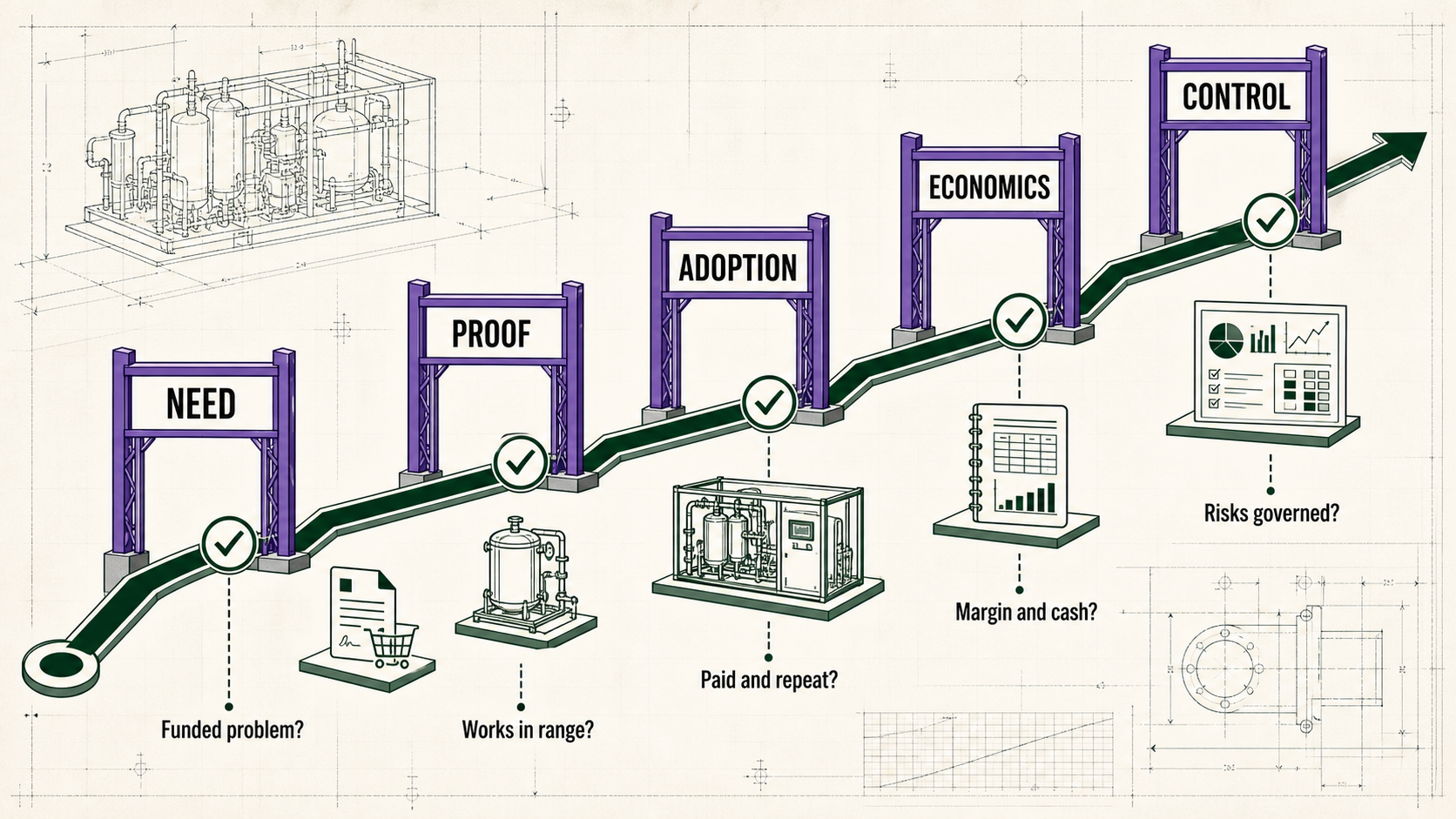
Diligence is useful only if its findings change the investment decision, terms or ownership plan. The final committee paper should show the chain from customer problem to company economics, required capital, water outcome and investor risk.
A concise decision framework can use five gates:
- Need: Is the customer problem specific, material and funded?
- Proof: Does the technology work in the target operating range, including failure conditions?
- Adoption: Have customers moved from evaluation to paid and repeat deployment?
- Economics: Do delivered margin, cash conversion and capital needs support the plan?
- Control: Can governance, evidence and resources manage the remaining risks?
Each gate should show evidence, uncertainty and a clear conclusion. A red flag is not always fatal. It may lead to a lower valuation, staged capital, a condition before completion, enhanced reporting or a decision to wait. The response should match the risk rather than depend on optimism.
The first 100 days of ownership should focus on evidence that protects the thesis. Priorities may include contract-margin reporting, a reliable order-to-cash forecast, product configuration controls, customer-reference tracking, a regulatory map and a small set of water-outcome indicators.
Board reporting should be designed before investment. Useful recurring measures include qualified pipeline by stage, sales-cycle movement, order intake, backlog quality, delivered gross margin, working capital, commissioning delays, system availability, repeat orders, customer concentration and selected outcome metrics.
Milestones should describe completed evidence, not activity. “Hire a sales director” is an action. “Two additional qualified channel partners produce paid orders within the defined application” is closer to an outcome, although the result still needs commercial and margin context.
Scenario triggers help avoid delayed decisions. Agree what happens if acceptance slips, gross margin falls, a certification takes longer, a major customer pauses or more capital is needed. The board can then respond using an agreed risk framework rather than inventing one during pressure.
Investors should also plan for information continuity. Technical and commercial evidence often sits across laboratory files, customer reports, spreadsheets and individual employees. A controlled data room, documented methods and clear ownership reduce key-person risk and improve future financing or exit readiness.
The Water Investment Network portfolio shows several direct routes across treatment, membranes and monitoring. It is a starting point for opportunity discovery, not a substitute for company-specific legal, financial, commercial, technical, tax, regulatory and impact diligence.
A credible decision to invest in water begins with a narrow mandate and ends with evidence that can survive ownership. The company should solve a funded customer problem, perform inside a defined technical range, capture value through a workable contract and scale without losing margin or control.
Water Investment Network considers access requests from eligible UK, European and GCC family offices, high-net-worth individuals, sophisticated impact and private-equity investors, and relevant advisers. These investors can request access to Water Investment Network to review selected direct private-company opportunities.
The network is invitation-only and does not provide regulated financial advice. Participation is subject to eligibility and availability. Every opportunity requires independent assessment of valuation, terms, liquidity, legal position, technical evidence, commercial performance, regulation, tax and impact. No water theme removes company-specific risk.
Frequently asked questions about investing in water
What does it mean to invest in water?
It can mean providing capital to infrastructure, services or technology connected to water supply, treatment, reuse, monitoring or risk management. This guide focuses on direct private water-technology companies.
What should a private investor examine first?
Start with the funded customer problem. Identify the buyer, budget, decision process, measured baseline and reason the customer would adopt now.
How is a water technology company different from a project business?
A technology company should have repeatable product, data or service advantages. A project business may depend more heavily on site-specific design, construction and financing. Many companies combine both, so investors need to separate the economics.
Which metrics matter in a direct water investment?
Useful measures include paid deployments, repeat orders, delivered gross margin, cash conversion, system availability, customer concentration and a defined water outcome compared with a baseline.
What are the main risks?
Material risks can include technical limits, slow procurement, site-specific engineering, regulation, customer or supplier concentration, working capital, further funding, weak outcome evidence and illiquidity.
Sources
- https://www.worldbank.org/en/topic/water/publication/scaling-up-finance-for-water-a-world-bank-strategic-framework-and-roadmap-for-action
- https://commission.europa.eu/topics/environment/water-resilience-strategy_en
- https://www.eib.org/en/projects/topics/energy-natural-resources/water-and-waste-water-management/index
- https://www.gov.uk/government/publications/a-new-vision-for-water-white-paper/a-new-vision-for-water
- https://www.unwater.org/publications/progress-implementation-integrated-water-resources-management-2024-update