
Patient capital is long-term funding for a company that needs time to build a large, durable business. In water, that patience can matter because technical validation, customer approval, site deployment and repeat sales rarely happen at the same speed.
Time alone does not make a water company investable. A longer holding period must support a clear path from a real customer problem to repeatable revenue, sensible cash use, measurable outcomes and a credible route to liquidity. The company still needs evidence. It may simply need more time for that evidence to mature.
This guide explains how UK, European and GCC family offices, high-net-worth investors and advisers can assess patient capital in water technology. It focuses on direct private-company opportunities, not public-market products or regulated investment advice.
What patient capital means in a water business
There is no single global definition of patient capital. The British Business Bank describes it as long-term investment in innovative firms that want to build large-scale businesses. Its review also links patient capital with illiquidity, a wide spread of outcomes between investments and higher risk. [1]
That definition is useful for water investors because it separates patience from optimism. The investor is not waiting without a plan. The investor is funding a company through a stage where the commercial model may need time, capital and operating discipline to become repeatable.
A water company may need this type of capital when it has a working technology but a long route to scaled adoption. It may need to complete customer qualification, build manufacturing capacity, fund inventory, establish service coverage or convert paid projects into recurring contracts. These are different uses of capital, and each needs a different milestone.
Patient capital can take different forms. It may be ordinary equity, preferred equity, a long-dated loan, a structured investment or a blend of instruments. The right structure depends on the company’s cash generation, asset base, risk and expected route to growth. The label does not remove the need to understand terms, control rights, dilution, repayment and downside protection.
For an investor, the central test is simple: what does extra time allow this company to prove? A strong answer might involve repeat orders, improved delivered margin, a standardised installation process, a larger service base or a measured customer outcome. A weak answer is only that water is important and the market is large.
Patient capital also needs a stopping rule. A company should be able to state which evidence would cause it to slow hiring, change the offer, pause a market or seek a different funding route. Patience becomes dangerous when it turns into permission to postpone difficult decisions.
The wider private-market guide to impact investing in water explains why the sector can sit within an impact-led investment thesis. This article narrows the question to the funding horizon and the company evidence needed to support it.
Why water can need a longer funding horizon
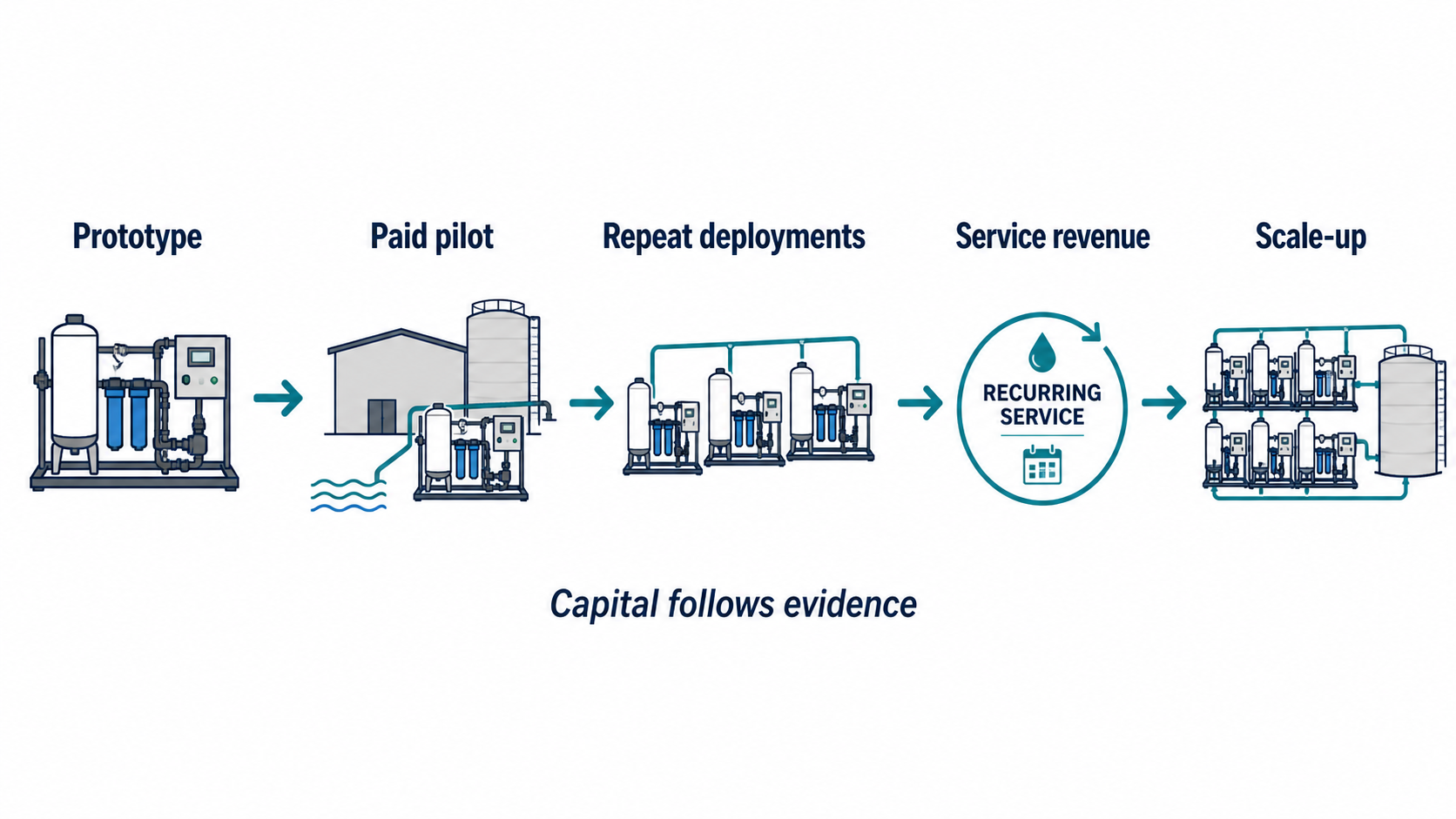
Water businesses often sell into systems that are essential, regulated or operationally hard to change. A customer may need a new treatment process, monitoring system or reuse solution, but approval can involve engineering, operations, procurement, finance and compliance teams.
The first sale may therefore take longer than a simple equipment purchase. The supplier may need to test a water stream, agree performance measures, adapt the design, pass a site review and show that the system can run without disrupting production. Each step can affect revenue timing and working capital.
The water financing context is also large and uneven. The Joint MDB Water Security Financing Report says that multilateral development banks approved USD 19.6 billion of water-related financing in 2024, including USD 14.4 billion for low- and middle-income countries. It also highlights the need for more investment, reform and private capital. [2]
Those figures describe a financing system, not the addressable market for any one company. They do show why investors should separate a broad water need from a specific commercial route. A company may benefit from a structural demand driver while still failing to secure contracts, protect margin or collect cash.
Longer funding horizons can help when the company is capital intensive or has a long commercialisation path. The British Business Bank notes that the long term can vary by sector, from several years to ten years or more in some technology businesses. That is a useful reminder that a fund’s normal exit timetable may not match the company’s operating reality. [1]
For water investors, the answer is not to accept an indefinite holding period. It is to model the time required for defined proof points. Those points may include a number of paid deployments, a service renewal pattern, a margin level after installation or a documented route to a larger buyer.
Regional context can change the timetable. UK and European customers may have formal procurement and compliance processes. A GCC customer may place greater weight on supply reliability, reuse and operating performance in a water-stressed setting. These are useful hypotheses, not facts about every buyer. The company must show its own sales cycle and customer evidence.
The European Investment Bank’s water programme illustrates how water finance can combine infrastructure, innovation and resilience priorities. Public and development finance can improve the backdrop. It does not guarantee demand for a private company or replace company-level diligence.
Start with the buyer, not the water theme
A patient-capital case should begin with a buyer who has a reason and a budget to act. Water scarcity, pollution or resilience may create urgency. The investable question is whether a customer will pay for a defined solution within a credible process.
Start by naming the user, economic buyer and approver. The user may operate a treatment system. The economic buyer may control a production budget. Procurement may negotiate the contract. A board, regulator or public authority may approve the wider programme. A company that cannot map these roles may have interest without a reliable route to revenue.
The customer problem should also be measurable. It might relate to freshwater use, discharge, downtime, energy consumption, compliance exposure or the cost of moving water. The baseline does not need to be perfect at the first meeting, but the company should know what it expects to measure and who will accept the result.
Look for evidence in order of commercial strength:
- A technical conversation shows interest but does not prove a funded project.
- A pilot can show performance, but its payment status and acceptance terms still matter.
- A purchase order shows commitment, but the investor should check delivery margin and collection timing.
- A repeat order or renewal gives stronger evidence that the customer value survives the first deployment.
The same discipline applies to channel partners. A distributor may open a market, but the company should know who owns the customer relationship, who carries warranty exposure and how pricing is controlled. A large partner logo is not a substitute for signed terms or customer references.
Private water companies can sell equipment, project delivery, monitoring, maintenance, consumables, treatment capacity or a mixture. Each offer creates a different buyer relationship. The investment case should explain what is purchased, how often it is purchased and which part of the customer value the company captures.
IFC describes barriers to private water investment such as weak institutions, non-cost-reflective tariffs, assets that are difficult to collateralise and limited long-term local-currency finance. These constraints can shape the route to market and the risk of payment. [3]
Investors should therefore ask for the customer evidence behind the forecast. Useful documents include signed contracts, purchase orders, acceptance certificates, invoices, renewal records and a schedule of open proposals. Redact confidential details where needed, but preserve enough information to test the commercial story.
The Water Investment Network portfolio gives a starting point for reviewing direct water opportunities. Any individual opportunity still requires independent legal, financial, technical, commercial, tax, regulatory and impact diligence.
Separate technical proof from commercial proof
A technology can work in a controlled test and still fail to become a durable business. Patient capital should not blur that distinction. It should give investors enough time to see whether technical performance survives real customer conditions and a repeatable delivery process.
Technical proof asks whether the process or equipment performs within defined conditions. Review the water characteristics, flow range, operating temperature, maintenance requirements, power use, consumables, data quality and failure limits. Ask which conditions were held constant and which were allowed to change.
Commercial proof asks different questions. Did a real customer pay? Was performance accepted under the contract? Was the system delivered at the expected cost? Did the customer buy again? Can the company support a second or third site without relying on the founder for every decision?
IFC’s Scaling Re-Water initiative shows why project preparation, standard documents, balanced agreements and lower transaction costs can help mobilise water finance. The lesson for a private company is practical: remove avoidable friction from the path between a working solution and a financeable deployment. [4]
Review the boundary between standard and bespoke work. A standard treatment module may have a repeatable bill of materials. The same company may still spend large sums on site surveys, integration, commissioning and after-sales support. Investors should know which costs belong to the standard offer and which are created by each customer.
Failure evidence matters as much as success evidence. Ask how the company handles off-specification water, fouling, sensor drift, delayed components, missed performance tests, warranty claims and customer complaints. The answer shows whether management understands the installed-base risk that arrives with growth.
Independent testing can strengthen the case when its method and limits are clear. A report paid for by the company may be useful. It should not be described as regulatory approval or independent customer validation unless it is both. Precise language protects the investor and the company.
A useful comparison is:
| Question | Technical proof | Commercial proof |
|---|---|---|
| What is tested? | Performance within stated operating conditions | Customer acceptance and delivered result |
| What is measured? | Water quality, flow, energy, reliability or other defined outputs | Price, cost, margin, collection, renewal and support effort |
| What remains uncertain? | Variation in water, site and operating conditions | Repeat sales, delivery capacity and cash conversion |
The table is not a scorecard by itself. It is a prompt to keep two kinds of proof visible. A company may be strong on one and early on the other. That can still suit patient capital, but the gap must be priced, staged and monitored.
Read cash conversion and working capital
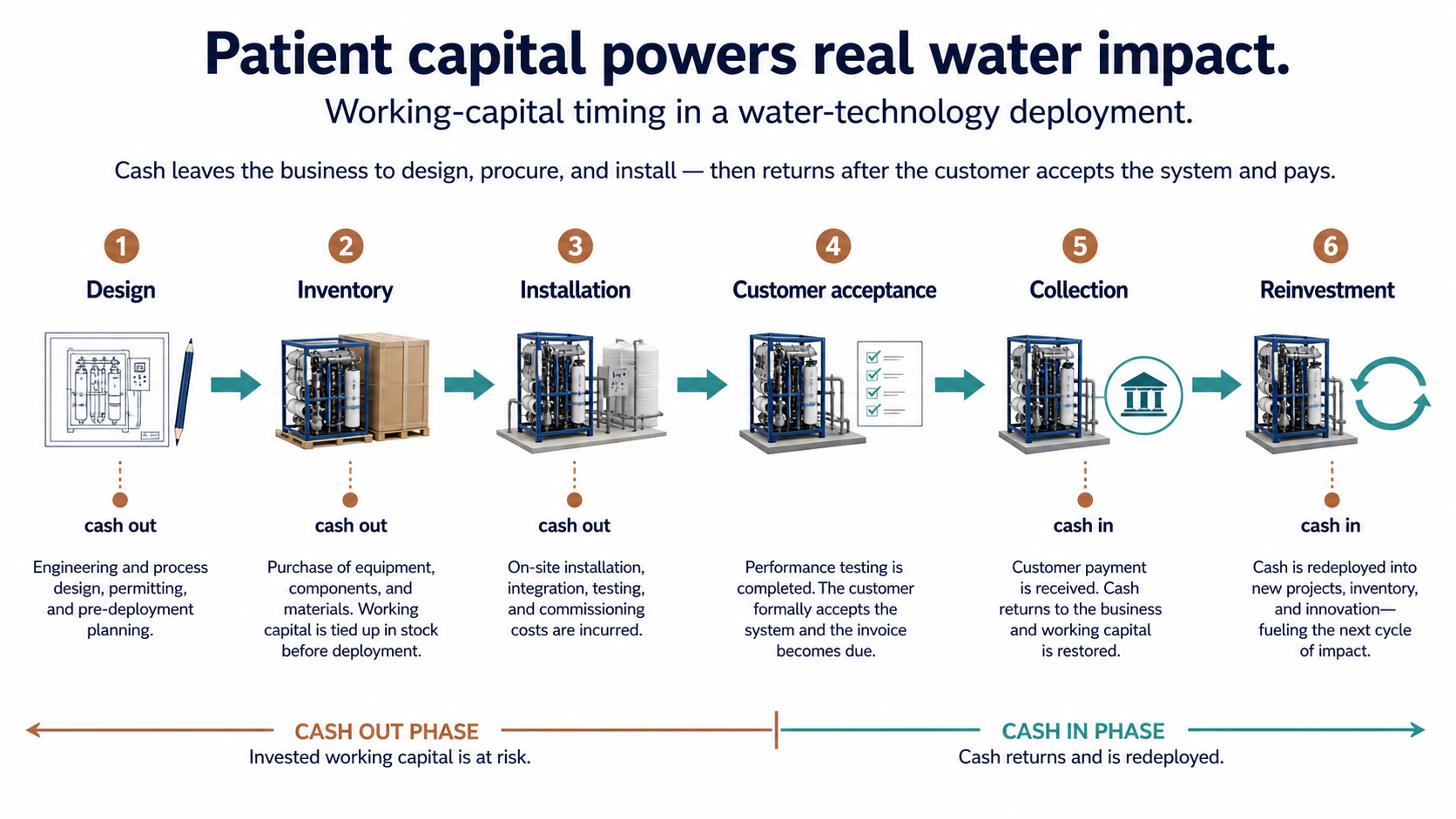
Working capital is the cash a company must fund before it collects from a customer. It can become the main use of patient capital in water because a project may require design, procurement, inventory, installation and testing before the final invoice is paid.
Revenue recognition does not make cash available. Review deposits, milestone invoices, retention, acceptance clauses, disputed invoices and actual collection history. A contract with a strong headline value can still weaken the company if it requires months of supplier payments before the customer pays.
The cash cycle should be mapped for each major offer. For a modular system, the cycle may begin when components are ordered and end after commissioning. For monitoring or treatment-as-a-service, the company may fund installation and then collect recurring fees. For a project-heavy model, change orders and customer approvals can shift the timing by months.
A simple cash review should answer:
- Which costs are paid before the customer commits?
- Which components must be held in stock?
- When does the customer accept performance?
- What percentage of invoices is collected on time?
- What happens to cash if a deployment slips by one quarter?
IFC notes that water investment can be limited by long-term finance constraints and weak sector conditions. Those constraints can make payment terms, currency and counterparty quality as important as the technology. [3]
Currency deserves attention for cross-border growth. A company may buy components in one currency, sell in another and pay staff in a third. A long sales cycle can increase that exposure. The investor should understand whether the company prices, hedges or accepts the risk, rather than assume that geographic expansion is neutral.
Patient capital can support inventory or deployment capacity when the use is tied to evidence. It should not hide weak collections, overdue suppliers or historic losses. Separate cash required for new growth from cash required to repair the existing operation.
Use downside cases that reflect the business. Delay a customer acceptance test. Extend a component lead time. Reduce a project margin. Add a warranty call. Then check minimum cash, covenant headroom, supplier terms and the point at which more capital would be needed.
The key investor question is not only whether the company can grow. It is whether growth improves cash resilience or makes the company more dependent on the next funding round.
Test the revenue model and delivered margin
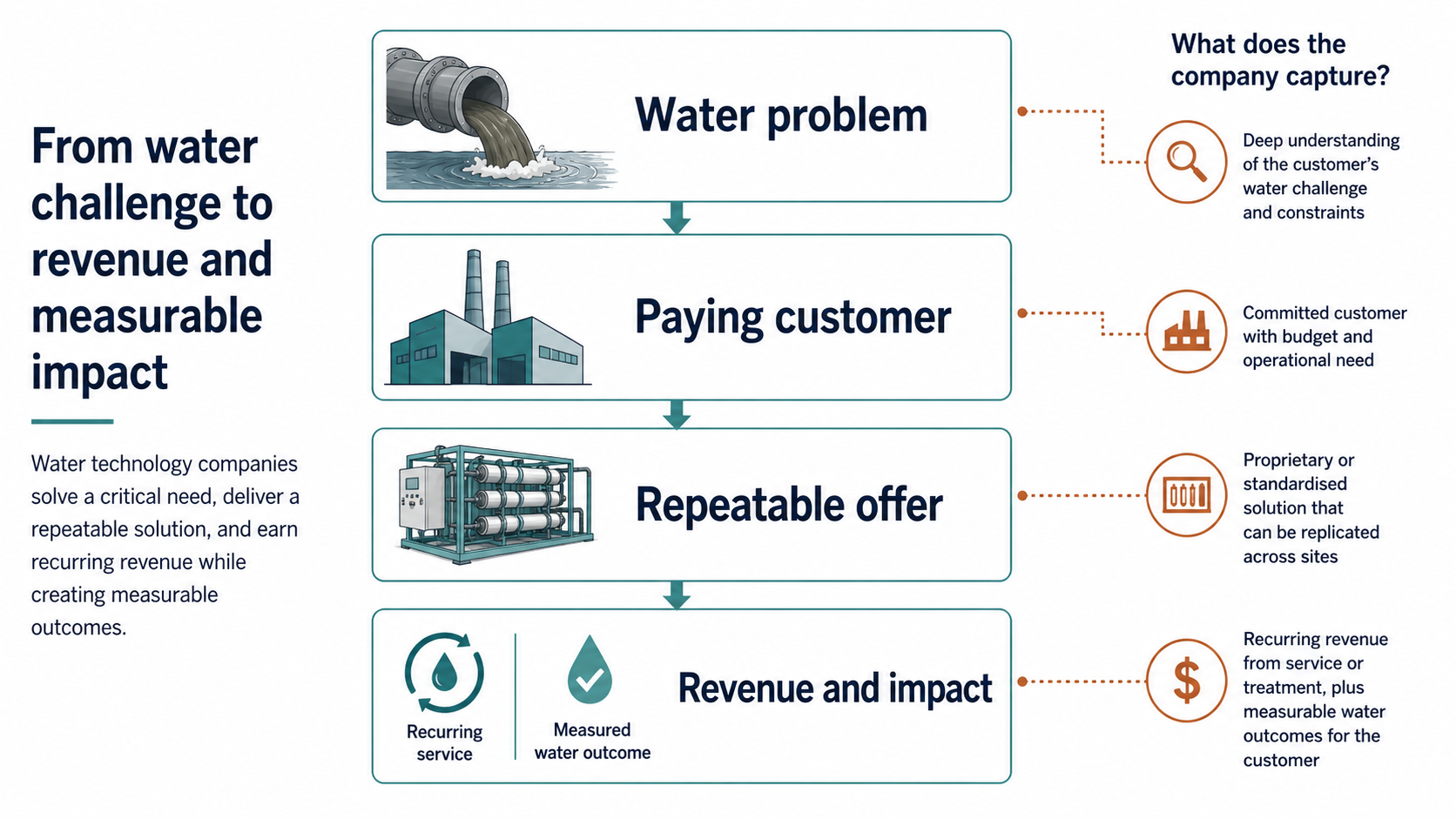
Patient capital works best when it helps a company turn evidence into better revenue quality. The investor should therefore read the contract model before accepting the market narrative. Ask what the customer buys, what the company must deliver and where margin can be lost.
Separate revenue lines that carry different risks. Equipment sales may create a strong order but uneven income. Installation may generate revenue while consuming engineering time. Service may be recurring but field-intensive. Consumables can support retention but depend on replacement cycles and customer behaviour.
Gross margin should be measured after delivery. Include freight, subcontractors, site changes, commissioning, training, warranty work and support calls. Compare quoted margin with delivered margin by application. A company can be profitable on a standard product and lose money on a bespoke site.
Unit economics should fit the business. A useful unit might be a treatment module, monitored site, operating hour, service contract, installed capacity or customer location. For that unit, show price, direct cost, support cost, replacement timing, sales cost and cash collection. Software metrics alone will not explain a water deployment.
Recurring revenue also needs a clear definition. A multi-year agreement is not automatically high quality. Review renewal rights, service levels, performance deductions, price changes, termination rights and the cost of keeping the customer satisfied. A repeat invoice is useful evidence only when the underlying service remains profitable.
Pricing power can come from measured customer value, integration knowledge, response time, validated performance or a difficult-to-replace service. It can also be limited by tender rules, procurement concentration, a powerful distributor or low switching costs. Patient capital should fund the company’s ability to understand and improve that position.
The company should explain what it captures from the customer problem. It might capture a product margin, a service fee, a performance payment, a share of water savings or a recurring monitoring charge. Investors should test whether the contract allows the company to retain enough value to cover delivery risk and future innovation.
Do not apply one margin percentage to every forecast year. Build separate cases for standard work, custom work, installation, service and consumables. Then test what happens if the sales mix changes or one large project is delayed. The result will show whether the business model is genuinely repeatable or simply growing through larger projects.
Long-term capital should improve the commercial model over time. If every new site is as bespoke, slow and cash-intensive as the first, patience may be funding complexity rather than scale.
Link capital to repeatable delivery
Capital should be linked to a delivery constraint. The constraint may be manufacturing capacity, design capacity, certification, field service, working capital, data infrastructure or customer onboarding. A funding plan is stronger when each use of capital has a measurable operating result.
Consider a company that has paid deployments but cannot deliver two sites at once. New capital might fund a second installation team, supplier qualification or a standard commissioning process. The milestone should show more than headcount. It should show shorter delivery time, fewer defects, stable margin or improved customer acceptance.
The World Bank’s framework for scaling finance in water highlights enabling conditions, private-sector participation and a range of financial solutions, including equity and commercial debt. It also stresses reforms, capacity and financial viability. [5]
For a private water company, the equivalent question is whether internal capacity is becoming more investable. Are designs documented? Are supplier alternatives approved? Are field failures recorded? Are customer data and operating settings controlled? Can the company forecast service workload from its installed base?
Standardisation does not mean every site is identical. Water quality, layout and customer processes vary. The company should know which variations are normal, which require a price change and which should be rejected. That boundary protects both margin and delivery quality.
Technology can improve scale when it solves a real operating problem. Remote monitoring may reduce site visits and improve maintenance evidence. It may also add cybersecurity, connectivity and support obligations. Investors should review installed performance and service records, not assume that a dashboard creates recurring revenue.
Supplier and partner concentration should be mapped. A single specialist supplier may be efficient but fragile. A single distributor may speed sales but weaken customer access. A small technical team may be valuable but create key-person risk. Patient capital can fund resilience, but the plan should show how dependence will reduce.
Staged funding can make this process clearer. The first tranche might fund a defined production change or a limited deployment set. A later tranche can depend on paid repeat orders, delivered margin, cash collection or service performance. Staging does not remove risk. It makes the relationship between capital and evidence visible.
A company is not ready for unlimited growth because it can sell one successful installation. It is ready for the next step when it can explain what will be repeated, what will change and how the change will be controlled.
Build governance around evidence
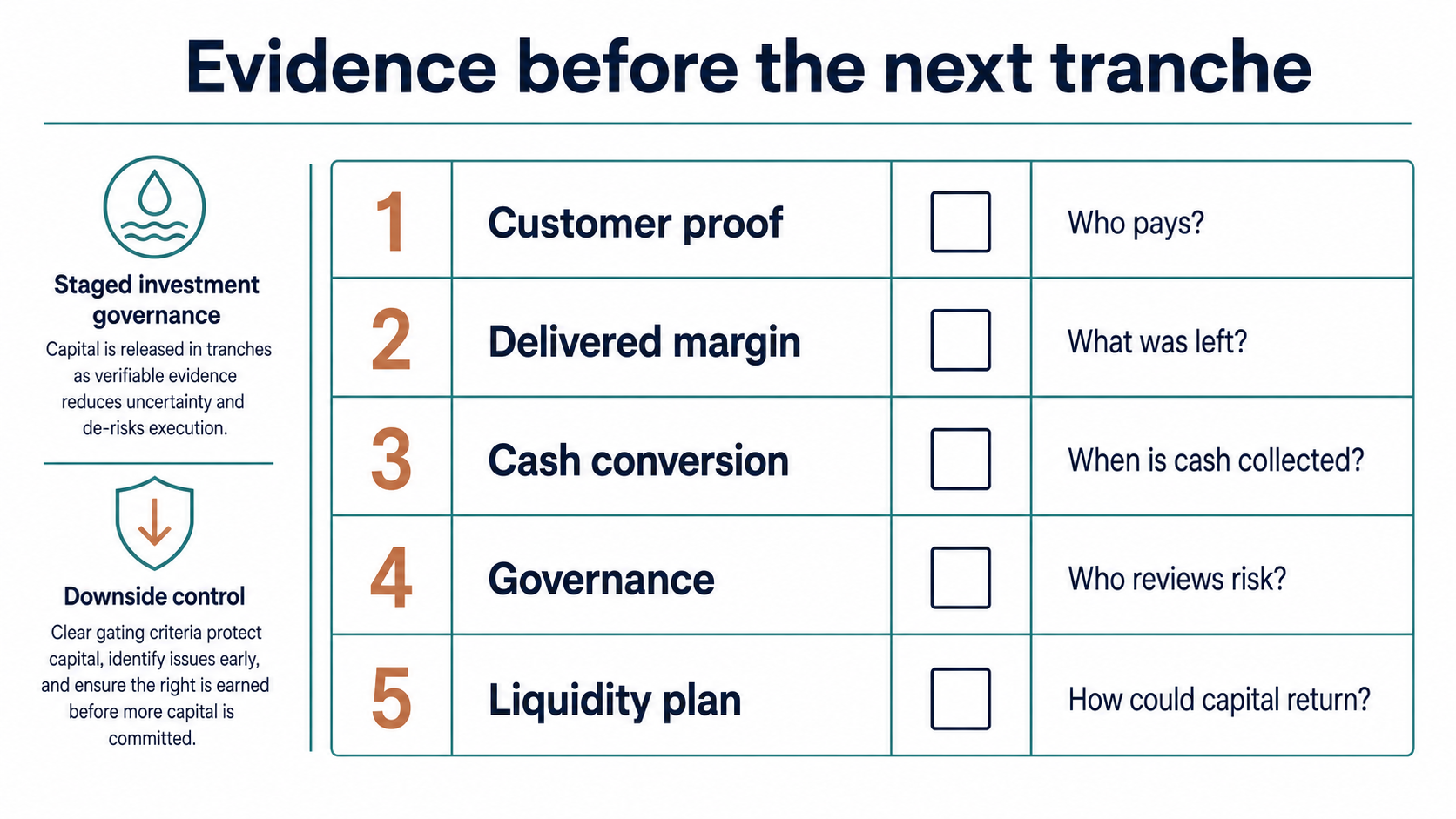
Patient capital needs governance that respects a longer horizon without lowering standards. The board or investment committee should agree what is measured, how often it is reported and what decision follows if the evidence is weak.
A useful monthly or quarterly pack can include funded pipeline, order intake, delivered margin, cash collection, customer concentration, deployment progress, service performance, product incidents, staff capacity and impact measures. The exact list will vary. The important point is that it connects commercial performance with operational reality.
Governance should make bad news easier to see. A missed customer milestone, lower margin, late invoice or failed test should appear before it becomes a funding emergency. Investors should ask who owns the measure, what evidence supports it and whether the definition has changed since the last report.
The ILPA Principles frame private-equity best practice around alignment of interests, governance, transparency and reporting. That framework is relevant to direct water investments even when the investment is not made through a conventional fund. [6]
Alignment also covers the relationship between founders, management and new investors. Review voting rights, reserved matters, information rights, board composition, conflicts, related-party transactions and future financing. A patient investor may accept uncertainty, but should not accept a structure that prevents useful oversight.
Milestones should be within management’s influence where possible. A company cannot control every customer approval or policy decision. It can control the quality of its testing, contract records, delivery process, cash forecast and response plan. External events should sit beside internal actions in the reporting pack.
Use a clear capital-release rule. Before the next tranche, ask: who pays, what margin was delivered, when was cash collected, who reviewed risk and how could capital return? This keeps the company focused on evidence and gives investors a practical way to pause or reprice the plan.
Good governance is not a sign that the company lacks entrepreneurial energy. It is the operating system that allows a small water company to handle larger contracts, more sites, more employees and more investor scrutiny without losing control.
Measure impact without confusing it with returns
Water outcomes can strengthen an investment case, but impact is not a substitute for financial analysis. An investor should understand both what changes for the customer and how the company earns money from solving the problem.
Start with a baseline. Depending on the business, the measure may include water withdrawn, water reused, discharge quality, avoided downtime, energy use, treatment performance, leakage or service reliability. Define the measurement boundary and the period covered. Do not count an outcome that the company cannot evidence.
Customer economics help make impact more credible. A reduction in freshwater use may lower exposure to supply constraints. Better treatment may support a production permit or reduce a discharge cost. Monitoring may reduce unplanned downtime. These links should be tested through customer records and contracts rather than presented as universal benefits.
Impact can also have limits. A treatment process may reduce one pollutant while creating a waste stream that needs management. A reuse project may reduce abstraction but increase energy use. A monitoring system may produce more data without improving decisions. A balanced case describes the benefit and the boundary.
The World Bank and EIB both connect water investment with resilience, service quality, innovation and economic activity. Those institutional priorities can help frame a thesis. They do not prove the impact of an individual company, product or deployment. [7]
For patient capital, impact reporting should mature with the business. Early reporting may focus on a small number of reliable operational measures. Later reporting can connect those measures to customer sites, contract performance and portfolio-level outcomes. Keep verified results separate from forecasts or management targets.
A good impact measure can support commercial performance in several ways. It may help a buyer approve a project, support renewal, improve pricing, reduce service disputes or create evidence for a wider rollout. This is a commercial benefit of measurement, not a promise of investment performance.
Investors should ask who verifies the data, how often it is checked and what happens when the result is below target. Clear answers protect against impact-washing and help management improve the product. They also make comparisons between opportunities more useful.
Check liquidity, exits and portfolio fit
Patient capital is still private capital. A company may create strong customer value and measurable water outcomes while remaining difficult to sell. Liquidity must therefore be considered at the start, not left to the final year of an investment.
Review the expected holding period, transfer restrictions, shareholder rights, future funding needs, valuation method and possible buyers. A credible exit route may involve a strategic acquirer, a larger water-services group, a specialist industrial buyer, a later-stage investor or a management-led transaction. None should be described as certain without evidence.
The British Business Bank links patient capital with capital gains, illiquidity and a relatively high spread of outcomes. That combination means an investor must be comfortable with both time and loss risk. [1]
Exit logic should follow the company’s value creation. A buyer may care about a validated product, a contracted installed base, recurring service revenue, customer relationships, specialist data, manufacturing capability or a defensible application. A slide that lists possible acquirers without explaining the asset they would buy is not an exit plan.
Portfolio fit matters as much as company quality. A direct water investment can be unsuitable for an investor who needs near-term liquidity, a low operational workload or a narrow risk budget. The same company may fit better in a diversified private portfolio with room for long holding periods and active oversight.
Patient capital should not be confused with patient underwriting. The investor can allow time for evidence to build while still setting valuation discipline, information rights, downside cases and capital-release conditions. A long horizon is a risk-management choice, not a reason to ignore price or terms.
For UK, European and GCC investors, cross-border considerations can include governance, currency, tax, ownership, data, regulation and the enforceability of contracts. These issues require qualified advice. Water Investment Network does not provide regulated financial advice, and access to an opportunity is not an endorsement or a guarantee.
A balanced committee conclusion should state what has been proved, what remains uncertain, what the capital will change, how progress will be measured and what could make the investment unsuitable. That is the proper role of patient capital: to fund a defined path through uncertainty, with the right to reassess when evidence changes.
Water Investment Network is an invitation-only network. Eligible family offices, high-net-worth investors, sophisticated impact and private-equity investors, and relevant advisers can request access to Water Investment Network, subject to the network’s eligibility process. Any opportunity still requires independent legal, financial, commercial, technical, tax, regulatory and impact diligence.
Frequently asked questions about patient capital in water
What is patient capital?
Patient capital is long-term funding for a company that needs time to build a large and durable business. In water, it can support technical commercialisation, customer qualification, deployment capacity, service infrastructure or working capital. It does not remove risk or guarantee returns.
Why might a water company need patient capital?
Water companies can face long customer approval cycles, complex sites, high deployment costs and slow cash collection. Patient capital may give a company time to convert technical proof into repeatable sales, provided each stage has clear evidence and funding milestones.
Is patient capital the same as impact investing?
No. Patient capital describes the funding horizon and tolerance for delayed returns. Impact investing describes an intention to create measurable social or environmental outcomes alongside financial returns. The two approaches can overlap, but neither replaces company-level diligence.
What should investors measure in a patient-capital water investment?
Useful measures can include funded customer demand, paid deployments, delivered margin, cash collection, repeat orders, customer concentration, service performance, operational capacity, governance quality and verified water outcomes. The right measures depend on the company’s business model.
What are the main risks?
Main risks include slow sales, bespoke delivery, technical underperformance, working-capital pressure, customer or supplier concentration, regulation, currency, future funding needs and illiquidity. Investors should test these risks against contracts, operating data, management controls and investment terms.
Sources
- https://www.british-business-bank.co.uk/sites/g/files/sovrnj166/files/2023-07/BBB-Interim-Evaluation-of-BPC-Final.pdf
- https://www.worldbank.org/en/topic/water/publication/water-security-financing-report-2024
- https://www.ifc.org/en/stories/2024/water-towards-sustainability-and-beyond
- https://www.ifc.org/en/what-we-do/sector-expertise/infrastructure/water/scaling-re-water
- https://www.worldbank.org/en/topic/water/publication/scaling-up-finance-for-water-a-world-bank-strategic-framework-and-roadmap-for-action
- https://ilpa.org/industry-guidance/principles-best-practices/ilpa-principles/
- https://www.eib.org/en/projects/topics/energy-natural-resources/water-and-waste-water-management/index