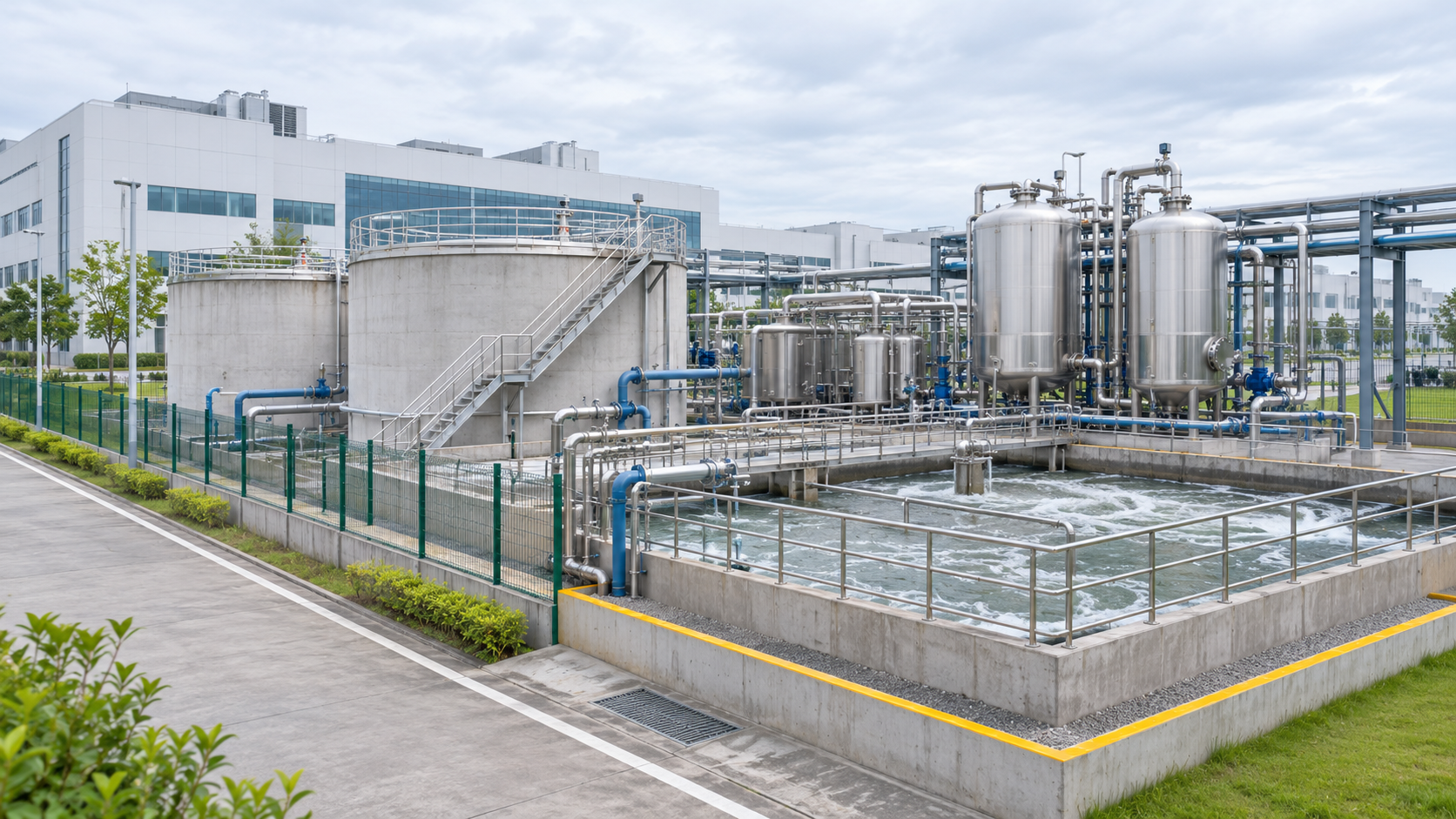
Pharmaceutical wastewater treatment is a customer-critical control system, not a single piece of equipment. It must handle changing production recipes, active pharmaceutical ingredients, solvents, salts, biological loads and cleaning streams without losing control of discharge quality.
That creates a more demanding market than a generic wastewater project. A customer is buying a defined treatment outcome, a compliance record, operating resilience and a credible plan for the residuals and emissions that the process creates. The Water Investment Network audience can assess these businesses as direct private-company opportunities rather than as abstract water themes.
This article examines the sector as an investment theme. It focuses on customer demand, treatment design, validation, revenue models, margins, adoption, regulation and diligence. For the wider industrial context, see the industrial wastewater treatment investment pillar.
Pharmaceutical wastewater treatment is a process-control business, not a single machine
Pharmaceutical manufacturing wastewater can come from fermentation, chemical synthesis, extraction, formulation, equipment cleaning, washdowns, filtration and other process steps. The relevant load may change when the product, batch size, solvent or cleaning procedure changes.
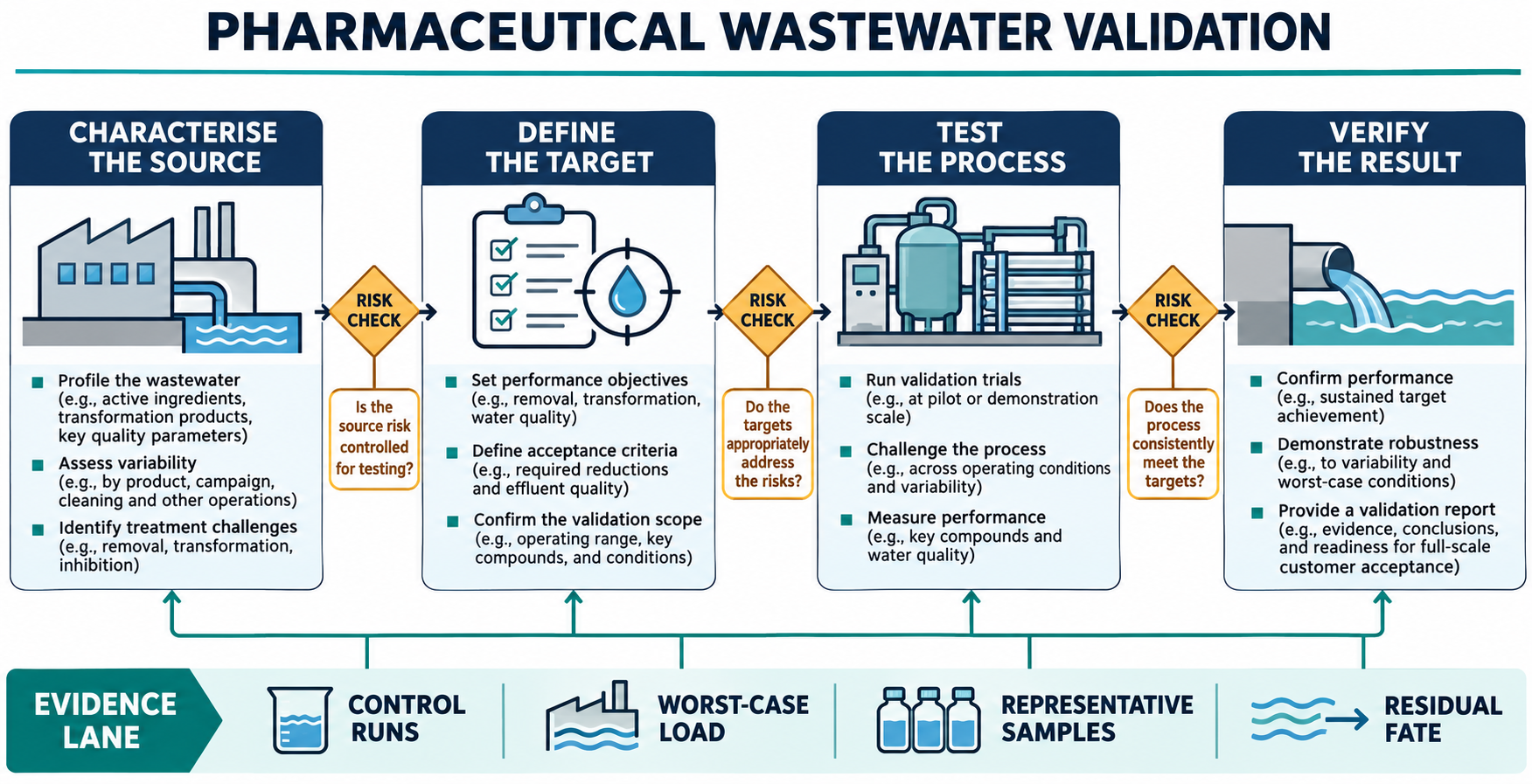
That variability affects the commercial specification. A treatment provider must understand the source, segregate streams where needed, define the target, select the treatment train, verify performance and keep the system within its operating envelope.
Source characterisation sets the design brief
Source characterisation means measuring the flow, concentration, temperature, pH, suspended solids, organic load and relevant active ingredients in a wastewater stream. It is not a one-off laboratory exercise if the plant has several recipes or campaign-based production.
The investor consequence is simple. A company that can build a reliable water and contaminant balance has a better chance of pricing the right system. A company that quotes from a generic influent assumption may win a project and still lose margin during commissioning.
The treatment train is a chain of decisions
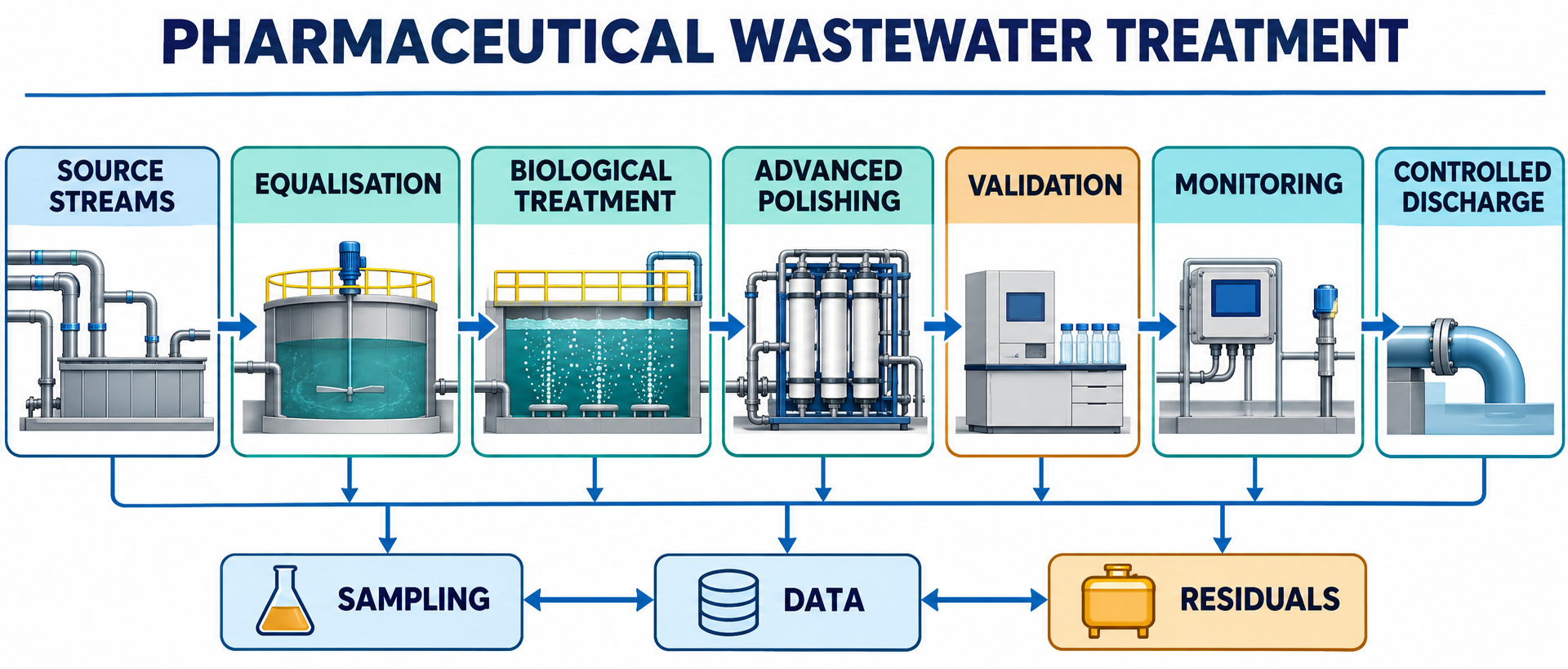
A treatment train is a sequence of physical, chemical and biological steps. Depending on the wastewater, it may include equalisation, solids removal, biological treatment, nutrient control, adsorption, oxidation, membranes, solvent management or another validated step.
The technology is only part of the sale. Pumps, controls, sampling points, alarms, bypass logic, residual handling, maintenance access and operator procedures can determine whether a customer trusts the installation.
Compliance evidence is part of the product
Pharmaceutical wastewater treatment is sold into an evidence-heavy setting. Customers may need a record of sampling, laboratory methods, calibration, deviations, corrective actions and discharge performance.
This creates a potential service layer around the asset. It also raises the delivery standard. A dashboard that does not support validated sampling or a defensible chain of custody has limited value to a regulated manufacturer.
Why pharmaceutical wastewater creates a durable customer problem
Pharmaceutical manufacturers cannot treat all wastewater as an interchangeable industrial stream. The process may contain substances with different treatability, toxicity, volatility or environmental behaviour. A site also has to protect production continuity while meeting its discharge obligations.
The US Environmental Protection Agency maintains a dedicated pharmaceutical manufacturing effluent framework and describes the industry as covering multiple process categories. Its guidance links the regulatory basis to the pollutants and processes generated by the category, rather than assuming one universal wastewater profile.
In the UK, the Environment Agency guidance for wastes containing medicines requires validation against the range of pharmaceuticals that may be present. It also states that dilution is not a valid treatment method. These points support demand for source-specific testing, treatment selection and performance evidence, although the exact permit route depends on the site and jurisdiction.
Production growth can expose treatment bottlenecks
A plant may have spare manufacturing capacity but limited wastewater capacity. A new product, a higher batch frequency or a revised cleaning cycle can change the loading profile before the customer has expanded its treatment footprint.
For a solution provider, this creates a credible entry point. The commercial question is whether the provider can offer a survey, pilot, retrofit or modular extension that resolves the constraint without creating a longer shutdown or an unpriced integration burden.
Environmental scrutiny can move upstream
Pharmaceutical residues can reach water through several pathways. The World Health Organization identifies sewage, uncontrolled disposal and agricultural runoff as routes by which pharmaceutical substances can enter water sources.
The investor should not turn this into a blanket claim that every manufacturer faces the same obligation. The relevant customer need depends on the manufacturing process, local permit, discharge route, receiving environment and risk assessment. The broader point is that environmental control is becoming a design and operating issue, not only a final discharge test.
Failure can be more expensive than the treatment bill
A failed treatment system can cause a discharge breach, production interruption, remediation work, emergency disposal or a customer relationship problem. It can also expose weaknesses in the treatment vendor’s validation and support model.
This is why a buyer may value reliability, response time and evidence quality alongside removal performance. A lower headline capital cost is not automatically the lowest total cost of ownership.
Investment thesis at a glance
The investable opportunity sits across several layers of the value chain. These include process design, treatment equipment, monitoring, laboratory services, residual management, compliance support and long-term operations.
Investors should separate a repeatable solution from a bespoke engineering contract. A project company may have attractive order value but limited renewal revenue. A technology or service company may have a smaller first contract but stronger expansion potential if it can standardise deployment across sites.
Demand is linked to a high-value customer
Pharmaceutical manufacturers protect product quality, production uptime and permit compliance. A wastewater solution that reduces a specific operational constraint can have a clearer budget owner than a general sustainability initiative.
Defensibility comes from process knowledge
Defensible value can come from validated process recipes, plant data, integration experience, a library of treatability results and the ability to support different wastewater profiles. It is weaker when the offer is only a catalogue of standard equipment.
Risk remains technical and commercial
Technology risk includes fouling, toxicity shocks, variable loading, residuals, energy use and unproven removal pathways. Commercial risk includes long sales cycles, site-specific engineering, customer concentration and a service model that consumes more labour than pricing allows.
What customers actually buy
The buyer may describe the need as pharmaceutical wastewater treatment, but the purchased package usually has several components. Understanding the package helps investors test the real source of revenue and margin.
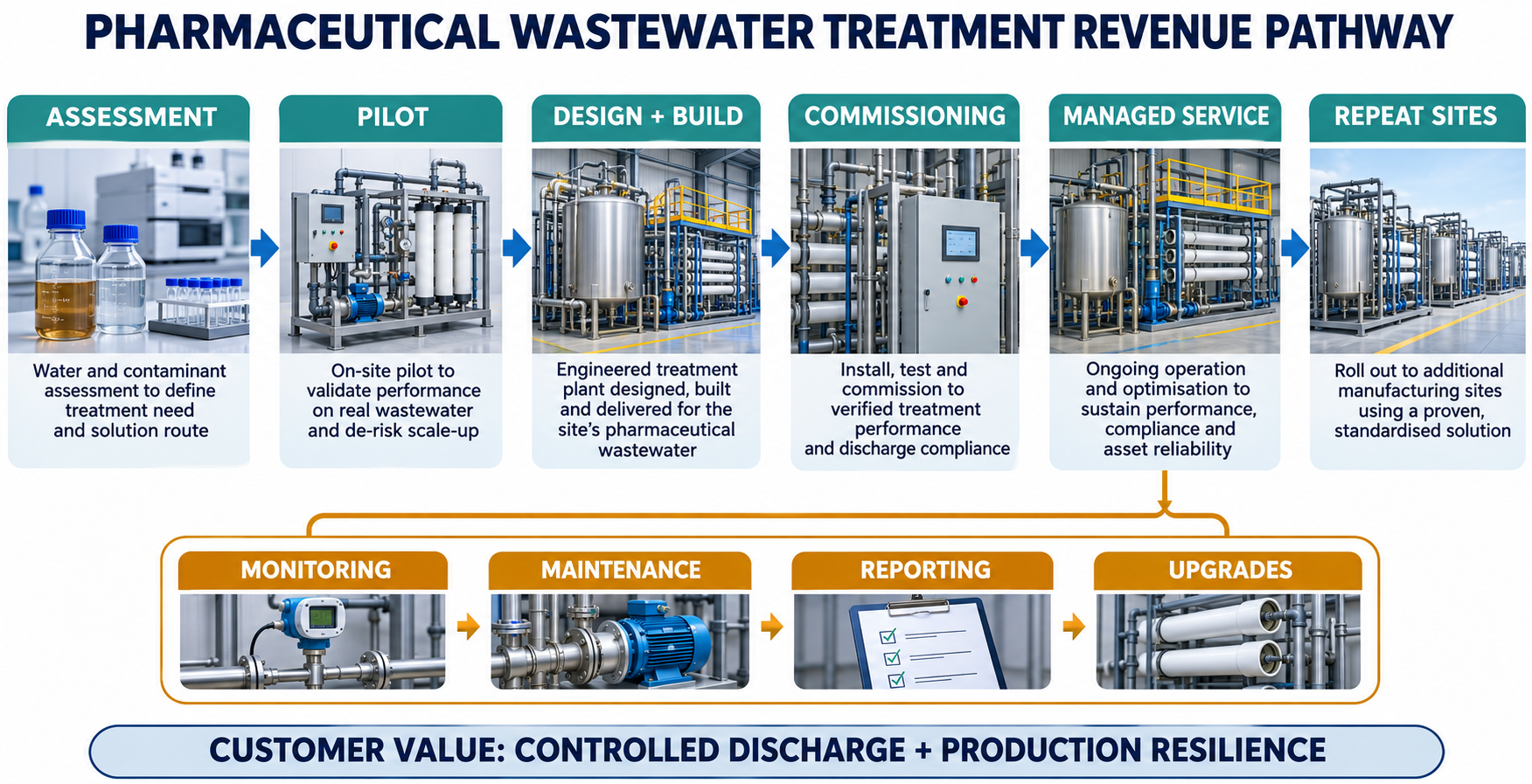
Assessment and sampling
The first engagement may include a site survey, source map, sampling plan, laboratory analysis and water balance. This work can be a paid diagnostic, a project-development cost or part of a larger contract.
Its quality matters because a treatment design built on a narrow sample can fail when production changes. A good provider explains what was measured, what was not measured and how uncertainty affects the design.
Design, pilot and validation
A pilot can test treatability, chemical compatibility, residence time, biological response, energy use, membrane performance or residual generation. Validation then connects the design to a defined set of operating conditions and acceptance criteria.
The customer is buying confidence that the full-scale plant can deliver the required outcome. A pilot that only demonstrates a best-case sample is not enough evidence for a variable manufacturing site.
Installation and integration
Installation includes tanks, pumps, pipework, instruments, control panels, sampling points and connections to the existing process. Integration can involve planned shutdowns, hazardous-area requirements, cleanability, data systems and operator training.
Integration revenue can be meaningful, but it can also hide project risk. Investors should ask how much of the work is repeatable, how much is subcontracted and how often the company absorbs changes without a signed variation.
Operations, reporting and renewal
Some customers need an operating partner, remote monitoring, routine sampling, laboratory coordination, maintenance and compliance reporting. These services can create recurring revenue when the provider has a clear scope, response standard and renewal process.
They also create obligations. Service gross margin depends on travel, callouts, consumables, laboratory costs, specialist labour and the quality of the installed base.
How pharmaceutical wastewater treatment companies make money
There are several commercial models. The strongest model depends on customer type, treatment complexity, project size and the provider’s control of the operating relationship.
Project-led equipment revenue
Under a project-led model, the provider sells design, equipment, installation and commissioning. Revenue is recognised around project milestones, while cash conversion depends on deposits, procurement terms, completion and acceptance.
This model can scale with a strong sales pipeline, but it can produce uneven revenue and working-capital pressure. Investors should inspect backlog quality, gross margin by project, change-order discipline and the time between order and cash collection.
Technology licensing and component sales
A company may license a treatment process or sell a proprietary component into an integrator-led project. This can reduce delivery burden, but it may also reduce control over the end customer and the operating data that supports renewal.
Licensing economics depend on enforceable rights, technical differentiation, validation evidence and the partner’s ability to sell and support the system. A nominal royalty rate is not enough to prove an attractive model.
Managed treatment and compliance service
A managed service can combine equipment, monitoring, maintenance and reporting for a recurring fee. It may be priced per site, per treatment volume, per operating period or under a service-level contract.
Recurring revenue is useful only when the contract covers the cost of delivery and the customer has a reason to renew. Diligence should test churn, gross retention, response costs, unplanned site visits and the share of revenue from the largest account.
Expansion across a manufacturing network
Pharmaceutical groups often operate more than one production site or use contract manufacturing partners. A successful deployment can create a reference site and a route to additional plants.
Expansion is not automatic. Each site may have different products, permits, wastewater sources and capital approval. Investors should look for evidence that the company has converted one installation into repeatable sales rather than treating a single relationship as a forecast.
Where margins and unit economics are won
Gross margin in this sector is shaped by engineering hours, equipment content, commissioning risk, energy use, consumables, service intensity and customer-specific requirements. The headline contract value does not show the quality of the economics.
Standardisation reduces engineering drag
Standard modules, repeatable controls, known suppliers and documented commissioning procedures can reduce cost and shorten delivery. Standardisation does not mean every site receives the same treatment. It means the company has reusable building blocks and a disciplined method for adapting them.
Energy and consumables affect lifecycle value
Biological treatment, oxidation, membranes, aeration, pumping and polishing can have different energy and consumable profiles. The provider must show how the operating cost changes with flow, loading, temperature and treatment target.
A low-capital system with high electricity or chemical consumption may lose its customer value over time. Conversely, a higher-capital solution can be commercially credible if it reduces operating risk and is supported by a clear lifecycle calculation.
Residuals and concentrate need an owner
Treatment can move contaminants into sludge, spent media, concentrate or another residual stream. The residual is not an accounting footnote. It can change transport, disposal, permit and service costs.
Investors should ask whether the proposal removes the problem, transfers it, or creates a new treatment obligation. A company that has a defined residual pathway is better positioned than one that only reports an effluent result.
Warranty and commissioning exposure must be priced
Performance guarantees may carry sampling, availability, concentration and operating-condition assumptions. If those assumptions are not documented, a provider can face expensive remedial work.
Unit economics should therefore include commissioning time, remote support, site visits, replacement parts, laboratory work and warranty provisions. The right question is not only what the system costs to build, but what it costs to keep credible.
What the treatment and validation stack must prove
Pharmaceutical wastewater treatment must connect process performance to an evidence plan. The stack includes source control, equalisation, treatment, monitoring, testing, data management and response procedures.
Source segregation can protect the whole plant
Keeping high-risk or unusual streams separate can prevent a small contaminant load from being diluted into a larger flow and becoming harder to identify. It can also make treatment more targeted and sampling more representative.
Biological treatment needs process control
Biological treatment uses microorganisms to reduce biodegradable load, but pharmaceutical streams can contain inhibitory compounds, changing organic loads, salts or solvents. A plant needs control of conditions such as loading, oxygen, temperature, pH and sludge behaviour.
The EPA permit guidance describes advanced biological treatment as a model technology basis for parts of the pharmaceutical manufacturing category. That does not require every site to use the same solution. It does show why the provider must connect a chosen technology to the actual process and pollutant profile.
Advanced polishing needs a removal claim
Polishing may use adsorption, oxidation, membranes or another step aimed at a defined contaminant group. The commercial claim must state what is being removed, under which conditions, and how performance is measured.
Validation must test the real risk
UK guidance for treatment of wastes containing medicines calls for control runs, multiple test runs and consideration of worst-case substances. It also asks operators to consider breakdown products and emissions from treatment.
The investor should look for a validation plan that reflects the customer’s manufacturing profile. A test on a convenient surrogate is useful only if the relationship to the real risk is explained.
Which customers can adopt first
Adoption is more likely where wastewater creates a clear operational or compliance constraint and where the customer can define the value of a solution. The best early customer is not simply the largest manufacturer.
Active ingredient manufacturing
Sites that manufacture active pharmaceutical ingredients may have higher contaminant concentrations or more complex process waste. The EMA has highlighted the environmental risk of active-substance production, including the potential for higher local concentrations in liquid waste.
These sites may value source control and dedicated treatment. They can also present higher technical and permitting risk, so a provider must show credible treatability and residual management.
Formulation and finishing plants
Formulation and finishing sites may have different water requirements and waste profiles from API plants. UK permitting guidance treats formulation and finishing as a defined regulated activity with relevant control and monitoring requirements.
A provider can target this segment with modular treatment, monitoring and compliance support, but it should not assume that one process note applies to every site or country.
Contract manufacturers
Contract manufacturers may change products and campaigns more often than a single-product facility. That can make flexibility, sampling and rapid changeover more valuable.
The risk is customer churn or short project visibility. Diligence should examine the customer’s contract profile, plant utilisation, product mix and decision rights before treating capacity as recurring demand.
Research and pilot facilities
Research facilities can need smaller systems, segregated waste handling and flexible treatment. They may become reference customers for a technology, but their budgets and flows can be too small to support a large installed base.
Regulation, governance and environmental risk
Regulation is a commercial variable. It shapes what can be discharged, what must be monitored, how a plant is permitted and how much evidence a customer needs before accepting a system.
Discharge route changes the obligation
A direct discharge, an indirect discharge to a sewer, an on-site reuse application and a waste treatment route can involve different authorities and requirements. EPA guidance distinguishes direct and indirect dischargers and identifies different regulatory bases for each.
Investors should avoid treating one jurisdiction’s threshold as a global rule. A company operating across the UK, Europe and the GCC needs a clear market-by-market compliance process rather than a generic claim of regulatory coverage.
Measurement methods affect proof
The EPA publishes pharmaceutical manufacturing analytical methods and permit guidance because the result depends on sampling, method suitability and the point of compliance. A customer may need to understand the difference between an instrument signal, a laboratory result and a legally relevant sample.
Data integrity is therefore part of the product. Missing calibration records, weak chain of custody or non-representative sampling can undermine an otherwise capable plant.
Environmental risk is not solved by concentration alone
A lower concentration at the final point can result from treatment, dilution or a change in flow. EPA guidance discusses the need to monitor before dilution where dilution could obscure the presence of a pollutant.
That distinction matters for investor diligence. A credible provider can explain the mass balance, treatment pathway, sampling location and residual fate. A weak provider may rely on a single final number without explaining how it was produced.
Governance protects the commercial relationship
Good governance means clear responsibility for operating limits, alarms, deviations, sampling, reporting and corrective action. It also means deciding who pays when the influent changes outside the design basis.
These details affect renewals. A customer is more likely to retain a provider that responds clearly to an event than one that treats every deviation as a contract dispute.
Investor diligence questions
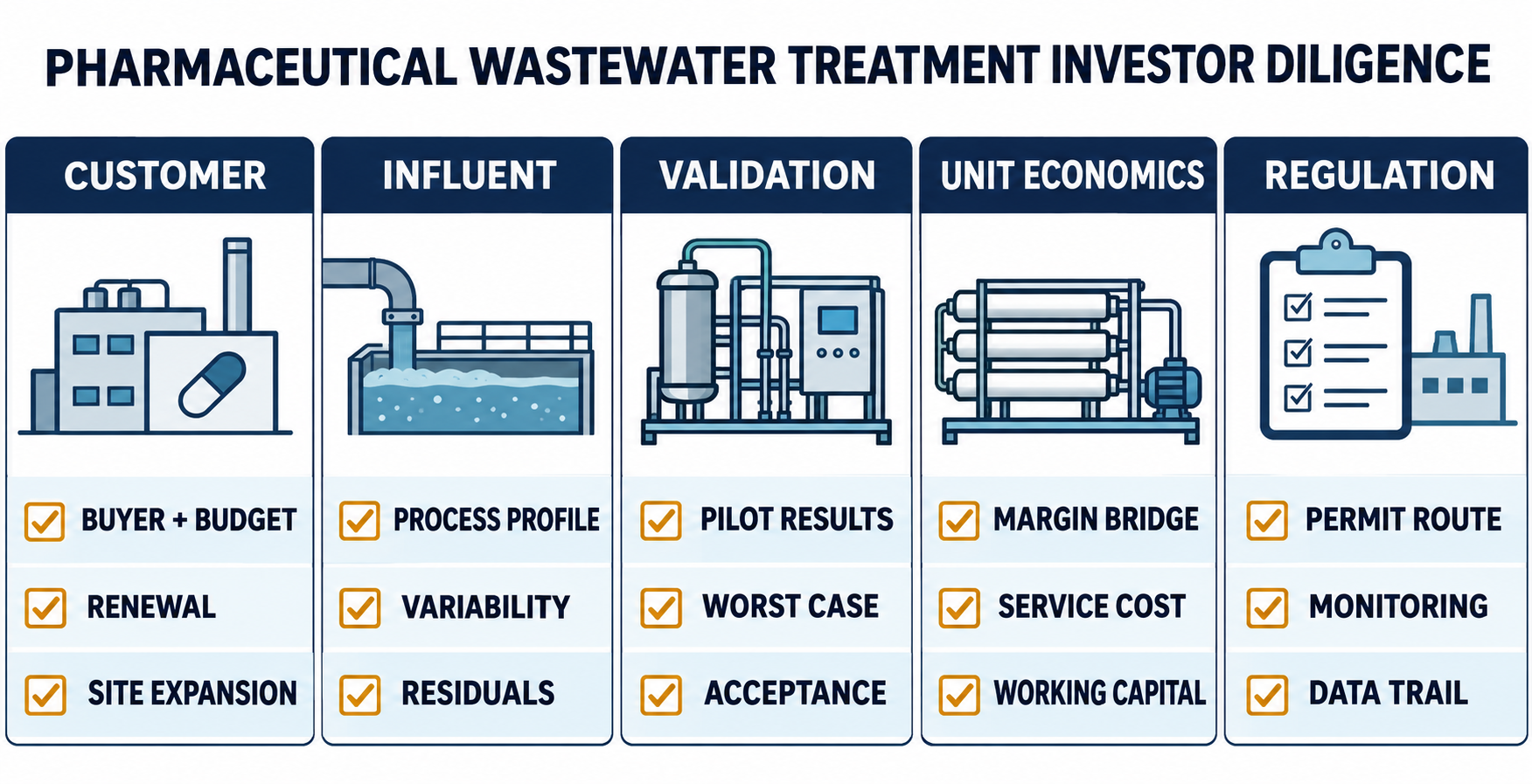
Investors should test the complete commercial chain. The goal is to understand whether the company can repeat the outcome with acceptable risk, not only whether a pilot worked.
Customer and offtake questions
- Which customer problem starts the buying process: discharge risk, capacity, production continuity, water cost or environmental scrutiny?
- Who owns the budget and who accepts the treatment result?
- How long is the sales cycle from survey to purchase order?
- What share of current revenue comes from repeat sites or renewals?
Technical and validation questions
- Which wastewater profiles have been treated in the field, and how variable were they?
- What were the control runs, worst-case substances, sampling points and acceptance criteria?
- What happens when a product campaign changes the influent beyond the design basis?
- Where do residuals, concentrate, spent media and sludge go?
Economic and delivery questions
- What is the gross margin by equipment, engineering, commissioning and recurring service?
- How much work is standardised, subcontracted or dependent on one specialist?
- What are the energy, chemical, laboratory and callout costs at each site?
- What warranty, performance guarantee and working-capital exposure remains after contract signature?
Regulatory and governance questions
- Which permits and discharge authorities apply to the installed base?
- Does the company distinguish treatment performance from monitoring performance?
- How are deviations reported, investigated and priced?
- Can the company prove that its claims are valid for the customer’s jurisdiction and intended use?
Pharmaceutical wastewater treatment FAQs and next steps
What is pharmaceutical wastewater treatment?
It is the controlled treatment, monitoring and management of wastewater produced by pharmaceutical manufacturing or related process activity. The treatment target depends on the source, contaminant profile, discharge route and applicable permit.
Is pharmaceutical wastewater the same as ordinary industrial wastewater?
No. Pharmaceutical sites can generate variable streams containing active ingredients, solvents, salts, organic loads and cleaning chemicals. The treatment design must be based on the actual process rather than a generic industrial assumption.
Can pharmaceutical wastewater treatment create recurring revenue?
It can create recurring revenue through monitoring, maintenance, laboratory coordination, managed treatment, reporting, consumables and additional sites. The investment case depends on contract scope, renewal behaviour and service gross margin.
What is the main investor risk?
A central risk is the gap between a successful pilot and repeatable full-scale delivery. Energy use, variable influent, residuals, permitting, integration and support costs can reduce margins if they are not included in the commercial model.
Is this regulated investment advice?
No. This article is sector analysis for private-market research. It is not regulated investment advice, a recommendation, a forecast of returns or an offer to invest. Eligible investors can review the portfolio and join the network to discuss access and conduct their own diligence.
Pharmaceutical wastewater treatment can be an investable water technology theme when the company links a real customer constraint to validated treatment, reliable evidence and repeatable delivery. The next step is to test the influent, the contract, the margin bridge and the compliance proof separately before treating a project pipeline as scalable growth.
Sources
- US EPA, Pharmaceutical Manufacturing Effluent Guidelines Documents
- GOV.UK and Environment Agency, Healthcare waste: validation tests for wastes containing medicines
- US EPA, Management Standards for Hazardous Waste Pharmaceuticals
- World Health Organization, Pharmaceuticals in drinking-water
- GOV.UK, Formulation and finishing of pharmaceutical products: process guidance note 6/43
- US EPA, Permit Guidance Document: Pharmaceutical Manufacturing Point Source Category
- European Medicines Agency, Environmental measures and pharmaceutical manufacturing