Private investment in water infrastructure is not one single asset class. It can mean equity in a project company, a loan to a utility, or capital committed to a long-term service contract. The investment case changes with ownership, the paying customer and the rights attached to the cash flow.
That distinction matters. A company selling water-treatment equipment carries product, customer and scale-up risks. A project company holding a treatment plant or pipeline carries construction, operating, contract and financing risks. Both may support water security, but they are not interchangeable investments.
This guide focuses on the asset and project level. It explains how to trace a water asset from its physical service to its contract, revenue, operating costs and risk allocation. It is general information for investors, not personal financial, legal or tax advice.
What counts as water infrastructure investment?
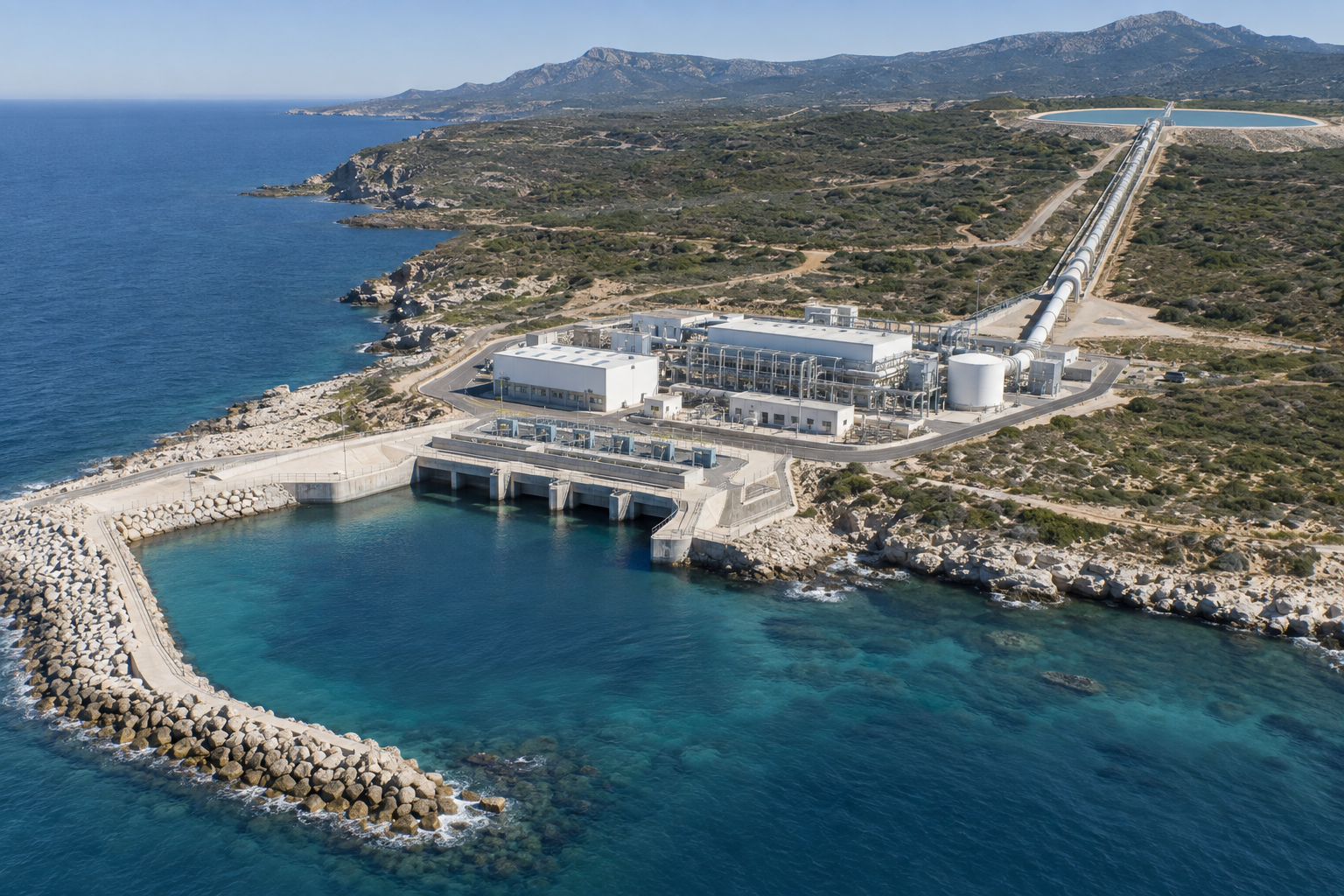
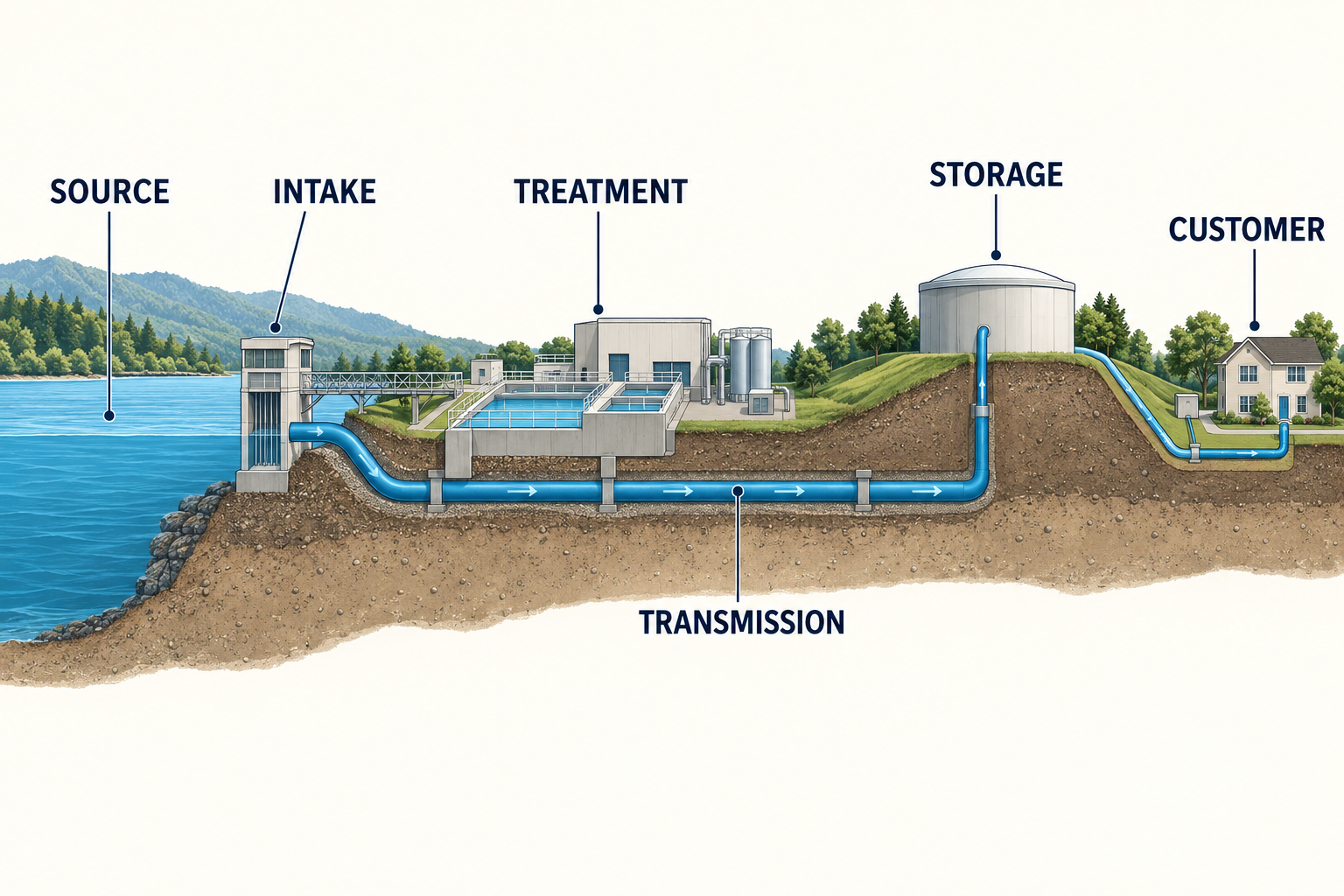
Water infrastructure includes the physical systems that capture, treat, move, store, distribute or return water. Examples include raw-water intakes, reservoirs, treatment works, desalination plants, trunk mains, pumping stations, wastewater treatment and reuse facilities. Supporting assets can include metering, control systems and energy connections when they form part of a defined project.
An investor needs to identify what the capital actually buys. It might buy shares in a special-purpose project company, provide debt secured against project cash flows, finance a concession, or fund an operator that maintains public assets. In some transactions, private capital pays for construction. In others, it finances an upgrade or working capital while the public authority retains asset ownership.
These structures create different rights. A shareholder may receive dividends only after the project meets its obligations. A lender may have priority over equity distributions and security over specified assets or contract rights. A service provider may earn fees without owning the infrastructure. Read the legal and commercial documents before treating any of these as equivalent exposure.
The central question is not simply whether a project is labelled a public-private partnership. Ask which entity owns each asset, who must deliver each service, who pays, and what happens when delivery falls short. Contract labels vary between jurisdictions, while the underlying allocation of responsibilities determines the investor’s exposure.
The World Bank’s water and sanitation PPP overview describes private participation in bulk supply, wastewater treatment, desalination, reuse and utility services. It also notes that dependable revenue is important for utilities’ investment and maintenance planning. That is a useful starting point, not proof that any specific project is bankable.
Follow ownership, contracts and control
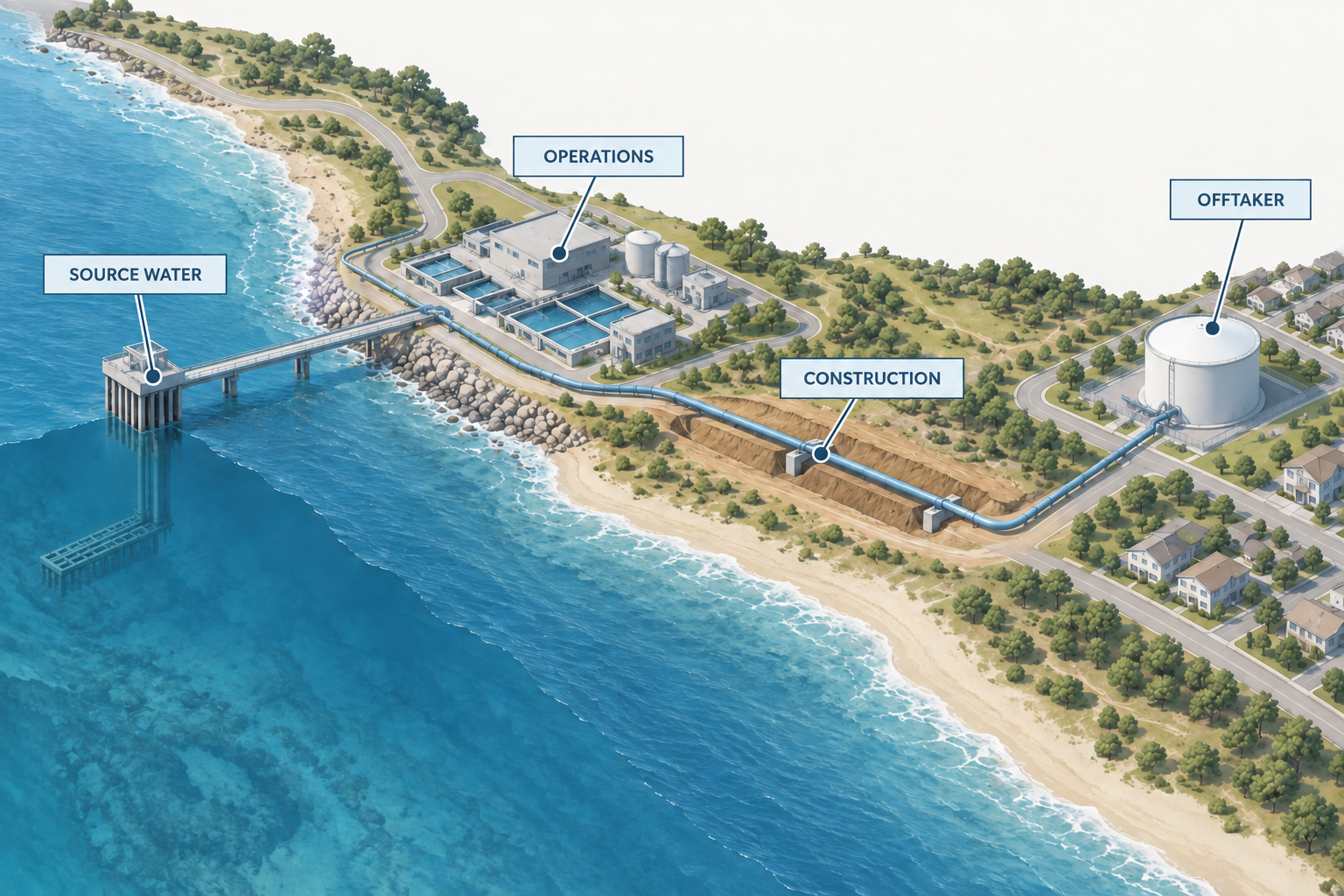
Project-level investment often uses a special-purpose vehicle, or SPV. The SPV holds defined project rights and signs the financing, construction, operating and offtake agreements. Investors should map those contracts rather than relying on a group-company summary or a short project announcement.
Ownership and operational control can sit in different places. A municipality may retain legal title to a facility while a private operator designs, builds or maintains it. A concessionaire may hold operating rights for a defined term without owning the underlying land. A utility may buy treated bulk water from a project company and then serve retail customers itself.
Trace the chain from the asset to the end user. Identify the grantor or asset owner, the SPV, construction contractor, operator, offtaker, regulator and ultimate payer. Note which party can make decisions about design changes, maintenance, tariffs, service standards and emergency response. If key decisions are split across contracts, understand how those agreements fit together.
The World Bank’s PPP structuring guidance treats required outputs, party responsibilities, risk allocation and payment as connected commercial terms. That is a useful level of detail for reviewing a project, although actual terms depend on the transaction and jurisdiction.
Then test whether the contracts survive ordinary project friction. Look for clear completion tests, service specifications, payment dates, deductions, indexation, change-in-law clauses, termination compensation and step-in rights. Ask whether lenders can cure a breach or replace an operator before a service contract ends. These provisions can influence both continuity of service and recoveries after default.
Project finance can ring-fence some exposure in an SPV, but it does not remove project risk. The World Bank’s overview of PPP finance structures explains that project lenders assess the asset’s expected cash flow and contractual structure. It also notes the costs of complex project finance, which may make it unsuitable for smaller transactions. A limited-recourse label is not a substitute for reviewing guarantees, security, covenants and completion support.
Identify who pays and how revenue is earned
Water assets can earn revenue through several different mechanisms. A project may collect user charges, receive a government payment, sell treated water under a bulk-supply agreement, or provide a contracted service to an industrial customer. Some contracts combine a base payment with performance adjustments or milestone payments.
Each mechanism creates a different demand and counterparty profile. A user-pays project depends on volumes, collection rates and the permitted tariff. A government-pays project depends on appropriation, contract enforceability and the public counterparty’s payment capacity. A bulk-water plant may depend on one utility or industrial buyer, which concentrates offtaker exposure even when that buyer has a strong public mandate.
Availability payments can reward an asset being ready to provide a specified service, whether or not actual usage is high. Usage-based payments respond more directly to quantities delivered. Performance deductions can reduce receipts when water quality, reliability or other contract standards are missed. Read the formula and the measurement method; a headline annual payment says little about how much can be deducted.
Tariff rules matter particularly where users pay directly. Review who sets the tariff, whether it can be adjusted, how often it can change and which cost pressures are recognised. A formula may refer to inflation or defined input costs, but the investor still needs to understand who approves an adjustment and what happens if approval is delayed.
The World Bank’s guide to PPP payment mechanisms sets out user charges, government payments, availability or usage-based payments, milestone support, and bonuses or deductions. It explains that payment design can change demand and performance risk. Treat that as a framework for reading an actual contract, not as a claim that every water project uses the same model.
Model cash flow after operating needs
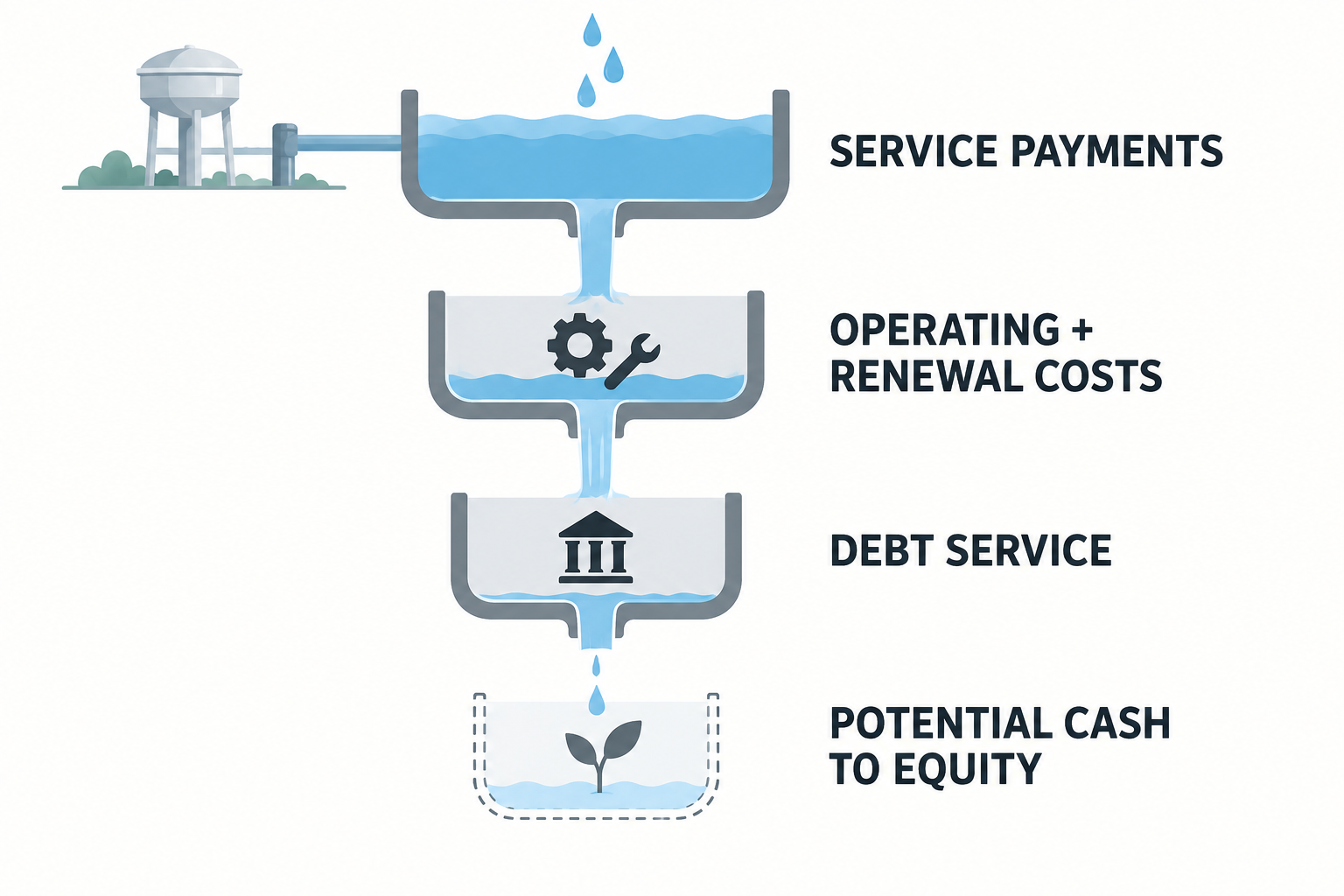
Gross receipts are not investor returns. A working model starts with expected service payments and tests their timing, reliability and deductions. It then accounts for operating costs, energy, chemicals, labour, routine maintenance, insurance, taxes, major renewals and working capital before debt service and any equity distribution.
Water assets can have long operating lives, but equipment does not last forever. Pumps, membranes, treatment units, electrical systems and pipelines each have their own maintenance and replacement cycles. If a model pushes major renewal costs beyond the forecast period, ask who must fund replacement and whether the contract allows enough time or revenue to do it.
Energy can be a material operating input in pumping, treatment and desalination. Test how the contract allocates energy-price changes and whether efficiency assumptions are supported by operating data. A fixed service fee may leave the project exposed to cost inflation unless the payment formula provides a workable adjustment.
Compare contracted volumes with the capacity the asset can reliably deliver. Nameplate capacity is not the same as available output. Water quality, source-water conditions, planned outages, network constraints and commissioning performance can all affect saleable volume. Check whether the buyer is obliged to take a minimum amount or pay for reserved capacity.
Debt introduces another timing test. Model interest, principal repayments, reserves, refinancing needs and any covenant headroom against plausible operating conditions. Ask what happens if commissioning is late, customer payments arrive slowly, or the cost of a major component rises. Scenarios should reveal where liquidity tightens, not merely show a single expected case.
The OECD’s 2026 report on financing water security highlights a sector-wide challenge: tariffs and other revenue can fail to cover the full cost of operation and maintenance. It also warns that project bankability and size can receive more weight than long-term impact or local needs. Investors should therefore test service durability and affordability alongside financial viability.
Allocate risks across construction and operations
Infrastructure risk is easier to analyse when divided by project phase. Before construction, risks may include land access, permits, source-water quality, design and procurement. During construction, investors face delay, cost overrun, interface and completion risks. After commissioning, performance, demand, counterparty, energy, climate and renewal risks become more prominent.
For each risk, ask who controls it, who bears the financial impact and what remedy exists. A construction contractor may accept delay damages for specified causes, but those damages may have caps. The public authority may retain responsibility for land access or pre-existing contamination. An operator can be responsible for maintenance yet depend on the asset owner to approve capital works.
Contract allocation should match practical control. Transferring a risk on paper does not ensure that the receiving party can manage or absorb it. If a small contractor accepts an uncapped obligation it cannot fund, the project may still bear the loss. For investors assessing private investment in water infrastructure, judge risk transfer against both the contract and the party’s capacity to manage the exposure. Check counterparties, exclusions, insurance, parent support and the financial capacity behind each promise.
Water-specific diligence should include source-water variability, drought and flood exposure, intake conditions, discharge obligations and resilience of power and transport connections. Climate assumptions should be tied to the location and design life. A regional water-stress narrative cannot replace site-level hydrology, permits and contingency planning.
The World Bank and Global Infrastructure Hub’s water and waste risk-allocation tool provides annotated matrices for different infrastructure project types, including water. Use it as a checklist for questions, not as a universal allocation template. Project design, local law, market depth and the parties’ actual capabilities can change what is workable.
Compare greenfield, brownfield and service models
Greenfield projects create new infrastructure. They can offer a clear design and contract structure, but carry development, permitting, construction, commissioning and initial demand risks. Forecasts may depend on future connections or customers that have not yet demonstrated their use of the service.
Brownfield investments upgrade, expand or operate existing assets. Historical operating records can improve visibility, but asset condition may be uncertain. Examine maintenance backlogs, leakage, energy use, water losses, environmental liabilities and the boundary between existing defects and new operator obligations.
Service and management contracts can bring private expertise without transferring ownership or requiring the same amount of private capital. A performance-based contract might reward reduced losses or improved service, while a long-term concession may place more investment and operating obligations on the private party. Confirm whether the investor is financing assets, providing services, or both.
Scale and contract structure affect financing. The World Bank’s PPP finance overview describes project finance as a means of aligning debt service and distributions with project cash flows, while noting that transaction costs can make elaborate structures uneconomic for smaller projects. A smaller project may use corporate funding, public contributions, guarantees or a portfolio approach. The appropriate structure depends on the project, not on a preferred label.
Compare opportunities using a consistent set of questions: asset scope, remaining useful life, committed capital, construction status, buyer concentration, payment basis, maintenance responsibilities, renewal funding and exit rights. Keep grants, public support and contingent guarantees visible in the analysis. Do not treat an announced financing package as equivalent to cash already committed or construction already completed.
Test commercial viability and affordability together
A project can produce a technically sound asset and still fail its commercial test. The service must have a payer, a credible payment route and enough revenue to meet delivery costs over time. At the same time, a payment structure that makes water unaffordable or shifts unmanageable costs to a public budget may not be durable.
Review demand evidence by customer, not only by aggregate population or industrial growth. For a utility offtaker, examine collection performance, existing obligations, tariff policy and its ability to pass costs through. For an industrial buyer, review the contract term, alternative supply options, credit quality and the buyer’s incentives to continue purchasing.
Separate willingness to pay from the social value of reliable water. Communities can benefit greatly from improved access even when their ability to pay is limited. That can create a role for public budgets, grants or carefully designed subsidies, but the source, duration and conditions of support need to be transparent.
Affordability analysis should identify who ultimately bears costs and how vulnerable users are protected. Consider connection fees, volumetric tariffs, service interruptions, subsidy targeting and complaint routes. These questions are part of project durability and stakeholder risk, not a separate public-relations exercise.
The OECD’s financing-water-security analysis argues that the structure and purpose of capital matter alongside its volume. That helps explain why investors should examine contract design, maintenance plans and distributional outcomes rather than screening only for project size or a bankable return profile.
Measure water outcomes without confusing them with revenue
Water impact should be connected to the service the asset actually provides. Depending on the project, relevant measures may include treated volume, service continuity, water quality, connections, wastewater treated, reuse, non-revenue water or resilience during defined conditions. Choose metrics that match the project and disclose the measurement boundary.
Record a baseline and identify what would have happened without the investment. A new plant may add capacity, but the delivered benefit depends on connection to a functioning network, operations, demand and safe use. An upgrade may improve reliability without adding nominal capacity. State what is measured and avoid attributing every local water improvement to one investor.
Do not assume that more volume always means more impact. A project should be assessed for water quality, environmental effects, energy use, affordability and the needs of local users. Where reuse or desalination is involved, examine discharge, brine or residuals management, source-water constraints and energy supply in the project’s own context.
Impact reporting is strongest when it follows the same chain as commercial monitoring. Link investment inputs to constructed or improved assets, operating service, end-user outcomes and any material adverse effects. Independent measurement, transparent methods and clear reporting periods help readers understand what changed and what remains uncertain.
IFC’s water-sector overview describes project preparation and financing alongside engineering, social and environmental standards, risk management and local-market considerations. That integrated view is useful: a capital structure does not replace technical, environmental or stakeholder diligence.
Build a project-level diligence file and ask these questions
Start with primary documents. Request the concession or service agreement, offtake contract, tariff schedule, construction and operating contracts, permits, land rights, financing agreements and any public-support instruments. Keep a source register that records version, date, responsible party and unresolved gaps.
Map cash and control. Draw who pays whom, when payments are earned, which deductions apply, what reserve accounts exist and which party can change the service. Compare that map with the project model. If a forecast assumes a payment, tariff adjustment or government guarantee, find the signed provision that supports it.
Build an evidence file for construction and operations. Review independent engineering reports, design assumptions, completion tests, operating history, maintenance plans, asset-condition surveys, energy requirements and water-quality results. Check whether performance indicators have been measured consistently and whether there is a remedy when they are missed.
Analyse counterparties and interfaces. A plant can meet its output test while the network cannot deliver the water. A utility may owe payment while relying on its own customer collections. A contractor may complete its scope while a separate connection or power upgrade is late. Identify dependencies that sit outside the SPV and ask how the agreements coordinate them.
Use downside cases to test the investment’s resilience. Consider construction delay, lower volumes, higher operating costs, missed availability, tariff constraints, late payment, drought restrictions and major asset renewal. Test combinations as well as individual shocks. Describe the response plan, additional funding need and decision point for each material case.
For an opportunity within the Water Investment Network portfolio context, review the specific asset, contract, counterparties and evidence available. A portfolio label or sector thesis is not a substitute for project-level diligence. Investors can also review the wider water impact investing landscape to place the project within the network’s broader coverage.
- What physical asset or defined service does the investment finance?
- Who owns the asset, and which entity signs the key contracts?
- Who is the ultimate payer, and what evidence supports their ability and obligation to pay?
- Are payments based on usage, availability, tariffs, milestones or a combination?
- Which costs can move, and how are energy, labour and replacement needs funded?
- Who bears completion, demand, operating, climate, regulatory and counterparty risks?
- What happens after missed service levels, payment delay, default or early termination?
- What independent evidence supports the forecast output, service quality and asset condition?
- How are affordability, local needs and environmental effects monitored?
- What rights do equity holders, lenders and public counterparties have in a downside case?
Answers should be traceable to contracts, data or named counterparties. Where evidence is missing, record the uncertainty and its importance instead of filling the gap with a sector-wide assumption. That discipline makes opportunities easier to compare without pretending that different projects carry identical risks.
Frequently asked questions
What is private investment in water infrastructure?
It is private capital committed to water-related physical assets or services, such as treatment, storage, transmission, distribution or wastewater systems. The form may be equity, debt, project finance or a contract-linked investment. Ownership, payment rights and risk allocation vary by project.
How do water infrastructure projects generate revenue?
Projects may earn user charges, government payments, bulk-water sale revenue or service fees. Payments can depend on volume, asset availability, milestones or performance. The signed contract determines the payment basis and the deductions that may apply.
Does project finance remove risk for investors?
No. A project company can ring-fence some obligations, but investors remain exposed to the project’s contracts, construction, operations, counterparties and cash flows. Guarantees, covenants, security and termination provisions can change the exposure.
What should investors check first?
Start with asset ownership, the paying customer, the executed service or offtake contract, operating costs and the allocation of material risks. Then verify technical, environmental, affordability and financial assumptions against independent evidence.
Can a water project have impact if it is not financially viable?
A project may provide important social or environmental benefits without having a self-supporting commercial revenue model. In that case, the funding source and duration of public, grant or concessional support should be clear. Impact claims do not replace a credible plan for operating and maintaining the asset.
Further reading
- OECD: Financing Water Security (2026)
- World Bank: Structuring PPP Projects
- World Bank: Payment Mechanism
- World Bank: Finance Structures for PPP
- World Bank and Global Infrastructure Hub: Water and Waste Risk Allocation Tool
- IFC: Water
Consider the asset, contract and cash flow together
Private investment in water infrastructure is best assessed from the physical service outward. Start with the asset and the customer, then follow ownership, contracts, payment mechanics, operating costs and lifecycle risks. Test whether the project can sustain the service while meeting its financial obligations.
Compare like with like, document uncertainty and separate measured water outcomes from expected financial performance. A clear project structure can make an opportunity easier to understand, but it cannot guarantee delivery, affordability or returns. Each investment requires independent review of its documents, counterparties and local context.
For an overview of the network’s investor focus, visit the Water Investment Network homepage. To explore the investor community and current opportunities, join the Water Investment Network. Review each opportunity carefully and seek independent professional advice where appropriate.