
Sustainable impact investing sounds precise, yet it can describe several different approaches. One investor may focus on environmental, social and governance risks. Another may seek companies that sell solutions to sustainability problems. A third may require a stated intention, measurable outcomes and evidence that its capital can make a difference.
That distinction matters in water. A treatment, monitoring or reuse company may serve a clear environmental need, but the label alone says little about demand, contracts, margins, cash needs or impact quality. Investors need to examine the business and the outcome together.
This guide is for UK, European and GCC family offices, high-net-worth investors, sophisticated impact and private-equity investors, and advisers reviewing direct private-company opportunities. It explains how to define a mandate, test company economics, measure water outcomes and control sustainability claims. It is limited to direct private-company analysis and is not a personal investment recommendation.
Define sustainable impact investing in operational terms
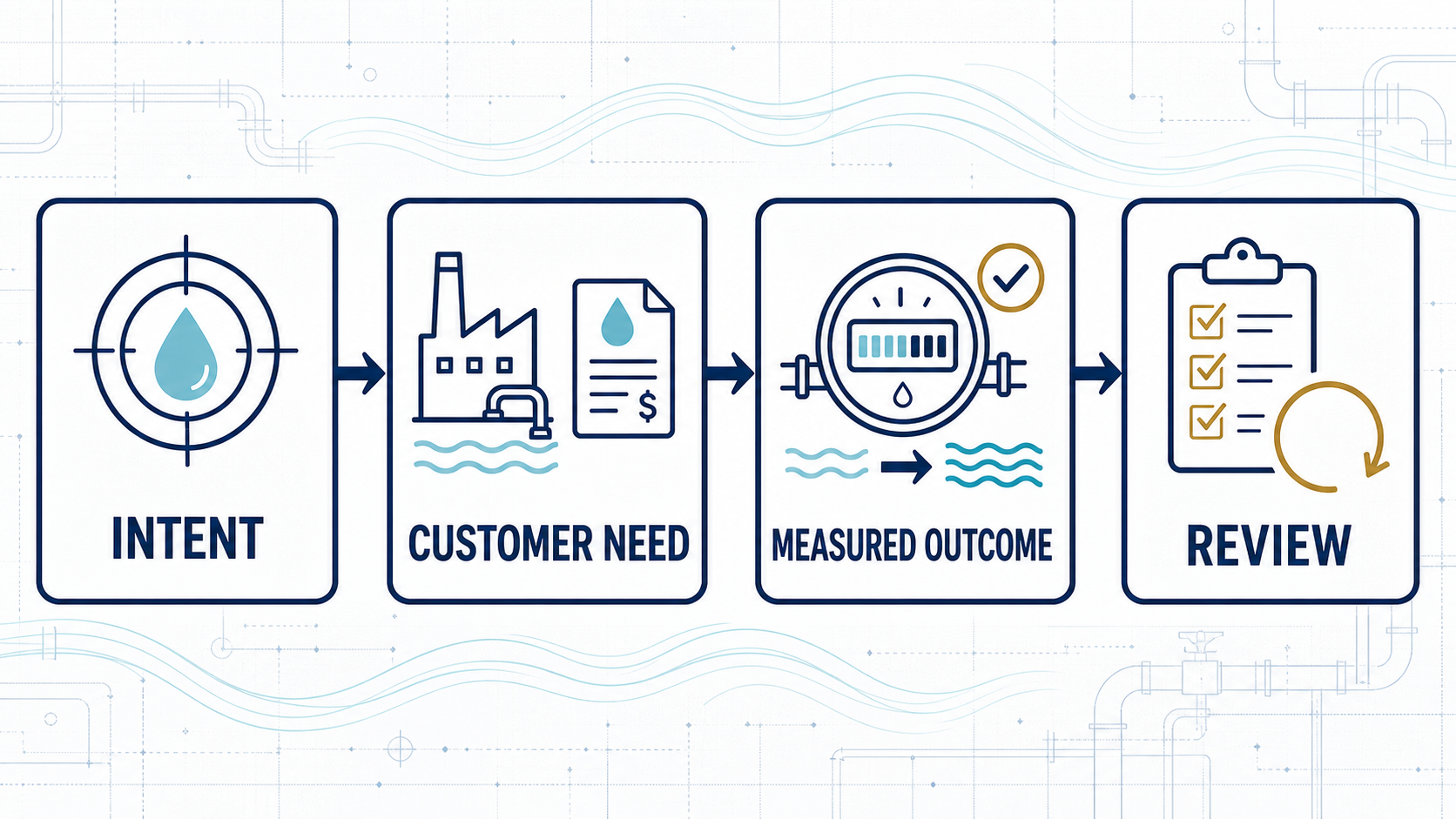
Sustainable impact investing combines a financial objective with an intention to support positive environmental or social outcomes. The exact mandate can vary, but a credible approach states what outcome is sought, how it will be measured and how the investment process will respond to evidence.
The word sustainable often refers to the ability of an activity or system to continue without creating unacceptable environmental or social harm. Impact adds a more active question: what change is the investment intended to support? In water, that change might involve safer treatment, lower pollution, greater reuse, improved efficiency, more reliable supply or better monitoring.
The financial objective remains central. A private company still needs customers, a workable price, reliable delivery and a route to durable cash generation. An environmental benefit cannot repair a weak contract or remove working-capital risk. Equally, strong revenue does not prove that a sustainability claim is accurate.
A useful mandate answers six questions:
- Outcome: Which water or environmental result is intended?
- Boundary: Which technologies, customer uses and geographies qualify?
- Commercial standard: What maturity, revenue and margin evidence is required?
- Contribution: What can the investor reasonably add beyond capital changing hands?
- Evidence: Which baseline, operating data and adverse effects will be tracked?
- Review: What evidence would cause the thesis to be changed or rejected?
These questions turn a broad preference into an investment process. They also protect consistency. Without them, a familiar label can lead to different standards for each deal.
The mandate should state whether it accepts businesses that are improving but not yet aligned with the intended outcome. A transition case can be valid, but it needs a dated plan, funded actions and measurable milestones. It should not be presented as an achieved result.
The mandate should also specify the evidence expected at each company stage. An early commercial business may have paid pilots, independently checked operating data and a credible cost model, but limited renewal history. A more mature company should normally provide cohort retention, realised gross margin, service performance and evidence from repeat sites. Matching the evidence standard to maturity avoids demanding false precision from young companies while still requiring stronger proof as valuation and capital needs increase.
Investors should also define exclusions. These may include revenue that is unrelated to the claimed benefit, untested technologies outside the risk budget, or activities that create material harm elsewhere in the water cycle. Clear exclusions reduce pressure to stretch the mandate when a commercially attractive company appears.
The private-market guide to impact investing in water sets out the wider investment case. Sustainable impact investing adds a disciplined mandate and an evidence system that continue throughout ownership.
Separate ESG, responsible investment and impact
ESG and impact investing are related, but they are not interchangeable. Environmental, social and governance analysis often asks how those factors affect a company. Impact investing also asks how the company and the investment affect people or the environment.
The Principles for Responsible Investment explains that responsible investment can use different approaches across asset classes. These include ESG incorporation, thematic exposure, stewardship and investing for sustainability impact. The tools and their relevance differ between private and public markets. [1]
For direct water investments, the approaches can be separated as follows:
| Approach | Main question | Example evidence |
|---|---|---|
| ESG integration | Which environmental, social or governance factors could affect company value? | Permits, energy exposure, safety, board controls and customer concentration |
| Screening | Which activities or practices are included or excluded? | Revenue thresholds, prohibited activities and conduct rules |
| Thematic investing | Does the company benefit from a long-term water or sustainability theme? | Customer need, market position and technology relevance |
| Impact investing | Is positive, measurable change intended alongside a financial result? | Impact thesis, baseline, targets, data and investor contribution |
A company can pass ESG risk checks without producing a material positive outcome. It can also sell an environmental solution while having weak governance or poor labour controls. Neither side should be ignored.
This is especially important when a water company uses the term ESG in sales material. Investors should ask what the term changes in the product, contract or operating result. If it only describes the customer’s reporting interest, it may help demand but does not prove impact.
Sustainable responsible impact investing sometimes combines several labels in one phrase. A longer label does not create a stronger process. The investment paper should still show the exact objective, decision rule, evidence and ownership plan.
For private companies, governance deserves early attention. Review board information, related-party transactions, intellectual-property ownership, customer claims, safety responsibilities and the controls around impact data. A sustainability thesis can increase reputational risk when evidence is weak or marketing runs ahead of operations.
Keep a short classification statement in each investment paper. State whether the deal is mainly an ESG integration case, a sustainability theme, an impact investment or a combination. Then state why. This prevents the language from changing after the decision.
Build a water mandate from outcomes, not labels
A water mandate should start with the result that matters and work back to technologies. Starting with a product category can create blind spots. The same technology may deliver a useful outcome at one site and little benefit at another.
United Nations Sustainable Development Goal 6 covers water quality, wastewater treatment, recycling and reuse, water-use efficiency, water stress, integrated management and water-related ecosystems. Its targets provide a useful public reference, but an investor still needs a company-level result and a clear boundary. [2]
Common private-market outcome lanes include:
- reducing untreated or poorly treated industrial wastewater;
- increasing verified reuse within a customer operation;
- lowering abstraction where local supply is constrained;
- reducing energy, chemicals or waste per unit of water treated;
- detecting losses or quality changes early enough for action;
- recovering a usable resource from a waste stream; and
- improving service reliability under defined operating conditions.
Each lane needs an inclusion rule. A reuse company may qualify only where recovered water replaces an existing demand. A monitoring company may qualify only when alerts lead to verified maintenance or lower losses. Equipment shipped is an output, not proof of the final outcome.
Geography changes the meaning. Lower abstraction can matter greatly in a stressed basin and less in another location. Higher treatment quality may be essential where discharge limits or customer standards are strict. A credible mandate records the local context rather than applying one impact value everywhere.
The mandate should also distinguish direct and enabling outcomes. A treatment system acts on water. A software platform may enable an operator to act. Enabling technologies can be valuable, but the evidence chain includes customer behaviour. Licence numbers alone do not show that water performance improved.
Define the unit of account before diligence. It might be a customer site, a treatment line, a cubic metre within a stated boundary or a service contract over a reporting period. A stable unit helps compare evidence across holdings without pretending that different technologies are identical.
Avoid turning SDG icons into the investment thesis. The goals can help organise intent, but company selection still depends on commercial relevance, causation and data. State which target is connected, how the product contributes and what cannot be claimed.
The result is a mandate that directs sourcing. It tells the team which opportunities deserve attention, which evidence to request and which adjacent companies should remain outside the allocation.
Put commercial proof ahead of the sustainability story
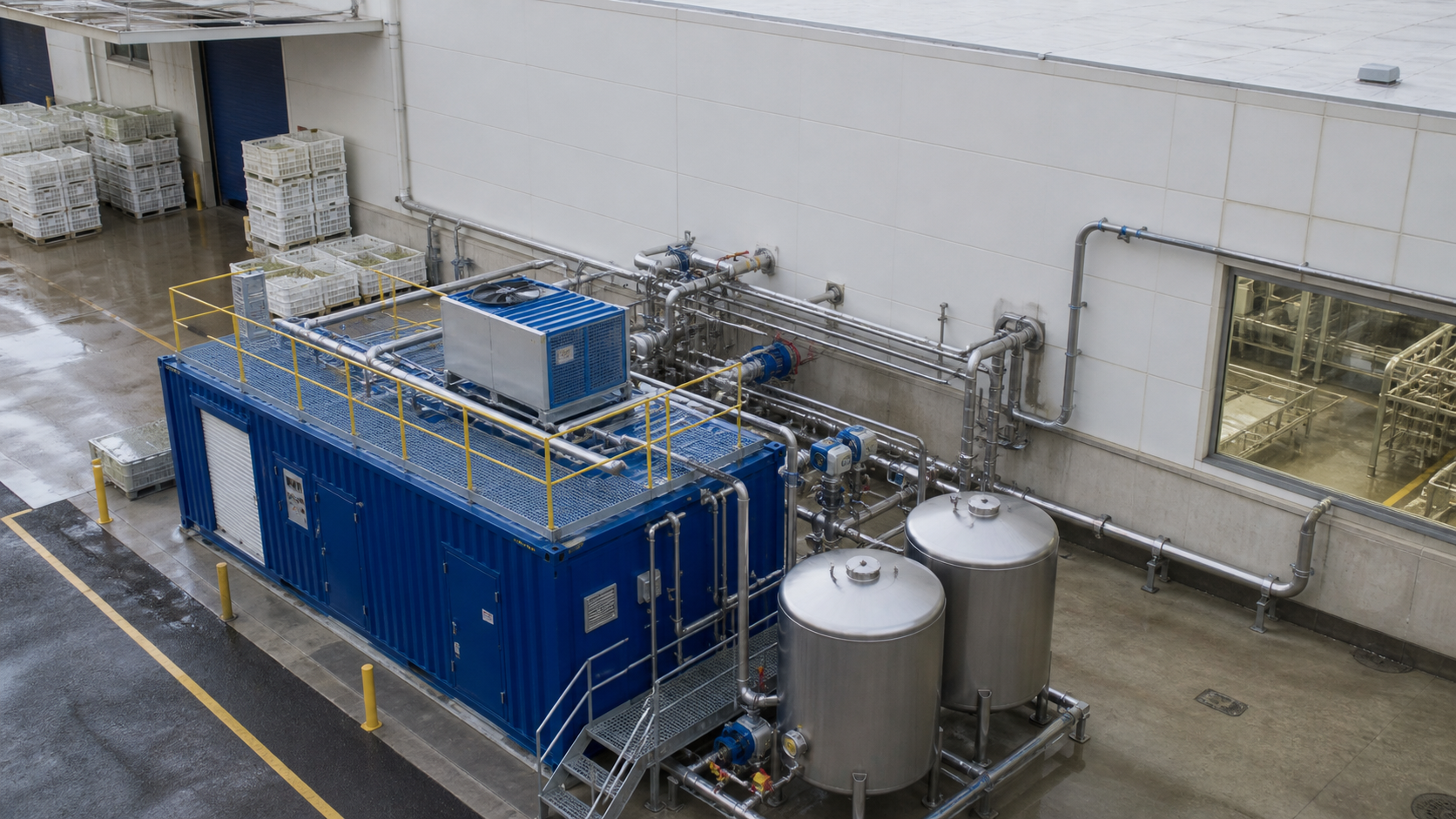
A sustainable water company needs a customer reason to buy now. The reason may be compliance, capacity, cost, quality, continuity or access to a valuable recovered material. The strongest case shows which operating problem reaches a budget holder and how the solution compares with alternatives.
Start with customers rather than the total environmental problem. Review the number of paid sites, contract value, order timing, commissioning status and cash collected. Separate grants, unpaid trials and conditional orders from repeatable customer revenue.
Then map the buying process:
- Who owns the operational loss or sustainability duty?
- Who approves technical change and capital?
- What proof is needed before a full deployment?
- How long do tender, permit and shutdown cycles take?
- What would cause the customer to delay or choose another option?
Revenue quality depends on the delivery model. Equipment sales may create large orders but uneven cash flow. Service contracts may improve visibility while moving uptime and performance duties to the provider. Consumables can support repeat revenue when the installed base is active. Software can carry attractive margins only after hardware, support and integration costs are included.
Reconcile gross margin by project and by mature product. Include design work, installation, commissioning, laboratory tests, travel, warranty and remote support. Founder time can hide the real cost of difficult deployments. A claimed standard product may still be a custom engineering business.
Working capital often decides whether growth creates value. Check customer deposits, milestone invoices, retentions, supplier terms, inventory lead times and the delay between installation and acceptance. Faster revenue growth can increase funding needs when cash arrives late.
Capital intensity changes the risk. A water-as-a-service provider that owns equipment may secure longer contracts, but it also carries finance, utilisation, maintenance and residual-value risk. Review the cash return and downtime sensitivity of each deployed unit.
International Financial Reporting Standard S1 asks companies using it to disclose sustainability-related risks and opportunities that could reasonably affect cash flows, access to finance or cost of capital. It organises disclosure around governance, strategy, risk processes, and metrics and targets. [3]
That is a useful diligence lens even when the investee does not report under IFRS S1. Ask how water, energy, regulation, customer standards and supply chains could change revenue, cost or capital needs. Then compare management’s sustainability story with its operating plan.
A credible sustainable impact investment can survive ordinary commercial scrutiny. The impact thesis should explain why the company matters. It should never be used to lower the standard for contracts, margins or cash.
Create an impact chain that can be tested
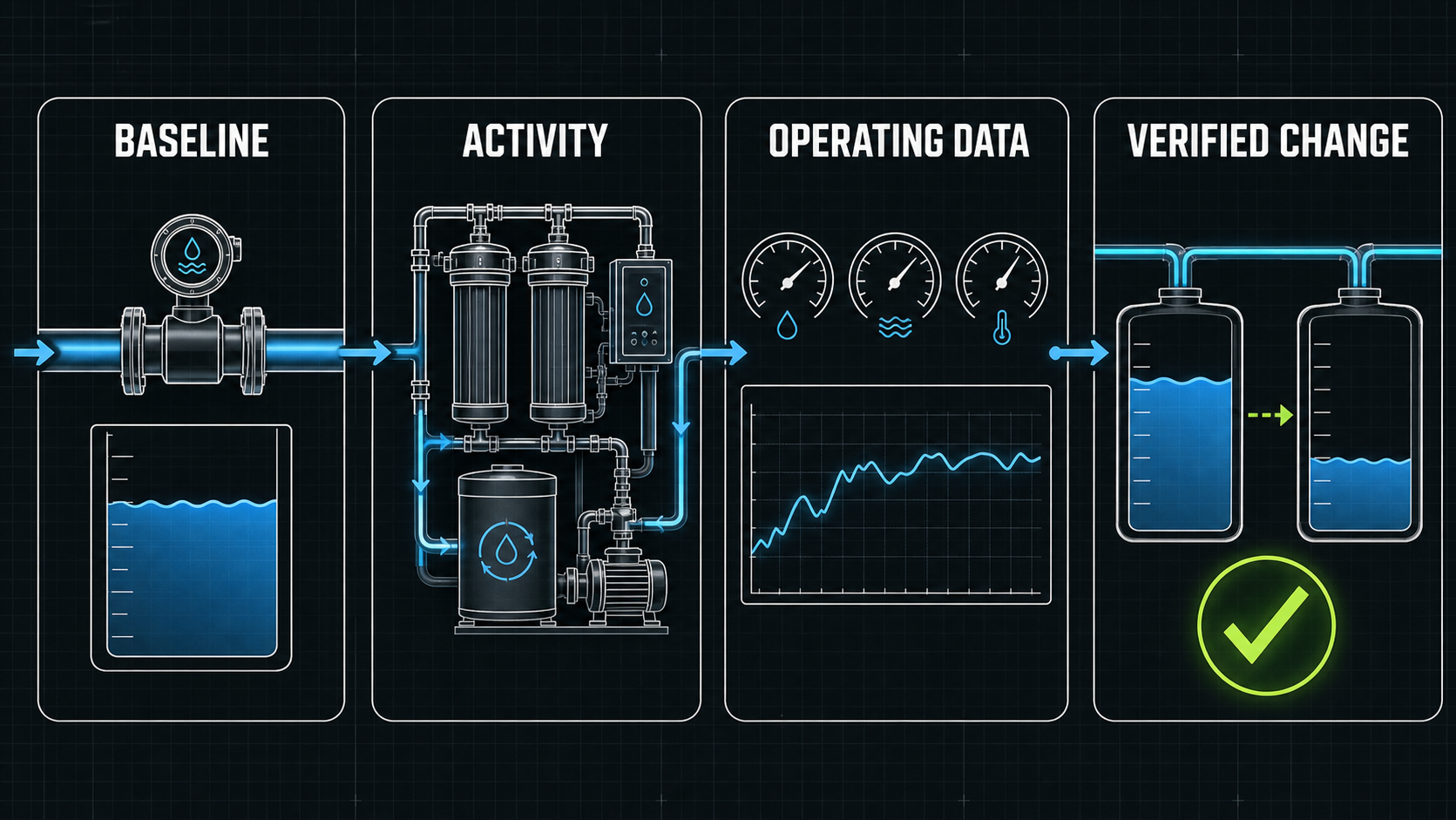
An impact chain connects the investment intention to an observable result. It prevents a team from reporting activity as outcome and helps identify where assumptions can fail.
A practical chain has five parts:
- Problem: the specific water or sustainability condition at the customer site.
- Activity: the product or service delivered by the company.
- Output: the immediate operating record, such as treatment volume or alerts issued.
- Outcome: the verified change, such as reuse, lower loss or improved discharge quality.
- Contribution: why the company and investor were relevant to that change.
Take industrial reuse. The problem might be a factory’s limited supply or discharge capacity. The activity is a treatment and reuse service. Output is the volume processed within specification. Outcome is the amount of recovered water that replaces another source, after allowing for production changes.
The chain reveals evidence gaps. A company may measure processed volume but not whether the customer reused it. It may estimate savings from design data rather than operating data. It may compare performance with a weak baseline. Each gap should be recorded before an impact number enters reporting.
The Operating Principles for Impact Management provide a framework for integrating impact through the investment lifecycle. They emphasise discipline, transparency and regular disclosure, with independent verification expected from signatories. [4]
Private investors can apply the same logic without claiming formal alignment. Set the strategic objective, assess each investment’s expected impact, monitor progress, consider exit and review the process. The exact controls should match the size and complexity of the portfolio.
Assign an owner for each data point. The investee may provide meter readings. A customer may confirm reuse. An external laboratory may test quality. The investor should know who collected the data, which period it covers and what checks were performed.
Record confidence as well as value. A metered result with customer confirmation is different from an engineering estimate. Both can be useful if they are clearly labelled. False precision damages trust and can lead to poor capital decisions.
The chain should be written before completion and tested during ownership. If the result cannot be measured at a reasonable cost, narrow the claim. A smaller supported statement is more useful than a broad promise that cannot be checked.
Measure outcomes, trade-offs and data quality
Impact measurement should help decisions. It is not a collection of attractive numbers. Select a small set of metrics that connect the technology, customer use and investment thesis.
Useful water metrics may include:
- volume treated to a defined quality standard;
- verified reuse that replaces another source;
- change in abstraction or discharge within the site boundary;
- water loss found and repaired after monitoring;
- energy, chemicals and residual waste per unit treated;
- system uptime and time to restore service; and
- recovered material that meets an agreed use or sale specification.
Every metric needs a baseline, unit, boundary, period and data source. State whether the value is measured, estimated or modelled. Explain adjustments for production volume, weather, changes in source quality and other factors that could create a false improvement.
Track commercial and impact measures together. A reuse plant can deliver strong water outcomes but require frequent service visits that damage margin. A monitoring platform can grow subscriptions while customers ignore its alerts. The combined view shows whether impact grows with a healthy business.
Trade-offs need their own record. Advanced treatment may use more energy or create a concentrate that requires disposal. Reuse may shift risk to product quality or maintenance. Resource recovery may depend on an offtake market. A positive result in one area should not hide material harm elsewhere.
Do not sum unlike outcomes into one impressive total. Cubic metres reused, energy saved and pollutants removed describe different changes. Report them separately unless a documented conversion method has a clear decision purpose.
Data quality can be scored simply:
- High confidence: direct measurement, stable boundary and independent or customer confirmation.
- Moderate confidence: measured operating data with some assumptions or incomplete external confirmation.
- Low confidence: modelled estimates, short pilots or management claims without source records.
Agree how errors will be corrected. Impact data may change after meter calibration, customer review or revised assumptions. A clear restatement policy is more credible than defending an old number.
Board reporting should focus on exceptions. Show missed targets, data gaps, customer non-use and adverse effects alongside progress. A sustainable mandate becomes stronger when evidence can challenge the original thesis.
Independent technical review may be proportionate for material claims, unfamiliar processes or high-consequence sites. Verification does not remove investment risk, but it can improve the reliability of the decision record.
Assess investor contribution without exaggeration
A company can produce a positive outcome even when a particular investor made little difference to it. Sustainable impact investing should separate company impact from investor contribution.
Contribution may come through several routes:
- providing capital at a time or on terms needed for a defined expansion;
- funding certification, manufacturing or service capacity that unlocks repeat sales;
- supporting governance, impact controls or senior hiring;
- introducing credible customers, partners or technical expertise; and
- protecting the impact purpose during later financing or strategic change.
The claim should match the evidence. A minority cheque in a well-subscribed round may support growth without being decisive. Board work can matter, but it should be linked to an action and result. Introductions count only when they lead to useful engagement.
Use of funds provides a practical test. Identify the milestone the capital is expected to support, the amount needed, the delivery owner and the date. Examples might include a repeatable manufacturing process, a reference deployment or a service operation capable of supporting more sites.
Then ask the counterfactual question: what was likely to happen without this investment? The answer may be uncertain. Record the assumptions rather than turning them into certainty. Additionality is often a judgement supported by evidence, not a number that can be proved precisely.
Terms can influence contribution. Governance rights, reserved matters, reporting duties and follow-on commitments may help protect the plan. They can also create obligations and conflict. Legal advice should clarify the actual rights and limits.
Contribution is not a reason to overpay or ignore dilution. Model future capital needs, likely financing stages and ownership outcomes. A company may require more funding before it reaches commercial scale, and existing investors may need to decide whether to participate.
At exit, consider whether the buyer or new owners can maintain the outcome. This does not mean rejecting every sale. It means including impact continuity, customer obligations and data access in exit planning where they are material.
A measured contribution statement is stronger than a grand claim. It should explain what the investor supplied, which milestone followed and what other factors also mattered.
Control sustainability claims across UK and European rules
Sustainability language can create legal, regulatory and reputational exposure. The correct rule depends on the entity, product, audience and jurisdiction. A private-company deal should not copy a label from a regulated fund or an EU classification without checking whether it applies.
In the UK, the Financial Conduct Authority’s Sustainability Disclosure Requirements include an anti-greenwashing rule for authorised firms making sustainability-related claims about products and services. The FCA says those claims must be consistent with the sustainability characteristics of the product or service. [5]
Water Investment Network does not provide regulated financial advice. The rule still offers a useful discipline for investor communications: claims should be clear, specific, supported, balanced and current. The wording should not imply that a private company or direct deal holds a regulatory label unless that has been verified.
The European Commission describes the EU taxonomy as a classification system for environmentally sustainable economic activities. It includes technical criteria and safeguards, while related disclosures use concepts such as eligibility and alignment. [6]
Eligibility and alignment are not the same. An activity can fall within the taxonomy’s scope without meeting every alignment condition. Investors should identify the exact activity, applicable criteria, reporting period, evidence and responsible entity before using the term.
Classification also does not replace commercial diligence. A taxonomy-linked activity may still have weak customer demand, poor margins or high financing risk. Conversely, an early technology may deliver useful outcomes while lacking the evidence needed for a formal alignment statement.
For cross-border portfolios, build a claim register. Record:
- the exact sustainability statement;
- where it appears and who receives it;
- the evidence and reporting period;
- the framework or rule referenced;
- the owner responsible for review; and
- the next date on which the statement must be updated.
Do not describe one country’s policy as a GCC-wide rule. The UAE, Saudi Arabia, Qatar, Kuwait, Bahrain and Oman have different institutions and requirements. Use regional context only when the exact jurisdiction and commercial consequence are sourced.
Claims should survive downside evidence. If a process lowers water use but increases energy, say so. If a metric covers only selected sites, state the coverage. If the impact depends on customer behaviour, explain that dependency.
Good claim control protects both trust and decision quality. It forces the investment team to understand what the evidence really supports.
Use ownership and committee discipline to protect the thesis
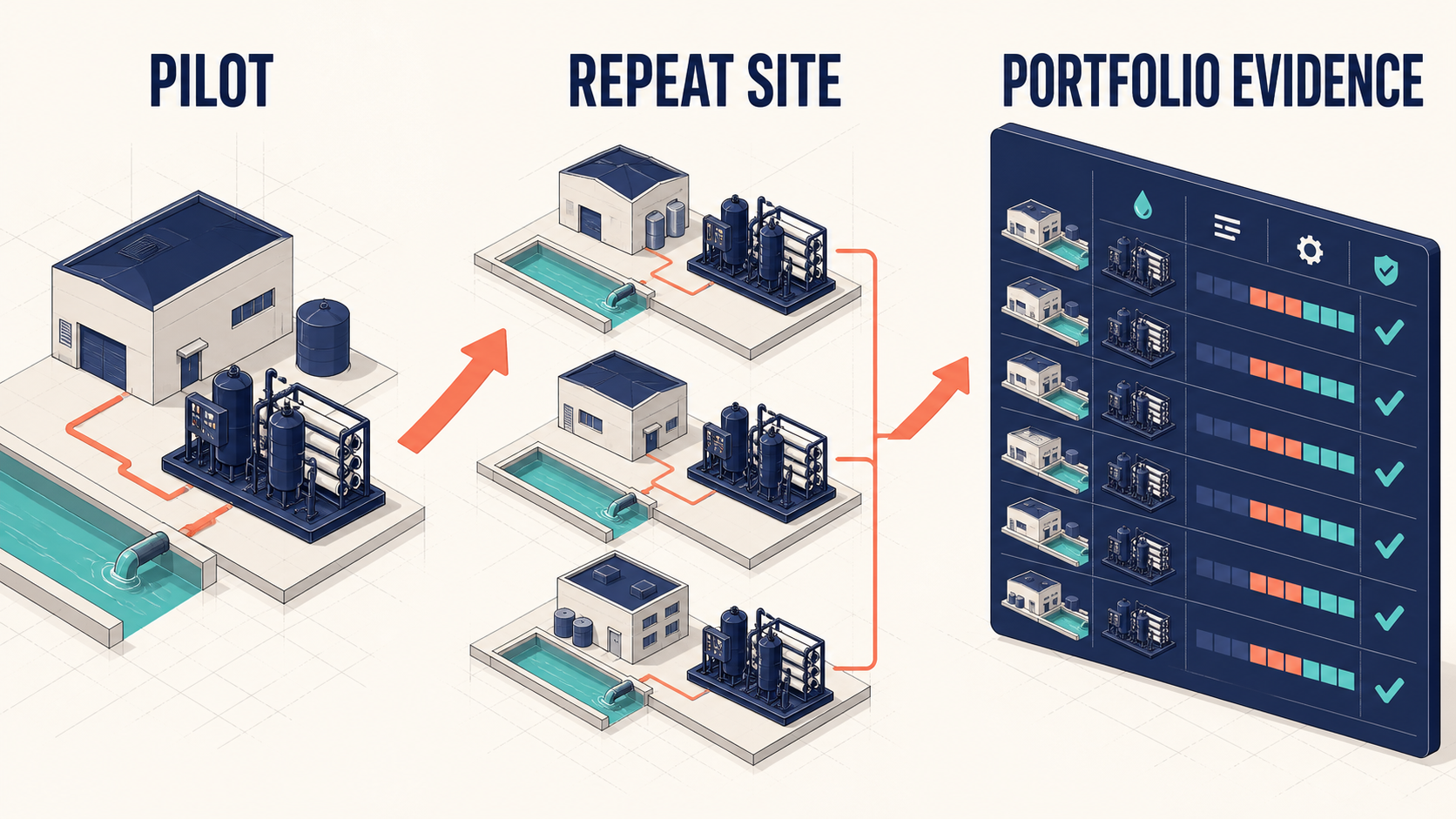
The investment committee should decide on a combined commercial and impact record. A strong sustainability narrative cannot compensate for weak deal terms, and an attractive financial case should not be presented as impact without credible intention and evidence.
A concise committee checklist can cover ten questions:
- Which sustainable water outcome is intended, and why is it material?
- Which customer problem releases budget for the solution?
- What paid evidence exists beyond grants and trials?
- What gross margin and cash profile has the company achieved?
- What technical, regulatory and delivery limits could slow adoption?
- Which baseline and operating data support the impact chain?
- Which adverse effects or trade-offs remain?
- What can this investor reasonably contribute?
- What further capital, dilution and liquidity risks exist?
- Which evidence would cause the committee to change its view?
Conditions before completion may include a customer reference, confirmation of intellectual-property ownership, a technical test, a regulatory opinion or agreement on impact reporting. Each condition should have an owner and a clear pass standard.
After investment, the board pack should connect orders, revenue, gross margin, cash, deployment time and customer retention with the selected outcome metrics. This makes it possible to see whether growth is improving both the company and its intended impact.
Set thresholds for escalation. A missed outcome target may require a better baseline, an operational fix or a change to the claim. Repeated project overruns may challenge scalability. A breach of permit or safety duties may require immediate board action.
Portfolio review should identify shared exposure. Several holdings can depend on the same customer sectors, equipment suppliers, policy assumptions or skilled engineers. Sustainable themes can create concentration even when technologies look different.
The Water Investment Network portfolio shows several routes into water treatment, membranes and monitoring. Each opportunity still needs separate work on contracts, maturity, evidence, terms and risk.
Record reasons for declining a deal. A company may fit the theme but fail on economics, evidence or governance. That decision helps maintain the mandate when a similar opportunity appears later.
Ownership plans should include exit without assuming one. Review likely buyers, strategic fit, information rights and the effect of future capital. No investor can guarantee timing, valuation or liquidity.
The purpose of discipline is not to make every holding look sustainable. It is to direct capital where a credible company, a useful outcome and an investable transaction meet.
Frequently asked questions about sustainable impact investing
What is sustainable impact investing?
It is an approach that seeks a financial result alongside an intended, measurable environmental or social outcome. A credible process defines the mandate, evidence, contribution and ownership response.
Is ESG investing the same as impact investing?
No. ESG analysis often focuses on factors that affect company risk and value. Impact investing also requires an intention to support positive change and a method for measuring it.
How can a water company demonstrate impact?
It can connect a defined customer problem to operating data and a verified result, such as reuse, lower abstraction, reduced loss, improved treatment or resource recovery.
What is investor additionality?
It is the difference an investor may contribute through capital, timing, terms, governance, expertise or relationships. Claims should be proportionate to evidence and acknowledge uncertainty.
What are the main risks in a private sustainable water investment?
Risks include slow procurement, technical limits, custom delivery, working capital, further funding, weak baselines, adverse effects, governance failures, exaggerated claims and illiquidity.
Explore sustainable water impact opportunities
Sustainable impact investing in water requires more than a suitable label. Investors need a defined mandate, paid customer evidence, sound company economics, measurable outcomes and clear limits on every claim.
Eligible family offices, high-net-worth individuals, sophisticated impact and private-equity investors, and relevant advisers in the UK, Europe and GCC can request access to Water Investment Network to review selected direct private-company opportunities.
The network is invitation-only, and access depends on eligibility and current opportunity availability. Every transaction requires its own legal, tax, financial, technical and commercial review. Water Investment Network does not provide regulated financial advice and does not guarantee returns, exit timing or liquidity.
Sources
- https://www.unpri.org/responsible-investment/intro-guides/what-is-responsible-investment
- https://sdgs.un.org/goals/goal6
- https://www.ifrs.org/issued-standards/ifrs-sustainability-standards-navigator/ifrs-s1-general-requirements/
- https://www.impactprinciples.org/
- https://www.fca.org.uk/firms/climate-change-and-sustainable-finance/sustainability-disclosure-requirements-sdr-regime
- https://finance.ec.europa.eu/sustainable-finance/tools-and-standards/eu-taxonomy-sustainable-activities_en