The revised Urban Wastewater Treatment Directive is turning compliance into a multi-year investment question. EU towns and cities must collect and treat wastewater more thoroughly, address nutrients and micropollutants, improve energy performance and manage stormwater risks.
For private investors, the opportunity is not a simple bet on one technology. It is a question of which suppliers, operators and service businesses can convert public requirements into repeatable contracts, reliable delivery and defensible margins. This article explains the market outlook without offering regulated financial advice or promising returns.
Why this directive matters to private investors
The European Commission says the revised directive entered into force on 1 January 2025. It expands the policy focus beyond basic collection and treatment to include new pollutants, circularity, climate performance, public-health monitoring and access to sanitation. The official overview also reports 30,354 urban wastewater treatment plants operating in the EU.
That scale matters because compliance work is delivered through physical assets and long operating contracts. A municipality may need a plant upgrade, a new monitoring layer, better stormwater control or a service partner that can keep the system within its permit conditions. Each case has a different procurement route, funding structure and counterparty risk.
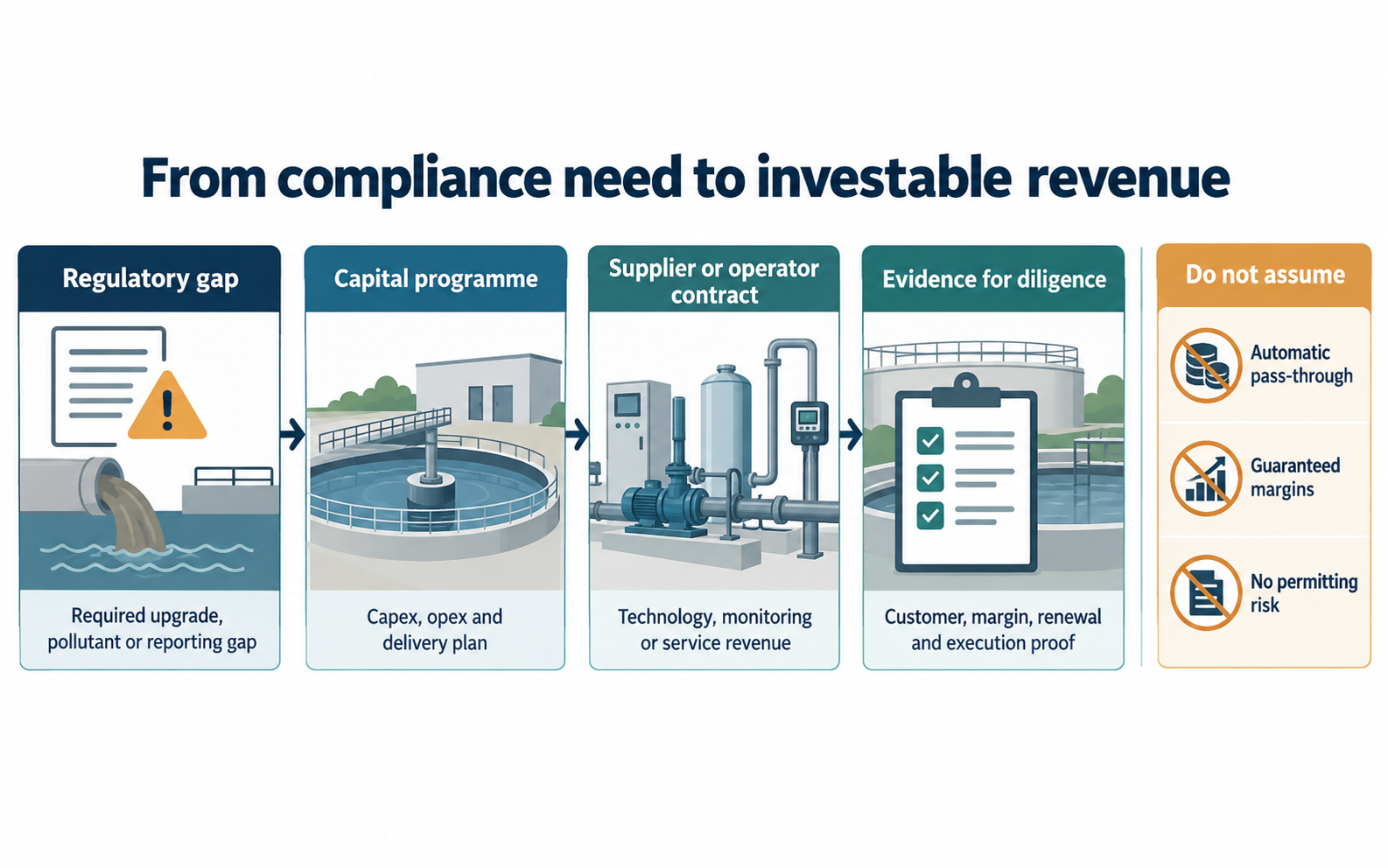
The commercial chain is therefore more useful than a headline market-size claim. An investor should start with a defined regulatory or service gap, then trace the capital programme, the supplier or operator contract and the evidence that supports renewal.
What the Urban Wastewater Treatment Directive adds
The recast directive is Directive (EU) 2024/3019. The official legal text covers the collection, treatment and discharge of urban wastewater. It also connects the regime to health protection, greenhouse-gas reduction, energy performance, circularity, transparency, sanitation access and the polluter-pays principle.
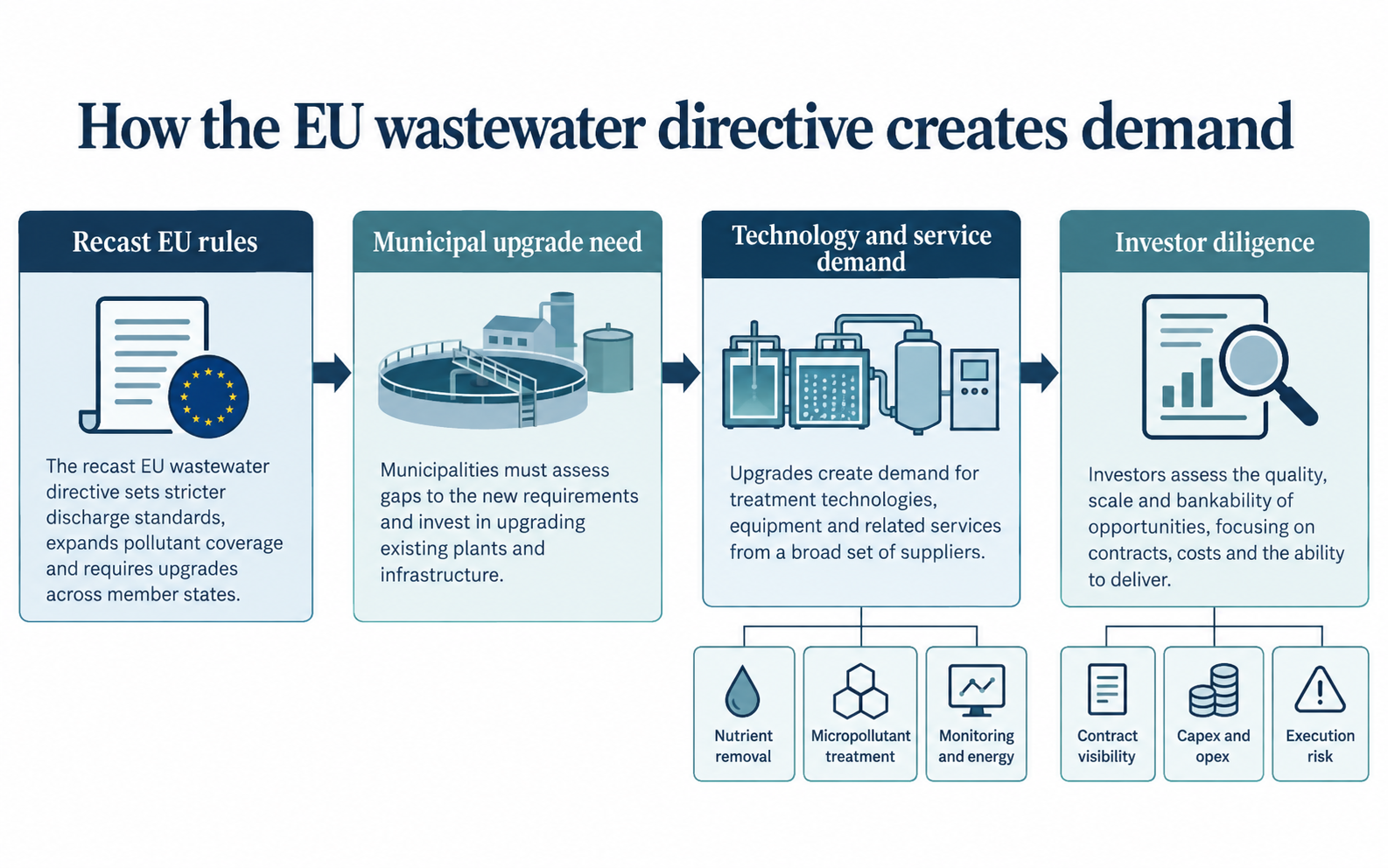
The Commission summarises several changes that are relevant to technology and service providers. These include wider coverage of urban areas, stronger nutrient removal, treatment for selected micropollutants, energy and emissions requirements, health-related monitoring and integrated stormwater planning.
| Policy area | Potential commercial demand | Investor question |
|---|---|---|
| Collection and treatment | New or upgraded assets serving smaller urban areas and underserved catchments. | Is the customer need mapped to a funded programme? |
| Nutrient removal | Process upgrades, control systems, chemicals, membranes and operating support. | Can the solution meet the required performance at the site’s actual load? |
| Micropollutants | Advanced treatment, monitoring, maintenance and producer-funded service models. | Who pays, who owns the asset and how is performance measured? |
| Energy and emissions | Energy optimisation, recovery, process control and plant modernisation. | Does the margin case survive energy-price and capex changes? |
| Stormwater and reporting | Overflow control, sensors, modelling, data systems and local planning support. | Is the product part of a required plan or only a discretionary pilot? |
The paying-customer problem behind the policy
Wastewater treatment is a service delivered to a defined catchment. The paying customer may be a municipality, a utility, a public-private project company or an industrial partner connected to the urban system. The technology company is usually one step removed from the policy maker.
That distinction protects the investment case from a common error. A legal requirement does not automatically create revenue for every supplier. It creates a need for an accountable asset owner to choose a compliant solution, secure funding, obtain approvals and keep the system operating.
The strongest commercial prospects usually solve a measurable operating problem. Examples include reducing nutrient discharge, adding treatment for selected micropollutants, increasing capacity without a large site expansion, improving energy use or proving performance through better data.
Demand quality matters more than demand language
“The market must upgrade” is not enough for diligence. A stronger case identifies the affected plant or network, the compliance timetable, the procurement route, the budget owner and the evidence required at acceptance.
The European Environment Agency explains that Member States report under the directive and that its maps and data products are based on this reporting. For an investor, this creates a useful starting point for checking whether a proposed opportunity is linked to a real catchment, plant or national implementation record.
Where technology and service demand may emerge
The directive does not select a single treatment technology. That leaves room for different technical approaches, but it also increases the need for site-specific proof. A solution must work with the existing process, flow pattern, pollutant load, energy system, land constraints and operating team.
- Nutrient control: biological or chemical processes, membranes, dosing systems and control software may help plants meet tighter nitrogen or phosphorus requirements.
- Micropollutant treatment: activated carbon, ozonation and other advanced processes may be relevant where the required treatment and producer-responsibility arrangements apply.
- Monitoring and data: sensors, laboratory services, telemetry and reporting tools can support compliance evidence and operational decisions.
- Energy and resource recovery: process control, biogas, heat, water reuse and nutrient recovery can improve resource efficiency where the local business case supports them.
- Stormwater management: overflow controls, retention, modelling and nature-based measures may sit alongside conventional grey infrastructure.
These categories are not interchangeable. A hardware sale may produce one-off revenue, while monitoring or operating support may create recurring revenue. The investor needs to understand whether the company sells equipment, design, commissioning, software, consumables, maintenance or a managed outcome.
What a credible solution must show
Technology selection begins with the receiving environment. Urban wastewater varies by catchment, season, industrial connection, rainfall pattern and existing treatment train. A process that works in one plant may need different controls, pre-treatment or energy input elsewhere.
Commercial proof should therefore go beyond a laboratory result. Investors should look for data from a relevant operating site, clear test conditions, independent sampling where possible and a defined acceptance standard. They should also ask how the company manages commissioning, operator training, maintenance and failure events.
This evidence helps separate a product with a repeatable deployment path from a project that depends on bespoke engineering. Both may have value, but they carry different sales cycles, capital needs and routes to scale.
Why this is an upgrade market, not only a construction market
New construction attracts attention, but the more durable demand may come from existing plants that must be upgraded while remaining in service. The EIB’s water-sector guidance describes the EU challenge as increasingly focused on operating, maintaining, upgrading and renovating water infrastructure, as well as tackling emerging pollutants.
That shift can favour businesses that fit into installed systems. Retrofit specialists, process-control providers, monitoring companies and operators may have shorter paths to revenue than firms waiting for a completely new plant. The trade-off is that retrofit work can carry more integration risk.
Investors should test the practical constraints. Does the solution need a shutdown? Can the site provide the required power, footprint and hydraulic conditions? Who carries the cost if the existing process performs below the design assumptions?
Recurring revenue needs a clear reason to recur
Maintenance, calibration, replacement media, software access and performance monitoring can support repeat revenue. They are not automatically high-quality revenue. The customer must have a reason to renew, and the supplier must be able to deliver without excessive service cost.
A sensible review separates contracted recurring income from expected renewals. It also checks customer concentration, service-level obligations, spare-parts exposure and the working capital needed to support public-sector payment cycles.
How the directive can translate into commercial demand
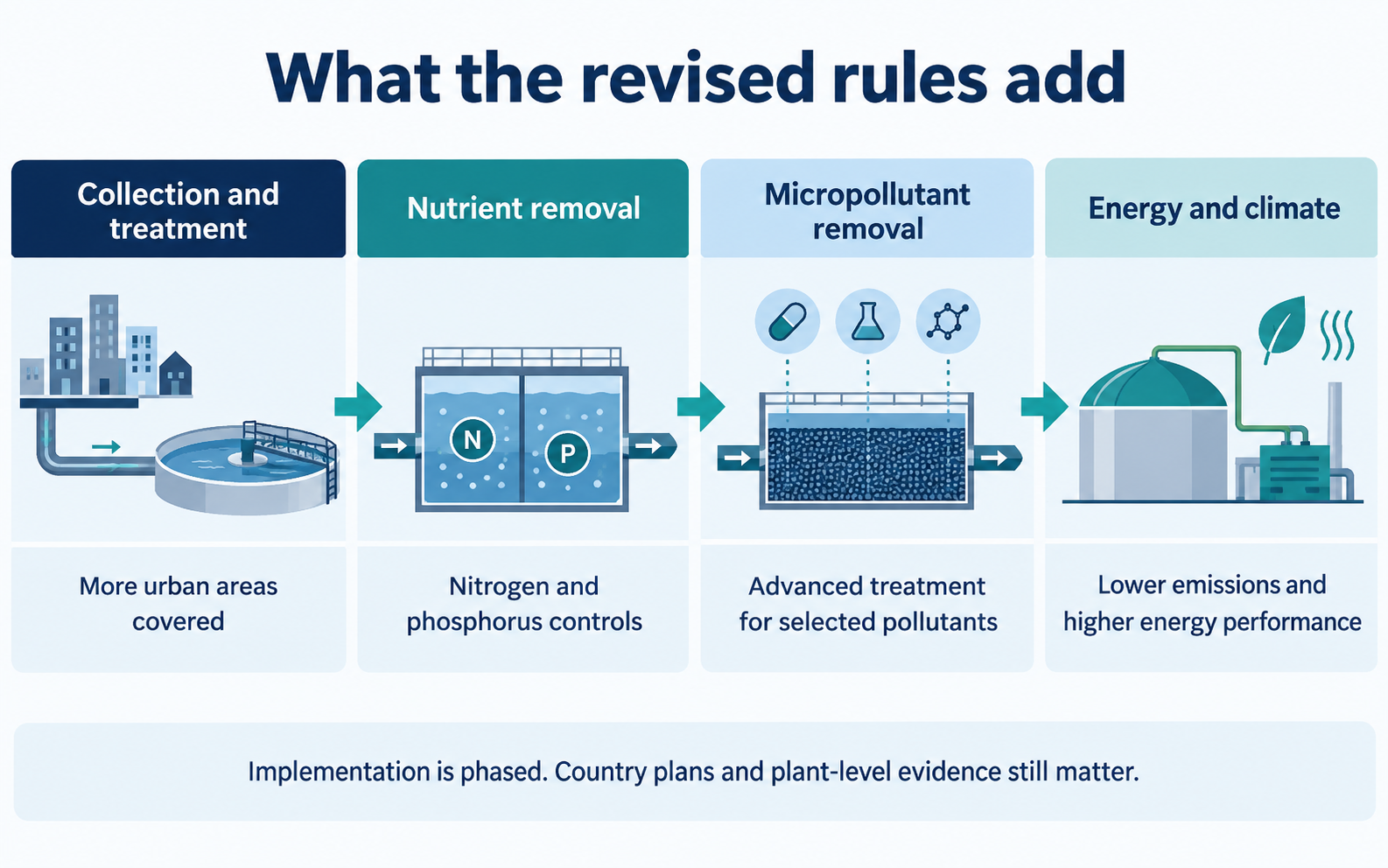
The commercial pathway has four steps. First, a regulator or asset owner identifies a gap. Second, the responsible authority turns that gap into a plan, budget and procurement route. Third, a supplier or operator wins a contract. Fourth, the company must prove performance well enough to support payment, renewal or expansion.
This is why a compliance-led market can still produce uneven outcomes. A directive can strengthen demand while individual projects are delayed by planning, funding, procurement, integration or permitting. Timing risk sits between the policy and the revenue line.
The Commission says advanced treatment for micropollutants will be financed mainly through extended producer responsibility, with the pharmaceuticals and cosmetics industries required to cover at least 80% of the removal cost. This may support new business models, but investors should confirm how each national system applies the rule and who bears the residual cost.
It is also useful to distinguish a supplier opportunity from an asset opportunity. A technology provider may earn from multiple plants, while an asset owner may depend on one concession or municipal contract. Their revenue quality, capital needs and exit routes are different.
Finance and project delivery are part of the market
Water projects often require long planning periods and large upfront investment. Public bodies, utilities, development banks and private capital may each play a different role. The presence of policy demand does not remove the need for financeable contracts, credible counterparties and a delivery plan.
A current EIB example shows the scale and complexity of one urban wastewater upgrade. In March 2026, the EIB announced a €470 million loan for Stockholm’s sewer and treatment system. The project includes a new collection tunnel and an expanded treatment plant, with completion planned for 2031.
The EIB says the upgraded system is expected to reduce nitrogen discharge by about 40% and phosphorus discharge by about 35%, while capturing microplastics and reducing overflow risk. Those are project-specific expectations, not a sector-wide forecast. They show why diligence must connect technical design, financing, timetable and measurable outcomes.
For private investors, the most relevant question is often not whether a project is large. It is whether a company has a repeatable role in projects of this type without taking unpriced construction, performance or counterparty risk.
Funding visibility is a commercial gate
A treatment requirement becomes more actionable when the responsible authority has a published plan, an identified funding source and a procurement timetable. Without those elements, a supplier may spend years building a pipeline that does not convert.
Project finance also changes how investors should read revenue. A company may report a signed framework agreement, a preferred-bidder position or a full notice to proceed. These are different stages. The diligence file should show which stage applies, what conditions remain and when cash is expected to arrive.
The same discipline applies to public funding and development-bank support. A financing announcement can validate the importance of an asset, but it does not prove that a particular technology company has won work. The link between the funded project and the company’s order book must be evidenced.
Europe, the UK and GCC: separate the exposure
The directive is an EU legal instrument. A UK or GCC investor may still gain exposure through an EU-based asset, supplier, operator or technology company, but the article does not assess domestic law outside the EU.
For UK investors, the useful questions are commercial. Does the target company sell into EU compliance programmes? Does it rely on common technical standards, export relationships or customers with EU operations? Is its growth plan based on a real European contract pipeline rather than a broad water narrative?
For GCC family offices and other regional investors, the relevance may sit in technology transfer, project finance, operating capability or cross-border water expertise. A European regulatory driver can support a company’s reference base, but it does not prove demand in Saudi Arabia, the UAE, Qatar, Kuwait, Bahrain or Oman.
Regional opportunity should therefore be tested market by market. Investors should ask who pays, which rules apply, how water is priced, whether procurement is public or private and whether the company can support local delivery.
Cross-border expansion also creates practical questions about certification, local partners, service coverage and currency exposure. A company that succeeds in one EU member state may still need a different route to approval or procurement in another. Treating Europe as one uniform customer base can hide this execution risk.
What can go wrong in a directive-led investment case
Regulation can create demand and still produce poor investments. The main risks sit in the translation from policy to project and from project to company economics.
- Timing risk: national implementation, planning or procurement may move more slowly than the company forecast.
- Technology risk: a process may work in a pilot but fail at commercial flow, pollutant load or energy conditions.
- Integration risk: an upgrade may depend on old equipment, limited footprint or an unavailable shutdown window.
- Counterparty risk: a single utility or public customer may dominate revenue and extend payment cycles.
- Margin risk: fixed-price delivery, energy costs, chemicals, warranties or liquidated damages may reduce returns.
- Evidence risk: claims about compliance, impact or performance may rest on estimates rather than independent data.
The EEA reporting system is useful context, but it does not replace company-level evidence. An investor still needs to inspect contracts, plant data, customer references, approvals, insurance and the bridge from gross revenue to cash generation.
A practical diligence scorecard
A short scorecard can keep a directive-led opportunity grounded. It should focus on evidence that a third party can review, not on the size of the policy language.
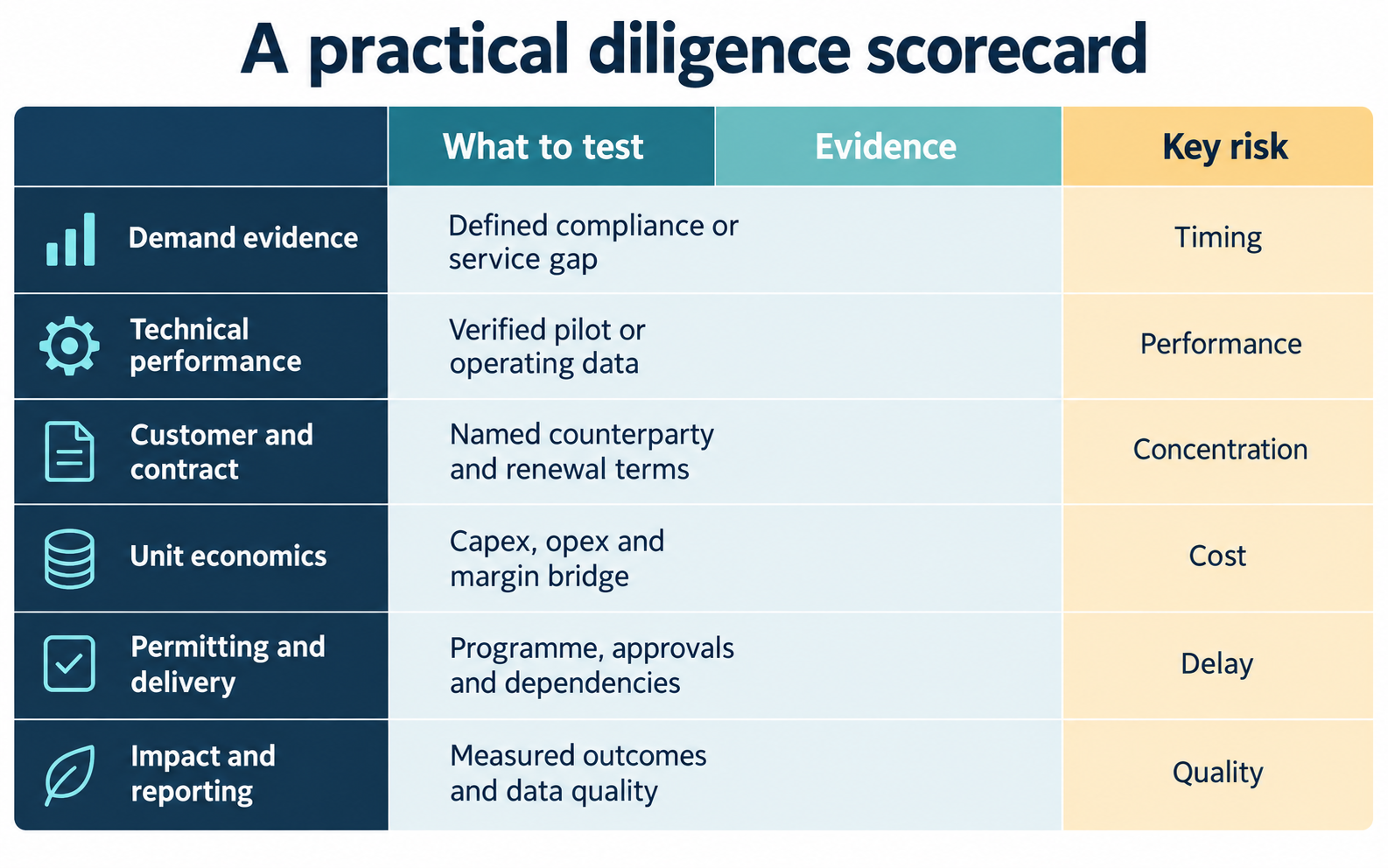
- Demand evidence: identify the plant, catchment, compliance gap, budget and procurement route.
- Technical performance: review operating data at relevant flow, pollutant and energy conditions.
- Customer and contract: confirm the counterparty, term, renewal logic, payment terms and performance obligations.
- Unit economics: understand capex, opex, gross margin, service cost, working capital and warranty exposure.
- Permitting and delivery: map approvals, programme dependencies, site access and integration responsibilities.
- Impact and reporting: define the measured outcome, baseline, data owner and verification method.
One weak row can change the nature of the opportunity. A company with excellent technology but no funded customer may be a research or business-development case. A company with a contract but weak delivery evidence may be an execution-risk case. The investment conclusion should reflect that difference.
Read the market outlook and decide what to do next
The market outlook is best described as compliance-led, upgrade-heavy and project-specific. The Urban Wastewater Treatment Directive expands the set of problems that asset owners must address. It does not guarantee that every supplier wins, that every plant uses advanced treatment or that every project produces attractive private returns.
The Commission estimates annual economic benefits of €6.6 billion by 2045. This is a policy-level estimate, not a forecast for any company or investment. It should be used as context for the direction of travel, then replaced in diligence by customer-level evidence.
The more defensible opportunities are likely to combine a clear customer problem with technical proof, repeatable deployment, sensible capital needs and a measurable outcome. That combination is more useful than a generic claim that water regulation will create a large market.
Investors who want to assess direct private-company opportunities should begin with the operating evidence behind the story. Review the customer, contract, deployment record, margin bridge, delivery dependencies and impact data before treating regulatory demand as an investment thesis.
Water Investment Network connects eligible investors with selected direct opportunities in water-treatment and water-technology companies. For broader context, read the Water Technology Market: An Investor’s Guide, then review the portfolio context and request access to the network. For general questions, use the contact page. This is informational content, not regulated financial advice, and no return is guaranteed.
Sources and further reading
- Directive (EU) 2024/3019 on urban wastewater treatment, EUR-Lex.
- Urban wastewater, European Commission Directorate-General for Environment.
- New rules for more thorough and cost-effective urban wastewater management, European Commission.
- Urban waste water treatment, European Environment Agency.
- EIB loan to help Stockholm cut wastewater pollution and protect the Baltic Sea, European Investment Bank.
- EIB water sector lending orientation: strengthening water security, European Investment Bank.