
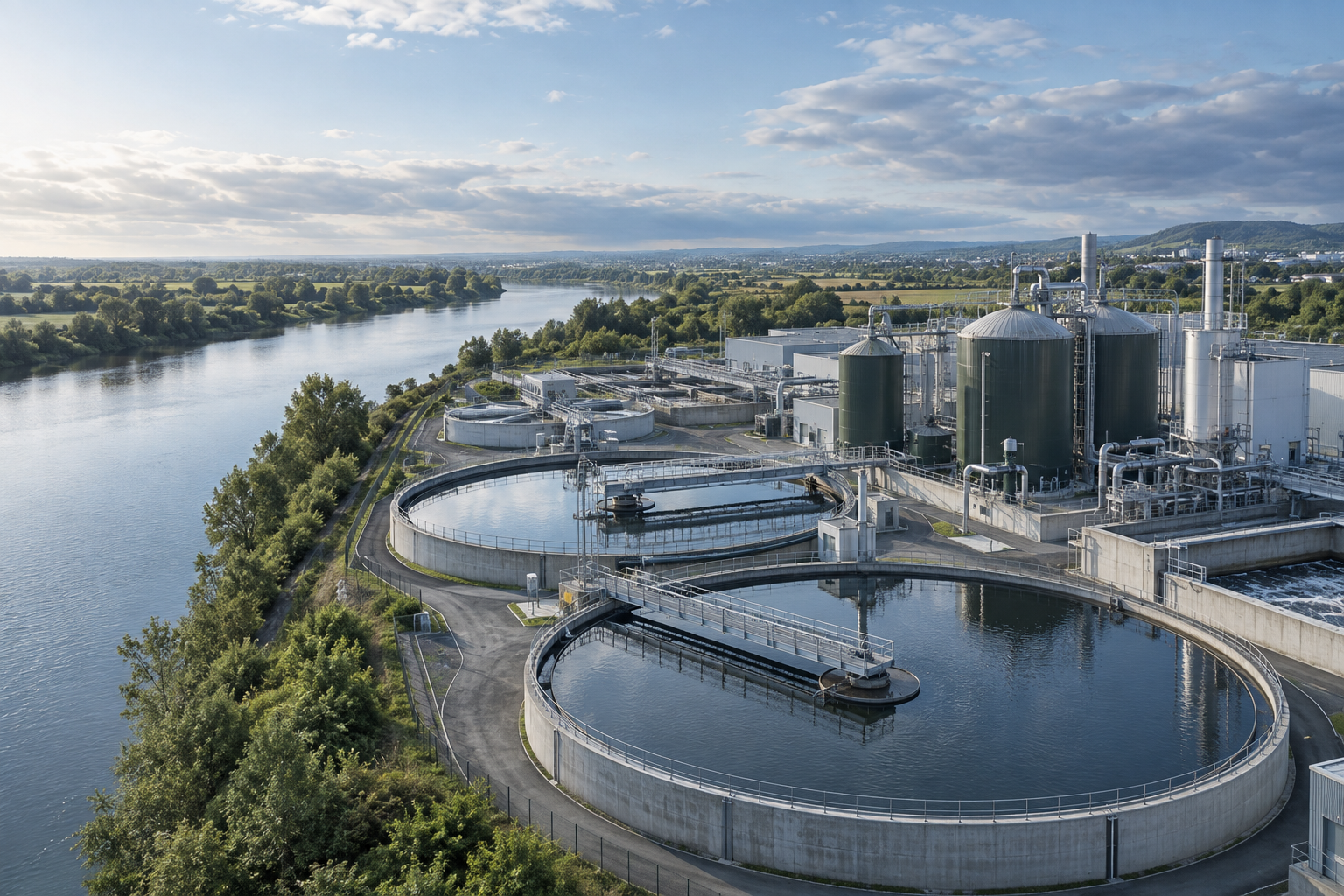
The polluter pays principle is becoming more relevant to water investment because it links environmental harm to economic responsibility. In simple terms, the party that causes pollution should bear the cost of preventing, controlling or repairing it where that is practical and proportionate.
For investors, the principle is not a guaranteed source of revenue. It is a way to test whether regulation, monitoring and remediation create a funded customer need for water-treatment equipment, services or infrastructure. The opportunity exists only when responsibility can be traced to a payer, a budget and a deliverable outcome.
This market outlook looks at the polluter pays principle through a private-market lens. It covers the UK, Europe and the Gulf Cooperation Council (GCC), while keeping the focus on commercial evidence, execution risk and investability. It is educational content, not regulated financial advice, and it does not promise returns.
What the polluter pays principle means for water
A cost-allocation rule, not a single tax
The European Commission describes the polluter pays principle as a response to market failure. Pollution costs can sit outside the price of a product or service, leaving the wider community to absorb health, ecosystem and economic damage. A policy can correct that gap by making the responsible party pay for prevention, control or remediation.
The principle is therefore broader than a fine. It can operate through a charge, permit condition, remediation duty, producer-responsibility scheme, procurement rule or contractual requirement. The right mechanism depends on the source of pollution, the available evidence and the policy objective. This is why the wider water market investment thesis needs to be tested at the level of the payer and the project.
Why proportionality matters
Responsibility is rarely as simple as finding one company beside one discharge point. Pollution can move through a catchment, accumulate over time or come from several sectors. A workable framework must decide who caused the problem, how much they should pay and which intervention will reduce harm at the lowest reasonable cost.
This is why investors should not read the principle as a blanket promise that every polluter will fund every treatment project. The commercial case depends on the rule in force, the evidence standard, the allocation method and the ability of the responsible party to pay.
Why the principle matters to private investors
It can turn an external cost into a customer problem
When pollution is treated as somebody else’s problem, a customer may delay monitoring or treatment. When responsibility is assigned, the same issue can become a permit condition, a remediation programme, an operating risk or a procurement requirement. That shift can support demand for measurement, source control, treatment and reporting.
The commercial question is whether the policy signal reaches a real operating budget. An industrial site may need to reduce a discharge before a permit renewal. A utility may need new treatment capacity. A manufacturer may need to document the effect of its products on a wastewater stream. Each case creates a different sales cycle and risk profile.
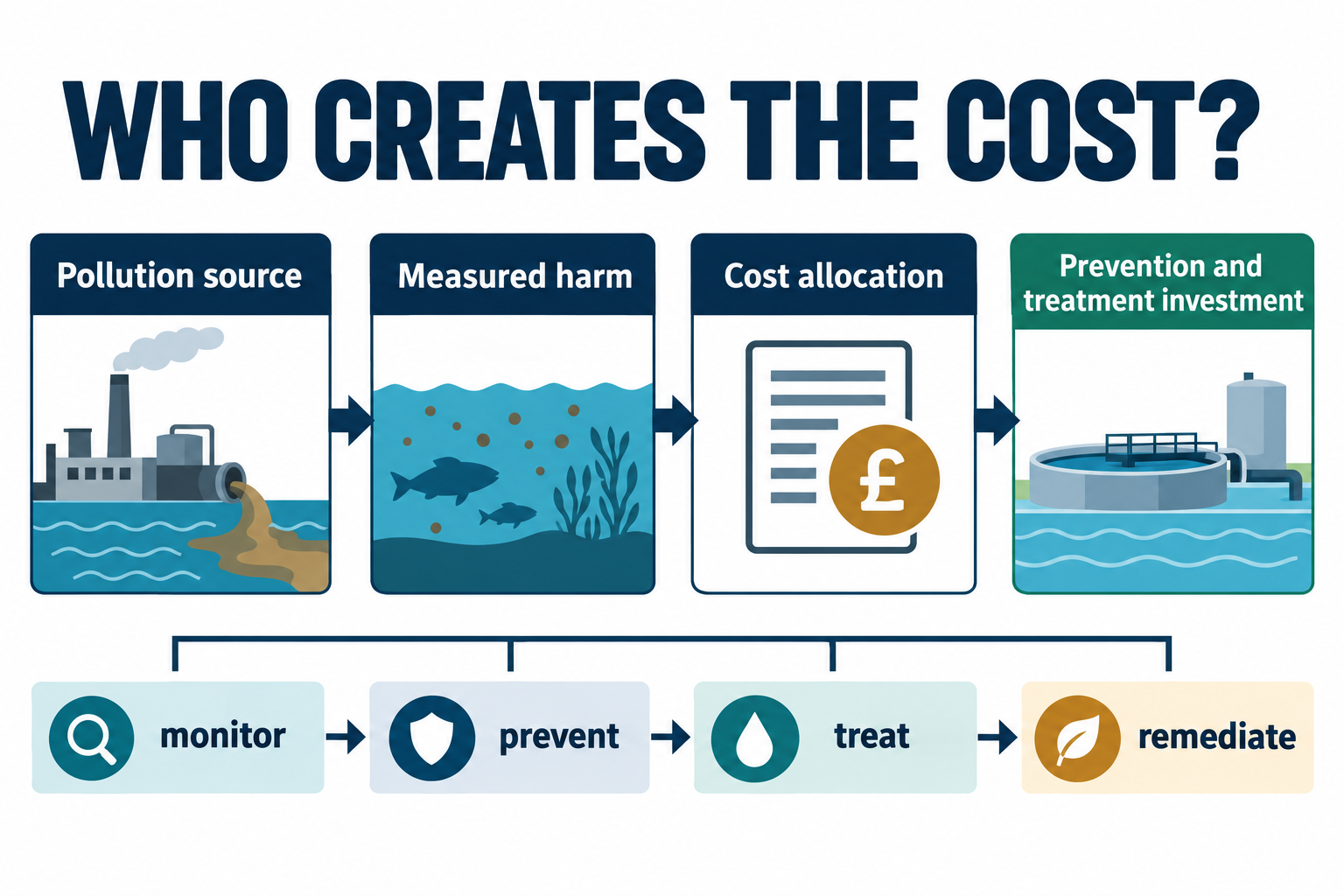
Policy strength is not the same as revenue quality
A clear rule can improve urgency, but it can also increase price pressure. Customers may run competitive tenders, ask several suppliers to carry performance risk or wait for public guidance before committing capital. A water technology business needs more than a favourable policy theme. It needs a repeatable way to win, deliver and collect cash.
Investors should separate four questions. Is the liability or obligation real? Can the customer measure the relevant harm? Is there a funded route to compliance or remediation? Can the supplier meet the required performance without excessive bespoke work?
How EU water rules can create demand
The principle sits inside a wider legal framework
Article 191(2) of the Treaty on the Functioning of the European Union states that EU environmental policy is based on precaution, prevention, rectifying damage at source and the polluter pays principle. The wording sets a policy foundation, but the practical effect still depends on later legislation, national implementation and enforcement.
The European Commission’s environmental liability framework covers damage to water, soil, protected species and natural habitats. It can require preventive action and remediation from responsible operators. This creates a reason to examine businesses that reduce environmental exposure, but it does not remove the need to test causation, scope and financial capacity.
Urban wastewater is a live market example
The revised Urban Wastewater Treatment Directive entered into force on 1 January 2025. The Commission says the revised rules strengthen the polluter pays principle, expand treatment requirements and support water reuse and resource recovery. It also says extended producer responsibility will finance quaternary treatment for micropollutants through the sectors responsible for the pollution.
The Commission’s implementation summary says urban areas above 1,000 inhabitants are covered by collection and treatment requirements, while additional nutrient and micropollutant controls apply to relevant treatment systems. These requirements can support demand for advanced treatment, monitoring, energy optimisation and asset upgrades, although the timing and payer differ by country and project.
The Commission has also stated that the pharmaceuticals and cosmetics industries will be required to cover at least 80% of the cost of removing certain micropollutants under the new framework. Investors should verify how each Member State transposes the rule and which entities face the payment obligation before assigning value to a pipeline.
For a private company, the opportunity may sit in equipment, engineering, operations, monitoring or resource recovery. The best position depends on who is contracted, who takes performance risk and whether the customer can recover the cost through its own pricing or production economics.
What the UK approach tells investors
Environmental policy can guide cost allocation
The UK government’s Environmental Principles Policy Statement says that, where possible, pollution costs should be borne by those causing the harm rather than by the affected person or wider community. It also states that the principle can be used before damage occurs to prevent or deter harm, or after an incident to restore or redistribute costs.
The same statement sets out three practical questions: who the polluter is, how much they should pay and how they should pay. It highlights proportionality, the difficulty of identifying responsibility and the use of fees, charges, regulatory requirements or contracts. It also makes clear that the principle does not automatically create a new tax.
Investment planning still needs economic judgement
UK river basin investment planning allocates the costs of measures broadly to sectors whose activities caused the problems. The guidance also says that this allocation does not necessarily mean those sectors will pay, because funding decisions can involve government, public bodies, private capital and voluntary organisations.
That distinction is useful for diligence. A business may benefit from a policy-led need without being able to invoice the original polluter. The paying customer could instead be a utility, a local authority, an industrial operator, a developer or a specialist contractor working under a public programme.
The UK’s 2026 water white paper also links long-term planning, stronger standards and investment attraction. It signals a more structured market, but policy direction is not a contract. An investor still needs to identify the procuring entity, approval stage, delivery timetable and allocation of construction, operating and regulatory risk.
Which water businesses may benefit
Measurement and source identification
Monitoring businesses can help regulators and customers establish where pollution comes from, how much is present and whether a control measure works. Their value depends on accuracy, calibration, data ownership, integration and the customer’s ability to act on the result. A dashboard without an operating decision behind it may not create durable willingness to pay.
Sensor networks, laboratory services, remote monitoring and compliance reporting can be attractive where data is required by a permit or contract. Investors should verify the replacement cycle, connectivity costs, service response and consequences of a failed reading.
Treatment and pollution prevention
Treatment companies may sell filtration, biological processes, membranes, activated carbon, disinfection, nutrient removal or other systems. Source-control businesses may reduce the contaminant load before it reaches a treatment plant. The relevant economics include energy, chemicals, maintenance, consumables, disposal and operator skill.
Resource recovery and operating assets
Some treatment systems can recover water, phosphorus, energy or other useful outputs. Recovery may improve the customer case, but it adds quality, offtake and process risks. Confirm whether a recovered product has a buyer, a specification, a route to market and a price that supports the extra equipment.
Asset owners and operating-service providers may earn capacity payments, treatment fees or availability-based revenue. Their risks include construction, utilisation, counterparty strength, refinancing, permits and long-term maintenance. These businesses may suit patient private capital, but the contract must explain who pays when volumes or performance differ from plan.
How the money reaches suppliers
Different payment routes create different risks
Polluter pays policy can reach the market through several routes. A direct fee may be simple to understand but sensitive to measurement and enforcement. A producer-responsibility obligation may create a pooled payment mechanism. A contract may require a utility or industrial operator to buy treatment capacity. A permit may require the customer to install or operate a system.
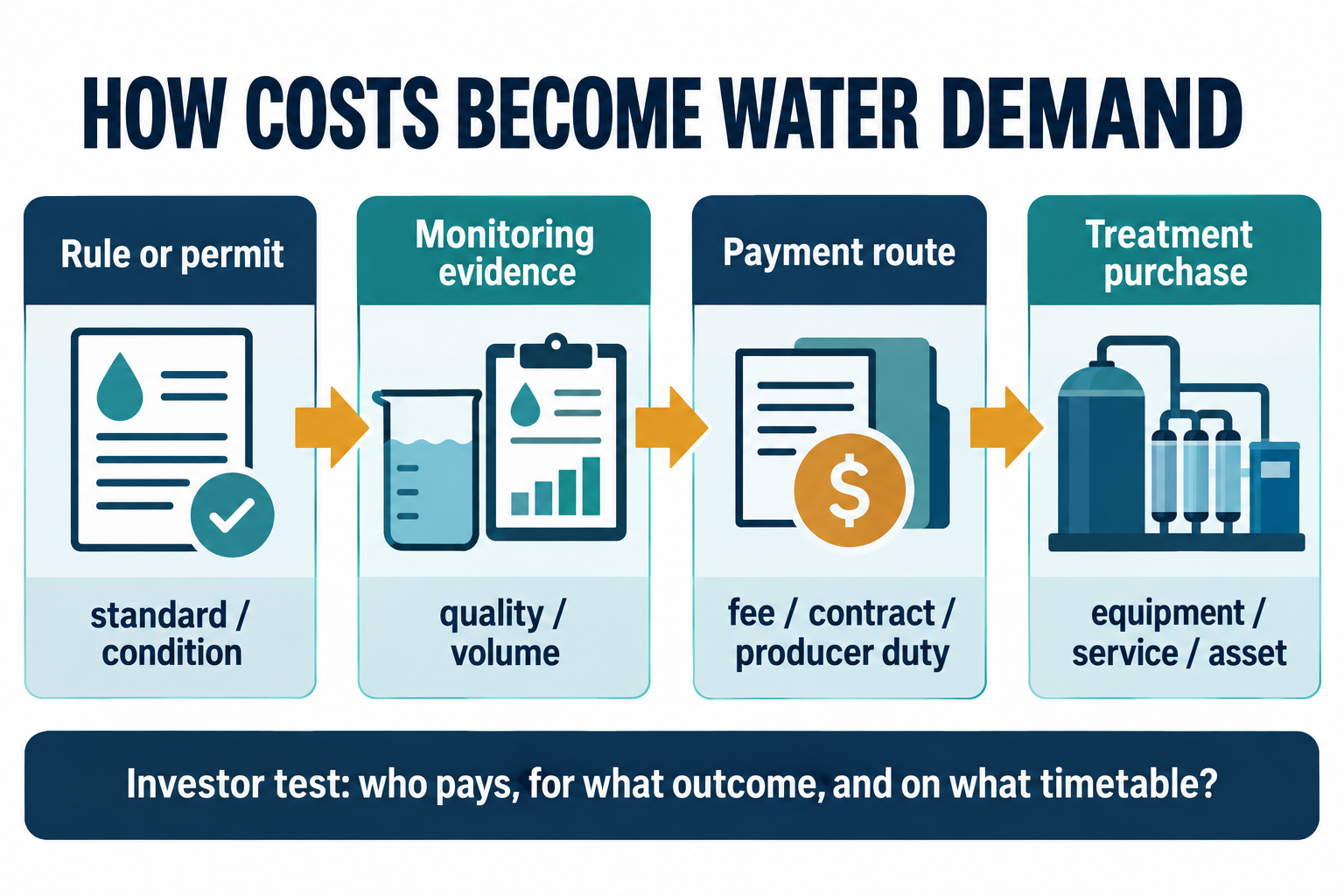
These routes affect revenue timing. A permit condition can create urgency but still require a long procurement process. A monitoring contract may start earlier but carry renewal risk. A treatment asset may produce long-term revenue but need significant capital before commissioning.
Test the payer before valuing the market
Start with the legal or commercial obligation. Then identify the named payer, the budget owner and the approval route. Ask whether the customer is paying for a required output, a reduction in measured pollution, an available asset, an operating service or evidence for a regulator.
The contract should match the claim. If the supplier promises a measured reduction, review the baseline, test method, warranty, remedy and termination rights. If it sells availability, examine downtime rules, spare capacity and the consequences of an outage. If it sells equipment, model installation, commissioning, warranty and working capital.
European Investment Bank material illustrates the scale of public and institutional interest in water infrastructure. The EIB says it has committed to increase investment in water to €15 billion between 2025 and 2027, including projects that control pollution and support water technology. That is evidence of capital mobilisation, not a forecast for a particular private company. The value for investors is the reminder to examine how a project is originated, coordinated, funded and financed.
From pollution data to treatment spend
Evidence is the bridge between principle and purchase
A regulator or customer cannot allocate responsibility with a slogan. It needs a credible link between the source, the pollutant, the harm and the required action. Data quality therefore becomes a commercial issue. It affects whether a customer can approve spend, defend a permit position or pass costs through a supply chain.
The European Environment Agency reports that only 37% of Europe’s surface water bodies achieved good or high ecological status in 2021, while 29% achieved good chemical status. The figures show a persistent environmental challenge, but they do not identify a single technology or payer. The investment task is to translate a broad problem into a specific catchment, site, process and contract.
Evidence also shapes the sales cycle. A company may need to support baseline sampling, pilot work, independent verification, commissioning tests and ongoing reporting. Each stage can involve a different buyer. A business that understands the hand-offs may build a more reliable path from early assessment to repeat revenue.
Operational proof matters more than policy language
An investor should ask what has been measured, by whom, under which conditions and for how long. Laboratory performance can show technical potential. A paid site reference can show adoption. A renewal or expansion can show that the customer values the result enough to continue paying.
This is also where claims about environmental impact need care. A reduction in discharge concentration may not equal a catchment improvement. Water saved at one site may not create additional supply elsewhere. Commercial and impact reporting should state the boundary, baseline and method rather than relying on a broad claim.
Why implementation risk matters
Rules can be clear while markets remain uneven
The European Commission has acknowledged that implementation of the polluter pays principle remains partial. Rules can differ in scope, evidence, enforcement and cost recovery. National authorities may take time to issue guidance, approve plans or clarify which entities pay.
This creates a timing risk for businesses that sell into regulation-led markets. A pipeline may look strong while customers wait for a permit change, funding decision or technical standard. Investors should separate identified need from approved budget and approved budget from signed contract.
Execution risk can move from the customer to the supplier
A customer may ask the technology provider to guarantee treatment performance, absorb energy volatility or finance installation. That can support a higher price, but it can also turn a product sale into a difficult service obligation. Review the risk allocation, insurance, acceptance tests, parent guarantees and termination rights.
- Regulatory risk: the rule, scope or timetable changes.
- Measurement risk: the baseline or test method is disputed.
- Technology risk: the system works in a pilot but not at commercial scale.
- Customer risk: the payer delays, changes process or cannot recover cost.
- Capital risk: commissioning, inventory or receivables consume more cash than planned.
The polluter pays principle can improve demand quality, but it does not remove these risks. In some cases, it may increase them by making the supplier part of a regulated performance chain.
How UK, European and GCC opportunities differ
UK opportunities need institutional detail
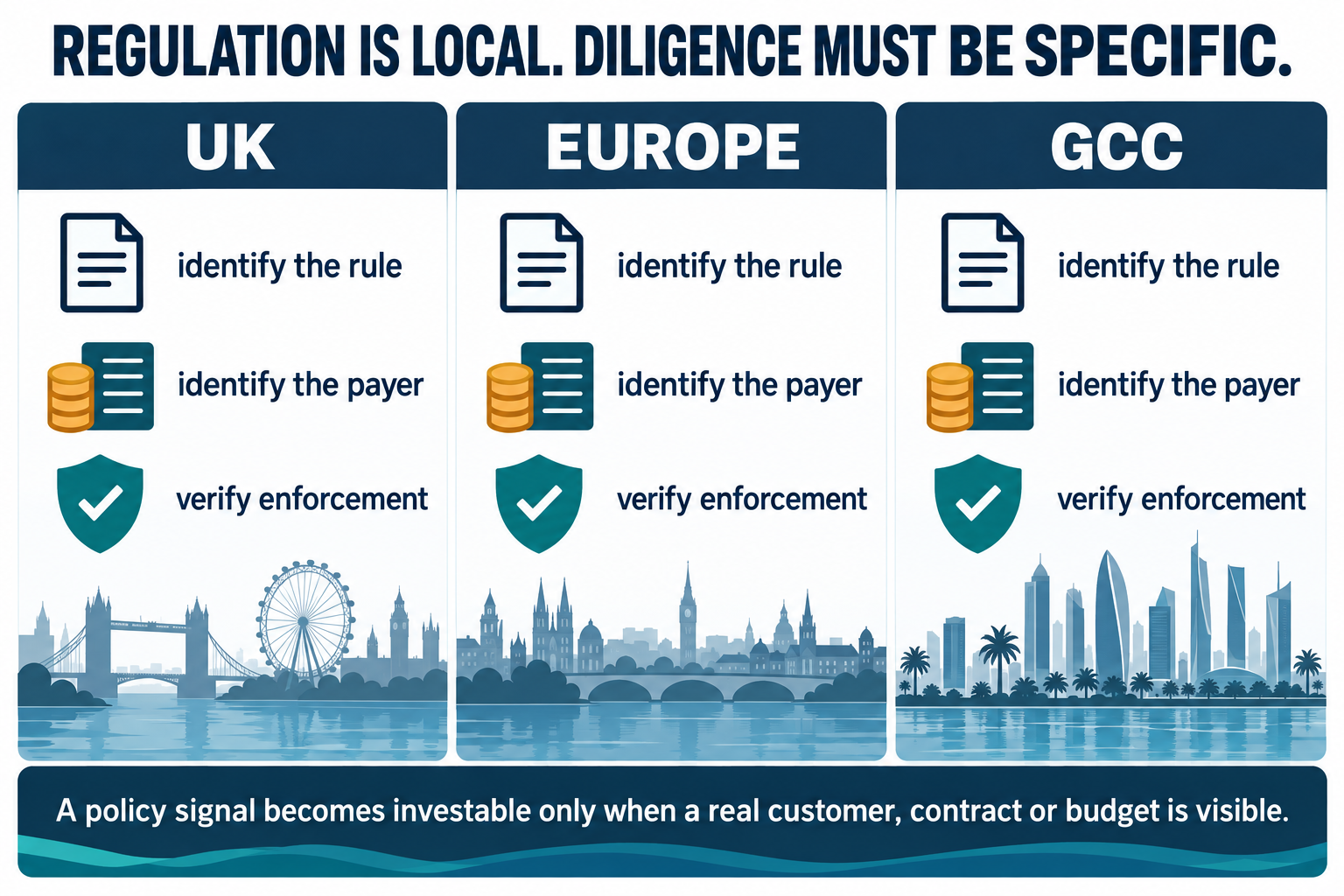
In the UK, an investor should map the relationship between central policy, regulators, water companies, local authorities, environmental bodies and industrial sites. The same pollution problem can be financed through a regulated investment plan, a procurement programme, a customer contract or public funding. The payer and timetable cannot be assumed from the principle alone.
European opportunities need country-level implementation
Europe offers a shared policy direction but not one uniform commercial market. EU legislation may set a common objective while Member States decide how to transpose it, allocate costs and enforce compliance. Compare the customer type, national implementation, procurement route, energy exposure and contract law before comparing market size.
GCC opportunities need project and counterparty diligence
GCC markets can create demand through water security, desalination, reuse, industrial development and urban growth. The commercial case still turns on the specific offtaker, tariff or service agreement, energy profile, local partner, import route, payment protection and operating capability.
Do not treat the GCC as one market or assume that a public water priority guarantees private revenue. A strong opportunity should show the site, the decision-maker, the performance requirement and the contract that connects the technology to cash flow.
Polluter pays principle diligence: five questions
1. Who is responsible and who pays?
Trace the pollution source, legal responsibility and practical budget owner. They may be different entities. Confirm whether the customer can pass the cost through a tariff, product price, service contract or public funding route.
2. What evidence defines the harm?
Review the baseline, sampling method, data ownership, independent verification and reporting frequency. Ask whether the evidence supports prevention, treatment, remediation or only further investigation.
3. What is the required outcome?
Define the output in operational terms. It may be a concentration limit, an available treatment capacity, a monitoring record, a water-reuse volume or a remediation milestone. Vague outcomes create disputes and make revenue quality hard to underwrite.
4. How are risks allocated in the contract?
Check acceptance tests, warranties, service levels, energy and chemical assumptions, change orders, liability caps, termination rights and payment milestones. A long contract is not automatically a low-risk contract.
5. Can the model repeat without losing control?
Separate repeatable engineering from bespoke delivery. Model the people, partners, working capital, commissioning effort, regulatory approvals and local adaptations required for the next site. Growth that increases unpriced obligations may destroy cash rather than create value.
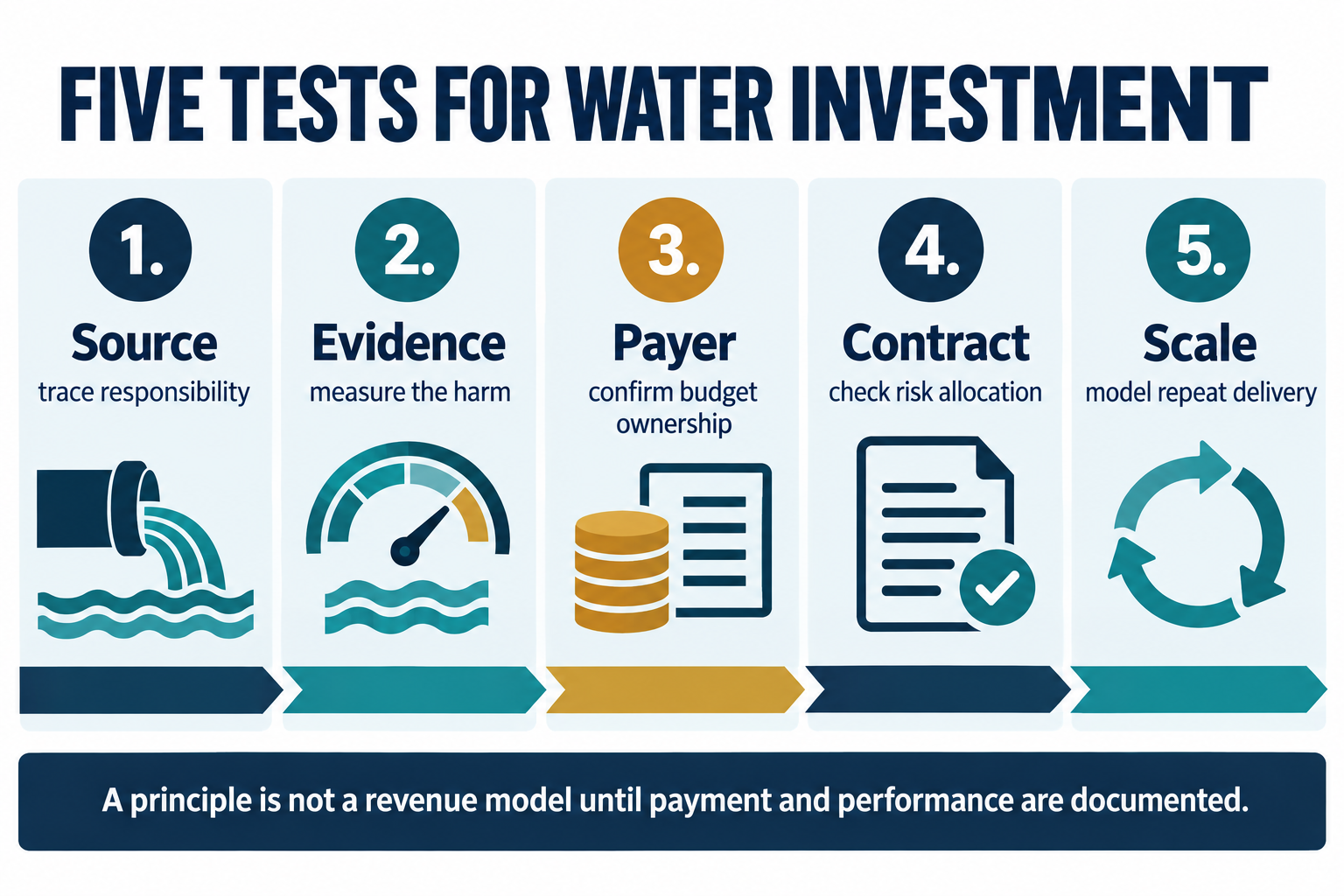
The best opportunities make these answers easy to verify. They connect a defined environmental problem to a defined payer, a measured outcome, a workable contract and a delivery model that can expand with control.
Frequently asked questions and next steps
What is the polluter pays principle?
It is an environmental policy principle that places the costs of pollution prevention, control or remediation on those responsible where that is possible and proportionate. Its practical effect depends on the applicable law, evidence and payment mechanism.
Does the principle create an automatic tax?
No. It can operate through charges, permits, producer-responsibility schemes, contracts or other requirements. The UK policy statement says the principle does not by itself require ministers to create a tax.
Can the polluter pays principle support water investment?
It can support demand for monitoring, source control, treatment, remediation and reporting when a real customer has a funded obligation. It does not guarantee revenue, margins or investment performance.
What should investors check first?
Start with the payer, the evidence and the contract. Then test treatment performance, customer concentration, capital needs, regulation, governance and the ability to repeat delivery.
Is the principle applied in the same way across UK, Europe and the GCC?
No. The policy idea is recognised in several jurisdictions, but rules, institutions, enforcement and funding routes differ. Cross-border investors should verify each opportunity at country and project level.
Explore direct water-technology opportunities
The polluter pays principle can help move water pollution from an unfunded externality towards a measurable commercial requirement. The investment case becomes stronger when a defined customer has a defined obligation, the evidence is credible and the supplier can deliver the required outcome at a workable margin.
Water Investment Network helps investors assess direct water-technology opportunities with attention to commercial fit, environmental evidence and execution risk. Explore the water-technology portfolio, review the network contact route, or join the network to discuss suitable private opportunities.
This article is an introduction to private opportunities, not a recommendation or regulated financial advice.
- European Commission, Ensuring that polluters pay.
- EUR-Lex, Treaty on the Functioning of the European Union, Article 191.
- EUR-Lex, Directive (EU) 2024/3019 on urban wastewater treatment.
- GOV.UK, Environmental principles policy statement.
- GOV.UK, Investment requirements for England’s river basin management plans.
- European Environment Agency, Europe’s state of water 2024.
- European Investment Bank, Securing safe, clean water for all.