Water infrastructure is moving up the private-market agenda. The opportunity is not simply that more water assets are needed. It is whether each project has a real customer, a funded route to payment, a deliverable contract and operating evidence.
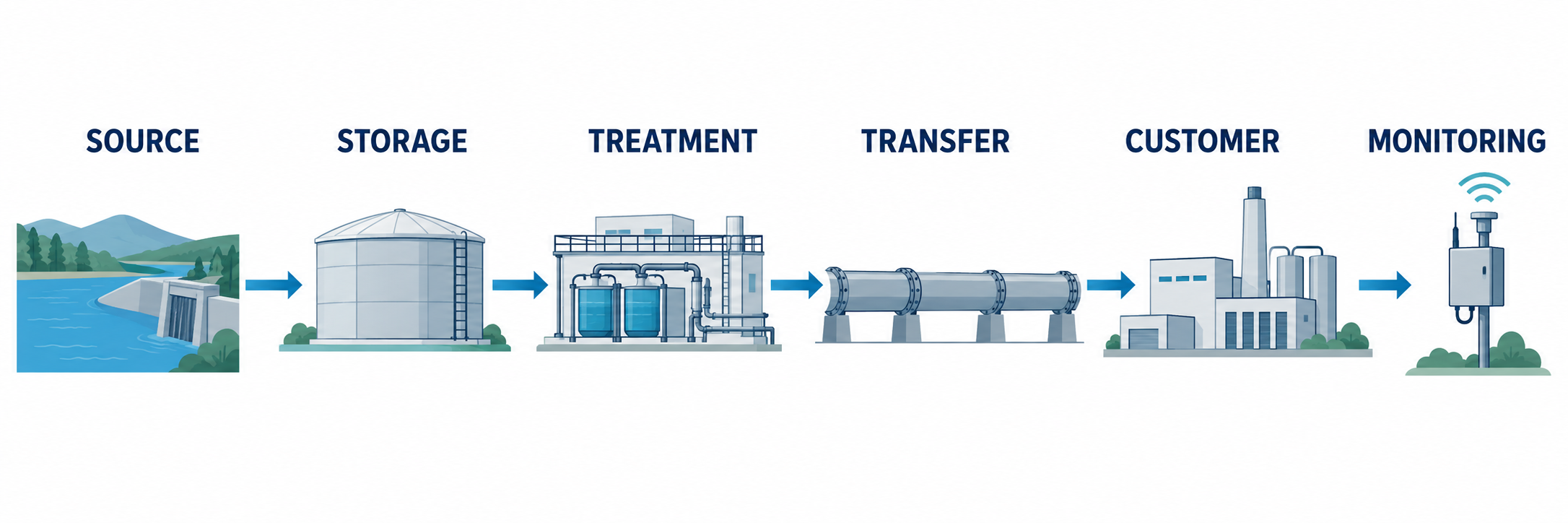
That distinction matters because water infrastructure is not one asset class. It includes source works, storage, treatment, transfer, distribution, monitoring and the digital systems that help operators manage them. Each part has different capital needs, customers, regulation and execution risk.
The wider water technology market investment thesis therefore needs to be tested at project level. This article sets out a practical market outlook for private investors assessing direct water infrastructure opportunities in the UK, Europe and the GCC.
What water infrastructure includes
A connected physical system
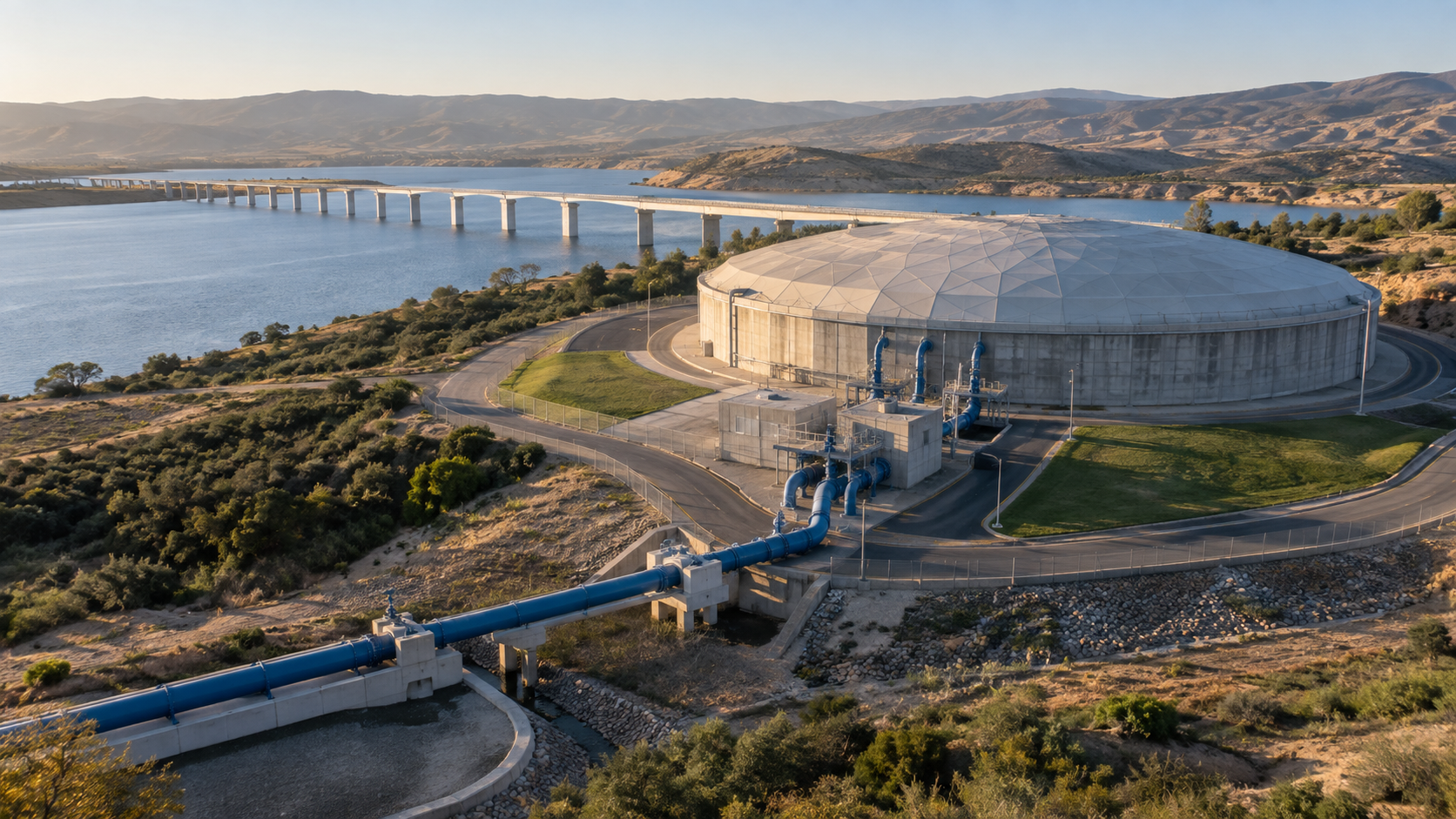
Water infrastructure moves water from a source to a point of use while controlling quality, timing and reliability. Source assets can include reservoirs, abstraction works, desalination intakes or reuse systems. Storage can smooth seasonal demand or protect supply during a disruption.
Treatment removes contaminants or changes water quality for a defined use. Transfer and distribution assets move water between locations. Monitoring measures flow, pressure, quality or performance so operators can manage the system and prove that it is meeting its obligations.
Different assets create different investment cases
A reservoir may depend on a long planning process and a public or regulated customer. A treatment unit may sell to an industrial site through a service contract. A monitoring system may use a recurring software or data fee. Grouping all three under one market label can hide the actual revenue model.
For an investor, the first question is not whether the asset is essential. It is who pays for the asset, under which agreement, and what happens when performance falls below the agreed level. A large physical asset can still have a weak investment case if the contract, permit or operating plan is unclear.
Why demand is becoming a funded problem
England shows the scale of the planning challenge
The Environment Agency’s National Framework for Water Resources 2025 models a possible public water supply deficit of up to 5,000 megalitres per day by 2055 without further action. It also identifies 1,200 megalitres per day of additional demand from non-public water users by the 2050s.
These are modelled needs, not guaranteed sales. The commercial question is how a region converts a need into a plan, consent, contract and operating budget. An investor should trace that chain rather than treat a long-term demand forecast as a revenue forecast.
Policy can improve visibility, but it does not remove risk
The UK government’s new vision for water describes £104 billion of private investment being delivered between 2025 and 2030. It also sets out reforms covering long-term direction, regulation, customer protection, clean water and water security.
That policy direction can help investors understand future priorities and delivery pathways. It does not guarantee that every supplier, project developer or technology company will win work. The investable question remains whether a specific business can access the spending, deliver its scope and collect cash under a robust agreement.
Europe is building a wider investment pipeline
The European Commission’s Water Resilience Strategy actions tracker covers finance, investment, infrastructure, digitalisation, research and security. It records actions to support water-resilience projects, improve project preparation and connect public bodies with investors and solution providers.
The European Investment Bank’s 2026 paper on future-proofing Europe’s water systems makes a useful point for private capital. The main obstacle is not only the amount of finance available. It is also how projects are originated, coordinated, funded and financed across a whole water system.
This creates a market for businesses that can make projects easier to specify, finance, deliver and operate. It also creates a diligence risk. A policy target or advisory facility can support project formation, but it is not the same as a signed customer contract or an asset with proven operating performance.
Water infrastructure investment thesis at a glance
| Question | What to test | Investor consequence |
|---|---|---|
| Demand | Is the need tied to a plan, regulation, customer budget or operating constraint? | Separates funded demand from a general market narrative. |
| Payer | Which utility, industrial customer, public body or project company pays? | Defines counterparty quality and collection risk. |
| Revenue route | Does cash come from delivery, availability, treatment volume, a service fee or data? | Shapes visibility, working capital and margin potential. |
| Scalability | Can the company repeat the offer without repeating every approval and engineering task? | Tests growth without assuming a large addressable market is enough. |
| Risk | What can delay permits, construction, commissioning, payment or performance? | Shows where downside protection and contingency are needed. |
| Impact | Can water reliability, quality, reuse or resource efficiency be measured? | Links environmental outcomes to operating evidence. |
The thesis is strongest when these questions reinforce each other. A company with a clear customer and repeatable delivery model may be more investable than a larger project with uncertain payment. Conversely, a contracted project can still produce weak equity economics if capital intensity, maintenance obligations or performance penalties are poorly controlled.
Capital structure is part of the same test. A project may use public funding, utility expenditure, bank debt, leasing, customer finance or private equity. Each source has its own conditions, timing and priority of payment. An investor should map where the proposed capital sits and which risks remain with the company.
The European Environment Agency’s state of water assessment also shows why resilience has a commercial dimension. It identifies water stress, pollution and flood risk as linked pressures, and points to efficiency, leakage reduction, reuse and better information as practical responses.
Project timing also matters. A business can show strong technical demand while waiting years for planning, procurement or connection approvals. That delay can consume working capital and change the customer’s priorities. The base case should show the steps between a qualified lead, a signed order, commissioning and cash collection.
Water infrastructure can support defensive demand, but defensive demand is not the same as defensive returns. The project may still face construction inflation, energy-price exposure, customer concentration, regulatory change or weak operating data. A careful investment case makes those risks visible instead of hiding them inside a large market estimate.
How money reaches a water infrastructure business
Equipment and project delivery
Some companies make money by supplying equipment, integrating a system or delivering a defined project. Revenue may be linked to design, manufacture, construction, commissioning or a milestone schedule. Investors should distinguish booked revenue from cash collection and one-off project margin from repeatable service income.
Project delivery can scale when the company has standard modules, repeatable procurement and a clear commissioning process. It becomes harder to scale when every site needs a new design, new permit route and bespoke subcontractor network. The diligence focus should therefore include delivery time, change-order history, warranty exposure and working-capital needs.
Operations and maintenance
Operations and maintenance contracts can add recurring revenue after an asset is installed. The service may cover planned maintenance, remote monitoring, consumables, performance checks or full operation of a treatment or reuse system.
Recurring revenue is not automatically high quality. Check the length of the contract, renewal terms, service-level obligations, staffing model and cost of failure. A long contract with uncapped performance obligations can create more risk than a shorter agreement with clear limits and a well-understood cost base.
Water as a Service and managed outcomes
Water as a Service can shift the customer from buying equipment to buying an outcome, such as treated water, reuse capacity or monitored performance. This can widen the addressable customer base where the customer lacks capital or specialist skills. It can also move capital and operational risk to the provider.
Before treating a service model as attractive, test who owns the asset, who funds working capital, how usage is measured and what happens when the customer changes production. The contract should explain payment, availability, quality, maintenance, termination and liability. The business needs enough data to prove performance without creating a reporting burden that erodes margin.
There is also a balance-sheet question. If the provider owns equipment at the customer site, the provider may carry residual value, replacement and recovery risk. If the customer owns the equipment, the provider may have lower capital exposure but less control over the long-term relationship. Neither model is automatically superior. The correct choice depends on contract strength, asset life, funding cost and service economics.
Investors should ask for cohort evidence where the business has several sites. Compare contracted price, installation cost, time to acceptance, service cost, renewal behaviour and cash conversion. A single successful demonstration proves that a system can work. It does not prove that the company can repeat the result at a margin that supports growth.
From water need to operating evidence
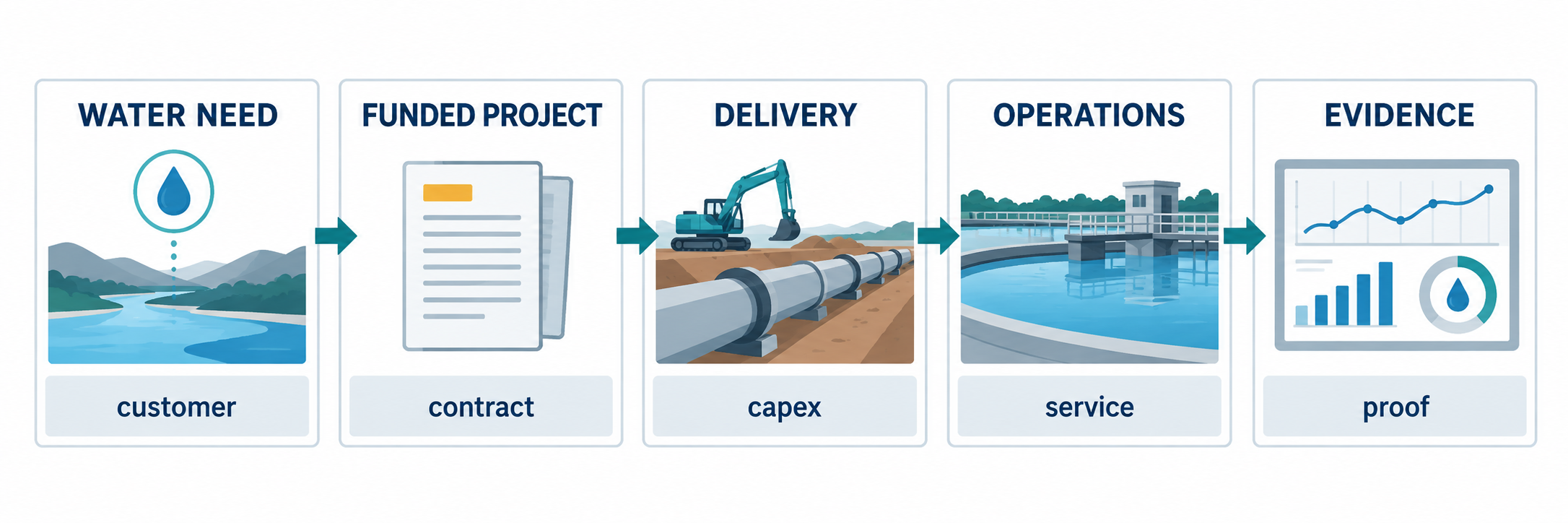
Infrastructure becomes investable through evidence, not through a broad description of need. A useful evidence pack should show the customer problem, the proposed scope, the delivery route, the operating assumptions and the expected measurement method.
Start with the customer’s current constraint. It could be limited supply, discharge capacity, water quality, compliance exposure, production downtime or a need to reduce fresh-water use. Then identify the decision-maker, budget owner and procurement route. The person who experiences the problem may not be the person who signs the contract.
Next, test the project’s readiness. Has the site been assessed? Are the relevant permits understood? Is land or access available? Has the technical design been checked against actual water quality, flow, pressure and seasonal conditions? A feasibility study is useful only when its assumptions are connected to a customer decision.
Operating evidence should follow commissioning. It may include flow, quality, uptime, energy use, maintenance records, service response and customer acceptance. The metric must be relevant to the contract. A dashboard with many readings is not proof if it does not show whether the customer received the promised service.
UK, European and GCC infrastructure lenses
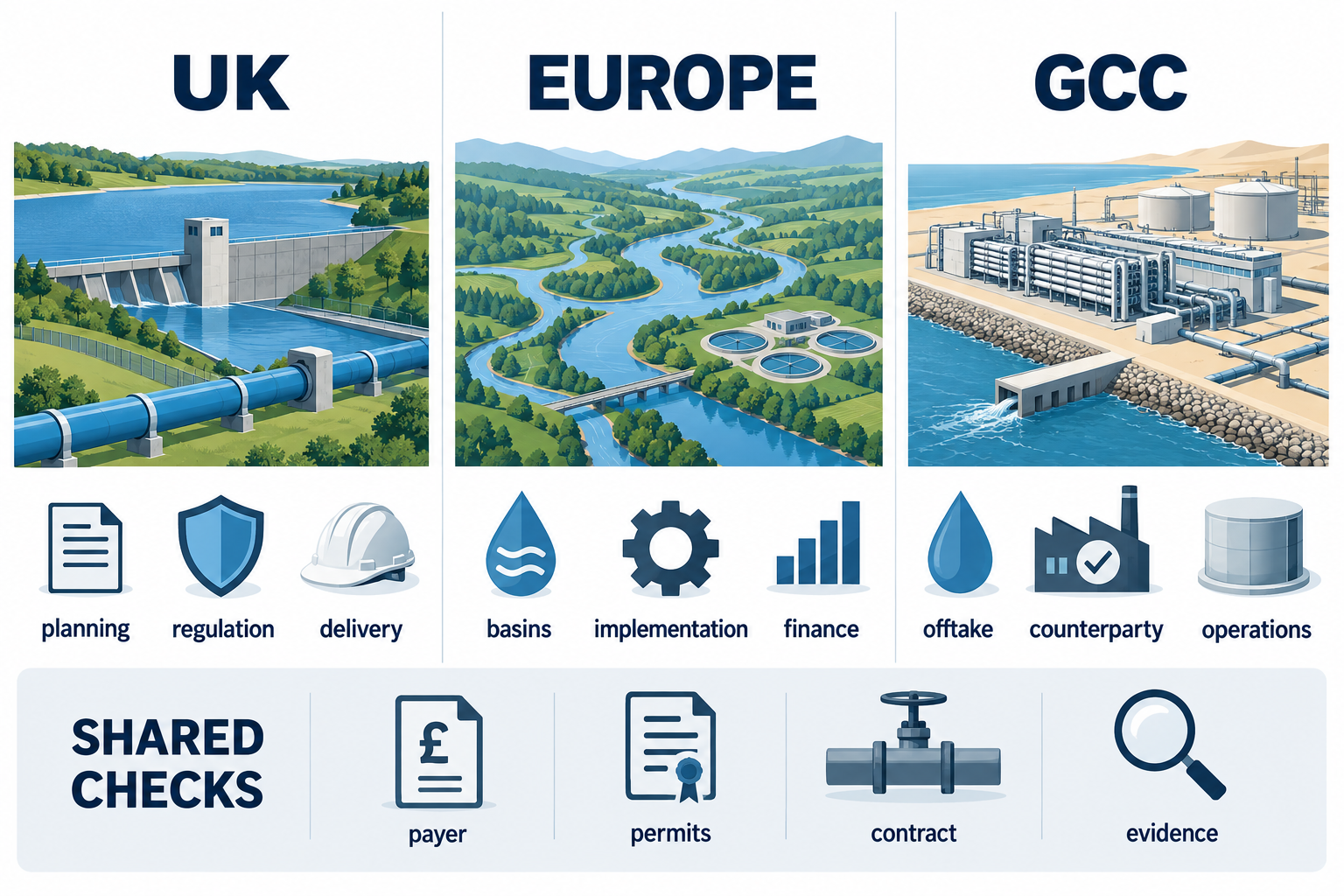
The UK: planning, regulation and delivery
UK opportunities should be assessed against the relevant national and regional planning route. England’s framework shows how supply, environmental constraints and non-public demand interact. The government’s water policy also points to changes in regulation, asset health, water reuse, leakage, metering and infrastructure delivery.
For an investor, the practical questions include which authority or regulated company controls the route to delivery, how the project fits a regional plan, and whether the customer has funding beyond an aspiration. A supplier may benefit from a clearer market need while still facing long procurement cycles, planning risk and concentrated customers.
Europe: basin context and implementation
European water opportunities sit within national laws, utility structures and river-basin conditions. The Commission’s resilience strategy places investment alongside governance, digitalisation, research and security. The EIB also stresses that water systems work across whole catchments rather than only at the boundary of one asset or municipality.
Investors should avoid treating the European Union as one procurement market. Check the national implementation route, the responsible utility or public body, the source of finance and the customer’s ability to manage the project. A project that benefits from technical assistance may still need a separate commercial contract and local operating partner.
The GCC: offtake, counterparty and operations
GCC opportunities can involve desalination, industrial water, reuse, storage, transfer and monitoring. The commercial case may depend on an offtake agreement, a large industrial customer, a public procurement process or a long-term operating arrangement. These routes have different payment, currency, political, construction and termination risks.
Climate and geography can also make energy use, corrosion, feed-water quality and maintenance central to unit economics. An investor should stress the operating model under high temperatures, variable demand, planned shutdowns and supply-chain delays. The regional label is not a substitute for a named payer, a signed route to revenue and evidence that the team can operate locally.
What makes water infrastructure scalable
Repeatability is more than a large market
Scalability means the company can win and deliver more work without increasing complexity at the same rate. A repeatable treatment module, standard monitoring platform or managed service process can help. So can a focused customer segment with similar water quality, procurement and compliance needs.
However, water infrastructure often remains local in its approvals and operating conditions. A design that works at one site may need changes at another. The investor should separate reusable intellectual property and process knowledge from site-specific civil works, permits and customer integration.
Defensibility must survive procurement
Defensibility can come from validated performance, integration know-how, data, customer switching costs, regulatory familiarity or a trusted channel. A patent alone does not prove that a customer will pay or that a competitor cannot deliver an alternative.
Test how the company wins after a procurement process. Does it have reference sites? Can it show lower downtime, lower water use or a better cost of service? Does the contract renew because the system is embedded in operations, or because the customer has not yet tested alternatives? These answers matter more than a generic claim of market leadership.
Supply-chain resilience is another part of scalability. Critical pumps, membranes, sensors, controls and construction inputs may have long lead times or limited suppliers. A company that has qualified alternatives, holds sensible spares and designs for maintainability may protect delivery better than a company with a technically strong but fragile bill of materials.
Digital systems can improve visibility, but they also create cyber, data-quality and integration risks. Ask who owns the data, how it is secured, how missing readings are handled and whether the customer can export useful records. A monitoring product is more defensible when its information changes operating decisions, not merely when it produces more charts.
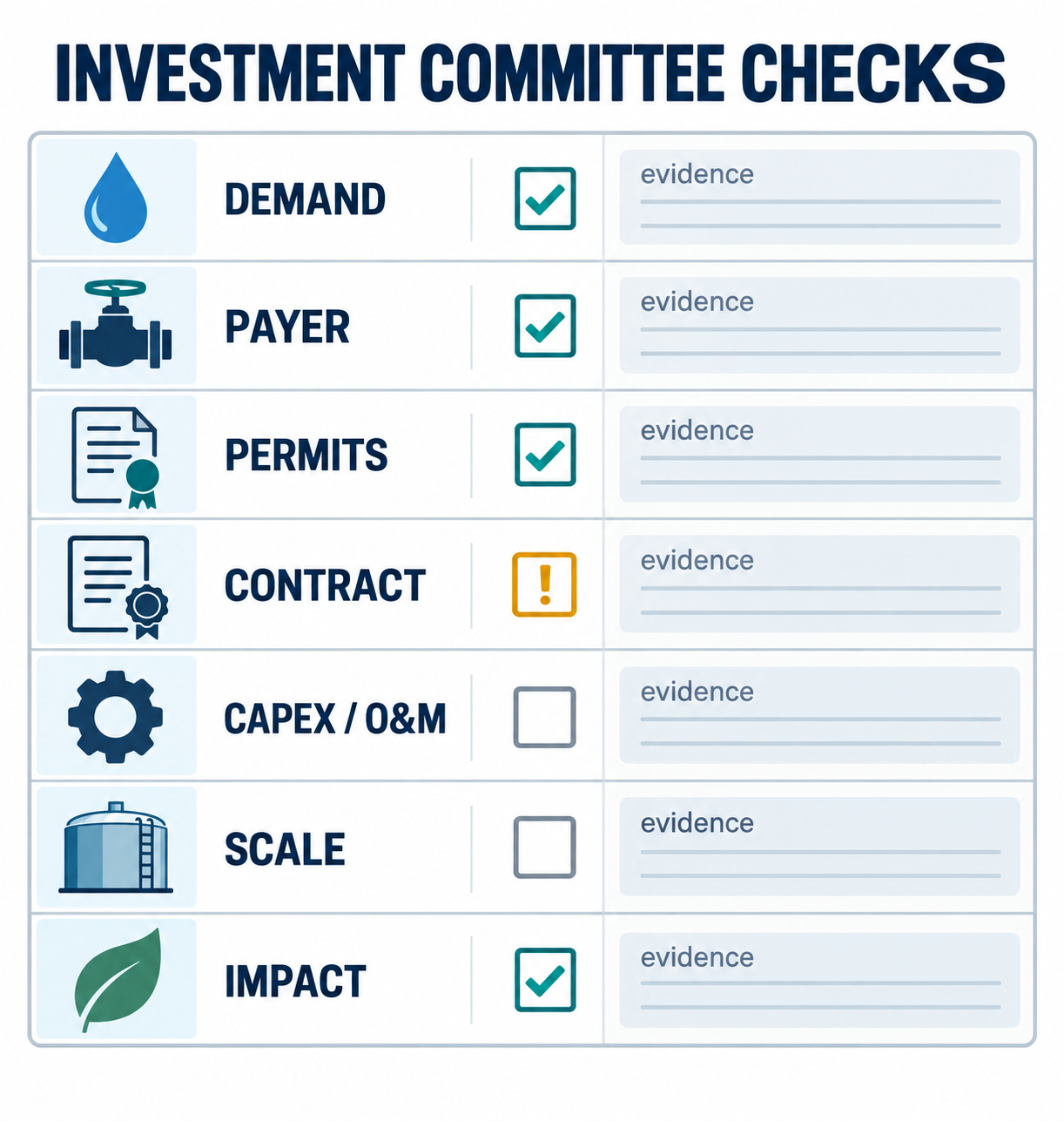
Water infrastructure diligence scorecard
Start with demand and the payer
- Identify the customer problem in operational terms.
- Name the budget owner and contracting counterparty.
- Separate a published need from an approved project.
- Check the procurement route, expected timing and decision gates.
Test permits and contract protections
- Map the planning, abstraction, discharge, construction and operating permissions that apply.
- Check whether the company or customer carries each approval obligation.
- Review payment terms, acceptance tests, service levels, indexation and termination rights.
- Stress delay, underperformance, change orders and disputed measurement.
Stress capex, operations and scale
- Reconcile the bill of materials, installation scope and commissioning plan.
- Test energy, consumables, labour, maintenance and replacement assumptions.
- Review working-capital needs and the timing of customer payments.
- Ask which parts of the model repeat and which parts remain bespoke.
Link impact to evidence
Measure the outcome that matters to the customer and the water system. That could be reliable supply, treated volume, reuse, reduced abstraction, improved quality, lower discharge or better asset visibility. Define the baseline, measurement period, data owner and verification method.
The World Bank’s assessment of public spending on water shows why finance alone is not enough. It identifies large spending gaps, low budget execution and the need for better planning, stronger service providers, long-term finance and improved data. For private investors, this reinforces the need to examine execution capacity and evidence quality alongside market demand.
Frequently asked questions and next steps
What is water infrastructure?
Water infrastructure is the physical and digital system that sources, stores, treats, transfers, distributes and monitors water. It includes public, industrial and private assets with different customers, contracts and operating risks.
Is water infrastructure a single investment category?
No. Storage, treatment, transfer, monitoring and reuse businesses can have different revenue models and risk profiles. Investors should assess the payer, contract, asset economics and delivery route for each opportunity.
What creates demand for water infrastructure?
Demand can come from resilience planning, regulation, population growth, industrial production, water quality needs or the replacement of ageing assets. A forecast need is not enough. It must connect to an approved plan, customer budget or funded project.
What should investors check first?
Start with the customer and the payer. Then verify permits, contract protections, capital and operating costs, performance evidence, scale constraints and measurable impact. This order helps expose a weak commercial case before detailed valuation work.
Can Water Investment Network provide regulated investment advice?
Water Investment Network is a network for direct water-technology opportunities. It does not provide regulated financial advice or guarantee investment returns. Eligible investors should complete their own legal, tax, commercial and financial diligence.
Eligible investors can review the water-technology portfolio, use the contact route for a factual discussion, or join the network to discuss access to suitable private opportunities.
Sources
- European Investment Bank, Future-proofing Europe’s water systems: From vision to investment.
- GOV.UK, A new vision for water.
- Environment Agency, National Framework for Water Resources 2025: how much additional water we need.
- World Bank, Funding a Water-Secure Future: An Assessment of Public Spending.
- European Commission, Water Resilience Strategy Actions Tracker.
- European Environment Agency, Europe’s state of water 2024: the need for improved water resilience.