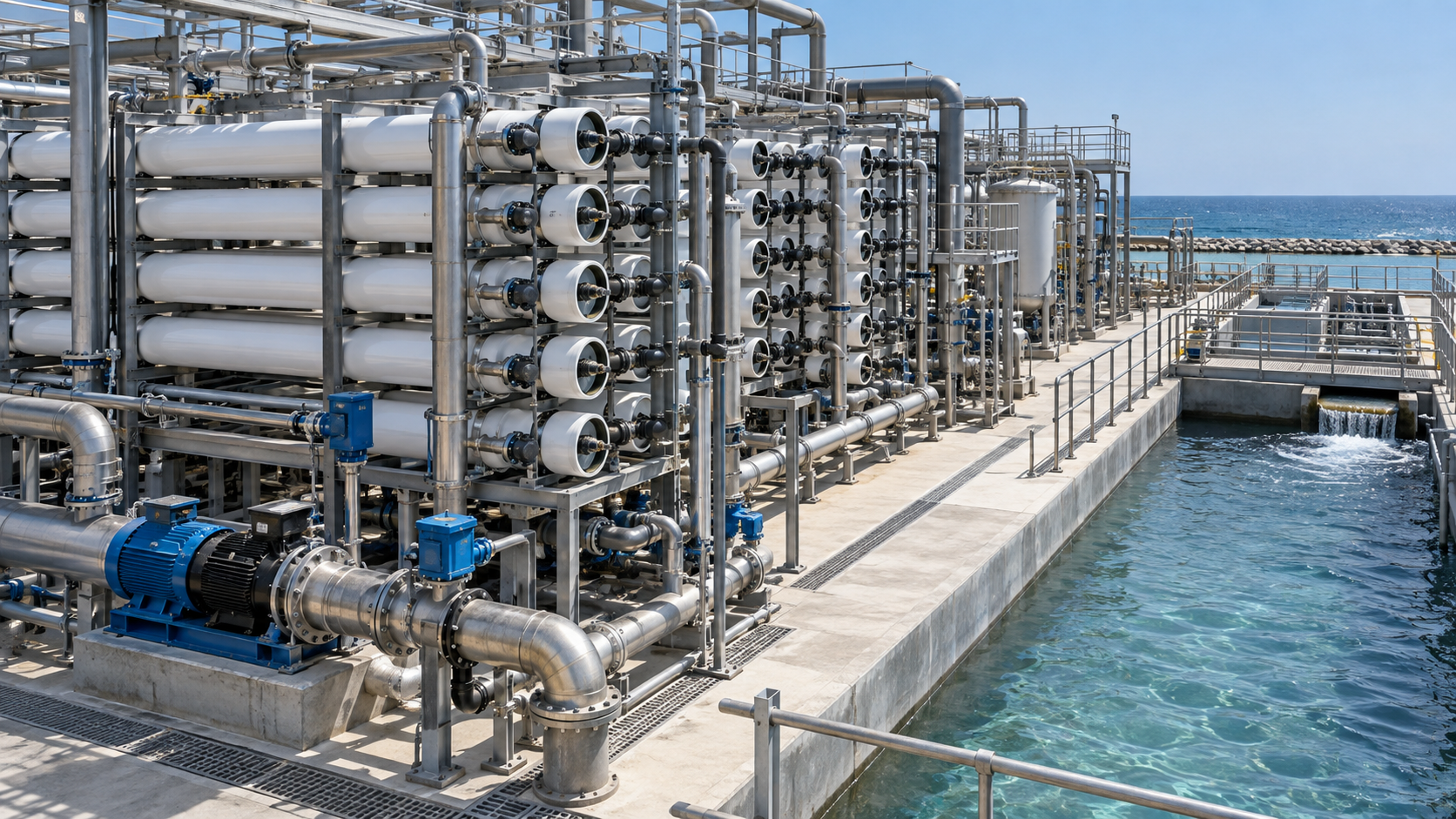
The reverse osmosis market is often described as a membrane story. For private investors, that is too narrow. The opportunity sits across equipment, project delivery, operations, monitoring and long-term water supply contracts.
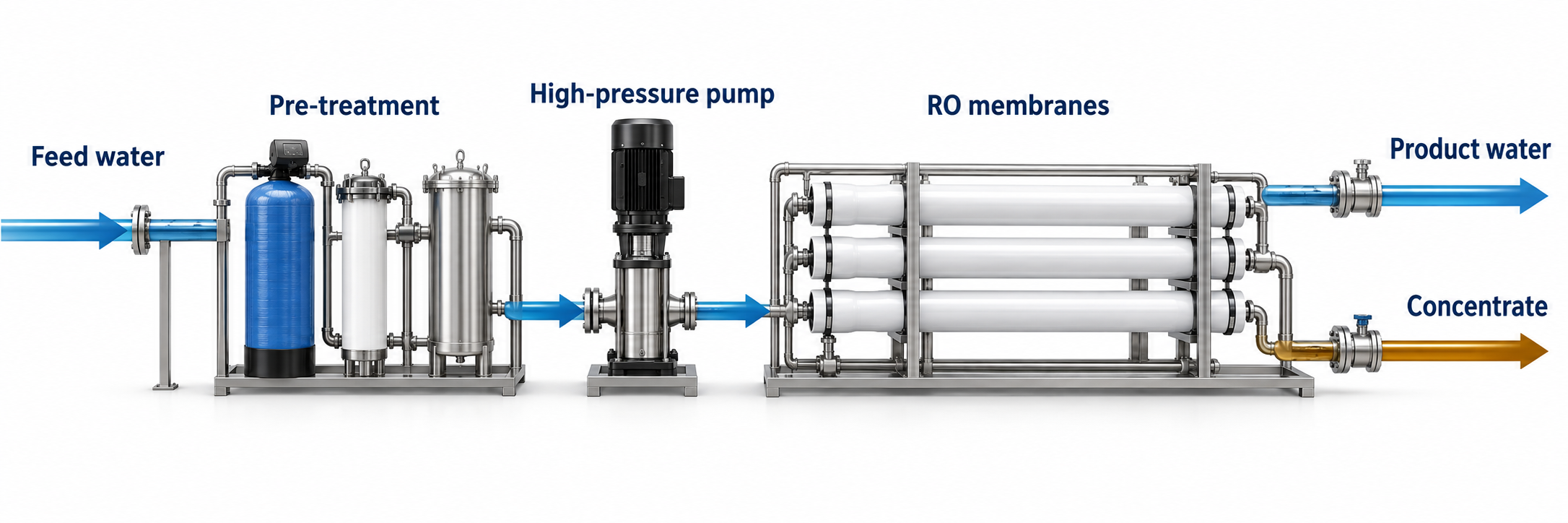
Reverse osmosis forces water through a semi-permeable membrane at high pressure. The membrane holds back dissolved salts and other substances, producing a treated water stream and a concentrated waste stream. The Drinking Water Inspectorate explains the process and its operating range for water-treatment professionals.
This market outlook focuses on the commercial questions behind the technology. It complements the wider water technology market investment thesis by testing customer demand, revenue models, operating economics, regulation, regional differences and the evidence an investor should request before considering a direct private-company opportunity.
Why the reverse osmosis market matters now
Water security is becoming a funded planning problem
Water users need reliable supply even when rainfall, abstraction or river flows become less predictable. The Environment Agency’s National Framework for Water Resources 2025 sets out pressures on England’s water resources to 2055 and beyond.
The framework calls for joined-up planning across water companies and other sectors. It also identifies new reservoirs, desalination and water recycling as part of the investment programme. This does not create guaranteed sales for every technology provider. It does improve the visibility of the problem that customers must solve.
Reverse osmosis is one option within a wider system
Reverse osmosis can treat seawater, brackish water and some industrial process streams. It is not a universal answer. Feed quality, electricity supply, pre-treatment, concentrate management, permits and the required product-water quality all shape the project.
That system context creates a useful investor distinction. A company may sell a membrane module, integrate a complete plant, operate a treatment service or provide monitoring and maintenance. Those activities share a technology family, but they do not share the same margins, working-capital needs or customer risk.
What the technology does, and where value sits
A simple explanation of reverse osmosis
Osmosis is the natural movement of water through a semi-permeable membrane. Reverse osmosis applies pressure to push water in the opposite direction. The membrane allows water to pass while retaining many dissolved substances.
The process produces two streams. The product stream contains treated water. The concentrate stream contains a higher level of the substances held back by the membrane. The DWI notes that reverse osmosis can operate at roughly 15 to 50 bar, depending on the application, and that the concentrate stream needs consideration.
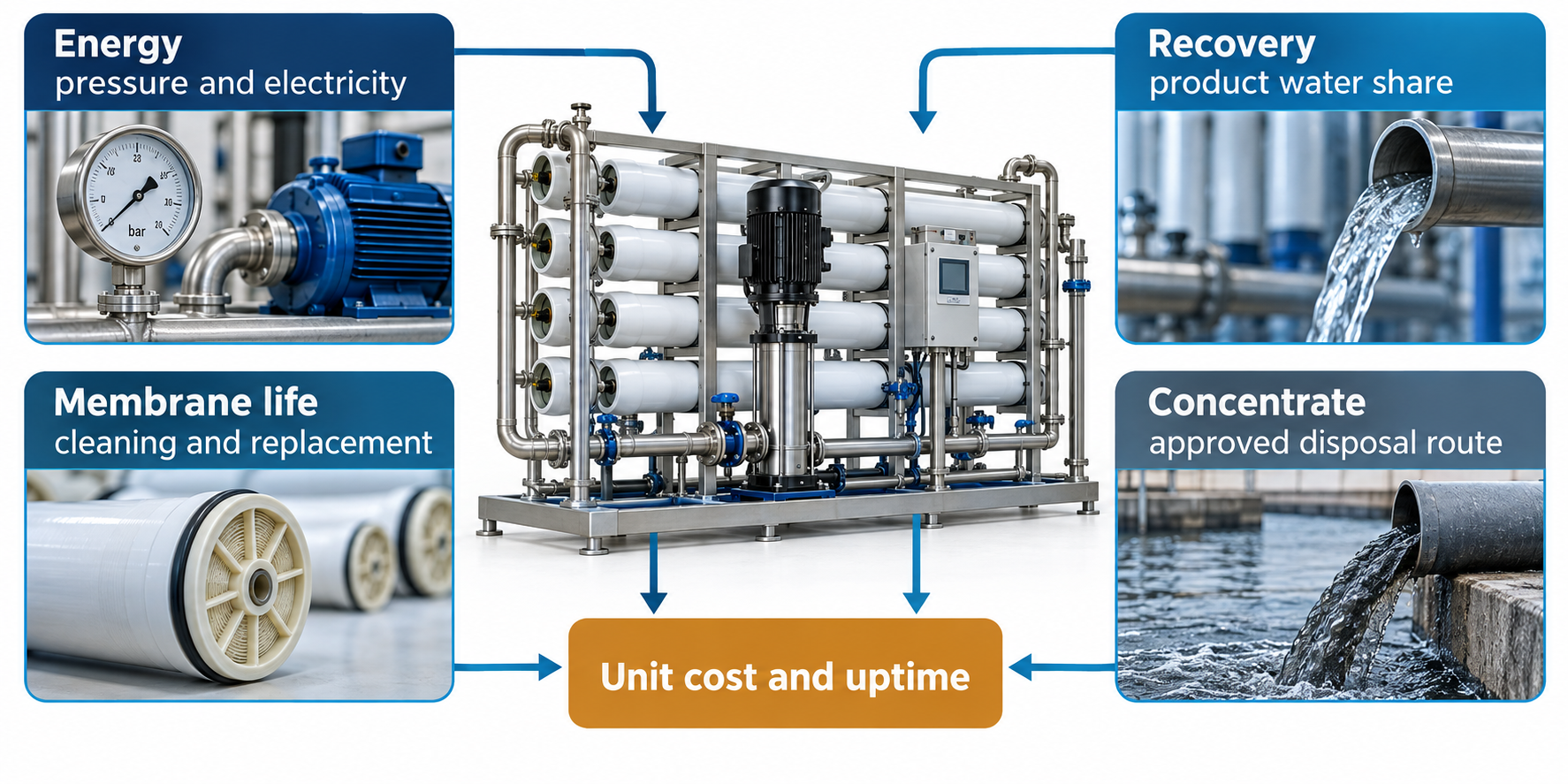
For an investor, the technical definition points to the main cost drivers. Pressure requires energy. Stable performance requires pre-treatment and cleaning. Product quality requires monitoring. Concentrate needs a compliant and affordable route out of the system.
Technology is only part of the customer proposition
A customer rarely buys membrane separation in isolation. The customer buys a reliable water outcome. That may be potable supply, process water, boiler feed, water reuse or reduced dependence on a constrained source.
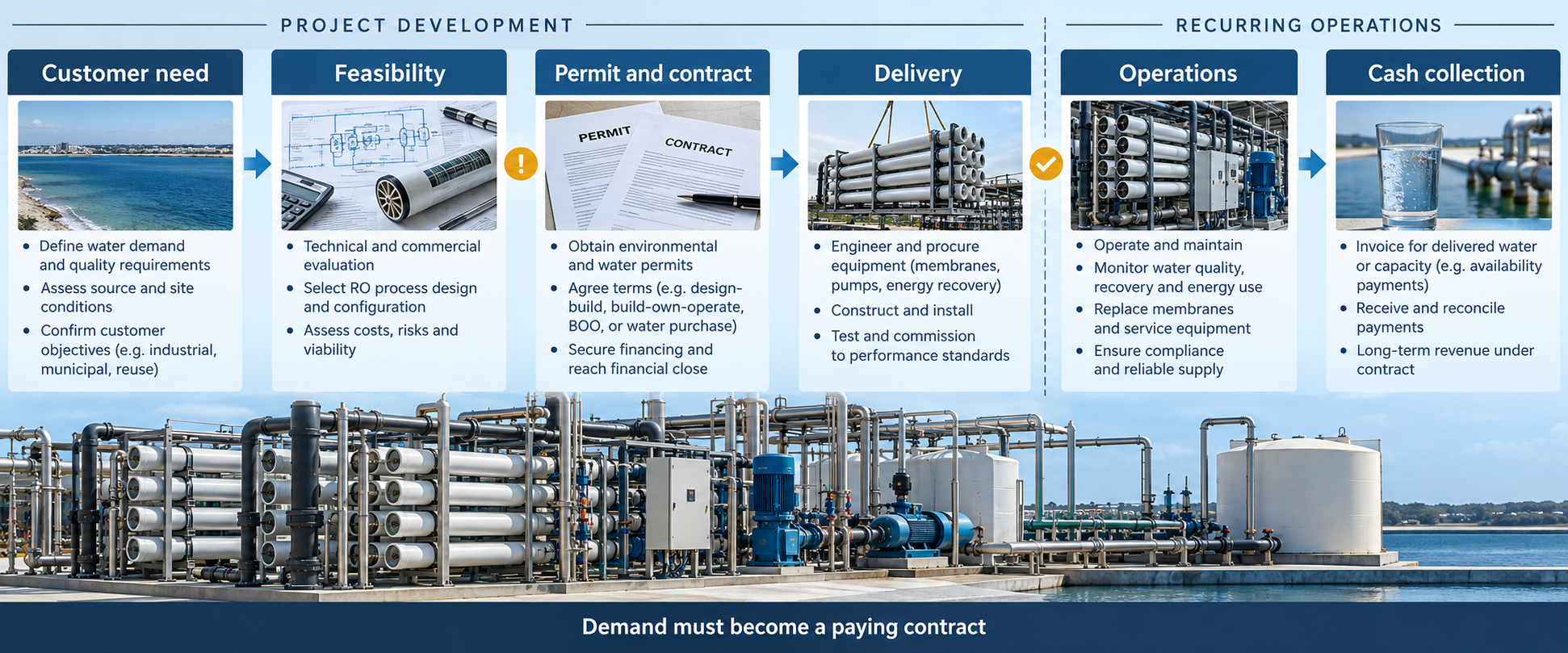
The commercial offer may therefore include design, construction, commissioning, remote monitoring, replacement membranes, chemicals, maintenance and performance reporting. A business that can combine these services may capture more value than a component seller. It may also carry more delivery and service obligations.
Where demand can become revenue
Public water supply and desalination
The Environment Agency’s position statement says desalination can form part of a diverse supply strategy in England. It notes that most new desalination plants use reverse osmosis and that several schemes are being developed through water-resource planning.
The same statement also records a useful warning. Thames Water’s Thames Gateway plant has capacity of around 150 million litres per day, yet it has experienced operational challenges and has operated below its original design capacity. A large nameplate capacity is not the same as dependable revenue or acceptable equity economics.
Industrial and commercial water users
Industrial customers may need stable water quality for manufacturing, food production, pharmaceuticals, electronics or energy systems. They may also need to reduce discharge, reuse water or protect production from local supply limits.
These customers can create attractive service opportunities because downtime has a direct commercial cost. The diligence question is whether the provider can show a repeatable customer problem, a clear buying process and a contract that pays for performance rather than only for installation.
Reuse and resource resilience
Reverse osmosis can sit inside a wider reuse system. The source may be treated wastewater, industrial process water or a brackish stream. The right design depends on the intended use, regulatory requirements, source contaminants and the cost of moving and storing water.
Reuse can widen the market beyond coastal desalination. It can also increase technical and regulatory complexity. Investors should trace the customer’s full water balance instead of assuming that every reuse project has the same demand profile.
How reverse osmosis companies make money
Equipment and system sales
Some companies sell membrane systems, pumps, controls, pre-treatment packages or complete skids. Revenue may arrive at delivery, commissioning or agreed project milestones. Gross margin can look strong while cash conversion remains weak if the company funds materials and subcontractors before payment.
The key test is repeatability. Standard modules, defined specifications and trusted suppliers can reduce engineering time. Bespoke designs may win complex projects, but they can increase execution risk and limit the number of projects a team can deliver.
Design, build and operation contracts
A provider may design and build a plant, then support operation under a separate agreement. It may earn a construction margin, a management fee, a volume charge or a performance-linked payment. Each revenue line should be separated in the investment case.
Longer contracts can improve visibility, but they do not remove counterparty risk. The investor should review termination rights, payment security, performance tests, liquidated damages, energy pass-through and responsibility for concentrate disposal.
Water as a service
Water-as-a-service models let a customer pay for availability, treated volume or an agreed water-quality outcome. The provider may retain ownership of the plant or finance it through a project company. This can support recurring revenue, but it also increases capital needs and operating responsibility.
A service model should show how the business funds growth. It should also show how it protects margins when electricity prices, membrane replacement costs or customer volumes change.
The economics investors should test
Energy is a central operating variable
Reverse osmosis uses pressure rather than heat, but pressure still requires electricity. Energy intensity depends on feedwater salinity, recovery, pressure, equipment efficiency and the wider plant design.
The Environment Agency recognises energy cost as a concern in desalination and points to membrane improvements and lower-carbon energy as part of the response. That is a useful market signal, not a forecast of falling costs for every provider.
Investors should request site-level energy data. They should test how the business performs under different power prices, operating loads and product-water requirements. A sales pitch based on a laboratory result is not enough for a commercial operating case.
Recovery and concentrate affect the unit economics
Recovery describes the share of feedwater that becomes product water. A higher recovery can reduce intake and pumping requirements, but it can increase concentration, scaling and cleaning pressure. The right level depends on the feedwater and the customer’s permitted discharge route.
Concentrate is not a footnote. It can require an outfall, further treatment, transport, evaporation, blending or another approved route. The cost and timing of that route can change the whole project case.
Lifecycle performance matters more than a first sale
Membranes, pumps, sensors and pre-treatment equipment need maintenance. Performance can fall when membranes foul or when source water changes. Customers may value a provider that can detect the issue early and restore output without disrupting production.
That creates a potential recurring revenue opportunity. It also creates a service standard to prove. Investors should ask for replacement cycles, response times, warranty claims, gross margin by service line and evidence that customers renew.
What can create defensibility
Application knowledge
Membranes are widely available. Defensibility may instead come from knowing a difficult feedwater, customer process or regulatory setting. A provider that understands the customer’s operating data can reduce commissioning risk and improve renewal potential.
Installed base and operating data
An installed base can create a route to replacement membranes, monitoring, optimisation and maintenance. Data from multiple sites can help identify fouling patterns, energy loss or changes in water quality. The value depends on data access, quality and the provider’s ability to turn it into customer savings.
Project execution and bankability
A company may be defensible because it can deliver a complete project in a difficult environment. Evidence may include on-time commissioning, repeat customers, approved suppliers, permit experience and clear performance testing.
Bankability is another possible advantage. The World Bank’s Governance and Economics of Desalination and Reuse series highlights policy, governance, economic viability, project delivery and financial structure as separate questions. A business that helps convert a technical solution into a financeable project may sit closer to the most valuable part of the chain.
UK, European and GCC market lenses
The UK market rewards evidence and permissioning
In England, desalination and other new supply options sit inside water-resource planning and regulatory oversight. The Environment Agency says proposed schemes need appropriate planning, environmental assessment and permits. The customer route may be clear, but the development path can still be long.
For a private company, this favours a credible pipeline over a list of leads. Investors should separate an option under discussion, a plan inclusion, a preferred bidder position, a signed contract and an operating asset.
Europe provides a project and financing context
The European Investment Bank has financed seawater reverse osmosis projects in Israel. Its account of the Sorek II project describes a €150 million finance contract for design, financing, construction and operation, with a planned capacity of 200 million cubic metres per year.
That example shows why the market is not only a membrane-equipment market. It can involve public-private partnerships, long-term supply needs, project finance and regional water security. It should not be copied into a forecast for another country without matching evidence.
The GCC requires country-specific diligence
GCC water opportunities can involve desalination, industrial water, reuse, energy integration and long-distance conveyance. The same technology can have a different risk profile depending on the buyer, offtake structure, power source, procurement model and discharge rules.
An investor should therefore test each jurisdiction separately. Country familiarity is useful, but it is not a substitute for a signed agreement, a permit plan, a secure energy route and a clear operating budget.
Reverse osmosis investment thesis at a glance
| Question | What to test | Investor consequence |
|---|---|---|
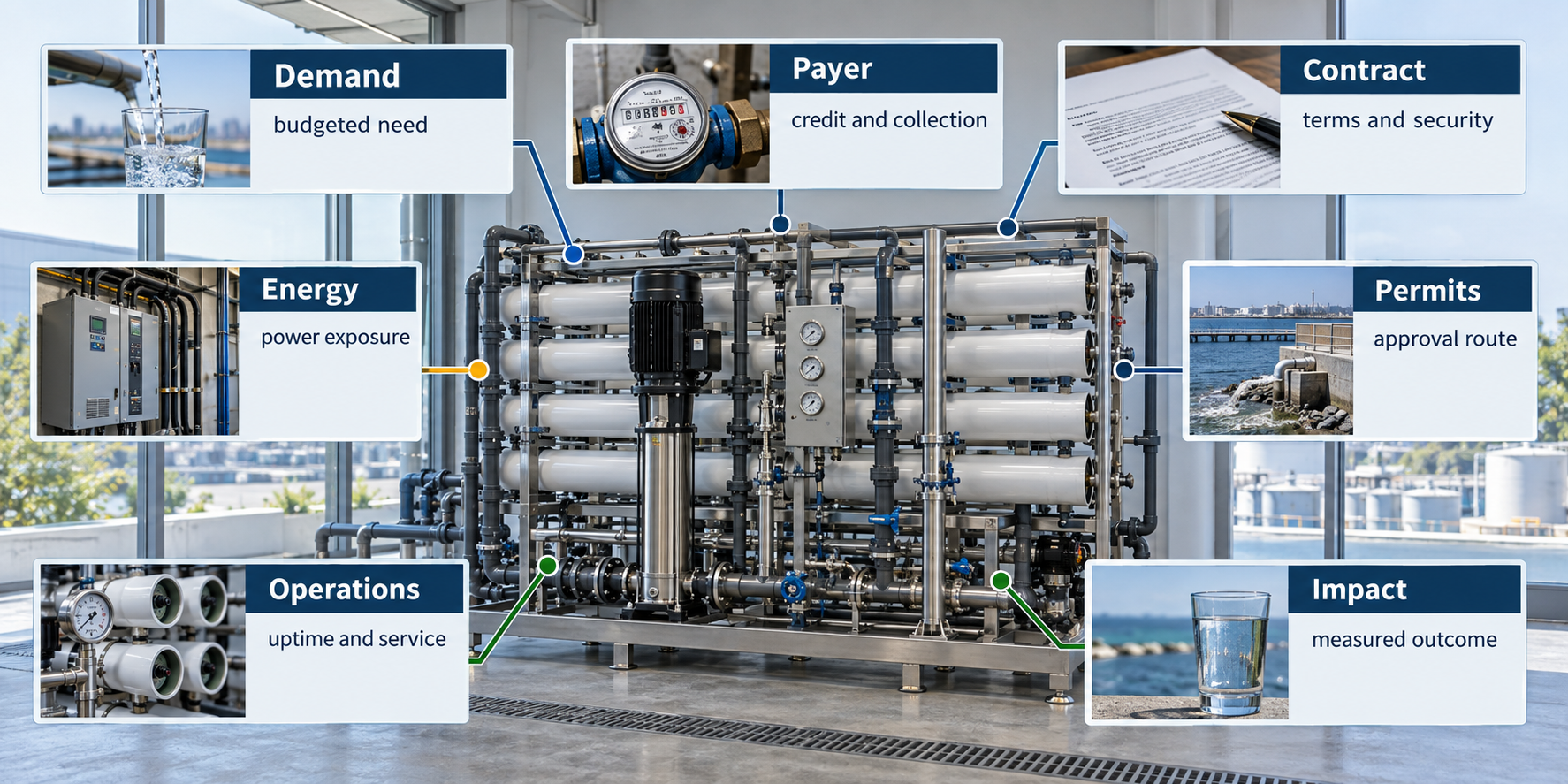
| Demand | Is the customer solving supply resilience, production risk, discharge limits or water quality? | Shows whether the project has a budgeted need. |
| Payer | Which utility, industrial group, public authority or project company pays? | Defines credit, collection and concentration risk. |
| Revenue model | Does cash come from equipment, delivery, treated volume, availability or service? | Separates one-off sales from recurring revenue. |
| Scalability | Can the company repeat the design, procurement and service process? | Tests growth without assuming every site is identical. |
| Operating economics | What happens to energy, recovery, membrane life and concentrate costs? | Shows how margin behaves under stress. |
| Defensibility | Does the company own application knowledge, data, contracts or delivery capability? | Tests why customers would renew or choose the provider. |
| Impact | Can the business evidence reliable supply, reuse, quality or reduced abstraction? | Links environmental outcomes to operating performance. |
The thesis is strongest when the customer need, payment route and operating evidence align. A large addressable market cannot repair a weak contract or an unproven service model.
How to diligence a reverse osmosis business
Start with the customer file
Request the customer list, contract status, renewal dates, payment history and pipeline stages. Classify each opportunity by evidence. A signed offtake agreement deserves different weight from a feasibility study or a non-binding discussion.
Then test the physical system
Review feedwater data, design assumptions, pre-treatment, pressure, recovery, product quality and concentrate disposal. Ask how the system behaves when source quality changes. Ask who bears the cost when output falls below the contract level.
Finally test cash and execution
Reconcile bookings with invoices, cash receipts, warranty claims and working capital. Review project margins by contract rather than relying on the group average. Check whether growth requires more staff, more inventory, more balance-sheet capital or more risk than the plan shows.
What could weaken the market case
Reverse osmosis is not a low-risk growth label. Energy prices can reduce margins. Poor pre-treatment can shorten membrane life. Concentrate rules can delay projects. A customer may postpone capital spending or select another supply option.
There is also technology substitution risk. Water recycling, leakage reduction, storage, transfers and other treatment systems may solve the same customer problem. The right comparison is not reverse osmosis versus nothing. It is reverse osmosis versus the alternatives available to that customer.
Execution can be the larger risk. The Environment Agency’s experience with the Thames Gateway plant shows why capacity, availability and actual operation need to be distinguished. Investors should value measured output and cash collection above headline design capacity.
The market can still support attractive companies. The investable difference is a clear customer, a bankable contract, controlled delivery, defensible operating knowledge and evidence that the economics survive real conditions.
A practical next step for eligible investors
Reverse osmosis can offer exposure to water security, industrial resilience and new supply infrastructure. The opportunity is strongest when the technology sits inside a repeatable commercial model rather than a one-off project story.
Eligible investors who want to assess direct private water-technology opportunities can join the Water Investment Network. You can also review the portfolio context and contact the network with questions. This article is general information, not regulated financial advice, and it does not guarantee investment performance.
Sources and further reading
- Environment Agency: Desalination for public water supply
- Environment Agency: National Framework for Water Resources 2025
- Drinking Water Inspectorate: Physical removal of contaminants
- European Investment Bank: Sorek II desalination project
- World Bank: Governance and Economics of Desalination and Reuse