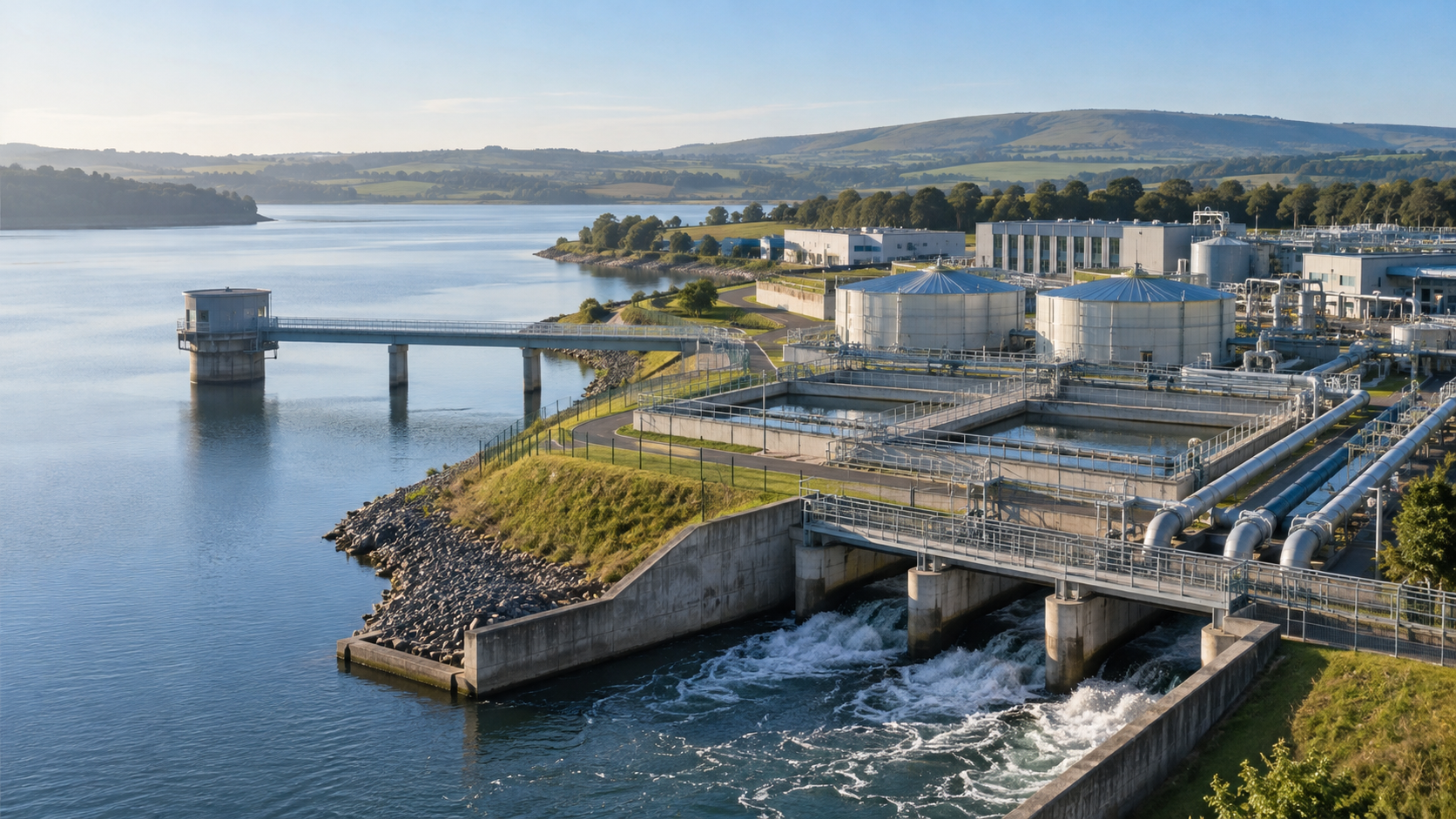
In brief: The water market is becoming more investable because water stress, regulation and infrastructure renewal are creating a wider set of paying-customer problems. The opportunity is not a single asset class. It spans resilient supply, treatment, reuse, networks, monitoring and industrial water services.
For private investors, the useful question is not whether water matters. It is where a company can turn a real water problem into contracted revenue, sound unit economics and a defensible position. This article sets out that framework alongside our water technology market and private investment guide for UK, European and GCC family offices, high-net-worth investors and private-market advisers.
What the water market means for private investors
The water market includes physical infrastructure, technology suppliers and service businesses. It also includes companies that help customers measure, reduce, treat, reuse or secure water. These businesses can have very different capital needs, sales cycles and risk profiles.
A regulated utility asset may depend on a long planning cycle and approved investment. A treatment company may sell equipment, a project or a long-term operating service. A monitoring business may earn subscription revenue, but still depend on hardware installation, data quality and customer retention.
A network of markets, not one trade
Grouping every water company together can hide the real investment case. A membrane supplier, a leakage-monitoring platform and a water-reuse operator do not share the same customer, margin profile or route to exit.
The first task is to identify the part of the value chain where the company earns money. The second is to understand who pays and why that payment should continue. Only then can an investor compare growth, risk and valuation with any confidence.
The revenue test
A strong water-market opportunity normally has a clear customer trigger. It may be a supply constraint, a discharge requirement, a production risk, a leakage problem or a need for better data. The company should be able to show how that trigger leads to a sale, a contract or a repeat service.
This is different from a broad sustainability story. Environmental benefit can strengthen demand and stakeholder support, but it does not replace a payer, a contract or operating evidence.
Why demand is becoming more investable
Water demand is being shaped by population, climate, industry, agriculture, energy and environmental requirements. These forces do not guarantee returns. They do create a wider set of problems that need funding, delivery and measurable performance.
UK: planned resilience and new demand
The Environment Agency’s National Framework for Water Resources 2025 models a possible public water supply deficit of up to 5 billion litres a day by 2055 without further action. It also identifies additional demand from other sectors. The same framework points to new supplies, strategic transfers, leakage reduction, demand management and water recycling as parts of the response.
For investors, this is a planning signal rather than a forecast of company revenue. It points towards projects and suppliers that can help deliver resilience. The diligence question remains whether a specific company has an eligible customer, a fundable project and a credible route through planning and delivery. The Environment Agency’s summary sets out the scale of the challenge and the need for investment in critical infrastructure.
Europe: policy, capital and water efficiency
The European Commission’s Water Resilience Strategy links water security with economic competitiveness, innovation and infrastructure. Its action areas include public and private investment, digitalisation, research and innovation, and security. It also sets an EU goal to improve water efficiency by 10% by 2030.
The EIB says it has committed to increasing investment in water to EUR 15 billion between 2025 and 2027. Its stated focus includes reservoirs, pipelines, treatment plants, loss reduction, pollution control and water technology. That activity can help create project pipelines, but private investors still need to separate funded public works from investable company economics.
Global: financing gaps and private capital
The World Bank’s Water Security Financing Report 2024 says ten multilateral development banks approved USD 19.6 billion of water-related financing in 2024. It also describes significant financing gaps and a mix of sovereign and non-sovereign finance intended to crowd in private capital.
This matters because private capital often enters through partnerships, project finance, growth capital or specialist suppliers. The route can be attractive when public funding reduces project risk. It can also be complex when a company depends on procurement, blended finance or a government-linked counterparty.
Where value sits across the water market
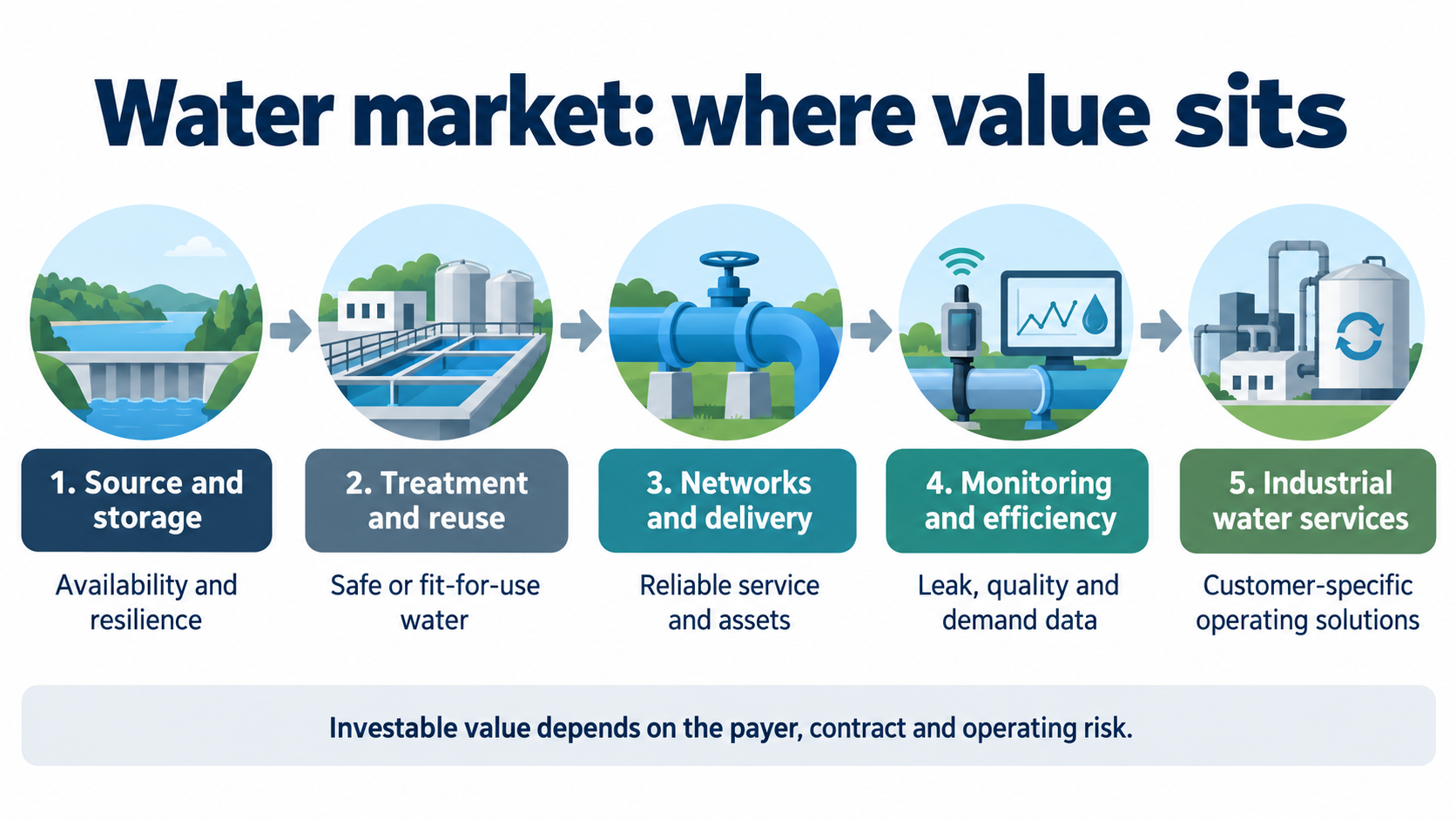
The water market is easier to analyse when it is split into functions. Each function has a different customer, revenue model and operating risk. The diagram below is a simple map, not a valuation model.
Source, storage and transfer
Water availability and resilience depend on assets such as reservoirs, intakes, pipelines, pumping stations and transfers. These assets can be long-lived and essential. They can also face planning delay, construction risk, environmental constraints and regulated pricing.
Investors should ask whether the opportunity is an asset, a contractor, an equipment supplier or an operating service. The answer changes the capital structure, the cash cycle and the likely exit buyer.
Treatment, reuse and resource recovery
Treatment businesses help customers meet quality, process or discharge needs. Reuse can reduce dependence on fresh supply where the site, regulation and economics support it. Resource recovery can add value, but it needs a real buyer, reliable quality and a cost-effective process.
The commercial test is site-specific. A technology may work in a pilot and still fail to scale because of energy use, maintenance, feed-water variation, concentrate management or customer downtime.
Monitoring and industrial services
Monitoring companies sell better information about quantity, quality, leakage, demand or asset performance. Industrial water-service companies may design, install and operate treatment systems at a customer site. Both models can be valuable when the data or service changes a measurable decision.
The strongest propositions usually make the customer safer, more productive, more compliant or less exposed to a supply problem. The benefit must be visible in the customer’s operating budget or risk register.
The customer problem is the starting point
Water demand becomes investable when a customer has a reason to act. That reason can come from a regulator, a production line, a water bill, a climate plan, a supply agreement or a board-level resilience target.

Public and regulated demand
Utilities and public authorities can provide large opportunities, but procurement and approval cycles can be slow. The buyer may prioritise compliance, reliability and whole-life cost over a new technology’s headline performance.
Investors should map the decision chain. It may include a utility, regulator, engineering contractor, local authority and finance provider. A company that cannot explain where it sits in that chain may have an attractive product but a weak route to revenue.
Industrial and commercial demand
Industrial customers can pay for water solutions when water affects output, quality, permits or site expansion. The sales case may be based on avoided downtime, lower discharge cost, reduced fresh-water use or a more resilient production process.
These savings need proof. A model based on assumed customer savings is not enough. The company should show a baseline, a measured result, the contract terms and the share of value it can retain.
Data and efficiency demand
Digital water businesses can improve decisions on leaks, quality and demand. Their economics depend on installation cost, data reliability, integration, customer adoption and renewal. A dashboard alone is not a defensible product.
Investors should test whether the data changes a work order, a maintenance plan, a capital project or a compliance decision. If it does not, the customer may not renew when budgets tighten.
Business models that can convert demand into revenue
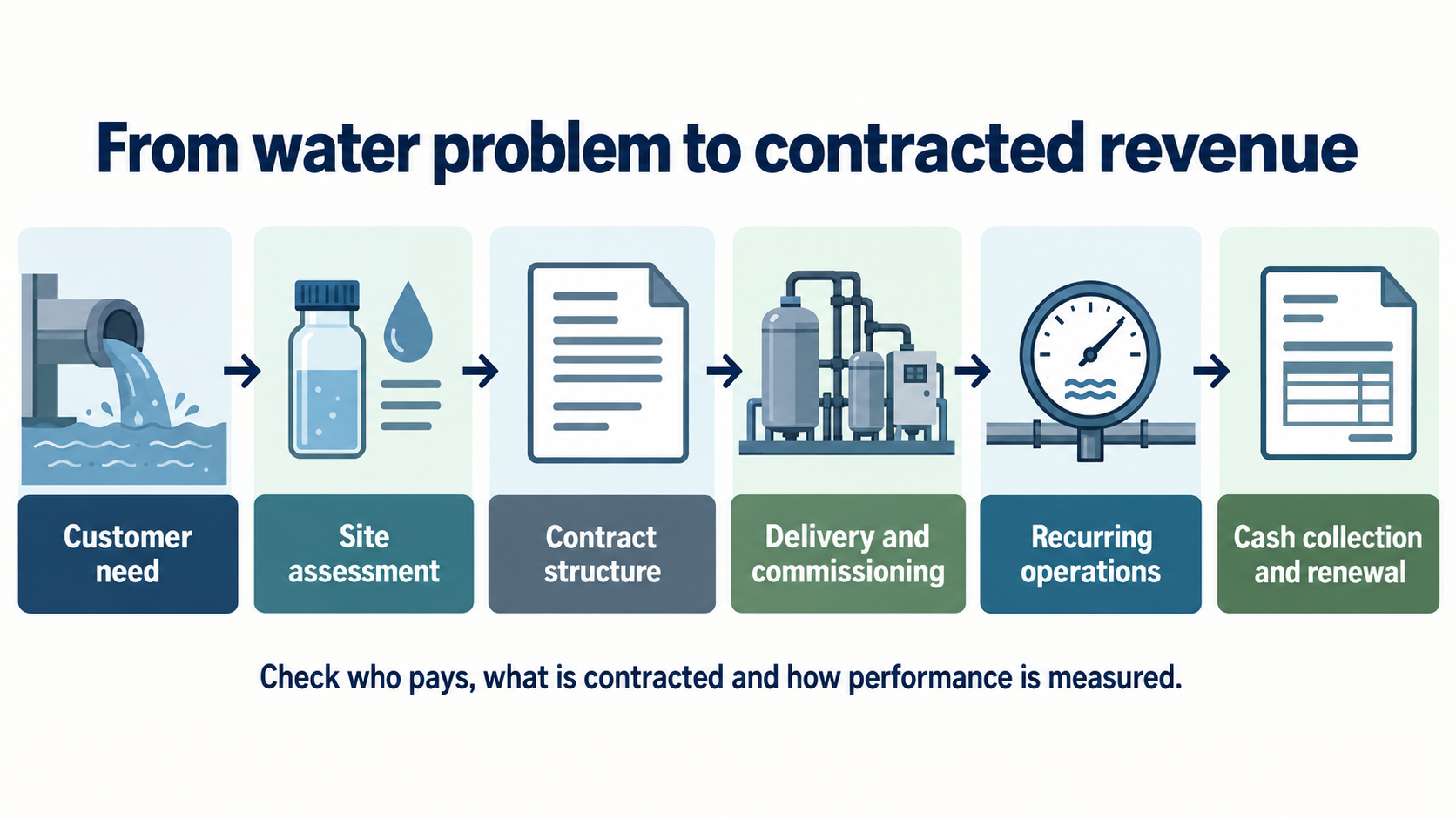
The business model should explain how a water problem becomes cash. It should also show where performance risk sits between the company and the customer.
Equipment and project delivery
Equipment suppliers can earn revenue from product sales, engineering, installation and after-sales support. Project businesses may have strong order books but lower visibility if revenue depends on one-off milestones.
Key tests include backlog quality, gross margin by project, warranty exposure, working capital, subcontractor dependence and acceptance criteria. Revenue growth is less useful when cash is tied up in unfinished work.
Recurring service contracts
Operations and maintenance contracts can create repeat revenue and closer customer relationships. They also place delivery responsibility on the company. Staffing, spare parts, energy, compliance and uptime can reduce margins if the contract is poorly priced.
Look for clear service levels, indexation, renewal history, termination rights and a record of meeting performance obligations. A long contract is not automatically a high-quality contract.
Software and data-enabled operations
Software can scale faster than physical infrastructure, but water customers still need deployment and operational trust. Customer acquisition may require site visits, sensors, integrations and long procurement cycles.
Test recurring revenue, retention, implementation cost, data ownership, cybersecurity controls and the cost of supporting each site. A water software business needs both product evidence and operating evidence.
Regulation is part of the product
Regulation affects water companies through permits, quality standards, abstraction, discharge, procurement and planning. It can create demand, but it can also delay a project or change the cost of delivery.
UK planning creates a route, not a guarantee
The Environment Agency’s 2025 framework calls for stronger multi-sector planning and identifies infrastructure, water recycling, demand management and innovation as parts of the response. Its role is to set a planning framework. It does not guarantee that a particular supplier, project or technology will be selected.
Investors should trace the relevant regional plan, customer procurement route, consent requirements and delivery timetable. The work should be specific to the company’s project and geography.
European water resilience
The European Commission’s strategy treats water resilience as a combination of governance, infrastructure, efficiency, digitalisation, innovation and preparedness. It also points to public and private funding as part of the implementation route.
The Commission and EIB launched a EUR 10 million Sustainable Water Advisory Facility pilot in 2026 to help public and private organisations develop circular water investments. This may support project preparation and investment-ready pipelines. It is not evidence of a guaranteed customer or return for every company in the sector.
Permission, compliance and evidence
A good diligence file should list the permits, tests, standards and approvals that the product needs. It should show who owns each task and what happens if approval takes longer than planned.
Compliance can become a moat when it is difficult to reproduce. It becomes a risk when the company treats an unresolved permission as if it were a commercial contract.
Unit economics investors should test
Water technology can look attractive at the system level while producing weak company economics. The model needs to connect the customer’s value to the company’s gross margin and cash conversion.
Revenue quality
Separate contracted revenue, qualified pipeline, pilot revenue and management ambition. Check the payer, contract length, renewal terms, pricing mechanism, concentration and termination rights.
For project businesses, test how much revenue is recognised before customer acceptance. For service businesses, test whether the price covers the full cost of meeting the service level.
Cost to serve
Operating cost can include energy, chemicals, membrane or component replacement, remote monitoring, site visits, compliance testing and insurance. These costs may move faster than the customer price.
Ask which costs are fixed, which are variable and which are passed through. A business with strong technical performance but poor cost control may not scale profitably.
Capital intensity and cash conversion
Physical assets need capital before they generate revenue. Investors should model equipment lead times, deposits, working capital, commissioning risk, maintenance capex and the timing of customer payments.
The result should be a cash-flow view, not only a revenue forecast. If the company needs repeated equity to fund delivery, the investment case should address dilution and financing risk directly.
Regional lens for UK, Europe and GCC investors
Regional context helps investors ask better questions, but it should not be used to transfer assumptions from one market to another.
UK
Start with the relevant water resources plan, customer class, procurement route and regulatory pathway. Distinguish public supply, industrial demand, agriculture, energy and data-centre demand. The Environment Agency makes clear that planning must work across sectors.
Europe
Map the company’s exposure to national implementation, EU water rules, infrastructure funding and local procurement. The Commission’s water-resilience work makes efficiency, digital solutions, innovation and private investment relevant themes, but the evidence still needs to be company-specific.
GCC
For GCC opportunities, test the local water source, energy profile, offtaker, contract structure, public-sector interface, permitting and long-term operating plan. Do not assume that a UK or EU regulatory model applies. A regional thesis becomes investable only when the local customer and delivery evidence are clear.
Risks and red flags
A water-market thesis can fail even when the underlying need is real. The most useful red flags are commercial and operational, not dramatic.
Demand without a paying customer
A report, policy target or climate scenario can show need without creating a contract. Ask who controls the budget, what decision must be made and what evidence would release the purchase.
Technology before bankability
Pilot results do not prove full-scale uptime, maintenance cost or customer acceptance. Require operating data from conditions that resemble the target site. Be cautious when the plan depends on a first commercial deployment with no contingency.
Concentration, delivery and exit
One utility, one project, one channel partner or one grant can create concentration risk. Construction delays, a weak counterparty or a change in policy can affect the whole plan.
Exit risk also matters. Identify likely strategic buyers, infrastructure funds or later-stage investors. A company should have a credible next owner, not only a large theoretical market.
A practical diligence checklist
The following checklist keeps the investment case grounded. Each answer should point to a contract, customer record, operating result, permit, test or financial schedule.
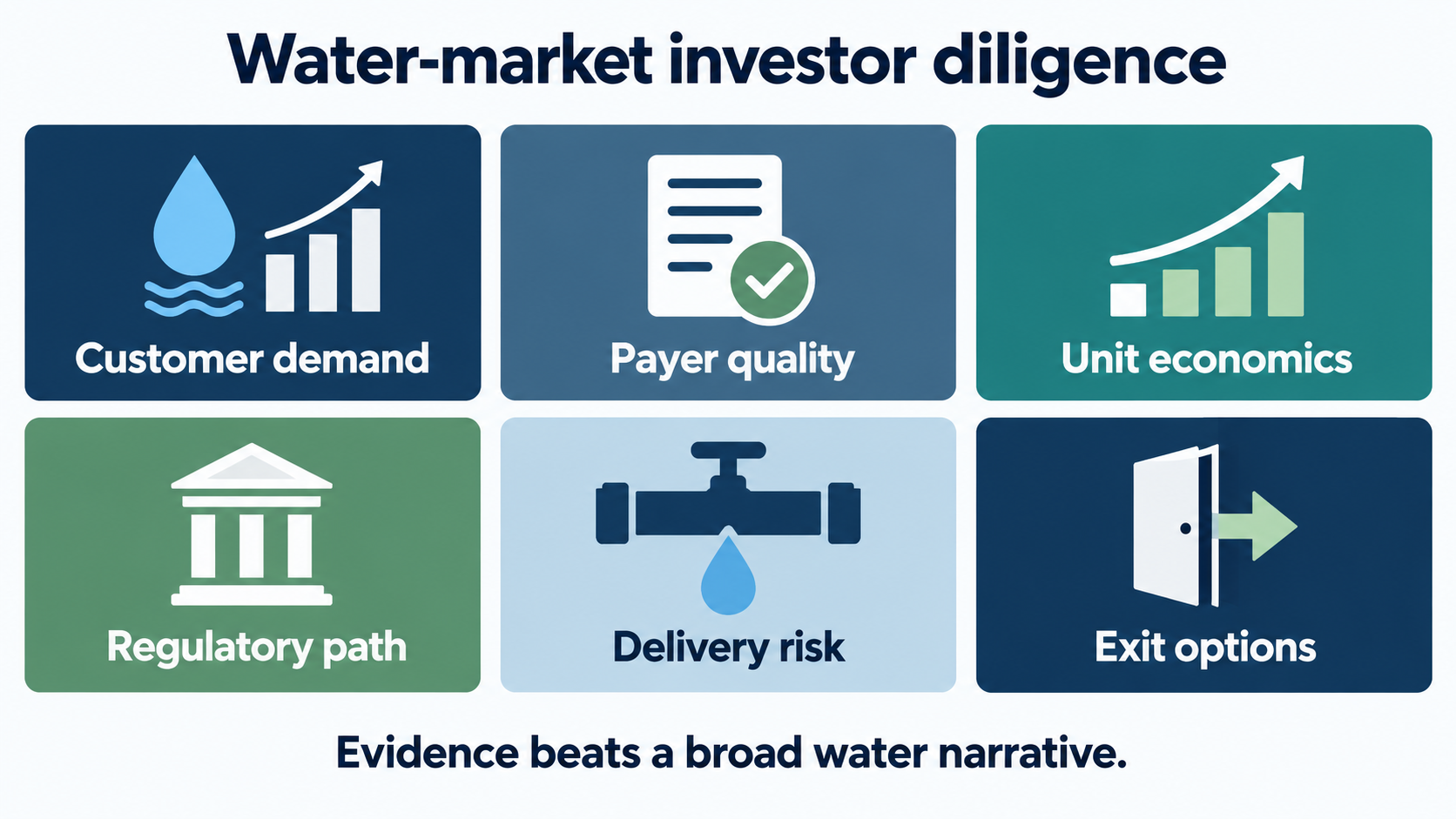
Questions that should have evidence
- Customer demand: What problem is urgent enough to fund now?
- Payer quality: Who signs, who pays and what protects collection?
- Unit economics: What is the gross margin after delivery and support?
- Regulatory path: Which permits, standards and approvals are required?
- Delivery risk: What could delay commissioning or reduce uptime?
- Exit options: Who could acquire or finance the company later?
What a credible investment case contains
A credible case connects the market problem, the customer, the product, the contract, the delivery plan and the financial model. It shows what has already been proven and what remains a risk.
It also explains downside. Investors should understand what happens if a project is delayed, an approval changes, energy costs rise, a customer does not renew or a follow-on round is needed.
Conclusion and sources
The water market offers a wide choice of private-market opportunities, but breadth is not the same as quality. The strongest candidates combine a clear customer problem, a credible contract path, measurable operating performance, defensible know-how and disciplined capital use.
Investors who want to assess direct private water opportunities can review the Water Investment Network portfolio and join the network if eligible. For a general enquiry, use the contact page. Water Investment Network is an opportunity network, not a provider of regulated financial advice, and no investment outcome is guaranteed.
Sources
- Environment Agency, National Framework for Water Resources 2025 executive summary
- Environment Agency, National Framework for Water Resources 2025 introduction
- European Commission, Water resilience strategy
- European Investment Bank, water and wastewater management
- World Bank, Water Security Financing Report 2024
- European Commission, Sustainable Water Advisory Facility pilot