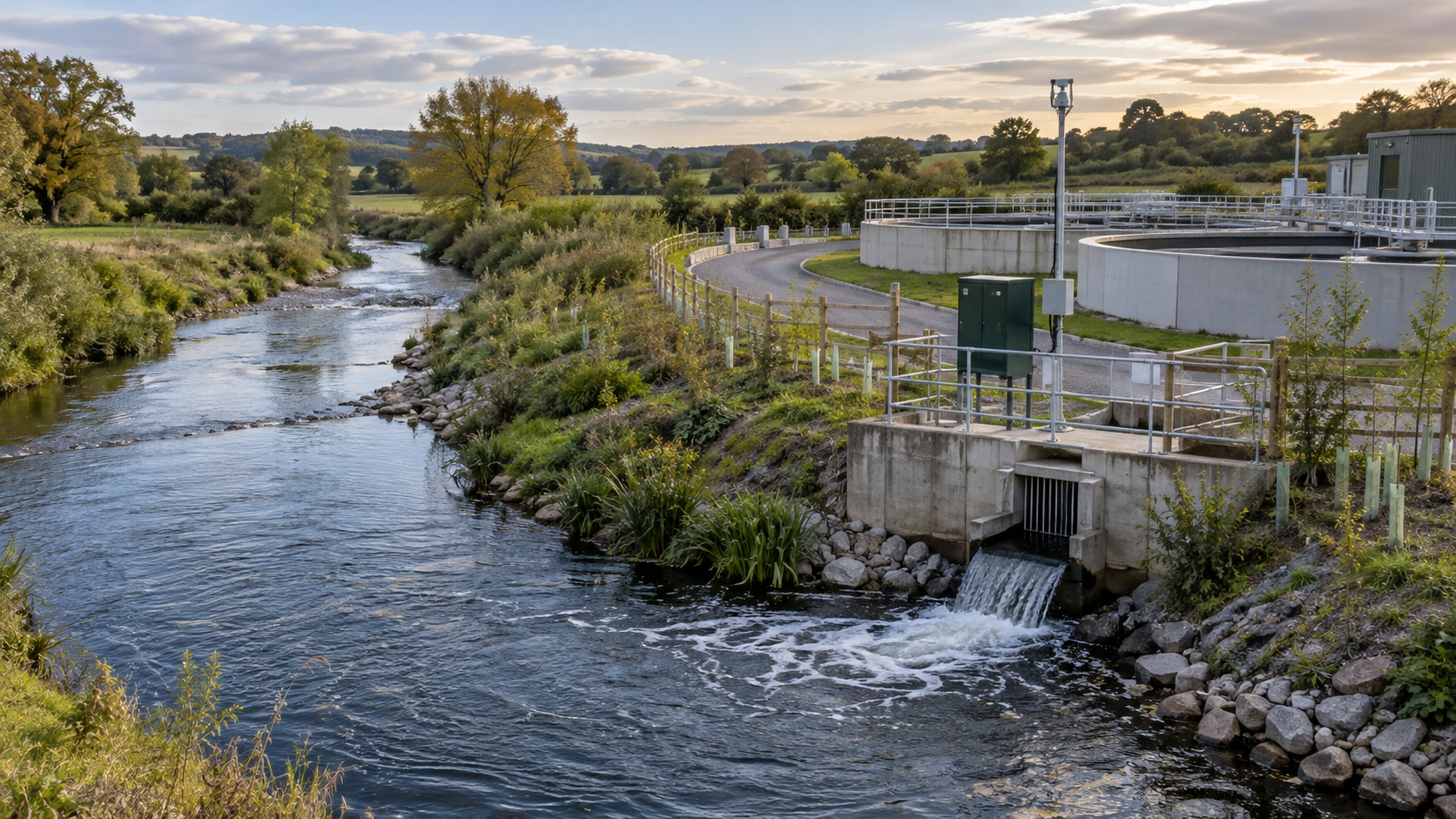
The Water Industry National Environment Programme (WINEP) is becoming a major source of funded environmental work for England’s water companies. For private investors, the opportunity is not a simple bet on rising water spending. It is a question of which companies can turn regulatory requirements into repeatable contracts, defendable margins and reliable delivery evidence.
In January 2025, the Environment Agency said the 2025 to 2030 WINEP contains more than 24,000 actions and represents £22.1 billion of environmental investment. That scale matters because it can create demand for monitoring, treatment, catchment work, data, engineering and long-term operating services. It does not remove customer concentration, procurement risk or execution risk.
This article explains the programme for family offices, sophisticated impact investors and private-equity investors assessing water-technology companies. It focuses on the commercial path from a public environmental obligation to private-company revenue. WINEP is a regulatory framework, not an investment product, and this article is not regulated financial advice.
What the water industry national environment programme is and why it matters to investors
WINEP is the Environment Agency’s programme of environmental actions for water companies in England. It brings together investigations, improvement schemes and other measures that support legal duties and wider environmental objectives. The programme is developed with Defra, Ofwat, Natural England and water companies, then incorporated into the wider price-review and business-planning process.
The Environment Agency describes the current programme as the largest environmental commitment secured from water companies since privatisation. Its January 2025 announcement also explains that the programme is linked to the 2025 to 2030 price-review period. Ofwat’s price controls determine how water companies recover allowed costs and finance investment from customers.
For an investor, the key point is the source of demand. A WINEP action can give a water company a defined problem, a delivery timetable and an accountability framework. That can be stronger than an uncommitted sustainability ambition. It still does not guarantee that any particular vendor will win work, that a scheme will be delivered on time, or that a supplier will earn an attractive return.
The programme should therefore be assessed alongside the broader water-technology market investment thesis. The relevant question is not whether WINEP is large. It is whether a business has a credible position inside the spending chain.
Why the water industry national environment programme changes the demand picture
The current WINEP creates a five-year window of visible environmental obligations. The Environment Agency’s published announcement puts the programme at more than 24,000 actions and £22.1 billion. That is a material increase on the previous price-review cycle, but the headline should be treated as a sector allocation, not as an addressable market for every water-technology company.
The demand picture is also shaped by the way WINEP is designed. The Environment Agency’s roadmap requires actions to connect to broader outcomes, such as water-quality improvement, biodiversity and surface-water management. It also expects companies to consider evidence-based options and, where suitable, catchment and nature-based solutions.
This creates several possible routes to commercial demand:
- water-quality and discharge improvement can require treatment, process control and monitoring;
- abstraction and water-resources work can require measurement, modelling and alternative supply or demand solutions;
- catchment actions can require land, ecological, data and verification capabilities;
- investigations can create earlier demand for sensors, sampling, analytics and specialist consultancy; and
- delivery assurance can increase the value of systems that produce reliable records and auditable evidence.
These are different markets with different sales cycles. An investor should avoid treating the entire WINEP value as one pool of technology revenue.
| Question | Investor lens |
|---|---|
| Demand driver | Environmental obligations and outcomes included in water-company planning. |
| Paying customer | Usually a regulated water company, its delivery partner or a public-sector customer. |
| Revenue model | Equipment, project delivery, monitoring, software, managed service or long-term operations. |
| Scalability test | Whether the solution can move across sites without matching growth in labour and bespoke engineering. |
| Primary risk | Procurement timing, customer concentration, technical performance and evidence of delivery. |
| Impact evidence | Measured progress against the relevant environmental action or outcome. |
What the programme actually funds
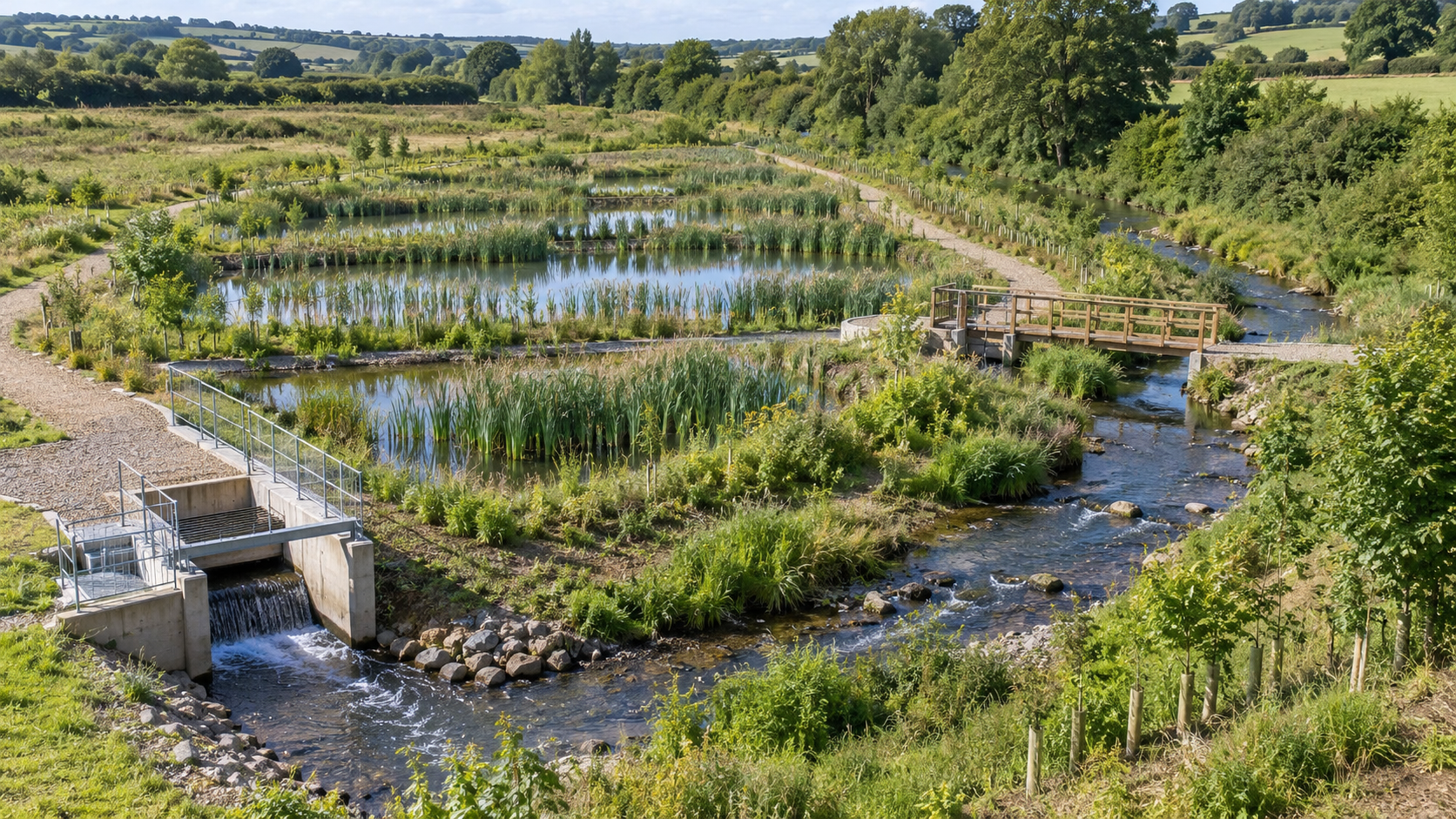
WINEP does not prescribe one universal piece of equipment. It sets actions and requirements that water companies must plan and complete. The final solution depends on the environmental driver, the catchment, the site, the company plan and the evidence accepted by the regulators.
The Environment Agency’s published roadmap describes a tiered approach. Broad outcomes sit above goals and outputs, so a company can have room to assess different ways of meeting the required result. The roadmap also says that options should be evidence based and should consider wider environmental outcomes.
This matters for technology investors because it shifts the commercial test away from a product label. A supplier may be exposed to WINEP without selling a product called WINEP equipment. It may provide a membrane system, a monitoring platform, a telemetry layer, an ecological intervention, a data service or an operating contract that helps a water company meet an action.
The current dataset is more specific than the programme headline. The Environment Agency’s PR24 WINEP dataset says it contains actions requested from all 19 water companies operating in England for completion between 2025 and 2030. It was issued to companies in January 2025 and was updated in September 2026. That gives investors a starting point for mapping drivers, companies and delivery dates, but the dataset is not a vendor pipeline or a promise of contract awards.
Investors should ask which layer of the programme a company serves:
- problem definition and investigation;
- option development and design;
- equipment supply or construction;
- commissioning and performance testing; or
- ongoing monitoring, operations and evidence.
Each layer has a different mix of gross margin, working-capital demand, repeatability and liability. A high-quality investment case makes that position explicit.
How a regulatory action becomes supplier revenue
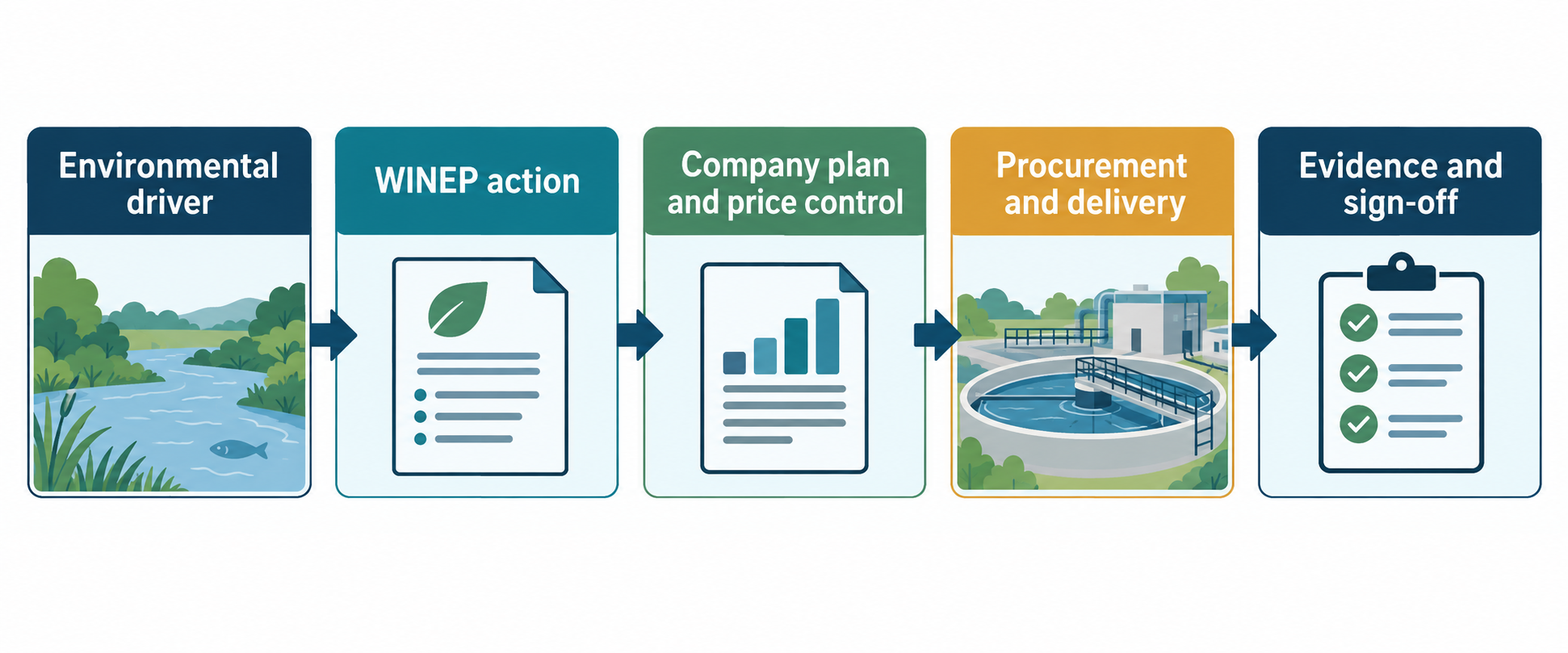
WINEP demand usually reaches a private company through a chain of decisions. The regulator identifies an environmental need. The water company or its partners develop possible solutions. The investment is incorporated into an approved business plan or price-control framework. The company then procures work, manages delivery and reports evidence.
That chain explains why an attractive technology can still face a long sales cycle. A vendor may need to pass technical qualification, framework procurement, site testing and commercial approval before revenue appears. The customer may also prefer an established contractor or systems integrator that can carry delivery responsibility across several sites.
For an investor, the commercial path should be shown with evidence rather than a general reference to regulation. Useful evidence may include a repeat order, an approved supplier position, a contracted pilot with a clear scale route, or installed assets generating service revenue. A press release about a regulatory programme is not evidence of customer adoption.
WINEP can support demand in three ways. It can make a problem visible, make a deadline harder to ignore, and create a budget conversation inside a regulated utility. It can also raise the standard of evidence required before a scheme is considered delivered. Those effects may improve the quality of the market, but they do not guarantee rapid purchasing.
Which business models fit WINEP-linked demand
There is no single WINEP business model. The most investable model depends on the customer’s problem and the supplier’s ability to retain value after installation.
Equipment and project delivery
Equipment suppliers may sell treatment, monitoring or control systems through a utility, contractor or integrator. The opportunity can be large, but project revenue may be lumpy. Investors should test warranty exposure, installation costs, payment timing and the share of revenue that depends on new projects.
Monitoring and data services
Monitoring can support both investigation and ongoing assurance. The stronger model is not simply more sensors. It is a service that turns reliable readings into decisions, alerts, reports and evidence that a customer can use. Investors should test data quality, device maintenance, software retention and the cost of serving dispersed sites.
Managed treatment and operations
A company may design, operate or maintain treatment assets under a service contract. This can create recurring revenue, but it also places performance and labour risk on the supplier. The diligence focus should include uptime, energy use, consumables, response obligations and the contract’s treatment of underperformance.
Engineering, ecological and specialist services
Some WINEP actions require surveys, modelling, catchment design or ecological work. Specialist services can be defensible when they combine scarce expertise with repeatable data and workflows. A services-heavy business still needs a clear plan for utilisation, hiring, pricing and conversion into longer-term customer relationships.
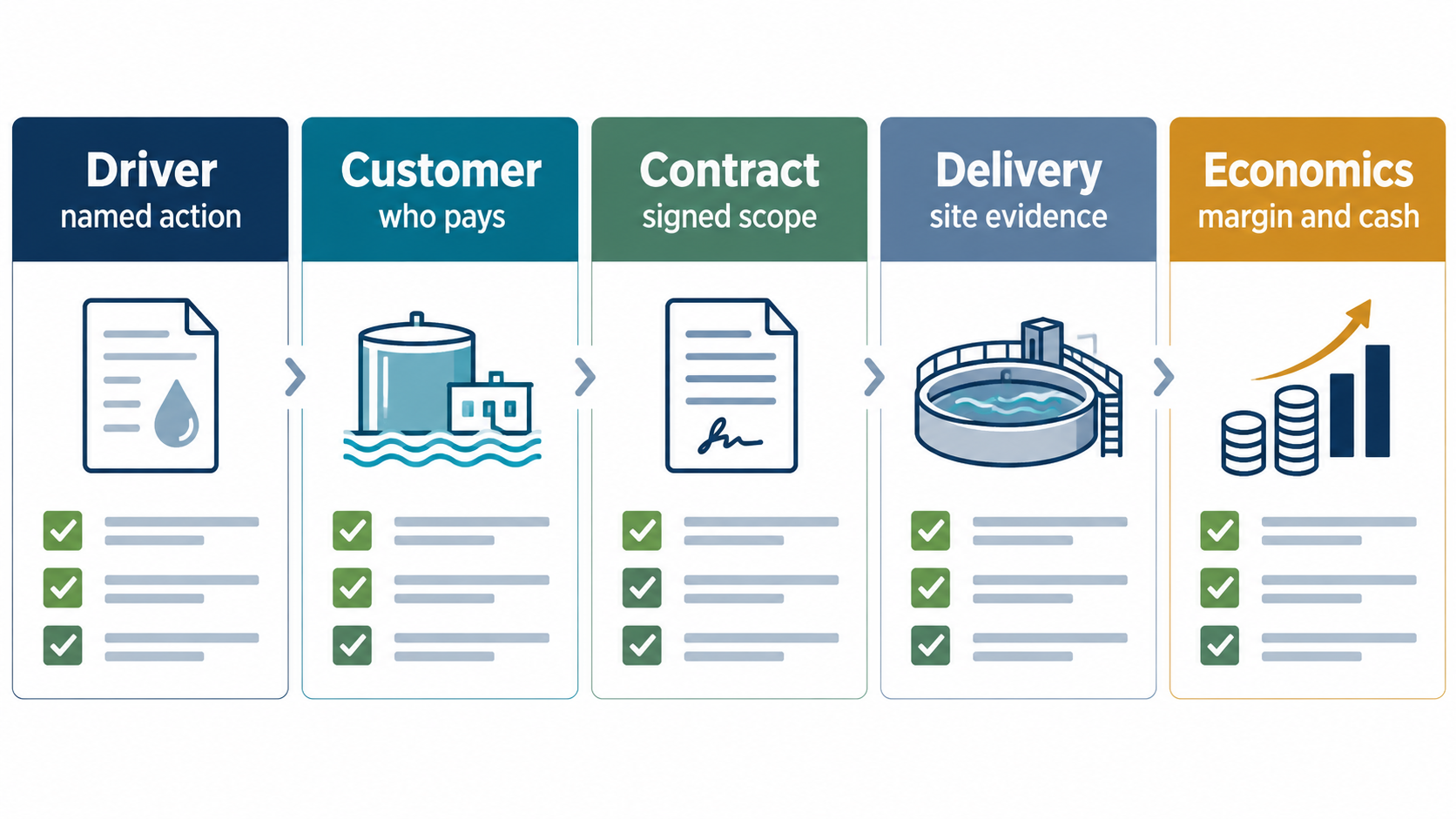
Across all models, the investor should separate contracted backlog from a target list. WINEP exposure becomes more credible as a company moves from regulatory theme, to customer problem, to named scope, to signed work, to verified delivery.
That distinction also affects valuation work. Project revenue can support a strong year while hiding low repeatability or heavy working-capital use. Service revenue can look smaller at first while producing better visibility, provided the customer renews and the supplier can maintain performance across sites. The quality of the contract matters as much as the number of schemes in the market.
Why data and delivery evidence matter
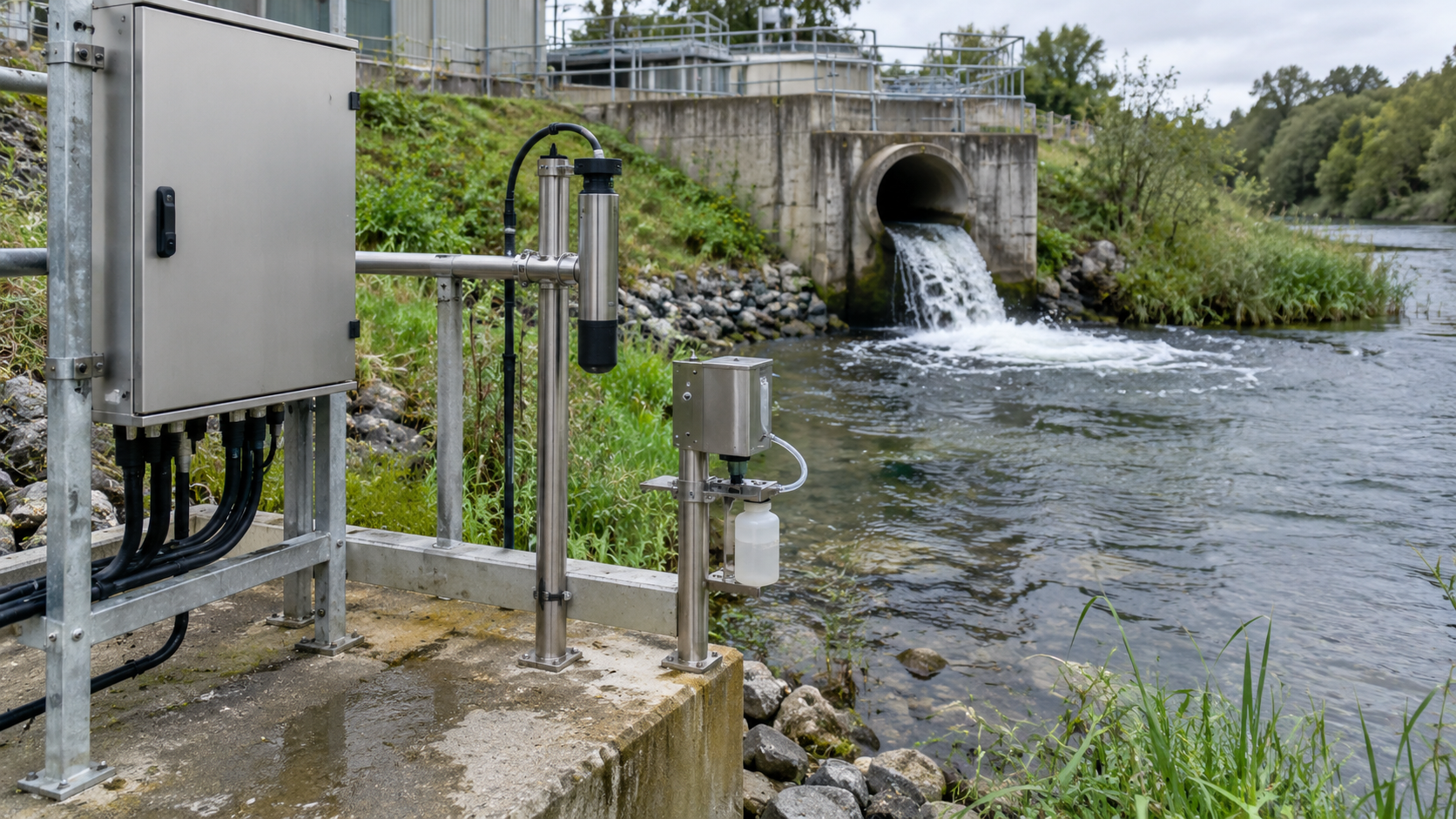
WINEP-linked work is exposed to a higher evidence burden than a normal equipment sale. A company must show that the work addressed the intended environmental problem and met the agreed specification. That makes data capture, audit trails and operational reporting part of the commercial product in many segments.
The Environment Agency’s 2026 to 2030 Environmental Performance Assessment methodology describes WINEP and the Welsh NEP as measures or actions that water and sewerage companies must invest in and complete during each five-year asset-management cycle. It tracks delivery against planned schemes and applies a cumulative approach across the period.
The same methodology sets an expectation of 100% WINEP delivery for the relevant actions, with performance assessed through red, amber and green thresholds. It also explains that evidence can affect whether a claimed scheme is signed off. This is useful for investors because it connects delivery quality to regulatory accountability.
A supplier that helps the customer prove performance may have more value than a supplier that only installs hardware. That does not mean every data product is defensible. The system must be accepted by the customer, produce trustworthy records and fit existing operational processes.
What long-term planning means for the pipeline
The WINEP roadmap is designed to look beyond one price-review cycle. It calls for five years of clear actions aligned to the 2025 to 2030 period, indicative actions for 2030 to 2035, and longer-term actions up to 25 years where there is enough evidence.
That structure can help investors distinguish near-term revenue from future option value. A business may have a real role in a long-term planning process without having a funded order today. Conversely, a funded 2025 to 2030 action can still be delayed by design, procurement, permitting, construction or customer priorities.
The roadmap also links WINEP with other statutory planning frameworks, including river-basin, drainage and wastewater, water-resources and flood-risk planning. That integration can increase the number of stakeholders and dependencies around a project. It may also create opportunities for solutions that work across more than one environmental outcome.
Investors should model the timing in stages. Near-term revenue should come from signed work or a credible procurement position. Medium-term revenue may depend on approved options and customer conversion. Longer-term opportunity should be treated as a scenario, with explicit assumptions about adoption, price, working capital and competition.
How to assess a WINEP-exposed company
A WINEP reference belongs near the start of diligence, not at the end. Use it to ask better questions about the customer and the delivery chain.
1. Driver
Which WINEP action or environmental driver creates the need? Can the company identify the relevant outcome, scheme type, timetable and responsible water company?
2. Customer
Who pays the company? Is the buyer a water company, a tier-one contractor, an engineering partner or another organisation? What share of revenue depends on one utility or procurement route?
3. Contract
Is the revenue contracted, in procurement, in pilot, or only in a sales pipeline? What are the payment milestones, renewal terms, performance obligations and termination rights?
4. Delivery
Can the business install and operate its solution at the required pace? Review manufacturing capacity, field labour, commissioning records, health and safety controls, working capital and subcontractor reliance.
5. Evidence
What proves that the solution works for the customer? Look for site data, verified performance, acceptance records and repeat purchases. A claim about environmental benefit is weaker when it cannot be connected to an agreed metric.
WIN’s portfolio is the relevant place to assess how direct water-technology opportunities fit this type of commercial analysis. The programme itself is not a substitute for company-level diligence.
UK, Europe and GCC: separate the market lenses
WINEP is an England-specific regulatory programme. Its documents should not be copied into a European or GCC market thesis without checking the local regulatory, procurement and funding structure.
For UK investors, the immediate questions concern water-company plans, Ofwat price controls, Environment Agency requirements and delivery evidence. Wales uses a National Environment Programme within a different institutional setting, even though the Environmental Performance Assessment methodology discusses WINEP and NEP together.
For European investors, WINEP is best treated as evidence of how environmental requirements can create structured utility demand. The relevant diligence then moves to the target country’s permits, utility economics, procurement rules and public funding model.
For GCC investors, the same commercial discipline applies, but the customer problem may be shaped more by water security, desalination, reuse, industrial demand, energy cost and national infrastructure programmes. A UK WINEP reference can support a company’s regulatory experience, but it does not prove regional transferability.
Principal risks in a WINEP-related investment case
Regulation can make demand more visible while leaving execution difficult. The most important risks are often commercial rather than scientific.
- Programme risk: priorities, dates and solution choices can change during planning and delivery.
- Procurement risk: the final contract may be won by a larger integrator or an incumbent supplier.
- Concentration risk: one utility or contractor may account for too much revenue.
- Technical risk: a solution may perform in a pilot but fail under variable site conditions.
- Working-capital risk: project delivery can require materials and labour before payment.
- Evidence risk: weak monitoring or documentation can delay acceptance and payment.
- Policy risk: a business may rely on a specific framework without proving broader customer value.
These risks should appear in the downside case. Investors should not assume that a large public programme creates a guaranteed revenue floor or a guaranteed exit route.
FAQs and next steps for eligible investors
Is WINEP a fund that private investors can invest in?
No. WINEP is a regulatory programme of environmental actions for water companies in England. Private investors assess companies that may supply, deliver, monitor or operate work linked to those actions.
How large is the current WINEP programme?
The Environment Agency said in January 2025 that the 2025 to 2030 programme includes more than 24,000 actions and represents £22.1 billion of environmental investment. That is a sector-level figure, not the addressable revenue of a single supplier.
What should investors request from a WINEP-exposed company?
Request the relevant driver, customer, scheme scope, procurement stage, contract evidence, delivery timetable, performance data and revenue assumptions. Ask the company to separate signed work from pipeline and long-term scenarios.
Does WINEP guarantee demand for water-technology businesses?
No. It can make environmental demand more visible and help fund water-company work. It does not guarantee a vendor contract, technical success, margins or investment performance.
What is the next step for a private investor?
Compare the regulatory driver with the company’s customer evidence, unit economics and delivery record. Eligible investors seeking direct private water-technology opportunities can join the Water Investment Network and use the contact page for a factual next step.
Sources
- Environment Agency: record commitments from the water sector.
- Environment Agency, Defra and Ofwat: WINEP roadmap.
- Environment Agency: PR24 WINEP dataset.
- Environment Agency: PR24 WINEP National Dataset.
- Environment Agency: 2026 to 2030 Environmental Performance Assessment metrics.
- Environment Agency: WINEP programme and interactive map.