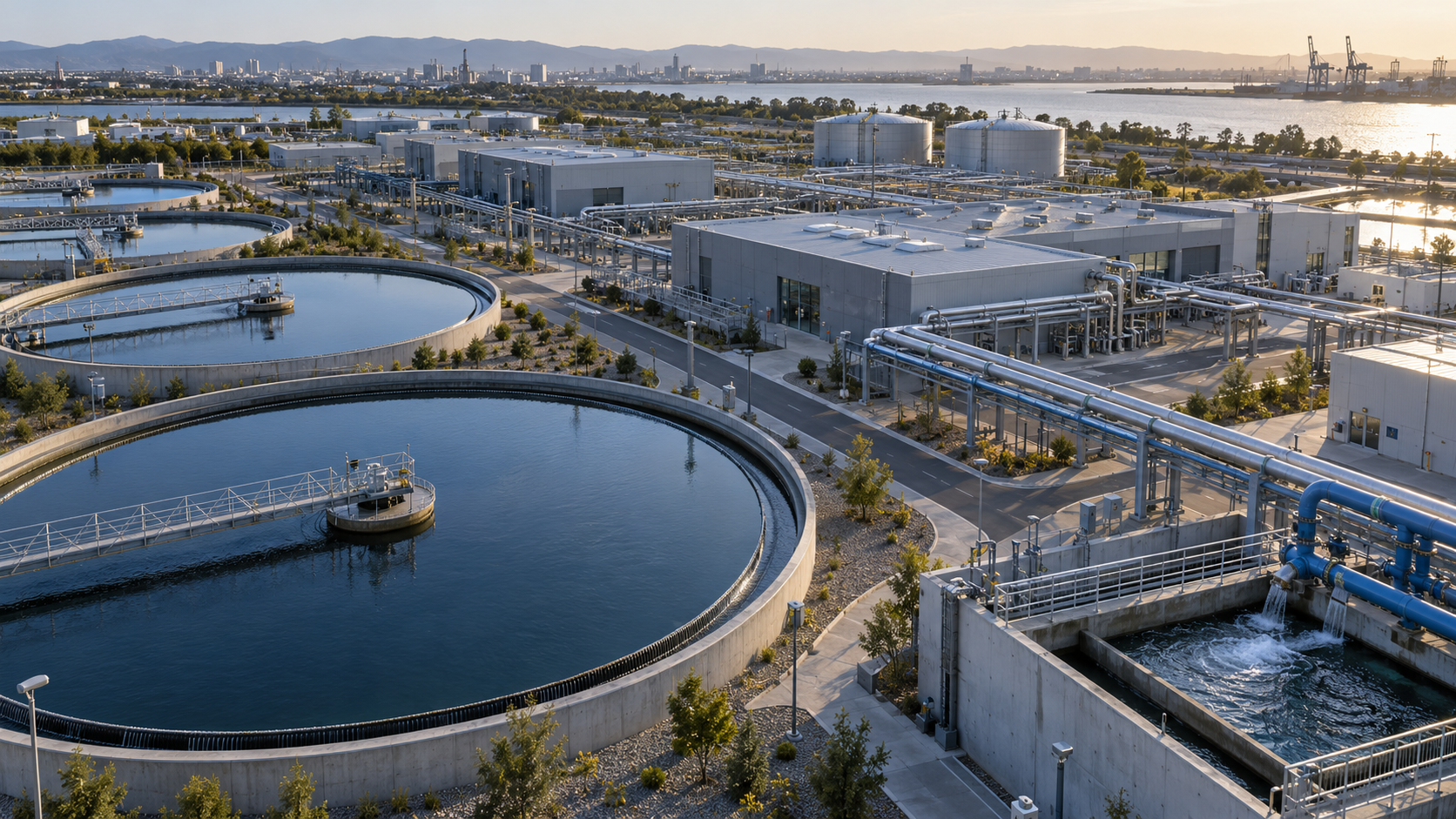
Water and wastewater companies are becoming more visible to private investors because water is now a business continuity issue, a regulatory issue and an infrastructure issue. The investable opportunity is not one broad market. It is a set of businesses that help customers secure supply, treat used water, meet discharge rules, reuse water or run critical assets.
That distinction matters. A company can sell equipment, deliver a project, operate a treatment plant, monitor performance or provide water as a service. Each model has different customers, margins, working-capital needs and risks. This article sets out how investors can compare them, using the broader water technology market as the starting point.
Why water and wastewater companies are not one market
“Water company” can mean a regulated utility, a specialist technology supplier, an engineering contractor or a private operator. “Wastewater company” can mean a business that treats industrial effluent, manages municipal assets, recovers resources or supplies monitoring systems.
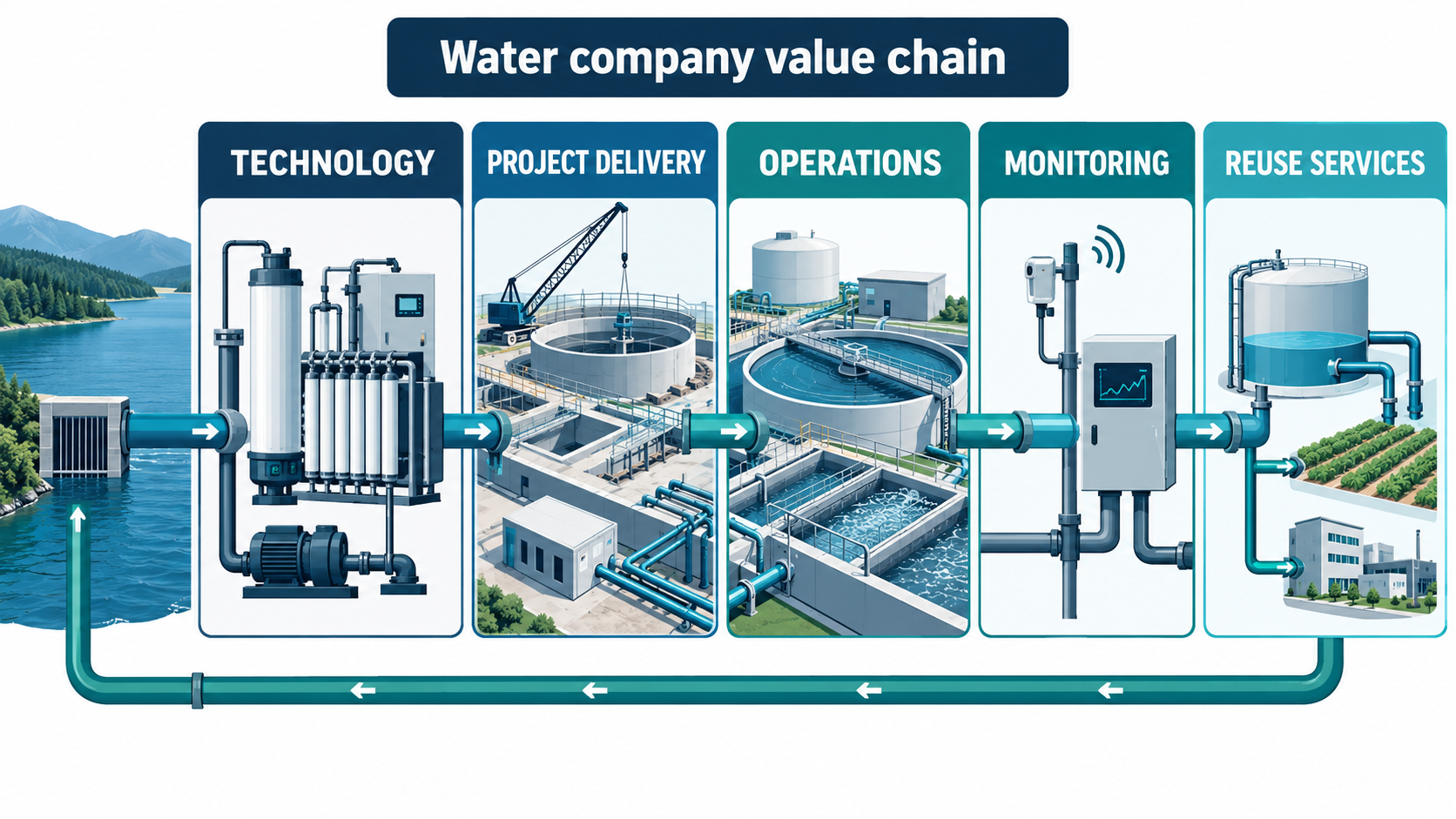
These businesses sit at different points in the value chain. They also sell to different decision-makers. A utility may buy against a long-term asset plan. A food manufacturer may buy to protect production and meet a discharge permit. An industrial park may buy a reuse service because new freshwater capacity is difficult to secure.
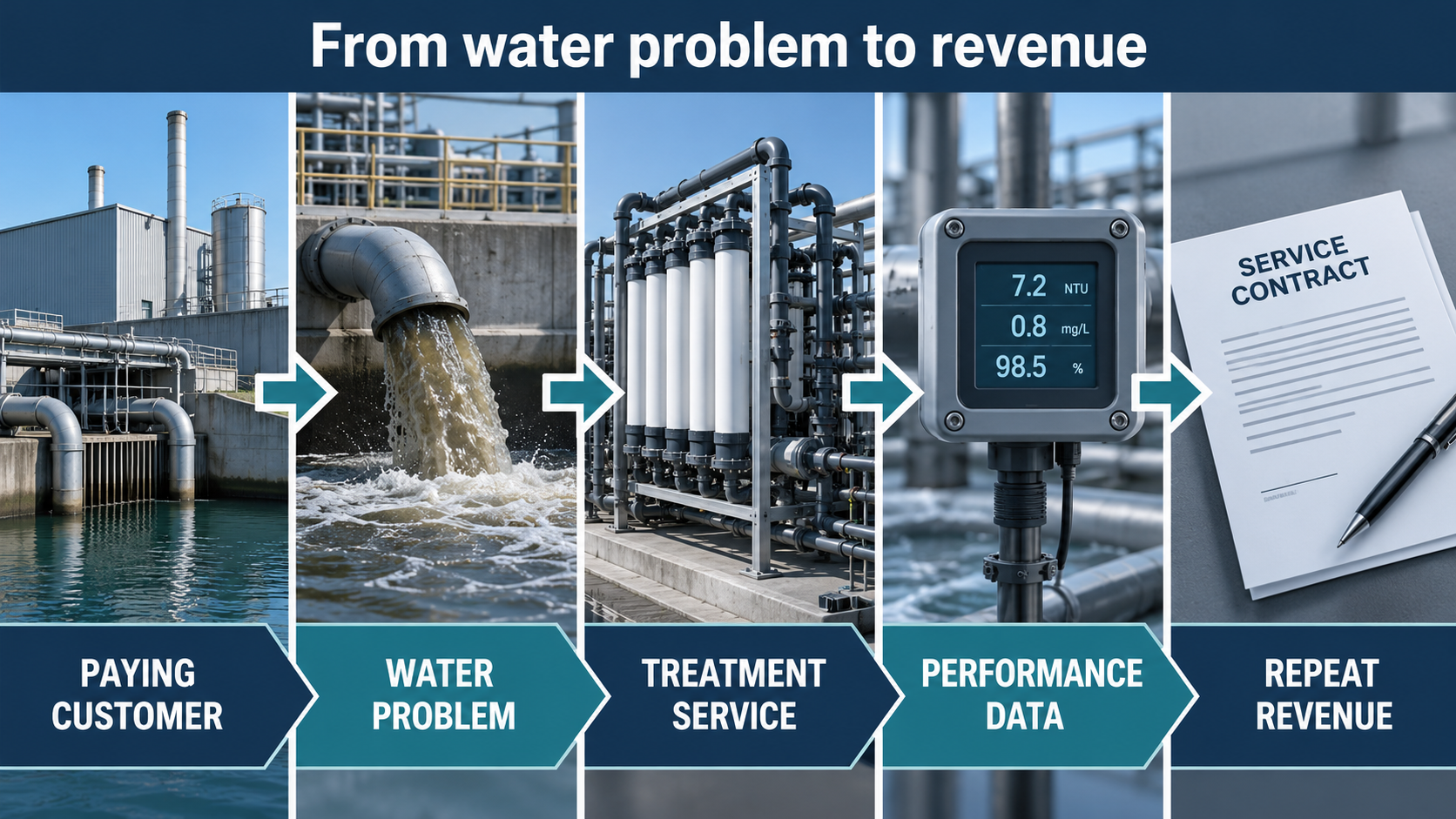
Investors should therefore avoid starting with a market-size headline. Start with the customer problem, the contract that solves it and the evidence that the solution works. This approach also prevents confusion between public water-company exposure and direct investment in private water technology.
Why demand is becoming a funded problem
Water demand is supported by several forces that can create paying customers. These include ageing assets, climate pressure, pollution controls, industrial expansion, water reuse and the need for better data. The strength of each driver depends on the location, customer and regulatory framework.
The European Commission says Europe’s water industry generates €107 billion and supports 1.7 million jobs. Its water resilience strategy also calls for public and private investment, infrastructure modernisation, digitalisation and innovation. Those statements describe a policy direction, not a forecast of returns for a private company. They show why investors should examine the sector as an operating economy rather than as a single theme.
The European Investment Bank reached a similar conclusion in its September 2026 paper on future-proofing Europe’s water systems. It says the challenge is not only the amount of finance available. The way projects are originated, coordinated, funded and financed can be the bigger constraint. That creates a useful test for companies: can they help customers move from a water problem to a funded, deliverable project?
In England, the National Framework for Water Resources 2025 describes a need for more infrastructure, stronger multi-sector planning and new options such as reservoirs, desalination and water recycling. The Environment Agency also says water resources management plans must cover at least 25 years. These plans can support demand, but they do not remove development, procurement, permitting or delivery risk.
Funded demand is not the same as an investable market. A policy can create a need without creating a contract for a particular supplier. The company still needs an approved specification, a buying route, delivery capacity and a customer willing to accept the operating risk.
What water and wastewater companies actually do
For an initial investment screen, most private water businesses fit one or more of five categories.
- Technology suppliers. They sell treatment modules, membranes, sensors, control systems or specialist process equipment. Investors should test product performance, replacement cycles, gross margin and dependence on a small number of projects.
- Project delivery businesses. They design, build and commission systems for a customer. Revenue can grow quickly, but fixed-price contracts, guarantees, delays and working capital can weaken cash conversion.
- Operations and maintenance providers. They run assets, maintain equipment or manage compliance data. Recurring service revenue can improve visibility, but labour, energy, spare parts and site performance determine the margin.
- Monitoring and digital businesses. They measure water quality, flow, leakage, energy or discharge performance. The key questions are data reliability, integration with customer systems, retention and the value of a verified alert.
- Reuse and resource-recovery businesses. They treat used water for another industrial or municipal use, or recover energy and materials. The investment case depends on the offtake, quality standard, pricing and the cost of moving water to the user.
Some businesses combine these categories. That can create a stronger customer relationship, but it can also hide a complex operating model. The financial statements should show which activity produces revenue, which activity consumes capital and which activity carries performance liability.
Investors can use the network’s portfolio overview as a useful reference point, while still completing their own commercial and technical diligence.
Water and wastewater companies investment thesis at a glance
| Investment question | What to look for | Why it matters |
|---|---|---|
| Who pays? | An identified industrial, utility, property or public-sector customer | Need must become a budget, contract or approved project |
| What is bought? | A defined output such as treated water, compliance, capacity or uptime | Clear outputs make value easier to price and measure |
| How does revenue repeat? | Consumables, service, monitoring, operations or expansion at existing sites | Repeat revenue can reduce dependence on new project wins |
| What limits scale? | Energy, permitting, integration, labour, finance or customer concentration | Growth can destroy value if delivery capacity does not keep pace |
| What proves impact? | Measured changes in water quality, reuse, discharge, leakage or resource use | Evidence protects both commercial credibility and impact reporting |
The thesis is strongest when a company solves an expensive or mandatory problem for a customer that can pay. A positive environmental outcome is valuable, but it does not replace a workable contract, service model or cash cycle.
How water and wastewater companies make money
Revenue models vary more than the technology. A supplier may sell a unit and leave the site. Another business may charge for design, installation, operations, monitoring and treated-water output over several years.
Common models include equipment sales, engineering and construction fees, long-term operations contracts, monitoring subscriptions, maintenance agreements, treatment charges, availability payments and water-as-a-service arrangements. The last model means a customer pays for an agreed water outcome rather than owning every part of the treatment asset.
Investors should map revenue from signed order to collected cash. Ask when the contract becomes binding, whether payment depends on commissioning, who funds equipment, who owns the asset and what happens when performance falls below specification.
Contract length should also be read with renewal terms. A five-year service agreement may be valuable if the customer has a clear renewal process and switching costs are real. It is less valuable if the customer can terminate easily, the supplier carries open-ended performance guarantees or the contract depends on one project sponsor.
The World Bank’s work on scaling water reuse makes the same commercial point at system level. Reuse is more investable when treated water is close to the point of use, regulation is clear and the offtake is credible. Its report highlights programmatic investment, pricing signals, bankable delivery models and private-sector participation as conditions for scale.
What creates repeatable revenue
Repeatable revenue comes from more than a growing order book. It comes from a product or service that can be sold, installed, operated and supported again without a similar increase in complexity.
For technology suppliers, repeatability may come from standard modules, validated performance data and a channel that can sell into several sites. For operators, it may come from common procedures, remote monitoring, spare-parts planning and contract terms that allocate performance risk clearly.
Customer retention matters because water systems are embedded in production and compliance processes. A replacement decision may be slow, but a trusted supplier can have an advantage when the customer expands, renews or adds a second treatment line.
Investors should separate a genuine installed base from a list of pilots. A pilot proves that a customer will test a product. A repeatable business proves that customers pay, renew, expand and refer the solution under normal operating conditions.
Margins, capital intensity and scale
Water businesses can look attractive at gross-margin level while producing weak cash flow. Treatment equipment may have good unit economics, but engineering rework, site delays, warranty claims, energy bills or long receivables can absorb the benefit.
Three tests are useful. First, compare gross margin by revenue type. Second, reconcile reported profit to operating cash flow. Third, measure the capital required to add each new site or customer. A business that needs heavy project finance may scale differently from one selling software-supported monitoring or standardised equipment.
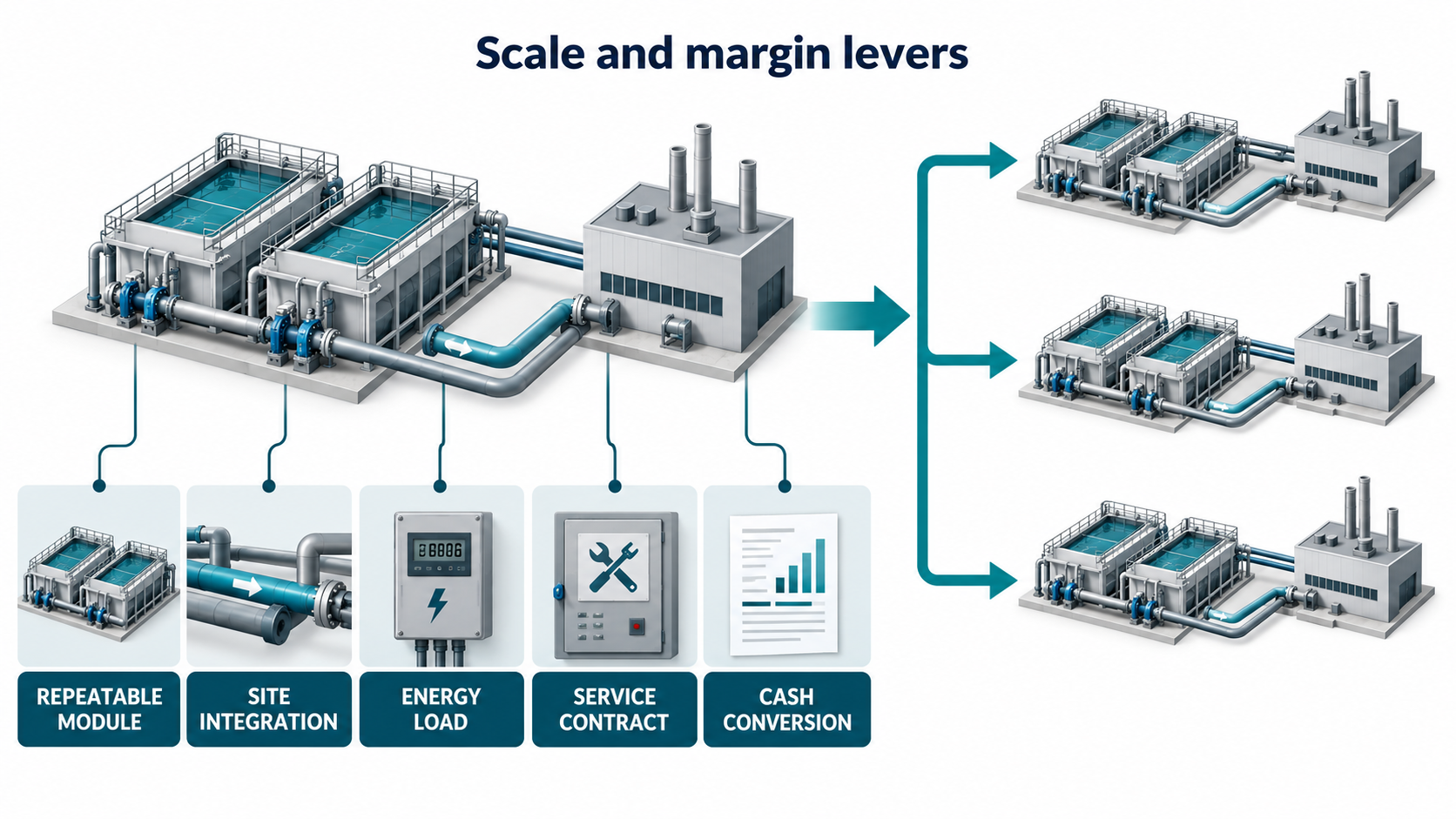
Energy is a practical risk. Processes such as high-pressure membrane treatment can be sensitive to power prices, feedwater quality and plant utilisation. The company may not control all three. A good diligence process tests how pricing, service levels and contract terms respond to those changes.
Scale also depends on people and permissions. A business may have strong technical IP but lack commissioning teams, qualified operators, local partners or a route through planning and environmental approvals. Those constraints should appear in the operating plan and not only in the risk section.
Potential exit routes should follow the operating model. A specialist supplier may attract a strategic buyer that wants a product or customer channel. An operator may suit an infrastructure platform or services group. An investor should test whether the buyer would value contracted revenue, technical capability, installed assets or data, rather than assuming that sector interest creates an exit.
UK, Europe and GCC: separate the routes to opportunity
Water and wastewater companies can serve similar needs in different markets, but the route to revenue is not interchangeable.
United Kingdom
In England, water resources management plans and environmental programmes shape utility demand. The Environment Agency reports that water companies must prepare plans at least every five years and cover a minimum period of 25 years. It also reports large environmental and storm-sewage investment programmes. Investors should still test procurement timing, regulatory approval, framework access and whether a supplier is exposed to one company or one programme.
Europe
The European Commission’s water resilience strategy links water security with infrastructure, private investment, digitalisation and innovation. The EIB’s water programme also covers treatment plants, water losses, pollution control and technology. For private companies, the opportunity may sit in specialist supply chains, industrial reuse, monitoring or project delivery rather than in owning a regulated utility.
GCC
GCC markets can have strong demand for desalination, reuse, industrial water and resilient supply. The exact commercial case varies across the UAE, Saudi Arabia, Qatar, Kuwait, Bahrain and Oman. Investors should assess the offtaker, tender structure, local partner, payment security, energy source, feedwater quality and the treatment standard required. A regional label is not a substitute for project-level evidence.
Across all three regions, the strongest businesses can explain who makes the buying decision, how the project is funded and what performance is measured after handover.
Regulatory context should be read alongside company evidence. The network’s water regulation overview can help frame the policy questions, but it does not replace jurisdiction-specific advice.
Water and wastewater companies diligence scorecard
Before considering valuation, an investor can score five evidence areas.
- Customer. Is the problem material to production, compliance, capacity or resilience? Can the customer pay without relying on an unapproved grant?
- Contract. Is there a signed order, framework, offtake agreement or only a memorandum? Who carries delay, performance and change-order risk?
- Performance. Are treatment results, uptime, energy use and maintenance records measured at operating sites? Are the figures independently checked?
- Compliance. Does the company understand permits, discharge standards, data rules, health and safety and local procurement? Can it prove compliance across customer sites?
- Capital. How much working capital and equipment finance are needed to support growth? What happens to cash conversion when the sales pipeline doubles?
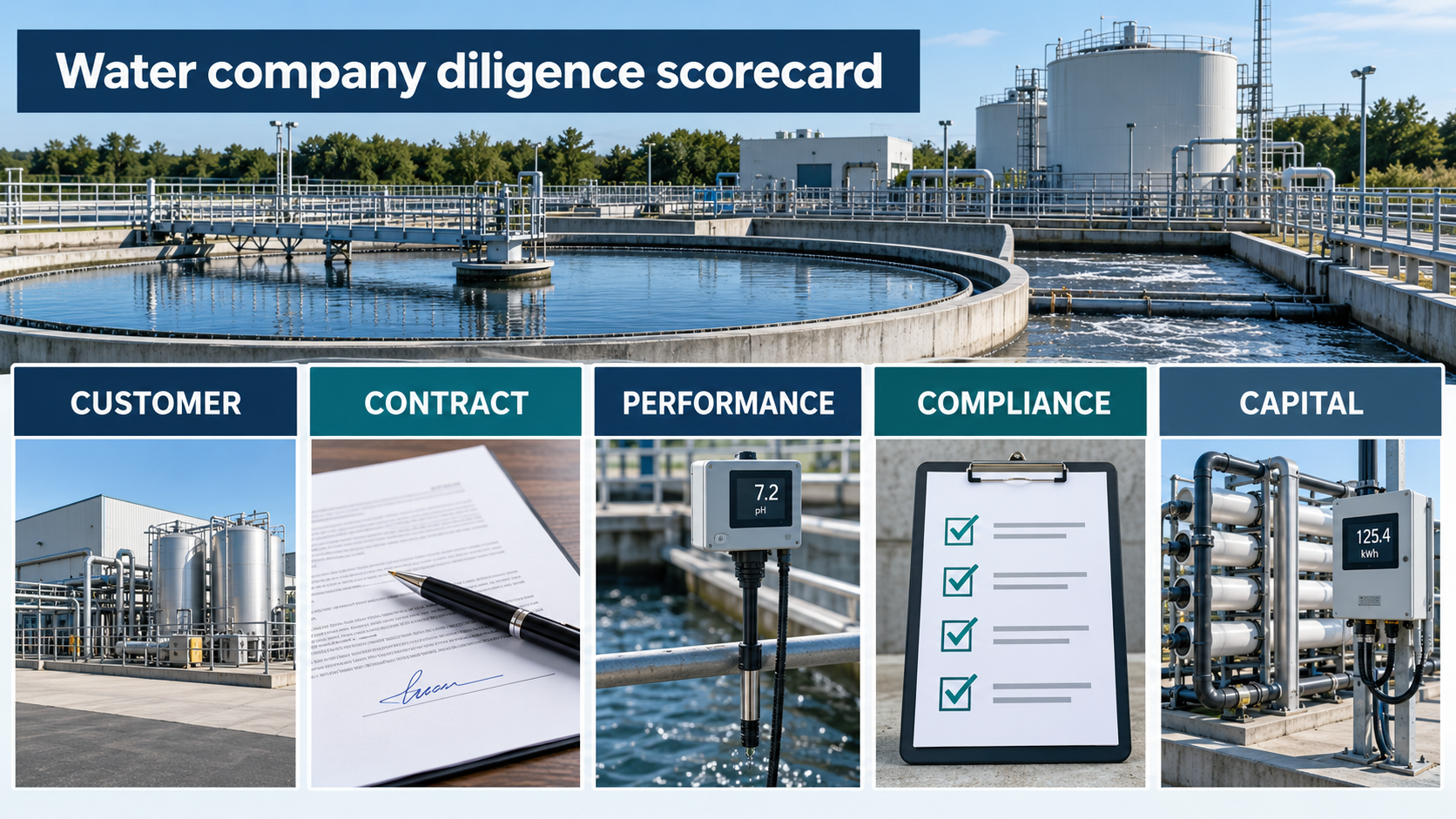
This scorecard is not a substitute for legal, technical, tax or financial advice. It is a way to keep the investment discussion connected to evidence. Investors should also compare claims in the sales deck with signed contracts, site data, accounts and customer references.
Risks and red flags
Water companies can benefit from structural demand and still be poor investments. The following risks deserve direct questions.
- Pilot dependence: revenue is based on trials that have not converted to normal procurement.
- Contract concentration: one utility, industrial group, public programme or distributor controls most revenue.
- Unpriced performance risk: the company promises a treatment or uptime result but has not priced energy, feedwater variation or maintenance.
- Working-capital strain: the company pays suppliers well before customers pay for commissioning or acceptance.
- Regulatory timing: the business case assumes a rule, permit, tariff or procurement decision that is not yet final.
- Weak impact evidence: environmental claims are based on modelled potential rather than measured operating data.
- Scale friction: every new site needs bespoke engineering, scarce staff or a new local approval path.
Regulation can create demand, but it can also delay revenue. The company should show which assumptions are verified, which are management forecasts and which are the investor’s own judgement.
Frequently asked questions and next steps
What are water and wastewater companies?
They are businesses that supply, treat, monitor, reuse or manage water and used water. They may sell equipment, projects, operating services, data or treated-water output.
Are water and wastewater companies defensive investments?
Some serve essential or regulated needs, but that does not make every company defensive. Contract quality, customer concentration, capital intensity, regulation and execution still drive risk.
How can investors compare a water technology supplier with an operator?
Compare the customer, revenue contract, gross margin, cash cycle, capital required per site and evidence of repeatability. Their financial profiles can be very different even when they use similar technology.
Does water reuse create a private investment opportunity?
It can create opportunities where treated water is close to a paying user, quality requirements are clear and the offtake is credible. The World Bank identifies regulation, pricing, delivery models and finance as important conditions for scale.
What should investors ask first?
Ask who pays, what output is guaranteed, how performance is measured, when cash is collected and what must happen before the next site can be sold.
Water and wastewater companies can offer direct exposure to a sector where environmental need and commercial demand often meet. The work is to separate a real customer problem from a broad theme, then test the contract, operating evidence and capital path. Eligible investors can join the Water Investment Network to explore selected private water-technology opportunities. For general enquiries, use the approved contact route through the network.
Sources
- European Investment Bank, Future-proofing Europe’s water systems: From vision to investment
- European Investment Bank, Water and wastewater
- World Bank, Scaling Water Reuse: A Tipping Point for Municipal and Industrial Use
- European Commission, Water resilience strategy
- GOV.UK and Environment Agency, National Framework for Water Resources 2025
- GOV.UK and Environment Agency, Investment requirements for England’s river basin management plans