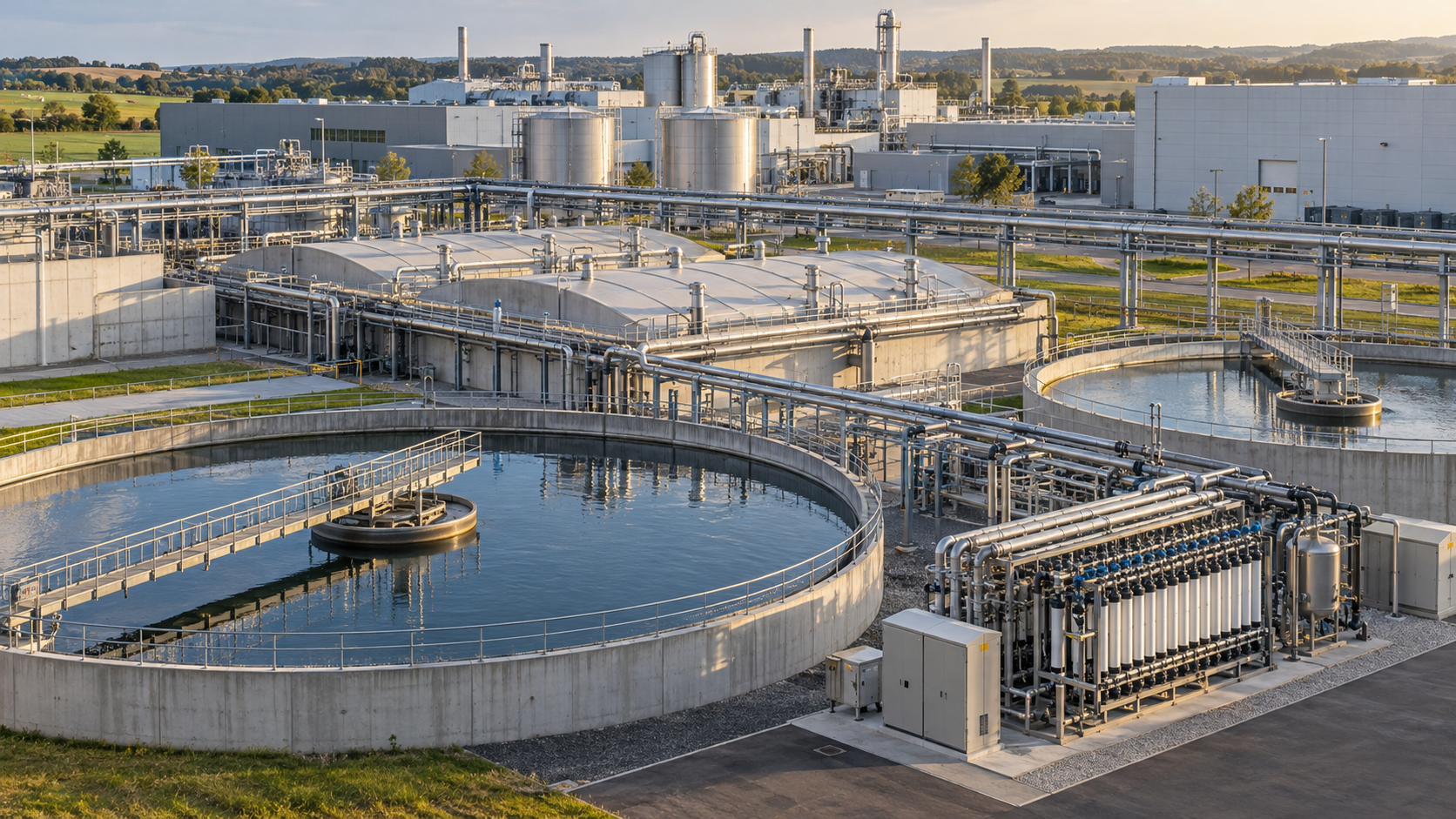
Effluent treatment companies sit at the point where industrial production meets water regulation, operating cost and resource security. They help factories, processors and other industrial sites treat used water before discharge, reuse or further recovery. This is one part of the wider water technology market investment landscape.
For private investors, the opportunity is not simply the presence of polluted water. It is the quality of the commercial response. A strong company solves a costly customer problem, produces repeatable treatment results and earns revenue through a contract that can support service, maintenance and future site expansion.
This article explains how to assess effluent treatment companies as private-market investments. It focuses on customers, revenue quality, technology risk, regulation, scalability and evidence. It is educational content, not regulated financial advice or a promise of returns.
Effluent treatment companies: what investors are buying
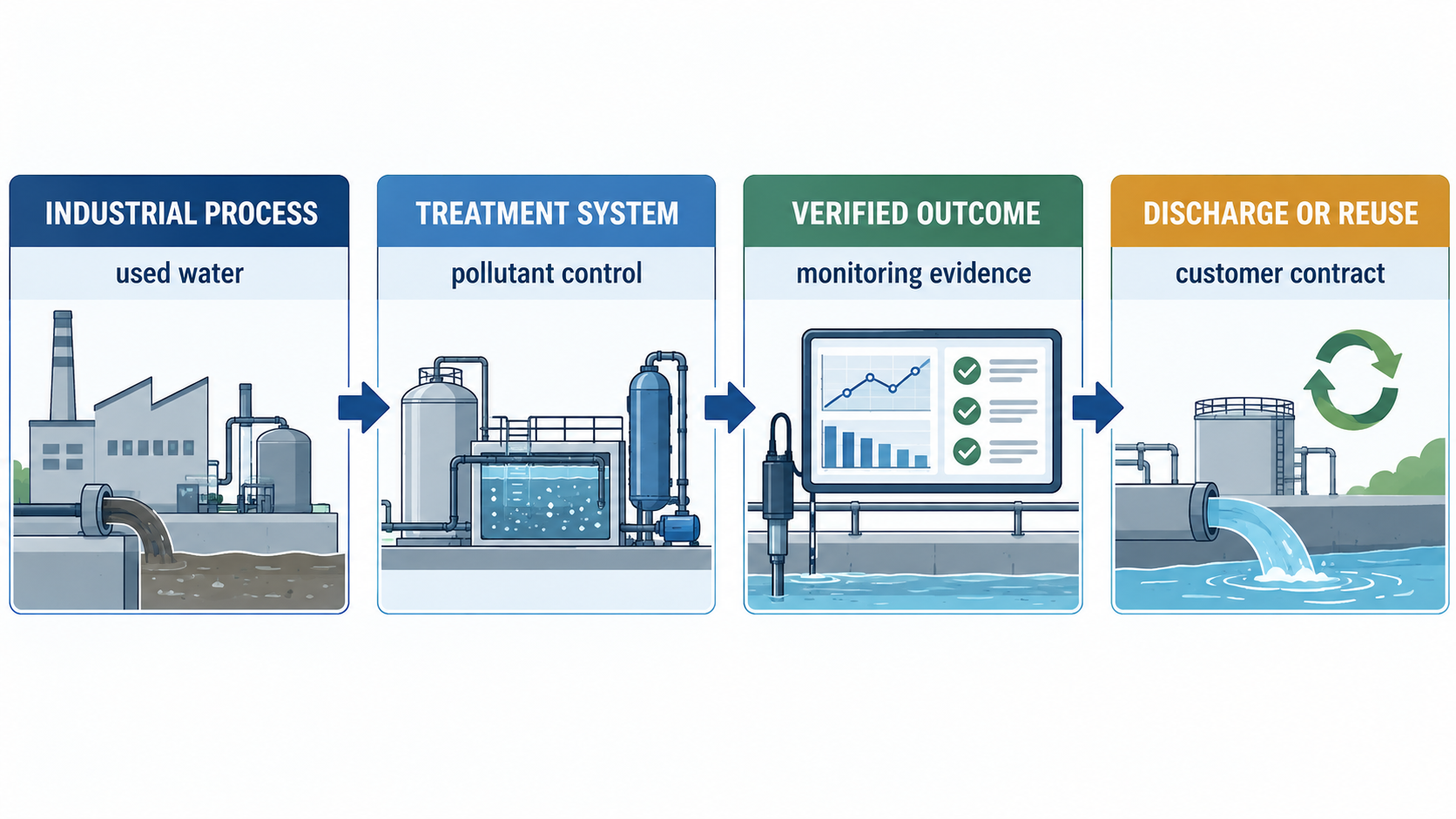
Effluent is water that has been used in an industrial or commercial process. It may contain organic matter, nutrients, metals, salts, oils, chemicals or suspended solids. The treatment process removes or reduces those pollutants to a level that supports the intended outcome.
That outcome may be discharge to a sewer, surface water or groundwater. It may also be internal reuse, such as process water, cooling water or wash water. The required treatment depends on the customer’s process, the discharge route, the receiving environment and the applicable permit or consent.
Effluent treatment companies can therefore take several forms:
- Technology suppliers sell treatment equipment, process packages, membranes, biological systems, dosing systems or monitoring hardware.
- Engineering and delivery firms design, install and commission a complete treatment system for a customer site.
- Operations and maintenance providers run treatment assets, manage consumables and maintain performance over time.
- Specialist service companies focus on difficult waste streams, compliance testing, sludge handling, monitoring or resource recovery.
The investor must identify which part of this chain the company controls. An equipment business may have strong technical IP but lumpy project revenue. An operator may have steadier service income but carry more delivery and working-capital risk. A monitoring company may be asset-light, yet depend on data quality and customer integration.
This distinction matters more than the label “water technology”. It determines how a company wins work, recognises revenue, funds growth and protects its customer relationship.
Where customer demand comes from
Industrial customers buy effluent treatment because untreated or poorly treated water creates a direct business problem. A site may face a discharge limit, a trade-effluent consent, a water shortage, a process constraint or the cost of transporting waste away.
Demand is strongest when treatment is linked to a measurable operating need. Examples include avoiding production downtime, keeping a permit, reducing freshwater purchases, increasing site capacity or enabling a new product line. A supplier that can quantify this link has a clearer route to a paid project.
The customer base can include food and drink processors, pharmaceutical manufacturers, chemical sites, metal finishers, paper mills, mining operations and industrial estates. Each segment has a different pollutant profile, decision cycle and tolerance for process change. Sector diversity can reduce concentration risk, but it can also increase sales and delivery complexity.
Water reuse can strengthen the case where a customer has a reliable source of used water close to the point of demand. The World Bank’s 2025 report on scaling water reuse says the business case is strongest in urban and industrial settings where wastewater is available close to the point of use. It also stresses that clear regulation, pricing signals and bankable delivery models are needed for private participation. The World Bank report explains the reuse case and its limits.
That does not make every effluent treatment company a reuse company. Investors should ask whether the company is solving discharge compliance, water supply, process efficiency or a combination of these needs. The answer should be visible in customer contracts and operating data.
Regulation creates a need, not a business
Regulation can create urgency, but it does not guarantee a profitable supplier. In England, an operator may need an environmental permit for a discharge to surface water or groundwater. The Environment Agency also requires the legal operator to have sufficient control of the activity, even when contractors perform parts of the work. The GOV.UK permit guidance sets out the operator, discharge and consent requirements.
This has an important commercial consequence. A contractor may install or operate a system, while the industrial customer remains legally responsible for the permitted activity. The supplier must therefore show that its process, monitoring and support help the customer meet the required conditions. It cannot treat compliance as a marketing slogan.
Environment Agency compliance assessments cover infrastructure, management systems, incident planning, emissions, monitoring, records, maintenance and reporting. The Agency says the risk assessment is adapted to the discharge, location and environmental receptors. The compliance guide shows why operating evidence matters alongside equipment design.
European regulation creates another demand channel. The European Commission describes the revised Industrial and Livestock Rearing Emissions Directive, known as IED 2.0, as a main EU instrument for reducing emissions to air, water and land from large industrial installations. The framework gives best available techniques a central role and supports stronger pollution control and resource efficiency. The Commission’s IED 2.0 overview gives the current policy context.
WIN’s water regulation resource gives readers a related overview, but investors should rely on the relevant regulator and the target company’s own permit records for diligence.
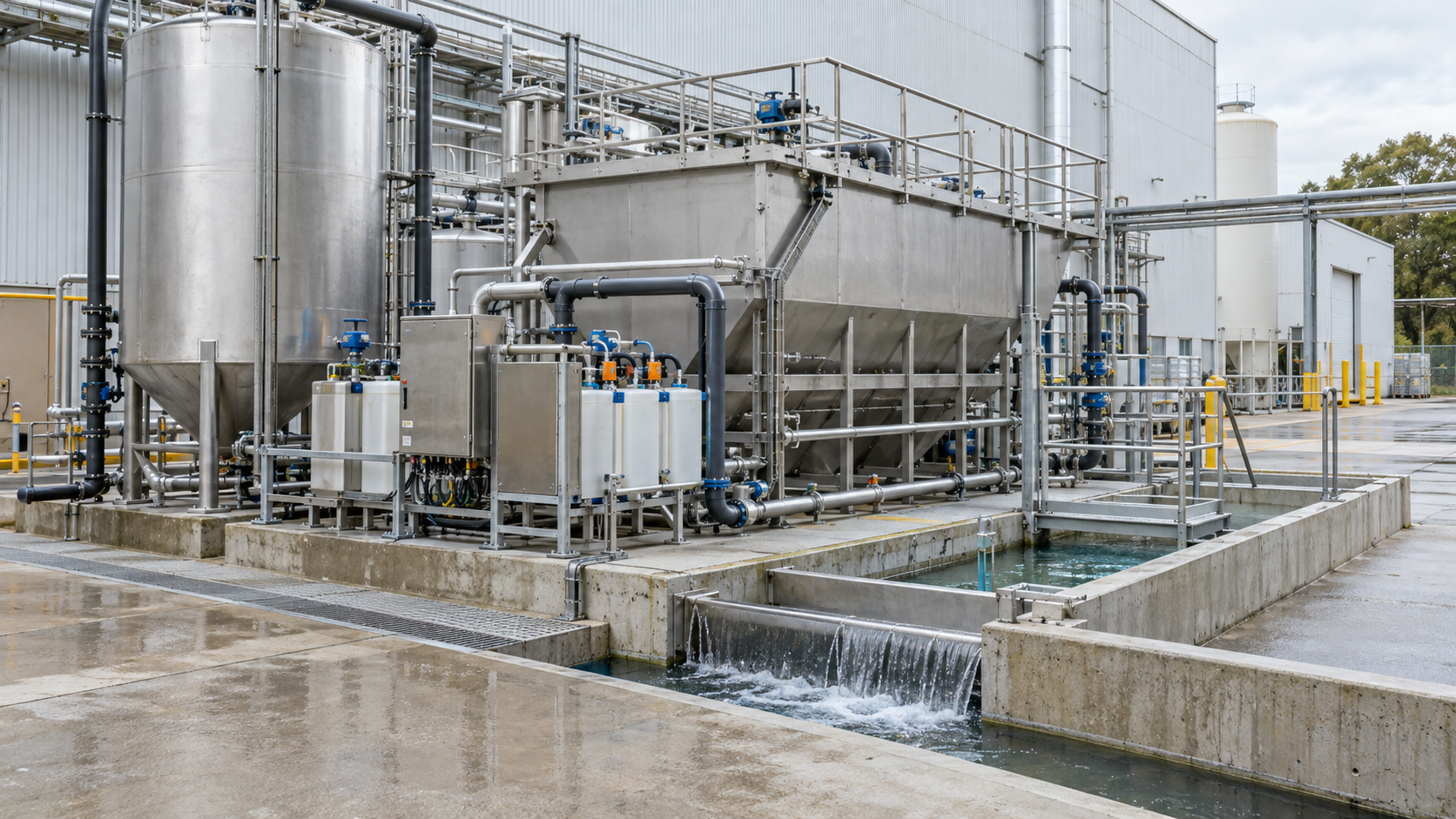
Investors should separate three questions: Is a rule real? Does it apply to the target customer? Can the company deliver a solution at an acceptable total cost? Only the third question tests the business.
Business models and revenue quality
Effluent treatment companies often combine project revenue with service revenue. The mix changes the risk profile and should be analysed by customer and contract, not only at group level.
- Equipment sales can generate a clear order but may be exposed to project timing, procurement cycles and margin pressure.
- Design and build can capture more value, but scope changes, commissioning delays and performance guarantees can consume margin.
- Operations and maintenance can create repeat income when the provider controls a valuable operating relationship and can renew on fair terms.
- Treatment as a service can align payment with treated volume or performance, but it may require more capital and careful risk allocation.
- Monitoring and compliance services can be recurring and asset-light, but the data must be trusted and embedded in customer decisions.
Revenue quality depends on more than duration. A five-year contract is not automatically strong if it can be cancelled, has weak payment protection or leaves energy and chemical costs with the supplier. Investors should review renewal rates, gross margin by contract, payment history, backlog conversion and customer concentration.
The strongest model may be a repeatable system with a clear service layer. The company wins an initial project, proves performance, adds monitoring and renews support. That path is only credible when the installed base is documented and the customer has a reason to stay.
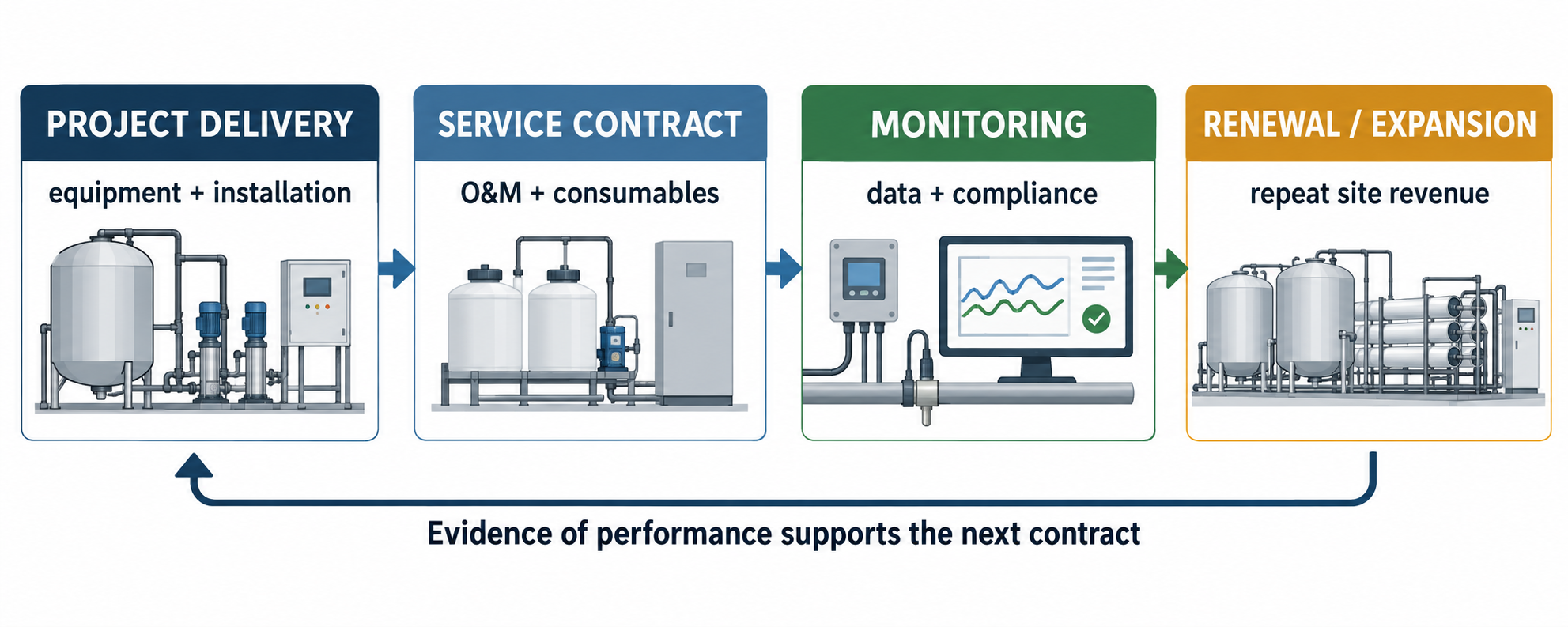
Unit economics: what moves margin
Effluent treatment unit economics start with the water stream. Flow rate, pollutant load, variability and required quality determine the process design. A system that performs well on a stable stream may struggle when the customer’s production mix changes.
The main cost drivers can include energy, chemicals, replacement media, membranes, labour, maintenance, sludge disposal, laboratory testing and site support. The customer may carry some of these costs, or the provider may carry them under a service contract. The contract must make that allocation clear.
Capital intensity matters as well. A company that builds or owns treatment assets may create a larger recurring revenue base, but it needs funding for equipment, installation and working capital. A company that sells components may grow with less capital, but it may have weaker control over the final customer outcome.
Investors should test margin using actual contracts and operating records. Ask how the company prices peak flow, changes in pollutant load, emergency call-outs, inflation, transport and disposal. Ask whether warranty claims, rework and commissioning support are included in reported project margin.
Cash conversion is a separate test. A profitable project can still create pressure if equipment must be purchased before the customer pays. Review payment milestones, retention amounts, inventory turns, receivables ageing and the working-capital effect of growth.
Technology risk and adoption proof
Effluent treatment is not one technology. Biological treatment, dissolved air flotation, filtration, membranes, adsorption, advanced oxidation and nutrient removal each suit different water streams. The question is not whether a process sounds advanced. The question is whether it works for the customer’s chemistry, operating conditions and discharge route.
Evidence should cover more than a pilot result. Investors should look for continuous operating data, performance against agreed limits, uptime, energy use, chemical consumption, maintenance records and customer acceptance. The evidence should be traceable to a real site and a defined process.
Adoption risk is often commercial. A treatment upgrade may require plant shutdowns, operator training, new monitoring, planning permissions or changes to the customer’s production process. A technically sound solution can still lose a sale if installation disrupts output or creates a new operating burden.
Defensibility can come from several sources: process know-how, a verified performance record, proprietary control software, difficult site integration, long customer relationships or access to a specialised waste stream. A patent alone does not prove a durable advantage.
Scaling beyond one site
Many water businesses look attractive at one customer site. Scaling requires a repeatable path from the first installation to the tenth. That path may involve standard modules, a documented design library, trained service teams, approved suppliers and a sales process that targets similar customer problems.
Standardisation can reduce engineering hours and shorten commissioning. It can also limit the need to redesign every system. Yet a company that claims a standard product should disclose where custom work remains. Site conditions, local permits, water chemistry and customer specifications can all add variation.
Geography changes the model. UK and European expansion may involve different permit systems, procurement norms and technical standards. GCC opportunities may involve water scarcity and reuse demand, but they can also involve different delivery partners, import requirements and payment structures. Regional growth should be assessed through signed work, local capability and a realistic route to service customers.
The European Investment Bank says it is supporting water infrastructure, treatment plants, pollution control and water-technology innovation as part of its water programme. That shows the sector has institutional attention, but it is not proof of demand for any individual supplier. The EIB’s water and wastewater overview provides wider investment context.
What separates a defensible company
A defensible effluent treatment company usually connects technical delivery to a recurring customer need. Its advantage may be a strong reference base in a difficult industry, a process that handles a hard waste stream, or a service model that reduces customer risk.
Look for five forms of evidence:
- Customer evidence: named customers, repeat orders, reference sites and a clear reason for purchase.
- Performance evidence: measured treatment results, uptime and maintenance history against contract requirements.
- Commercial evidence: gross margin by project, renewal rates, backlog quality and payment behaviour.
- Operational evidence: installation capacity, supplier resilience, safety controls and service response times.
- Regulatory evidence: a clear view of permit responsibility, monitoring duties and changes that may affect the customer.
Companies that can produce this evidence are easier to underwrite than companies that rely on a market narrative. The Water Investment Network portfolio is the relevant internal destination for readers assessing direct water-technology opportunities.
Diligence questions for investors
Before investing, an investor should test the business at customer, contract, technology and cash-flow level. A useful first meeting should lead to documents, not only a presentation.
- Which customer problem triggered each of the ten largest contracts?
- What percentage of revenue comes from equipment, installation, operations, monitoring and consumables?
- Which contracts renew, and what happened at the last renewal date?
- Who carries the risk of energy, chemicals, sludge disposal, inflation and performance shortfalls?
- What treatment results were achieved at each reference site, and who verified them?
- How long does a typical installation take from order to accepted performance?
- What happens when the customer changes its production process or pollutant load?
- How much working capital is needed to fund the next stage of growth?
- Which permits, consents and discharge agreements affect the customer’s decision?
- What would a strategic buyer be acquiring: technology, contracts, service capability, data or market access?
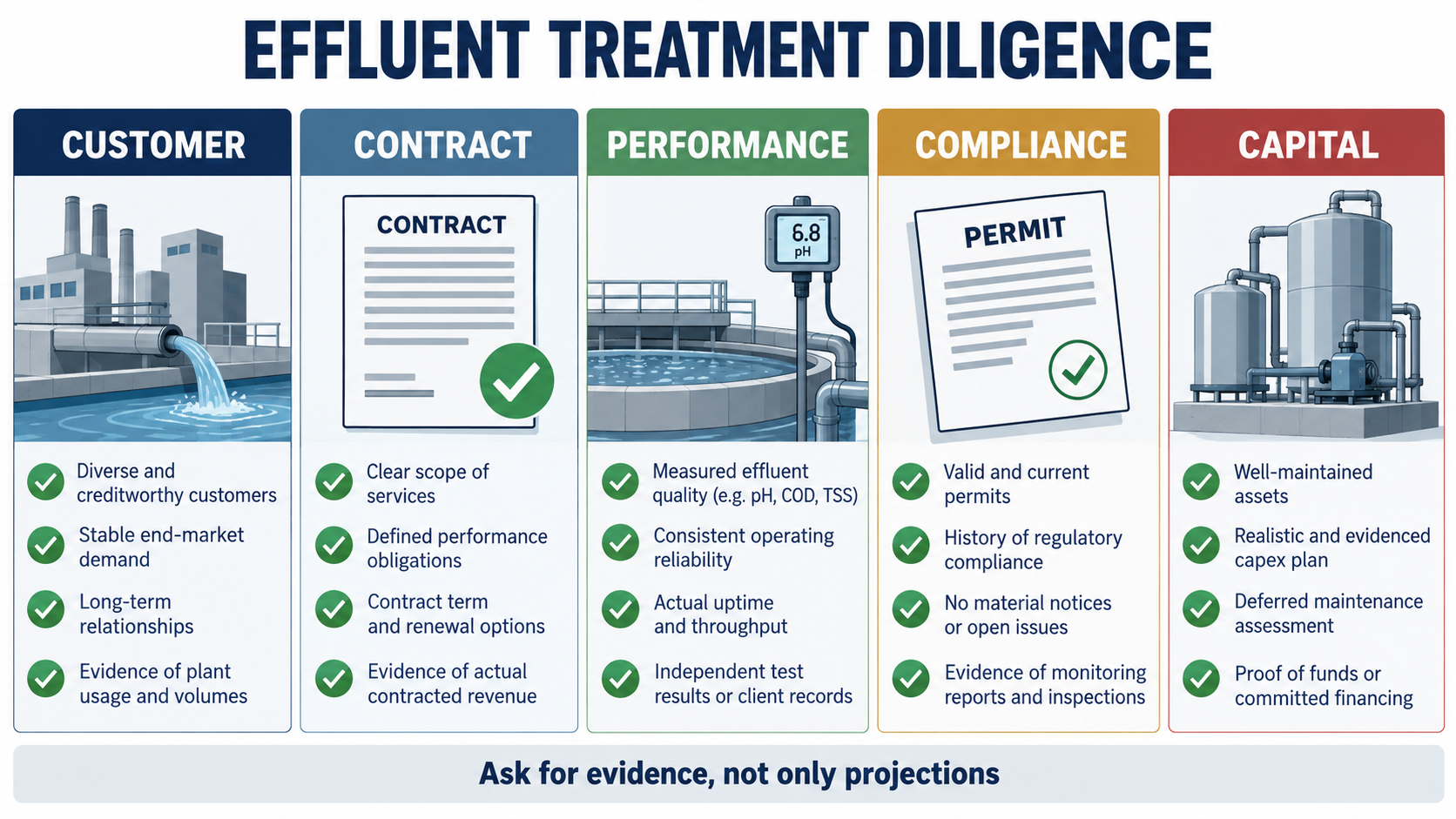
Investors should also compare claims with the underlying records. A customer list without contract values, a pilot without long-run data or a pipeline without procurement evidence should be treated as incomplete proof.
Principal risks and exit considerations
The sector carries technical, commercial and regulatory risks. Treatment failure can create penalties, customer claims, plant disruption and reputational damage. The risk is higher when the company makes performance promises that its monitoring and service systems cannot support.
Customer concentration can be material. One large industrial account may provide a strong reference and efficient service route, but it can also create dependence on one procurement team or production site. Review concentration by revenue, gross profit, receivables and installed capacity.
There is also a risk of mistaking regulation for automatic sales. Rules can increase the need for treatment, but customers still compare capital cost, operating cost, downtime and alternatives. A supplier must win the commercial decision as well as meet the technical requirement.
Exit analysis should focus on strategic value and evidence. Potential buyers may value a trusted customer base, hard-to-replicate treatment know-how, recurring service revenue, monitoring data or a platform that can add sites. Investors should not assume a buyer, valuation or return without transaction evidence.
Effluent treatment companies: investor FAQs
What do effluent treatment companies do?
They design, supply, install, operate or monitor systems that treat used industrial water before discharge, reuse or recovery.
Why can regulation support demand?
Permits and discharge conditions can require customers to control pollutants and maintain treatment evidence. Regulation creates a need, but the supplier must still offer a workable commercial solution.
What is the strongest revenue model?
There is no universal answer. Recurring operations, maintenance and monitoring can improve visibility, while project work may provide entry to a customer. Contract terms, margins and cash conversion matter more than the label.
What should investors verify first?
Start with customer contracts, measured site performance, renewal history, gross margin by project, working capital and permit responsibilities.
Are effluent treatment companies low-risk investments?
No. They can face technology, delivery, customer concentration, regulation, energy, chemical and working-capital risks. Each company needs its own evidence-led assessment.
Conclusion and investor next steps
Effluent treatment companies can offer direct exposure to a water-technology problem with clear industrial customers and measurable operating outcomes. The investable case depends on more than demand for cleaner water. It depends on a company’s ability to convert that demand into reliable treatment, repeat revenue and controlled cash use.
Investors should start with the customer’s problem, then test the permit route, treatment evidence, contract economics and scale path. This keeps the assessment commercial without losing sight of environmental performance.
For eligible investors who want to explore selected private water-technology opportunities, join the Water Investment Network. Review each opportunity on its own evidence, structure and risks.