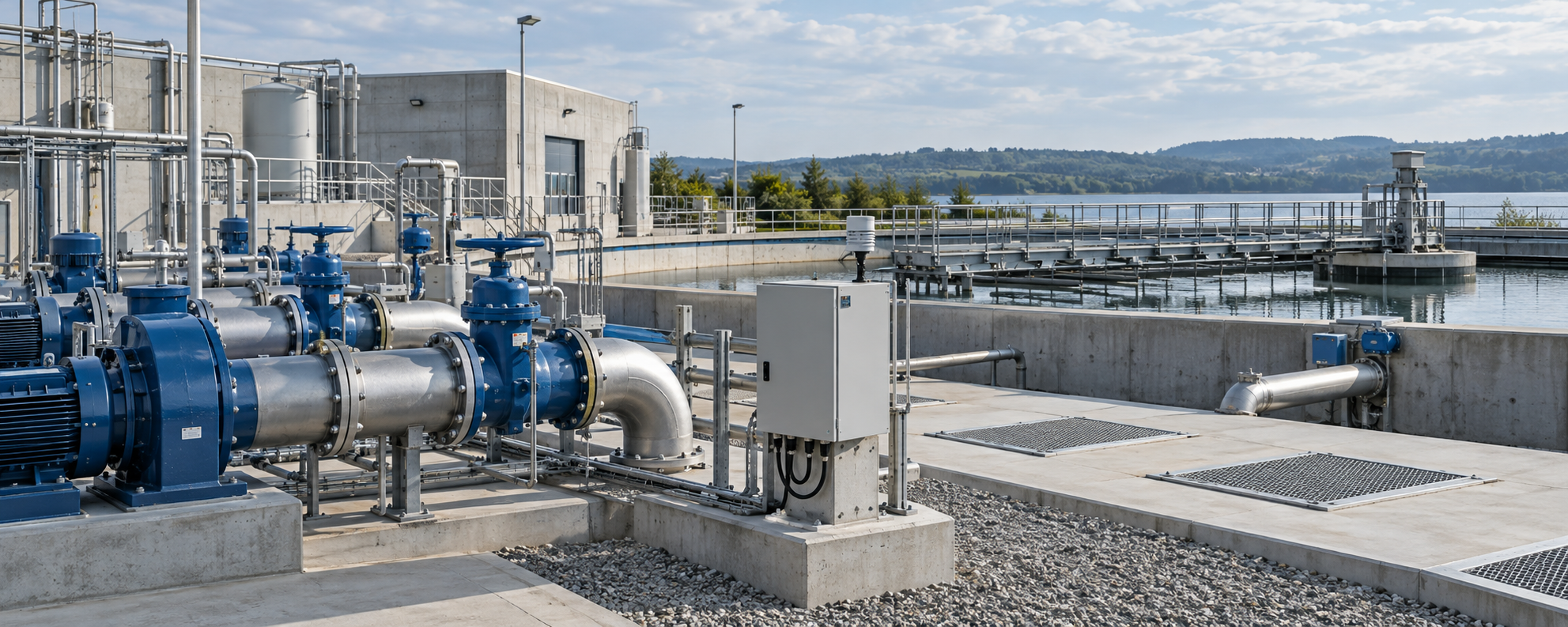
Water infrastructure asset management is becoming a commercial discipline, not just a maintenance function. Owners need to keep pumps, pipelines, treatment works, reservoirs and monitoring systems safe, compliant and productive over long lives. For investors, the opportunity sits with businesses that turn condition data and planned interventions into contracted customer value.
This is narrower than a general water infrastructure thesis. The question is not whether a region needs more assets. It is whether an asset-management company can identify a real failure risk, win budget approval, deliver the intervention and prove the result. The wider context is set out in the Water Technology Market investor guide, but this article focuses on the operating and commercial layer beneath that market.
Readers can also review the network’s portfolio context to understand how asset, technology and customer questions fit within direct private-company opportunities.
What water infrastructure asset management includes
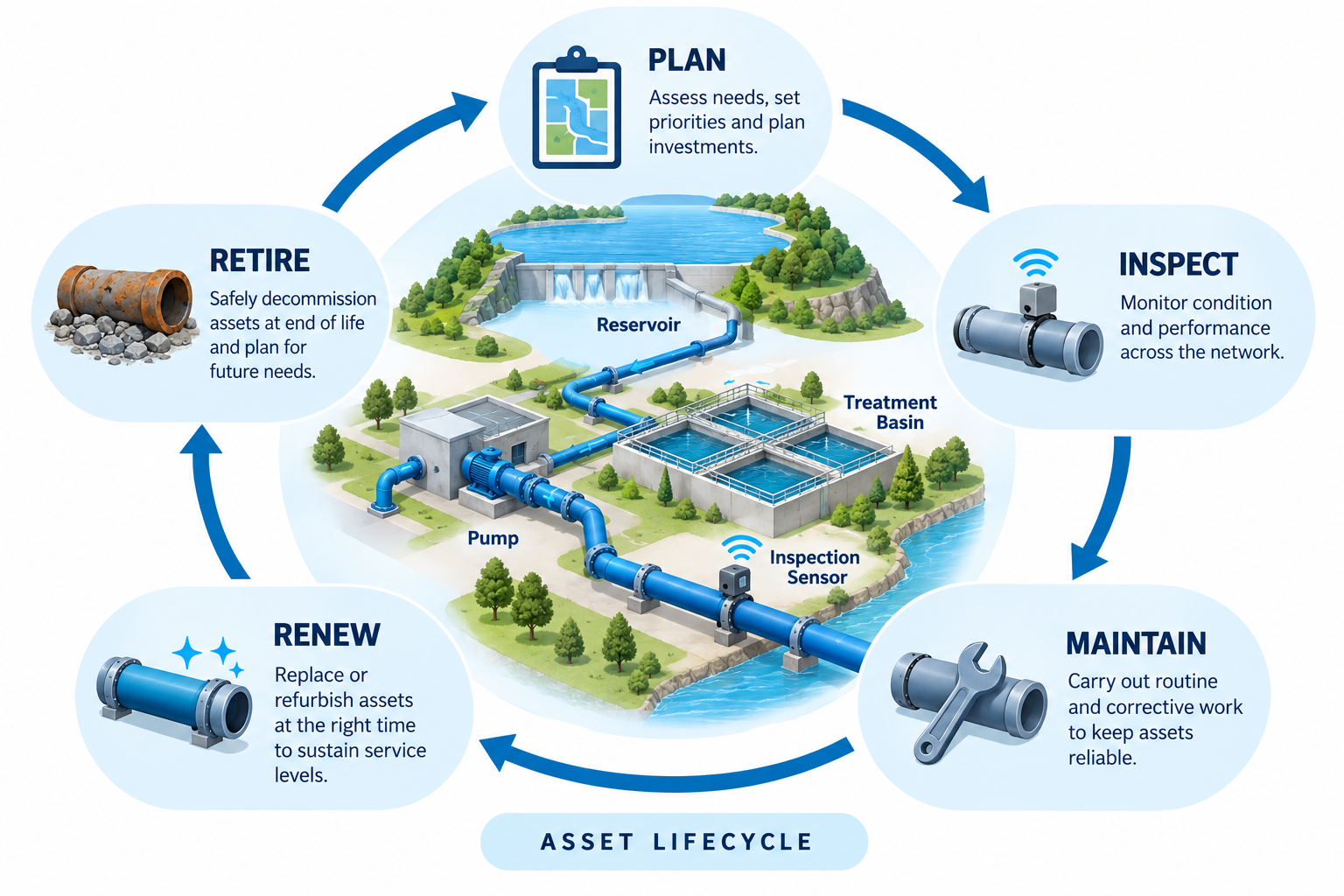
Asset management means managing infrastructure across its full life. It covers planning, acquisition, operation, inspection, maintenance, renewal, modernisation and retirement. The World Bank describes a lifecycle approach as a way to decide whether to build, rehabilitate, modernise or change operating practice while balancing performance, cost and risk.
In water, the asset base is connected. A pump affects pressure and energy use. A pipe affects leakage, service continuity and repair exposure. A treatment basin affects compliance, throughput and the cost of meeting customer demand. A sensor can improve decisions, but only when its data changes an operating or investment choice.
The investable market therefore includes several types of business:
- condition assessment and inspection providers;
- maintenance and refurbishment specialists;
- digital monitoring and decision-support providers;
- engineering and project-delivery businesses; and
- operators that manage water assets under service or performance contracts.
These models have different capital needs and revenue quality. A survey-led business may convert quickly but rely on project sales. A service operator may have more recurring revenue but carry greater delivery, staffing and working-capital risk. A software layer may scale faster, but it still needs reliable asset data and a customer willing to change decisions.
Why demand is becoming a funded problem
Demand is becoming more visible because water infrastructure now sits at the intersection of resilience, regulation, energy cost and economic activity. The European Commission’s water resilience strategy calls for water infrastructure to be modernised through public and private funding, supported by digital solutions. Its action areas include infrastructure investment, digitalisation, research and preparedness.
The European Investment Bank has also committed to increasing water investment to €15 billion between 2025 and 2027. Its programme covers reservoirs, pipelines, treatment plants, water-loss reduction and water technology. That is a financing signal, not a guarantee that every supplier or project will win work.
The EIB’s 2026 paper on future-proofing Europe’s water systems makes a related point. The constraint is not only the amount of finance available. It is how investments are originated, coordinated, funded and financed. This creates demand for businesses that can turn fragmented condition evidence into a prioritised, deliverable programme.
In the UK, water-resource planning creates a long planning horizon. Water companies in England and Wales must prepare and maintain a water resources management plan, forecast supply and demand for at least 25 years, and review the plan annually. This does not remove procurement or regulatory risk, but it can improve visibility of the problems that asset owners must solve.
There are also place-based examples of the scale of the challenge. The Fens 2100+ action plan projects £6 billion to £9.4 billion of investment demand to improve asset health and performance across Environment Agency and internal drainage board assets. It says public finance alone cannot meet the full need and identifies private investment and innovative finance as part of the response. That estimate relates to the Fens asset system, not the whole UK water market.
Investment thesis at a glance
| Question | What a credible company should show |
|---|---|
| Demand driver | Ageing or critical assets, regulatory obligations, service resilience, energy cost or customer expansion. |
| Paying customer | A named asset owner, utility, municipality, industrial operator or infrastructure manager with budget authority. |
| Revenue model | Assessment, project delivery, planned maintenance, monitoring, managed service or a defensible combination. |
| Scalability | Repeatable methods, standardised data, trained delivery capacity and a sales process that works beyond one site. |
| Key risks | Unreliable asset data, long procurement cycles, performance liability, labour shortages, capex overruns and customer concentration. |
| Measurable impact | Evidence of better reliability, lower loss, lower energy use, compliance or improved service outcomes. |
The table is a diligence framework, not a score. Each row needs evidence from contracts, asset records, operating data and customer references.
The customer problem comes before the technology
The strongest asset-management companies start with a costly customer problem. A customer may need to reduce unplanned downtime, extend the life of a critical pump, meet a discharge requirement, cut leakage or justify a capital-maintenance budget. A technical feature matters only when it improves one of those outcomes.
This is why “digital water” is not a sufficient investment description. A monitoring system can create value by detecting abnormal vibration, pressure or flow. It can also create noise if nobody trusts the data, owns the response or has budget to act. Investors should ask what decision changes after the product is installed.
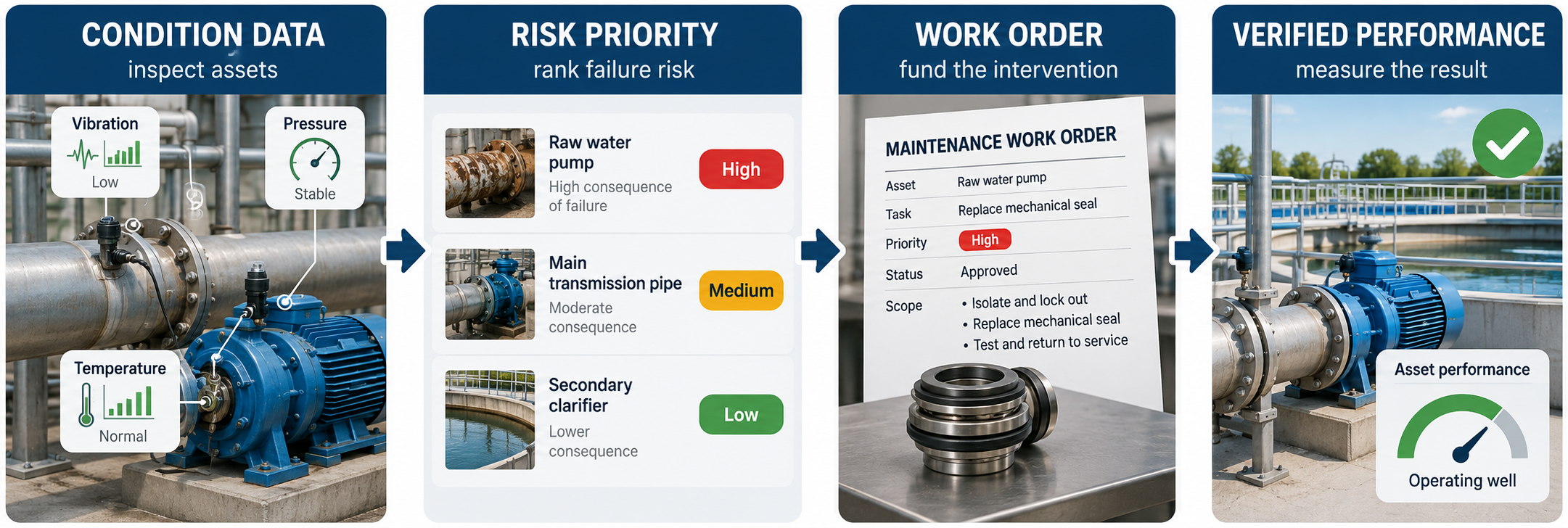
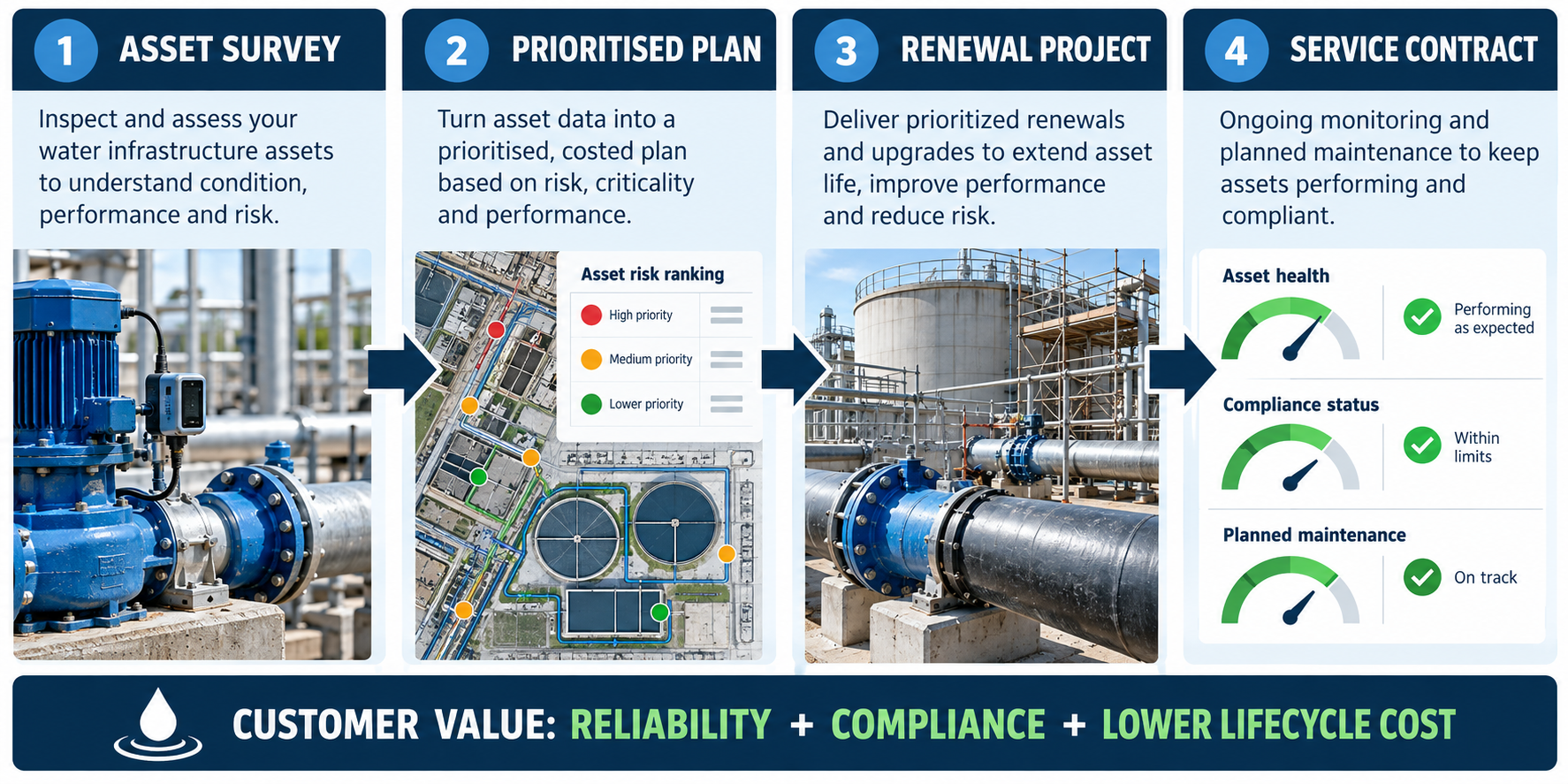
The customer journey usually has four stages:
- the owner establishes a problem through inspection, failure history or regulatory need;
- the provider ranks the asset by condition, criticality and consequence;
- the customer funds maintenance, renewal or an operating change; and
- the provider measures whether service, cost or compliance improved.
Asset data is part of the product
Asset condition is not a single number. It may combine age, failure history, inspection findings, operating performance, criticality, maintenance records and the consequence of failure. A mature provider makes those inputs comparable enough for a customer to choose what to do next.
The World Bank’s water-sector analysis describes asset management as assessing current condition, determining future needs and planning operations, maintenance, modernisation and rehabilitation across the asset lifetime. It also links this work to performance, cost-effectiveness and risk reduction.
That link matters for margins. Good data can reduce unnecessary site visits, prioritise high-consequence failures and make a renewal programme easier to defend. Poor data can create rework, missed defects and liability after an asset fails.
Energy is one clear commercial consequence. In the World Bank’s Europe and Central Asia analysis, water use embeds about 10% of average total primary energy consumption. The report says pumping accounts for about 80% of energy use in water and wastewater utilities and up to 40% of total operating costs in the cited analysis. These are regional findings, not universal company benchmarks, but they show why asset condition and operating choices can affect the cost base.
Revenue models and unit economics
Water infrastructure asset management businesses can earn revenue at different points in the lifecycle. Some sell surveys or inspections. Others deliver refurbishment projects, supply replacement equipment, provide planned maintenance or manage assets under a recurring service agreement.
Revenue quality depends on what the contract makes repeatable. A company with a strong first project may still have weak economics if every site needs bespoke engineering, customer approval takes months and payment arrives after completion. A smaller contract can be attractive when the scope is standardised, renewal is visible and the provider can serve several sites with the same method.
Investors should separate revenue from cash generation. Review gross margin by service line, mobilisation cost, subcontractor exposure, warranty obligations, retention payments and the timing of customer acceptance. A recurring label is not enough. The contract must define the work, performance evidence, renewal process and limits of liability.
Capital intensity also varies. Inspection and software models may need less fixed capital but depend on skilled staff and data quality. Renewal and operating models may create larger revenue but require working capital, equipment, insurance and delivery capacity. A credible plan explains how the company funds growth without making execution risk invisible.
Where margins and scalability are won or lost
Scalability in this market is operational, not just digital. A provider needs repeatable assessment methods, consistent asset taxonomies, reliable reporting and a delivery network that can work safely on live infrastructure. A platform cannot compensate for unclear scope, weak site access or poor handover between survey and intervention.
Standardisation can improve margin when it reduces engineering hours without hiding site-specific risk. Examples include common inspection templates, reusable condition categories, defined intervention packages, documented commissioning tests and a shared evidence model. The goal is not to make every asset identical. The goal is to make decisions comparable.
Procurement can be a defensibility test. A company may have good technical results but still struggle if it is not an approved supplier, lacks required certifications, cannot meet insurance terms or has no reference projects in the target customer class. Investors should test the full route from technical proof to purchase order.
UK, Europe and GCC: different routes to opportunity
United Kingdom
UK opportunities are shaped by long-term resource planning, regulated service outcomes, environmental requirements and public scrutiny. The Environment Agency and partner regulators require long planning horizons for water resources, while infrastructure programmes must still pass procurement, approval and delivery gates. The WIN regulation resource is a useful starting point, but investors must review the rule set for the exact asset and customer.
The commercial opportunity is often in helping an owner evidence condition, justify a maintenance choice or deliver a defined performance improvement. The risk is assuming that a regulatory need automatically produces a profitable supplier market. Budget ownership, framework access and contract terms remain decisive.
Europe
Europe is not one water market. Basin conditions, public procurement, utility structures and national implementation differ. The European Commission’s resilience strategy creates a common direction around modernisation, digitalisation and public and private investment, while the EIB’s recent work stresses the need for coordinated, system-level investment.
For investors, this supports a regional thesis only when the company has a clear entry route. Look for a repeatable use case, local delivery capability, evidence that the customer can fund the work and a plan for navigating different procurement and compliance settings.
GCC
GCC water opportunities often involve supply security, desalination, reuse, industrial development and the operating performance of critical infrastructure. The commercial case can be strong, but the diligence questions are different. Investors need to test the offtaker, payment security, operating partner, energy exposure, local content requirements and the practical route to long-term maintenance.
A UK or European reference does not prove GCC transferability. The same technology may face different feedwater, climate, energy, contracting and service conditions. Regional expansion should therefore be treated as a separate execution plan, not as a simple sales extension.
What investors should test in diligence
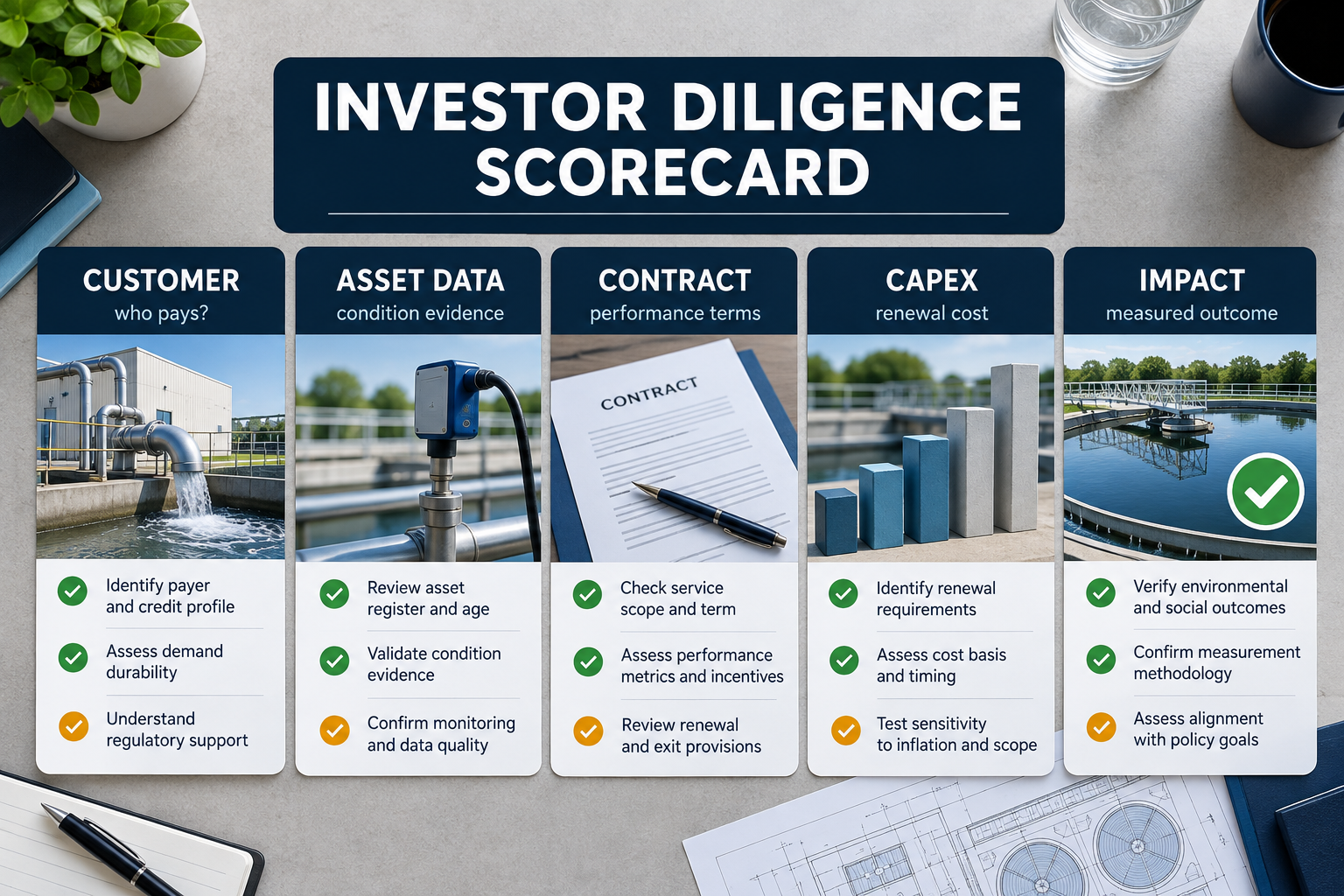
Diligence should start with the asset register and customer contract, not the product brochure. The aim is to connect a real condition or performance issue to a funded intervention and a measurable outcome.
- Customer: who owns the asset, who pays, who approves work and how concentrated is the customer base?
- Condition: how are age, criticality, failure history and inspection data recorded and verified?
- Contract: what are the service levels, acceptance tests, payment milestones, renewal rights and liability limits?
- Delivery: what work is done in-house, what is subcontracted and where could safety or access delay the programme?
- Capital: what renewal, mobilisation, inventory and working-capital needs sit behind growth?
- Impact: how are reliability, energy, water loss, compliance or service improvements measured?
Investors should also ask what happens when the evidence is incomplete. A company that is honest about data gaps may be safer than one that presents precise scores without a reliable audit trail. The right response may be a staged pilot, a limited warranty, a survey-first contract or an independent technical review.
Principal risks and what can change the thesis
Asset management can look defensive because water services are essential. That does not make the underlying business low risk. The risks are often practical and cumulative.
- Long sales cycles: public and regulated customers may require frameworks, tenders and multiple approvals.
- Performance liability: a provider may carry responsibility for an outcome that depends on the wider asset system.
- Data quality: incomplete asset records can undermine prioritisation and create avoidable rework.
- Delivery capacity: shortages of qualified people, specialist subcontractors or safe site access can limit growth.
- Capital intensity: renewal projects can grow revenue while consuming cash and increasing warranty exposure.
- Policy and procurement: a strategic priority can still move slowly through budgets, permissions and contracting routes.
- Customer concentration: one utility or infrastructure owner can represent a large share of revenue and negotiation power.
The thesis is stronger when the company can show commercial proof across more than one customer type, asset class or region. It is weaker when growth depends on one uncontracted programme, one grant, one technical claim or one large customer renewal.
Frequently asked questions and next steps
What is water infrastructure asset management?
It is the structured management of water assets across planning, operation, inspection, maintenance, renewal and retirement. The commercial focus is keeping service reliable and risks controlled over the asset lifetime.
Why can asset management create a private investment opportunity?
Asset owners need condition evidence, planned interventions and measurable performance. A company can create value when it converts those needs into repeatable services, projects or long-term contracts.
Is water infrastructure asset management a defensive investment?
Essential demand can support resilience, but it does not remove procurement, delivery, capital, customer or regulatory risk. Each opportunity needs company-level diligence.
What should investors review first?
Start with the paying customer, asset evidence, contract terms, cash conversion and the measurement method for the promised outcome. Then test whether the model can repeat across sites.
Does Water Investment Network provide regulated financial advice?
No. Water Investment Network provides access to selected direct private-company opportunities and investor information. It does not provide regulated financial advice or guarantee returns.
Eligible investors who want to assess direct water-technology opportunities can join the Water Investment Network. Any investment decision should be based on independent advice, complete diligence and the final terms of the specific opportunity.
Sources
- European Commission, Water Resilience Strategy.
- European Investment Bank, Water and wastewater.
- European Investment Bank, Future-proofing Europe’s water systems: From vision to investment.
- GOV.UK, Water resources planning guideline.
- GOV.UK, Fens 2100+: Case for Change and Partnership Action Plan.
- World Bank, De-Energizing Water: The Energy Footprint of Water Use.