Water infrastructure companies sit between a clear public need and a difficult private-market question: who pays, under what contract, and with what evidence of delivery?
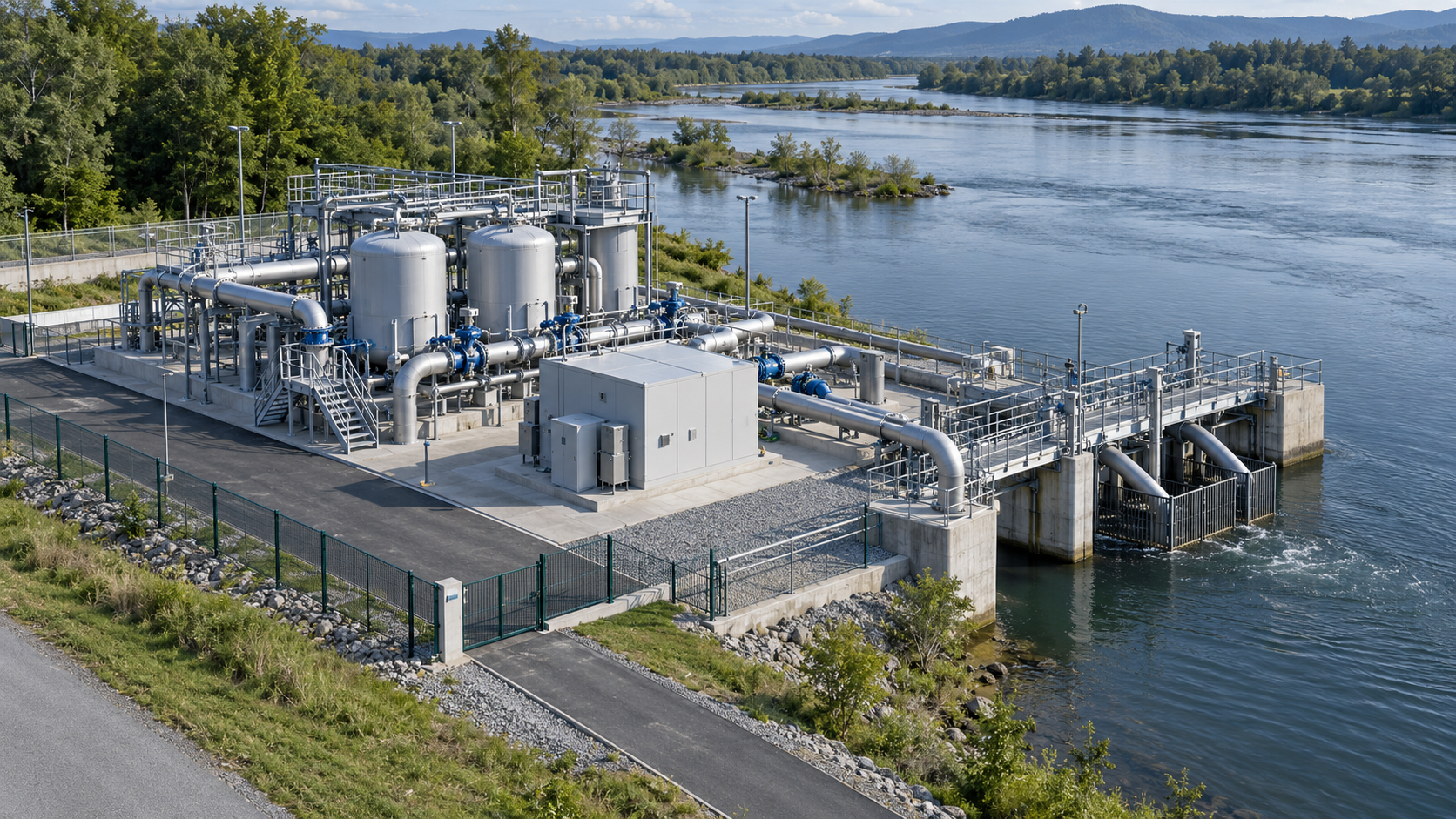
For investors, the category includes firms that design, build, upgrade, operate, monitor or maintain assets. Those assets can include treatment plants, pumping stations, storage, distribution networks, reuse systems and monitoring equipment.
The opportunity is not simply that water matters. It is whether a company can turn a funded customer problem into repeatable revenue, acceptable margins and measurable outcomes. This article sets out the commercial case, the main business models and the diligence tests that matter before considering a direct private-company opportunity.
Why water infrastructure companies are an investment category, not one market
Water infrastructure companies do not all sell the same product. One may deliver a treatment upgrade. Another may provide planned maintenance. A third may sell monitoring hardware with a data service. A fourth may manage a programme across several sites.
That difference changes the investment case. Project contractors may have larger order values but uneven revenue. Service providers may have better visibility but carry more delivery and liability risk. Digital monitoring firms may scale faster, but only if their data becomes part of a customer’s operating process.
The first question is therefore not whether a company operates in water. It is which part of the infrastructure decision it controls. Investors should map the route from customer problem to paid work, then test where value is retained. The wider water technology market investment context can help frame that comparison.
Why demand is becoming a funded problem
The European Investment Bank says Europe’s water systems face pressure from climate change, biodiversity loss, ageing infrastructure and growing water needs. Its 2026 report also says that the obstacle is often how investments are originated, coordinated, funded and financed, rather than finance alone.
That distinction matters for companies. A recognised need does not become revenue until a customer has a budget, a procurement route, an approved scope and a way to verify the result.
The European Commission’s water resilience strategy places public and private investment, infrastructure modernisation and digital solutions among its main action areas. It also calls for better water efficiency and reduced leakage. These are useful demand signals, but they do not remove the need to test customer access and contract quality.
In England and Wales, water resources management plans must show how companies will secure supply, protect the environment and plan over at least 25 years. The guidance links company plans with regional planning, business plans and major project cost reviews. That creates a long planning horizon, but not a guaranteed supplier order book.
What water infrastructure companies actually do
A company can create value at several points in the infrastructure lifecycle. The work may start with a survey or feasibility study and continue through design, procurement, construction, commissioning and operations.
- Supply and treatment: build or improve assets that abstract, treat, store or distribute water.
- Wastewater and reuse: reduce pollution, recover water or improve the performance of a treatment process.
- Networks and pumping: manage pipes, pumps, storage and control systems that move water through a network.
- Monitoring and control: collect evidence on flow, quality, condition, energy use or performance.
- Asset services: inspect, maintain, repair or renew infrastructure under a project or service contract.
Technical language can hide the commercial question. For example, a condition-monitoring system is a set of sensors and processes that show how an asset is performing. Its value depends on whether the customer uses that evidence to avoid downtime, prioritise capital expenditure, meet a requirement or improve service reliability.
Investment thesis at a glance
| Investment question | What to establish |
|---|---|
| Demand driver | Which funded customer problem creates the need for the work? |
| Paying customer | Who owns the asset, controls the budget and signs the contract? |
| Revenue model | Is revenue project-based, recurring, data-led or a mix of these? |
| Scalability | Which parts of delivery can be standardised without hiding site risk? |
| Principal risks | What could delay procurement, consume cash or create performance liability? |
| Potential exit routes | Which strategic or infrastructure buyer could value the capability? |
| Measurable impact | How will reliability, water quality, leakage, energy or compliance outcomes be evidenced? |
This framework keeps the thesis commercial. It also prevents a policy target or technical feature from being mistaken for a business model.
How customer need becomes revenue
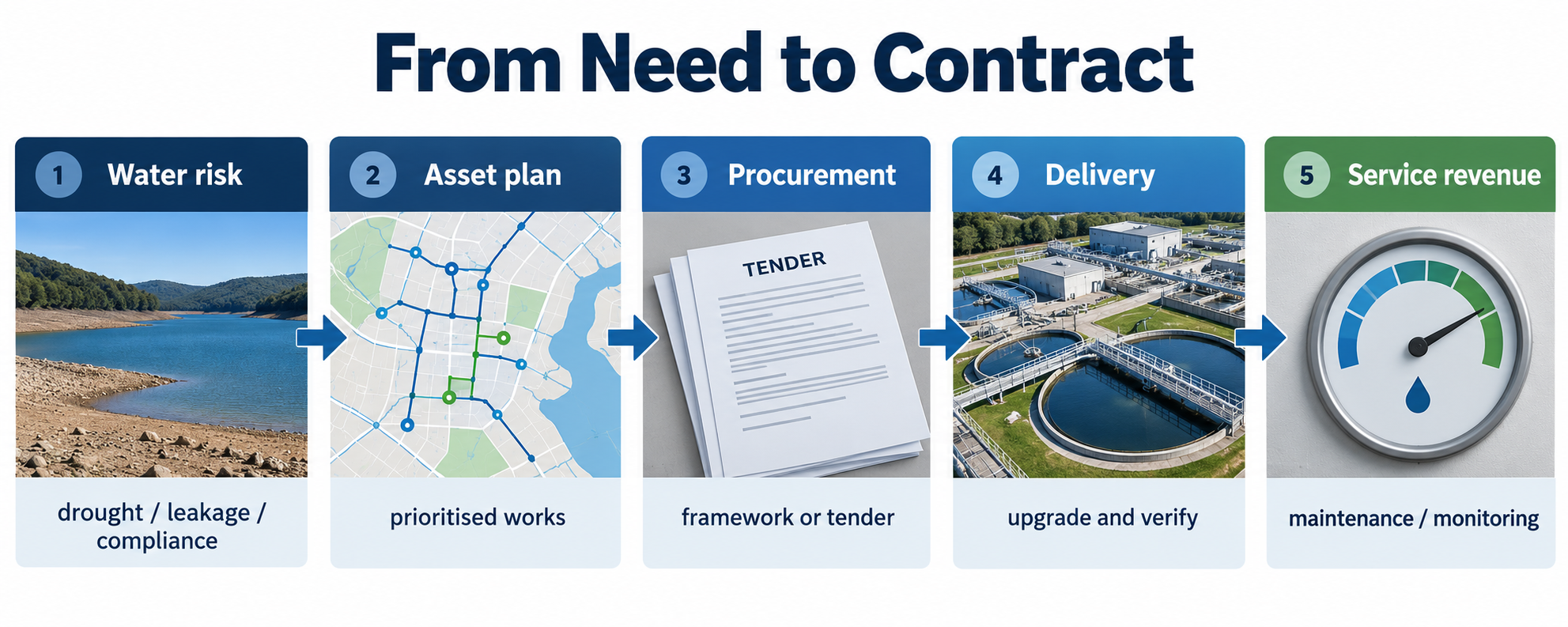
Customer demand usually begins with a risk or obligation. A utility may need more secure supply. An industrial site may need to reduce water use. A municipality may need to upgrade an ageing treatment asset. A regulator or planning process may require evidence that a proposed option is safe and deliverable.
The company earns revenue when it can define the work, win approval and deliver an outcome that the customer can accept. That may happen through a framework, tender, negotiated project, operating contract or recurring service agreement.
Investors should ask how much of the pipeline is funded. Separate signed work, preferred-bidder status, approved programmes, qualified opportunities and early conversations. The categories have different probabilities, working-capital needs and time to cash.
The EIB’s water investment analysis is useful here because it highlights coordination across whole water systems. A company that solves only one narrow task may still prosper, but its route into larger programmes must be clear. Look for a position in the decision chain, not just a list of potential projects.
Business models and cash conversion
Water infrastructure companies commonly combine three revenue lanes. Project delivery covers design, construction and upgrades. Recurring service covers maintenance, operations and support. Data and monitoring cover inspection, evidence and decision tools.
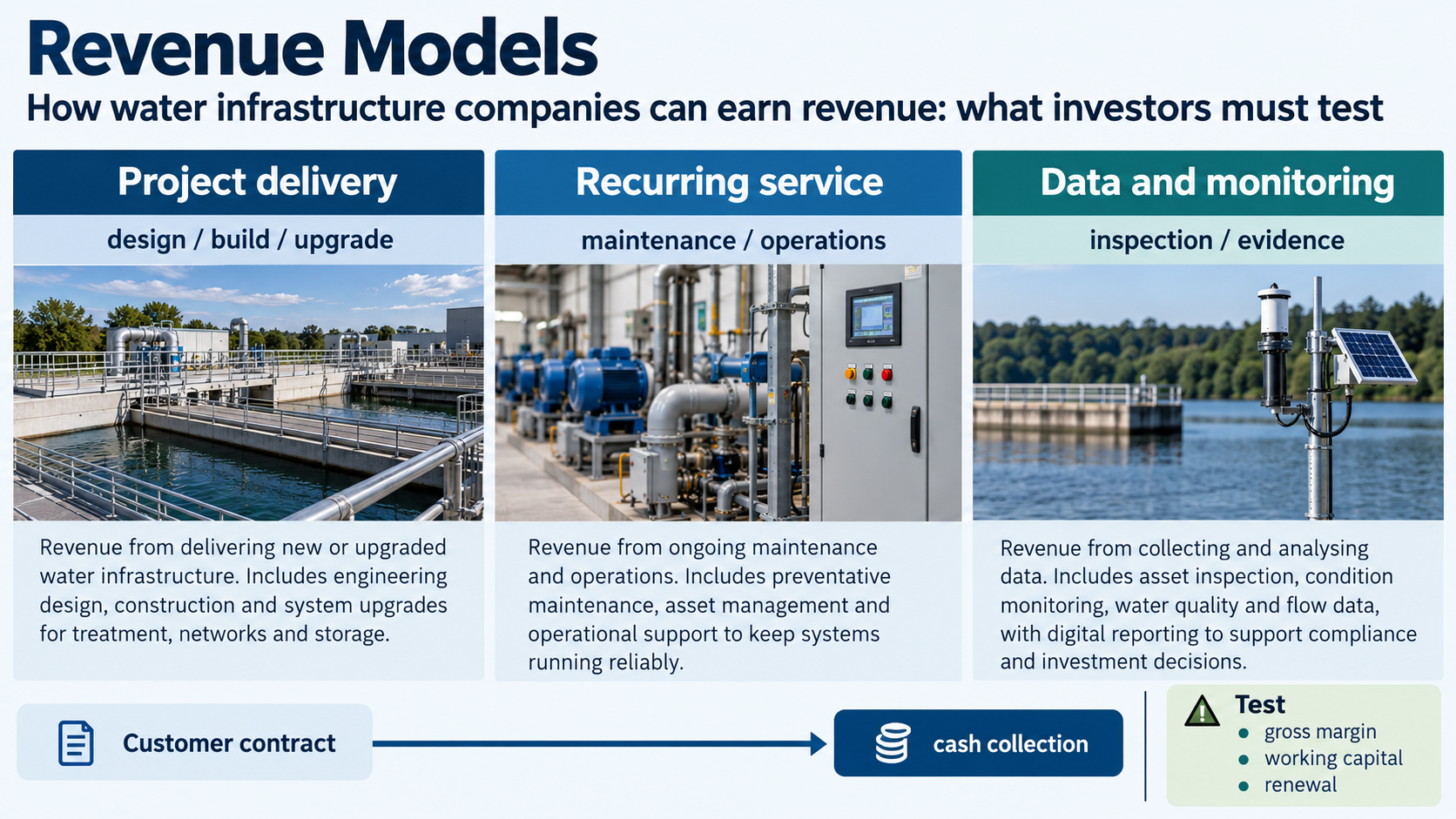
None of these lanes is automatically superior. Project work can create a strong customer relationship but consume cash before milestone payment. Recurring work can improve visibility while adding response obligations. Data revenue can be attractive when it is embedded in a customer workflow, but weak when it is treated as an optional dashboard.
Review gross margin by service line. Then test mobilisation cost, subcontractor use, warranty exposure, payment milestones, retention, inventory and debtor days. A company can report growing revenue while cash conversion deteriorates.
Contract renewal also needs evidence. Ask how many customers renewed, what changed at renewal and whether the company had to discount or add unpriced work. A recurring label is not proof of recurring economics.
Scaling beyond one site
Operational scale is the central test for many water infrastructure companies. A successful installation proves that a solution can work in one setting. It does not prove that the same margin or outcome will hold across different water quality, site access, procurement rules and customer teams.
Strong companies make delivery more repeatable. They use clear specifications, standard commissioning tests, defined maintenance routines, trained partners and consistent reporting. They still allow for site-specific engineering where the risk requires it.
Scaling can also change the capital profile. More projects may require inventory, specialist equipment, additional insurance, longer receivables and a larger delivery team. Investors should model the cash needed to move from signed order to accepted work.
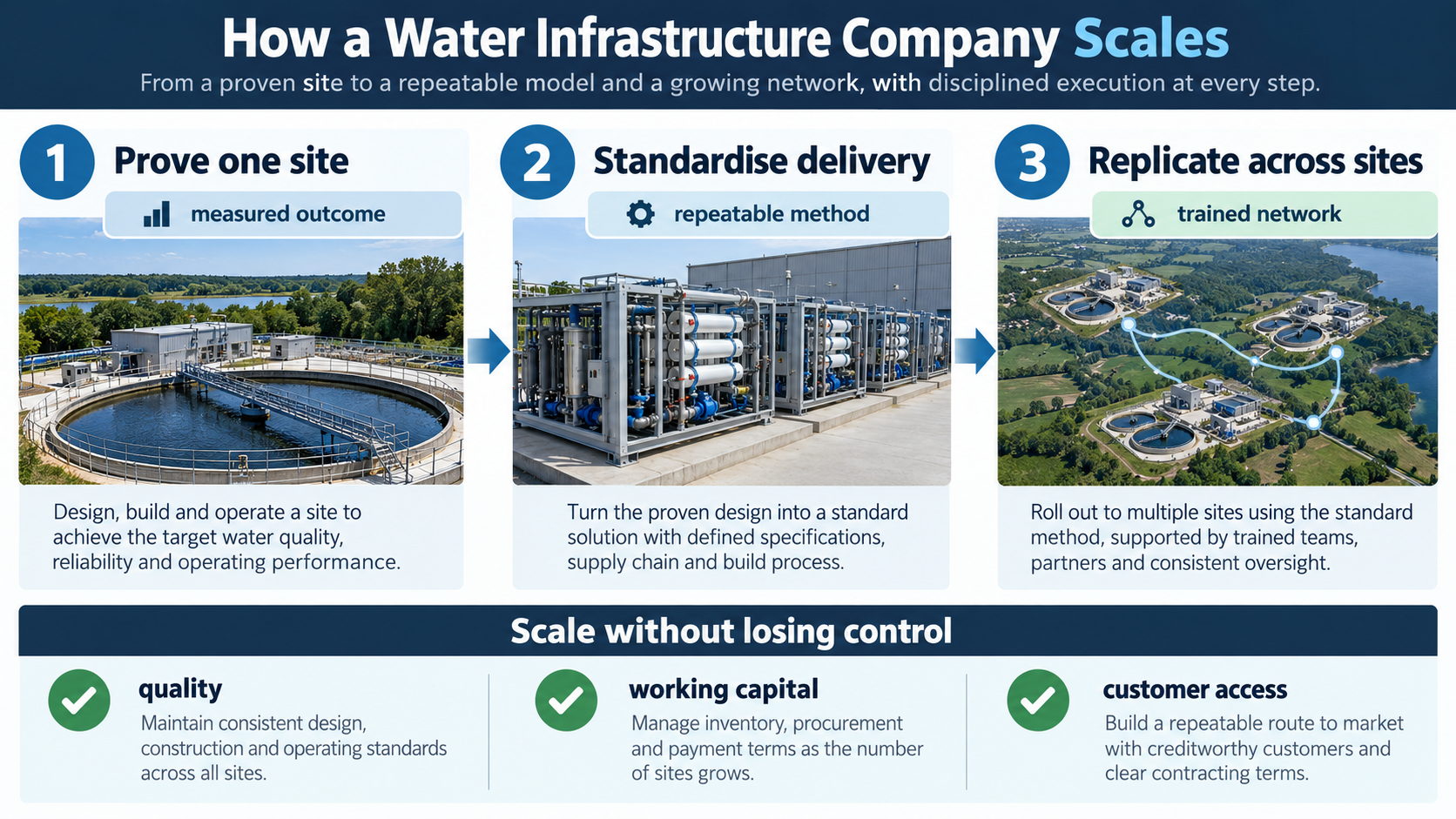
Defensibility may come from a combination of site references, approvals, data history, operating know-how and customer integration. A patent or a technical feature can help, but it does not replace a credible route to procurement and repeat work.
UK, Europe and GCC: different routes to opportunity
United Kingdom
UK opportunities often sit within long-term resource planning, regulated outcomes, environmental requirements and public procurement. The GOV.UK water resources planning guidance says regional plans should consider secure supplies, environmental protection and options that deliver wider resilience benefits.
For a company, the opportunity may be a defined contribution to a larger plan. Investors should test framework access, approved-supplier status, the budget owner and the time between technical selection and purchase order. The WIN regulation resource can provide context, but it is not a substitute for company-level diligence.
Europe
Europe is a group of water markets, not one procurement system. The European Commission’s strategy creates a shared direction around modernisation, efficiency, digitalisation and public and private investment. The EIB also stresses the need to coordinate investment across water systems and catchments.
A company seeking regional growth needs more than a broad European addressable market. It needs a clear first country, a paying customer, local delivery capacity and a plan for different rules, procurement practices and technical conditions.
GCC
GCC opportunities can involve desalination, reuse, industrial water, supply security and critical infrastructure operations. The commercial questions include the offtaker, payment security, energy exposure, local service capacity, contracting structure and long-term maintenance.
A UK or European reference site may support credibility, but it does not prove transferability. Feedwater, climate, energy costs, local content requirements and operating partners can all change the economics.
What investors should test in diligence
Start with the customer and asset evidence. The World Bank describes water asset management as assessing assets and making timely interventions such as inspection, repair and replacement. It also links asset condition to risk-informed investment decisions.
- Customer: who pays, who approves the work and how concentrated is revenue?
- Asset proof: what site data shows that the problem exists and the solution works?
- Contract: what are the scope, acceptance test, payment milestones, renewal terms and liability limits?
- Delivery capacity: which work is done in-house and where do people, partners or site access constrain growth?
- Cash conversion: how much working capital is needed before the customer pays?
- Impact evidence: how are reliability, water quality, energy, leakage or compliance outcomes measured?
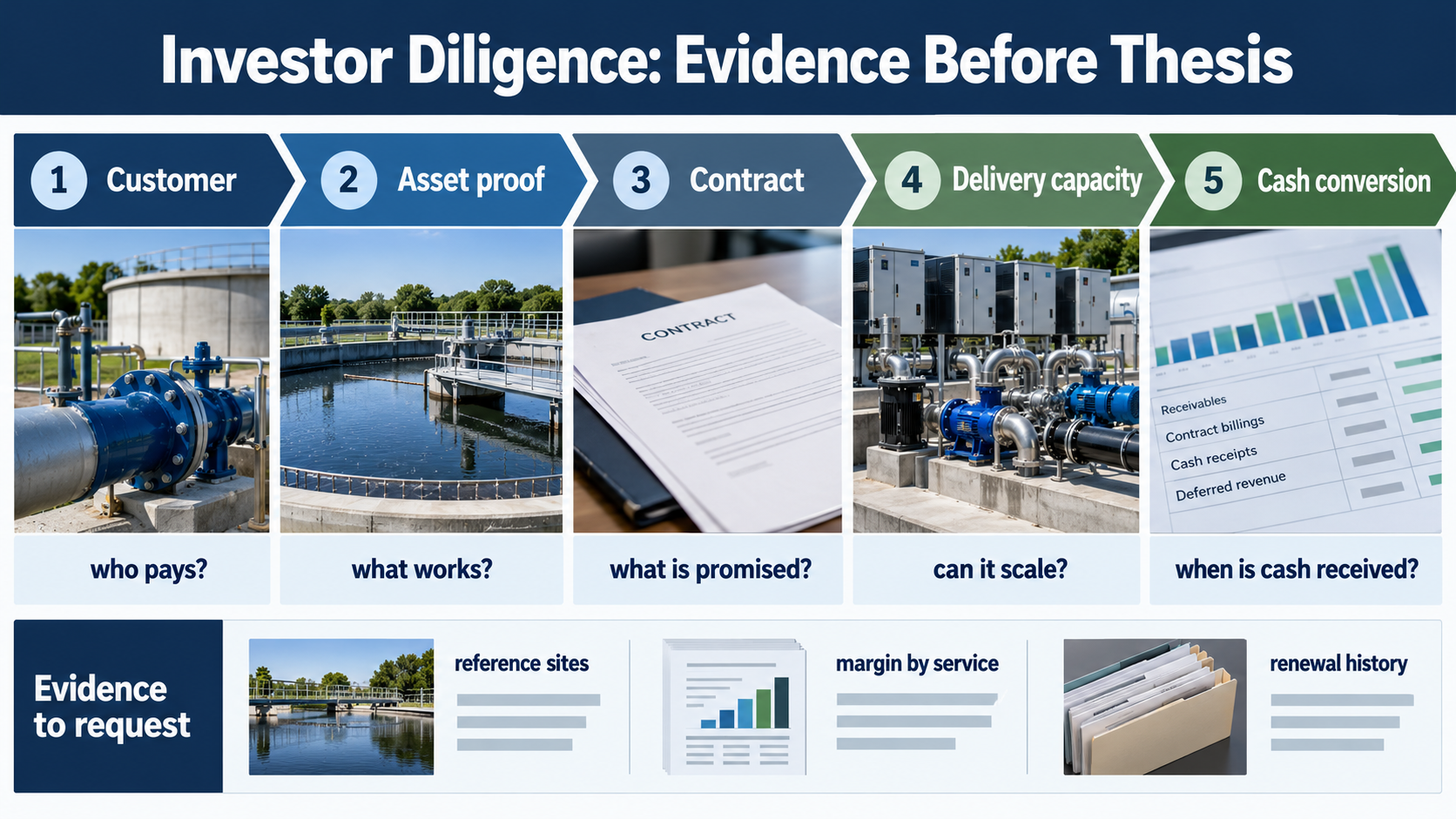
Ask for reference sites and speak to customers where possible. Review margin by service line, the history of change orders, warranty claims, renewal rates and delayed invoices. The objective is to understand the repeatable economics, not just the technical outcome.
Also test data quality. Precise scores built on incomplete asset records can create false confidence. A staged pilot or independent technical review may be safer than accepting an unsupported scale assumption.
Principal risks and what can change the thesis
Water infrastructure can look defensive because the underlying service is essential. The company can still be exposed to long sales cycles, project delays, customer concentration and poor cash conversion.
- Procurement risk: a recognised need may take years to become an order.
- Performance risk: the company may be held responsible for an outcome affected by the wider system.
- Capital risk: growth may require equipment, inventory, people and receivables funding.
- Customer risk: a small number of utilities, industrial groups or public bodies may hold negotiating power.
- Regulatory risk: a rule or planning priority may change the scope, timing or approval path.
- Execution risk: installation, commissioning, safety and maintenance may be harder across sites than in a pilot.
- Technology risk: an asset or monitoring method may not perform under different operating conditions.
The thesis is stronger when the company shows repeat customers, documented outcomes and a controlled route from order to cash. It is weaker when growth depends on one uncontracted programme, one grant, one technical claim or one customer renewal.
Frequently asked questions and next steps
What are water infrastructure companies?
They design, build, operate, maintain, monitor or upgrade assets used to supply, treat, store, distribute, reuse or manage water and wastewater.
Why can water infrastructure companies attract private investors?
They may serve funded infrastructure needs and can combine project revenue with recurring services or data-led work. Each company still needs separate diligence on customers, contracts, margins and cash.
Are water infrastructure companies defensive investments?
Essential demand can support resilience, but it does not remove procurement, delivery, capital, customer or regulatory risk. The company’s revenue quality matters more than the theme alone.
What should investors review first?
Start with the paying customer, the asset evidence, the contract, gross margin by service line and the path from delivery to cash collection. Then test whether the model can repeat across sites.
Does Water Investment Network provide regulated financial advice?
No. Water Investment Network shares information about selected direct private-company opportunities. It does not offer regulated financial advice or promise investment returns.
Investors who want to assess selected direct water-technology opportunities can review the Water Investment Network portfolio and join the network. Any investment decision should be based on independent advice, complete diligence and the final terms of the specific opportunity.
Sources
- European Investment Bank, Future-proofing Europe’s water systems: From vision to investment.
- European Commission, Water resilience strategy.
- Environment Agency, Natural Resources Wales and Ofwat, Water resources planning guideline.
- World Bank, Asset Management for Resilient Water Supply and Sanitation Services.