
In brief: Water innovation becomes an investable opportunity when a new solution moves beyond technical novelty. It must solve a paying customer’s problem, produce evidence in the field and support repeatable revenue.
For private investors, water innovation covers more than a new membrane or sensor. It can include better water efficiency, treatment, reuse, monitoring, data and resource recovery. The commercial question is whether the innovation improves cost, capacity, compliance, resilience or service quality for a defined customer.
The opportunity is gaining policy and capital attention. The European Commission’s water resilience strategy places public and private investment, digitalisation, research and innovation in the same action framework. [1] That does not remove execution risk. It does make the route from water need to commercial adoption easier to examine.
Why water innovation is moving into the investment conversation
Water systems face pressure from ageing assets, climate change, pollution, population growth and industrial demand. These pressures matter to investors only when they create a budget, a contract or a measurable operating problem.
The European Commission says global water demand could exceed available resources by 40% by 2030. It also identifies water technology, digital solutions and research as part of the response. [1] This is a policy signal, not a revenue forecast for any company.
The World Bank’s 2030 Water Resources Group reports a similar shift from dialogue towards delivery. Its 2025 report describes work to strengthen how water investments are planned, financed and delivered. It also focuses on mobilising private-sector innovation across water for people, food and planet. [3]
This creates a useful investment lens. The strongest water innovation companies do not sell novelty alone. They help a customer reduce a cost, meet a requirement, protect production, secure supply or make an existing asset perform better.
What counts as water innovation
Water innovation is a commercial improvement that changes how water is sourced, treated, measured, reused or managed. It may be a physical system, a component, a process, software, data service or a new operating model.
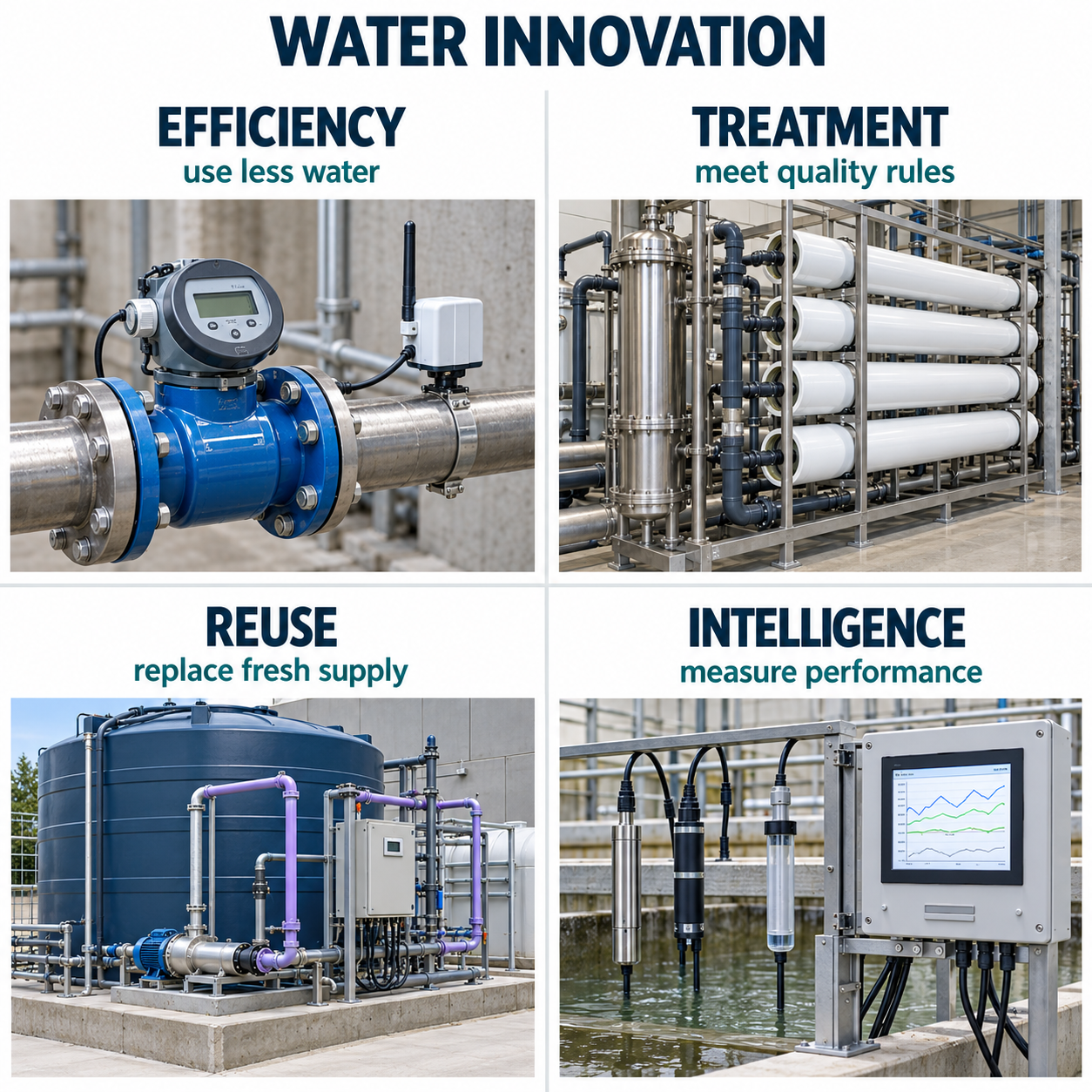
Efficiency reduces water use, leakage or energy consumed per unit of treated water. Treatment removes contaminants or improves water quality. Reuse turns treated water into a reliable input for another process. Intelligence improves measurement, control, maintenance or decision-making.
The categories overlap. A sensor can support a treatment plant, while data can reduce chemical use and extend asset life. Investors should therefore assess the customer outcome first, then decide which technology category best describes the business.
Water innovation investment thesis at a glance
The investment case is strongest when each part of the thesis can be supported by company evidence. A large addressable market cannot compensate for weak customer proof or poor cash conversion.
| Question | What to test | Why it matters |
|---|---|---|
| Demand driver | Which customer problem creates a budget? | Need must become a funded buying decision. |
| Paying customer | Who signs, pays and owns the outcome? | Decision-makers and users may be different. |
| Revenue model | Is revenue linked to equipment, service, data or performance? | Billing terms shape revenue quality and cash timing. |
| Scalability | What can be standardised across sites? | Repeatable delivery can reduce sales and installation friction. |
| Defensibility | What survives a competitor’s technical comparison? | Application knowledge, data, contracts and service capability may protect the position. |
| Key risk | Which assumption could stop adoption? | Technical, regulatory, procurement and financing risks can interact. |
| Potential exit route | Which strategic or private-market buyer could value the asset? | A possible exit is not a promised outcome. |
| Measurable impact | What water, energy, quality or pollution result is recorded? | Impact evidence should be linked to the operating process. |
This framework complements the wider water technology market investment guide. The focus here is narrower: how innovation becomes a product, service or operating model that a customer can adopt.
From pilot to repeatable sales
Many water innovations can work in a controlled test and still fail to become a business. A pilot may use unusual support, generous customer access or a founder-led sales process. Investors need evidence that the solution can survive normal procurement and operating conditions.
The European Investment Bank’s 2026 paper on Europe’s water systems makes a related point. It says the main barrier is not simply a lack of finance. The way investments are originated, co-ordinated, funded and financed also matters. [2]
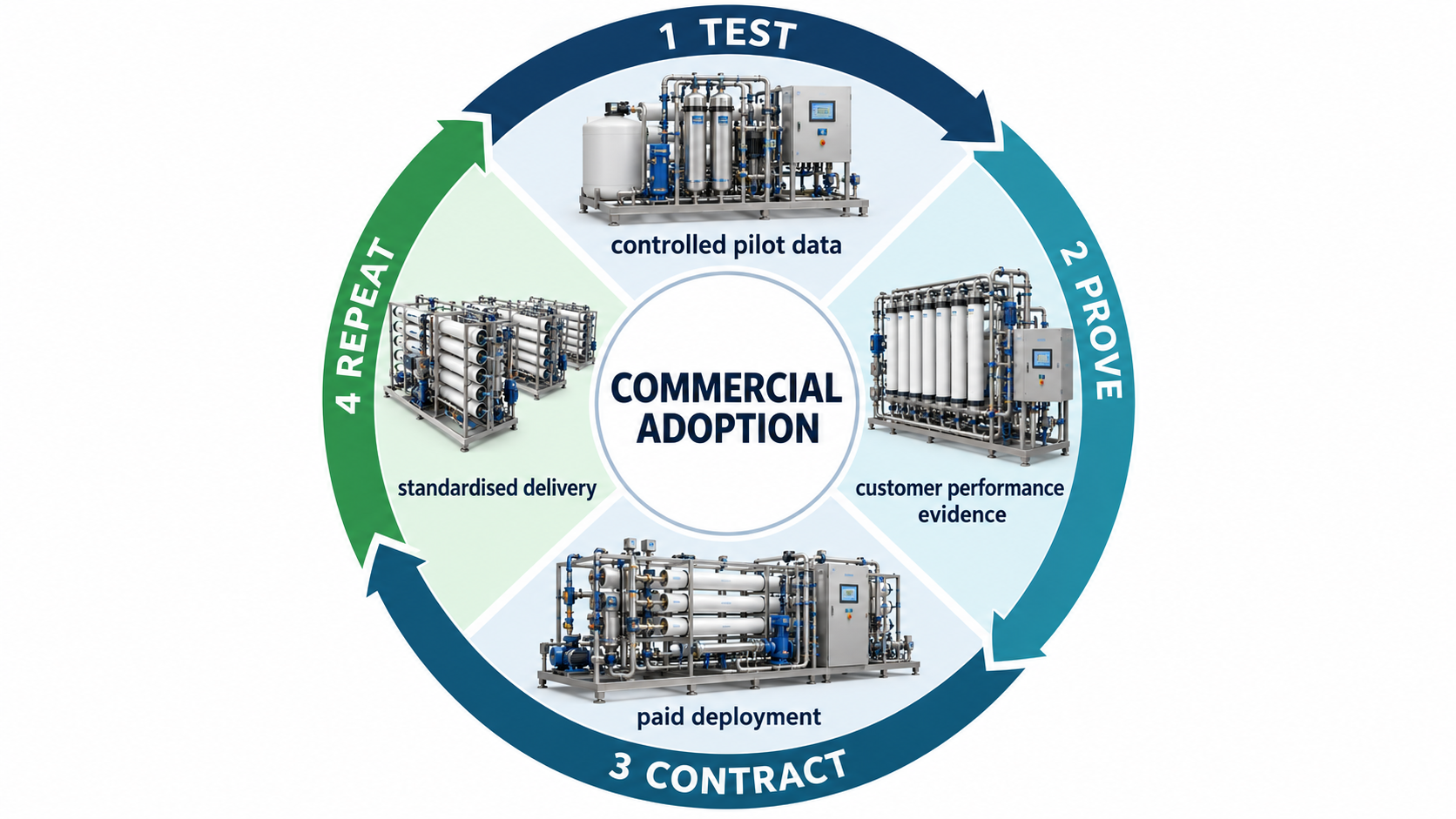
For a company, the commercial path often contains four tests. The first is controlled data from a pilot. The second is customer evidence under real operating conditions. The third is a paid deployment with clear responsibilities. The fourth is repeatable delivery without a matching increase in complexity.
Each step should change the investment case. A pilot can prove technical performance. A paid deployment can prove willingness to pay. A repeatable delivery model can show whether growth is possible without losing margin or control.
Who pays and how revenue is made
Customer identity is central to water innovation investment. A utility may own the asset, an industrial operator may use it and a regulator may define the required outcome. Those parties can have different budgets, approval processes and risk tolerances.
Potential customers include utilities, municipalities, industrial sites, food and beverage producers, agriculture businesses, property owners and infrastructure operators. The relevant customer is the party with authority to approve the purchase and responsibility for the problem.
Revenue can come from equipment sales, design and delivery contracts, installation, operations and maintenance, software subscriptions, monitoring services, licensing, consumables or managed water outcomes. Each model has different working-capital and renewal characteristics.
Equipment revenue may be large but irregular. Service revenue can be more repeatable but may require field labour and careful performance management. Software or data revenue can scale differently, but only when the data is trusted and embedded in the customer’s workflow.
The World Bank and the Mohamed bin Zayed Water Initiative have highlighted innovation and investment in areas including irrigation, water reuse and desalination. Their 2025 memorandum also refers to financing, incubation, testing and scaling of solutions. [4] For investors, this supports a commercial question about project structure and customer payment. It does not guarantee demand for a specific company.
Unit economics: where innovation creates or destroys value
Unit economics means the revenue and cost profile of one repeatable unit of activity. In water innovation, that unit might be a treated cubic metre, a monitored site, an installed module, a service contract or a customer account.
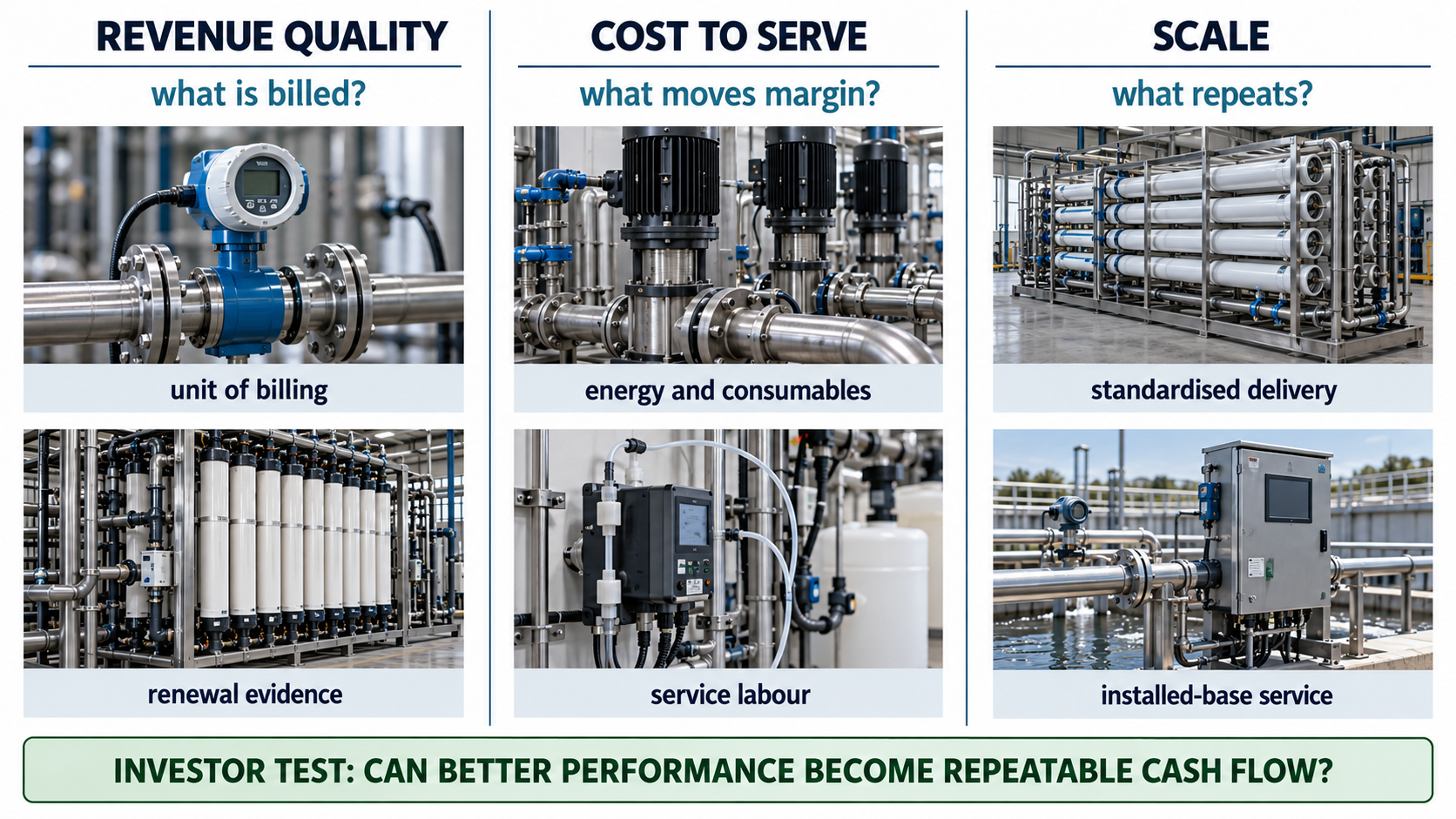
Investors should ask what is billed, what it costs to serve and what repeats. Energy, chemicals, replacement parts, field labour, warranty work and installation time can change margins. A technology that lowers one cost but adds difficult maintenance may not improve the full customer or company economics.
Scale can also increase risk. More installations may require more skilled technicians, more inventory, more commissioning work or more customer support. A credible growth plan explains which activities become standardised and which remain site-specific.
UK, Europe and GCC: different routes to opportunity
Water innovation is not one regional market. The same solution can face different buyers, approvals, procurement routes, energy costs and financing structures in the UK, Europe and the Gulf Cooperation Council, or GCC, markets.
In the UK, investors should test how an innovation fits a customer’s regulated or operational budget. A UK Government water research and innovation framework describes the need to co-ordinate public funding and work with private and third-sector organisations. [5] That framework was published in 2012, so it is context rather than a current funding forecast. Current diligence still needs project-level evidence.
In Europe, the Commission’s water resilience strategy links efficiency, infrastructure, digitalisation, research and innovation. The EIB’s 2026 analysis adds a whole-system perspective. Investors should examine whether a solution fits the wider basin, utility, industrial or infrastructure plan rather than treating an isolated pilot as the market.
In the GCC, water scarcity, desalination, reuse and industrial development can create different commercial requirements. The World Bank and Mohamed bin Zayed Water Initiative source shows the importance of irrigation, reuse, desalination and collaboration across public and private stakeholders. Country-specific counterparty, offtake, energy, permitting and delivery diligence remains essential.
Regional fit should therefore be part of the revenue thesis. A company with a strong technology but no route through local procurement or operating conditions may struggle to convert interest into cash.
Diligence: evidence that innovation has crossed the gap
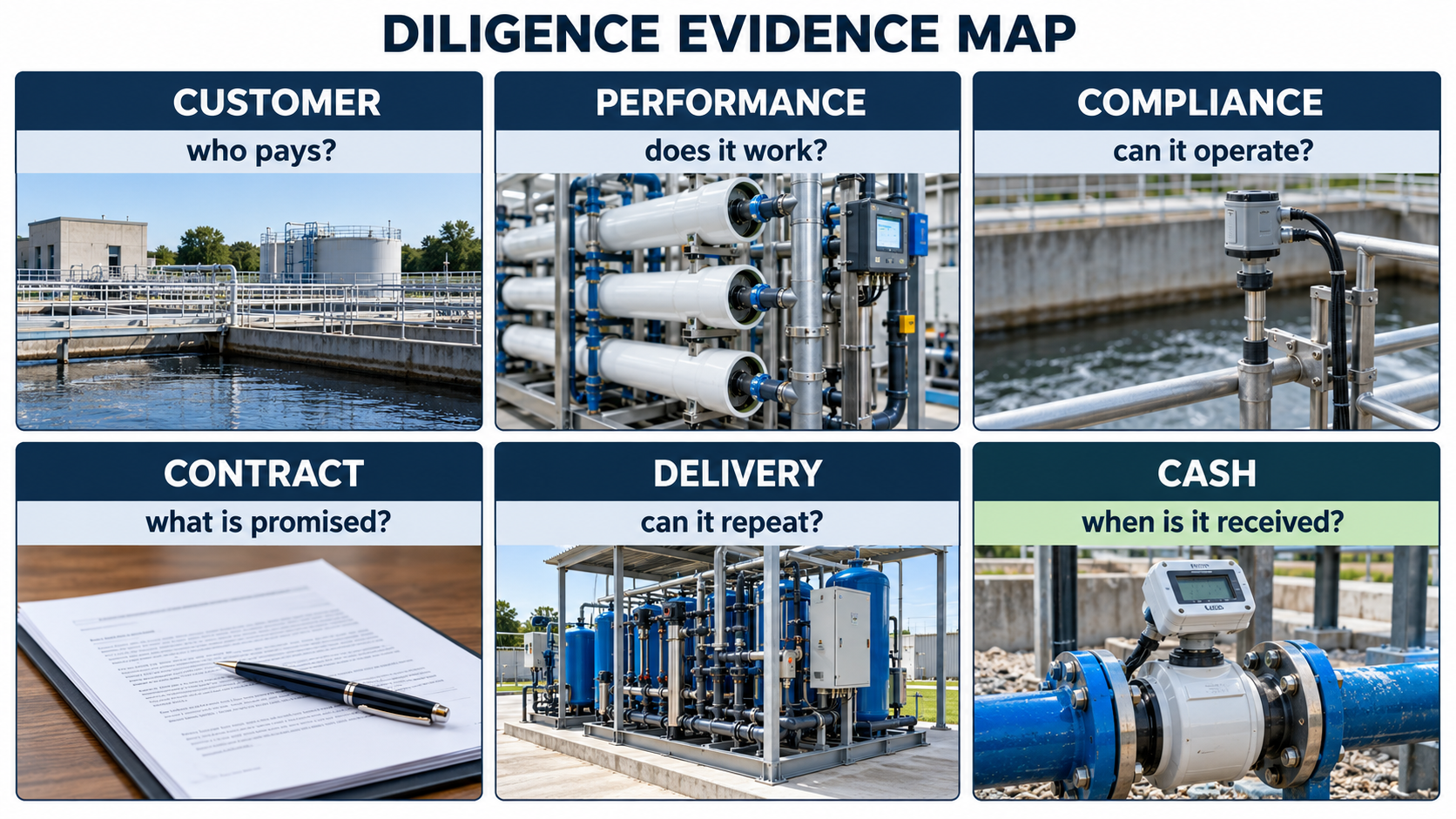
Investors should request evidence in the same order that adoption risk appears. Start with the customer, then test performance, permission to operate, contract terms, delivery capacity and cash receipt.
- Customer: who pays, who uses the solution and what budget owns the problem?
- Performance: what independent or customer data shows that the system works in the target setting?
- Compliance: which permits, standards or operating controls apply to the deployment?
- Contract: what has been promised, what is measured and who carries underperformance risk?
- Delivery: can the company install, commission and support several sites without losing control?
- Cash: when is the company paid, and how much working capital is needed before payment?
A strong reference site is useful, but it is not enough. Investors should compare promised performance with measured performance, review the renewal record and test whether the commercial model depends on exceptional founder involvement.
Principal risks and what can change the thesis
Technical risk is the obvious concern, but adoption risk can be more important. A system may perform in one water chemistry, climate or site layout and fail to transfer cleanly to another.
Procurement risk can extend the sales cycle. Budget ownership may be unclear, the buyer may require a long reference period or an incumbent supplier may control access to the site. A large pipeline without signed scope, funding and customer authority should be treated carefully.
Operating risk affects margins after installation. Energy use, consumables, maintenance, replacement parts and response times can weaken the economics. Data quality can also create risk when performance claims rely on sensors that are poorly calibrated or not independently checked.
Financing risk matters when the company funds equipment before payment. Contract concentration, warranty exposure, permitting changes, supply-chain dependence and limited exit buyers can also change the outcome. These risks do not make water innovation unattractive. They define the diligence work.
Investors should separate verified facts from forecasts and opinion. No water innovation investment is guaranteed, and a policy ambition does not equal a company return.
FAQs and next steps for eligible investors
What is water innovation?
Water innovation is a commercially useful improvement in how water is sourced, treated, measured, reused or managed. It can involve equipment, processes, software, data or operating models.
Why can water innovation attract private investors?
It can address a defined customer problem linked to water quality, supply, compliance, efficiency or resilience. The investment case depends on customer payment, performance evidence, scalable delivery and risk control.
What evidence shows that a water innovation is commercially ready?
Useful evidence includes paid deployments, measured performance, repeat customers, clear contract terms, credible unit economics and a delivery model that does not depend on one exceptional site.
Are water innovation investments low risk?
No. Technology, adoption, regulation, procurement, working capital, customer concentration and exit risks can all matter. Private-market investors should assess each company and contract on its own evidence.
Does Water Investment Network provide regulated financial advice?
No. Water Investment Network is an invitation-only network that connects eligible investors with direct private-company opportunities. It does not provide regulated financial advice or guarantee returns.
Eligible investors can review the current portfolio context and request access to the network. For a question about eligibility or the process, use the contact page.
Sources
- European Commission, Water resilience strategy. Reviewed 29 June 2026.
- European Investment Bank, Future-proofing Europe’s water systems: From vision to investment. Published 22 September 2026.
- World Bank, 2030 Water Resources Group 2025 Annual Report.
- World Bank, Mohamed bin Zayed Water Initiative and World Bank memorandum on innovation and investment. Published 11 February 2025.
- UK Government Office for Science, Water research and innovation framework. Published 19 January 2012.