
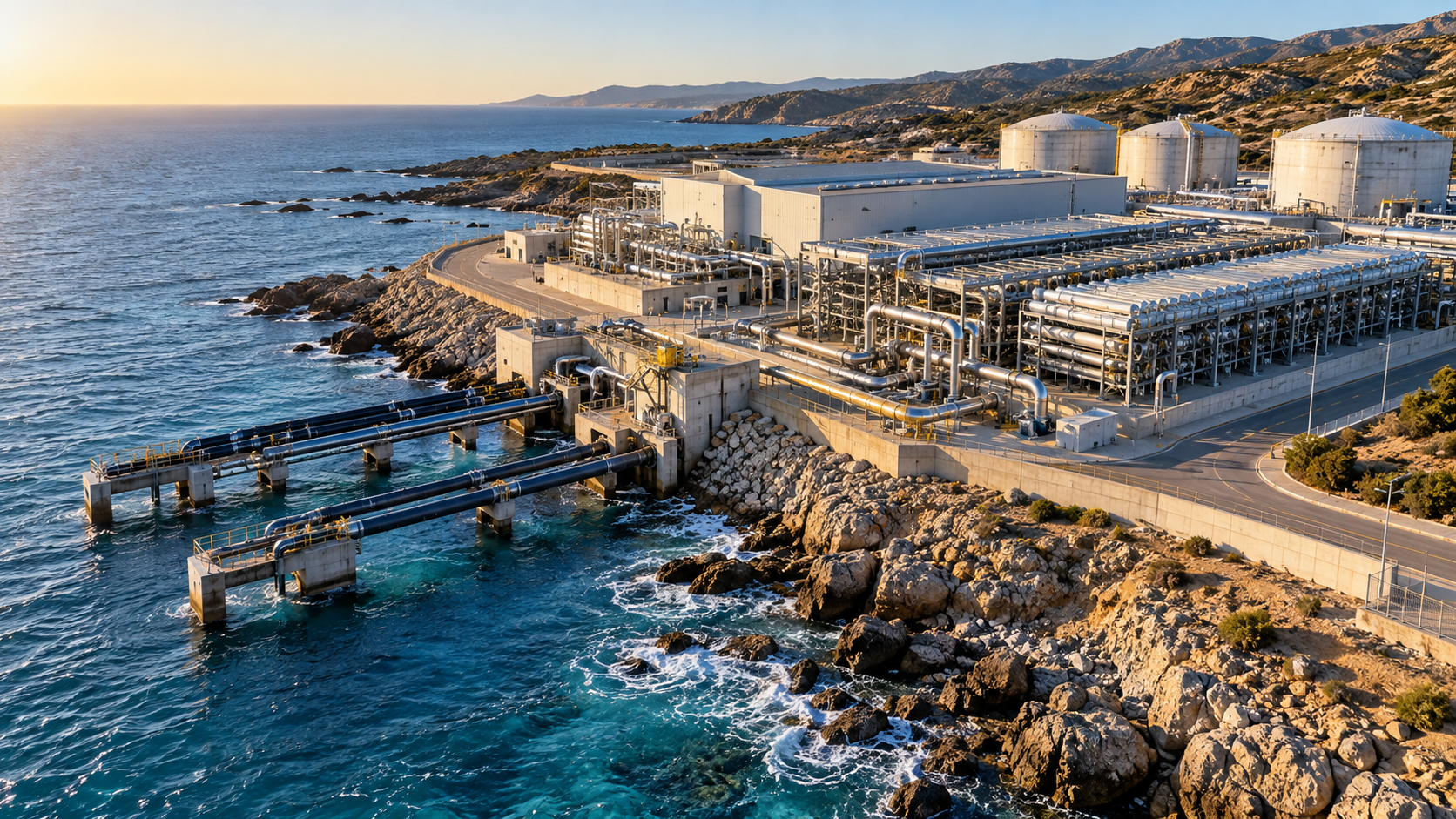
Desalination is moving from a specialist engineering topic into a serious private-market investment question. Water-stressed regions need more reliable supply, while utilities, industrial users and agriculture face rising pressure to secure usable water.
That does not make every desalination project investable. The opportunity depends on the customer, the energy system, the contract, the environmental approvals and the operator’s ability to keep producing water at the required quality. For investors, the central question is not simply whether a plant can make fresh water. It is whether the asset can turn that output into durable, risk-adjusted revenue.
This article complements Water Investment Network’s wider water technology market investment research. It also addresses the practical intent behind searches such as invest in desalination, invest in water desalination and investing in water desalination.
Why desalination is becoming an investment question
Desalination removes dissolved salts from seawater or brackish water so the output can be used for drinking water, industry or other approved purposes. It is one response to water stress, not a universal replacement for conservation, reuse or better allocation.
The World Bank identifies rising investment in desalination and water reclamation infrastructure as countries respond to population growth, rainfall variability and water stress. Its work also makes a key investor point: governance, institutional design and financial structure shape whether unconventional water sources can be deployed sustainably.
The European Commission’s Blue Economy Observatory describes desalination as an expanding part of Europe’s water market, with drought pressure and technology development influencing investment. In the Middle East and North Africa, the IEA says desalination growth is closely linked to changing power systems and rising electricity demand.
For a private investor, this creates a sector thesis with two sides. Demand for reliable water can be resilient, but the asset remains exposed to energy prices, permitting, contracts, technical performance and political decisions about tariffs.
How a desalination asset creates value
A typical seawater reverse-osmosis system begins with an intake. Pretreatment removes particles and protects the membranes. High-pressure pumps then push water through membranes that allow water molecules through while retaining most dissolved salts. Post-treatment adjusts the output for its intended use.
The process also produces a concentrated stream known as brine. Its handling is part of the operating and environmental case. A project that produces good water but lacks a credible brine route may face higher costs, approval delays or operating restrictions.
Value is created at each link in this chain. A business may develop the project, integrate equipment, operate the plant, supply monitoring and maintenance, or own a contracted asset. Investors should understand which link the target company controls and which risks remain with suppliers, utilities or customers.
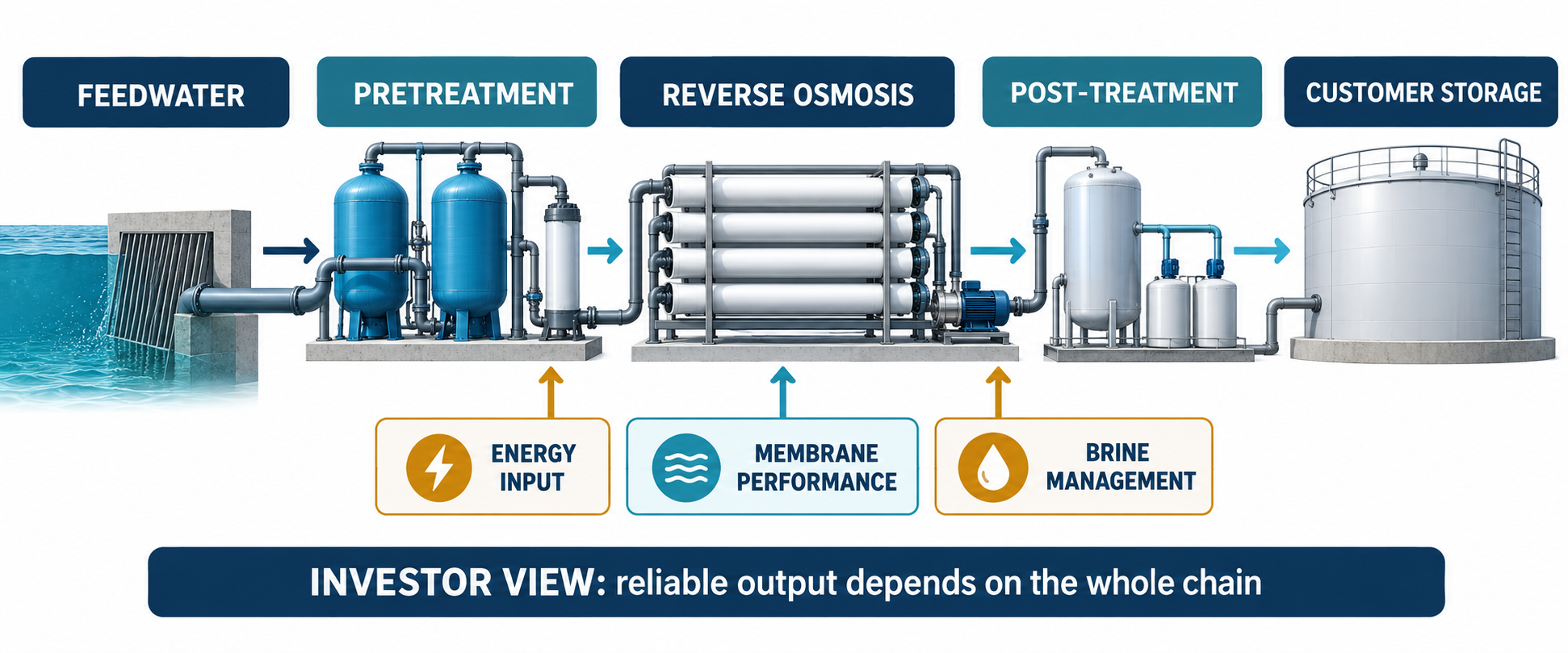
The practical test is output reliability. Capacity on a specification sheet is not the same as water delivered to a customer. Uptime, feedwater quality, membrane condition, power availability and maintenance discipline all affect the revenue-producing asset.
The commercial demand case
Desalination demand is strongest where the cost of unreliable water is high and alternative supplies are constrained. Potential customers include municipal water systems, industrial facilities, ports, islands, agriculture and large developments. The right customer is not defined by geography alone. It must have a clear water requirement, a budget and a route to approve the service.
Industrial buyers may value water quality, process continuity and reduced exposure to local supplies. Municipal buyers may prioritise volume, resilience and compliance with public-service obligations. Agricultural users may value dependable irrigation, but their ability to pay can be more sensitive to crop economics, subsidies, water policy and seasonal demand.
The World Bank’s desalination and reuse guidance highlights the need to test the economic rationale before selecting a project delivery model. That matters because a water shortage can create political urgency without creating a bankable customer contract.
Investors should therefore ask four basic questions:
- Who pays for the water and what problem does the contract solve?
- Is the demand continuous, seasonal or dependent on a single project?
- Can the customer accept the output quality and the tariff structure?
- What cheaper or lower-energy alternatives could compete with the project?
These questions separate a market narrative from a revenue opportunity. They also help avoid treating a public announcement, development target or water-stress statistic as proof of private-company demand.
Energy is a margin variable
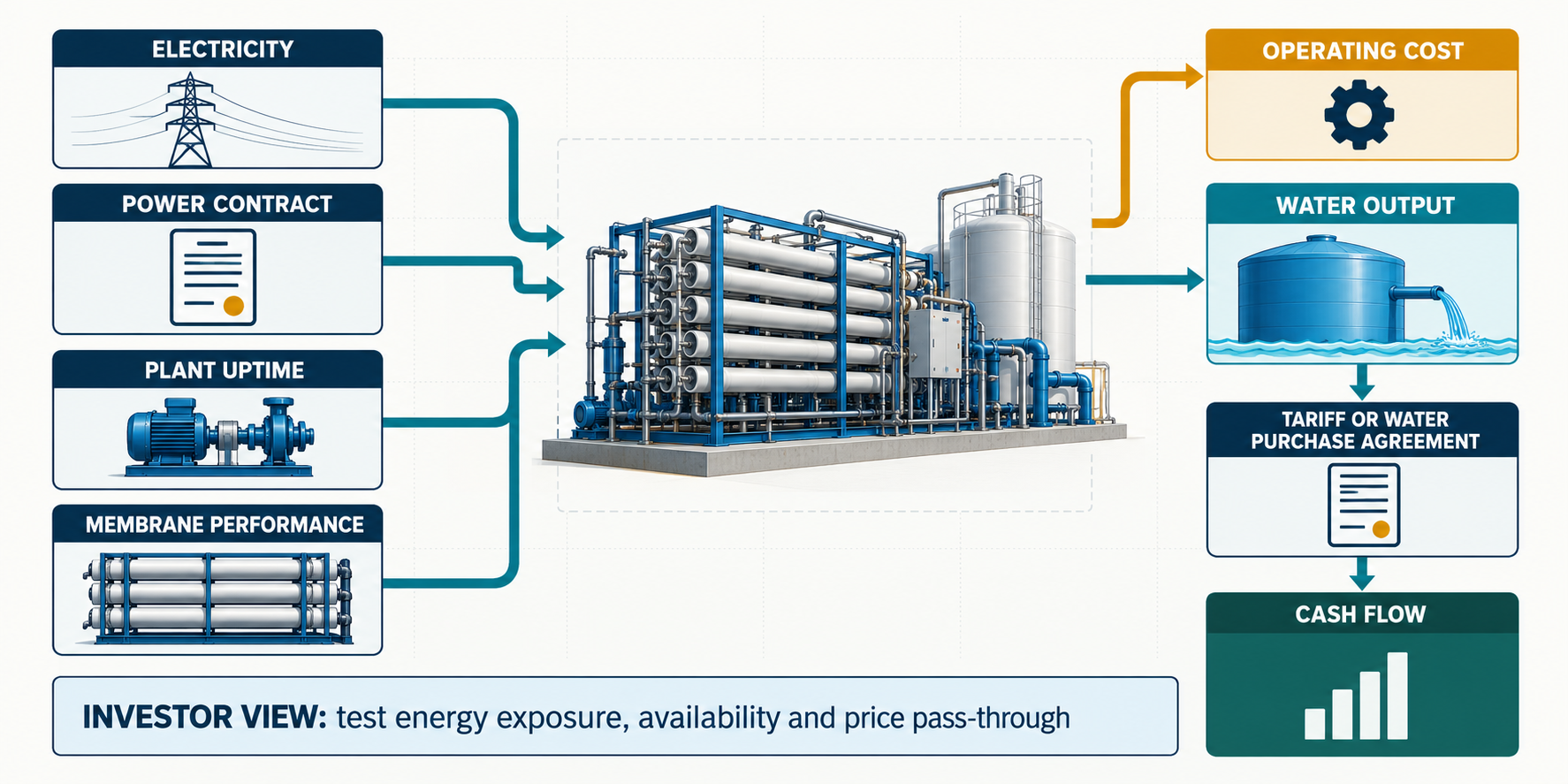
Desalination is closely tied to electricity. Reverse osmosis uses electrically powered pumps to create pressure across the membranes. The plant’s energy cost therefore depends on system design, feedwater conditions, operating discipline, power prices and the reliability of supply.
The International Energy Agency links desalination growth with a changing power system in the Middle East and North Africa. Its analysis states that desalination can become a material source of electricity demand in regions with high reliance on the technology. That makes energy procurement and power-system integration commercial questions, not only engineering questions.
Renewable power may reduce exposure to fossil-fuel volatility in some projects, but it does not remove the need to test reliability, storage, grid connection and contractual pass-through. IRENA’s guidance on renewable-energy desalination explains that reverse osmosis can use electricity from solar photovoltaic and concentrated solar power, including in arid regions such as the Gulf.
A serious model should show how energy cost moves through the income statement. Investors should test the base case, downside case and contract protections for power-price changes. They should also examine whether lower energy consumption comes from proven operating improvements or from an unproven performance assumption.
Where the investable opportunity sits
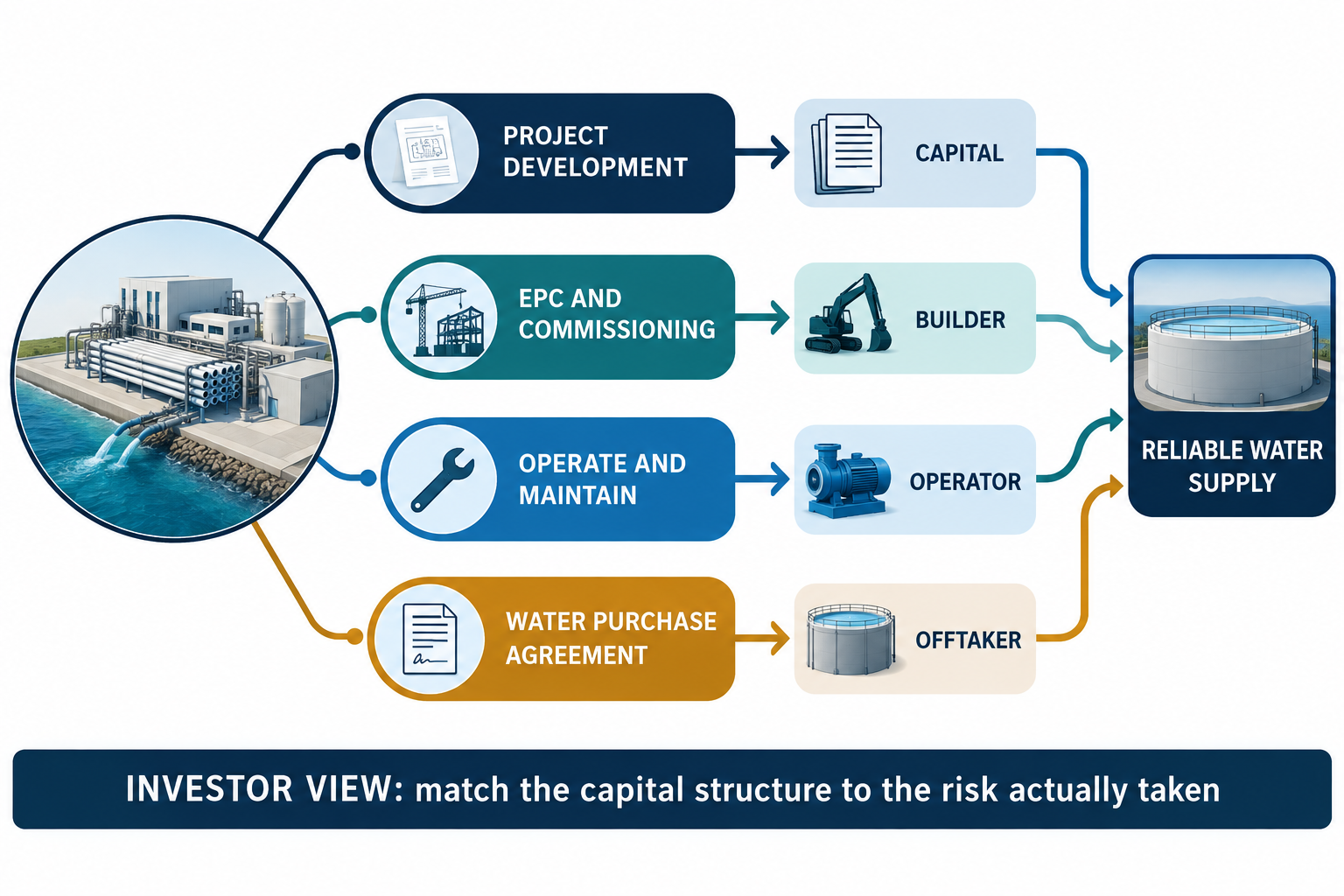
Desalination investment opportunities do not sit in one company type. A private-market investor may encounter a project developer, an engineering and commissioning business, an operator, a maintenance specialist, a monitoring provider or an asset owner with a long-term water contract.
Project development can offer early exposure to site selection, customer contracting and approvals. It also carries development and financing risk. Engineering, procurement and construction work can create revenue during delivery, but investors must examine working capital, claims, guarantees and customer concentration.
Operations and maintenance can create recurring service revenue after commissioning. The quality of that revenue depends on renewal, response obligations, spare parts, technical capability and the number of installed assets. Asset ownership can offer contracted cash flow, but it brings capital intensity, refinancing, performance and counterparty risk.
The World Bank’s project-delivery and financial-structure guidance covers concession, build-operate-transfer and other models. The investor’s task is to map the capital structure to the risk actually taken, rather than assuming that every desalination business has the same return profile.
Europe and the GCC require different underwriting
Regional demand can be real while the investment case remains local. The European Commission records desalination plants across coastal and inland settings, with Spain, Greece and Cyprus using desalination in different ways. The customer may be a municipality, an industrial user or an agricultural system, and the transport distance between the plant and the demand centre can affect the economics.
The GCC has a different operating context. Solar resource, coastal concentration, public-sector involvement and large-scale water planning can create strong project pipelines. IRENA’s renewable desalination material specifically identifies the Gulf as a region where solar resources can support membrane desalination.
Neither region should be treated as one market. Investors need country-level evidence on water rights, environmental approvals, public procurement, tariff design, foreign-exchange exposure, power markets and the credit quality of the buyer.
The World Bank’s MENA water-scarcity work warns that large infrastructure investment and rising desalination alone are not fiscally or environmentally sustainable. That is a useful discipline for GCC-related opportunities. A large pipeline is not a substitute for a credible allocation model and a contract that can survive changing policy.
Regulation and brine are core investment risks
Desalination projects interact with water, energy, land-use and marine regulation. The exact requirements depend on the country, the feedwater source, the discharge route and the customer’s use of the output. A project may need approvals for intake structures, discharge, construction, power connection, water quality and operation.
The European Commission notes that desalination can consume significant energy and create brine. Its analysis of circular water systems warns that poorly managed discharge can damage marine ecosystems. These are not side issues. They can affect permitting, insurance, construction schedules, operating cost and the project’s ability to expand.
Brine risk should be assessed at site level. The questions include concentration, temperature, chemicals, diffuser design, receiving-water conditions, monitoring and liability. A company that sells equipment may pass much of this risk to the asset owner. A company that owns or operates the plant may retain it for the life of the contract.
Investors should also test regulatory change. Stronger environmental standards can create demand for better treatment and monitoring, but they can also require retrofit capital or narrow the available sites. The investable business is the one that can adapt without losing its margin or its permission to operate.
Revenue quality matters more than plant size
A large plant can still be a weak investment if the buyer, contract or tariff is unclear. Revenue quality starts with the off-taker, meaning the party that agrees to buy the water. It then extends to volume, quality, availability, indexation, payment security, termination rights and the allocation of operating risk.
A long-term water purchase agreement may support financing, but its value depends on the counterparty and the terms. Investors should examine minimum offtake, payment history, currency, inflation linkage, force majeure, change-in-law treatment and what happens when output falls below specification.
Service businesses need a different review. Recurring maintenance revenue is useful only when customers renew, service obligations are priced correctly and the business can support the installed base. Equipment sales may grow quickly, but the margin profile can be weaker if projects are bespoke or working capital is stretched.
Look for evidence that revenue is linked to delivered performance. Customer references, operating data, renewal rates, gross-margin bridges and working-capital history are more useful than a capacity headline. The commercial model should make clear which costs are fixed, which costs move with output and which risks can be passed through.
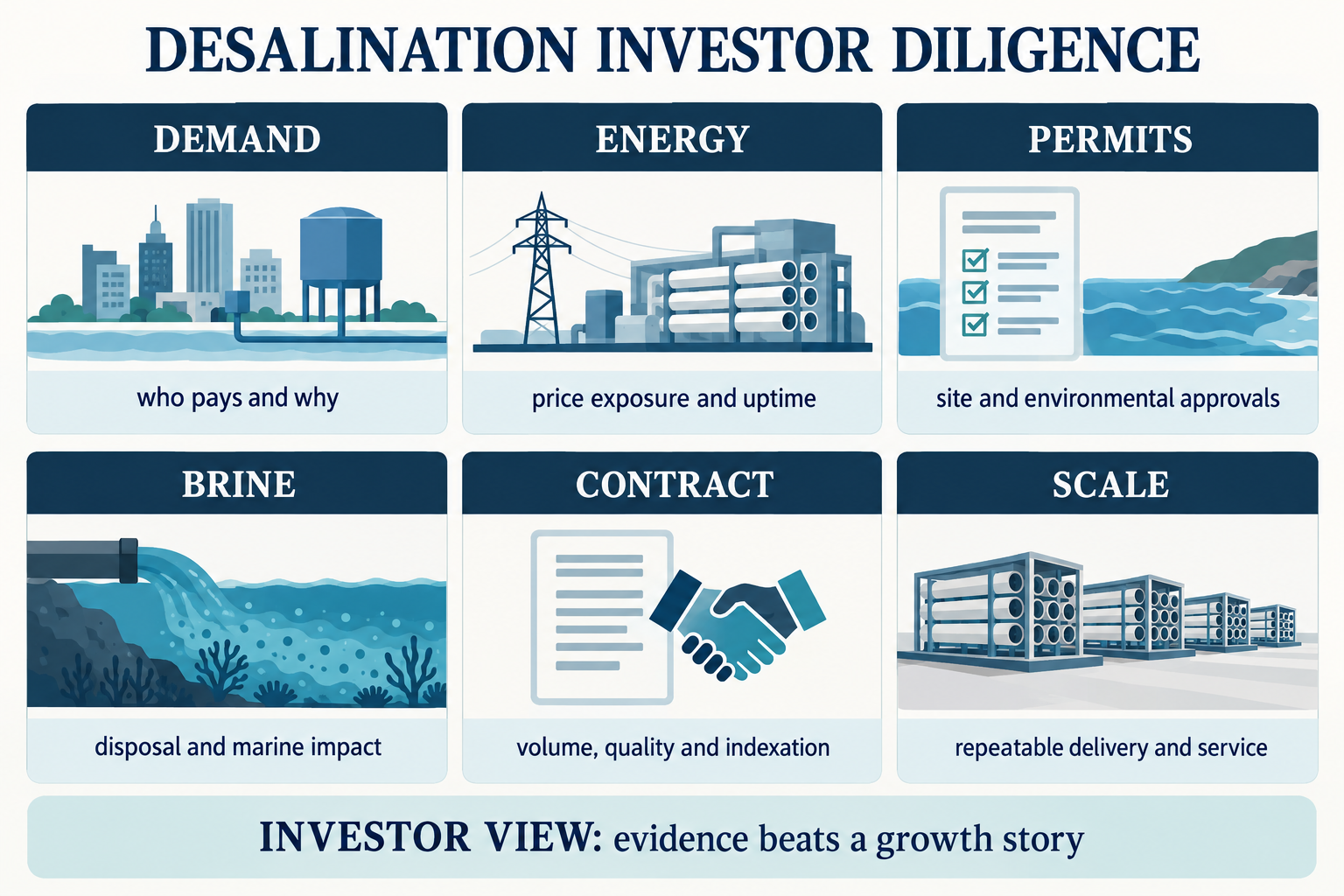
A six-part investor diligence scorecard
Desalination investment opportunities deserve a structured review because technical performance and commercial performance are tightly linked. The scorecard below is a starting point for an investment committee, not a substitute for legal, technical, environmental or financial advice.
- Demand: identify the customer, the water problem, the alternatives and the evidence of willingness to pay.
- Energy: model power price, availability, efficiency, maintenance and any pass-through or hedging protection.
- Permits: confirm site control, intake and discharge permissions, water-quality requirements and approval timing.
- Brine: review the disposal route, environmental monitoring, chemicals, liability and expansion constraints.
- Contract: test volume, quality, tariff, indexation, payment security, renewal and termination provisions.
- Scale: assess repeatability, supply chain, installation capacity, service coverage and the evidence behind expansion plans.
The World Bank identifies demand and revenue risk, energy-price volatility, environmental risk and technology obsolescence as issues that can affect desalination projects. A good diligence process turns those risks into specific documents, tests and downside cases.
How desalination businesses can scale
Scale can come from more installed capacity, more sites, more service revenue or a repeatable platform. These are different growth paths. A project developer may scale through a pipeline, while an equipment or monitoring company may scale through standardised products and a wider installed base.
Repeatability is the key question. Investors should look for common modules, a reliable supplier base, documented commissioning procedures, trained service teams and data that supports performance claims. The business should show how the next project becomes less expensive or less risky to deliver without hiding new site complexity.
Defensibility may come from process knowledge, customer integration, operating data, regulatory capability or a service relationship. It should be visible in customer retention, margins, bid win rates, delivery time or the cost of switching provider. A patent or technical label alone does not prove commercial protection.
Growth also needs capital. Working capital, project finance, guarantees, inventory and receivables can all absorb cash before the customer pays. Investors should match the pace of expansion to the company’s balance sheet and the evidence that the sales cycle is repeatable.
Desalination investment opportunities: a practical next step
The strongest private opportunities are likely to combine a clear water problem with a credible route to paid output. The investment thesis should be specific about the customer, the contract, the energy exposure, the environmental obligations and the company’s role in the value chain.
| Question | What to test |
|---|---|
| Demand driver | Water stress, resilience, industrial continuity or another documented customer need. |
| Paying customer | The named off-taker, its credit quality and its alternatives. |
| Revenue model | Asset ownership, project delivery, operations, maintenance, equipment or monitoring. |
| Scalability | Evidence that the next site can be delivered with less execution risk. |
| Principal risks | Energy, permits, brine, technology, counterparty, construction and working capital. |
| Potential exit routes | Strategic acquisition, infrastructure ownership, service-platform consolidation or another evidenced route. |
| Measurable impact | Reliable water output, reduced pressure on scarce supplies and transparent environmental monitoring. |
Before underwriting, request the customer list, signed or draft contracts, site-level operating evidence, energy assumptions, permit documents, brine studies, gross-margin bridge, working-capital history and the installation pipeline. Compare the investment case with reuse, conservation and alternative supply options.
Water Investment Network focuses on direct private-company opportunities for eligible family offices, high-net-worth investors and sophisticated impact investors. Investors who want to explore the network can review the portfolio and then request access to the network. For a specific enquiry, use the contact page.
Sources and further reading
- World Bank: Governance and Economics of Desalination and Reuse
- World Bank: Selecting the Appropriate Project Delivery Model and Financial Structure
- International Energy Agency: Wired for water
- European Commission: Desalination
- European Commission: Circular systems and freshwater use
- IRENA: Drinking water from the sea using renewable energy
- World Bank: Institutional solutions to water scarcity in MENA