In brief: The industrial water market is becoming a more important private-market theme because factories, processors, power operators and extraction businesses need reliable water, compliant discharge and lower operating risk. The investable question is not whether industry uses water. It is whether a company can solve a defined customer problem, prove performance and convert that work into repeatable revenue.
For UK, European and GCC family offices, HNW investors and specialist impact or private-equity investors, the market spans equipment, engineering, monitoring, treatment, reuse and long-term operations. Each segment has a different buyer, contract structure and capital requirement. Those differences matter more than a broad market-size claim.
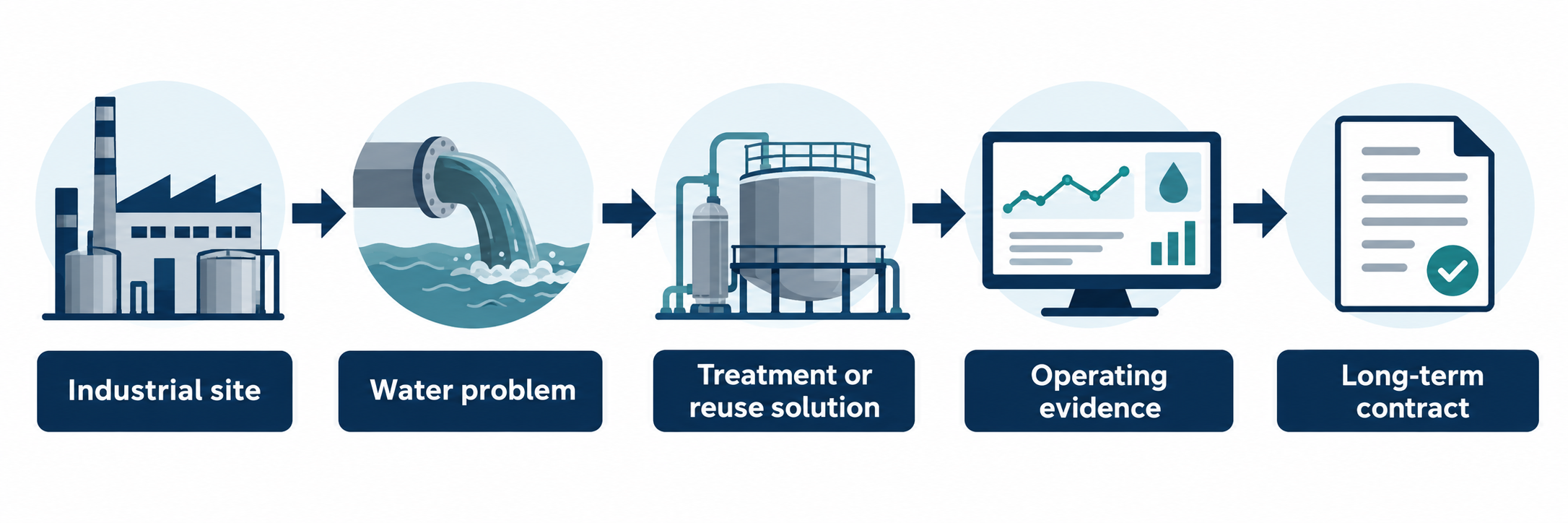
Industrial water market: start with the customer problem
Industrial water is an operating input, a compliance obligation and a source of downtime risk. A food producer may need consistent process water and a reliable way to manage high-organic-load wastewater. A chemicals site may need tightly controlled water quality. A power or cooling operator may need dependable circulation and discharge management.
The customer does not usually buy “water technology” as an abstract category. It buys a reduction in a specific operational problem. That might be more predictable water quality, lower freshwater dependence, a permit-compliant discharge, less production disruption or better evidence for an internal capital decision.
This creates the first investor test. Can management identify the budget owner, the technical acceptance criteria and the event that releases spend? A technically strong product without a clear buyer can remain stuck in pilots. A less novel service with a clear operational contract can have a more durable commercial path.
Why industrial water demand is changing
Industrial water demand is changing for several connected reasons. Water scarcity raises the cost of unreliable supply. Production growth can increase abstraction, treatment and discharge requirements. Customers and regulators also expect better measurement of pollution, resource use and environmental performance.
The European Environment Agency reports that water abstraction increased in most sectors between 2010 and 2022, while water scarcity remains a concern across Europe. Its analysis also identifies water-efficiency measures in manufacturing as part of the response. This is a demand signal, but it is not a revenue forecast for any single supplier.
The same distinction applies to pollution data. The EEA reports an overall decline in industrial pollutant releases to European water bodies between 2010 and 2024, even as the economic value of industry increased. That can mean better control and cleaner production, but it also creates demand for monitoring, process improvement and treatment systems that can demonstrate performance.
For investors, these drivers are useful only when connected to a paying customer. A good market thesis should show which site has the problem, what decision will be made, how procurement will work and why the supplier can deliver repeatedly.
Industrial water market segments have different buyers
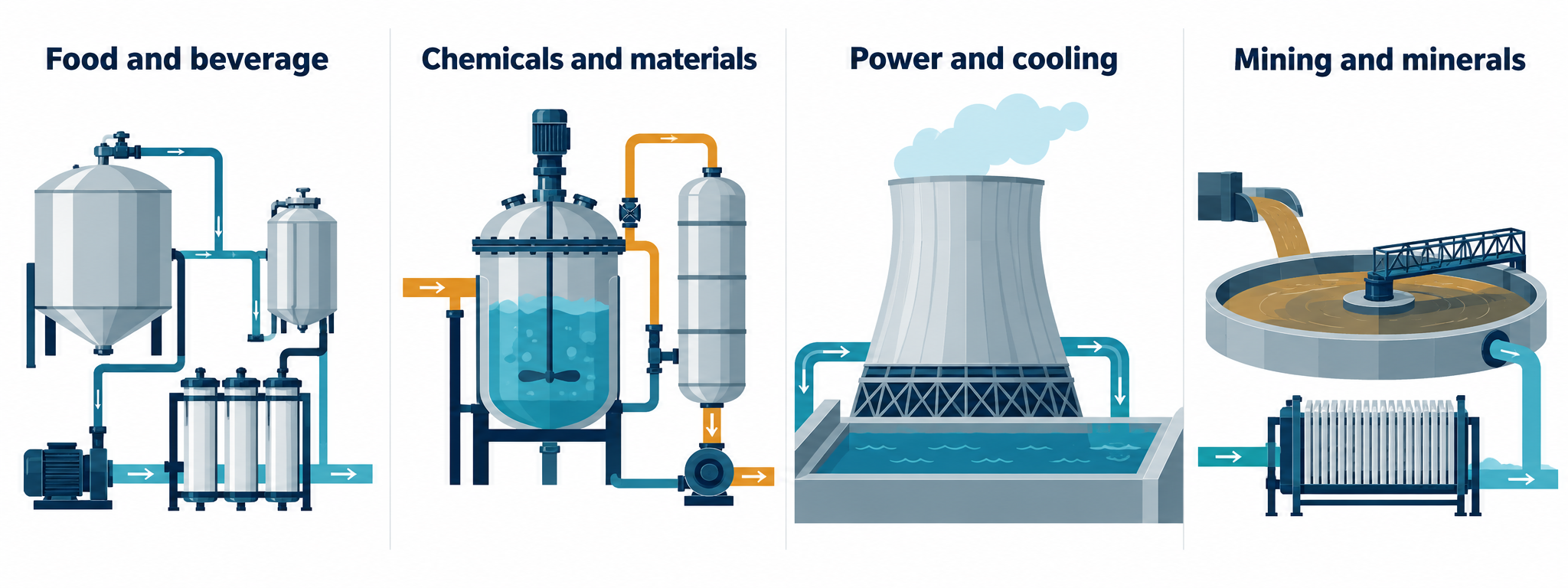
Industrial water is a collection of end markets rather than a single customer group. The buyer may sit in operations, engineering, environment, health and safety, procurement or finance. The sales cycle and evidence required will differ by site and sector.
| Customer segment | Typical problem | Commercial question |
|---|---|---|
| Food and beverage | Process water quality, hygiene and variable wastewater loads | Can the solution protect production while meeting site standards? |
| Chemicals and materials | Complex contaminants, process reliability and controlled discharge | Can performance be proven across changing feedwater conditions? |
| Power and cooling | Water availability, circulation, scaling and heat-management constraints | Does the system support uptime without creating a new maintenance burden? |
| Mining and minerals | Large water movements, settling, reuse and site-specific discharge risks | Can the operator manage a difficult site with credible monitoring and permits? |
This segmentation prevents a common underwriting error. A supplier may report strong demand across several industries, but its sales process, installation cost and gross margin may be concentrated in one. Investors should test revenue and contribution margin by end market, customer type, site complexity and contract stage.
From treatment technology to business model
Technology matters because it determines what can be treated, reused or monitored. It does not determine the investment case on its own. The commercial question is how the technology is packaged, installed, operated and supported after the first sale.
Industrial water businesses may provide filtration, biological treatment, membranes, disinfection, monitoring, controls, water reuse or integrated plant services. “Reuse” means treating water so it can serve another approved industrial purpose instead of being discharged or replaced by new freshwater. The required quality, permit position and process design must be tested at the customer site.
The strongest companies explain their technical choice in customer language. They show what input is being treated, what output is required, what operating evidence will be collected and what happens if feedwater quality changes. This makes adoption easier to assess and reduces the risk of underwriting a laboratory result as a commercial product.
How industrial water companies earn revenue
Revenue can come from equipment, engineering, construction, commissioning, monitoring, operations and maintenance, consumables or a service contract. Some businesses are paid when equipment is delivered. Others earn recurring revenue from running a plant, guaranteeing a service level or providing measured treatment capacity.
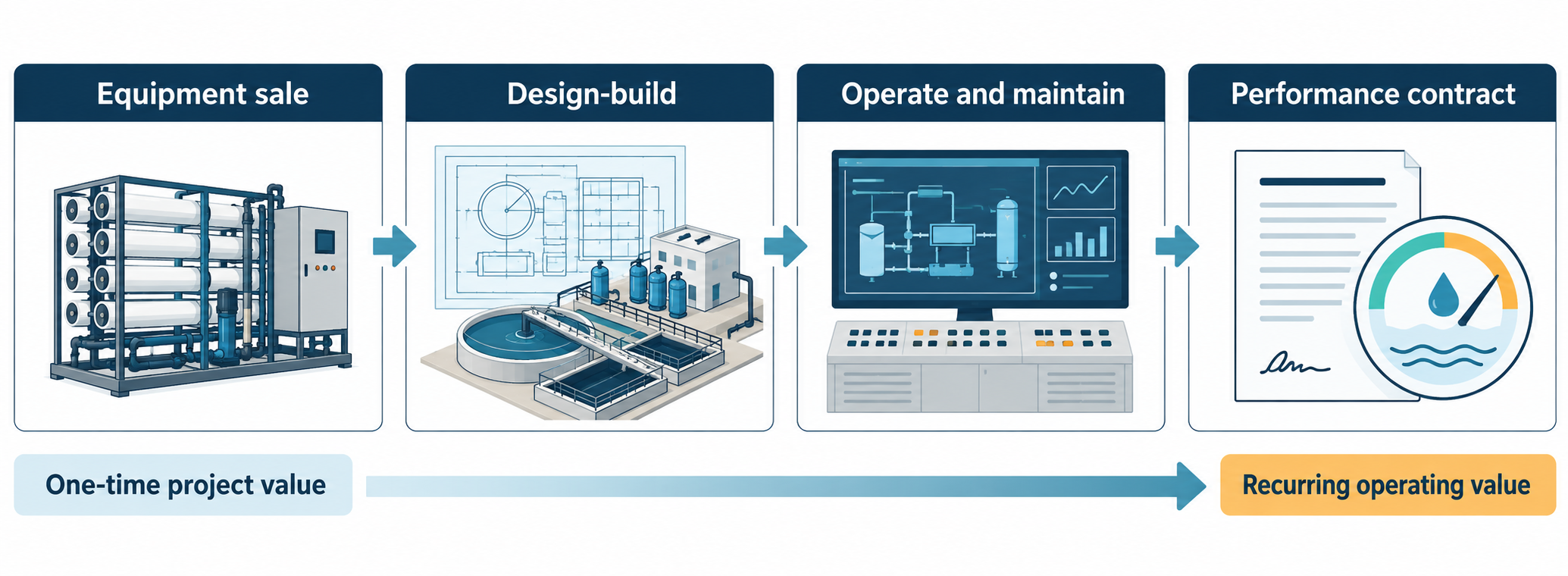
One-time project revenue can support growth, but it can also create working-capital pressure, warranty exposure and uneven cash conversion. Recurring operating revenue may improve visibility, but it can require more people, spares, compliance systems and balance-sheet support. A performance-linked contract may align customer and supplier incentives, yet it also makes measurement, baseline conditions and liability allocation central to the deal.
Investors should separate contracted revenue from qualified pipeline, pipeline from proposal activity and proposal activity from a technical pilot. They should also ask whether the company retains the customer after installation. Cross-selling monitoring, maintenance, upgrades or consumables can be valuable, but only if the evidence shows that customers renew and pay.
Regulation turns water management into an operating requirement
Regulation can create a need for work, but it does not guarantee a supplier margin. In England, discharges of liquid effluent or wastewater to surface water or groundwater can require an environmental permit. The buyer must still choose a solution, fund it, install it and operate it successfully.
In the European Union, the revised Industrial Emissions Directive, known as IED 2.0, covers large industrial installations and strengthens the focus on emissions, resource efficiency and environmental management. The European Commission states that the directive entered into force in August 2024. Its practical effect for a supplier depends on the installation, permit, best available techniques and enforcement context.
The International Finance Corporation’s Environmental, Health and Safety Guidelines provide technical references for wastewater management and pollution prevention. They emphasise that measures should be appropriate to the site and capable of being achieved at reasonable cost. That supports a diligence approach based on site evidence, not a generic compliance claim.
For GCC exposure, local permitting, water allocation, offtake arrangements and public-sector procurement must be reviewed separately. A European regulation cannot be used as a proxy for a Gulf customer contract. The same discipline applies when a company sells across jurisdictions.
What investors should test in the unit economics
Industrial water unit economics are site-specific. The relevant unit may be a treatment train, operating site, installed module, monitored volume, service visit or contracted availability period. Management should be able to explain which unit drives revenue, gross profit and working capital.
- Customer acquisition: How long is the sales cycle, who signs, and what technical work is required before an order?
- Installation: Who pays for site preparation, integration, commissioning and modifications?
- Operating cost: Which costs move with flow, contaminants, energy, chemicals, labour, membranes and maintenance?
- Cash conversion: When is the business paid, and how much working capital sits between purchase order and acceptance?
- Service quality: What happens to margin when an asset misses a service level or feedwater changes?
- Expansion: Can the company sell the same offer to another site without rebuilding the solution from scratch?
Margins should be reviewed by contract type, not only at group level. A growing project pipeline can hide low-margin delivery, delayed acceptance or a high cost of support. Investors should request cohort data, backlog quality, warranty history, site-level gross margin and the bridge from reported profit to cash.
Adoption and defensibility are operational
Industrial water adoption is usually constrained by risk. A plant manager must protect production. An environment team must support compliance. Finance must approve capital or operating spend. The supplier therefore needs more than a good technical demonstration. It needs installation references, repeatable commissioning, reliable service and clear ownership of performance data.
Defensibility can come from process knowledge, embedded monitoring, operating history, site integration, customer switching costs or a trusted service network. A patent may help, but it does not replace field evidence. Conversely, a service business may be defensible because it understands a difficult operating environment and can deliver reliably across a dispersed customer base.
Scalability should be measured at the level of delivery. Can the same engineering package, software workflow, maintenance method and compliance record be reused? What must be local? If every project depends on the founder, one specialist engineer or a bespoke design, growth may increase execution risk faster than revenue.
UK, Europe and GCC need separate market lenses
The UK market lens includes environmental permitting, regulated utility interfaces and industrial operators making site-level water decisions. European opportunities may be influenced by the Industrial Emissions Directive, water reuse rules, national permits and industrial decarbonisation programmes. The buyer, funding source and timetable can vary significantly between member states.
GCC opportunities often require a different view of water security, desalination, reuse, industrial development and public-sector procurement. The presence of a large project does not by itself establish bankable revenue. Investors should identify the contracting authority, offtaker, payment mechanism, operating partner, currency exposure and evidence that the project can reach operation.
This regional separation also matters for exits. A business dependent on one country, one industrial customer or one public procurement framework may deserve a different risk assessment from a company with diversified customers and transferable operating capability.
For a wider view of the sector, compare this industrial lens with the water technology market investment thesis and the Water Investment Network portfolio. Those internal destinations are useful only when the company or asset under review fits the relevant commercial category.
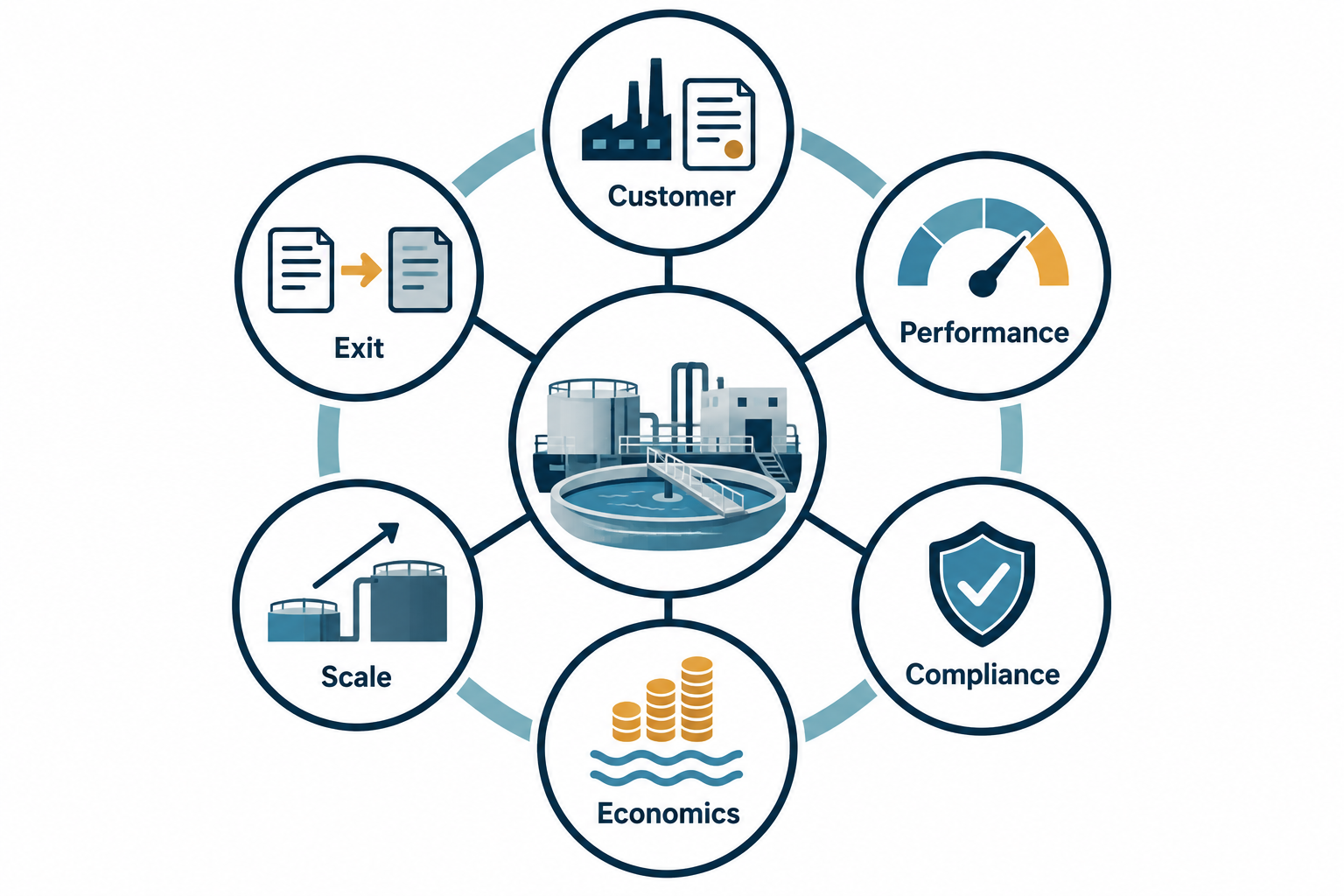
Industrial water market diligence: six questions
Are industrial water businesses suitable for private investors?
They can be relevant when a business has a clear customer, credible contracts, reliable performance evidence and a manageable capital requirement. The category is not automatically suitable and requires technical, commercial, regulatory and financial diligence.
What is the most important demand test?
Identify who pays, what operational problem is funded, which decision-maker signs and what evidence is required for acceptance. A general statement about water stress is not a substitute for a customer and contract map.
How should investors compare project and service revenue?
Compare margin, cash conversion, working capital, warranty exposure, renewal behaviour and operating responsibility. Project revenue can be valuable, while recurring revenue can be more visible, but neither is automatically higher quality.
What regulation should be reviewed?
Review the permit, discharge route, site obligations, monitoring requirements and enforcement context for each location. Then test whether the company has the people, systems and documentation to deliver against them.
What proves that an industrial water solution can scale?
Look for repeatable design, reference sites, commissioning records, service processes, consistent gross margin and a sales pipeline that does not depend on one founder or one bespoke project.
What can weaken the investment case?
Common risks include customer concentration, unproven performance, slow procurement, permitting delays, energy or chemical cost pressure, warranty claims, poor cash conversion and a pipeline that is not contractually funded.
Industrial water market: investor next step and sources
The industrial water market deserves a granular underwriting approach. Start with the customer problem, trace it through the technical solution and contract, then test delivery evidence, unit economics and regulation. A credible investment case should survive that chain without relying on a broad market forecast or a promise of returns.
Investors and advisers who want to explore relevant water technology businesses can join the Water Investment Network. For a specific enquiry, use the contact page. This article is general market information, not regulated investment advice or a recommendation.
Sources
- European Environment Agency, Water savings for a water-resilient Europe.
- European Environment Agency, Industrial pollutant releases to water.
- European Commission, Industrial and livestock-rearing emissions directive.
- GOV.UK, Discharges to surface water and groundwater: environmental permits.
- International Finance Corporation, General Environmental, Health, and Safety Guidelines.
- International Finance Corporation, Scaling Re-Water.
- World Bank Group, Water overview.
- European Commission, Water reuse.