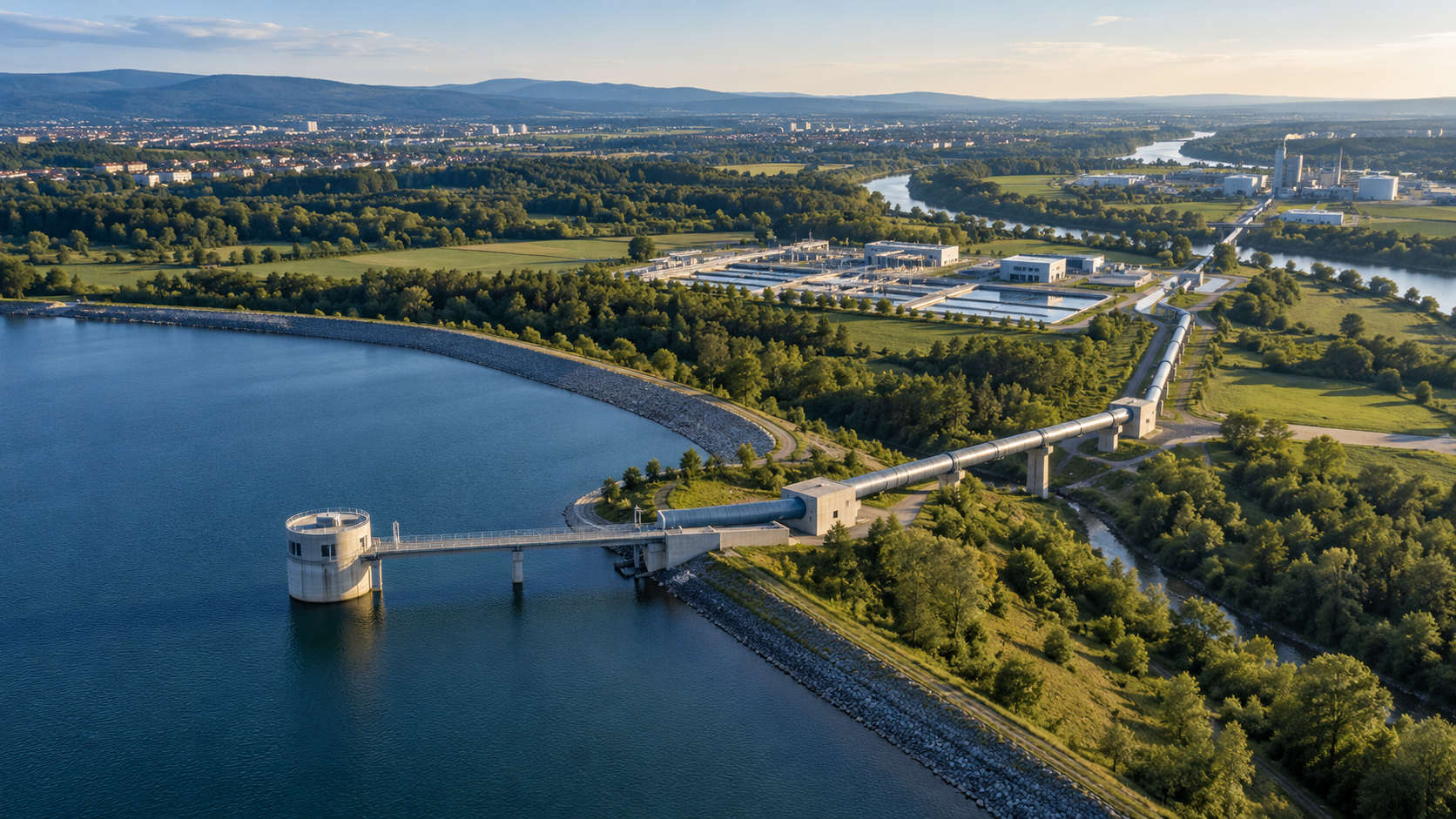
The water and wastewater sector is moving from a specialist infrastructure theme into a wider investment question. Governments, utilities, cities and industries need reliable water systems, cleaner discharge, better data and more resilient supply. The commercial opportunity is not the size of the problem alone. It is the quality of the route from need to funded work, contracted revenue and measurable operating performance.
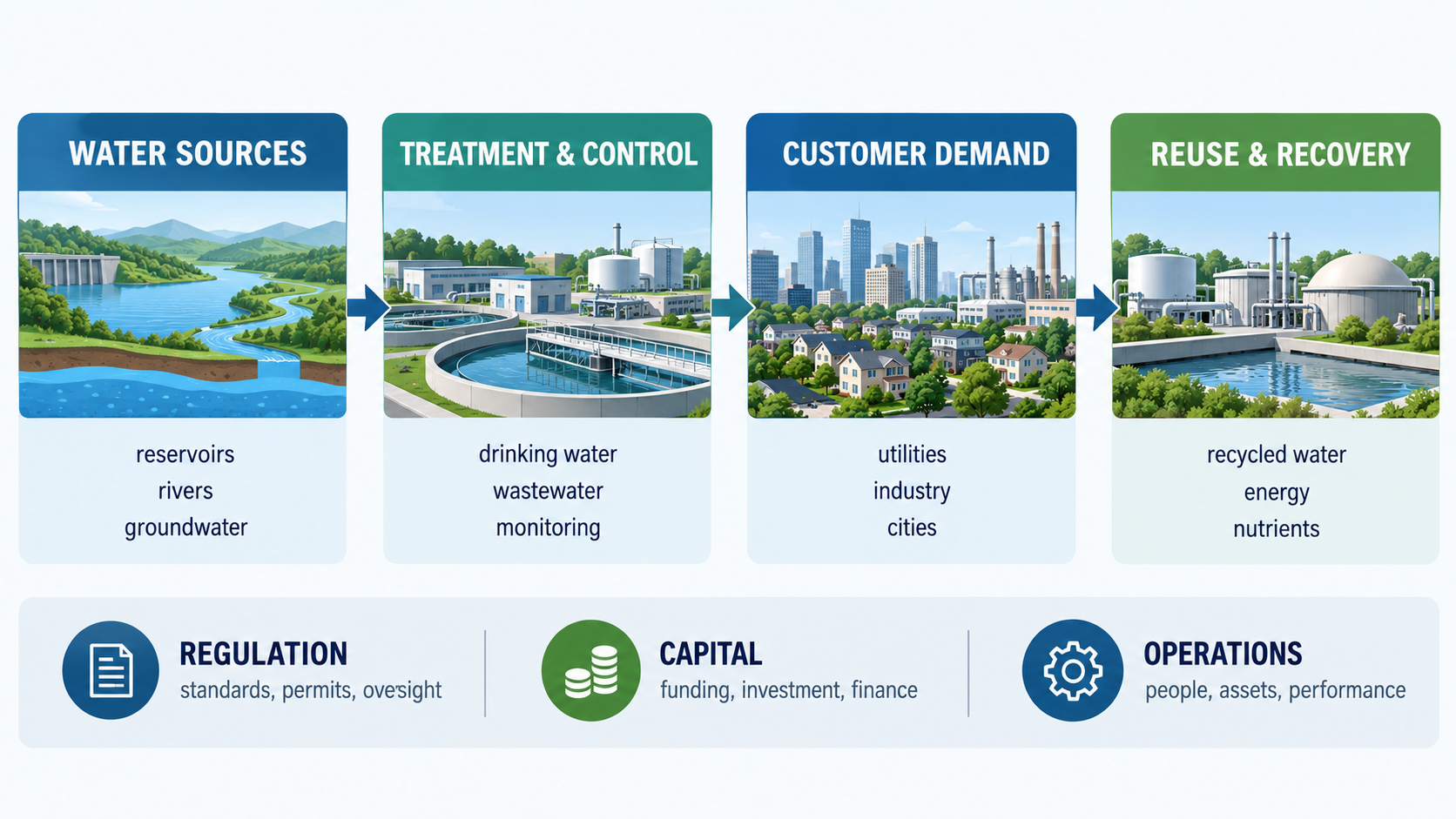
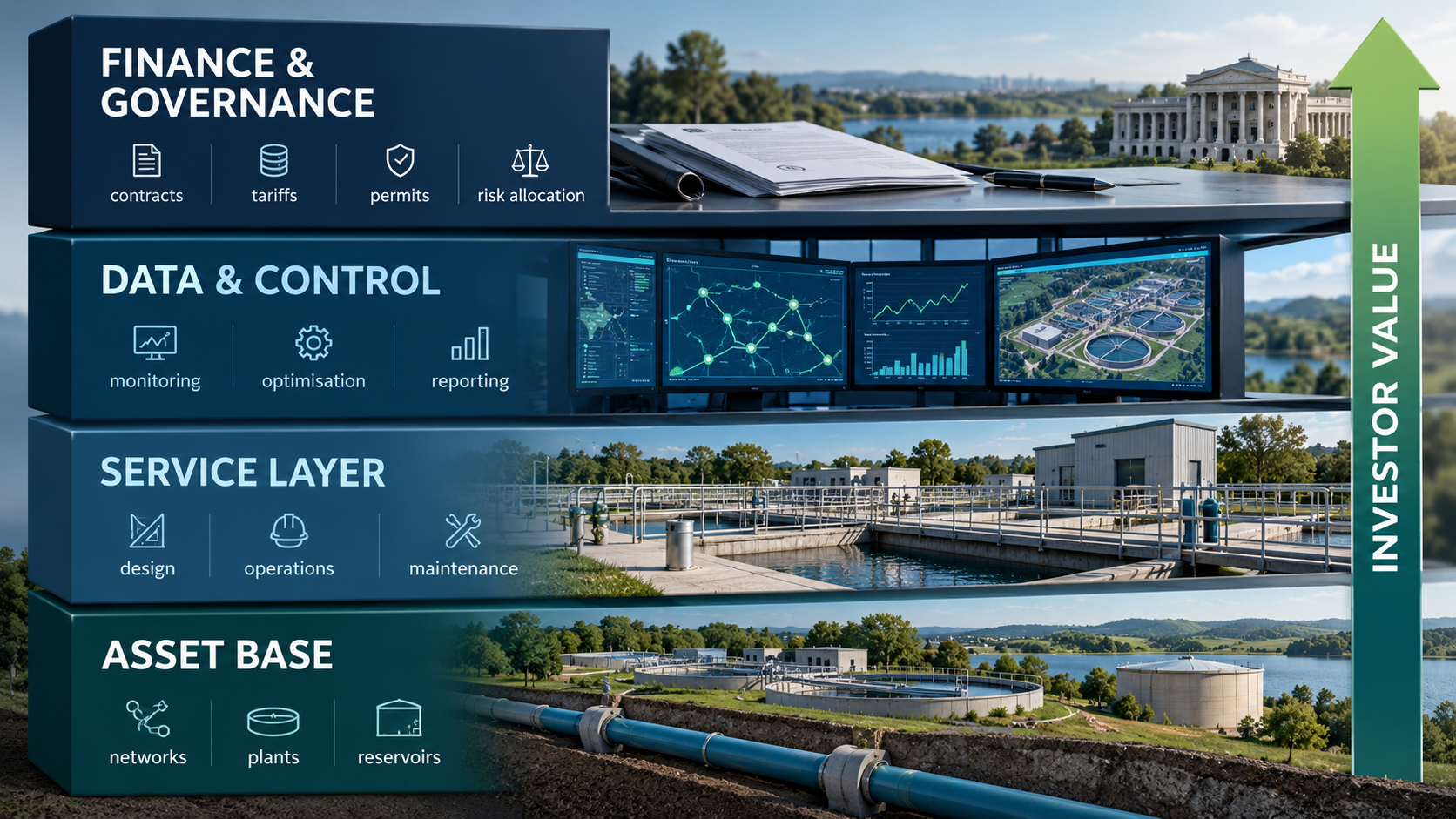
For family offices, high-net-worth investors, sophisticated impact investors and private-equity teams, the sector is best understood as an ecosystem. It includes physical assets, engineering, operations, monitoring, software, resource recovery, financing and specialist services. Each layer has different customers, capital needs, margins, regulation and failure modes.
This article explains how the water and wastewater sector works as an investable landscape across the UK, Europe and the Gulf Cooperation Council (GCC). It is educational content for investment research, not regulated financial advice, a recommendation or a guarantee of returns.
Water and wastewater sector: investment thesis at a glance
| Sector question | Evidence to test |
|---|---|
| What creates demand? | Water scarcity, pollution control, capacity, growth, resilience, compliance or industrial continuity. |
| Who pays? | Utilities, municipalities, industrial customers, developers, public programmes or contracted offtakers. |
| Where is value captured? | Asset ownership, project delivery, operations, monitoring, data, reuse, resource recovery or finance. |
| What limits scale? | Permits, procurement, specialist labour, energy, working capital, customer concentration or local service coverage. |
| What proves quality? | Uptime, treatment results, customer retention, cash conversion, compliance records and transparent impact data. |
The central thesis is conditional. Water demand can be durable, but durable demand does not automatically become attractive equity economics. The investor still needs a clear payer, sensible risk allocation, credible execution and a business model that can fund maintenance and renewal.
The strongest opportunities often sit where several needs meet. A customer may need more capacity, lower freshwater use, better compliance and stronger resilience at the same time. A solution that addresses several needs can create more value, but it can also carry more integration and delivery risk.
What the water and wastewater sector includes
Water supply and resource systems
Water supply begins with sources such as rivers, reservoirs, groundwater, desalination and water reuse. It then depends on abstraction, treatment, storage, transfer, distribution and monitoring. The commercial chain includes the assets themselves and the companies that design, build, operate, maintain and improve them.
Water resources planning is not only a utility issue. It affects housing, manufacturing, agriculture, energy and data-intensive businesses. A supply constraint can delay development or reduce industrial output. A solution therefore needs to be judged against the customer cost of insufficient or unreliable supply.
Wastewater and environmental systems
Wastewater systems collect, convey, treat, monitor and discharge used water. They may also support recycled-water supply, energy recovery, nutrient recovery and flood management. A technology supplier, operator or project company can participate without owning the underlying network.
Wastewater economics depend on the customer and the obligation. A utility may buy a treatment upgrade to meet an environmental requirement. An industrial site may pay for pretreatment to protect production or comply with a permit. A municipality may contract for operation, maintenance or a new connection.
Technology, data and specialist services
The sector also includes sensors, laboratory testing, leakage detection, asset management, optimisation software, advanced treatment, engineering, project development and specialist maintenance. These businesses may have lower capital intensity than an asset owner, but they often depend on long sales cycles, integrations and technical credibility.
Investors should avoid treating all water businesses as one category. A recurring software contract, a design-and-build contractor and a regulated asset have different revenue quality. The label matters less than the customer, contract, capital burden and operational responsibility.
Why sector demand is becoming more investable
Water stress is becoming an operating constraint
The Environment Agency’s National Framework for Water Resources 2025 describes growing pressure from population growth and climate change. Its foreword says that, without continued action, public water supplies could face a five billion litre per day shortfall by 2055. This is a planning signal, not a revenue forecast for a specific company.
The investment implication is that water demand can affect economic activity beyond the water utility. Industries, developers and public bodies may need to fund supply, efficiency, reuse or resilience before a shortage becomes a business interruption. That creates potential demand for equipment and services, while the timing remains subject to planning, permits, funding and procurement.
Environmental expectations create upgrade pathways
The European Commission’s water overview describes the 2025 European Water Resilience Strategy. It focuses on restoring the water cycle, building a water-smart economy and securing clean and affordable water and sanitation. The Commission lists more than 50 actions and reports that only 37% of surface water bodies achieve good ecological status.
These policy signals can support work in treatment, monitoring, efficiency, reuse and nature-based solutions. They do not remove competition or execution risk. An investor should identify the exact obligation, responsible buyer, technical requirement, delivery date and payment route.
Resilience is linked to economic productivity
Water systems support agriculture, industry, energy, health and housing. When a system becomes less reliable, the economic impact can appear as higher operating cost, delayed expansion, production interruption or additional compliance work. A supplier creates value when it can reduce a customer’s defined risk at a cost the customer can justify.
The key commercial test is evidence. Does the customer have a budget? Is the alternative more expensive or less reliable? Can performance be measured? Is there a credible contract? These questions separate a fundable sector need from a broad thematic narrative.
How public planning creates private-market routes
Plans provide visibility, not certainty
England and Wales use long-range water resources management plans and regional planning to coordinate supply, demand management and environmental protection. The National Framework says the latest plans support approximately £8 billion of water resources investment during 2025 to 2030. It also identifies pathways involving reservoirs, water transfers, desalination and minewater treatment.
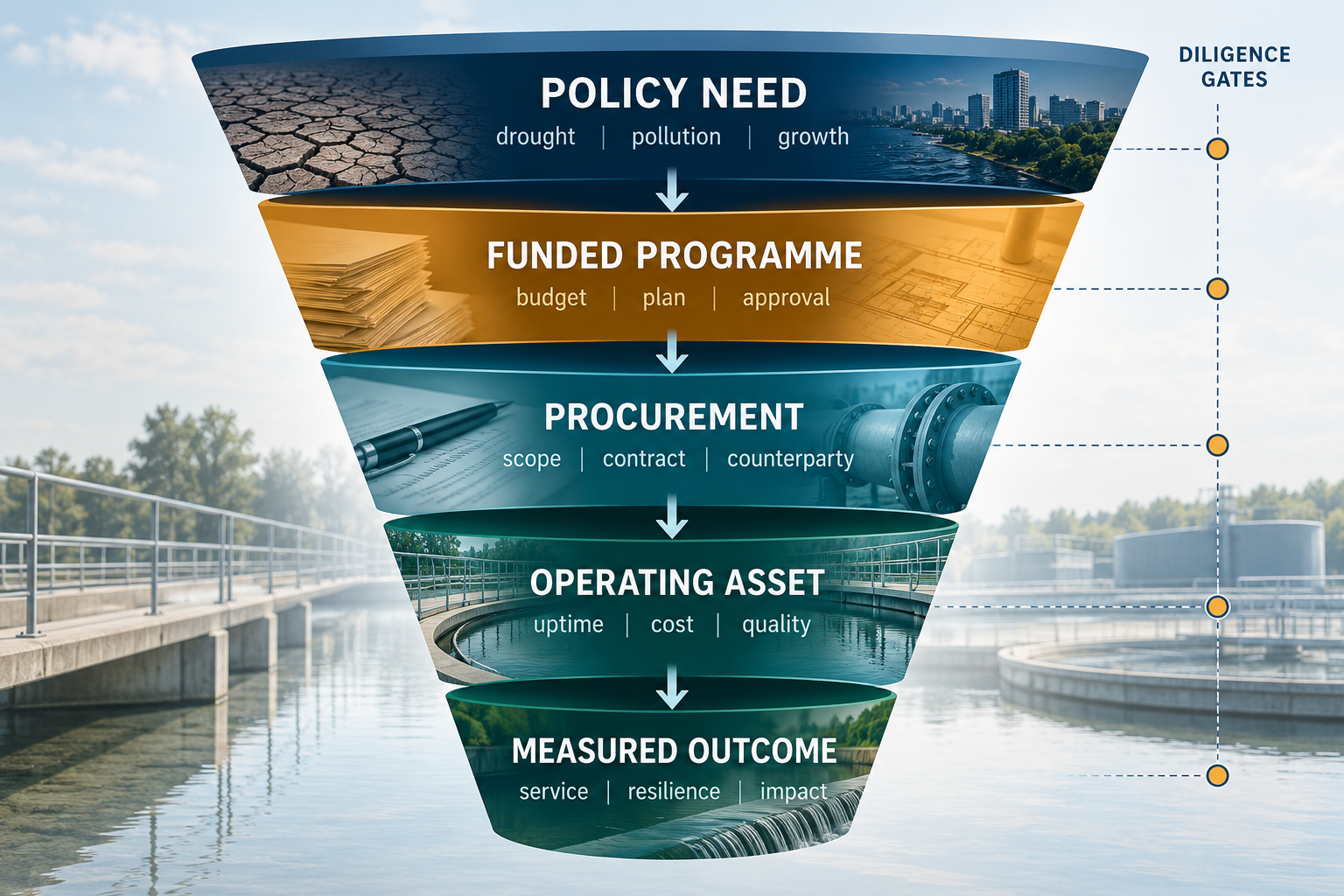
A plan can improve market visibility, but it is not the same as a signed order. Investors should trace each opportunity through the relevant gates: need, option selection, approval, procurement, contract, construction, commissioning and operation.
Regulators shape risk allocation
Water markets are influenced by economic regulators, environmental regulators, planning authorities, public procurement rules and customer expectations. Regulation can create a requirement to act, but it can also determine who pays, how returns are recovered, what performance is measured and what happens when delivery fails.
For a private company, a regulated customer can provide useful visibility. It can also create price pressure and detailed reporting obligations. Diligence should cover allowed expenditure, outcome commitments, procurement rules, asset ownership, change control and the consequences of missed performance.
Supply chains can become an investment variable
Large water programmes depend on construction capacity, specialist equipment, skilled operators, energy, chemicals, laboratory services and digital infrastructure. A company may have strong demand but weak delivery capacity. Investors should test supplier concentration, lead times, warranty exposure, subcontractor dependence and the working capital required to execute.
Scale is valuable only when a business can deliver it. A pipeline that grows faster than the operating base may create quality failures, delayed cash collection or margin compression. Capacity planning belongs in the investment case from the start.
Where revenue sits across the sector
Asset ownership and availability
Asset owners may earn through tariffs, availability payments, capacity arrangements, treatment volumes, contracted offtake or long-term service agreements. Revenue can be visible, but investors need to understand utilisation, indexation, debt, maintenance capital, renewal obligations and counterparty strength.
Engineering and project delivery
Engineering, procurement and construction companies are paid for design, equipment, installation and commissioning. Their opportunity can expand when utilities and industries invest, but their margin depends on scope discipline, procurement, change orders, testing, acceptance and cash conversion.
Operations and maintenance
Operations and maintenance businesses may earn recurring service revenue. The economics depend on staff productivity, energy, chemicals, spare parts, response times, compliance and performance penalties. A contract is stronger when the scope is clear and the price can adapt to the cost base.
Data, monitoring and optimisation
Monitoring and software businesses may sell equipment, subscriptions, analytics, integration or managed services. The recurring element can be attractive, but the customer must use the information. Test data quality, cyber controls, ownership, integration cost, renewal behaviour and the operational decision triggered by each insight.
Reuse and resource recovery
Reuse, energy recovery and nutrient recovery can add value to an existing asset. The opportunity depends on a defined buyer, quality specification, connection, monitoring and price. A recovered output without a route to market may remain an operating cost.
Investors should map each revenue stream to the physical work required. A company may describe one platform, but the economics may combine installation, service, consumables, data and project management. Understanding that mix is essential for forecasting margin and capital needs.
What makes a water business scalable
Repeatability reduces transaction cost
A scalable water business can repeat a design, process, contract, service model or customer acquisition route. Repeatability may come from modular equipment, standardised project preparation, a regional operating network, a software product or a portfolio of similar assets.
The most useful question is what must grow when revenue grows. If each new customer needs bespoke engineering, senior technical attention and a large working-capital commitment, the company may be growing sales faster than economic value.
Operating density can support margin
Service businesses can become more efficient when several assets or customers are close together. A regional network may reduce travel time, improve response coverage and share specialist staff. The advantage is not automatic. It depends on route density, contract scope, asset access and the ability to schedule work reliably.
Defensibility is often practical
Defensibility may come from approvals, reference sites, data, operating history, integration knowledge, customer trust or a position in a long procurement cycle. A patent can help, but it does not replace reliable delivery. Investors should ask what remains difficult for a competitor to reproduce after a contract is won.
Quality systems protect the growth case
Water businesses operate in environments where an error can affect public health, environmental compliance, customer production or asset availability. Quality assurance, maintenance discipline, incident response, training and reporting are commercial assets. They protect retention and reduce the risk that growth creates expensive remediation.
Financing and risk allocation
Different phases need different capital
Early development may need equity and grant support. Construction may need project finance, equipment finance, customer deposits or working capital. An operating asset may support debt or long-term contracted capital. A technology company may need growth capital before recurring revenue becomes predictable.
Do not treat the availability of finance as proof of quality. The financing structure should match the asset life, revenue certainty, construction risk and customer obligation. A short-term instrument can create unnecessary refinancing risk for a long-lived asset.
Public and private capital can be complementary
The World Bank’s Water Forward materials link water security to policy reform, stronger institutions, utility performance, private participation and investment risk mitigation. They also describe blended tools such as guarantees, concessional loans and risk-sharing instruments. These tools may improve bankability, but they do not remove the need for customer demand and operating evidence.
The World Bank’s 2025 Global Water Security and Sanitation Partnership report says the partnership influenced $47.9 billion in active World Bank lending across 90 countries during fiscal year 2025. Such figures describe the scale of public and development-finance activity. They should not be treated as private-market revenue available to any individual company.
Risk allocation determines resilience
Review which party carries construction delay, cost escalation, demand, volume, energy, quality, permit, currency and political risk. A project may look attractive at headline level while placing most downside on the operating company. Contracts should be tested through delay, lower utilisation, higher energy cost and a failed performance test.
Impact needs operating evidence
Impact claims should connect to measurable activity. Relevant evidence may include water saved, treated volume, discharge quality, avoided interruption, energy use, leakage reduction, resilience improvement or people served. The correct metric depends on the asset and customer.
Good impact reporting strengthens commercial diligence when it is linked to contracts, regulatory outcomes or customer decisions. It becomes weaker when it relies on broad claims without a baseline, measurement method or accountable operator.
UK, Europe and GCC: different routes to opportunity
UK: regulated investment and delivery discipline
UK opportunities are shaped by regulatory determinations, water resources plans, environmental programmes, planning, procurement and public scrutiny. The market can offer visibility around funded programmes, but suppliers must still compete and deliver. Investors should distinguish a company exposed to an approved work package from one relying on a general infrastructure theme.
England’s 2026 annual water resources review says the industry is in the second year of the 2025 to 2030 asset management period. It also notes that delivery risks, delays and changes to schemes require active management. This reinforces the need to test execution, not only the value of the plan.
Europe: common direction, local execution
European policy increasingly links water resilience, competitiveness, innovation and investment. The European Investment Bank’s 2026 paper says the largest obstacle is often how investments are originated, coordinated, funded and financed rather than a simple lack of finance. It argues for a broader view of water systems across catchments and institutions.
For investors, this means the same solution may face different procurement, permitting, tariff and operating conditions across countries. A technology can be transferable while the route to revenue remains local. Country-level partners, data, approvals and service coverage therefore matter.
GCC: water security and customer specificity
GCC opportunities can be linked to water security, desalination, reuse, industrial development, urban expansion and energy-intensive production. The region is not one market. Diligence should identify the exact jurisdiction, offtaker, energy profile, local partner, currency, import route, contractor structure and payment protection.
A solution may be technically suitable across borders but commercially weak if the operator cannot support it after commissioning. Investors should test local maintenance, spare parts, permit obligations, customer credit and the relationship between water cost and the customer’s production economics.
How to diligence sector opportunities
1. Define the customer problem
Who is paying, what decision are they making and why now? Test the cost of doing nothing, the alternative solution, the budget owner, the approval path and the procurement route. A serious customer problem should be visible in a contract, plan, permit, operating loss or funded project.
2. Trace revenue to physical delivery
Map every revenue line to equipment, staff, energy, data, consumables, maintenance or capital. Review gross margin by contract and understand what happens when utilisation falls or delivery takes longer. Recurring revenue is only useful when the underlying obligation is sustainable.
3. Test approvals and performance
Confirm permits, quality standards, acceptance tests, warranties, service levels and reporting duties. Separate a pilot result from a commercial asset operating under contractual obligations. Review historic incidents and the process for resolving them.
4. Examine scale and concentration
Test whether the company can repeat its model without an equal increase in bespoke labour, senior management or working capital. Review customer concentration, supplier concentration, geographic density and dependence on one technical founder or partner.
5. Verify impact and governance
Ask which outcomes are measured, by whom and against what baseline. Check data rights, cyber controls, incident escalation, board oversight, health and safety and regulatory reporting. In the water and wastewater sector, governance is part of asset quality.
Frequently asked questions
What is the water and wastewater sector?
It includes the assets, companies and services that source, treat, distribute, monitor, reuse and manage water and wastewater. It spans utilities, engineering, operations, technology, data, resource recovery and specialist finance.
Why can the sector attract private investors?
Water systems support essential economic activity and face funded needs linked to resilience, compliance, capacity, efficiency and environmental performance. The investment case still depends on a clear payer, delivery route, contract and operating evidence.
Is water infrastructure a defensive investment?
Some assets may benefit from essential demand or long contracts, but no label removes construction, regulatory, energy, counterparty, technology or renewal risk. Each opportunity requires specific diligence.
Where do private investors participate?
Private capital can participate in assets, project delivery, operations, technology, monitoring, reuse, resource recovery and specialist services. The appropriate structure depends on revenue certainty, capital intensity, risk allocation and investor time horizon.
What should an investor review first?
Start with the customer, contract, approvals, performance evidence and cash conversion. Then test scalability, concentration, governance, impact measurement and the capital required through construction and renewal.
Explore direct water-technology opportunities
The water and wastewater sector can support durable commercial activity, but the investable case is specific. It rests on a defined customer need, a credible delivery route, measurable performance and economics that remain workable through operation and renewal.
Water Investment Network helps eligible investors review direct water-technology opportunities with a focus on commercial fit, evidence and execution risk. Explore the water-technology portfolio, read the water market investment thesis, or contact the network with a specific question.
If you are assessing opportunities aligned with this sector, join the network to discuss the next step. This is an introduction to private opportunities, not a recommendation or regulated advice.
Sources
- GOV.UK, National Framework for Water Resources 2025: executive summary.
- GOV.UK, National Framework for Water Resources 2025: public water supplies.
- European Investment Bank, Future-proofing Europe’s water systems: From vision to investment.
- European Commission, Water and the 2025 European Water Resilience Strategy.
- World Bank Group, Water Forward FAQ.
- World Bank, Global Water Security and Sanitation Partnership 2025 Annual Report.