A water quality monitoring system turns measurements into operating decisions. It can help a utility, industrial site or water operator see a problem earlier, control treatment and support compliance. For investors, the question is more specific: can the provider turn reliable data into repeatable revenue, defensible margins and customer retention for Water Investment Network readers?
The market includes sensors, analysers, sampling equipment, telemetry, software and specialist services. A system may monitor a drinking water source, a distribution network, a river, a private supply or an industrial discharge. Each use case has a different buyer, measurement need, sales cycle and risk profile.
This article explains how to assess water quality monitoring system businesses as private-market opportunities across the UK, Europe and the Gulf Cooperation Council (GCC). It is educational content, not regulated financial advice. It does not recommend an investment or guarantee a return.
Water quality monitoring system: the investor thesis
| Question | Evidence to test |
|---|---|
| Customer problem | Which quality, safety, discharge, production or resilience problem is urgent enough to fund? |
| Measurement value | Which parameter is measured, at what frequency, and what decision changes because of the result? |
| Revenue model | Does the provider sell hardware, projects, monitoring subscriptions, data or managed services? |
| Proof of performance | Are accuracy, uptime, calibration and maintenance claims supported in real operating conditions? |
| Scale path | Can installation, connectivity, support and reporting become more repeatable as sites increase? |
| Investor risk | What could delay approval, procurement, deployment, payment, renewal or replacement? |
A strong thesis is not simply that clean water matters. It is that a defined customer has a funded problem, the monitoring output changes a decision, and the provider can deliver the system at an attractive cost. Public policy can strengthen demand, but policy alone does not prove a sales pipeline or profitable unit economics.
Monitoring businesses can also look more recurring than they are. A company may report a growing installed base while carrying high commissioning costs, site visits and replacement obligations. The investor must connect the number of sites to contract terms, service workload, data quality and cash collection.
What a water quality monitoring system includes
Sensors and analysers
A sensor measures a physical or chemical condition. Common measurements include pH, temperature, conductivity, dissolved oxygen and turbidity. More specialised instruments can measure nutrients, chlorine, ammonia, nitrate, phosphate, metals, organic carbon or other target substances.
The instrument is only one part of the system. The right specification depends on the water matrix, the range of expected values, interference risk, required detection limit, sampling point and operating environment. A cheaper device may not produce commercially useful data if it drifts, fouls or needs frequent manual attention.
Sampling, telemetry and data management
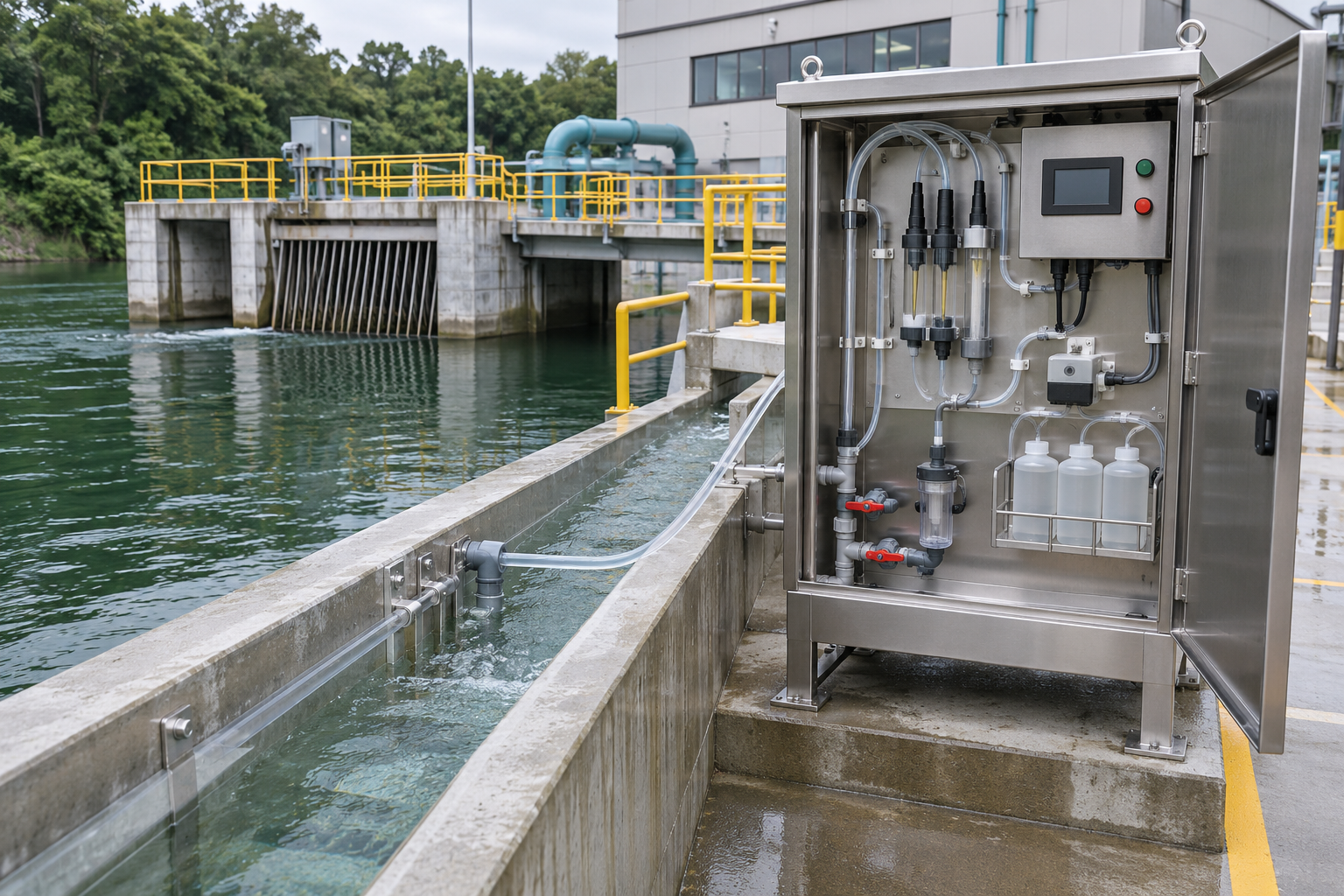
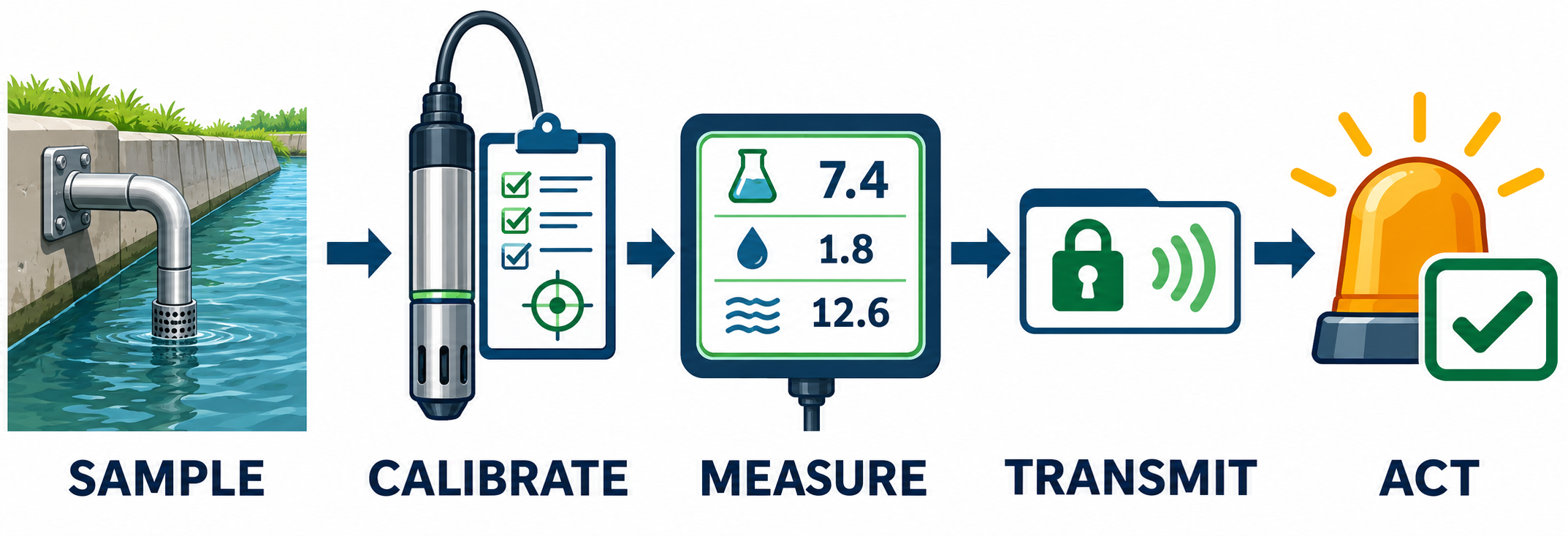
Sampling equipment brings water to the analyser or controls when the instrument measures. Telemetry sends results to a local control system or cloud platform. Data management stores readings, flags missing values, shows trends and allows authorised users to review alarms.
Connectivity can be difficult at remote assets. Power, signal strength, temperature, sediment, biofouling and access all affect uptime. A provider that sells a dashboard but cannot maintain the sample path may have weak customer value even when the software looks polished.
Decision support and service
A useful system links a measurement to an action. It may trigger an investigation, adjust a treatment process, divert an effluent stream, support a laboratory sample or alert an operator to a possible contamination event. The United States Environmental Protection Agency describes online monitoring as a way to optimise treatment, detect incidents and improve distribution-system control.[3]
Service can include installation, calibration, cleaning, repairs, data review and reporting. Investors should separate the value of the equipment from the value of the service layer. The service layer may support retention, but it can also create labour and travel costs that rise with every new site.
Why demand is becoming more investable
Regulation needs credible measurements
Regulators need evidence about the condition of water bodies, supplies and discharges. The European Commission says the Water Framework Directive requires monitoring to support the assessment of chemical and ecological status, while priority substances and national pollutants are part of the framework.[1]
In England, Environment Agency guidance says regulatory monitoring must show, within acceptable uncertainty, whether an operator is meeting permit conditions. It also stresses documented sampling, quality assurance, calibration and maintenance for continuous water monitors.[2] That creates demand for dependable measurement, but it also raises the proof standard for providers.
Operators need earlier operational signals
Periodic laboratory testing provides a result at the time of sampling. Continuous or near-real-time monitoring can show a changing condition between samples. That can help a customer investigate a process change, protect a treatment step or respond before a quality issue becomes a larger event.
The commercial value depends on the action. If the data does not influence treatment, maintenance, reporting or customer service, the system may be an information cost rather than an operating asset. Diligence should identify the named decision owner and the cost of ignoring the signal.
Water security raises the value of information
Water operators face pressure to protect supply, control pollution and improve asset performance. The Drinking Water Inspectorate explains that monitoring helps identify supplies that do not meet water quality standards and verify whether control measures work.[4] This is a practical use case for data, not a promise that every monitoring vendor will benefit equally.
Demand can be strongest where a measurement affects safety, production continuity, permit compliance or capital planning. The investor should map that effect to a budget. A technically impressive signal has limited value if the customer cannot fund the installation or cannot act on the output.
The parameters and data problem
Measure the parameter the customer needs
A water quality monitoring system should be designed around the determinand, meaning the specific substance or property being measured. One instrument may be suitable for pH but unsuitable for a particular nutrient, metal or organic compound. The Environment Agency says the method must be appropriate for the exact determinand specified in the permit.[2]
This matters for sales and margins. A broad product claim may attract attention, while each site still needs a defined configuration, validation process and service plan. The more configurations a provider supports, the greater the risk of bespoke engineering and uneven gross margin.
Calibration and drift are commercial issues
Calibration compares an instrument with a known reference so that readings remain within the required performance range. Drift is the gradual movement of a reading away from the true value. Fouling, temperature, sediment and chemical interference can all reduce data quality.
Regular calibration and maintenance are vital for continuous water monitors, according to Environment Agency guidance. The guidance also recommends written schedules and records for maintenance and calibration work.[2] For investors, these requirements affect technician capacity, spare parts, contract scope and customer retention.
Data needs a chain of evidence
A customer may need to show how a reading was produced, changed and reported. The chain can include the sampling point, timestamp, instrument identity, calibration record, data transfer, alert history and any laboratory confirmation. Weak records can create disputes even when the underlying instrument is sound.
Review data ownership, access rights, retention periods, cyber controls and export formats. Interoperability can support adoption because utilities and industrial sites rarely want another isolated system. It can also increase integration cost if every customer uses a different control platform.
Commercial models for monitoring providers
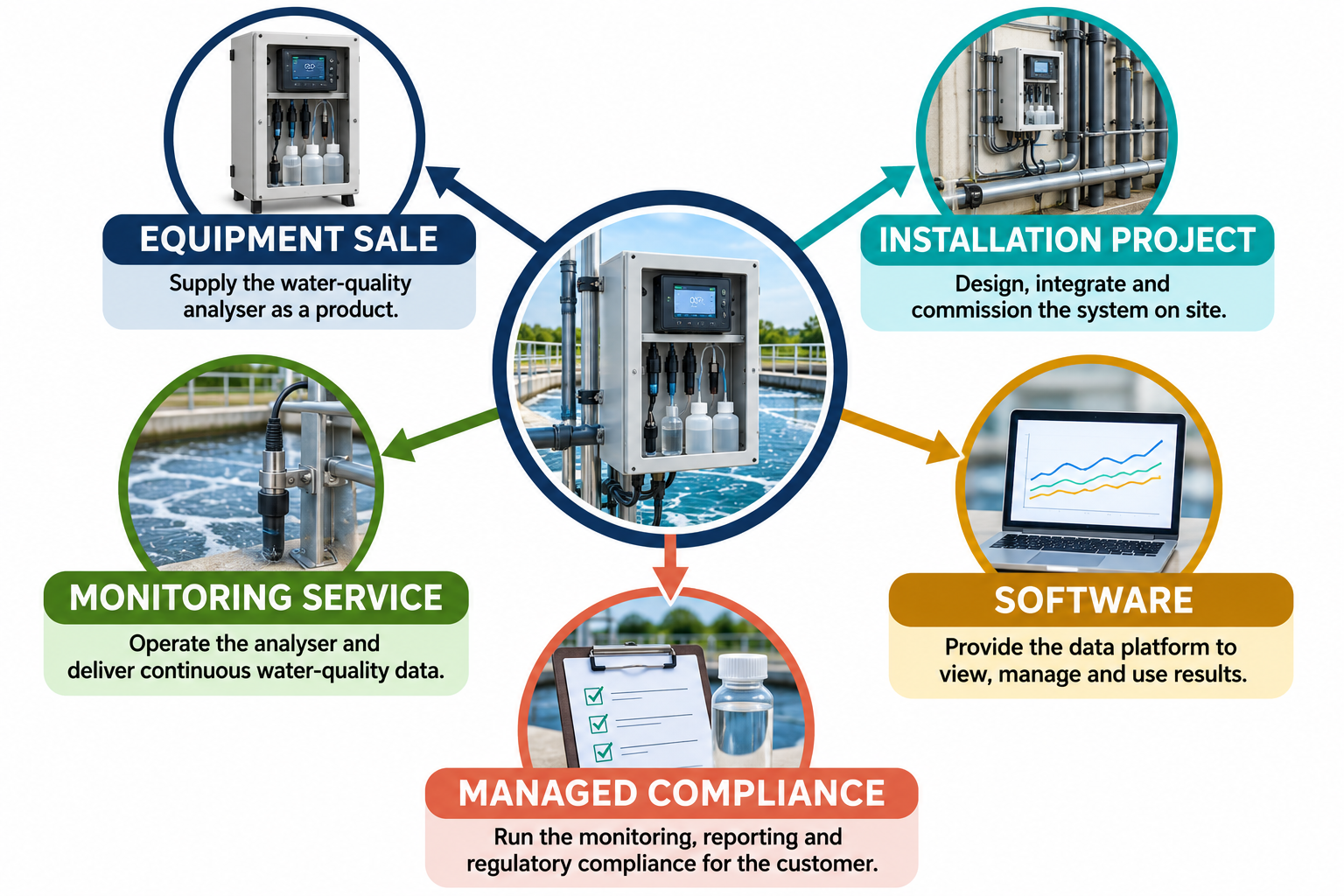
Equipment sales and installation
The provider may sell sensors, analysers, samplers or complete monitoring cabinets. Revenue is recognised around delivery or commissioning, while warranty and support obligations may continue for years. Margin depends on manufacturing, procurement, installation time, subcontractors and replacement parts.
Ask whether the product is standardised or engineered for each site. Standard equipment can support repeatable delivery. A project with a large contract value can still be difficult to scale if every deployment requires a new design, custom interface and long acceptance process.
Monitoring as a service
Monitoring as a service can combine equipment, connectivity, software, maintenance and reporting into a monthly or annual contract. This model may improve visibility on recurring revenue and customer retention. It can also leave the provider responsible for uptime, site visits, calibration and response times.
Review the installed base by cohort. Check contract length, renewal rate, average revenue per site, support tickets, travel cost, spare-part consumption and customer concentration. A recurring contract is not automatically high margin if service intensity rises with every deployment.
Data, analytics and managed compliance
Some providers charge for a software platform, a data feed, anomaly detection or compliance reporting. Analytics can be valuable when it reduces manual review or helps a customer prioritise action. It is weaker when the customer receives alerts without a clear operating workflow.
Managed compliance services may create a deeper relationship with the customer. They also require clear responsibility boundaries. The provider must define what it measures, what it reports, what the customer must verify and what happens when a sensor fails.
| Model | Potential strength | Risk to test |
|---|---|---|
| Equipment sale | Clear product value and order economics | Warranty, inventory, installation and replacement demand |
| Installation project | Access to a larger system contract | Scope changes, acceptance delays and working capital |
| Monitoring service | Contracted revenue and customer data | Calibration, travel, uptime and renewal costs |
| Software and analytics | Replicable data layer after integration | Data quality, cyber risk, adoption and churn |
| Managed compliance | High customer relevance and workflow integration | Liability, reporting accuracy and responsibility disputes |
Scaling from pilot to customer base
A pilot tests more than the instrument
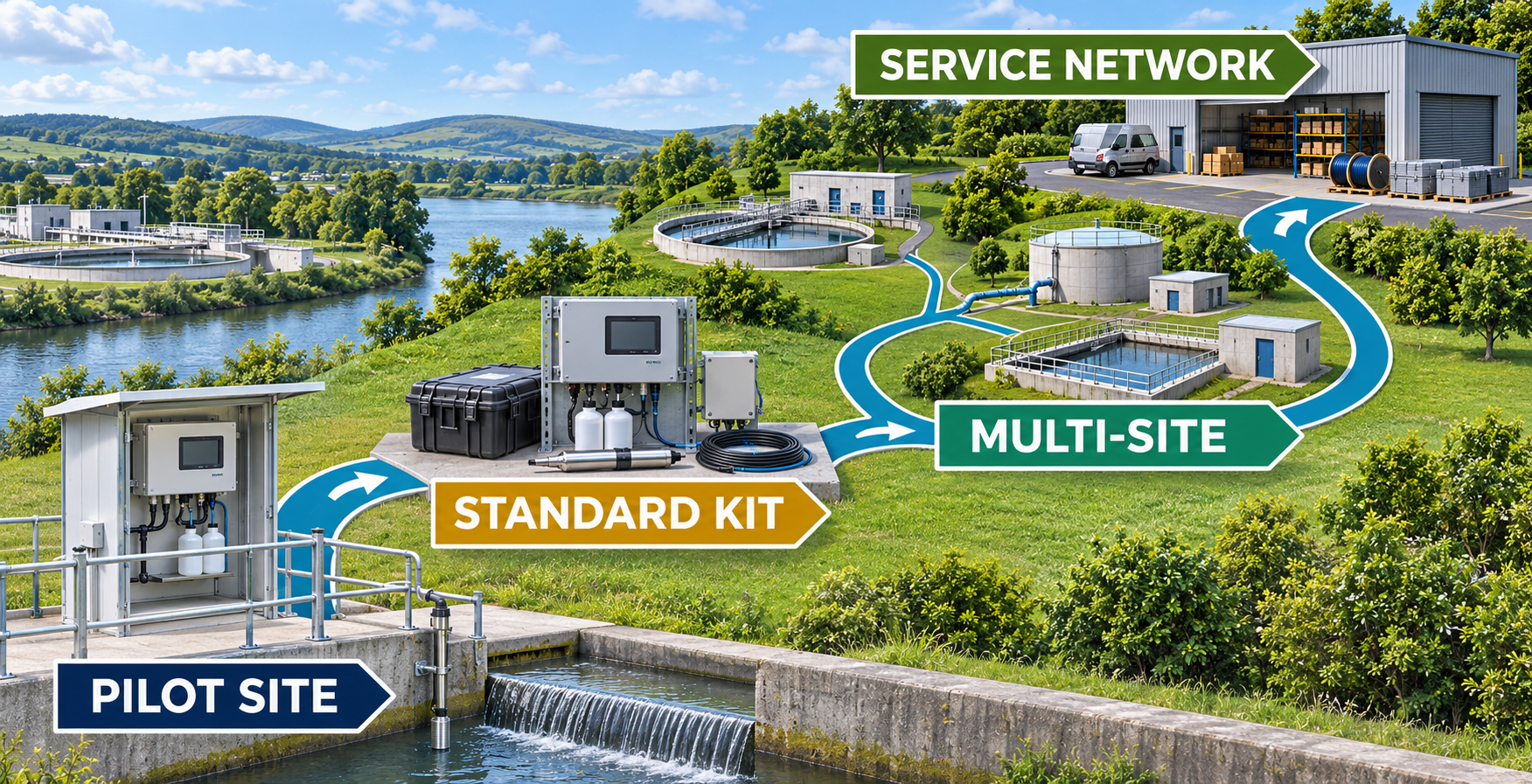
A pilot can show that a measurement is possible. A commercial rollout must show that the system can be installed, calibrated, connected, maintained and trusted across the customer’s normal operating range. It must also fit procurement, cyber, safety and reporting requirements.
Separate a paid pilot, a free trial, a framework position, a purchase order and a live recurring contract. These stages have different conversion rates and different cash consequences. Treating them as one pipeline can inflate the apparent scale of the business.
Standard operating procedures create operating scale
Scale improves when the provider has repeatable site surveys, installation kits, commissioning steps, calibration routines, alert rules and support playbooks. These assets can reduce delivery time and training cost. They also make quality easier to audit.
Ask how much of the work is performed by the founder, one senior engineer or an informal contractor network. A business may have strong technology but limited organisational capacity. That gap can slow sales, increase defect rates and require more capital.
Integration can defend the account
Once monitoring data feeds a treatment control loop, regulatory report or asset-management process, switching providers may become inconvenient. This can support retention and create a defensible position. It can also make implementation slower because the system must pass more customer checks.
Review the integrations that are already repeatable. Look at application programming interfaces, data formats, user permissions, alarm logic and support procedures. A list of possible integrations is less valuable than evidence of live, maintained connections.
Regulation and procurement shape the route to revenue
Monitoring evidence must be fit for purpose
Environment Agency guidance says analytical results are estimates of the true value and must meet performance expectations for their intended use. It also discusses uncertainty, quality control, proficiency testing and documentation.[2] This means a monitoring provider may need to sell evidence and quality systems as well as hardware.
Do not assume that a sensor marketed for one application can be used for regulatory reporting without further validation. Check the customer’s stated method, sampling design, acceptance criteria and responsibility for sign-off.
Procurement is a commercial capability
Water customers often buy through frameworks, integrators, engineering contractors or long procurement processes. The provider must understand the route to the budget holder and the role of each intermediary. A product can lose margin if channel partners control the customer relationship.
Review tender win rates, procurement lead times, approved-vendor status, contract terms and the cost of responding to bids. Also check whether a pilot can convert within the customer’s budget cycle. Sales capacity is part of the operating model, not a separate assumption.
Regulation can support demand and add risk
Regulation may create a requirement to monitor a parameter, but it can also change the technical standard, reporting method or liability position. The EU Water Framework Directive is supported by detailed requirements for monitoring and assessment, while UK guidance emphasises the quality of the monitoring approach.[1][2]
The investor should identify the exact requirement, the paying customer, the implementation timetable and the cost of compliance. Avoid turning a broad regulatory theme into a revenue forecast without contract evidence.
UK, Europe and GCC routes to opportunity
UK customers and reference sites
UK opportunities may come from water companies, private supplies, industrial discharges, laboratories, environmental monitoring and specialist contractors. The Drinking Water Inspectorate explains that monitoring supports compliance and the evaluation of control measures for private water supplies.[4] Ofwat also identifies the Environment Agency, the Drinking Water Inspectorate and Ofwat as distinct parts of the UK water regulatory framework.[5]
For a provider, the route may be direct, through an engineering partner or through a framework. A UK reference site can support credibility, but investors should check whether the reference uses the same parameter, operating environment and buyer type as the next target customer.
European market routes
The European Commission describes water protection through a river basin approach and links monitoring to chemical and ecological status. Requirements and procurement structures can still vary by country, utility and application.[1]
Expansion therefore requires more than translating product material. Review local standards, language, service coverage, data hosting, certification, channel partners and customer concentration. A strong technical product may need a local operating model to win and retain contracts.
GCC demand and delivery risk
GCC markets may create monitoring demand around water security, desalination, reuse, industrial production and new infrastructure. The commercial case depends on the precise jurisdiction, off-taker, project sponsor, local partner, energy setting and payment structure.
Test whether the provider can commission and support systems in the target market. A distributor can open access, but it may reduce margin and customer visibility. A local service partner can improve uptime, but it creates quality-control and dependence risk.
Unit economics, risk allocation and diligence
Bridge the price to gross margin
Start with the customer price and work down to the real cost of delivery. Include the instrument, enclosure, sampling equipment, installation labour, connectivity, cloud hosting, calibration, travel, consumables, repairs, warranty and customer support.
Then test the result by customer type and site complexity. Gross margin may be strong on standard deployments and weak on remote or highly integrated sites. A blended group margin can hide this difference and make expansion look easier than it is.
Cash conversion follows the contract
Project revenue may require stock, engineering and site work before the customer pays. Service revenue may be collected monthly but still require upfront equipment and installation. Check deposits, milestones, retentions, payment terms, bad debt and working-capital support.
A company that grows quickly can need more capital even when its reported margin improves. The investor should model the cash cost of a new site, the time to first invoice and the cost of keeping spare equipment available.
Allocate failure and data risk
Contracts should explain what happens when a sensor fails, data is missing, a sample is invalid or an alert is not acted upon. Review service levels, exclusions, liability caps, insurance, cyber obligations and customer responsibilities.
Environment Agency guidance notes that maintenance, calibration and records are central to continuous monitoring quality.[2] These tasks are part of the risk allocation. A provider that promises high availability without pricing the required service may be selling an uneconomic contract.
Customer and sales evidence
Identify the customer problem, budget owner, buying route and alternative solution. Separate live paid sites from pilots, demonstrations, letters of intent and framework access. Review renewal history and lost opportunities by reason.
Ask how the product becomes part of the customer’s normal workflow. A system that supports a permit, treatment decision or production process may have stronger retention than one used only for occasional reporting.
Technical and data evidence
Review the target parameters, detection range, accuracy, calibration method, sampling design, uptime and maintenance schedule. Check data gaps, alert response, cybersecurity, user permissions and export capability. Confirm which claims are independently verified and which are management estimates.
Ask for evidence from the same water type and operating environment as the target market. A laboratory result is useful, but it may not show how the system handles fouling, temperature change, sediment or intermittent connectivity.
Economics, defensibility and governance
Build a site-level contribution margin. Include hardware, field service, calibration, cloud costs, support, warranty and replacement cycles. Then test how the margin changes when the customer is remote, the system needs integration or the contract includes response obligations.
Look for defensibility in verified performance, reference sites, data history, integration, service coverage and customer workflow. Review governance around environmental claims, data handling, safety, related-party transactions and regulatory communication. A technical feature is not a moat unless it supports adoption or retention.
Finally, set clear impact measures. Depending on the use case, the relevant outcome may be earlier detection, fewer incidents, better treatment control, safer supply, improved compliance or a stronger evidence base for investment. Keep the claim within what the system can actually prove.
Frequently asked questions
What is a water quality monitoring system?
It is a combination of sensors or analysers, sampling equipment, data transmission, software and services used to measure a defined water quality condition and support an operating or reporting decision.
Why can water quality monitoring attract private investment?
Monitoring can support safety, compliance, treatment control, resilience and production continuity. The investable case still depends on a paying customer, reliable data, repeatable deployment and workable service economics.
What is the difference between periodic and continuous monitoring?
Periodic monitoring takes samples at defined times and sends them for analysis or uses portable equipment. Continuous monitoring uses a permanently installed or continuously fed instrument to provide data with few gaps, subject to calibration and maintenance.
Are water quality sensors automatically suitable for regulatory reporting?
No. Suitability depends on the parameter, method, uncertainty, calibration, sampling design, quality controls and the customer’s regulatory requirements. A sensor specification alone does not prove that the complete monitoring approach is acceptable.
What should investors review first?
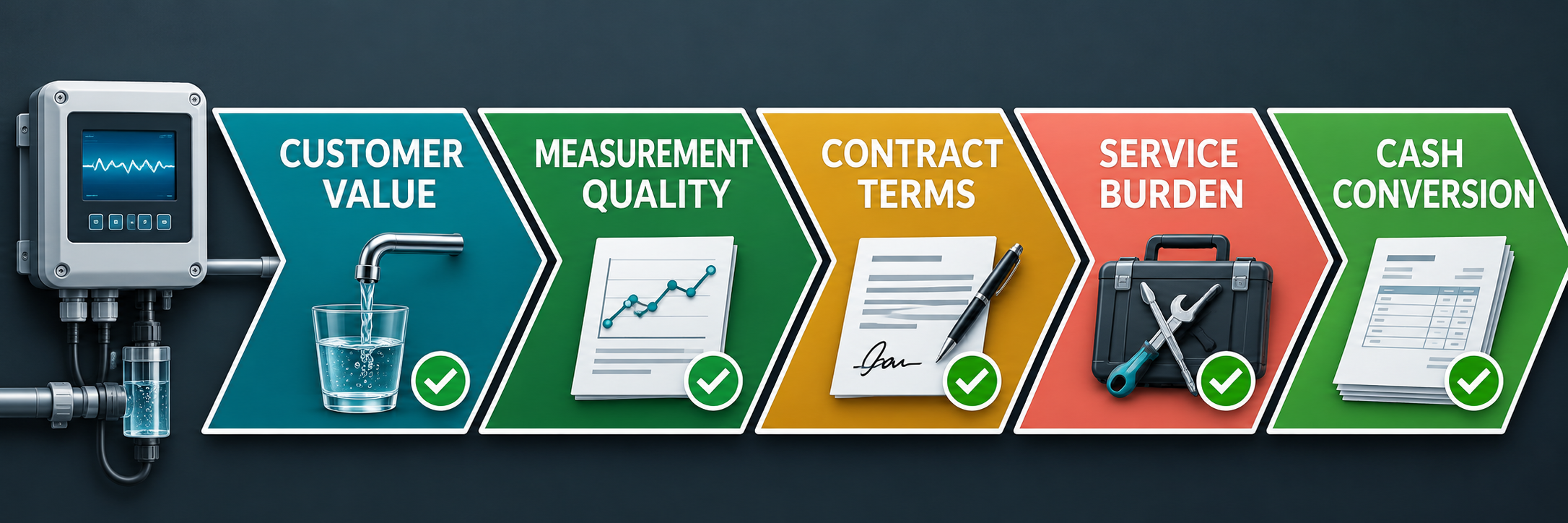
Start with the customer problem, the measured parameter, the decision that uses the data, contract terms, site-level margin and service burden. Then test technical proof, cash conversion, integration, defensibility and governance.
Explore direct water-technology opportunities
A water quality monitoring system can become a valuable operating tool when its data is accurate, trusted and linked to action. The commercial opportunity is specific. It depends on the customer, parameter, procurement route, installation model, service burden and contract risk.
Water Investment Network helps eligible investors review direct water-technology opportunities with attention to commercial fit, evidence and execution risk. Explore the water-technology portfolio and read the Smart Water Monitoring investment thesis.
If you are assessing opportunities in this area, join the network to discuss the next step. This is an introduction to private opportunities, not a recommendation or regulated advice.