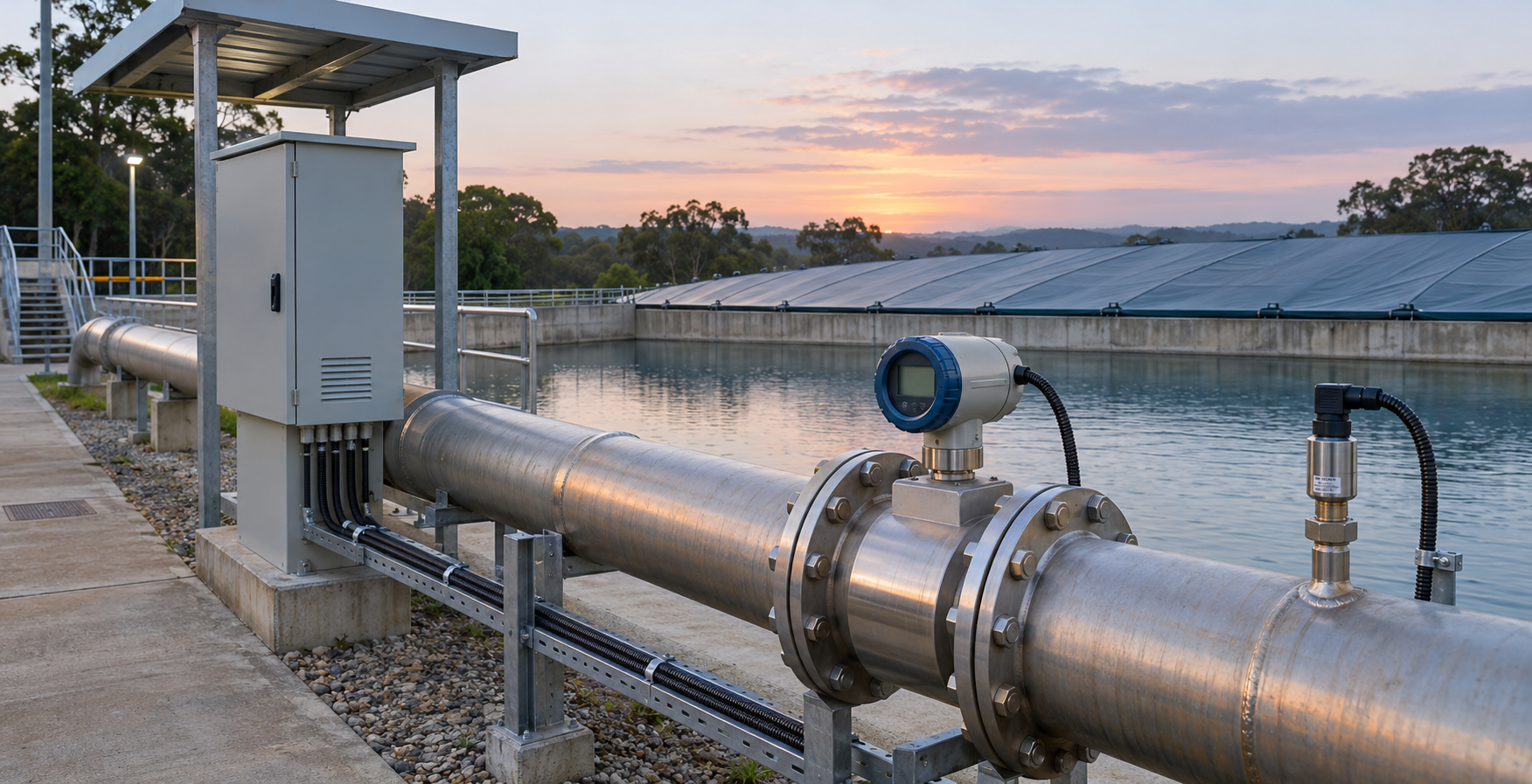
Smart water monitoring is moving from a technical feature to an operating requirement. Water companies, industrial sites and water-intensive property operators need better evidence about flow, pressure, quality, levels and leakage. The commercial opportunity is not simply to sell a sensor. It is to turn distributed measurements into decisions that reduce waste, protect compliance and improve asset utilisation.
For private investors, that distinction matters. A credible smart water monitoring business must show who pays, what decision changes, how the system is deployed, and why the revenue repeats. It must also prove that its readings remain trustworthy outside a controlled demonstration. This article examines the commercial models, scaling path and diligence questions behind the theme. It sits within the network’s smart water monitoring investment theme.
Why smart water monitoring is becoming a commercial priority
Water operators are managing ageing assets, variable demand and tighter expectations for evidence. The UK’s National Framework for Water Resources 2025 expects widespread smart metering, prioritised in areas of greatest water stress. It also links daily and sub-daily data with earlier leak detection, better targeting of efficiency work and stronger customer information.
The same framework points to the commercial challenge. Companies need standards, data infrastructure and supply-chain capacity before the benefits of a large metering programme can be realised. That creates demand for equipment, connectivity, integration, analytics, installation and ongoing support. It does not remove procurement risk or guarantee that a supplier will win a contract.
At EU level, the Water Resilience Strategy actions tracker describes a proposed action plan on digitalisation, including smart metering and improved water-data sharing. It identifies fragmented repositories, analogue systems and interoperability as practical barriers. For an investor, those barriers define the addressable work. The most valuable businesses may be those that make existing assets usable, rather than those that add another isolated dashboard.
What a smart water monitoring system includes
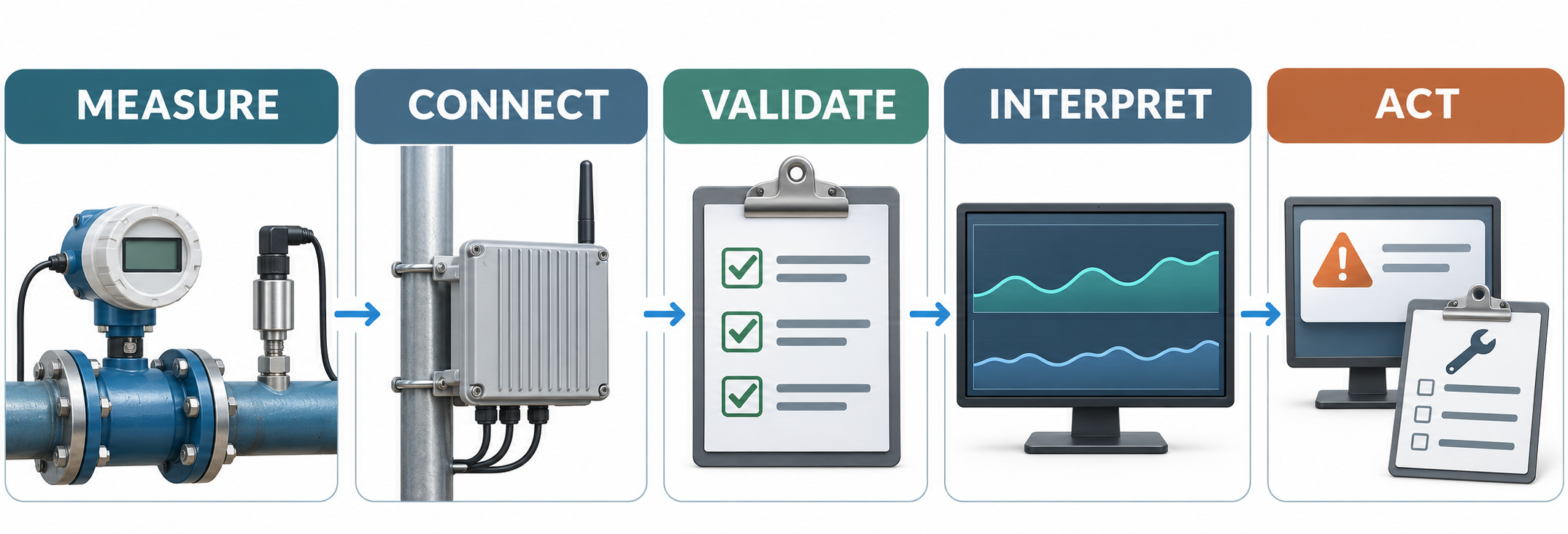
A smart water monitoring system usually combines four layers. The first is the physical measurement layer. It can include flow meters, pressure sensors, level sensors, acoustic devices, water quality probes or smart meters, depending on the customer problem.
The second layer is communications. A remote water monitoring system may use cellular, radio, fibre, satellite or a local gateway. The right choice depends on site access, power, signal coverage, data frequency and the cost of failure. Connectivity is an operating input, not a decorative software feature.
The third layer is data management. This includes time synchronisation, storage, device identity, alert rules, permissions and links to the customer’s existing systems. The fourth is the workflow layer. It sends an alert, creates a work order, supports a compliance record or changes how an operator runs an asset.
These layers should be assessed separately. A company may have excellent sensing hardware but weak field service. Another may have useful analytics but depend on unreliable third-party devices. An investor should understand which layer the company controls, which it resells and where gross margin is earned.
Smart monitoring is broader than water quality
Water quality monitoring is one important use case, but smart water monitoring also covers network flow, pressure, tank levels, pump performance, rainfall response and customer consumption. The distinction prevents a common diligence error: assuming that a successful quality-monitoring deployment proves demand for every remote monitoring application.
Remote does not mean unattended
Remote water monitoring reduces routine site visits. It does not eliminate calibration, inspection, cleaning, battery replacement, communications checks or exception handling. Remote water monitoring systems still need a service model that accounts for the physical environment where each device operates. Sediment, corrosion, biofouling, temperature, power loss and poor signal can all reduce the value of a clean-looking data feed.
The customer problem behind the sensor
The paying customer is rarely buying data for its own sake. A utility may need earlier visibility of leakage or network conditions. An industrial operator may need evidence that a discharge remains within permit conditions. A property or facilities operator may need to find continuous flow, reduce avoidable consumption or manage multiple sites without sending staff to each one.
The commercial case becomes stronger when the monitoring event is connected to a decision with an owner. Who receives the alert? What action follows? How quickly must the action occur? Which budget pays for the response? If those questions are unanswered, the product may remain a pilot even when the sensor itself performs well.
For example, a pressure change may prompt a network investigation. A high-flow event may open a maintenance ticket. A water quality reading may trigger a confirmatory sample or a process adjustment. A level reading may alter pumping or storage decisions. The buyer values avoided downtime, better control, lower field effort, stronger evidence or reduced water loss, not the reading alone.
The US EPA Water Sensors Toolbox describes applications across source waters, distribution systems, treatment, contamination detection and physical water characteristics. It also highlights the need to understand sensor capability, reliability, maintenance and lifecycle cost. That is a useful commercial test: the product must fit a real operating environment and a repeatable budget line.
Customer value should be observable
A strong deployment has a baseline, an intervention and a measurable operational outcome. The outcome may be a reduction in site visits, better alarm response, more complete compliance records or a clearer view of water use. The investor should ask how the customer observed the change and whether the evidence was accepted by the person who controls renewal.
Buyer and user may be different
The person who specifies a system may not be the person who approves the recurring contract. Procurement, operations, compliance, information technology and finance can all influence the sale. A business with a clear user but no economic buyer may have high engagement and weak conversion.
How smart water monitoring companies make money
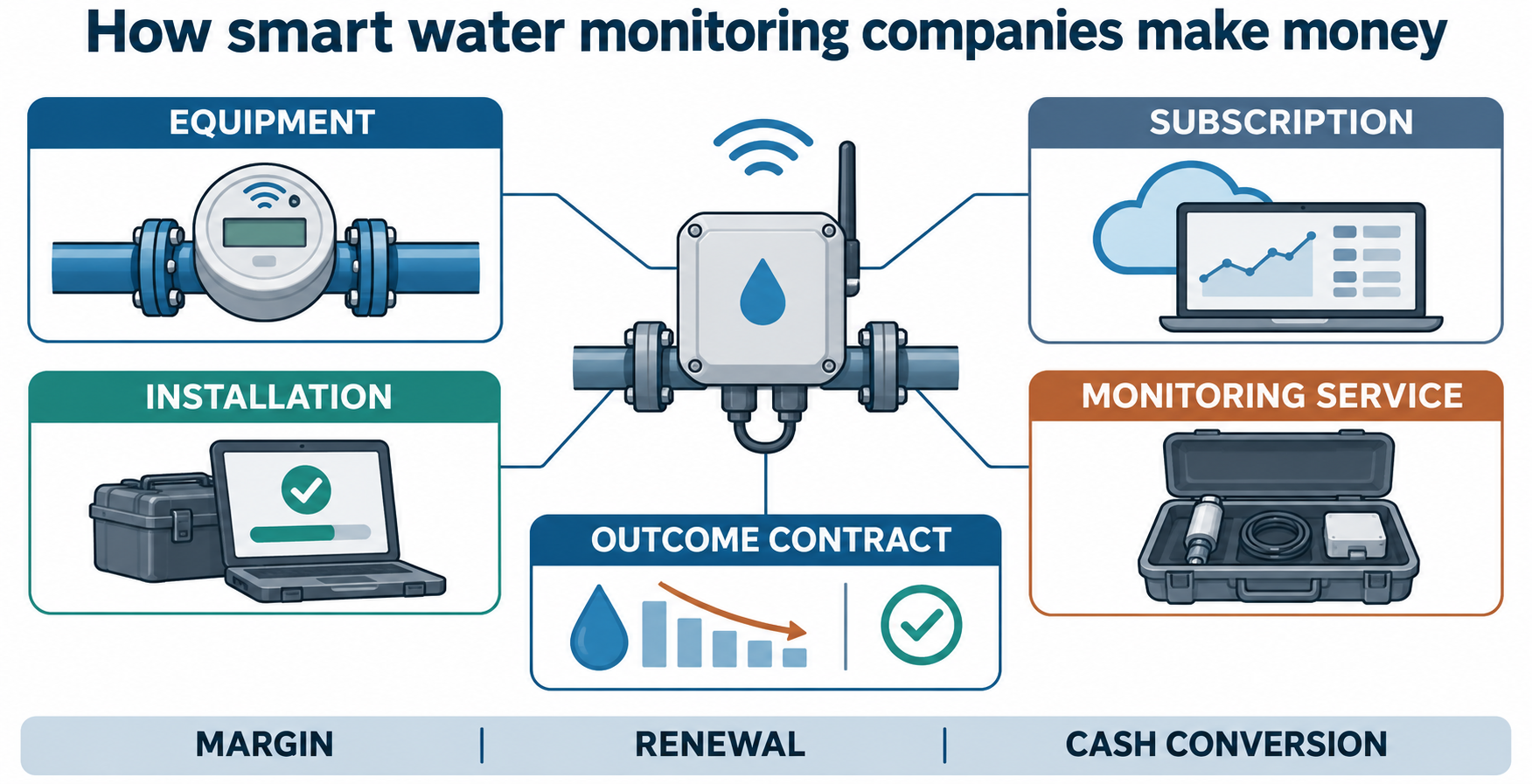
Commercial models range from one-off equipment sales to recurring monitoring services. The right model depends on installation complexity, data frequency, service requirements, customer risk and the level of operational change delivered.
Equipment and installation
Hardware revenue is easy to understand, but it can be cyclical and margin-sensitive. Installation can add value when the site survey, commissioning and integration work are repeatable. Investors should separate product margin from project labour and test whether each deployment becomes faster and more profitable over time.
Software and data subscriptions
A subscription can cover dashboards, alerts, data storage, integrations, reporting or analytics. Recurring revenue is attractive only when the customer continues to use the system. Renewal evidence, active users, alert response and data completeness are more informative than contracted annual value alone.
Monitoring as a service
Monitoring as a service bundles devices, connectivity, maintenance and software for a monthly or annual fee. It can reduce the customer’s upfront decision burden, but it makes the supplier responsible for field reliability and replacement economics. Investors should examine service hours, spares, travel, warranty exposure and the cost of supporting older hardware.
Outcome-linked and managed contracts
Some suppliers may charge for a managed result, such as a monitoring programme, compliance support or a leakage-response service. This can deepen customer value, but outcome definitions must be precise. A supplier should not be paid for a result it cannot measure, control or attribute.
The best model may be hybrid. Hardware creates the initial deployment, software and connectivity create continuity, and specialist services protect retention. The risk is that a company presents a high recurring-revenue story while most of its work remains bespoke installation.
What deployment looks like in practice
Deployment begins with a site and measurement question. A customer should define the parameter, the required accuracy, the measurement interval and the decision the result will support. The system then needs a suitable installation point, power, communications, data configuration and an agreed response process.
For regulated discharges, the Environment Agency’s monitoring guidance distinguishes periodic monitoring from continuous water monitors. Continuous instruments can provide automatic measurements and may trigger an intervention when permit limits are approached. The guidance also stresses that the method must match the determinand and required accuracy.
The commercial implication is that a remote water monitoring system must be designed around a use case, not installed as a generic kit. Site assessment, sampling location, commissioning and validation can determine whether the customer receives useful evidence. The sales process therefore includes technical discovery that can lengthen the cycle but also create defensibility.
Installation density changes the economics
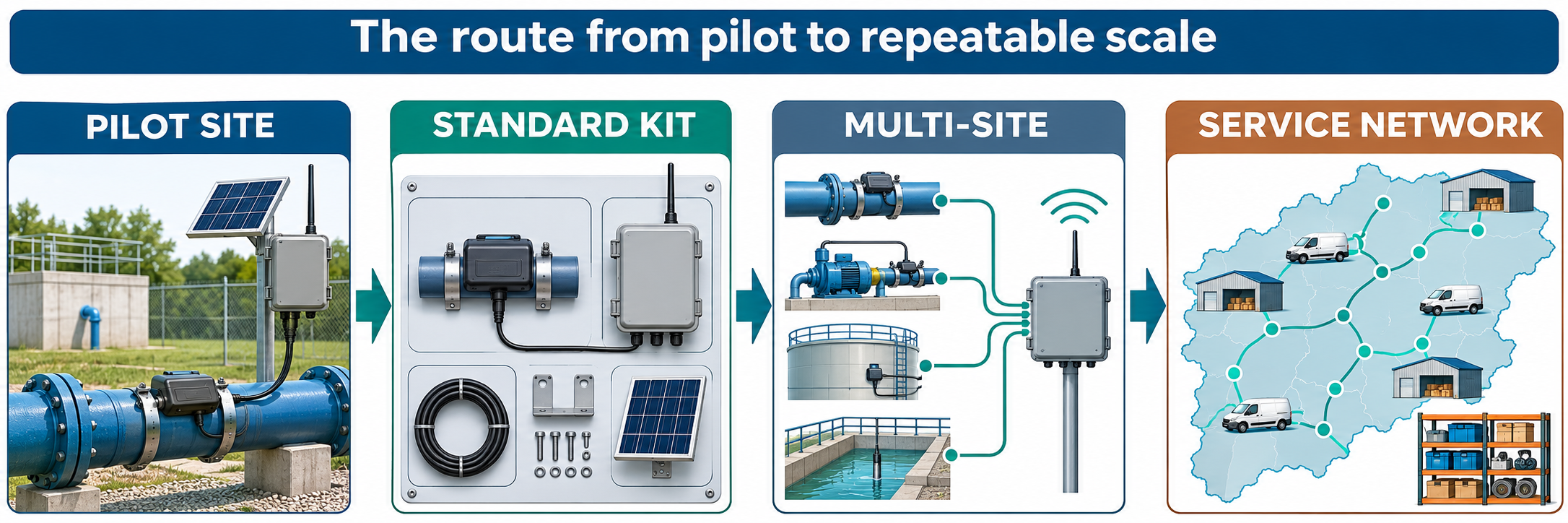
One site with one device may support a proof of concept. A portfolio of sites creates the opportunity for standardisation, remote configuration, shared support and lower acquisition cost per deployment. It also creates more failure points. Investors should compare revenue growth with the number of installations, service tickets and field hours required to produce it.
Integration is often the hidden work
Customers may need alerts in a control room, reports in a compliance workflow or readings in an asset-management platform. Each integration can increase customer value and switching cost. It can also create bespoke engineering work that limits scale. The company should show which integrations are standard, which are configurable and which require custom development.
Data quality is the real product
A sensor can be technically impressive and commercially weak if its data cannot support action. Data quality includes accuracy, completeness, time alignment, calibration history, exception handling and traceability. It also includes the ability to explain why a reading changed or why a gap occurred.
The Environment Agency guidance states that continuous water monitors need regular calibration and maintenance. It recommends documented procedures, records of calibration, spare parts and consumables, and access to emergency repair support. Those requirements have direct implications for gross margin and customer retention.
The EPA also identifies performance evaluation, maintenance, site-specific conditions and lifecycle cost as important considerations. In a diligence process, a company should be able to show its failure rates, mean time to resolve, calibration intervals, device replacement assumptions and the proportion of readings that reach the customer’s usable workflow.
Connectivity and cybersecurity are operating risks
Remote water monitoring depends on a communications path that may be outside the supplier’s control. A device may lose signal, power or time synchronisation. The platform needs clear status indicators so a silent device is not mistaken for a stable measurement.
Data access also needs governance. An investor should ask how credentials are managed, how device identities are protected, how customers export their data and how the supplier responds to a security incident. These controls do not replace product-market fit, but weak controls can delay procurement with larger customers.
Regulation and procurement shape the sales cycle
Regulation can create a need for monitoring, but it does not guarantee a supplier’s revenue. In the UK, the Environment Agency’s guidance links discharge monitoring with performance standards, quality systems, calibration and documented reporting. It also points to MCERTS certification and accreditation routes for relevant equipment and services.
This can favour suppliers that understand compliance evidence and customer processes. It can also raise entry costs. A company may need qualified staff, validated methods, certified equipment, quality documentation and a support network before it can serve a regulated account credibly.
Public procurement adds a second layer. The buyer may require financial resilience, cyber controls, references, interoperability, service-level commitments and evidence from comparable sites. The sales funnel should therefore be analysed by procurement stage, not only by the number of pilots or expressions of interest.
Standards can be a moat or a constraint
Standards and certification may improve trust and reduce buyer uncertainty. They can also limit which hardware, methods or claims are acceptable. The investment question is whether compliance capability supports repeatable sales or merely adds cost to every project.
Regional expansion needs local proof
The UK, European and GCC markets do not share one procurement rulebook or one operating environment. A company expanding across regions needs local channel access, installation capability, data governance and evidence that its measurement method suits local conditions. Geographic reach should not be confused with a transferable sales deck.
The route from pilot to repeatable scale
The first commercial milestone is not a successful demonstration. It is a repeatable deployment that solves a defined customer problem within an acceptable payback and service envelope. That requires a clear implementation playbook, standard data model, installation checklist, support process and renewal owner.
The UK framework’s focus on standards, supply-chain engagement and data infrastructure illustrates why the market may develop in stages. Large roll-outs need coordination. Smaller customers may adopt through specialist service providers or facilities partners. A supplier that can serve both segments must be clear about which channel owns the customer relationship.
Scale can come from more devices per customer, more sites per account, new monitoring parameters, channel partners or expansion into adjacent workflows. Each route has a different working-capital and support profile. Investors should test whether the company’s growth plan adds recurring value or simply adds installation complexity.
Defensibility may come from validated field data, integration into customer workflows, service coverage, trusted reporting, proprietary analytics or a distribution partnership. A sensor specification alone is rarely enough. If a customer can replace the device without changing its process, the supplier may have limited pricing power.
Investment thesis at a glance
| Question | What to test | Investor consequence |
|---|---|---|
| Demand driver | Leakage, efficiency, compliance, resilience or asset control | Shows whether demand is budgeted and repeatable |
| Paying customer | Utility, industrial operator, property group, contractor or public body | Defines procurement, sales cycle and concentration risk |
| Revenue model | Equipment, installation, subscription, service or outcome-linked contract | Shapes margin, cash conversion and renewal quality |
| Scaling constraint | Hardware supply, installation, connectivity, calibration or integration | Identifies the capital and operating bottleneck |
| Defensibility | Workflow integration, field evidence, service network, data or channel | Tests retention and pricing power |
| Impact evidence | Measured water savings, improved response or stronger compliance evidence | Connects commercial value with credible impact reporting |
This is a framework, not a score or a forecast. The right opportunity depends on the company’s stage, customer evidence, capital plan and execution capability. Investors should separate the attractiveness of the theme from the quality of the specific business.
Investor diligence questions
Due diligence should move from the measurement claim to the operating and financial evidence. The following questions help expose whether the company has a product, a service business or a repeatable platform.
What decision does the system change?
Ask for the before-and-after workflow. A useful answer names the customer role, alert threshold, response and measured outcome. A vague answer about visibility or intelligence is not enough to support a recurring-revenue assumption.
How reliable is the data in the field?
Request calibration records, missing-data rates, false alerts, device uptime, maintenance intervals and failure-resolution times. Compare the evidence across customer sites rather than relying on the best reference deployment.
What is the true deployment cost?
Include site surveys, installation, commissioning, connectivity, integration, training, travel, spares and customer support. Then test whether the cost falls as the company repeats the same deployment pattern.
Who owns the renewal?
Identify the budget holder, the active user and the person who can terminate the contract. Review renewal history, expansion revenue, support tickets and the reasons for any churn. A device that remains installed but is no longer used is not strong retention.
Can the company scale without losing trust?
Check quality management, cyber controls, data export, field-service capacity, supplier concentration and regulatory evidence. Growth that weakens the audit trail can create a liability for customers and investors.
Frequently asked questions
Is smart water monitoring the same as smart metering?
No. Smart metering is one category within a wider set of monitoring applications. Smart water monitoring can also cover quality, pressure, flow, levels, leakage and industrial process conditions.
What makes a remote water monitoring system commercially valuable?
It becomes valuable when reliable data changes an operating decision, reduces avoidable work, supports a compliance obligation or improves control of water use. Remote access alone is not a value proposition.
Does regulation guarantee demand?
No. Regulation may create a monitoring requirement, but suppliers still need the right method, evidence, procurement capability, service model and commercial terms.
What is the main risk in water monitoring?
A system can collect data without creating action. Investors should test adoption, data quality, integration, field support, renewal and the customer’s ability to pay for the result.
What should an investor request first?
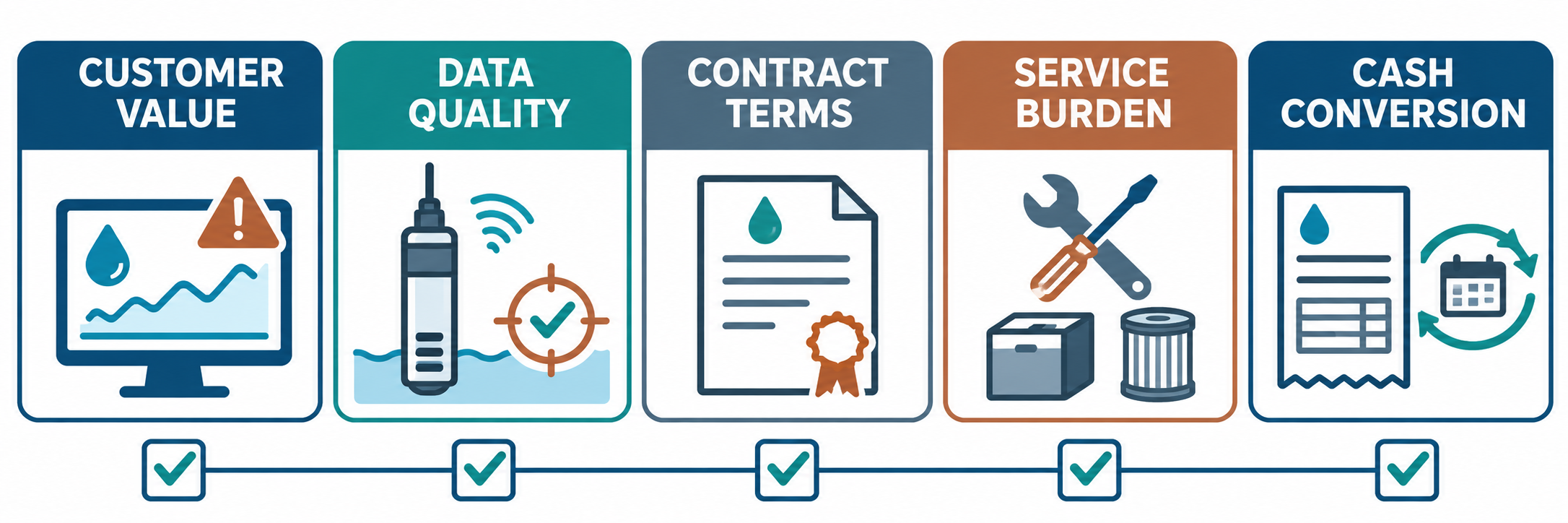
Start with the customer map, contract evidence, deployment economics, data-quality controls, calibration history, service burden, reference-site outcomes and renewal record.
Conclusion: assess the operating system, not the sensor
Smart water monitoring can support a broad set of commercial needs, from leakage and efficiency to compliance and asset control. The investable question is whether a company can turn measurement into a repeatable customer outcome while maintaining trustworthy data and manageable service costs.
For broader context on the network’s direct water-technology focus, visit Water Investment Network before reviewing a specific opportunity.
For eligible investors assessing direct private-company opportunities, the next step is to compare the company’s customer evidence, revenue quality, deployment economics, defensibility and risk controls. Review the Water Investment Network portfolio context, then request an introduction to the network if the opportunity fits your mandate. Water Investment Network does not provide regulated financial advice or guarantee investment returns.
Sources
- US EPA, Water Sensors Toolbox.
- Environment Agency, Monitoring discharges to water: guidance on selecting a monitoring approach.
- GOV.UK, National Framework for Water Resources 2025.
- European Commission, Water Resilience Strategy actions tracker.