
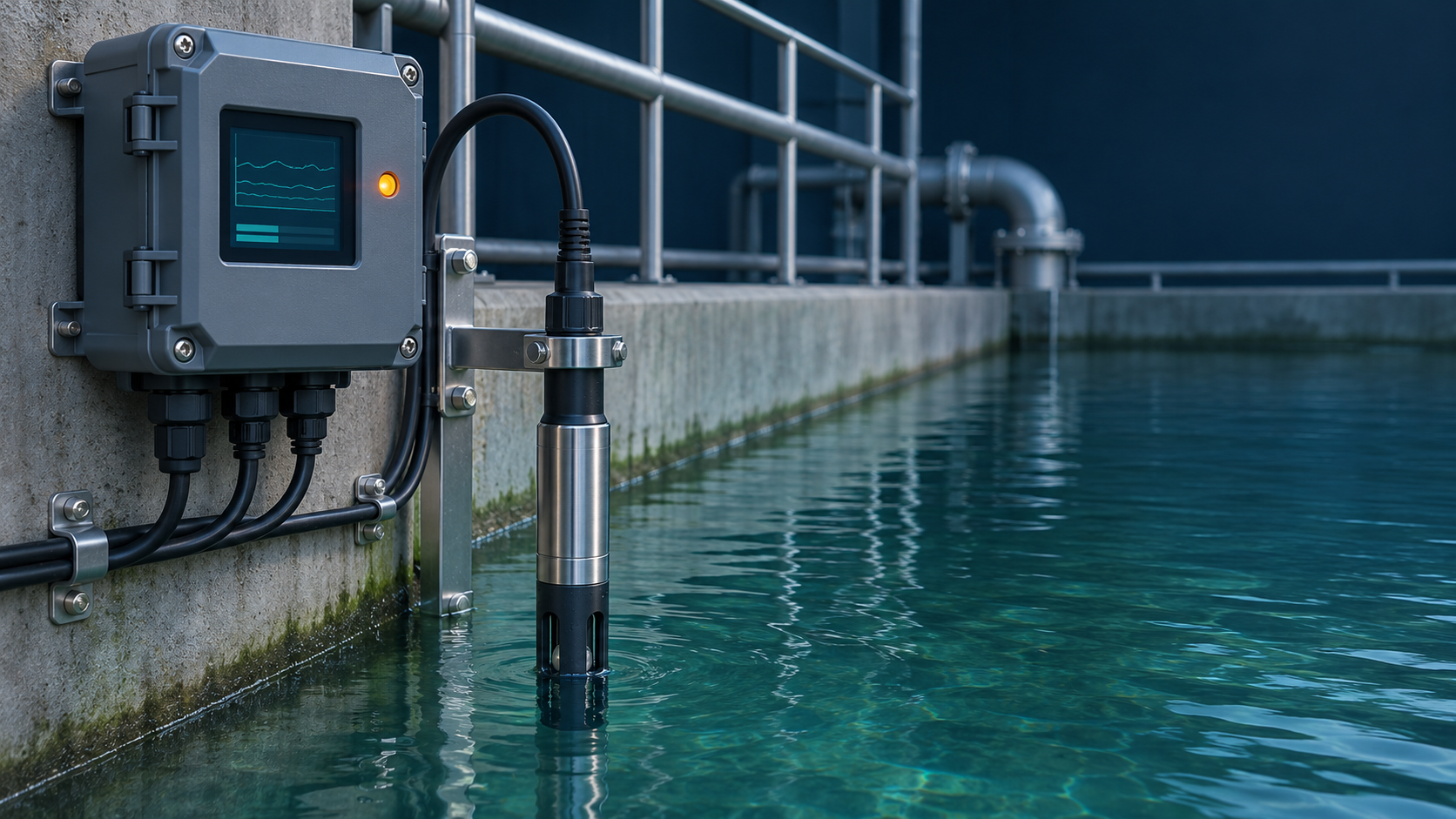
Water sensors are becoming a commercial category in their own right. Utilities, industrial operators and water-intensive sites need reliable measurements of flow, pressure, level and quality. The opportunity is not simply to sell a sensing element. It is to deliver a measurement that a customer can trust, transmit, interpret and use.
For private investors, sensor performance is only the beginning. A credible water sensors company must show application fit, field reliability, installation economics, customer adoption and a route to recurring revenue. It must also explain how calibration, maintenance, certification and replacement affect margins. This article examines those commercial models and the diligence questions behind them.
Why water sensors are becoming a commercial category
Water operators make decisions with incomplete information. A meter may show how much water moved, but not why pressure changed. A quality probe may show an abnormal reading, but not whether the reading reflects a real event, fouling or a calibration problem. A level sensor may reveal a storage change, but the value depends on the action that follows.
The commercial need is therefore broader than measurement. Customers want earlier warning, more complete evidence, fewer unnecessary site visits, better process control and clearer compliance records. The US EPA’s online monitoring resources describe real-time station design, communications systems, time-series analysis and evaluation of online instruments. Those requirements create work for hardware suppliers, integrators, data platforms and field-service providers.
For investors, this is a useful market boundary. The investable company is not necessarily the one with the most novel sensor. It may be the business that makes a known measurement dependable in a difficult site, or turns a device into a repeatable operating service.
What a water sensor actually does
A sensor converts a physical or chemical condition into a signal that can be recorded. In water applications, that may involve flow, pressure, level, temperature, conductivity, dissolved oxygen, turbidity, pH, nutrients or another defined parameter. The device is only one part of the measurement system.
Installation, sampling point, power, communications, calibration, software and operator response can all affect the result. The US Geological Survey’s guidance on continuous water-quality monitors describes site selection, field operation, cleaning, calibration, error correction, data computation and reporting as connected activities. This is why a product specification cannot be assessed separately from its intended use.
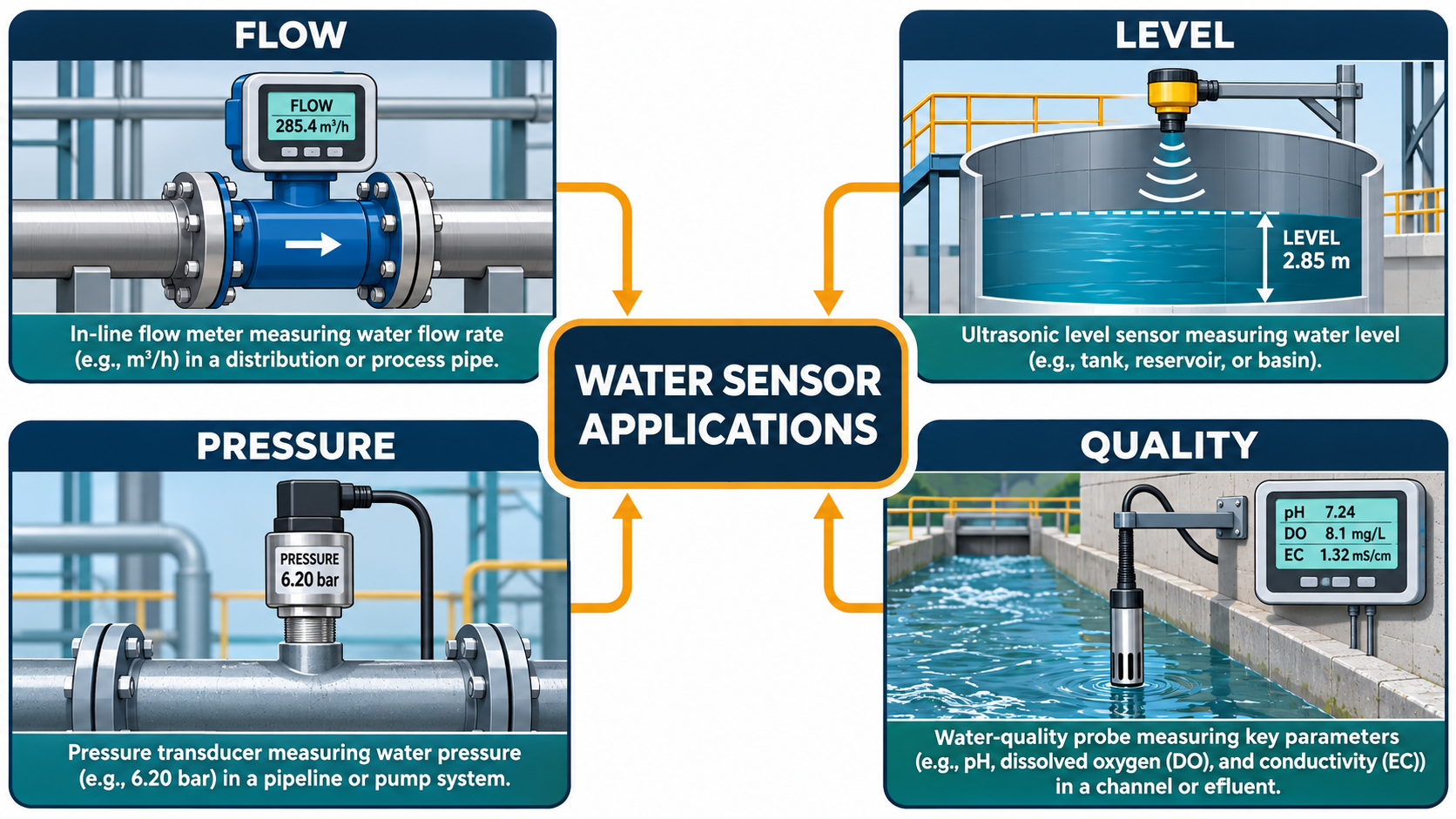
Flow and pressure sensing
Flow sensors measure the movement of water through a pipe, channel or process. Pressure sensors measure force in the system and can help operators understand network conditions or equipment behaviour. Both can support leakage investigations, process control and asset management, but their economics depend on installation access, hydraulic conditions and the required accuracy.
Level and event sensing
Level sensors track water depth in tanks, reservoirs, channels or other structures. An event monitor may instead identify whether a threshold has been reached. The buyer may value a continuous record, a reliable alarm, or evidence that an overflow or storage event occurred. Each use case has a different data, service and contract requirement.
Quality sensing
Quality sensors can measure parameters such as pH, conductivity, dissolved oxygen, temperature, turbidity, ammonia or other determinands. A determinand is the specific substance or property being measured. The commercial consequence is important: the product must measure the right parameter in the right form and within the customer’s required range.
The Environment Agency’s MCERTS performance standard for online monitors describes continuous water monitors as fixed-location instruments that operate without constant operator control. It also recognises that the required measurement range is application-specific. That is a reminder to investors that broad claims about water sensors may conceal narrow application fit.
Application fit matters more than a benchmark reading
A sensor that performs well in clean water may behave differently in wastewater, a corrosive industrial matrix or a channel with sediment. Interference, biofouling, temperature, flow conditions and access can change the quality of the signal. A customer therefore buys a configured measurement system, not an abstract accuracy number.
Application fit starts with the customer’s decision. If the goal is an early warning, response time and false-alert control may matter most. If the goal is a regulatory report, traceability, uncertainty and certification may matter more. If the goal is process optimisation, integration and data continuity may outweigh the lowest device price.
The EPA resources identify the design and installation of monitoring stations, communications systems and analysis of normal time-series variability as separate concerns. A company that handles these concerns in a repeatable way may have a stronger commercial position than one that only supplies a component.
The sample point is part of the product
Where a sensor measures can be as important as what it measures. A poor location may expose the device to turbulence, solids, air entrainment or an unrepresentative flow. It can also make cleaning or replacement expensive. Investors should ask whether the company controls site assessment and whether that work is priced into the deployment model.
Data gaps have a commercial cost
A missing reading is not automatically a failed product. It becomes a commercial issue when the customer cannot distinguish a sensor fault from a stable condition. Good systems show device health, communications status, calibration history and exception states. The buyer needs to know when the evidence is incomplete.
False alerts can destroy adoption
An alert only creates value if someone trusts it enough to act. Too many false alerts create alarm fatigue, while missed events can damage the customer’s process or reputation. Investors should request field evidence on invalid alerts, response times and the changes made after early deployments.
How water sensor companies make money
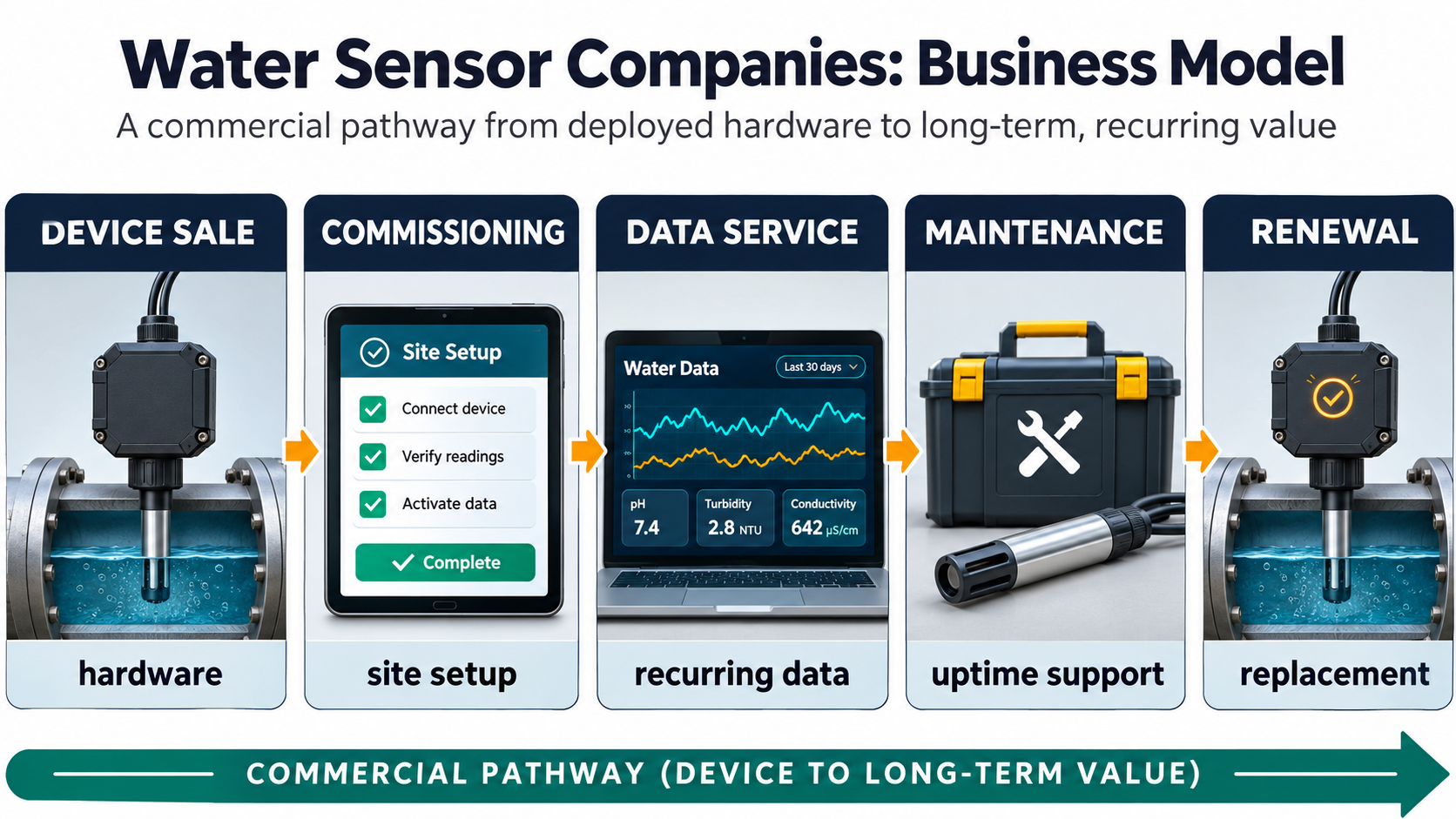
Commercial models can be arranged around the device, the deployment, the data or the ongoing service. The choice affects working capital, gross margin, customer switching costs and the supplier’s responsibility for performance.
Device sales
A device sale is straightforward and can support channel distribution. It can also produce one-off revenue with limited visibility after installation. Investors should test replacement cycles, discounting, warranty claims and the proportion of sales that require technical support.
Commissioning and integration
Commissioning includes site survey, installation, configuration, validation and connection to the customer’s workflow. This revenue may be attractive when the process is standardised. It becomes less attractive when every site requires bespoke engineering that cannot be recovered through price or future renewals.
Data and software subscriptions
A subscription can provide dashboards, alerts, data storage, reporting or integration. The recurring value depends on continued use and trusted data. Investors should compare active customer use with contracted subscription value, and examine whether customers can export their data if they leave.
Monitoring and maintenance services
Service contracts can cover cleaning, calibration, inspection, spares, field visits and response support. These services may protect retention, but they also create cost exposure. A company should know its service hours per installed device, travel profile, replacement rate and spare-parts requirements.
A hybrid model may be strongest. The device opens the account, commissioning proves the use case, software keeps the data available, and service protects performance. That model only deserves a recurring-revenue valuation when renewals, usage and service economics support it.
Performance claims, calibration and field validation
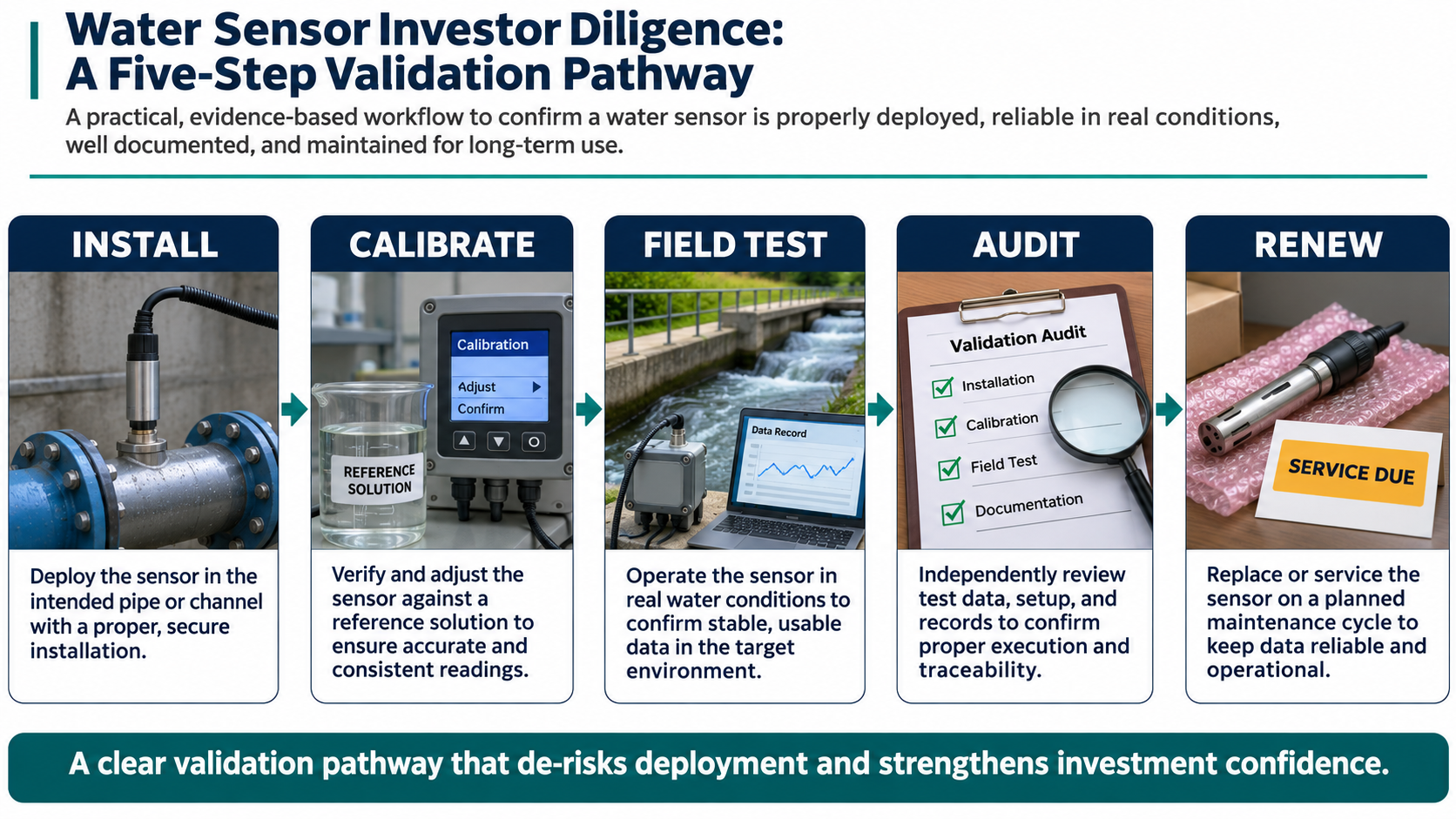
Sensor performance should be assessed in the environment where customers will use it. Accuracy, precision, response time, range, uptime and maintenance burden can all matter. Investors should distinguish laboratory results, controlled field trials and performance across a paying installed base.
The USGS guidance explains that continuous monitors need field observation, cleaning and calibration, with procedures for error correction and final record computation. The practical implication is that a water sensors business must invest in field processes, not only research and development.
MCERTS certification provides another example of the evidence burden. The Environment Agency’s online-monitor standard says that users remain responsible for selecting, installing and operating equipment appropriate to the application. It also sets out laboratory and field testing concepts, including response time, uptime and maintenance.
Calibration is a workflow, not a one-time event
Calibration compares a sensor’s output with a known reference and records the relationship. The frequency and method depend on the device, matrix, operating conditions and required evidence. A supplier that cannot explain calibration responsibility may be underpricing the service contract.
Field trials should test the business model
A field trial should test more than whether the sensor produces a reading. It should test installation time, cleaning, data transmission, customer workflow, alert response and support cost. A technically successful pilot can still be commercially weak if the supplier cannot repeat it profitably.
Modifications can create certification risk
The MCERTS online-monitor standard states that modifications to certified equipment must not degrade performance and that manufacturers should maintain design records and verification procedures. For investors, engineering change control is therefore part of the commercial risk assessment, especially when a company adapts hardware for new applications.
Lifecycle service shapes installed-base economics
The installed base is an asset only when it remains useful and supported. A device can create repeat revenue through consumables, calibration, software, maintenance or replacement. It can also create hidden liabilities through warranty, field travel, obsolete components and difficult access.
The sensor’s operating environment should be reflected in the contract. A clean utility chamber, an open channel and an industrial discharge do not create the same service burden. The company should segment customers by site conditions and show how the service model changes.
Spare parts and obsolescence
Customers may expect continuity even when a component is discontinued. Investors should review supplier concentration, lead times, second-source options, firmware support and the cost of retrofitting a replacement. A low device price can become expensive if it creates a difficult installed base.
Remote support has limits
Remote diagnostics can reduce travel, but not every fault can be solved from a dashboard. Sensors may need cleaning, physical inspection, reinstallation or a reference check. The revenue model should separate remote support from work that still requires trained field personnel.
Renewal depends on evidence
Customers renew when the system remains useful, trusted and affordable. Renewal evidence should include active sites, data completeness, support tickets, calibration completion, contract expansion and reasons for churn. An installed device that no longer informs a decision is not strong recurring revenue.
Standards, certification and procurement
Standards can make a water sensor easier to specify, but they can also raise the cost and time needed to enter a regulated market. The GOV.UK MCERTS collection covers water and flow monitoring performance standards, sampling, laboratories, inspectors and related equipment.
The MCERTS online-monitor standard is technology transparent, meaning different technical solutions can qualify if they meet the requirements. That can support innovation, but it also means the supplier must prove the whole measurement system. Hardware novelty alone is not a certification strategy.
For flow applications, the minimum requirements for self-monitoring of flow connect product certification with installation, maintenance, calibration, telemetry and uncertainty. It gives a practical example of how a device sale becomes a site-conformance and evidence obligation.
Certification can reduce buyer uncertainty
Certification may shorten technical evaluation when buyers recognise the scheme. It does not remove procurement, integration or service requirements. Investors should ask which certifications are already held, which are required for the target customer, and which applications remain outside the certification scope.
Procurement rewards complete evidence
Utilities and industrial buyers may request test reports, field references, quality procedures, cyber controls and support commitments. The supplier’s sales process should show how it moves from technical interest to an approved vendor, contract and renewal.
Regulation is not a revenue forecast
A requirement to monitor can create a market need. It does not determine the supplier’s share, price, timing or margin. Investors should model the company’s route to customers rather than treating a standard or permit condition as guaranteed growth.
From one site to a repeatable product
Scaling water sensors means standardising more than the device. The company needs a repeatable site survey, installation method, data configuration, calibration schedule, customer training process and service response. The more of this playbook it owns, the more credible its gross-margin and renewal assumptions become.
Growth can come from more devices at an existing account, more sites per customer, additional measured parameters, channel partners or adjacent sectors. Each route creates different working-capital and support needs. Investors should ask which route the company has already demonstrated.
Standardisation improves unit economics
Standard kits, approved installation patterns and reusable integrations can reduce engineering time. They can also make training and support more predictable. The company should show whether the average deployment is becoming faster and whether gross margin improves after accounting for service.
Channels can expand reach
Engineering firms, utilities, facilities providers and specialist integrators may act as channels. A channel can lower customer-acquisition cost while reducing the supplier’s control over the relationship. Investors should review channel margin, data ownership, renewal responsibility and customer concentration.
Data creates value only when it stays usable
A growing installed base creates more data, but not automatically more defensibility. The data must be consistent, traceable and connected to customer workflows. A company may have a large device count and weak pricing power if customers can replace it without changing their process.
Investment thesis at a glance
| Question | What to test | Investor consequence |
|---|---|---|
| Application | Flow, pressure, level, quality or event detection | Defines buyer, performance requirements and service burden |
| Evidence | Laboratory results, field trials, certification and paying-site history | Separates technical promise from commercial proof |
| Revenue model | Device, commissioning, data subscription, maintenance or managed monitoring | Shapes margin, working capital and renewal quality |
| Scaling constraint | Installation, calibration, connectivity, spares or integration | Identifies the real operating bottleneck |
| Defensibility | Workflow integration, service network, data quality or certification | Tests switching cost and pricing power |
| Impact evidence | Better control, reduced waste, earlier response or stronger records | Connects commercial value with credible impact reporting |
This framework does not score an opportunity or forecast returns. It helps an investor separate a component supplier, a project integrator, a software provider and a recurring monitoring service. Each can be viable, but the capital needs and risk profile differ.
Investor diligence questions
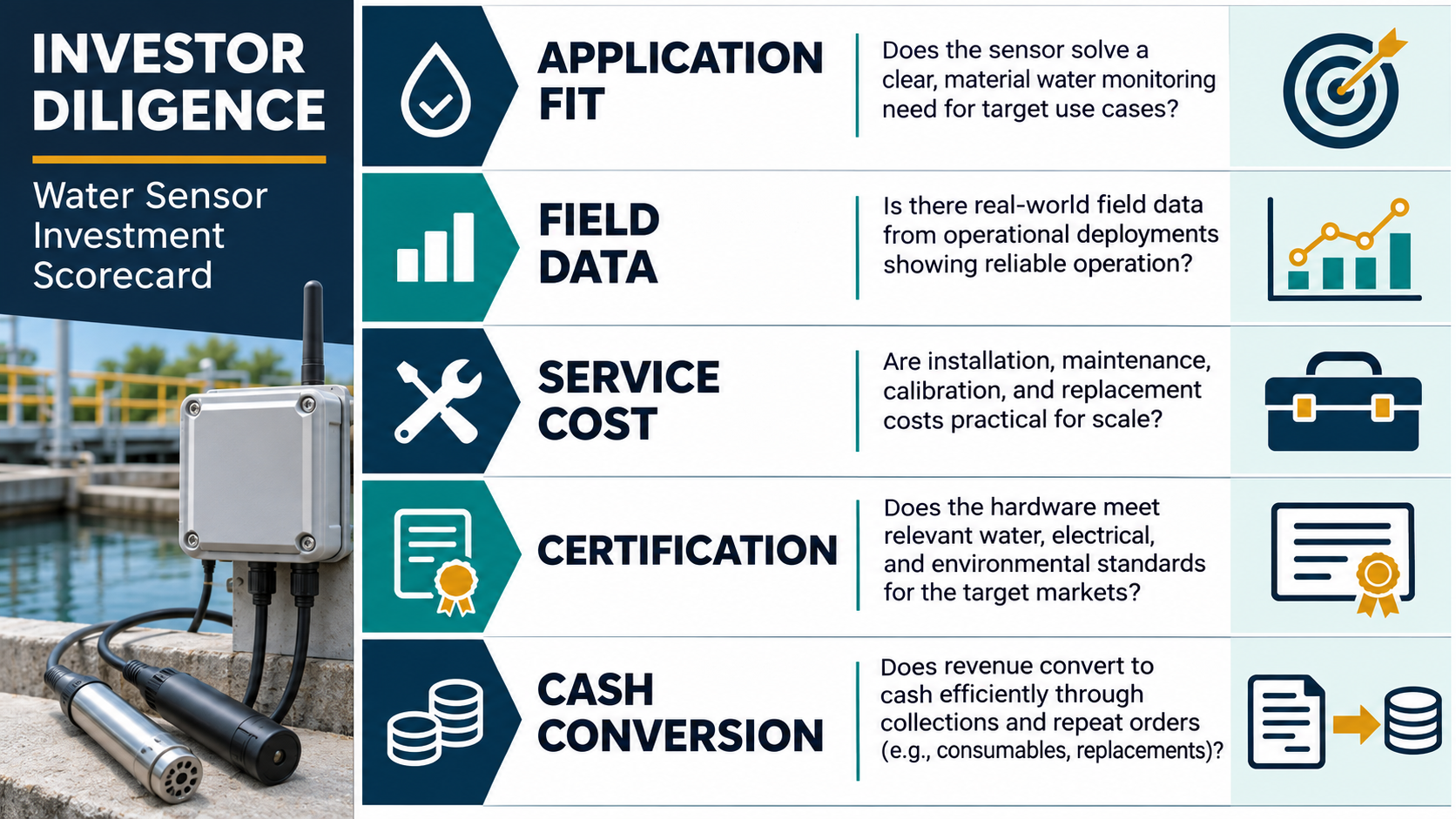
Diligence should move from the sensor specification to the complete commercial system. The following questions help identify whether the company has repeatable evidence and a manageable installed-base risk.
Which customer decision does the sensor improve?
Ask for the operating workflow before and after deployment. A useful answer identifies the user, trigger, response and measured outcome. General claims about visibility do not support a recurring-revenue assumption.
How was field performance validated?
Request test conditions, calibration records, missing-data rates, false alerts, uptime, maintenance intervals and results across more than one site. Compare the evidence with the company’s published claims.
What is the complete cost to serve?
Include site surveys, installation, commissioning, calibration, cleaning, connectivity, support, travel, spare parts and warranty. Then test whether the cost falls as deployments become more standardised.
Who owns the customer relationship?
Identify the buyer, user, procurement owner, renewal owner and channel partner. Review contract duration, expansion, churn, support tickets and the reasons for non-renewal.
Can certification and quality scale with sales?
Check design-change controls, quality records, certification scope, supplier continuity, data governance and field-service training. Growth that weakens traceability can become a customer and regulatory liability.
Frequently asked questions
What are water sensors used for?
Water sensors can measure flow, pressure, level, temperature, conductivity, dissolved oxygen, turbidity, pH, nutrients and other defined parameters. The right use depends on the site, application and decision being supported.
Are water sensors a software or hardware business?
They can be either, or a combination. A company may sell devices, installation, data software, maintenance or a managed monitoring service. Investors should assess where margin and renewal value actually arise.
Does certification prove a sensor will work at every site?
No. Certification can provide evidence against defined performance requirements, but selection, installation and operation still need to suit the application. Site conditions and service quality remain important.
What is the main commercial risk?
A sensor may produce technically valid readings without changing a customer decision. Other risks include field-service cost, false alerts, certification limits, component obsolescence and slow procurement.
What should an investor request first?
Start with the customer map, field-validation evidence, calibration history, deployment economics, certification scope, renewal record, installed-base support cost and cash-conversion profile.
Conclusion: value the measurement system, not just the device
Water sensors can sit at the centre of better water-quality evidence, process control, leakage response and asset management. The investable question is whether the company can deliver a trusted measurement repeatedly, maintain it economically and connect it to a customer outcome.
For eligible investors assessing direct private-company opportunities, compare the company’s application fit, field evidence, revenue quality, service burden, certification position and route to scale. Review the Water Investment Network portfolio context, then request an introduction to the network if the opportunity fits your mandate. Water Investment Network does not provide regulated financial advice or guarantee investment returns.
For broader context, visit Water Investment Network and explore the smart water monitoring investment theme.
Sources
- US EPA, Online Water Quality Monitoring Resources.
- US Geological Survey, Guidelines and standard procedures for continuous water-quality monitors.
- GOV.UK, MCERTS monitoring emissions to air, land and water collection.
- Environment Agency, Performance standards and test procedures for continuous water monitoring equipment, part 2.
- GOV.UK, Minimum requirements for self-monitoring of flow.