
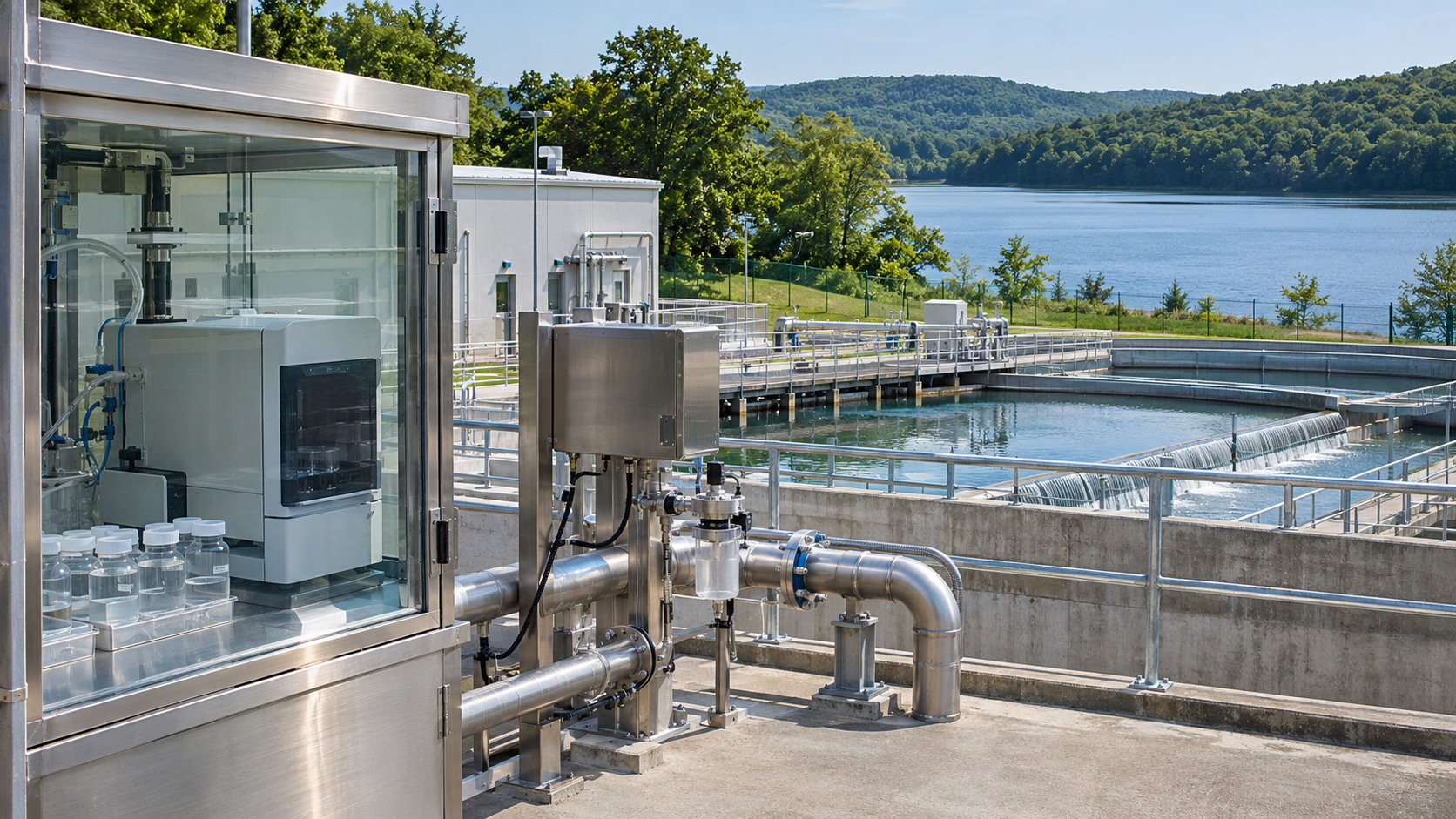
PFAS monitoring is moving from a specialist laboratory service to a recurring water-risk requirement. For investors, the opportunity is not simply the sale of a test. It is the delivery of trusted evidence that helps water companies, industrial operators and public bodies decide what to investigate, treat, disclose or change.
PFAS means per- and polyfluoroalkyl substances. This is a large group of fluorinated chemicals used in industrial and consumer applications. Their persistence, mobility and varied behaviour make the quality of the monitoring process as important as the result itself.
This article explains the commercial models behind PFAS monitoring, the technical issues that affect margins and renewal, and the questions a private investor should ask before treating a monitoring business as scalable. It is sector analysis, not regulated investment advice or a forecast of returns. For wider context, see the Water Investment Network guide to smart water monitoring investment.
PFAS monitoring is an evidence market, not only a lab test
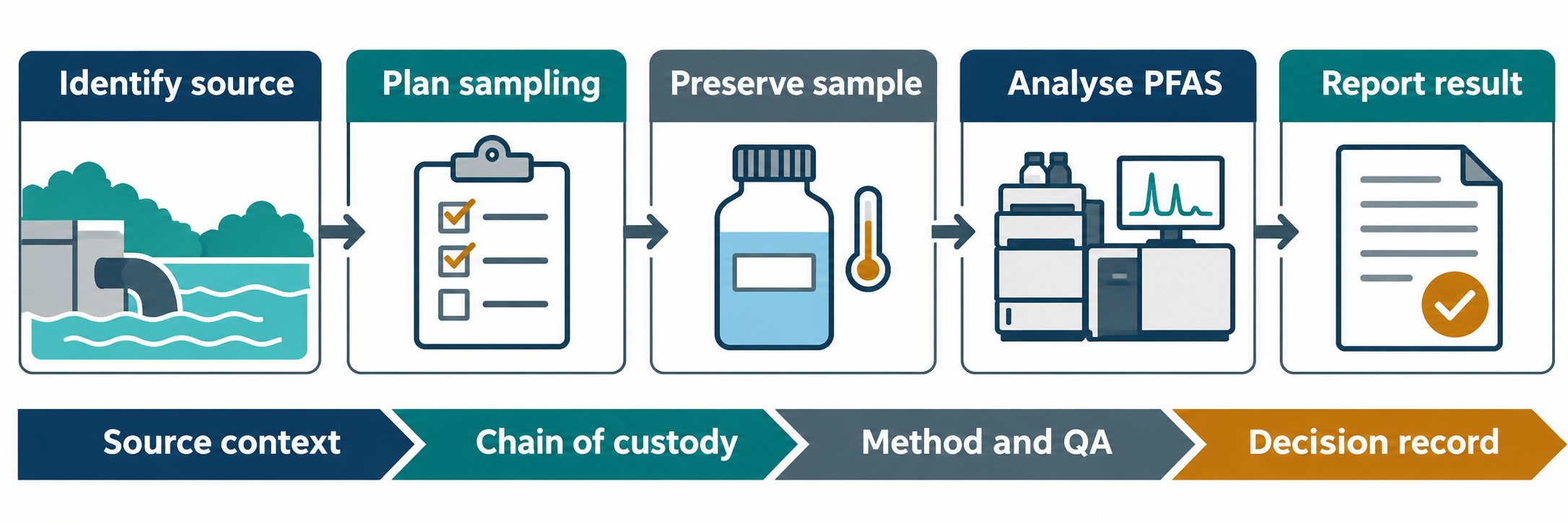
A laboratory result is one part of a PFAS monitoring service. Buyers also need to know where to sample, which substances to include, how a sample was handled, whether the method fits the water matrix and what action follows the result.
The Drinking Water Inspectorate describes PFAS as a group that includes PFOA, PFOS and other related substances. It also notes that some PFAS can persist in the environment and may bioaccumulate. That combination creates a long-lived need for source investigation, repeat sampling, treatment verification and reporting.
The commercial value sits in the chain from uncertain risk to defensible decision. A monitoring provider may supply sampling design, laboratory analysis, interpretation, reporting software, regulatory evidence or an ongoing risk programme. These services can be sold together, but they should be tested separately during diligence.
What PFAS monitoring means in practice
PFAS monitoring is the planned measurement of selected PFAS in water or another relevant matrix over time. The programme may cover raw water, treated water, groundwater, surface water, wastewater, discharge points or a catchment.
The correct scope depends on the buyer’s question. A drinking-water supplier may need source-to-tap evidence. An industrial operator may need wastewater data that supports a permit or internal risk decision. A public authority may need a catchment picture that connects suspected sources to affected supplies.
Why the data becomes a commercial input
Monitoring data can influence treatment choice, abstraction decisions, blending controls, permit discussions, site prioritisation and public communication. It can also reveal whether an existing process is working or whether a capital project is reducing exposure.
That does not make every test result valuable. The value depends on method fit, quality control, turnaround, chain of custody and the customer’s ability to act. Investors should therefore assess the full workflow, not just the laboratory instrument or the number of samples processed.
Why demand is becoming more structured
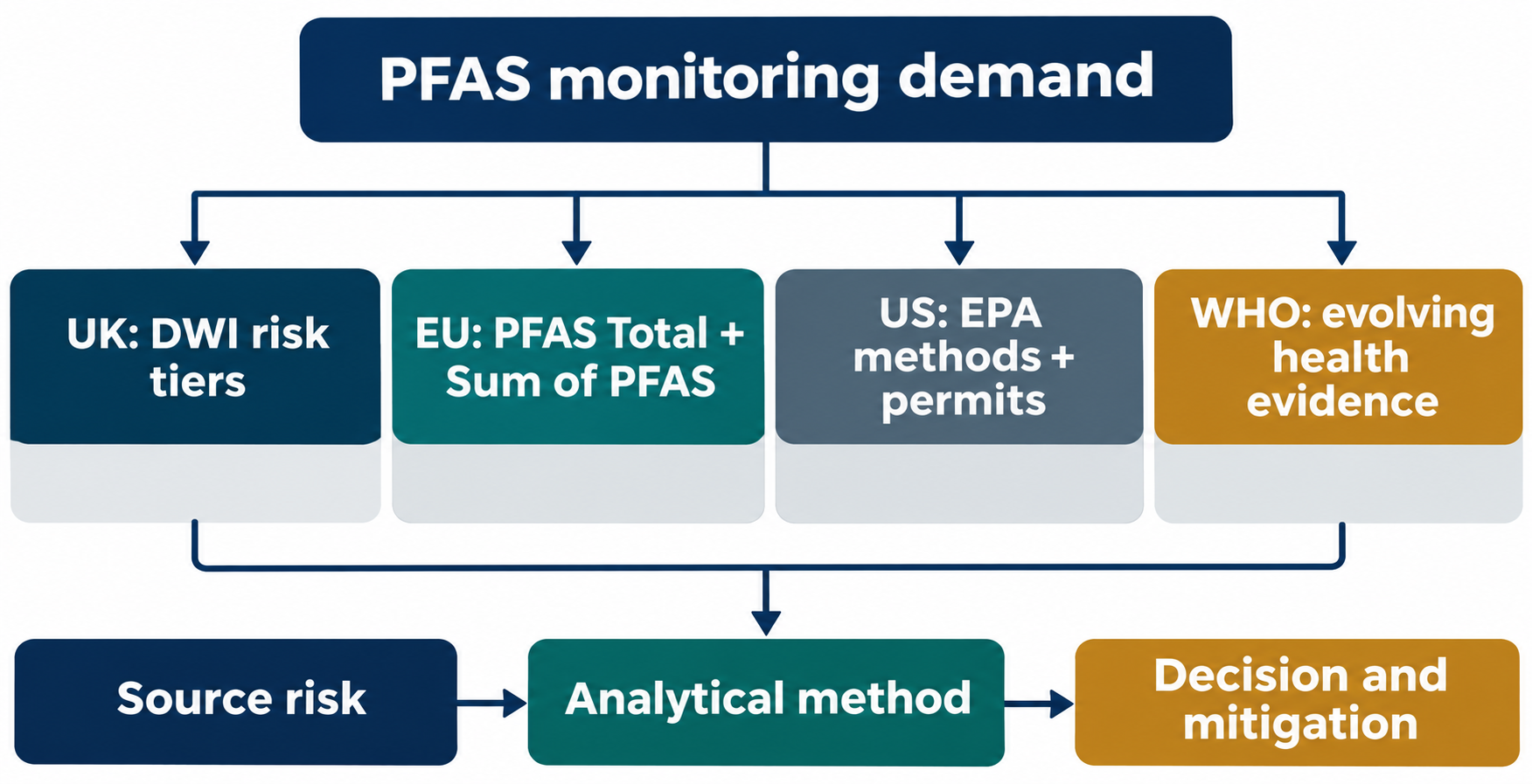
PFAS monitoring demand is being shaped by three forces. Regulators are defining parameters and risk tiers. Water companies are building larger evidence bases. Buyers are learning that occasional testing is not enough when concentrations, sources and treatment performance can change.
The UK source-to-tap signal
The Drinking Water Inspectorate’s 2025 report states that companies across England and Wales undertook more than 666,000 analyses for individual PFAS in 2025. It also reports more than 2.3 million analyses since 2012. The figure is a measure of monitoring activity, not a market forecast, but it shows how a regulatory concern can create repeat analytical work.
The same report describes a tier framework. Tier 1 is below 0.01 micrograms per litre, Tier 2 is below 0.1 micrograms per litre, and Tier 3 is at or above 0.1 micrograms per litre. The framework supports prioritisation, but it also creates a need for reliable results and consistent reporting across sites.
The EU measurement signal
The European Commission’s technical guidance for the Drinking Water Directive sets a PFAS Total parameter of 0.50 micrograms per litre and a Sum of PFAS parameter of 0.10 micrograms per litre. Member States were required to comply with these parameters by 12 January 2026.
The guidance also sets performance expectations for measurement. It describes a limit of quantification at 30% or less of the relevant parametric value and recommends a lower individual limit of quantification for the 20 substances in the Sum of PFAS parameter. This matters commercially because a provider may need validated equipment, skilled staff and quality systems before it can serve regulated work.
The evidence and health signal
The World Health Organization is continuing a broader assessment of PFAS occurrence and health risks. Its current advice says that countries should aim for concentrations as low as reasonably practical, minimise contamination of water sources and balance PFAS risks with other water-supply risks.
That is not a single global limit. It is a reason to avoid treating one national rule as the whole market. An investor should map the buyer’s jurisdiction, water use, analytical standard, reporting duty and decision process before comparing demand across regions.
Investment thesis at a glance
| Question | What a credible PFAS monitoring business should show | Investor consequence |
|---|---|---|
| Demand driver | Customer programmes linked to regulatory, source-risk or treatment decisions | Demand should be tied to a budget and decision, not only concern |
| Paying customer | Water suppliers, industrial operators, laboratories, authorities or asset owners | Customer concentration and procurement routes affect resilience |
| Revenue model | Sampling projects, laboratory analysis, reporting, software or recurring programmes | Recurring work is valuable only if cost to serve and retention are proven |
| Scalability | Standardised methods, trained capacity, documented QA and repeatable reporting | Instrument capacity alone does not prove operating leverage |
| Key risks | Method changes, sample contamination, turnaround constraints, regulation and liability | Risk controls can determine margin more than headline price |
| Measurable impact | Better source knowledge, earlier intervention and clearer treatment verification | Impact claims need a traceable baseline and decision record |
The thesis is strongest where the provider sits close to a repeat decision. A one-off site investigation may be commercially useful, but a monitoring programme that supports treatment operation, reporting or risk reduction can create a more durable relationship.
What buyers actually purchase
Buyers often describe the need as “a PFAS test”. The procurement requirement is usually wider. It may include a sampling plan, suitable containers, field controls, laboratory analysis, data review, a report and advice on the next sampling round.
Baseline and targeted programmes
A baseline programme establishes what is present and where. A targeted programme follows a risk hypothesis, such as a suspected source, a change in raw-water quality or an unexpected treatment result.
The DWI advises risk-based monitoring and says that an investigation should establish the root cause, the point in the source-to-tap chain, the PFAS types present and the concentrations over the sampling period. A provider that can turn a baseline into a defensible targeted programme may capture more value than a provider selling isolated results.
Laboratory and reporting layers
The laboratory layer generates the measurement. The reporting layer makes the measurement usable. Buyers may need results compared with a specific parameter, presented by site, linked to a chain of custody and placed beside prior results.
For an investor, this is the difference between capacity and workflow ownership. A laboratory can process samples while a separate consultant owns the customer relationship. That structure affects gross margin, renewal and the risk of disintermediation.
Decision support
Decision support should be factual. It can explain whether a result is above a customer threshold, whether more sampling is needed or whether treatment performance needs review. It should not turn laboratory data into a guarantee about health, compliance or investment performance.
How PFAS monitoring companies make money
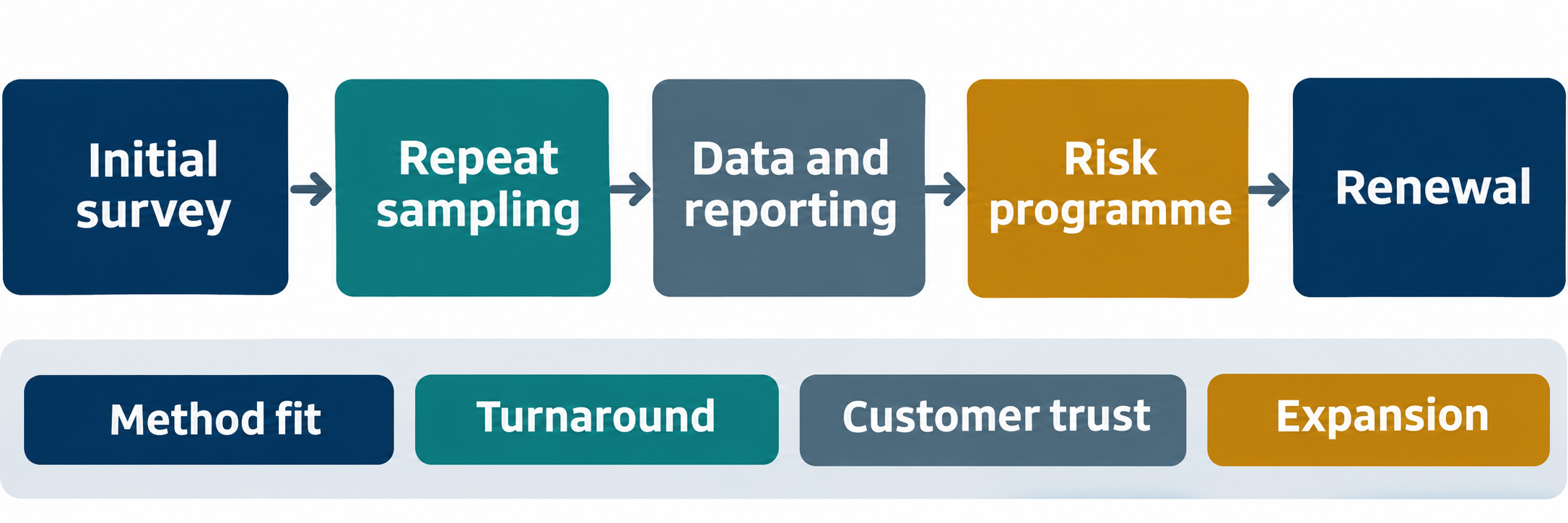
PFAS monitoring businesses commonly combine project revenue with repeat services. The precise mix varies by customer and by whether the company owns the laboratory, the software, the field team or only the interpretation layer.
Project-led revenue
Initial surveys can cover site review, sampling design, fieldwork and a first analytical report. Project work can be a useful entry point because it answers an immediate question. It can also be lumpy, with revenue dependent on tenders, incidents, budgets and customer procurement cycles.
Recurring monitoring
Recurring programmes may include scheduled sampling, laboratory analysis, trend reporting, regulatory submissions or treatment verification. This can improve revenue visibility, but only when the service remains necessary and the customer sees a clear reason to renew.
Data and workflow products
Software may organise sampling locations, preserve records, flag changes and create reports. The software does not replace laboratory quality. Its value comes from reducing manual work, improving traceability and keeping the customer inside a repeat workflow.
For portfolio context, investors can review the Water Investment Network portfolio page. Any individual opportunity still requires independent diligence on the company, its customers and its evidence.
Where margins and unit economics are won
PFAS monitoring prices can look attractive until the operating detail is examined. Samples require planning, handling, transport, laboratory time, quality checks, interpretation and customer communication. Each layer can add value, cost or both.
Cost to serve
Ask how much work is manual. Field visits, sample custody, data cleaning, report preparation and customer queries can consume capacity even when the laboratory process is standardised.
Also ask which costs are fixed and which are variable. Owned instruments create capacity and depreciation commitments. Outsourced analysis can reduce fixed capital but may compress gross margin or create a service dependency.
Turnaround and capacity
Turnaround is part of the product when a customer is managing a live risk. The DWI’s 2025 report describes laboratory capacity and analytical turnaround as practical constraints when monitoring frequency increases.
A provider should show how it manages peaks, urgent samples, method changes and quality holds. Utilisation is not enough if rapid work requires overtime, subcontracting or a higher error rate.
Retention and expansion
Retention should be measured by customer, site and service line. A customer that renews one small contract but does not expand may behave differently from a buyer that adds sites, matrices or reporting services.
Expansion must be earned. It can follow from reliable data, responsive reporting and a clear understanding of the customer’s decision process. It should not be presented as automatic because PFAS is a high-profile issue.
The technical stack behind trusted results
Investors do not need to become analytical chemists. They do need to understand which parts of the stack protect data quality and which parts create operational risk.
Sampling integrity
PFAS monitoring is sensitive to sampling design and contamination control. A programme must specify locations, timing, containers, preservation, transport and the records that connect each sample to its result.
The DWI says investigations should record the PFAS types and concentrations, as well as maximum and minimum concentrations over the monitoring period. It also points to ISO standards for sampling in private-supply investigations. These requirements raise the value of disciplined field operations.
Analytical method fit
The EPA says Methods 533 and 537.1 can measure 29 PFAS in drinking water and are approved for certain drinking-water monitoring. That does not mean a drinking-water method is automatically right for wastewater.
For wastewater under NPDES, the EPA points to Method 1633 or 1633A and warns that modified drinking-water methods may not be validated for wastewater matrices. An investor should ask which matrix the business serves and whether its method, accreditation and quality system match that use.
Quality management
Quality assurance and quality control, often shortened to QA/QC, are the checks that help show whether a result is reliable. They may include blanks, spikes, calibration controls, duplicates, instrument checks, corrective actions and documented reporting.
In practice, QA/QC affects margin. A failed batch can mean rework, delayed reporting and a customer escalation. A robust system can protect renewal, but it has a cost that should appear in the operating model.
Which customer segments can adopt first
Adoption is likely to be strongest where the buyer has a defined risk, a reporting duty or a treatment decision. The most attractive segment is not necessarily the one with the largest number of potential sites. It is the segment where monitoring changes an action.
Drinking water and private supplies
Water companies and local authorities may need source investigations, risk-based monitoring and evidence that treatment or blending controls are working. Private supplies can require a different sales motion, with local authority investigations and smaller site volumes.
The DWI describes sources that can include fire training sites, pollution incidents, industrial locations, landfills and wastewater treatment works. The range of possible sources creates demand for catchment intelligence, but it also makes a standard one-size-fits-all package less credible.
Industrial and wastewater buyers
Industrial operators may need to understand PFAS in process water, wastewater or surrounding media. Their requirements can differ from drinking-water monitoring because the matrix, permit, treatment process and target substances may differ.
EPA guidance makes this distinction clear. Drinking-water methods may need adjustments for suspended solids in wastewater, while Method 1633A is designed for relevant wastewater analysis. Method fit is therefore a commercial differentiator.
Environmental and public-sector users
Environmental agencies, consultants and public bodies may purchase surveys, catchment studies and evidence reviews. These projects can be strategically important but may have longer procurement cycles and more formal reporting requirements.
Where a provider sells across the UK, Europe and GCC, regional rules and laboratory access should be mapped separately. Do not assume that a method accepted in one jurisdiction is accepted for every customer or matrix.
Readers seeking the wider Water Investment Network context can return to the network homepage. The relevant investment question remains the same: does the business solve a paid problem with evidence customers can trust?
Investor diligence questions
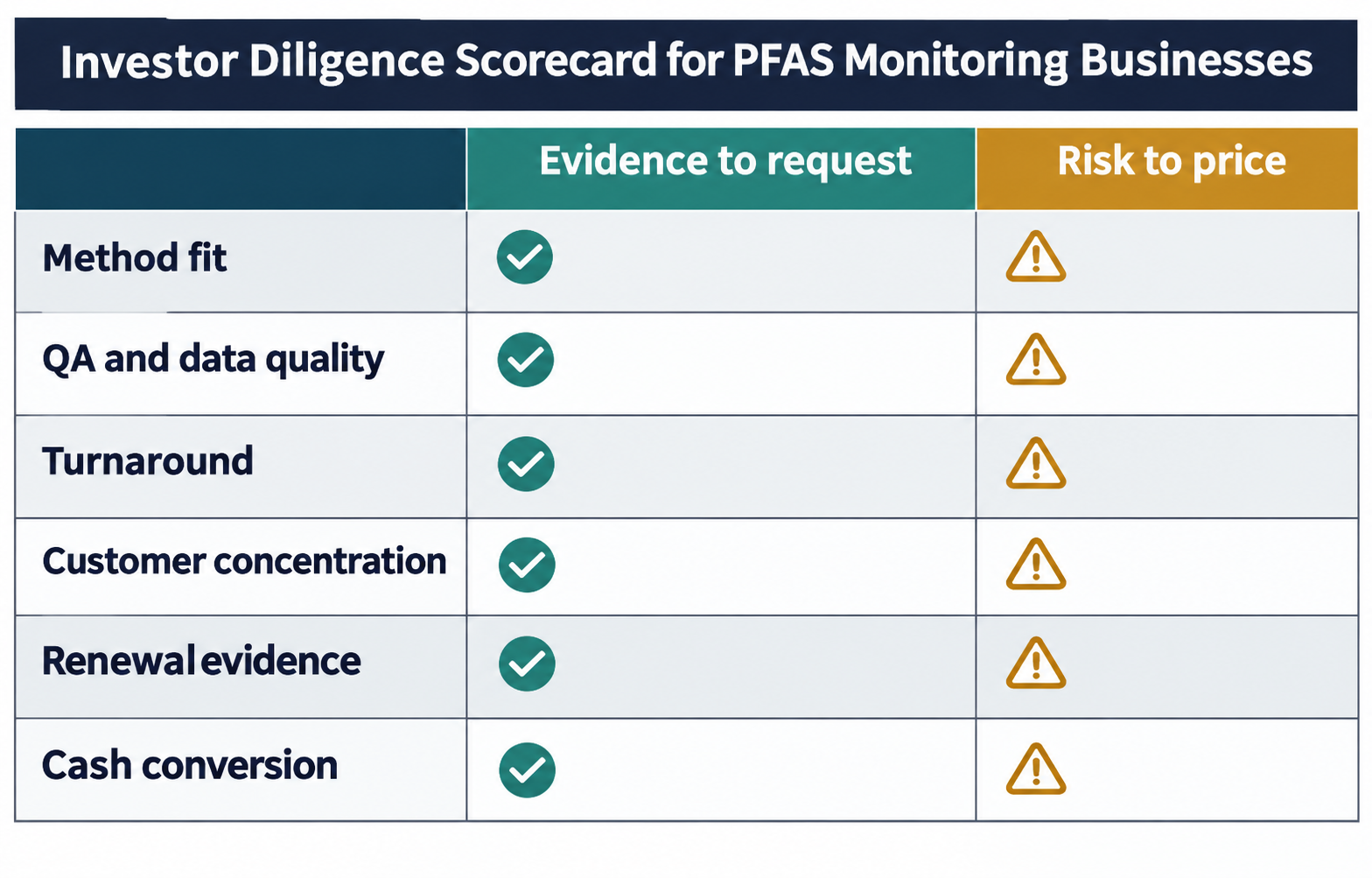
Can the company prove method fit?
Request the method list by matrix, customer type and jurisdiction. Ask for accreditation scope, validation data, method detection limits, limits of quantification and the treatment of non-standard samples.
Check whether sales materials blur drinking-water and wastewater work. That is a warning sign when the commercial promise depends on compliance or a high-consequence decision.
Does the customer renew?
Review renewal by customer and site. Separate scheduled monitoring from one-off investigations, incident work and pass-through laboratory spend. Then examine whether renewals depend on a contract, a regulatory programme, a consultant relationship or an uncommitted budget.
Can delivery scale?
Map the bottleneck. It may be field staff, laboratory instrument hours, trained analysts, quality review, report writing or customer approval. Ask what happens when sample volume doubles without assuming that revenue doubles with it.
Also review subcontractor dependence. Outsourcing can be sensible, but the company should show how it controls method quality, turnaround, data ownership and customer communication.
What is the regulatory risk?
Regulatory change can create demand, but it can also change the required method, parameter, reporting format or customer budget. Track proposals, guidance and implementation separately. Do not treat an announced proposal as a completed rule.
What is the outcome for investors?
The central diligence question is whether the monitoring business has defensible access to repeat decisions. A company with strong data quality, credible methods, customer trust and a controlled cost base may have more durable economics than a company selling equipment capacity without a repeat workflow.
What PFAS monitoring can and cannot prove
Monitoring is not remediation
Monitoring shows what was measured under a defined method and sampling plan. It does not remove PFAS. Treatment, source substitution, blending or other mitigation may be considered after the result, but the monitoring provider should not claim to deliver a treatment outcome unless it actually has evidence for that service.
Detection is not causation
A detected concentration does not by itself identify the source, exposure route or health outcome. The DWI says investigations should establish the cause and location in the supply chain, while health advice may require specialist public-health input.
Results need context
Results should be interpreted beside the sample date, location, matrix, method, quality controls and prior measurements. This is why a data product can be useful, but only if it preserves the underlying evidence rather than hiding it behind a single score.
WHO is still reviewing PFAS evidence and working towards future normative values. That is a reminder to build businesses that can update methods and reporting as evidence develops, rather than relying on one fixed threshold forever.
PFAS monitoring FAQs and next steps
What is PFAS monitoring?
PFAS monitoring is the planned sampling, analysis and reporting of per- and polyfluoroalkyl substances in a defined water or environmental context. A credible programme explains the source risk, method, quality controls and decision that the result supports.
Why do buyers need PFAS monitoring?
Buyers need evidence to assess source risk, compare results with applicable parameters, check treatment or blending controls, support reporting and decide whether more investigation is needed. The programme should be risk-based rather than a generic test package.
Which analytical methods should be used?
The correct method depends on the matrix, customer and regulatory purpose. EPA Methods 533 and 537.1 are used for defined drinking-water work, while EPA Method 1633A addresses relevant wastewater analysis. The provider should show validation and quality evidence for its exact use case.
Can PFAS monitoring create recurring revenue?
It can create recurring revenue through scheduled sampling, repeat laboratory analysis, reporting, data management and risk programmes. Renewal depends on customer need, trusted results, cost to serve, turnaround and the provider’s ability to support a real decision.
What should an investor request first?
Start with the method and accreditation scope, customer and site-level renewal history, sample volumes, turnaround, quality incidents, subcontractor use, gross-margin bridge, working-capital cycle and evidence that monitoring changes customer action.
Sources and next step
- Drinking Water Inspectorate: PFAS guidance and investigations
- Drinking Water Inspectorate: 2025 PFAS monitoring report
- European Commission: technical guidance for PFAS monitoring under the Drinking Water Directive
- US EPA: PFAS drinking-water laboratory methods
- US EPA: PFAS methods for NPDES permits
- WHO: PFAS in drinking-water evidence review
Eligible investors can review the network’s direct water-technology opportunities through the Water Investment Network application page. The next step is a suitability and diligence conversation, not a promise of access, performance or returns.