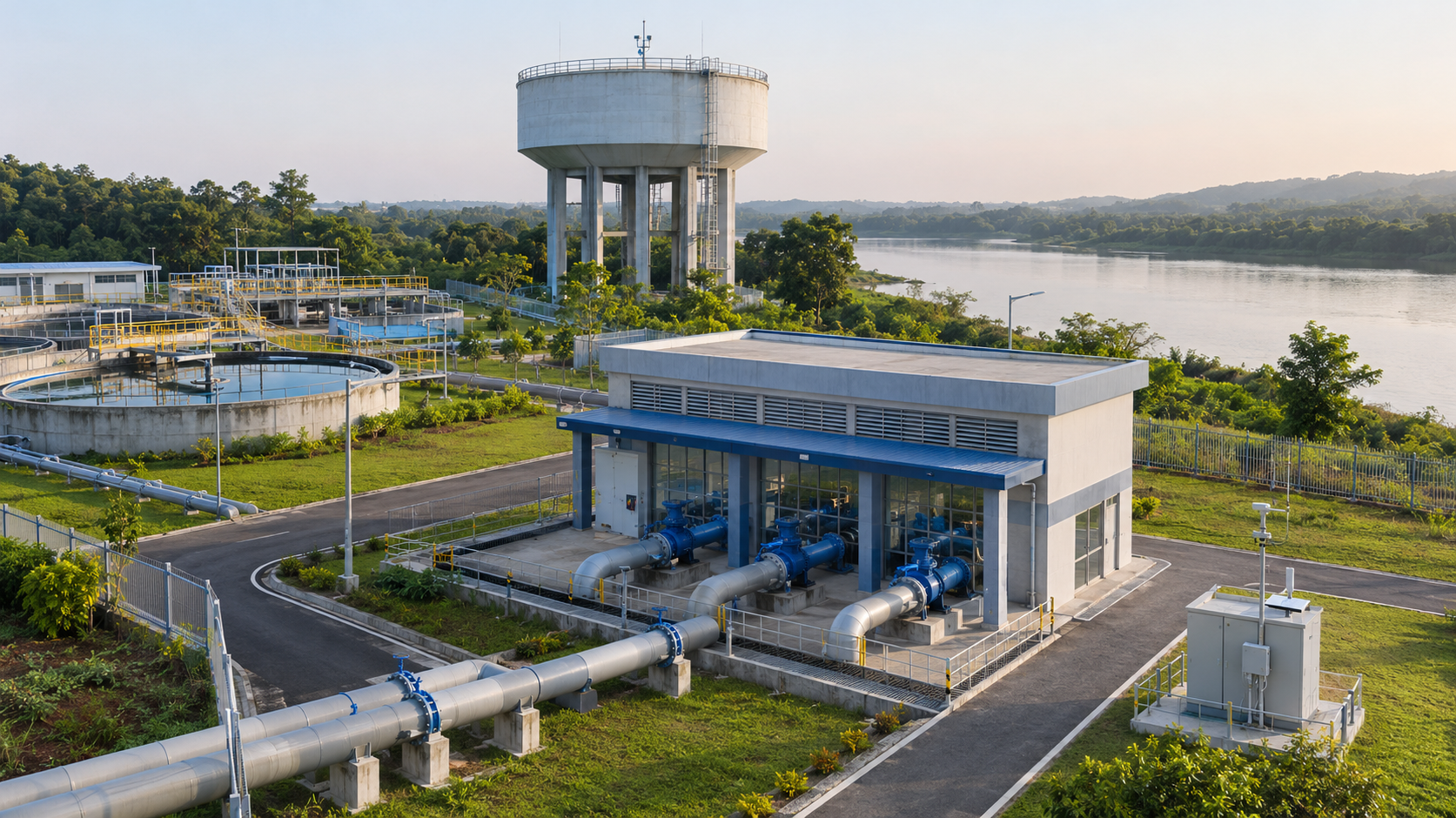
Smart water infrastructure is becoming a practical investment theme as utilities, industrial users and regional authorities seek better control of ageing assets, water losses, resilience and operating cost. The opportunity is broader than smart meters or a software dashboard. It includes the physical networks, sensors, controls, data systems, modelling tools and specialist services that make water assets more measurable and manageable.
For investors, that breadth is both the attraction and the risk. A company may sell valuable technology, yet still depend on slow procurement, local integration, uncertain data quality or a service-heavy deployment model. The right question is not whether a product is described as smart. It is whether the infrastructure solves a budgeted operating problem, produces evidence of value and can scale without converting every customer into a bespoke project.
Smart water infrastructure is an operating system for physical assets
Infrastructure includes more than pipes and meters
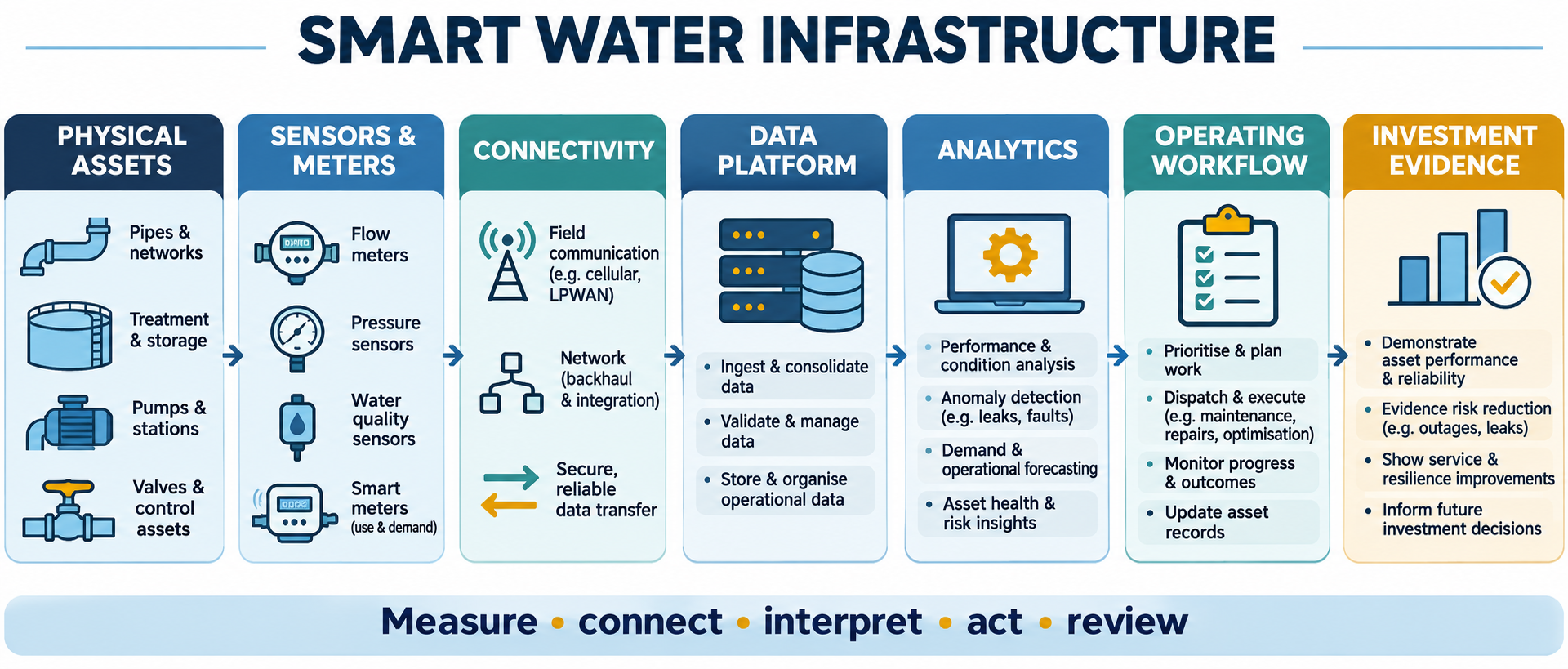
Smart water infrastructure combines the assets that move, store, treat or measure water with the systems that help operators make decisions about them. A practical deployment can include pumps, valves, reservoirs, treatment plants, district meters, pressure controls, remote sensors, communications, asset registers, maintenance software and analytical models.
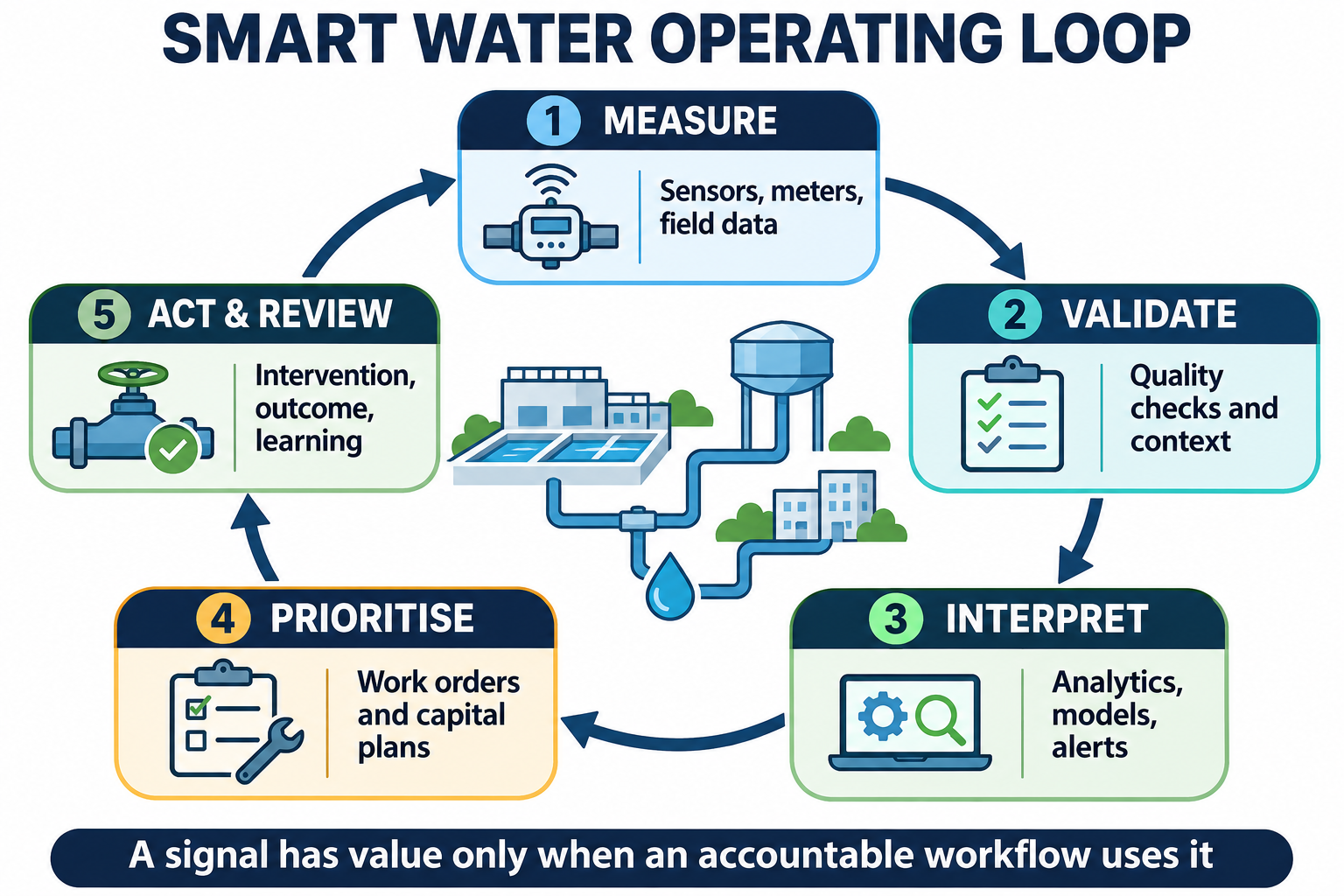
The commercial value comes from the connection between those layers. A sensor that produces a reading is useful only when the data reaches the right operator, is interpreted in context and leads to an action such as a work order, pressure adjustment, inspection or capital-planning decision.
The decision layer matters to investors
The US Environmental Protection Agency groups smart sewer technologies into asset-management tools, system-monitoring and operations tools, and system-condition and capacity tools. Its examples include computerised maintenance management, enterprise asset management, remote sensors, real-time decision support systems and automated controls. That taxonomy is useful beyond sewers because it shows how a technology can sit inside an operating workflow rather than beside it.
For an investor, the decision layer is where defensibility may emerge. Hardware can be replaced. A workflow that is trusted by operators, connected to a utility’s asset history and embedded in planning or maintenance may be harder to displace. The proof must be customer-specific, however. Integration depth can create retention, but it can also create expensive implementation work.
Smart does not mean fully automated
Some infrastructure companies use automation to adjust pumps, gates or pressure. Others provide evidence for human decisions. The distinction matters because the product’s liability, support requirement and buyer may change when software is allowed to control a live asset.
A credible system explains its operating limits. It identifies what is measured, what is inferred, which decisions are recommended, which actions are automated and how an operator can review the result. Investors should treat that clarity as part of the product rather than as documentation added at the end.
Why the market is moving now
Ageing assets make visibility more valuable
Water infrastructure is capital intensive and long lived. Operators cannot replace every pipe, pump or treatment asset at once, so they need better evidence about condition, performance and priority. Digital tools can help turn scattered asset records, inspections and live signals into a more usable view of where intervention is needed.
The EPA describes asset-management tools as a way to track corrective work, improve preventive maintenance and support life-cycle planning. That is a direct commercial need. A supplier that helps a buyer prioritise maintenance or capital work is closer to a budget owner than a supplier selling information without a defined decision.
Resilience is becoming an investment criterion
The European Commission’s water resilience strategy identifies modernising water infrastructure, reducing leaks and taking up digital solutions as part of building a water-smart economy. It also places public and private investment, infrastructure, digitalisation, research, security and preparedness within the strategy’s main areas of action.
This does not guarantee demand for any individual vendor. It does show why infrastructure modernisation can appear in long-term planning, procurement and investment conversations. The investable question is which suppliers can convert policy direction into repeatable products, contracted services and measurable customer outcomes.
Water digitalisation remains uneven
The World Bank describes digitalisation as a journey from a traditional utility to a digitally integrated smart utility. Its Digital Water work points to different starting points for different utilities, including diagnostics, assessments, roadmaps, training, smart metering, data integration, predictive maintenance, leak detection and cybersecurity.
Uneven adoption creates a market for assessment and implementation as well as for software and equipment. It also creates a risk of fragmented sales. A company may win early work because it can solve a complex local problem, yet struggle to make the same delivery model profitable across regions.
Investment thesis at a glance
The opportunity
Smart water infrastructure companies can sit at the intersection of essential services, asset renewal, operational efficiency, resilience planning and data-led management. Their customers may include regulated utilities, municipalities, industrial sites, developers, agricultural operators and infrastructure owners.
The strongest businesses normally have a clear starting problem. Examples include reducing unaccounted-for water, prioritising leak repairs, improving pump scheduling, monitoring pressure, preventing asset failure, managing treatment performance or improving the evidence behind capital plans.
The value-creation path
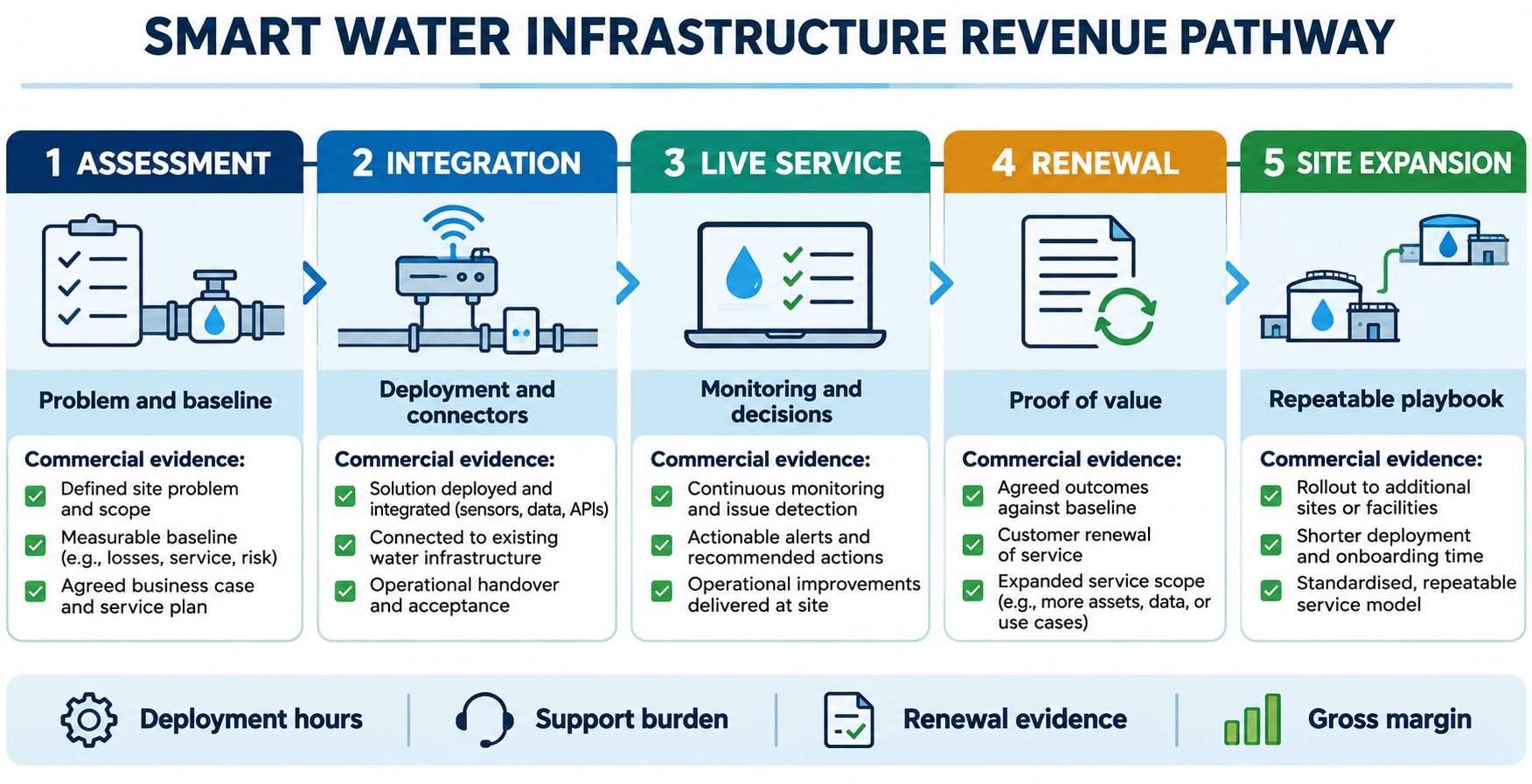
A company can create value through several layers: selling equipment, integrating systems, licensing software, delivering managed monitoring, providing engineering services or combining these into a multi-year operating contract. Each layer has a different margin profile and working-capital requirement.
The investor should map the first purchase to the expansion path. A sensor deployment may lead to analytics, a data service, maintenance planning or additional sites. That expansion is attractive only when the first deployment creates a trusted data set, a repeatable workflow and a budget owner with authority to buy again.
The principal risks
Common risks include long procurement cycles, public-sector budget timing, integration with legacy systems, inconsistent connectivity, cybersecurity incidents, unclear ownership of data and weak evidence of return on investment. Climate exposure can increase the need for resilience while also increasing the complexity of the operating environment.
There is also a category risk. Smart water infrastructure may describe a hardware company, a specialist engineering consultancy, a software vendor or a project developer. Comparing them on one revenue multiple can obscure the real economics. Investors should first separate recurring software or service revenue from pass-through equipment, one-off integration and construction activity.
What customers actually buy
They buy a defined operational outcome
Utilities rarely buy data for its own sake. They buy the ability to see a problem sooner, prioritise an intervention, meet a service objective, manage an asset portfolio or support a regulatory and investment decision. Industrial customers may buy lower water consumption, improved process reliability, better reuse performance or reduced downtime.
A good sales proposition therefore names the decision, the responsible team, the existing process and the evidence that will show improvement. The value proposition becomes more credible when it identifies the cost of delay and the constraint that currently prevents action.
They buy integration with existing operations
EPA guidance on smart sewer systems notes that hardware and controls need to be configured with existing infrastructure, software systems and databases. This is a central commercial point. A solution that requires a full replacement of the customer’s control environment may face a much higher adoption barrier than a modular product that can connect to existing systems.
Integration can be a moat when it is repeatable and documented. It can become a margin problem when every deployment depends on a new interface, manual data cleansing or scarce engineering talent. The difference should be visible in implementation hours, gross margin by cohort and time to first value.
They buy confidence to scale
Asset owners need confidence that a pilot can move into a wider operating area. That confidence may come from data quality checks, a clear change-management plan, operator training, cyber controls, documented maintenance and an evidence trail that can survive internal review.
The European Mission on Adaptation describes a Puglia water programme using a modular mix of control-room capability, digital-twin modelling, acoustic monitoring, smart meters, district metering and pressure control. The lesson for investors is not to copy that exact programme. It is to test whether a company can fit into a modular adoption path rather than requiring an all-or-nothing transformation.
How smart water infrastructure companies make money
Equipment and deployment revenue
Hardware revenue can provide a clear entry point, especially where a customer needs sensors, meters, controllers or communications equipment. It can also be competitive and exposed to component costs, procurement pricing and inventory requirements.
Deployment revenue may include site surveys, installation, commissioning, configuration and integration. It is valuable when it opens a recurring relationship. It is less attractive when the company must repeat the same bespoke work for every site without improving its delivery playbook.
Software and data services
Software can be sold as a licence, subscription, usage-based service or managed platform. Data services may include monitoring, alert management, reporting, model maintenance and operational reviews. Investors should distinguish contracted recurring revenue from usage that depends on new project awards.
Retention is not enough by itself. A customer may renew a low-value monitoring service while never expanding it. Stronger evidence includes active users, decisions influenced, sites added, modules adopted, renewal reasons and the support cost required to preserve the account.
Performance and managed-service contracts
Some providers combine technology with ongoing operational support. This can increase customer value and make the provider harder to replace, but it also places more delivery risk on the vendor. Contract terms should clarify the scope of service, data access, performance measurement, liability, change control and the boundary between advice and operational responsibility.
Performance-linked pricing can align incentives when the baseline is reliable and the provider controls enough of the delivery chain. It can become dangerous when outcomes depend on weather, customer behaviour, capital works or regulatory decisions outside the company’s control. Investors should prefer a pricing structure that matches controllable value.
Where margins and unit economics are won
Standardisation beats heroic delivery
Water assets vary by geography, age, regulation and operating practice. A business does not need identical sites to scale, but it does need repeatable components. These may include deployment templates, connectors, data models, installation procedures, training modules and standard reporting.
Track implementation hours per site, time from contract to live operation, first-year support tickets, hardware replacement rates and the proportion of work delivered by internal specialists. These measures show whether growth is increasing contribution or simply increasing complexity.
Gross margin needs a bridge
Headline gross margin can hide the difference between equipment, software and service. A useful bridge separates hardware cost, third-party connectivity, installation labour, cloud or hosting costs, customer support, engineering change and ongoing model maintenance.
The investor should ask how the bridge changes as the company moves from a pilot to a multi-site contract. If revenue grows while deployment hours and support intensity grow at the same rate, the company may be a specialist contractor rather than a scalable infrastructure technology platform.
Renewal depends on operational proof
Renewal value often depends on whether the customer’s operating team can show a change in decisions. That could be faster response, fewer emergency interventions, more targeted capital planning, improved reliability or better evidence for a regulator or asset owner.
Do not accept a claimed saving without a baseline, measurement method and counterfactual. A reported improvement may reflect weather, maintenance already planned, a change in operating policy or a different reporting period. The company should be able to explain what it controlled and what it merely observed.
The technical stack behind a scalable deployment
Physical layer
The physical layer includes meters, sensors, pumps, valves, control panels, communications equipment and the asset itself. Reliability, calibration, power, environmental protection and maintenance access affect the cost of collecting a usable signal.
Technology providers should explain what happens when a sensor fails, a network connection drops or a reading becomes implausible. Resilience is not only a feature of the water asset. It is also a requirement for the data path that supports operational decisions.
Data and control layer
The data layer receives signals, stores history, applies quality controls and makes information available to the systems used by operators. The control layer may connect to supervisory control and data acquisition, or SCADA, systems and other operational technology. This is where cybersecurity, permissions and change management become material investor risks.
The EPA describes real-time decision support systems as combinations of sensors, communications, software and analytics that produce dashboards and actionable information. A provider should show which part it owns, which part it integrates and which part depends on third-party systems.
Analytics and workflow layer
Analytics can identify anomalies, estimate demand, model capacity, prioritise inspections or compare intervention options. The commercial value comes from the workflow around the output. A useful alert has an owner, a response window, a record of action and a way to learn from the result.
Artificial intelligence may be included in a product, but it should not replace operational evidence. Investors should ask how models are validated, how false positives are handled, how changes in conditions are detected and how a customer can challenge or review an output.
Which customers can adopt first
Utilities with a defined operational pain
Utilities with recurring leakage, pressure, overflow, energy, maintenance or capacity problems may have a clearer business case than customers starting with a general digital transformation ambition. The best entry point is usually connected to a named asset class and a budget owner.
Scale and complexity can support demand, but they can also increase procurement and integration time. A smaller utility may move faster but have a smaller contract and fewer internal resources. The company’s go-to-market model must match the buyer’s capacity.
Industrial and commercial water users
Industrial sites may purchase smart water infrastructure to improve process continuity, reduce water intensity, manage reuse or document environmental performance. The buyer may be operations, engineering, sustainability, finance or a site owner, and the sales process can become slower when several functions share the decision.
Investors should test whether the product is tied to production economics. A solution that improves a critical process can have stronger willingness to pay than one positioned only as a reporting tool. The company should still show that the customer can measure the benefit without relying on an unverified estimate.
Regional and climate-exposed markets
Water-stressed regions can create demand for monitoring, leak reduction, pressure management, reuse and resilience planning. The Puglia case described by the European Commission shows how modular technologies can be combined across a large network, from smart meters and district metering to leak detection and digital-twin modelling.
Regional opportunity is not the same as automatic market access. Investors should examine local procurement rules, public funding dependence, currency exposure, service coverage, partner requirements and the company’s ability to support customers over a long asset life.
Regulation, governance and data
Regulatory planning shapes budgets
In England and Wales, the water resources planning framework requires companies to maintain long-term plans, assess supply and demand and support decisions with evidence. The guidance also describes the roles of Ofwat, the Drinking Water Inspectorate and the Regulators’ Alliance for Progressing Infrastructure Development.
For suppliers, this can make planning evidence and assurance part of the commercial proposition. It does not mean every technology qualifies for regulatory funding. Investors should identify the specific budget, plan or performance obligation that supports the customer purchase.
Data governance is part of product quality
Water data can affect safety, service continuity, environmental reporting and capital allocation. A credible company sets out data ownership, access rights, retention, auditability, hosting, incident response and the process for correcting unreliable data.
The European Commission’s water resilience work places security and preparedness alongside digitalisation and infrastructure. Cybersecurity therefore belongs in commercial diligence, not only in technical diligence. A weak control environment can delay procurement, increase insurance requirements or make a customer unwilling to connect live systems.
Claims need a reliable evidence trail
Investors should separate a product claim from an outcome claim. It is possible to verify that a platform collects pressure data. It is harder to verify that the data reduced losses, avoided a capital project or improved resilience.
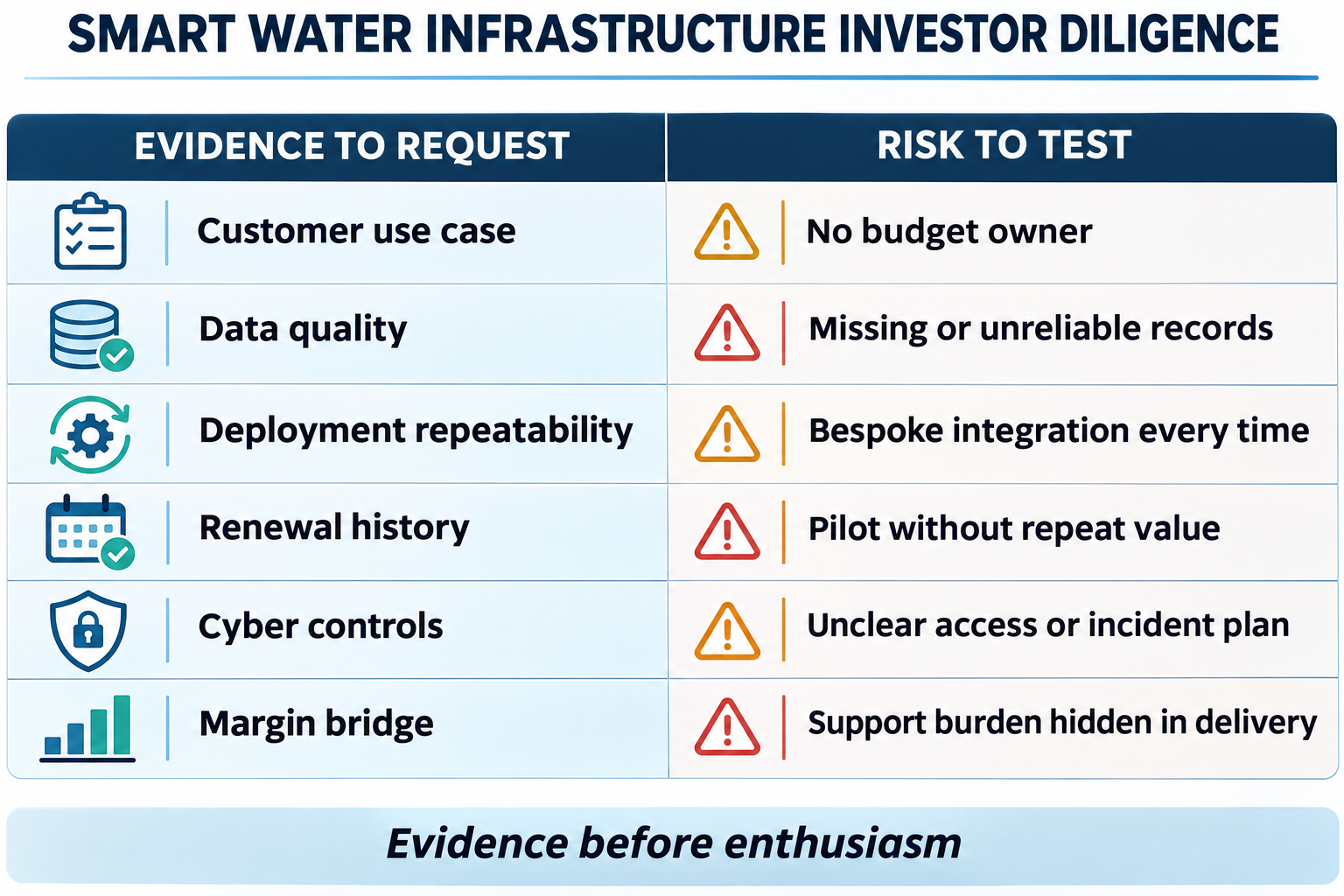
Ask for the baseline, measurement period, customer sign-off, operational change and any material external factors. This discipline protects the business from overstating performance and helps a buyer convert a successful deployment into a repeatable reference.
Investor diligence questions
Customer and market
- Which customer role owns the budget and which operational problem creates urgency?
- What procurement route is used, and how long does it take from first engagement to contract?
- Which deployments became repeat purchases, and why did the others stop?
- How does the company compete with internal utility teams, incumbent engineering firms and broad software platforms?
Product and deployment
- Which components are standard, and which require site-specific engineering?
- How many interfaces, connectors and data-cleaning steps are needed per deployment?
- What happens when sensors, connectivity, telemetry or customer systems fail?
- Which outputs are advisory, and which can control a live asset?
Financial quality
- What percentage of revenue is recurring, and how is recurring revenue defined?
- What are gross margins by hardware, software, integration and managed service?
- What is the payback period for a typical customer, and what evidence supports it?
- How do implementation hours, support tickets and renewal rates change as the installed base grows?
Governance and risk
- Who owns customer data, models, integrations and the outputs created during a deployment?
- What cyber controls, permissions, logging and incident processes are in place?
- How are models validated, recalibrated and retired when operating conditions change?
- Which regulatory, public-funding or policy assumptions are necessary for the forecast?
Smart water infrastructure FAQs and next steps
What is smart water infrastructure?
Smart water infrastructure is the connected combination of physical water assets, measurement, communications, software, analytics, controls and operating workflows. It is designed to improve decisions about water supply, distribution, treatment, wastewater, maintenance, resilience or capital planning.
Is smart water infrastructure the same as smart metering?
No. Smart metering is one component. A broader infrastructure system may also include pressure management, asset records, remote monitoring, digital models, maintenance workflows, treatment controls and evidence for investment decisions.
Can smart water infrastructure produce recurring revenue?
It can, through software access, monitoring, managed data services, model updates, support, reporting, training and additional sites. Recurring revenue is more credible when customers renew because the system is embedded in an operating process and produces evidence of value.
What is the main investor risk?
The main risk is often a mismatch between a technically valuable solution and a repeatable commercial model. Long procurement, bespoke integration, weak data, unclear accountability and support-heavy delivery can reduce margins even when the technology works.
Is this article regulated investment advice?
No. This article is sector analysis for private-market research. It is not regulated investment advice, a recommendation, a forecast of returns or an offer to invest.
Investors should treat smart water infrastructure as a diligence-led theme. Start with the physical problem, the customer budget and the evidence that an intervention changes decisions. Then test deployment repeatability, data governance, commercial retention, margin progression and exposure to regulation or public procurement.
For wider context, see the smart water monitoring investment pillar and review the Water Investment Network portfolio for the type of direct private-market opportunities the network evaluates. Eligible investors can join the network to discuss access and suitability. The Water Investment Network homepage provides further background.