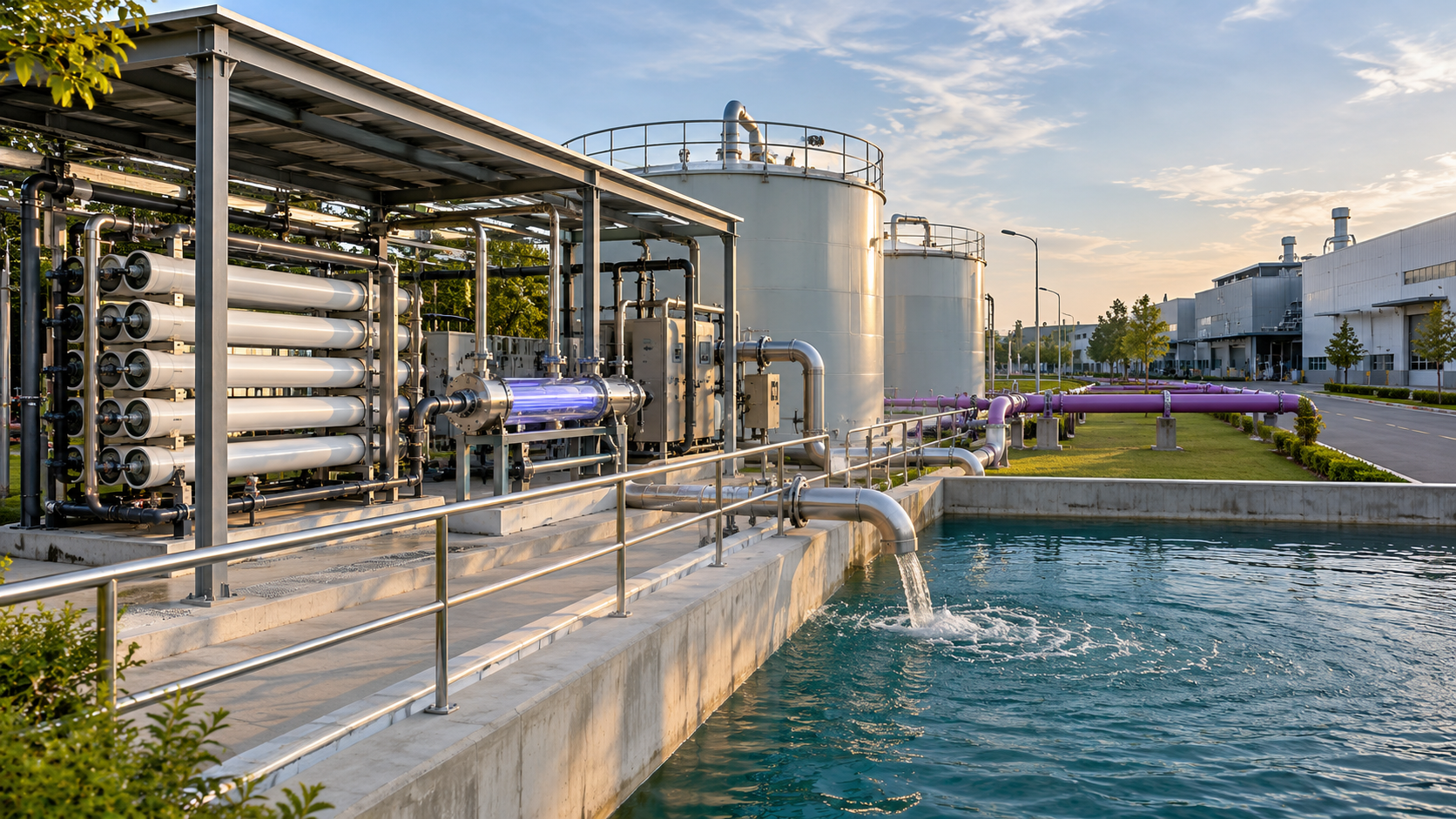
Smart water recycling turns treated wastewater into a managed supply of water for a defined use. The commercial opportunity is not simply to move water through another treatment step. It is to match source water, treatment, monitoring, storage, offtake and operating risk in a system that customers can keep using.
For investors, that distinction matters. A recycling project can require substantial equipment and energy before it produces recurring revenue. A technology provider may create value through treatment modules, digital controls, water-quality assurance, managed service or repeatable deployment across industrial and municipal sites.
This article examines smart water recycling as an investment theme. It focuses on customer demand, revenue models, unit economics, adoption barriers, quality assurance and the diligence evidence needed to separate a scalable water business from a capital-heavy project contractor. For the wider context, see our smart water monitoring investment pillar.
Smart water recycling is a commercial system, not a slogan
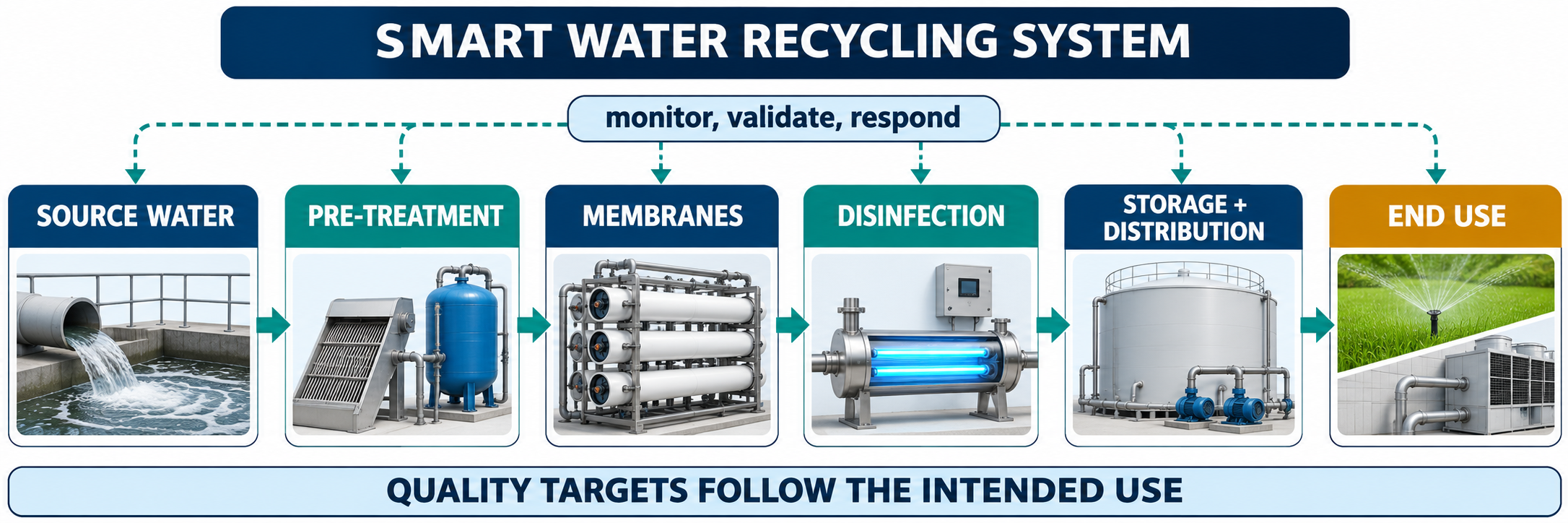
Smart water recycling uses treated wastewater as an input to a further treatment, storage and distribution system. The output may support industrial processes, irrigation, environmental buffers or public water supply, depending on the quality target, permit and local operating context.
The word “smart” should describe how the system operates, not act as a substitute for a business model. A credible system can monitor water quality, control treatment stages, identify faults, preserve an evidence trail and adjust operations when the source or end use changes.
Water recycling is also different from a single treatment product. The customer may need source-water assessment, a water balance, treatment design, installation, controls, monitoring, storage, distribution and ongoing review. The investment case therefore depends on integration and operating ownership as much as on the treatment technology.
The source is part of the product
Recycling starts with a defined source, not an abstract volume of wastewater. Its variability, contaminants, temperature, flow profile and existing treatment determine the complexity of the treatment train and the reliability of the output.
The end use sets the target
A water stream used for cooling, irrigation or process supply may have a different quality requirement from water used in a public supply chain. The practical consequence is that a provider must sell a fit-for-use system rather than a universal quality promise.
The operating model creates defensibility
Defensibility can come from validated operating procedures, customer-specific data, integration knowledge and repeatable service delivery. It is less likely to come from generic claims about digital controls without evidence of adoption or renewal.
Why demand is moving from disposal towards reuse
Water recycling demand is shaped by supply resilience, industrial water intensity, discharge constraints and the cost of securing new sources. The Environment Agency says water recycling can form part of a diverse set of supply and demand options in England, particularly where other options are limited and locations are suitable.
The agency’s 2025 position statement describes indirect recycling in England as treating wastewater, passing it through an environmental buffer such as a river, reservoir or aquifer, and then treating it again for drinking water standards. It also identifies industrial supply options that can reduce demand on potable systems. These are policy and planning signals, not a guarantee of project approval or investor returns.
Industrial customers may have a more immediate use case. A process that needs consistent water can face supply interruptions, abstraction limits, discharge costs or a constraint on site expansion. Recycled water can become attractive when it is available near the point of use and can be specified against the customer’s process.
The World Bank’s review of water reuse makes a similar commercial point. It says the business case is strongest when wastewater is available close to the point of use, including urban centres and industrial parks. That favours solutions that combine local source mapping with practical offtake and distribution planning.
Resilience creates a paying problem
Customers do not pay for circularity in isolation. They pay for a more resilient water input, a permitted discharge pathway, a stable process or a supply option that fits their operating plan.
Reuse can postpone larger infrastructure
The Environment Agency identifies recycling as one option alongside demand management, reservoirs and desalination. This creates a market for modular or phased systems, but the provider still needs to prove that its solution fits the customer’s wider plan.
Policy does not remove execution risk
Water reuse depends on permits, public confidence, energy, residuals management and the reliability of treatment. Investors should treat policy support as a demand signal, then test the project economics site by site.
Investment thesis at a glance
| Investment question | What to test |
|---|---|
| Demand driver | Is the customer solving scarcity, discharge, process, permit or expansion pressure? |
| Paying customer | Which party controls the budget and which party owns the water-quality risk? |
| Revenue model | Does revenue combine design, equipment, integration, monitoring, service or water supply? |
| Scalability | Can the company repeat its treatment and operating method without repeating bespoke engineering? |
| Principal risk | Could energy, offtake, water quality, permitting or residuals make the system uneconomic? |
| Measurable impact | Can the project document reduced freshwater demand, better reuse or lower discharge pressure? |
| Potential exit route | Would the asset be strategic to a water technology, industrial services or infrastructure buyer? |
The strongest thesis sits at the intersection of a nearby wastewater source and a customer that needs a dependable non-potable or potable supply pathway. The system can become more valuable when the provider controls the data, service and expansion process rather than only the initial equipment sale.
The thesis is weaker when the project depends on an uncontracted end use, an untested quality target or an energy assumption that has not been validated. Investors should underwrite the water balance and offtake before accepting the technology narrative.
What customers actually buy
Customers usually buy an answer to a water-management problem. They may need to reduce potable consumption, create a reliable process stream, comply with a discharge condition, improve drought resilience or unlock capacity at an existing site.
A provider can package the answer in different ways. It may sell a feasibility assessment, a modular treatment system, a design-build project, a managed reuse service, a monitoring platform or a long-term water supply arrangement. Each model has a different capital requirement and risk allocation.
Industrial customers may prefer a clear service boundary. They want to know the quality delivered, the reliability of supply, the response when the treatment train is offline and who pays for additional treatment or storage. A technically strong offer can still fail if the commercial contract leaves every abnormal event unresolved.
Municipal and utility customers may value strategic resilience and local supply diversification, but they can require planning evidence, public communication and regulatory assurance. The Environment Agency says water companies must demonstrate how recycling could secure supplies sustainably within their water resource management plans. That creates a route to market, but not a short sales cycle.
Feasibility is a paid decision
The initial assessment should establish the source, demand, treatment target, site constraints and likely operating cost. Investors should test whether assessment revenue is recognised and repeatable or simply free work used to win a later project.
Integration is a commercial milestone
Integration includes pipes, pumps, storage, controls, existing treatment and the customer’s operating procedures. It should be priced as a defined stage, not absorbed as unlimited technical support.
Ongoing assurance supports retention
Customers may continue paying for monitoring, reporting, maintenance, operator support and performance reviews. The service becomes defensible when those activities reduce operational uncertainty without requiring constant bespoke intervention.
How smart water recycling companies make money
There are several commercial layers. The first is water-balance assessment, which maps source availability, demand, storage and discharge. The second is design and pilot work, where the provider establishes the treatment train and quality target.
The third is retrofit and integration. This may include membranes, disinfection, controls, storage, distribution and connection to a customer’s existing plant. The fourth is managed reuse service, which can include monitoring, maintenance, quality assurance, reporting and incident response.
The fifth layer is repeat-site deployment. A customer may expand from one site to several, or a provider may use a standardised configuration across a sector. That is where investors should look for evidence that a project business can develop operating leverage.
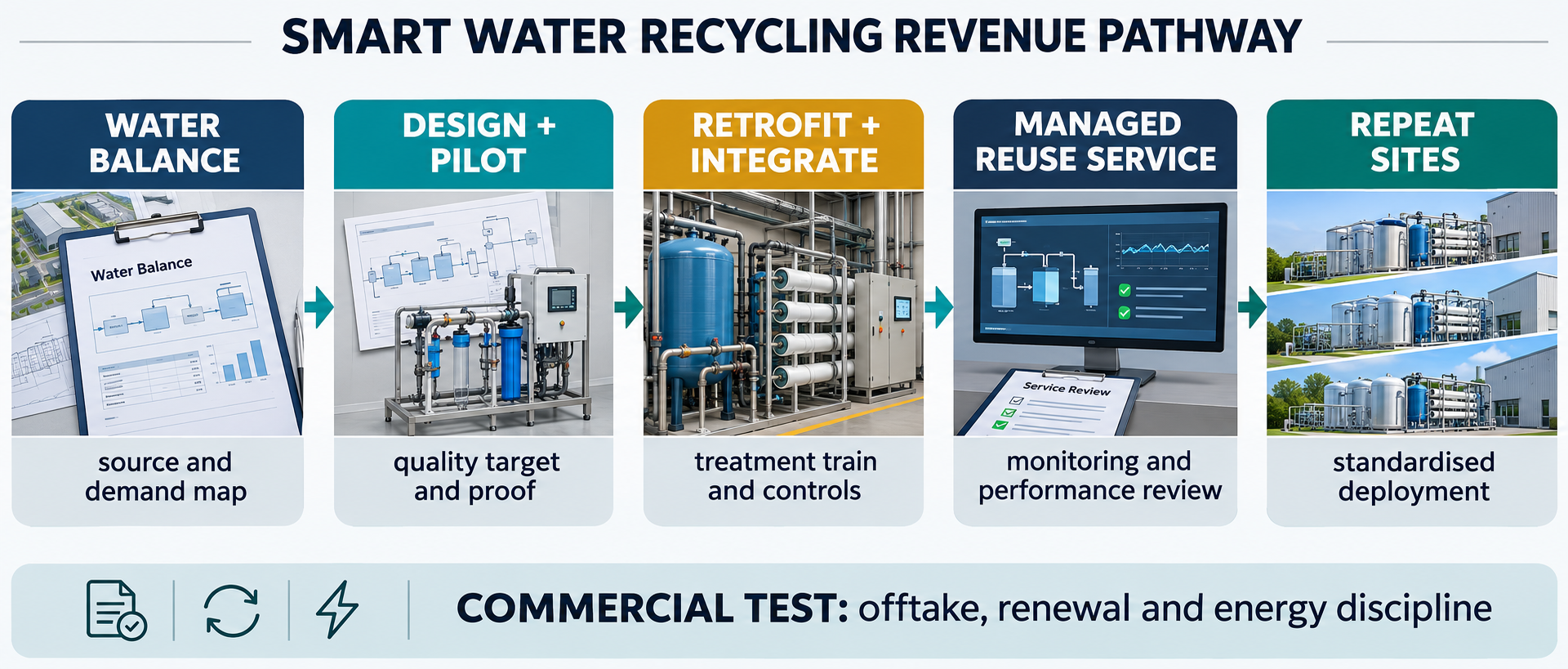
Alternative structures include equipment sale with service support, a subscription for monitoring and controls, a performance-based contract or a water-as-a-service arrangement. The last model may create stronger recurring revenue, but it can also place more capital, operating and availability risk on the provider.
Investors should reconcile contract value to cash needs. A long-term service agreement may require upfront equipment, replacement reserves, energy purchases and field staffing. A project with attractive headline revenue can still consume cash if payments arrive after commissioning and performance testing.
Contract structure matters
Request the allocation of ownership, maintenance, energy, quality failure, downtime, residuals and volume risk. The contract should show which risks the provider can control and which risks remain with the customer.
Offtake is the revenue anchor
A recycling system needs a buyer or internal user for its output. Investors should test contracted volume, specification, price, minimum take, seasonal variation and the consequences of a customer changing its process.
Where margins and unit economics are won
Smart water recycling is often more capital-intensive than a software monitoring product. Equipment, civil works, membranes, chemicals, energy, laboratory analysis, storage, distribution and field support all affect the unit economics.
Energy deserves special attention. The Environment Agency says energy and carbon considerations are significant for energy-intensive processes such as reverse osmosis. A project cannot rely on low energy assumptions without showing source-water conditions, recovery, pressure, operating hours, electricity cost and the treatment required for its end use.
Residuals also matter. Concentrate, sludge, spent media and maintenance waste need a route that is technically and economically viable. UK guidance for permitted biological waste treatment says operators should reuse water where possible, keep less contaminated streams separate and monitor significant fresh-water use. These are operational details with direct commercial consequences.
Investors should request gross margin by revenue type, energy cost per unit of delivered water, consumables use, membrane replacement, laboratory cost, site labour, downtime, warranty exposure and residuals disposal. They should also ask how much of the margin depends on a customer providing free land, power, storage or operational staff.
Scale can help, but not automatically. Standard modules may reduce engineering time and procurement cost. They can also create underutilised assets if each customer needs a different water-quality target or if demand is seasonal.
Capacity is not the same as utilisation
A plant can have a nominal output that is rarely used. The investment case should connect treatment capacity to offtake, operating hours, storage and a realistic demand profile.
Energy is a margin variable
Power consumption affects every unit of delivered water and can change with feed quality or treatment target. A scalable company should measure and manage this variable rather than hide it inside a fixed project price.
Service intensity sets the ceiling
Remote monitoring can reduce unnecessary visits, but it cannot remove maintenance, sampling and quality assurance. Investors should compare service hours per site with contract revenue and renewal behaviour.
What the treatment and data stack must do
A smart water recycling system has a physical treatment train and a control layer. The physical train may include screening or pre-treatment, biological or chemical treatment, membranes, disinfection, storage and distribution. The exact configuration depends on source water, intended use and the required risk controls.
The data layer should show whether the system is operating within its validated conditions. It can combine online surrogate measurements, laboratory results, alarms, maintenance records, energy readings and customer demand. The objective is not to create a visually impressive dashboard. It is to make a quality or operating decision traceable.
The US EPA Guidelines for Water Reuse describe monitoring as an important part of protecting public health and the environment, with requirements that vary by state and reuse type. They identify parameters such as biochemical oxygen demand, suspended solids, turbidity and pathogens or pathogen indicators, while noting that real-time monitoring of surrogate parameters may be specified in some settings.
The EPA’s 2026 water reuse material frames risk-based treatment targets, process crediting frameworks and performance validation monitoring as linked steps. For investors, this reinforces the need to understand how a provider proves treatment performance over time rather than only at commissioning.
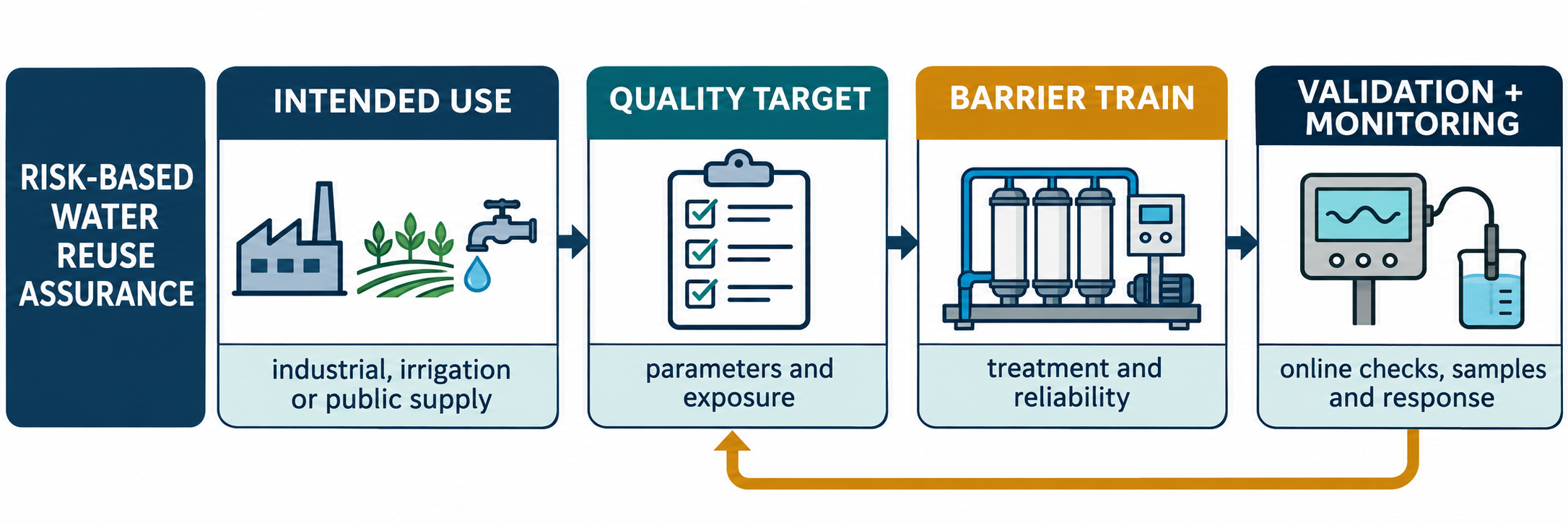
Controls should also manage failure. A credible system defines what happens when a sensor drifts, a membrane loses performance, power is interrupted, storage is full or an output falls outside its required range. The response may be diversion, shutdown, additional treatment, sampling or customer notification.
Validation is an operating capability
Validation is not a one-off certificate. It requires records, procedures, calibration, sample design and evidence that the treatment train remains within the assumptions used to approve it.
Controls should support a safe response
Automation can detect a problem, but the customer still needs an agreed response. Investors should ask who owns the decision, how the system fails safely and whether incident handling is priced into the contract.
Which customers can adopt first
The best first customer is usually close to both the wastewater source and the reuse demand. Industrial parks, manufacturing sites, food and beverage facilities, data-intensive operations and large developments may have a clear reason to consider a local recycled-water system.
Industrial customers can be attractive because the end use is often non-potable and the water balance can be tied to a production process. Yet industrial chemistry, operating schedules and shutdowns can make each deployment different. Investors should examine the repeatability of the customer segment rather than assume that one successful installation transfers unchanged.
Utilities and municipalities can offer larger strategic opportunities. They also bring longer planning horizons, procurement processes, public scrutiny and a need to coordinate multiple regulators and users. The route to market may require a consortium rather than a single technology provider.
Regional expansion requires care. The UK, EU and GCC do not share one reuse permit structure or one public acceptance pathway. A company can use a common technical platform, but its quality evidence, contract model and regulatory work may need to be localised.
Industrial reuse can start with a defined use
Process water, cooling and non-potable utility uses can provide a clearer specification than a broad water-supply ambition. The customer can test the value against a production or resilience outcome.
Municipal reuse needs a wider coalition
Public supply projects can require water companies, regulators, planners, environmental bodies and communities to align. That can create substantial demand, but investors should price the time and evidence burden.
Exportability depends on the operating method
A standard module is not enough if permits, energy, offtake or customer responsibilities vary. The repeatable asset is the combined design, evidence and service process.
Quality, regulation and risk management
Water reuse is not governed by a single global standard. Quality targets depend on intended use, local rules, exposure, treatment barriers, monitoring and the authority responsible for the permit or approval.
Regulation (EU) 2020/741 establishes minimum requirements for the safe reuse of reclaimed water for agricultural irrigation in the European Union. It uses a risk-management approach, requires monitoring and links the quality of reclaimed water to the intended use. The regulation is not a universal rule for every reuse project, but it demonstrates how quality, responsibility and risk planning are embedded in the commercial model.
The US EPA guidance also emphasises that monitoring requirements vary by state and reuse type. For some projects, monitoring can include the reclaimed water plant, groundwater, monitoring wells or other points in the system. This creates demand for quality-assurance capability, but it also means a provider cannot make a generic regulatory promise.
In England, the Environment Agency’s position statement distinguishes direct and indirect recycling for public water supply and notes that energy and carbon considerations are significant. It also says water recycling schemes must meet required environmental discharge standards and obtain the necessary permits.
The governance question is simple: who is responsible for water quality at each point? The answer should be visible in the contract, quality plan, operating procedures, data record and incident response. If responsibility is unclear, a small technical fault can become a commercial dispute.
Fit for use is the core rule
A provider should state the intended use, relevant parameters, treatment barriers and evidence required. Avoiding universal claims is a sign of technical and commercial discipline.
Public confidence has operating cost
Projects serving public supply can require more than treatment equipment. Communication, transparency, independent assurance and long-term monitoring can affect schedule and cost.
Risk management supports the contract
A water reuse risk plan can identify hazards, controls, monitoring and responsible parties. Investors should test whether the company can produce this evidence efficiently across sites.
Investor diligence questions
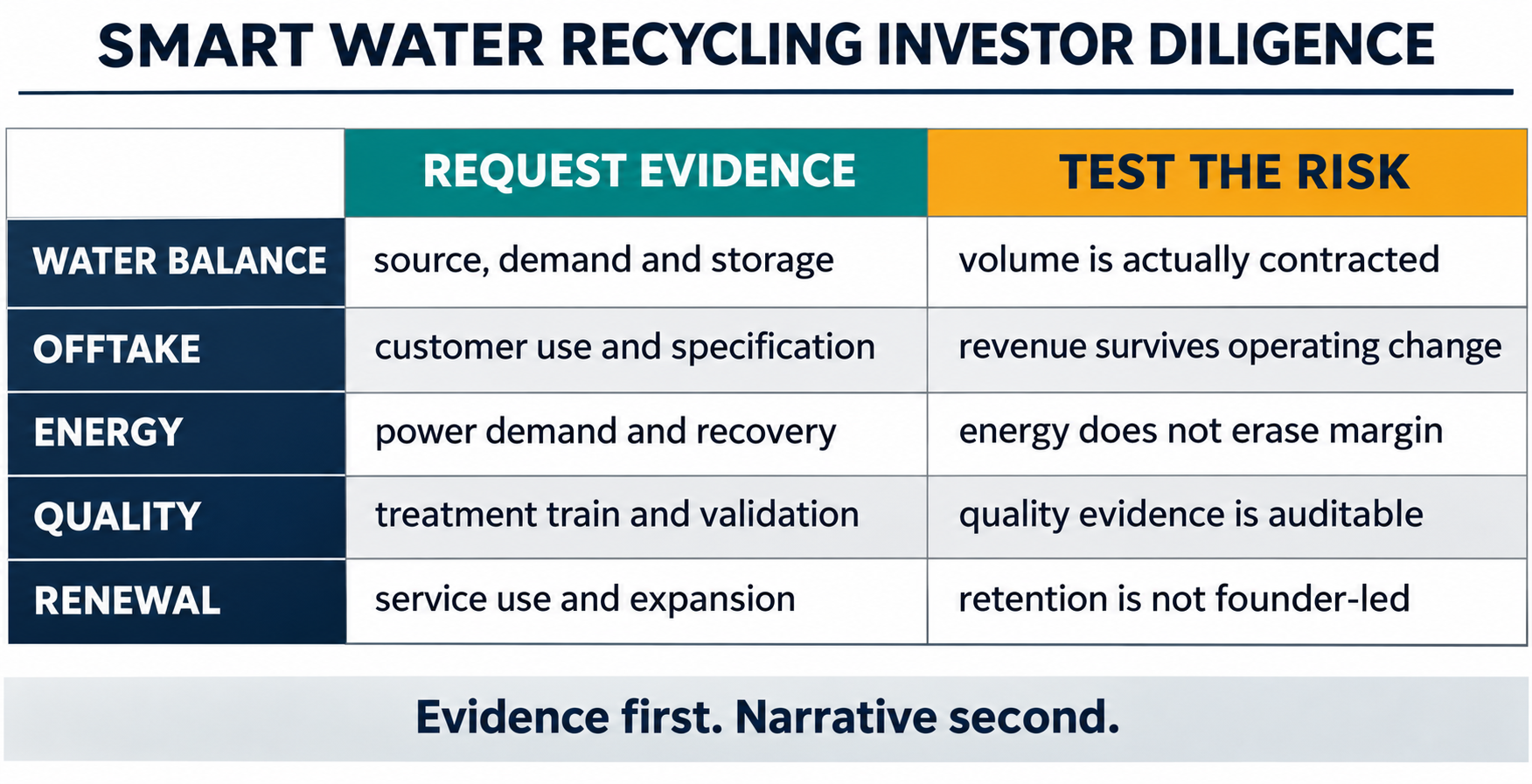
Diligence should begin with the water balance. Request source volumes, demand profiles, storage, discharge routes, seasonal variation and the assumptions used in the project model. A recycling system without an assured source and buyer is an equipment project, not yet a durable business.
Next, test offtake. Review customer specifications, minimum volumes, quality clauses, pricing, downtime rights and expansion options. If the customer can switch back to a cheaper or more convenient source without a material consequence, retention may be weaker than the headline contract suggests.
Then test the treatment train and quality evidence. Ask for validation records, monitoring plans, calibration history, laboratory reports, incident logs and examples of the system responding to an out-of-range result. Check whether evidence is generated by the company, a partner or the customer.
Energy and residuals should be modelled under different operating conditions. Request actual power data from comparable sites, maintenance and consumables history, membrane replacement assumptions and the cost of concentrate or sludge management.
Finally, examine renewals and repeat sites. A company can have impressive engineering references but weak economics if every new site requires a new design team. Look for standard modules, repeatable documentation, shorter commissioning, expansion revenue and service usage that continues after the project invoice.
Request contracts, not just case studies
Case studies show what happened once. Contracts, invoices, service logs and renewal records show whether the model can repeat.
Request quality evidence, not just specifications
Equipment specifications describe capability. Monitoring records and incident responses show whether the system performs within its operating assumptions.
Smart water recycling FAQs and next steps
What is smart water recycling?
Smart water recycling is the treatment, monitoring, storage and distribution of treated wastewater for a defined reuse purpose. The system may use sensors, controls, laboratory analysis and digital workflows to manage quality and operations.
Is smart water recycling the same as water reuse?
Water reuse is the broader concept. Smart water recycling emphasises the connected treatment, monitoring and operating system used to produce and manage the reclaimed water.
Can smart water recycling create recurring revenue?
It can support recurring revenue through managed treatment, monitoring, maintenance, quality assurance, reporting, water supply and expansion to additional sites. Investors should verify offtake, service margins and cash requirements.
What is the main investor risk?
A central risk is that the treatment system is technically feasible but commercially underwritten by uncertain demand, energy costs or quality responsibilities. The water balance and offtake should be tested before the equipment story.
Is this regulated investment advice?
No. This article is sector analysis for private-market research. It is not regulated financial advice, a recommendation, a forecast of returns or an offer to invest.
Water Investment Network focuses on direct private-company opportunities where commercial proof and measurable impact can be assessed together. Eligible investors can review the portfolio for context and join the network to discuss access. This is a factual next step for research, not a promise of performance or a substitute for independent advice.
Sources
- Environment Agency, Water recycling for public water supply: position statement
- Environment Agency, Biological waste treatment: process efficiency
- US EPA, 2012 Guidelines for Water Reuse
- US EPA, Water Reuse Action Plan 2.0: Validation and Monitoring
- EUR-Lex, Regulation (EU) 2020/741 on minimum requirements for water reuse
- World Bank, Scaling Water Reuse: A Tipping Point for Municipal and Industrial Use
- World Bank, Circular economy in water