In brief: The agricultural wastewater treatment market is becoming more investable as farms and food producers face tighter water, pollution and resilience constraints. The opportunity is not a broad bet on agriculture. It is a question of whether a treatment business can solve a defined customer problem, prove water quality and convert delivery into repeatable revenue.
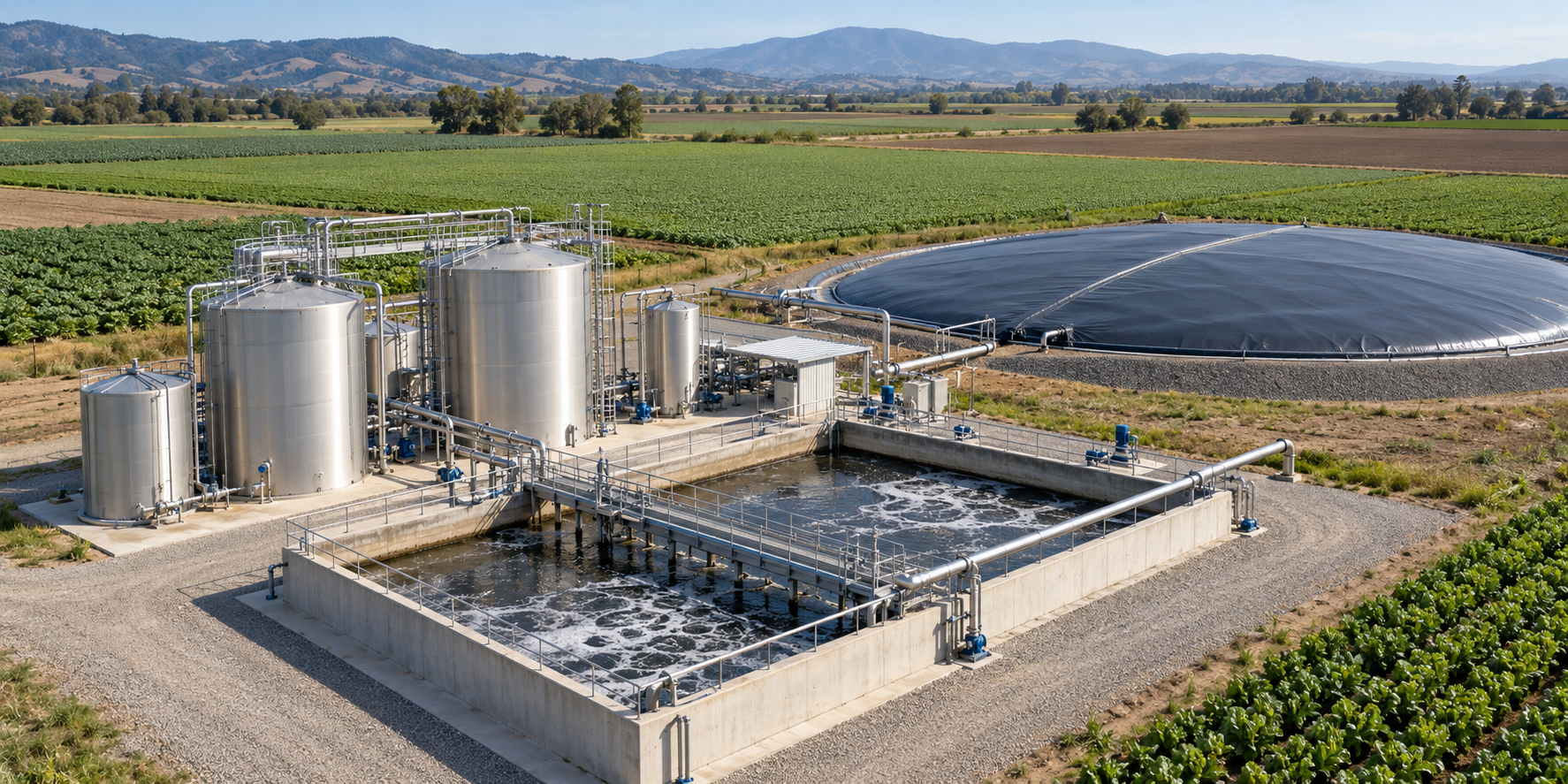
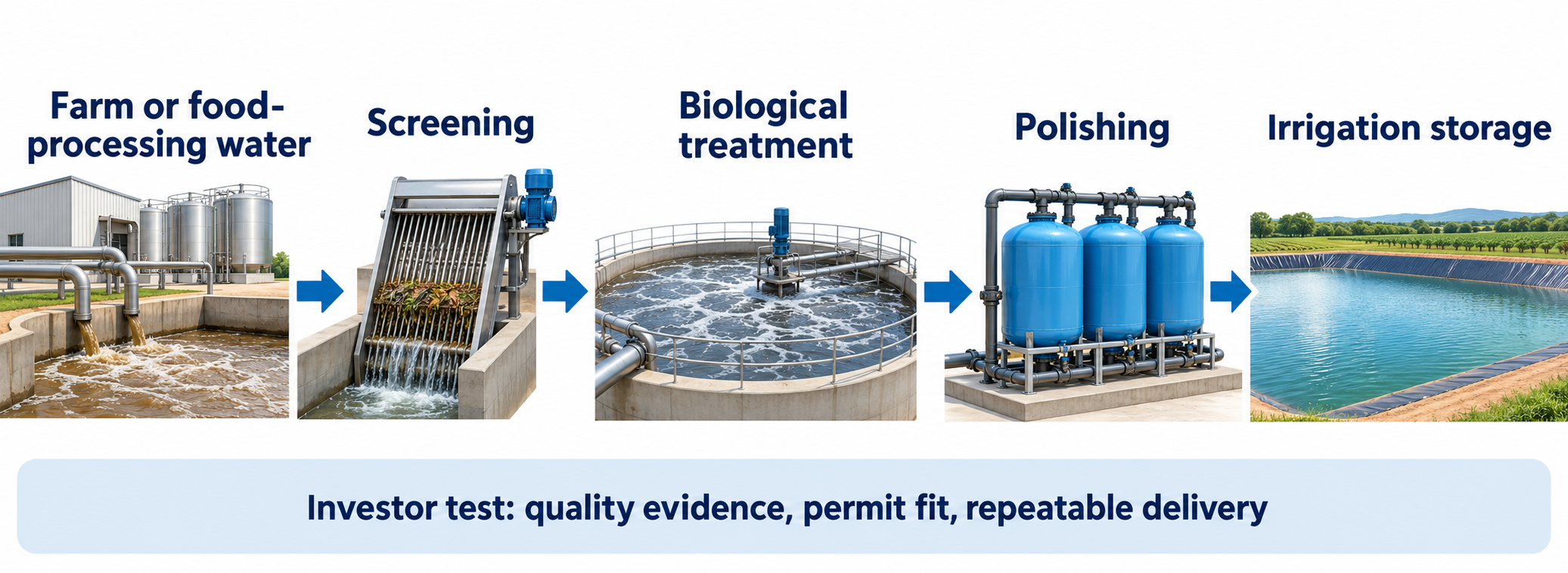
Agricultural wastewater treatment can cover screening, biological treatment, nutrient removal, filtration, disinfection, monitoring, reuse and resource recovery. The right system depends on the source water, the crop or process, the receiving environment and the permitted end use. This makes the sector technically varied and commercially uneven.
For family offices, high-net-worth investors and private-equity teams, the starting point is therefore commercial. Who pays? What performance is required? How much capital is tied up before cash is collected? A useful overview of the wider water technology market investment landscape helps, but this article focuses on the agricultural treatment segment.
Why agricultural wastewater treatment is entering investment screens
Agriculture has a large relationship with water, both as a user and as a source of pollution risk. The Food and Agriculture Organization reports that agriculture accounted for 72% of global freshwater withdrawals in 2023. Its data also show severe water stress in Western Asia and Northern Africa, regions that matter to investors assessing GCC-linked food and water security themes.
This does not mean that every farm needs a complex treatment plant. It means that the value of water management is rising in places where supply is uncertain, discharge is scrutinised or production depends on reliable reuse. A treatment supplier can become commercially relevant when it lowers freshwater demand, protects a permit, reduces nutrient losses or keeps a high-value production process running.
The market also sits inside a wider shift in how water risks are managed. The European Environment Agency identifies agriculture as a major pressure on European surface and groundwaters through water use and nutrient and pesticide pollution. It also points to technology, water efficiency and reuse as part of the response. That creates a route to demand, but not a guarantee of profitable growth.
Agricultural demand is a water and pollution problem
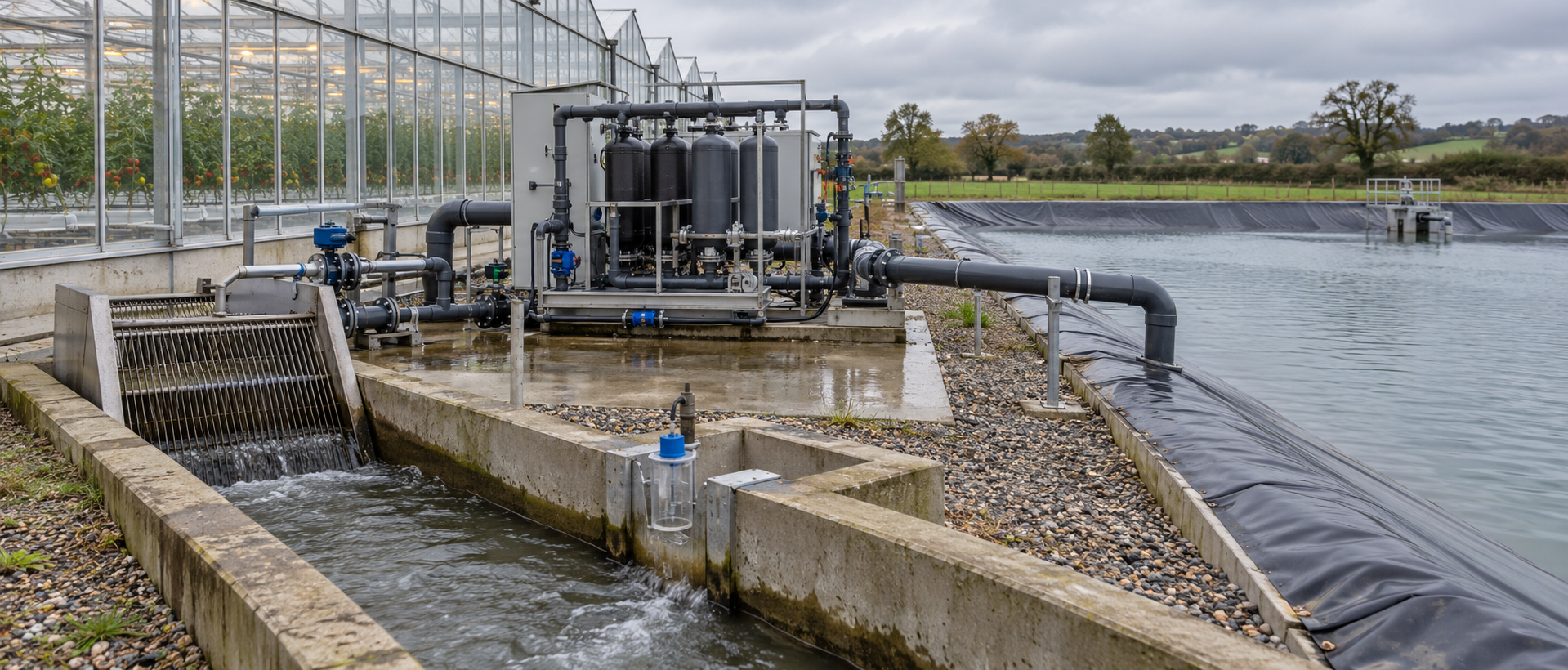
Agricultural wastewater is not one uniform feedstock. It can include livestock effluent, wash water, nutrient-rich runoff, drainage, food-processing water and water used in controlled-environment growing. Each stream carries a different treatment burden and a different customer value proposition.
The pollution pathways matter because many agricultural sources are diffuse. The FAO describes contamination pathways that include livestock and aquaculture waste, fertiliser and pesticide misuse, leaching and runoff from cropland and grazing systems. A solution that works in a contained food-processing site may not work across open fields.
That distinction shapes the investment case. Point-source treatment is easier to measure, contract and service. Diffuse pollution may require monitoring, farm practice change, catchment coordination or nature-based measures alongside equipment. Investors should ask whether a company is selling a defined treatment outcome or a broad environmental promise.
In the UK, the Environment Agency’s Farming Rules for Water apply to land managers in England and aim to reduce diffuse pollution from agricultural sources. The guidance covers fertiliser, manure, soil and livestock management. It also expects land managers to show plans that address crop need, nutrient content and pollution risk. This supports demand for measurement and compliance support, but it does not turn a technology into a mandated purchase.
What the treatment market includes
Agricultural wastewater treatment businesses can sit in several parts of the value chain:
- Pre-treatment: screening, grit removal, equalisation and solids handling that protect downstream equipment.
- Biological treatment: processes that use microorganisms to reduce organic loading and, in some designs, transform nitrogen compounds.
- Nutrient and contaminant removal: treatment that targets nitrogen, phosphorus, suspended solids, salts or specific compounds in the feedstock.
- Polishing and disinfection: filtration, ultraviolet treatment or other final barriers where the reuse or discharge standard requires them.
- Monitoring and control: sensors, sampling, data services and remote operating tools that show whether the system is working.
- Reuse and resource recovery: treated water, recovered nutrients, energy or other outputs that can lower input costs or create a second revenue stream.
These categories have different economics. Equipment may create a large first sale but uneven revenue. Monitoring may have lower project value but stronger recurring income. Managed treatment can produce longer contracts, while resource recovery adds value only when the recovered product has a buyer and the compliance route is clear.
Customer demand must become a contract
A strong agricultural wastewater treatment business starts with a paying customer, not with a treatment method. Potential buyers include intensive farms, food processors, dairies, livestock operations, greenhouse operators, irrigation networks, utilities and public bodies. The buyer may want lower freshwater use, lower disposal cost, protection from pollution, production continuity or evidence for a permit.
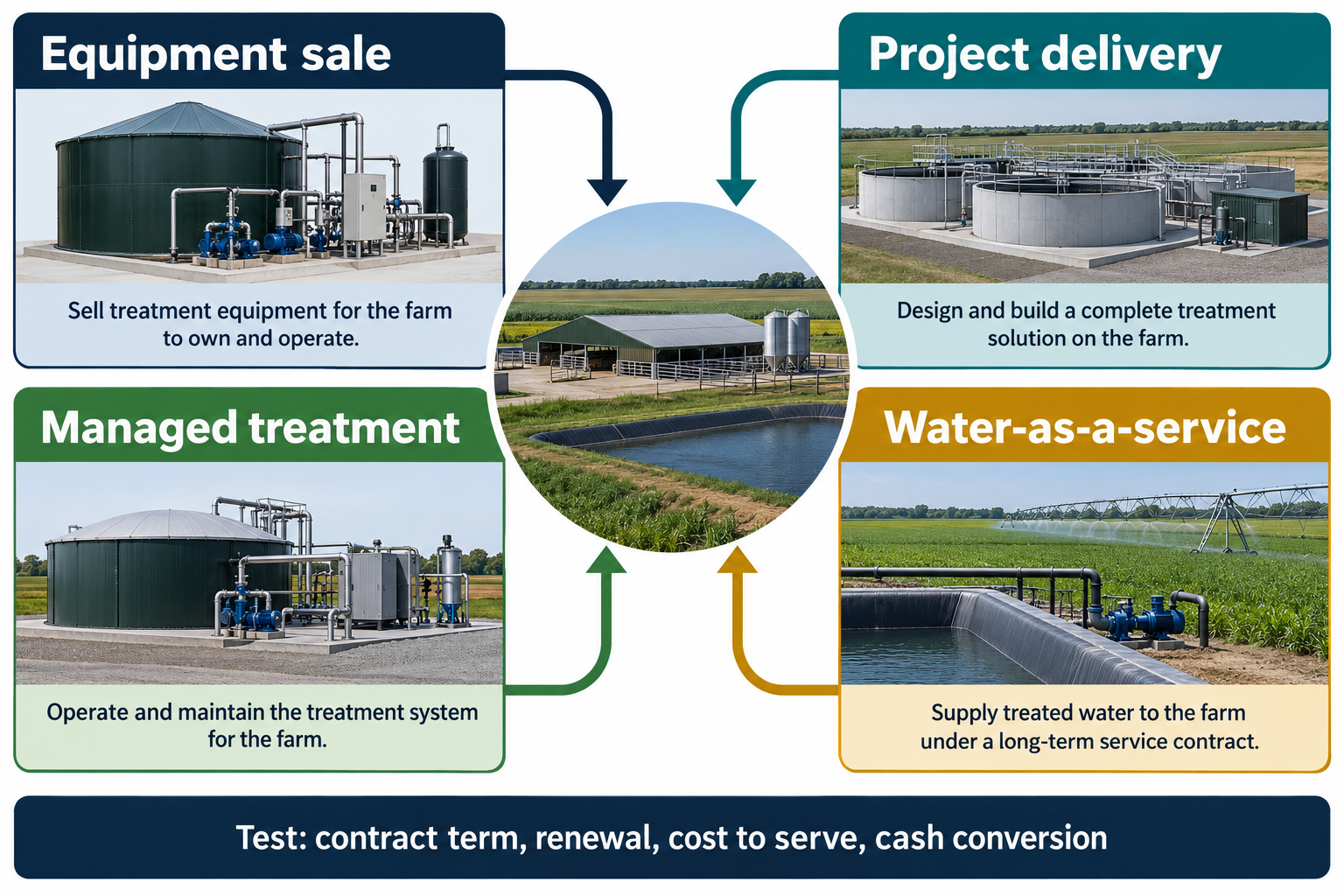
Those needs can support different commercial routes:
- Equipment sale: the customer buys and operates a treatment system.
- Project delivery: the supplier designs and builds a complete solution, often with staged payments and commissioning risk.
- Managed treatment: the supplier operates and maintains the system for a recurring fee.
- Water-as-a-service: the supplier provides a treated-water outcome under a service contract, with performance and availability obligations.
Investors should map the route from site problem to invoice. A long sales cycle may reflect real permitting and procurement work, or it may reveal weak product-market fit. A pilot may show technical potential without proving a repeatable sales process. The quality of evidence depends on whether the customer has paid, renewed, expanded or accepted the measured output.
Business models and unit economics
Unit economics explain whether a treatment company can scale without consuming all of its cash. The relevant unit may be a farm site, a cubic metre treated, a treatment train, a service contract or a monitored asset. Management should be able to explain the unit in operational terms and reconcile it to revenue and gross margin.
Key questions include:
- What is the installed cost, and which parts are standard or bespoke?
- How much energy, consumable material, labour and maintenance does the system need?
- Who pays for upgrades when the feedstock changes or the permit tightens?
- How long do commissioning, acceptance testing and payment collection take?
- Does the company carry performance guarantees, availability obligations or liquidated damages?
- Can the same design be delivered at the next site without a new engineering cycle?
Margin is not the same as cash generation. A project can show a healthy gross margin while working capital grows because equipment is bought before a milestone is paid. A service contract can create recurring revenue but still be unattractive if each site needs too much travel, manual sampling or bespoke maintenance.
Resource recovery deserves the same discipline. Recovered water or nutrients may reduce the customer’s costs, but the seller still needs a permitted use, a reliable quality specification and a buyer. Do not treat a possible by-product as revenue until the commercial chain exists.
Regulation creates a need, not a margin
Regulation can make a customer problem visible and create a timetable for action. It cannot by itself prove that a supplier will win work or retain pricing power.
The European Commission says excess nitrogen from agricultural sources is a major cause of water pollution in Europe. Its Nitrates Directive framework requires monitoring, vulnerable-zone designations and action programmes for fertiliser and manure management. The same framework also shows why local implementation matters. Rules, enforcement and farm economics vary by country.
England’s Farming Rules for Water provide another example. The Environment Agency says it may escalate to civil or criminal sanctions when advice and warnings do not change behaviour. For a business selling measurement or treatment, this can increase the cost of non-compliance for the customer. It still leaves open the questions of budget owner, procurement route, competing solutions and implementation capacity.
Water reuse is another policy-supported route. The European Commission identifies the EU regulation on minimum requirements for water reuse for agricultural irrigation as a tool to stimulate and facilitate reuse. Investors should still test the full permissioning chain, including water quality, crop or end-use requirements, monitoring, liability and local authority acceptance.
UK, Europe and GCC: different routes to opportunity
One regional thesis should not be applied to every agricultural water market.
United Kingdom
UK opportunities may be linked to diffuse-pollution control, catchment outcomes, farm compliance, food processing and water efficiency. Customers often need clear evidence, credible installation partners and a practical operating model. Investors should separate England-specific rules from the arrangements in Scotland, Wales and Northern Ireland.
Europe
European demand can combine water scarcity, nutrient pollution, reuse and food-system resilience. The EEA reports that water stress affects parts of Europe each year and that agriculture is a major pressure on water bodies. This supports a broad need for better management, but country-level permits, subsidy design, farm structure and buyer budgets remain decisive.
GCC
GCC cases require country-specific diligence on water scarcity, food security, desalination, groundwater, imported food exposure, offtake and public-sector counterparties. A treatment company may have a strong technical fit but still face long procurement cycles, concentration risk or a need for a local operating partner. Regional relevance is not proof of a bankable contract.
What scalable businesses do differently
Scalability in this market is operational. It comes from repeatable designs, reliable commissioning, standard procurement, documented performance and a service model that does not grow labour faster than revenue.
Defensibility can come from several sources:
- Application knowledge: understanding the customer’s water stream, seasonality and operating limits.
- Performance data: a credible history of quality, uptime, energy use and maintenance.
- Integration capability: the ability to connect treatment, storage, monitoring and reuse into one working system.
- Channel access: relationships with engineering firms, farm groups, utilities, processors or public procurement bodies.
- Service density: enough nearby sites to make inspection and maintenance economic.
Patents can help, but they are not a substitute for installation evidence. A cheaper or simpler competing solution may win if it meets the required quality standard with less operating risk. Investors should look for a reason the customer stays after the first contract, not only a reason the customer buys once.
For investors comparing opportunities, the Water Investment Network portfolio provides a relevant route into direct water-technology opportunities. Any opportunity still needs its own customer, contract, performance and cash-flow review.
Diligence scorecard for private investors
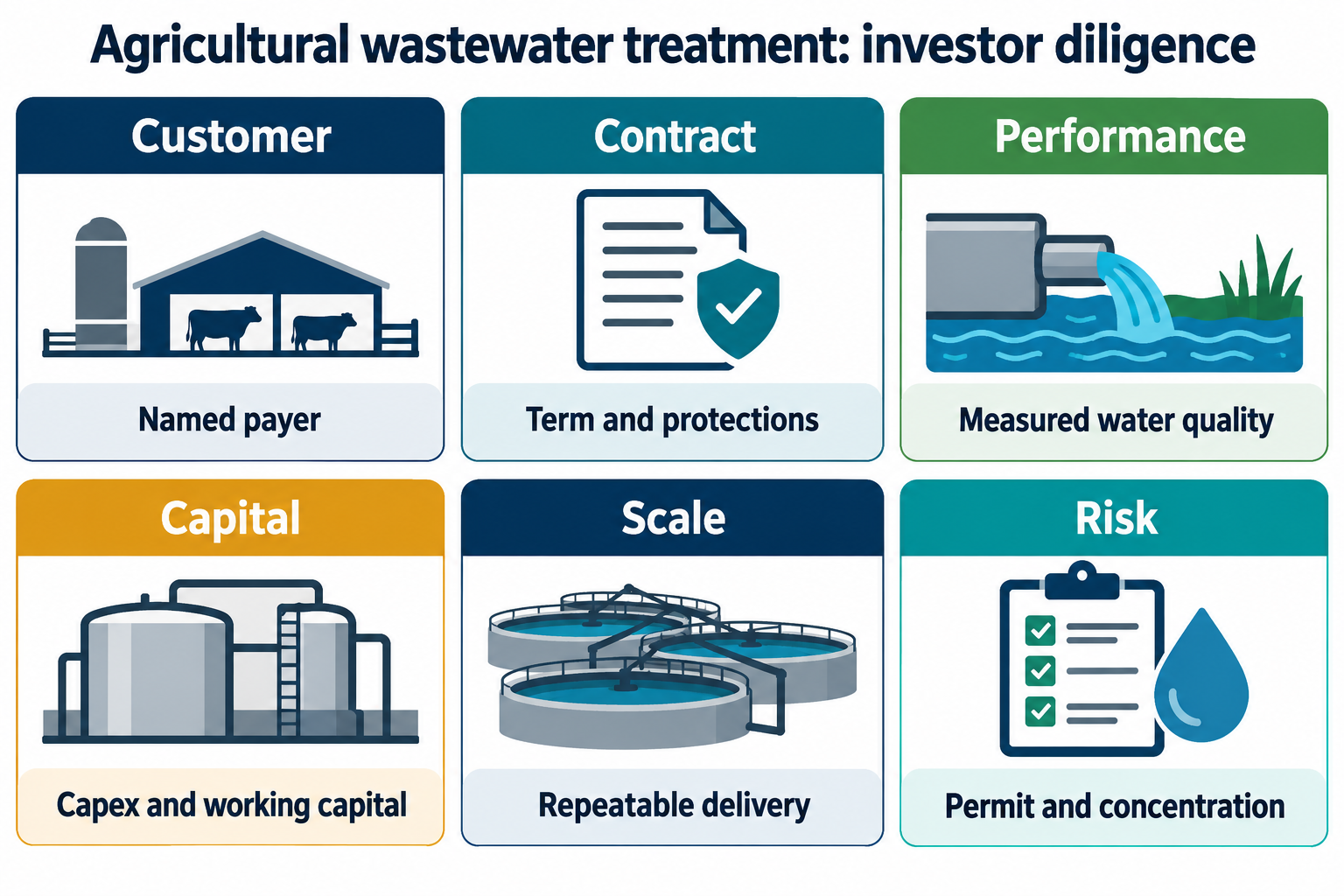
A practical review can be organised around six tests:
- Customer: Is there a named payer with a costly, recurring problem?
- Contract: Are term, payment milestones, renewal rights, performance obligations and liability clear?
- Performance: Do independent test results show the required water quality, uptime and operating cost?
- Capital: How much capex and working capital are needed before a site produces cash?
- Scale: Can the next installation use a repeatable design, supply chain and delivery team?
- Risk: Are permit, feedstock, counterparty, concentration and technology risks understood?
The evidence should be specific. Ask for signed contracts, acceptance certificates, water-quality reports, maintenance logs, energy data, warranty claims, customer references and aged receivables. Then reconcile the story to the financial statements. A pipeline is not revenue, a pilot is not a renewal and a treatment claim is not an approved reuse route.
Risks, FAQs and next steps for eligible investors
What is the agricultural wastewater treatment market?
It is the group of equipment, services, operating models and monitoring solutions that treat agricultural or farm-linked water streams before discharge, reuse or further recovery. It includes contained farm and food-processing systems as well as services that manage diffuse pollution risk.
Is agricultural wastewater treatment a defensive investment?
It can address essential customer needs, but it is not automatically defensive. Revenue may depend on farm profitability, public budgets, permits, weather, crop cycles, energy costs and project execution. Investors should test downside cases rather than rely on the importance of water alone.
Does regulation guarantee demand?
No. Regulation can create a compliance need, but the customer may choose farm practice changes, monitoring, nature-based measures, a competing process or no immediate capital project. The investable case requires a paying customer, a credible route to procurement and evidence that the supplier can deliver.
Can water reuse create value for agricultural treatment businesses?
Yes, where treated water meets the required quality, the reuse route is permitted and the customer values a more reliable supply. Reuse can support revenue, but investors should test monitoring, liability, operating cost and the buyer’s willingness to renew.
What should investors request first?
Start with the customer list, signed contracts, site-level performance evidence, gross-margin bridge, working-capital history, permit documents and the installation pipeline. These documents show whether the company has a business or only a promising technical proposition.
For eligible investors who want to review direct water-technology opportunities, join the Water Investment Network. For a specific question about access or eligibility, use the contact page. Water Investment Network does not provide regulated financial advice, and past or projected performance is not guaranteed.
Sources
- Food and Agriculture Organization, SDG Indicator 6.4.2: Level of water stress. Global withdrawal and regional water-stress data.
- Food and Agriculture Organization, Water and One Health. Agricultural pollution pathways and water-management context.
- GOV.UK, Enforcing the Farming Rules for Water. England-specific diffuse-pollution enforcement guidance.
- European Commission, Nitrates Pollution Factsheet. European nutrient pollution and Nitrates Directive context.
- European Commission, Water scarcity and droughts. EU water scarcity, reuse regulation and policy context.
- European Environment Agency, Europe’s state of water 2024. European water stress, agricultural pressure and resilience context.