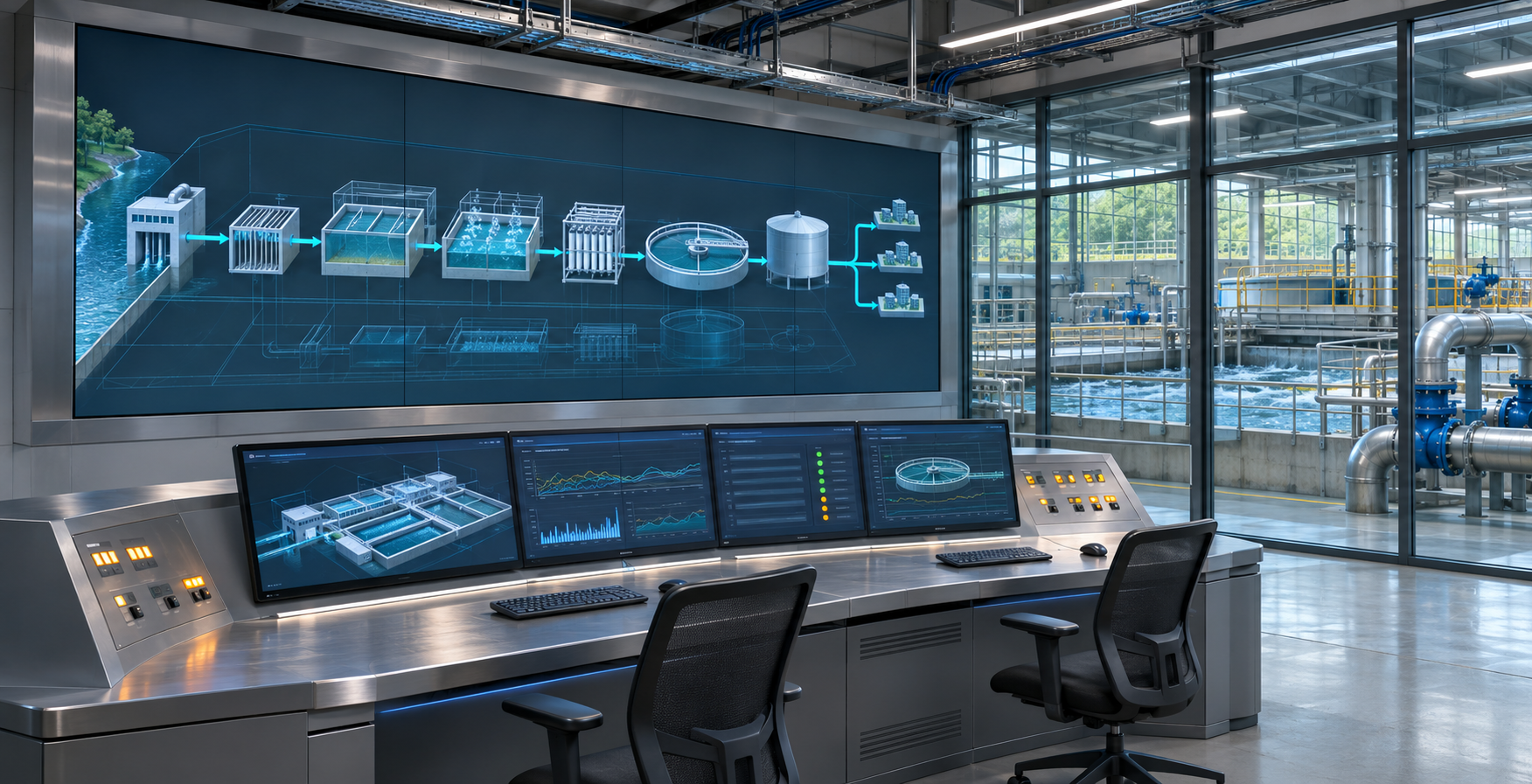
Digital twin water treatment is becoming a practical investment theme because operators need more than another dashboard. They need a live working model that connects plant data, process behaviour and operational decisions.
A digital twin is a digital representation of a physical system that is updated with data and used to understand, test or improve what happens in the real system. In water treatment, that may include works, pumps, tanks, filters, membranes, dosing systems, laboratories, energy use and the surrounding network.
The commercial opportunity is not the visual model on its own. It is the service around a paid decision: reduce energy use, plan maintenance, test a process change, improve resilience, support compliance or defer unnecessary capital work. Investors should therefore assess the evidence chain from plant data to customer action. For wider context, see the Water Investment Network guide to smart water monitoring investment.
Digital twin water treatment is an operating system, not a dashboard
A dashboard shows information. A useful twin connects information to a model of how the asset behaves. It can help an operator compare the current state with an expected state, test a scenario, investigate an anomaly or choose a next action.
What makes a twin different
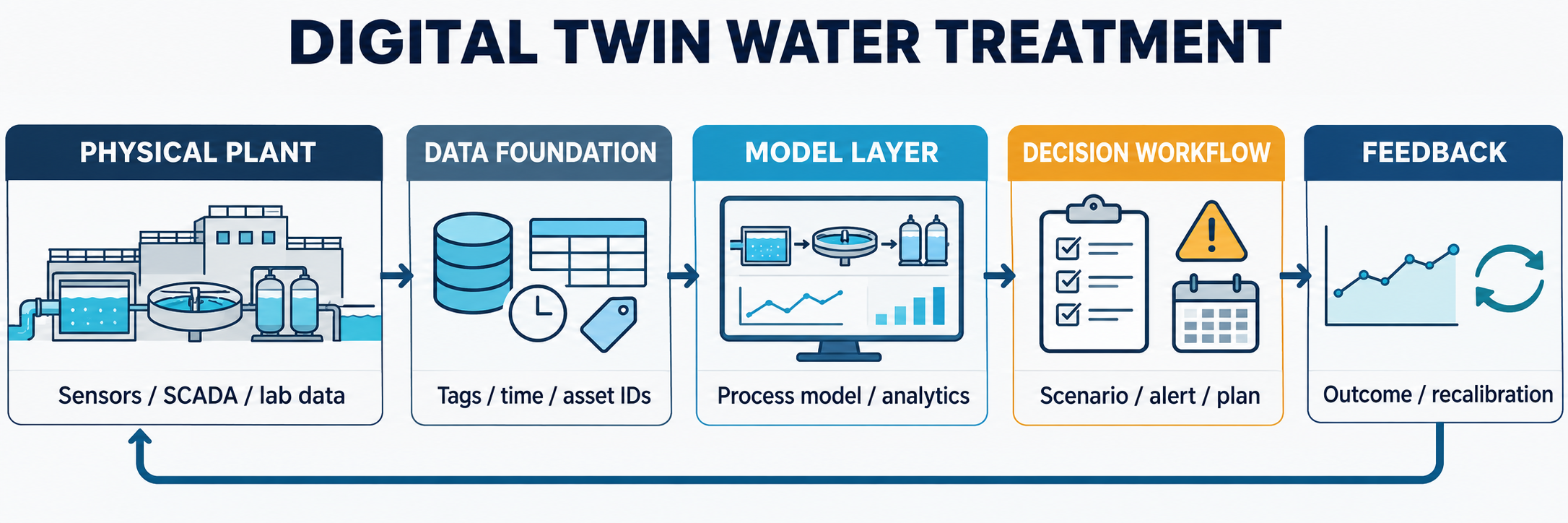
A digital twin normally combines a physical asset, data collection, a model and a decision workflow. The model may be mechanistic, statistical, machine-learning based or hybrid. Mechanistic models describe known process relationships. Statistical and machine-learning models learn patterns from operating data. Hybrid models combine both approaches.
The distinction matters for diligence. A static three-dimensional design file, a reporting dashboard and a continuously updated operational twin may all be marketed with similar language. They do not have the same customer value, delivery effort or renewal potential.
Why treatment works are a good test case
Treatment works produce many operating signals. Flow, pressure, turbidity, temperature, chemical dose, power use, filter condition and laboratory results can all affect decisions. The value of a twin is to place these signals in process context.
That context can support questions such as whether a change in raw-water quality is affecting treatment, whether a pump is operating outside its normal envelope, or whether an operating change should be tested before it is made. A model does not remove the need for engineers. It gives them a more consistent evidence base.
Commercial meaning for investors
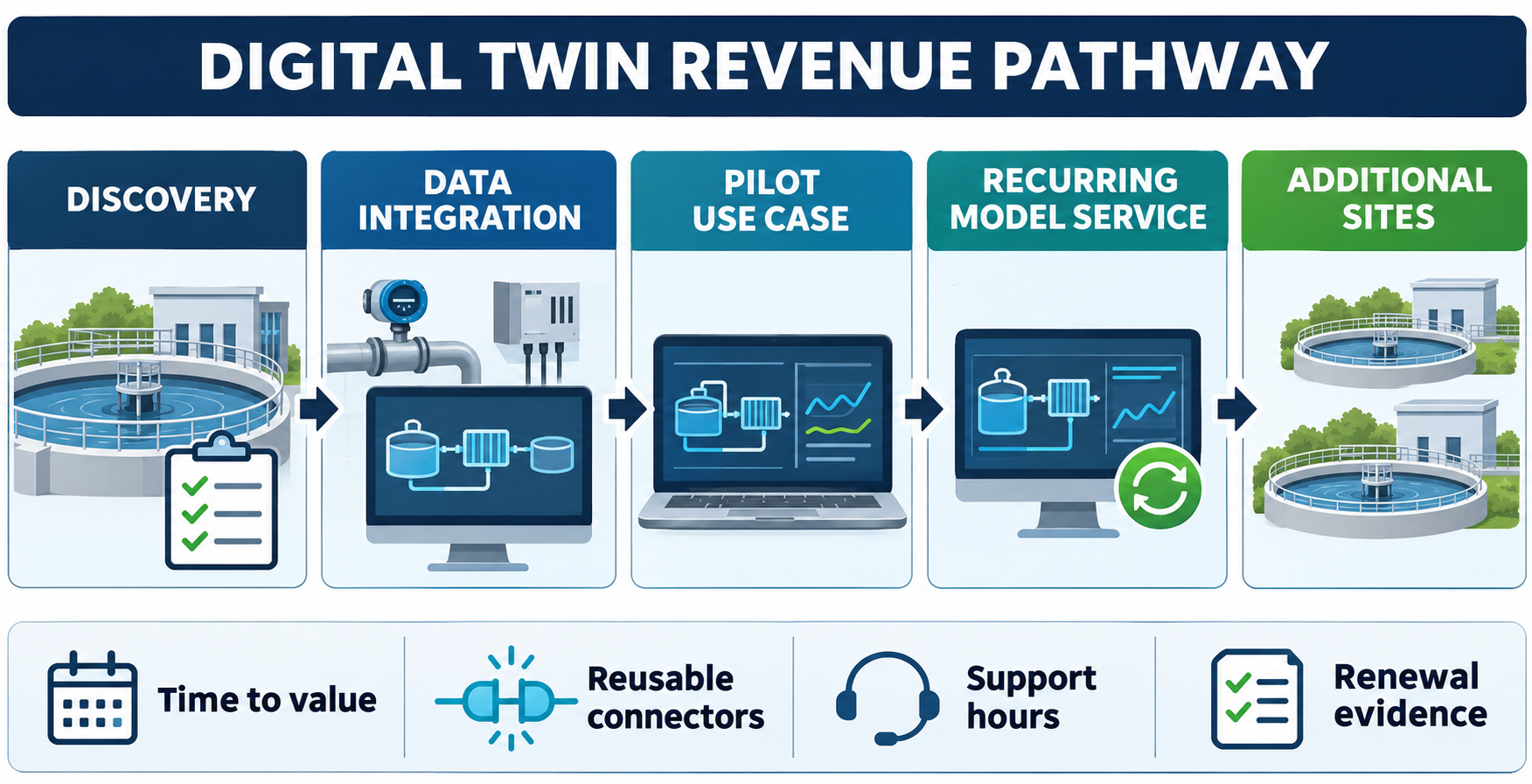
The commercial product is often a combination of software, engineering and ongoing support. A company may earn revenue from data integration and model commissioning first, then from subscriptions, managed services, model updates, training or additional sites.
Investors should ask which part of the offer customers renew. If the answer is only a visual interface, switching may be easy. If the supplier owns calibrated models, trusted workflows, data connectors and a record of useful operating decisions, the relationship may be harder to replace.
Why the water market is moving towards digital twins
Digital twins are not a single regulatory category. Demand is developing through operational pressure, infrastructure investment, environmental monitoring, climate risk and the need to make better use of existing assets.
Utilities are building a wider digital journey
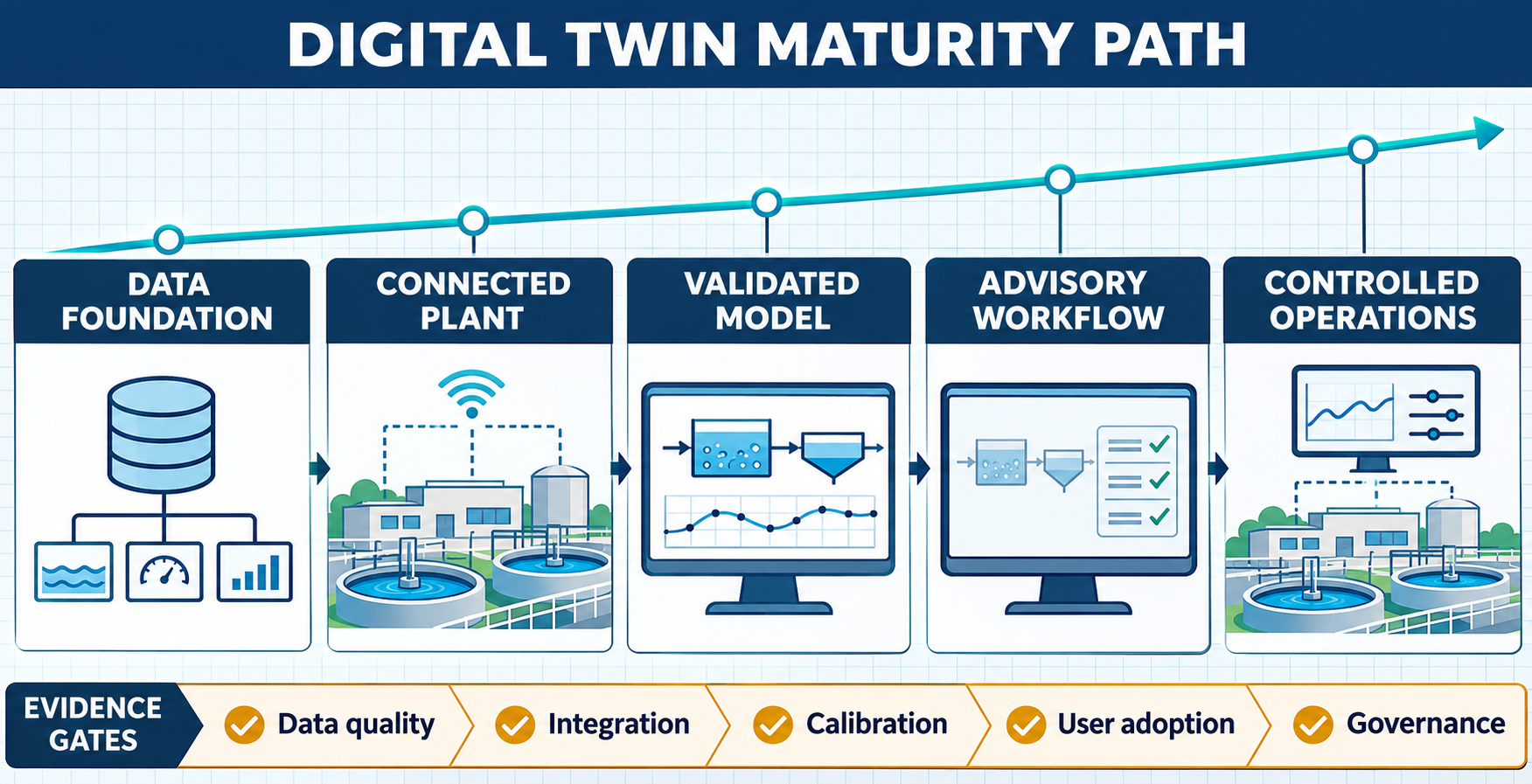
The World Bank describes water digitalisation as a journey that differs by client. Its Digital Water work includes assessments, roadmaps, training and tools that help utilities choose where to start. This is commercially relevant because many buyers need staged implementation rather than a single large technology purchase.
The first paid engagement may be a data assessment, asset survey or use-case study. A later phase may add connectors, sensors, a model, operational workflows and support. The supplier that can manage this progression may have more expansion potential than one that sells a platform before the buyer has a defined use case.
Policy is increasing the value of evidence
The UK Government’s Plan for Water describes digital twins as data-driven representations of processes and systems. Its Stiffkey catchment example brings together effluent, water-quality, biodiversity, flow, storm-overflow and weather data to support scenario analysis and decision-making.
The Environment Agency has also published a digital-twin proof of concept for an industrial cluster on the Humber Estuary. It combines real and notional environmental and industrial data with climate projections to examine future impacts and resource pressure. These are project examples, not proof of a universal market size. They do show the type of evidence buyers may value: connected data, a defined decision and a route to reuse.
Innovation funding is testing real demand
Ofwat’s Innovation Fund report shows how digital twin work is being framed around live water-sector problems. Its ecological digital twin case combined more than 28 data sources, an ontology, a scalable data platform and tools for monitoring and planning.
Public funding is not the same as a signed recurring contract. It is still useful market evidence because it shows buyers and partners defining a real decision, a data architecture and a route to reuse. Investors should follow the chain from funded project to operational deployment, customer reference, renewal and gross-margin contribution.
Investment thesis at a glance
| Investment question | What to look for | Risk to test |
|---|---|---|
| Customer demand | A defined plant, process or resilience decision | A technology demo without a budget owner |
| Product value | Better planning, operation, maintenance or evidence | Claims that do not connect to a measured baseline |
| Revenue quality | Implementation followed by support, updates or additional sites | Services-heavy work described as software revenue |
| Defensibility | Calibrated models, data connectors, workflow ownership and customer trust | Easy replacement by a consultant, internal team or generic platform |
| Scale | Reusable data models and controlled site configuration | Every deployment requiring bespoke engineering |
The thesis is strongest when a company sits inside a repeat operating decision. The twin should help a customer decide what to run, inspect, maintain, upgrade or model next. A polished interface is useful only when it improves that decision.
What could create value
Value may come from reduced manual analysis, better use of treatment capacity, earlier maintenance planning, improved energy decisions, clearer capital prioritisation or stronger evidence for environmental reporting. The benefit depends on the site, the starting data and the authority to act.
What could destroy value
Value can be lost through poor source data, weak model calibration, slow integration, unclear ownership of decisions, cyber risk, procurement delays or a product that cannot fit the buyer’s operating systems. The same technology can be valuable at one site and uneconomic at another.
How to frame the opportunity
Frame the opportunity as a private-market infrastructure software and engineering question. Ask whether revenue, margins and renewal improve as the company moves from one plant to a family of sites. Do not assume that an emerging technology label creates pricing power or guaranteed returns.
What buyers actually purchase
Buyers rarely purchase a digital twin as one isolated object. They purchase a sequence of work that makes the twin usable in their own plant and governance environment.
Discovery and data assessment
The first stage may map the asset, operating questions, available data, control systems, laboratory records and existing models. It should define the decision that matters and the data needed to support it.
This work is commercially important because it exposes the true cost of the deployment. A site with fragmented records, missing time series or inconsistent tags may require more engineering before the twin can provide useful output.
Integration and model commissioning
Integration connects operational technology, information technology, sensors, historians, laboratory systems and external data. Model commissioning then tests whether the virtual representation follows the physical process under relevant conditions.
Customers may pay for connectors, data cleaning, configuration, calibration, validation, documentation and training. These activities can create a strong relationship, but they can also make revenue dependent on specialist labour.
Operating workflow and support
The recurring product may include alerts, scenario analysis, planning tools, model updates, performance reviews, support and training. The supplier may also help the customer interpret results and manage changes to the physical process.
A buyer should know where the human handover sits. A twin that produces a useful recommendation but cannot fit an existing approval workflow may remain an expensive pilot. A twin that is adopted in daily planning or maintenance has a clearer path to renewal.
How digital twin water treatment companies make money
The most useful revenue analysis separates the initial project from the repeatable product. A company can have strong customer value and still be a services business. That is not automatically negative, but it affects margins, working capital and scale.
Paid assessments and pilots
Assessments and pilots can be a sensible entry point. They help the buyer choose a use case and help the supplier learn the site’s data and operating constraints. The investor should track conversion from pilot to contracted deployment, not only the number of pilots announced.
Implementation revenue
Implementation revenue may include data engineering, model development, configuration, integration, testing, training and commissioning. Gross margin depends on the amount of repeatable software and the amount of site-specific work.
Review project scope carefully. A low initial price can be a customer-acquisition tactic, a sign of underpriced delivery or evidence that future software revenue is expected. The board should know which interpretation is true for each contract.
Recurring software and managed service revenue
Recurring revenue may come from hosted software, model monitoring, data services, support, training, scheduled recalibration and managed operational analysis. Renewal should be reported by site and customer, with one-off consulting and pass-through costs separated.
Expansion revenue is more credible when a customer adds another process or treatment works using the same data foundation. It is less convincing when every new site requires an entirely new architecture, new code base and new team.
Where margins and unit economics are won
Digital twin water treatment can look like software in a pitch deck while operating like a specialist engineering project. The unit economics depend on how the company handles the bridge between those two models.
Data preparation and integration effort
Data preparation can include tag mapping, missing values, time alignment, unit conversion, asset naming, sensor checks and access permissions. These tasks may be essential, but they can consume senior staff time and delay a go-live date.
Track implementation hours by site, time to first useful output, change requests and the percentage of connectors reused. A reusable integration layer should reduce cost to serve over time. If it does not, the company may be selling bespoke consultancy with software branding.
Model validation and recalibration
Models must be tested against real operating conditions. Treatment processes change as raw-water quality, weather, equipment condition, chemical dose and operating policy change. The cost of keeping the model useful belongs in the recurring service plan.
Model accuracy is not the only measure. A model may be valuable because it improves the timing or quality of a decision. Still, the company should define validation criteria, known limits and escalation routes when the model is uncertain.
Support, cyber and governance
Support is part of the product when a twin informs plant operations. Customers may expect service levels, access controls, audit trails, incident response and clear ownership of data. Cybersecurity, change management and integration with operational technology can add both cost and defensibility.
Review whether those obligations are priced. A contract that promises high availability, frequent model updates or operational support without a matching cost base can create unpriced liability.
The technical stack behind a trusted twin
Investors do not need to become process engineers, but they should understand the layers that make a twin useful and the failure modes at each layer.
Physical and data layer
The physical layer includes treatment assets, sensors, actuators, laboratory readings and operating procedures. The data layer moves those signals into a usable structure. Good metadata matters because a model cannot reliably interpret a tag that has no stable meaning.
Model and analytics layer
The model layer represents process relationships and produces forecasts, scenarios or recommendations. The KWR roadmap for drinking-water treatment highlights the need for clear terminology, data architecture, modelling choices and a functional design before a twin can move into a real operating context.
A provider should explain when it uses a physical model, a statistical model or a hybrid approach. It should also show how uncertainty is communicated. A precise-looking number without a defined confidence range can create a false sense of control.
Decision and feedback layer
The final layer connects an output to an approved decision. This may be a maintenance plan, process adjustment, capital option, environmental investigation or operator review. Feedback from the physical system should then update the twin and reveal whether the decision worked.
Which customer segments can adopt first
Adoption is more likely where the customer has a measurable operating problem, a defined asset owner and authority to use the output. The largest market is not always the easiest first market.
Drinking-water treatment works
Drinking-water operators may use twins to understand treatment performance, plan maintenance, test changes and manage raw-water variability. Procurement can be demanding because the system supports a public service and may connect to operational technology.
Wastewater and resource recovery
Wastewater treatment creates use cases around energy, biological processes, nutrient removal, discharge quality, sludge and resource recovery. The buyer may value scenario testing before changing aeration, dosing or asset operation.
Industrial, catchment and infrastructure partners
Industrial operators may need a twin for process water, reuse, discharge or resilience planning. Public bodies and catchment partnerships may use connected data to understand how interventions affect water quality or resource availability.
Each segment has a different sales cycle, data environment and decision owner. A provider that sells to all of them with one generic proposition may be spreading its delivery team too thin. For portfolio context, investors can review the Water Investment Network portfolio page, while assessing each opportunity independently.
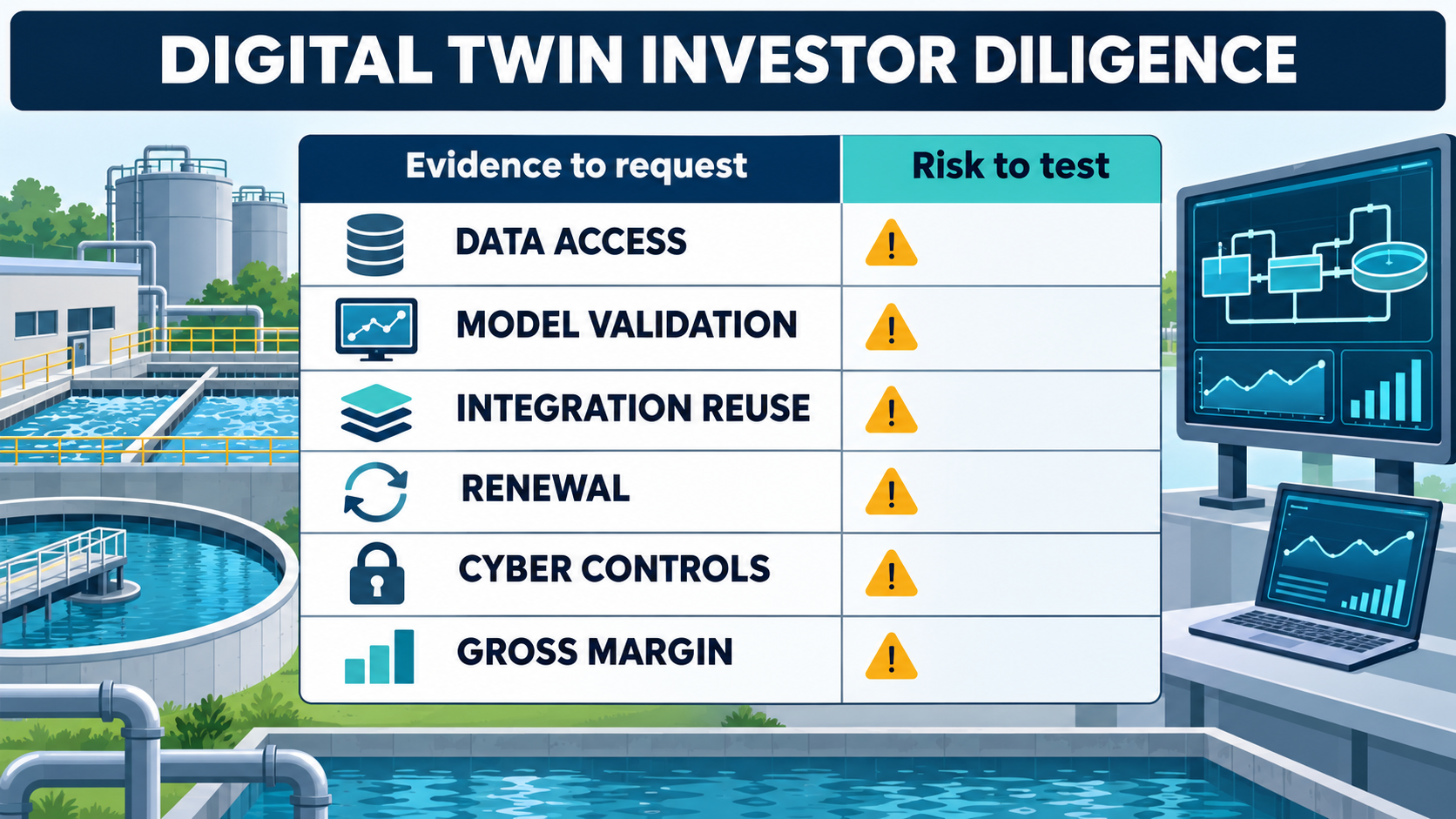
Investor diligence questions
A digital twin business should be diligenced as a technology company, an engineering service and a critical infrastructure supplier. The investor needs evidence across all three.
Is the customer buying a decision or a demonstration?
Ask for the original use case, budget owner, decision calendar, operating workflow and acceptance criteria. Review what changed after deployment. A demonstration can open a relationship, but it does not prove repeatable customer value.
How much of the product is reusable?
Compare the code, connectors, data models, ontologies and deployment process across customers. Request a bridge from the last implementation cost to the expected cost of the next comparable site.
How is model performance validated?
Request calibration records, validation windows, failure cases, uncertainty treatment and examples of model drift. Ask who can approve a recommendation and what happens when the twin disagrees with an operator.
Does revenue renew without a new project?
Separate licence, support, managed service, consultancy and pass-through revenue. Review renewal by site, churn, expansion, support hours and gross margin. A recurring invoice can still hide a labour-intensive service.
Can the business manage critical infrastructure risk?
Review cyber controls, access rights, data ownership, incident response, audit trails, subcontractor exposure, insurance and contract liability. The closer the twin sits to operational control, the more important these questions become.
What a digital twin can and cannot prove
A twin can improve a defined decision
A trusted twin can help a customer compare scenarios, identify unusual behaviour, plan maintenance, test operational changes and make better use of data. The benefit should be tied to a baseline and a decision record.
A twin cannot remove physical uncertainty
A model cannot create a missing sensor history, guarantee a treatment outcome or replace an operator’s responsibility. It can also produce a poor answer when the physical process changes outside the conditions used for calibration.
A pilot is not a scale proof
A successful pilot proves that a use case can work in one context. It does not prove that the same economics apply across different plants, countries or regulatory environments. Scale evidence should include deployment time, support load, model reuse, renewal and cash conversion.
Digital twin water treatment FAQs and next steps
What is digital twin water treatment?
Digital twin water treatment is the use of a continuously updated digital representation of a water or wastewater treatment system to understand, simulate, monitor or improve operations. It combines physical assets, data, models and decision workflows.
How is a digital twin different from a dashboard?
A dashboard presents data. A digital twin adds a model of the physical system and connects outputs to scenarios, predictions or decisions. Some products use the term loosely, so investors should test the data update, model and feedback loop.
Can digital twin water treatment create recurring revenue?
It can create recurring revenue through hosted software, model updates, data services, support, training, recalibration and managed operational analysis. Renewal depends on useful decisions, reliable data, cost to serve and the customer’s procurement route.
What should an investor request first?
Start with the customer use case, deployment cost, data access, model validation, renewal history, support hours, gross-margin bridge, cyber controls and evidence that the twin changed a real operating or investment decision.
Is digital twin water treatment regulated investment advice?
No. This article is sector analysis, not regulated investment advice, a recommendation, a forecast of returns or an offer to invest. Each opportunity requires independent commercial, technical, legal and financial diligence.
Sources and next step
- KWR: A Roadmap to Creating Digital Twins for Drinking Water Treatment
- GOV.UK: Plan for Water
- Environment Agency: Digital twin of an industrial cluster
- US EPA: EFAB Water Affordability Final Deliverable
- World Bank: Digital Water
- World Bank: Water digitalization
Investors who want to understand the network’s water-technology focus can return to the Water Investment Network homepage. Eligible investors can use the network application page to start a suitability and diligence conversation. Access is not a promise of performance or returns.