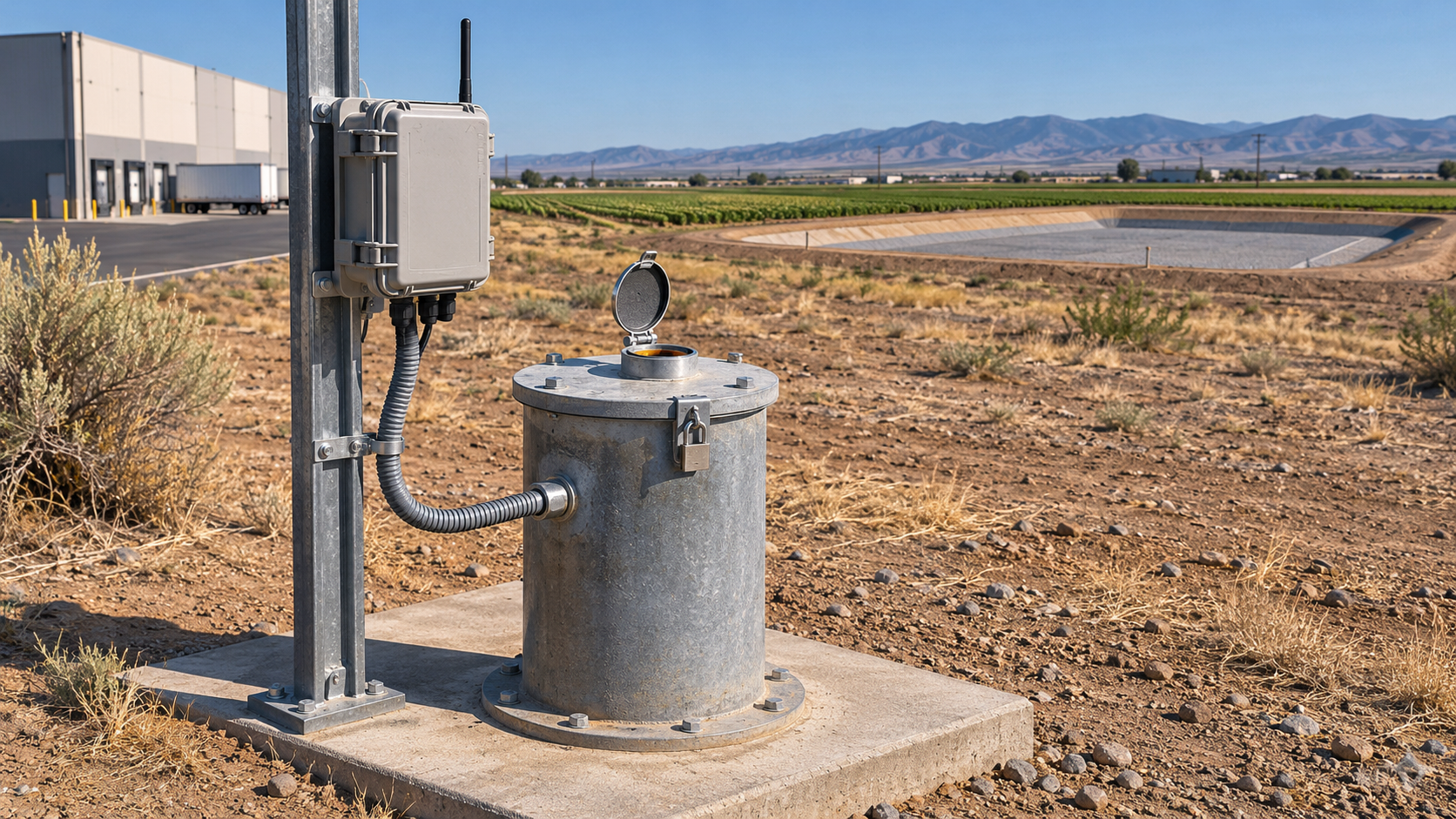
Groundwater monitoring is becoming a more important commercial capability as asset owners, regulators and water users need better evidence about what is happening below ground. The opportunity is not simply to drill a borehole or collect a sample. It is to design a reliable monitoring system, maintain it, interpret the data and connect it to a decision.
For private investors, that distinction matters. A groundwater monitoring company may earn from site assessment, well design, installation, sampling, laboratory coordination, telemetry, data management or recurring compliance support. The investable question is whether those activities form a repeatable, defensible service with acceptable field costs and credible renewal economics.
Why groundwater monitoring is a commercial category
Groundwater is stored below the water table in geological strata. It can support abstractions, springs, rivers and groundwater-dependent ecosystems, while also being exposed to pollution from activities at the surface. The Environment Agency’s overview of groundwater protection describes the practical need to understand both groundwater quality and quantity before deciding what permissions or controls an activity needs.
That creates a customer problem with several layers. An operator may need to demonstrate that a discharge is not degrading an aquifer. A developer may need baseline information before construction. An industrial site may need to identify a change in water level or chemistry before it becomes a larger operational, environmental or remediation issue.
Measurement becomes evidence
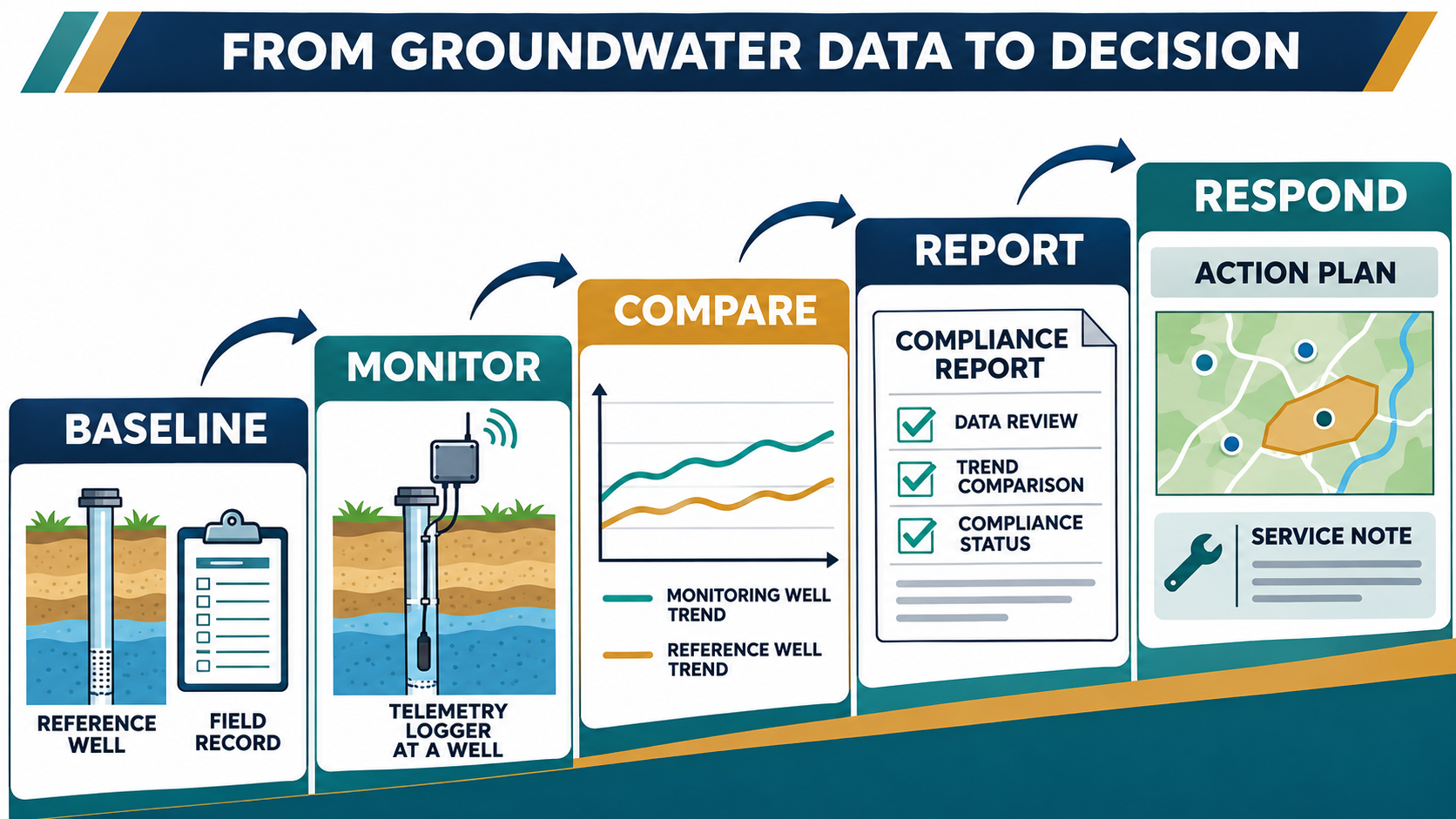
A monitoring service turns field observations into a record that can be reviewed, compared and acted upon. The value is higher when the system explains where the measurement came from, how it was collected, whether the well and instruments were suitable, and what uncertainty remains.
The buyer pays for reduced uncertainty
The buyer is rarely paying for a number in isolation. They are paying for a better basis for permitting, asset management, site remediation, abstraction planning or environmental reporting. That supports a commercial model in which the physical monitoring point is the entry product and trusted evidence is the higher-value service.
What groundwater monitoring actually measures
Groundwater monitoring can include water levels, water quality and the context needed to interpret changes. The right mix depends on the site, the aquifer, the potential source of impact and the decision the customer must make. A monitoring programme is therefore an application design exercise, not a generic sensor deployment.
Water levels and hydraulic behaviour
Water-level observations help show how an aquifer responds to recharge, abstraction, seasonal conditions and nearby activity. A groundwater level is useful only when its location, depth, timing and reference point are known. Long-term records can support trend analysis, but recent data may still be provisional or require review.
The US Geological Survey’s National Ground-Water Monitoring Network brings together selected wells from federal, state and local networks. Its portal includes current and historical information on water levels, water quality, lithology and well construction. That combination illustrates why data structure and metadata matter alongside the measurement itself.
Quality and indicator parameters
Quality monitoring may cover parameters such as pH, electrical conductivity, temperature, salts or substances associated with a known source. The Environment Agency advises that parameters should be indicative of the pollutant and its expected impact. That is commercially important because a smaller, well-justified parameter set may be more practical than a broad test panel that creates unnecessary cost and noise.
Context makes data comparable
A result from one well is not automatically comparable with a result from another. Depth, screen position, sampling method, preservation, seasonality and the surrounding hydrogeology can affect interpretation. A provider that manages those variables can create more value than a provider that simply increases the number of readings.
Site design defines the value of the service
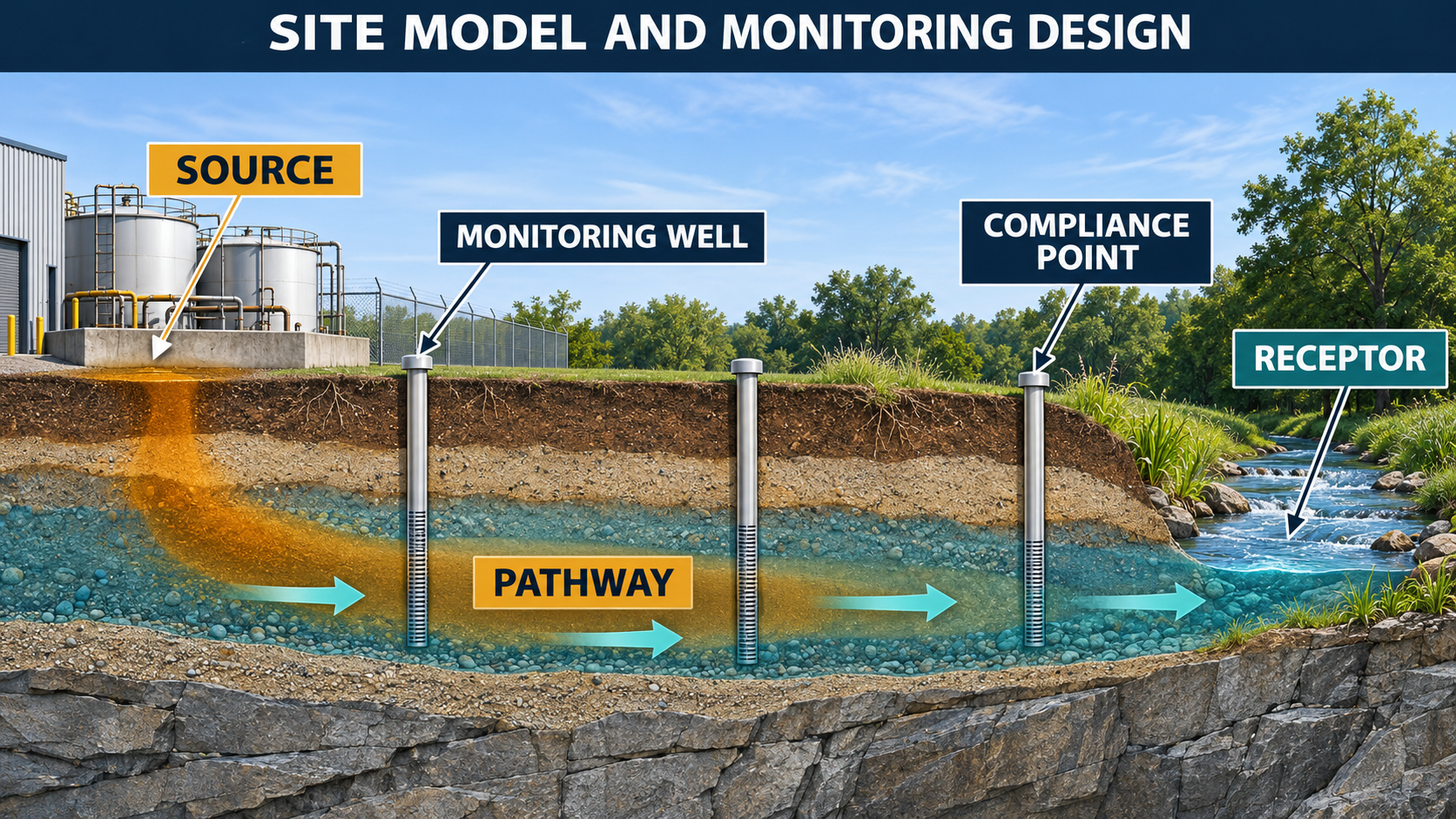
Groundwater monitoring starts with a conceptual model. In plain language, that means a structured view of the source, the pathway through the ground and the receptor that could be affected. The model determines which wells, depths, parameters and intervals are commercially useful.
Monitoring points must answer a question
The Environment Agency’s groundwater risk-assessment guidance says monitoring should be designed case by case around parameters, frequency and monitoring-point location. It also explains that background or up-gradient monitoring may be needed to compare conditions before an activity with later down-gradient results.
Well construction is part of product quality
The US EPA’s monitoring-wells guidance describes procedures and considerations for designing and installing wells used to collect groundwater samples. For an investor, this means installation quality is not a peripheral contractor issue. It can determine whether the data is representative, whether the site must be revisited and whether the customer can rely on the resulting record.
Geometry changes with hydrogeology
In one England risk-assessment pathway, the Environment Agency says that at least three monitoring points in a triangulation formation may be needed to define a hydraulic gradient. That is not a universal rule for every site. It is an example of how the commercial scope changes when the customer needs to understand direction of groundwater movement rather than simply observe one water level.
Who buys groundwater monitoring and why
Demand can come from several customer groups, but each has a different buying trigger and service expectation. Investors should avoid treating them as one market. A provider that serves environmental permits may have different sales cycles, evidence requirements and gross margins from one focused on abstraction management or industrial site operations.
Permitted operators
Where an activity could affect groundwater, an environmental permit may specify how often monitoring is required, what data must be collected and how it should be stored. The Environment Agency may also request monitoring data during inspections or at regular intervals. This can create recurring demand, although the provider must still prove that the service is reliable and properly scoped.
Developers and infrastructure owners
Construction, land redevelopment and infrastructure projects can require baseline information, risk assessment and ongoing observation. Customers may value a provider that can combine desk study, field work, data management and reporting rather than coordinate several disconnected suppliers.
Industrial and resource users
Industrial sites, waste operators, agricultural businesses and abstraction users may need to understand groundwater quantity or quality around an operating asset. The relevant commercial outcome might be earlier detection, more defensible reporting, better operational planning or lower risk of an avoidable site investigation.
How groundwater monitoring companies make money
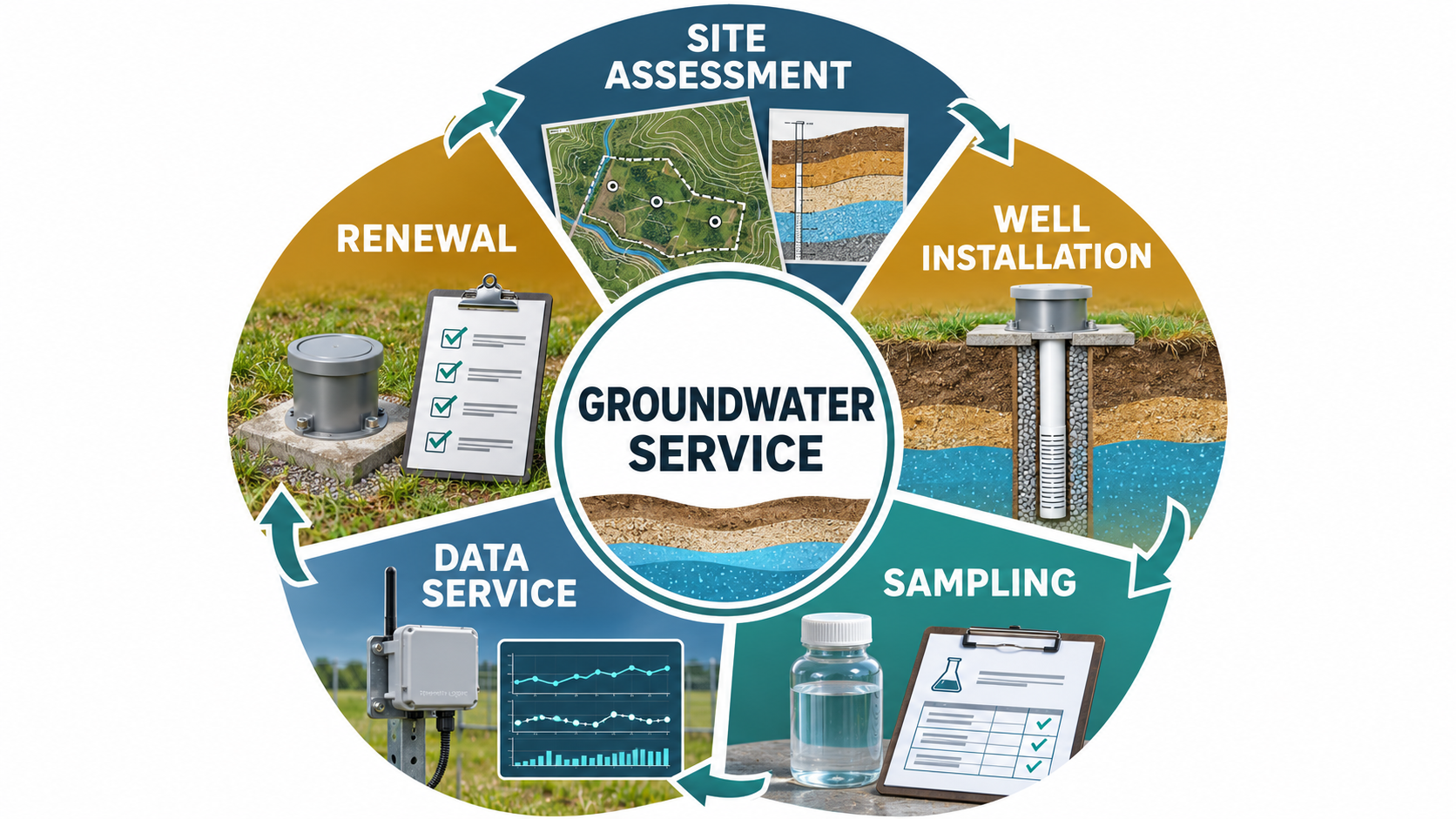
The revenue model can range from project work to recurring services. An investor should map revenue to the customer lifecycle rather than assume that every monitoring contract is subscription-like. A company may have attractive recurring data revenue but still carry a high field-service burden that limits contribution margin.
Site assessment and design
Early work may include reviewing existing records, defining the conceptual model, selecting monitoring points and setting a sampling or telemetry plan. This work can be commercially valuable because it shapes later installation and service scope. It also requires staff with credible hydrogeological and regulatory understanding.
Installation and commissioning
Well installation, development, instrument fitting and commissioning can create a meaningful project invoice. Investors should separate pass-through drilling or laboratory costs from the company’s own value-added revenue. The quality of this distinction affects gross-margin analysis and the credibility of any scale narrative.
Sampling and laboratory coordination
Sampling may be performed at defined intervals and require preservation, transport and analysis. The provider may coordinate accredited laboratories, manage chain-of-custody records and return a structured report. The key question is whether the company controls a repeatable workflow or simply resells third-party capacity.
Telemetry and data services
Remote data services can make a monitoring network easier to review between site visits. The USGS network demonstrates the value of combining historical and current groundwater information with well and construction metadata. For a private provider, the commercial test is whether customers pay for usable monitoring information, alerts and reporting rather than only for access to a dashboard.
Renewal and remediation support
Renewal can include routine sampling, instrument maintenance, well rehabilitation, data review, permit reporting or additional investigation. These services may support customer retention, but they also add travel, scheduling and safety costs. A strong renewal rate without a clear cost-to-serve view is not enough for investment confidence.
Field service and data quality shape margins
Groundwater monitoring businesses are often operationally heavier than their software language suggests. Wells may be remote, access may be seasonal, and each site can have different geology, depths, contaminants and reporting requirements. Investors should therefore review field productivity and data quality together.
Travel and access cost
Revenue per monitoring point can look attractive until travel, permits, equipment transport and repeat visits are included. Review route density, average site time, failed visits, subcontractor use and the proportion of work that can be performed remotely. These measures help distinguish a scalable network from a collection of bespoke projects.
Quality assurance is a commercial asset
Data quality includes well identification, sampling records, instrument checks, laboratory results, timestamps and review history. The company should be able to explain how it detects missing, inconsistent or implausible observations. Better quality control can reduce rework and strengthen customer trust, but it also has a cost that must be reflected in pricing.
Maintenance can protect renewal
Monitoring systems need maintenance of wells, pumps, loggers, telemetry and data workflows. A provider that documents service intervals and failure modes can forecast its installed-base burden more credibly. Investors should ask whether the renewal price covers the actual maintenance package or whether margin is being protected by under-servicing the asset.
Regulation and evidence create demand, not guaranteed revenue
Regulatory frameworks can create a reason to monitor, but they do not guarantee that a particular supplier will win work. In England, the Environment Agency states that permit conditions may define monitoring frequency, data type and storage, while the required level depends on discharge, environmental sensitivity and the risk assessment.
At European level, the European Environment Agency describes groundwater management through chemical and quantitative status. The framework seeks to prevent hazardous substances entering groundwater, limit other pollutants and avoid reducing available groundwater through abstraction. It also highlights the need to avoid impacts on linked surface water and groundwater-dependent ecosystems.
Scope matters more than the word compliance
A sales deck may describe a service as compliance monitoring, but the investor needs to identify the exact obligation, customer, geography and data acceptance process. England-specific guidance does not automatically describe requirements in Scotland, Wales, Northern Ireland, Europe or the GCC. Regional expansion requires local regulatory mapping and a delivery model that can handle different standards.
Evidence must survive scrutiny
Customers may need to explain how a result was obtained, stored and interpreted. A company with clear records, repeatable field procedures and transparent reporting can be better positioned than a low-cost provider that produces data without a durable evidence trail.
From pilot site to repeatable installed base
Scaling groundwater monitoring is not only a sales exercise. The company must repeat site assessment, well selection, installation, sampling, data review and reporting while adapting to real hydrogeological differences. Standardisation helps, but pretending that every site is identical creates technical and commercial risk.
Standard kits reduce avoidable variation
Reusable field checklists, instrument packages, reporting templates and data schemas can reduce training and rework. The standard kit should still have controlled options for well depth, sample requirements, telemetry and access. Investors should ask how often the company departs from its standard configuration and why.
Data architecture can improve retention
A customer is more likely to renew when historical data remains accessible, comparable and useful for the next permit cycle or site decision. The USGS National Ground-Water Monitoring Network shows how data can be organised across dispersed wells and providers. A private company does not need to replicate that network, but it should demonstrate that its data model can support an expanding installed base.
Partnerships extend reach with trade-offs
Drillers, laboratories, environmental consultants and telemetry partners can expand capacity. They can also create dependency, inconsistent quality or margin leakage. Diligence should identify which customer relationships, methods, data and service processes remain under the company’s control.
Investment thesis at a glance
| Investment lens | Evidence to request | Principal risk |
|---|---|---|
| Customer demand | Named use cases, buying triggers and repeat order history | Project work is mistaken for recurring demand |
| Technical fit | Well design logic, parameter selection and data-quality procedures | Measurements cannot answer the customer’s question |
| Revenue quality | Mix of assessment, installation, sampling, data and renewal income | Pass-through costs obscure true margin |
| Operational scale | Field productivity, route density, subcontractor controls and rework | Growth increases service cost faster than revenue |
| Defensibility | Customer data history, workflows, expertise and regulatory credibility | Customers can switch to a generalist provider |
The table is a diligence frame, not a forecast. The quality of an opportunity depends on verified company evidence, not on the existence of a regulatory theme or a large number of potential monitoring points.
Investor diligence questions
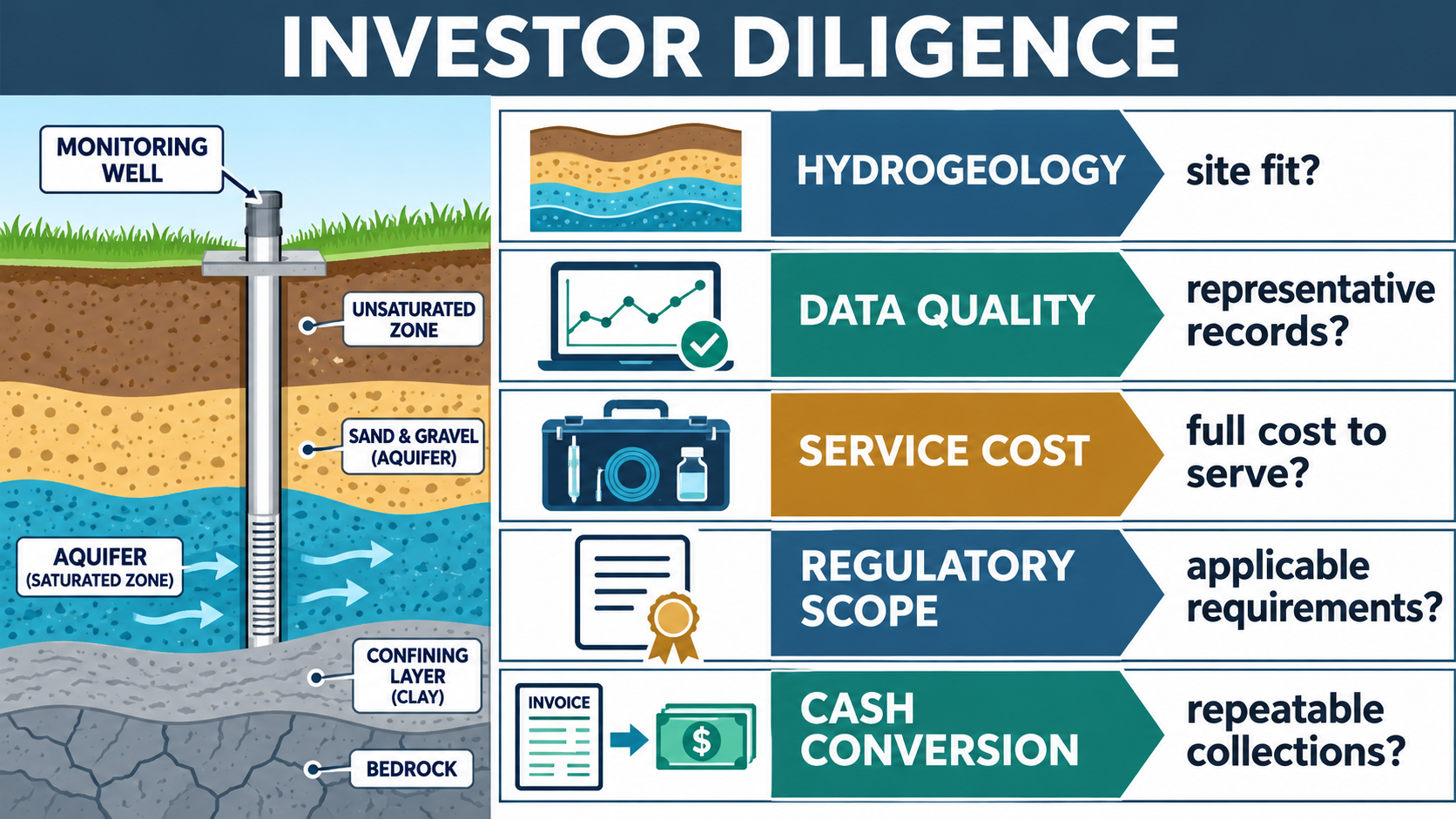
Which customer decision does the service improve?
Ask the company to connect each monitoring package to a customer decision. Is the service supporting a permit, a baseline, an abstraction plan, an investigation, an asset-protection programme or an operational response? Vague claims about insight are less useful than a documented workflow from observation to action.
How representative and repeatable is the data?
Request well files, location logic, screen depths, sampling procedures, laboratory controls, telemetry records and examples of data review. The aim is not to demand one universal method. It is to understand whether the company can defend the method used at each site.
What is the complete cost to serve?
Review drilling or installation subcontractors, travel, equipment, laboratory charges, data hosting, customer support and repeat visits. Separate one-off mobilisation costs from recurring service costs. Then test whether the current price and renewal assumptions cover the full operating burden.
Who owns the customer relationship and the evidence?
A monitoring company may be one supplier inside a consultant-led project. That can be a useful channel, but it may weaken pricing power and customer ownership. Review contracts, data rights, renewal responsibility, referral concentration and the practical ability to move from a project to a long-term relationship.
Can quality and regulatory scope scale?
Ask how the business handles changes in standards, new parameters, different aquifers and new regions. The company should distinguish methods that are repeatable from judgements that require scarce specialist staff. Growth without quality controls can increase both liability and rework.
Frequently asked questions
What is groundwater monitoring?
Groundwater monitoring is the planned observation and analysis of groundwater levels, quality or related conditions at defined locations and intervals. It can support permitting, resource management, investigations and asset decisions.
Why do companies pay for groundwater monitoring?
Companies pay for monitoring when they need evidence about a potential environmental impact, abstraction, baseline condition, permit obligation or operational risk. The value depends on how clearly the data supports a decision.
Is groundwater monitoring a recurring service?
It can be. Sampling, telemetry, data review, reporting, maintenance and permit support may recur, but the revenue mix should be checked because some work remains project-based.
What is the main commercial risk?
The main risk is that technically valid monitoring does not produce enough customer value to support renewal. Other risks include field cost, poor well design, inconsistent data, subcontractor dependency and changing regulatory scope.
What should an investor request first?
Start with the customer map, monitoring-point rationale, sample and data-quality procedures, revenue mix, full cost to serve, renewal record, customer concentration and evidence that the operating model works across more than one site type.
Conclusion: value the evidence system, not only the well
Groundwater monitoring can be an attractive water-technology and environmental-services category when it links a physical monitoring network to a decision customers must make. The strongest businesses are likely to combine credible site design, reliable field execution, disciplined data management and a service model that customers can renew.
For eligible investors assessing direct private-company opportunities, compare application fit, data quality, revenue quality, field burden, regulatory scope and the pathway from one site to a repeatable installed base. Review the Water Investment Network portfolio context, then request an introduction to the network if the opportunity fits your mandate. Water Investment Network does not provide regulated financial advice or guarantee investment returns.
For broader context, visit Water Investment Network and explore the smart water monitoring investment theme.
Sources
- Environment Agency, Groundwater risk assessment for your environmental permit.
- Environment Agency, Protect groundwater and prevent groundwater pollution.
- US EPA, Design and Installation of Monitoring Wells Guidance.
- US Geological Survey, National Ground-Water Monitoring Network.
- European Environment Agency, Groundwater quantitative and chemical status.