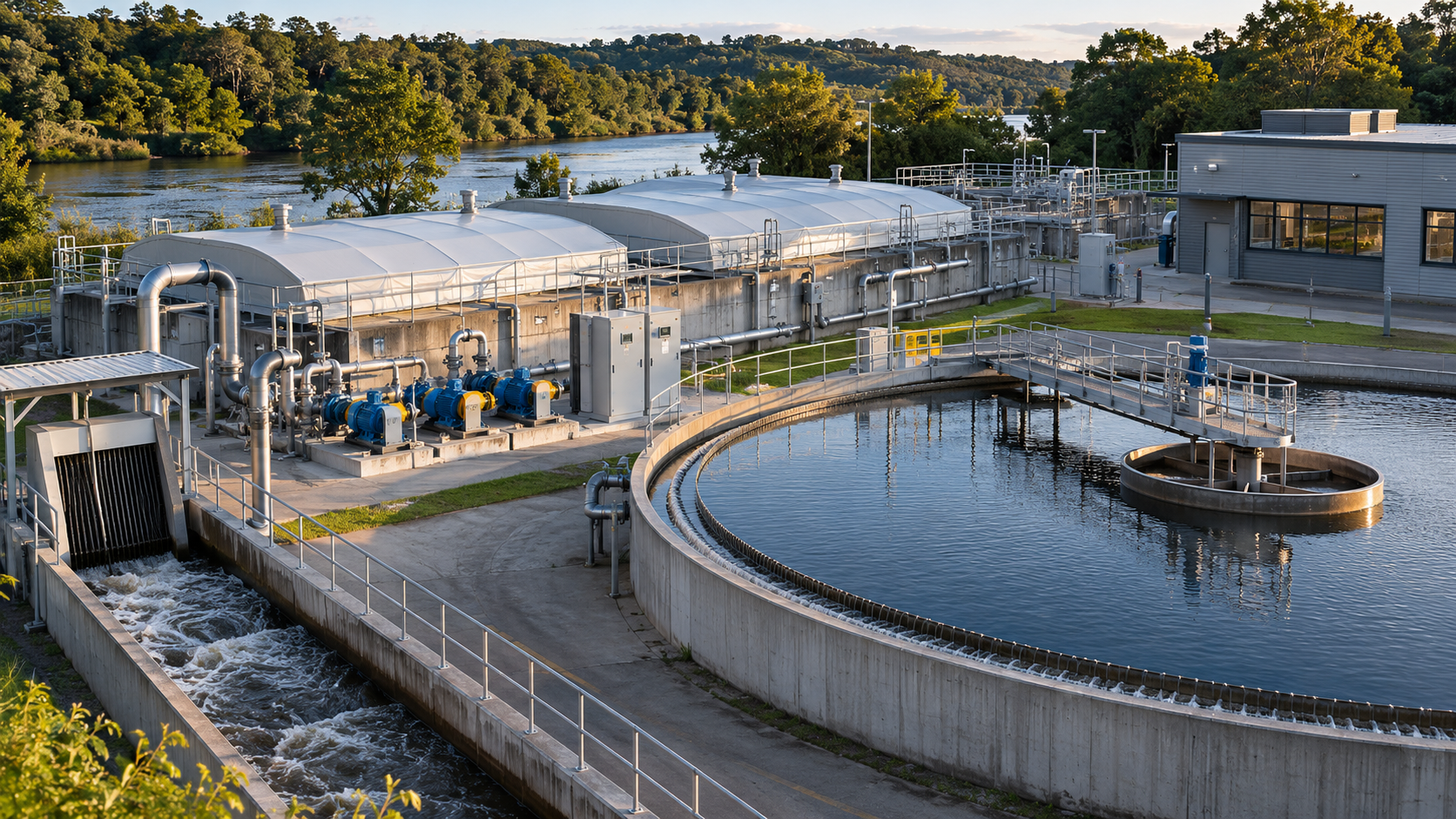
Smart wastewater management is becoming an investable operating theme because sewer and treatment systems are under pressure from ageing assets, heavy rainfall, tighter monitoring and rising treatment complexity.
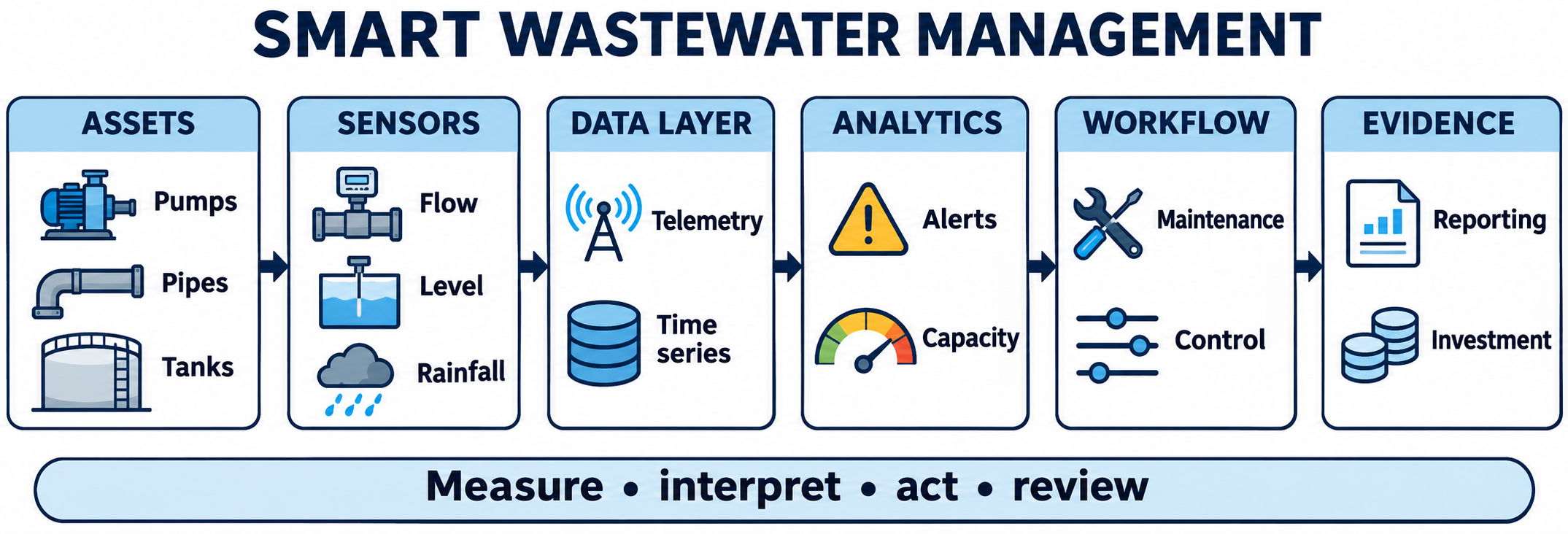
The term covers the connected use of sensors, telemetry, software, models, controls and maintenance workflows across wastewater networks and treatment works. It does not describe one product. It describes a way to turn operating data into decisions about flow, capacity, treatment, maintenance, compliance and capital planning.
The commercial question is more specific. Can a supplier help a utility or industrial customer make a better decision often enough to justify implementation, recurring support and expansion? Investors should follow the chain from measured problem to customer action, from customer action to economic value, and from one deployment to repeatable revenue. For related context, see the Water Investment Network guide to smart water monitoring investment.
Smart wastewater management is a decision system, not a dashboard
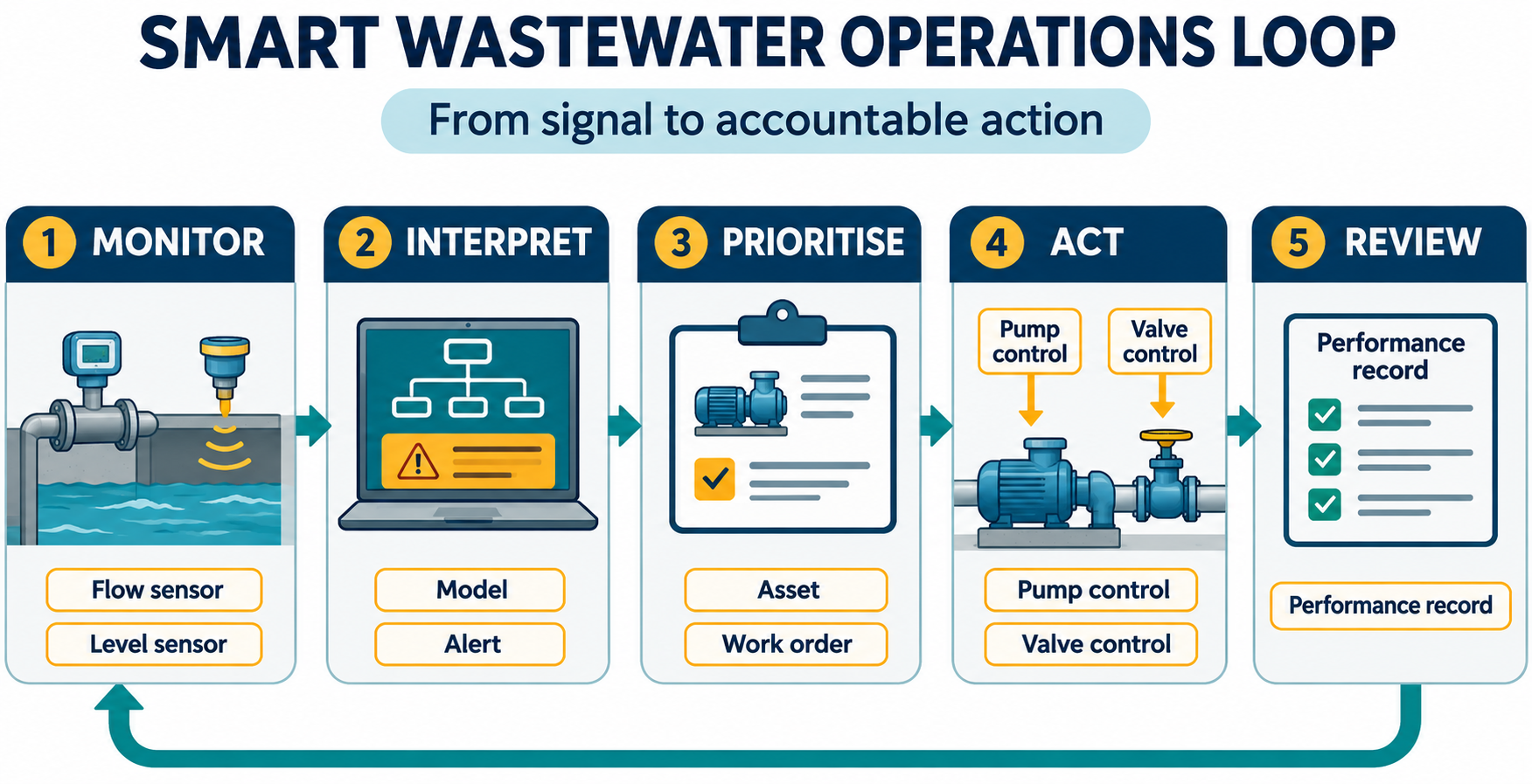
A dashboard presents information. Smart wastewater management connects information to a defined operational task. That task may be spotting abnormal flow, prioritising inspection, routing wet-weather capacity, planning maintenance or testing a catchment intervention.
What the system combines
A typical system combines field devices, communications, data storage, analytics and an operating process. Sensors may record flow, level, rainfall, pump status, pressure, energy use or treatment quality. The data then moves into a central platform or an existing supervisory control and data acquisition system.
Software may compare current conditions with a baseline, model a catchment, identify a likely failure or recommend an action. The final value depends on what the operator does next. A technically strong alert that is not trusted, assigned or acted upon has limited commercial value.
Why the distinction matters for diligence
Different suppliers can use similar language for a reporting tool, a real-time decision support system, a control layer or an asset-management platform. Their integration effort, liability, renewal potential and margin profile can be very different.
Investors should ask whether the product owns a recurring workflow. A company that links monitoring to work orders, maintenance plans, capital decisions or compliance evidence may sit deeper in the customer process than a company that only displays data.
Why wastewater buyers are adopting smarter operations
Demand is developing from several directions at once. Utilities need to improve performance from existing infrastructure. Regulators need stronger evidence. Customers need resilience during wet weather. Industrial sites need reliable treatment and lower operating risk.
Regulation is raising the value of usable data
The revised European Urban Wastewater Treatment Directive entered into force on 1 January 2025. The European Commission says it expands treatment and monitoring requirements, including new pollutants, health parameters, energy performance and circularity. It also requires monitoring data to be collected and made available for implementation reporting. The Commission overview sets out these objectives and reporting requirements.
The Commission also says digital databases will support reporting under the revised rules. That does not mean every utility will buy the same software. It does mean that data quality, traceability and interoperability can become part of the purchasing conversation.
Stormwater creates a live operational problem
Wet-weather events expose the limits of sewer capacity, pumping stations, storage and treatment works. The US Environmental Protection Agency groups smart sewer tools into asset management, system monitoring and operations, and system condition and capacity tools. It describes sensors, decision support, automated controls and performance models as parts of a broader system. EPA’s smart sewer technology guide provides that framework.
In England, GOV.UK guidance says event duration monitoring data is used to inform regulation, investment programmes and investigations. Water and sewerage companies must maintain records and publish storm-overflow information in near real time from 1 January 2025. The storm-overflow policy and guidance explains this data and reporting context.
Operational pressure can be more durable than a technology cycle
A technology label may change. The need to reduce overflows, protect treatment capacity, keep pumps available and justify capital work is more durable. This is why investors should test the customer problem before they test the product category.
Investment thesis at a glance
| Investment question | Evidence to seek | Risk to test |
|---|---|---|
| Customer demand | A named operational or compliance decision with a budget owner | A pilot without a route to procurement |
| Product value | Improved availability, planning, treatment, reporting or maintenance | Benefits described without a baseline |
| Revenue quality | Implementation followed by support, data services or more sites | Beside-the-point consultancy presented as software revenue |
| Defensibility | Connectors, workflows, validated models and customer trust | Replacement by an internal team or generic platform |
| Scale | Reusable deployment patterns with controlled site configuration | Every site needing bespoke engineering |
What could create value
Value may come from fewer emergency interventions, better use of storage, earlier maintenance, improved treatment performance, lower energy waste or more defensible investment choices. The actual benefit depends on the site, data quality, operating authority and counterfactual cost.
What could destroy value
Value can be lost through unreliable sensors, fragmented data, slow procurement, weak cyber controls, poor model calibration or unclear responsibility for action. A platform may also struggle if it needs deep access to systems that the customer cannot safely expose.
How to frame the opportunity
Frame the opportunity as infrastructure software combined with engineering and operational services. The central test is not whether wastewater is a large market. It is whether the company can convert a difficult operating problem into repeatable, paid work with improving unit economics.
What customers actually purchase
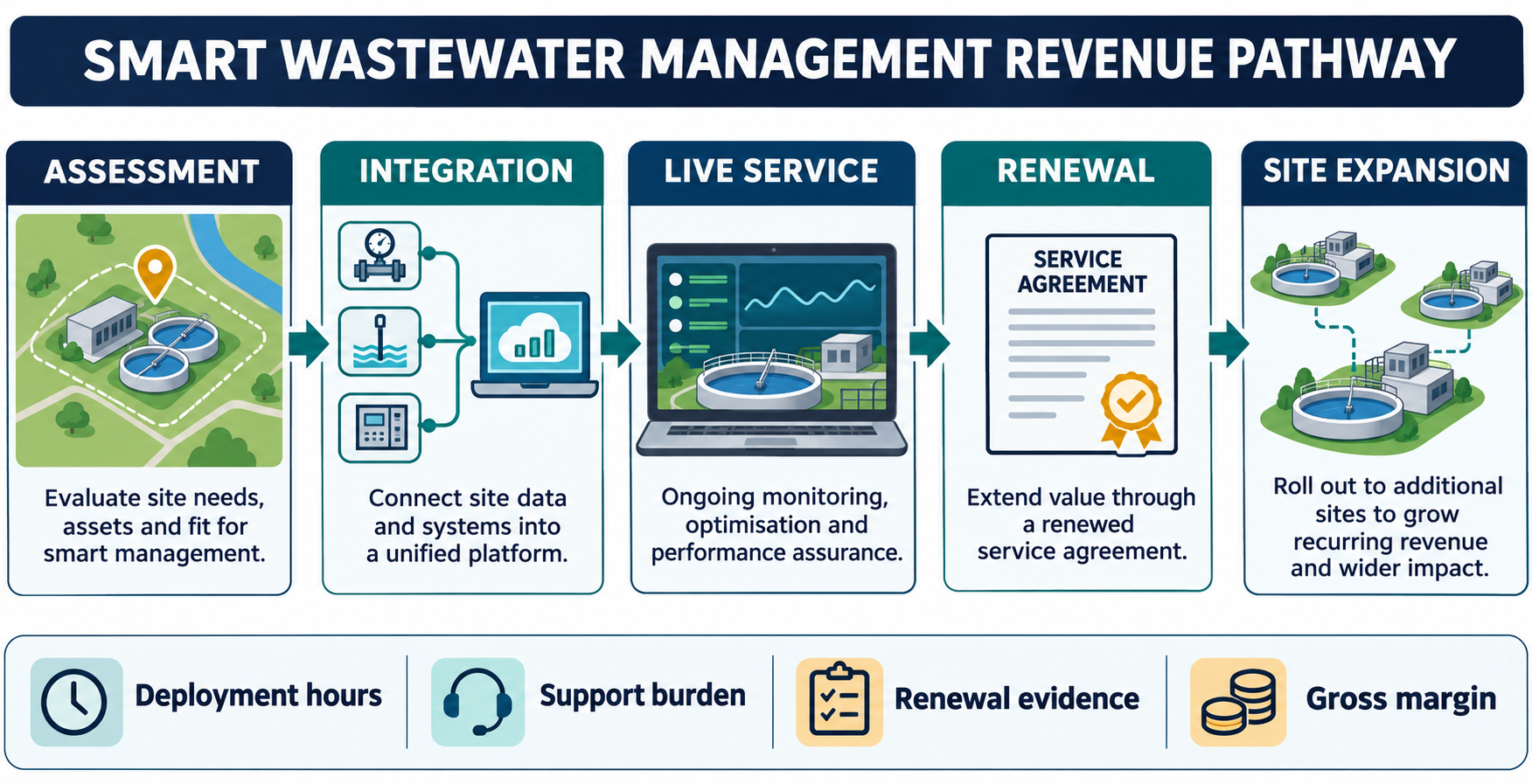
Customers rarely buy smart wastewater management as one isolated application. They buy a sequence that makes data useful inside an existing network, plant, control room and governance process.
Discovery and asset mapping
The first stage may map pumps, sewers, tanks, overflow points, treatment units, control systems, records and existing models. It should define the decisions that matter and the data needed to support them.
This stage is commercially important because it exposes deployment cost. A site with reliable tags and historical data may move quickly. A site with missing time series, inconsistent asset IDs or manual records may require more paid engineering before the software can create value.
Monitoring and integration
Monitoring may use existing instruments, new sensors or both. The supplier must connect field data to a secure data layer, establish ownership and define how exceptions are handled. The Environmental Protection Agency notes that smart sewer implementations are not necessarily off-the-shelf. Hardware, controls and software need to fit existing infrastructure and databases. Its smart sewers guidance makes the implementation and return-on-investment point explicit.
Decision support and workflow change
The buyer may then purchase alerts, forecasts, scenario analysis, maintenance prioritisation or control recommendations. The output should fit a real work queue. If an alert does not identify the asset, owner, urgency and evidence needed for action, the operational value may remain theoretical.
How smart wastewater management companies make money
The revenue model can combine project work and recurring services. Investors should separate these elements rather than treating every contract as subscription revenue.
Paid assessment and implementation
Initial revenue may come from a catchment assessment, sensor deployment, data integration, hydraulic model, treatment optimisation project or compliance data programme. These projects can create a customer relationship, but they may also be labour-intensive and site-specific.
Implementation revenue is strongest when it creates reusable assets. Examples include standard connectors, repeatable data models, tested deployment methods, documented control logic and a clear handover process.
Recurring software and data services
Recurring revenue may include platform access, monitoring, data storage, model updates, alerting, reporting, cyber support and managed operations analysis. The contract may be priced per site, asset, data stream, user or service level.
The pricing basis should match customer value and delivery cost. A low annual fee can look attractive but become unprofitable if every incident requires a senior engineer. A higher fee can still be weak if the customer can replace the tool with an existing platform.
Expansion across sites and use cases
Expansion can come from adding more assets, catchments, treatment works or use cases. A supplier may start with overflow monitoring, then add maintenance planning, capacity modelling or treatment performance.
Investors should ask whether the second site uses the same product or a new consulting project. The answer affects gross margin, implementation time, customer concentration and the capital needed to scale.
Where margins and unit economics are won
Margins depend on how much repeatable product the company has built and how much bespoke site work remains. The business may look like software from the outside while carrying substantial engineering, support and field-service cost.
Measure deployment effort honestly
Track the hours required for data mapping, installation, calibration, integration, testing, training and handover. Separate one-off implementation hours from recurring support hours. Without this split, a growing contract base can hide weak contribution margins.
Track data and support burden
Sensor faults, communications failures, drift and incomplete records create support work. Model updates and false alarms can also consume expert time. The supplier should know which incidents are included in the contract and which create additional billable work.
Look for reusable deployment assets
Reusable connectors, standard asset models, common dashboards, tested integration patterns and clear configuration tools can lower the cost of the next deployment. Reuse is not automatic. Each customer may have different tags, controls, data rights and procurement rules.
Test renewal against operating value
Renewal should relate to a continuing job. Ask whether the customer still needs monitoring, reporting, maintenance prioritisation, model recalibration or operational support after the first project is complete. A renewal based only on enthusiasm for a pilot is weak evidence.
The operating stack behind a useful system
Smart wastewater management is a stack of physical, digital and organisational components. The stack must work as one operating system for the customer.
Field layer
The field layer includes sensors, meters, pumps, valves, gates, actuators and local control equipment. Reliability, calibration, access and maintenance determine whether the data is useful. An inexpensive sensor that fails in difficult conditions can create more work than value.
Data and communications layer
This layer moves data from remote assets into storage and operational tools. It may include telemetry, gateways, time-series databases, asset identifiers and interfaces to existing systems. Data lineage matters because a regulator, operator or investor must be able to understand where a result came from.
Model and analytics layer
Analytics may detect anomalies, forecast flow, estimate capacity, prioritise maintenance or test scenarios. Hydraulic models and process models can be useful, but model scope and calibration must match the decision. A model that is accurate for one catchment or operating range may not transfer to another.
Workflow and governance layer
The final layer connects output to people, permissions, procedures and records. It defines who can act, who approves changes, how overrides are logged and how performance is reviewed. Cybersecurity and access controls are part of the operating model, not an optional feature.
Which customer segments can adopt first
Adoption is more likely where the cost of poor decisions is visible and the buyer already has operational data or a funded improvement programme.
Water and sewerage companies
Utilities have large asset bases, recurring monitoring needs and long planning cycles. A supplier can enter through a defined storm-overflow, pumping, capacity or maintenance problem. Procurement, assurance and integration requirements can lengthen the sales cycle, but a successful deployment may create a reference for wider adoption.
Industrial sites
Industrial customers may value treatment reliability, discharge compliance, water reuse, production continuity or energy control. The use case can be easier to quantify than a broad network programme, but site economics and process data can be highly specific.
Engineering and infrastructure partners
Engineering firms, asset managers and infrastructure operators may use software and data services inside larger programmes. This can accelerate access to customers, but investors should test margin sharing, ownership of the account and whether the supplier is visible in the renewal contract.
Public-sector and catchment programmes
Catchment and environmental programmes can create demand for integrated data and scenario analysis. World Bank Digital Water work describes assessments, roadmaps, training and tools as part of a utility’s digital journey. That institutional view supports staged adoption, but it is not evidence of a particular vendor’s revenue or returns.
Regulatory and data considerations
Regulation can create demand for better evidence, but it does not guarantee a commercial outcome for any supplier. The buyer must still choose a system that is reliable, auditable and proportionate to the site.
Monitoring quality is part of the product
GOV.UK’s MCERTS requirements say event duration monitoring systems need suitable installation, performance and management controls. The standard covers sensors, electronics, wiring, maintenance evidence and audit. The MCERTS guidance shows why data quality and assurance can become part of the commercial offer.
Digital tools support decisions, not legal responsibility
A platform can improve monitoring, investigation and reporting. It does not transfer the customer’s regulatory responsibility to the software supplier. Contracts should define data ownership, system boundaries, validation, human review, incident handling and audit access.
Regional rules change the buying case
The European framework and the English storm-overflow framework are not interchangeable. An investor should map the company’s target geographies, customer obligations and evidence requirements before treating a regulatory tailwind as transferable market demand.
Investor diligence questions
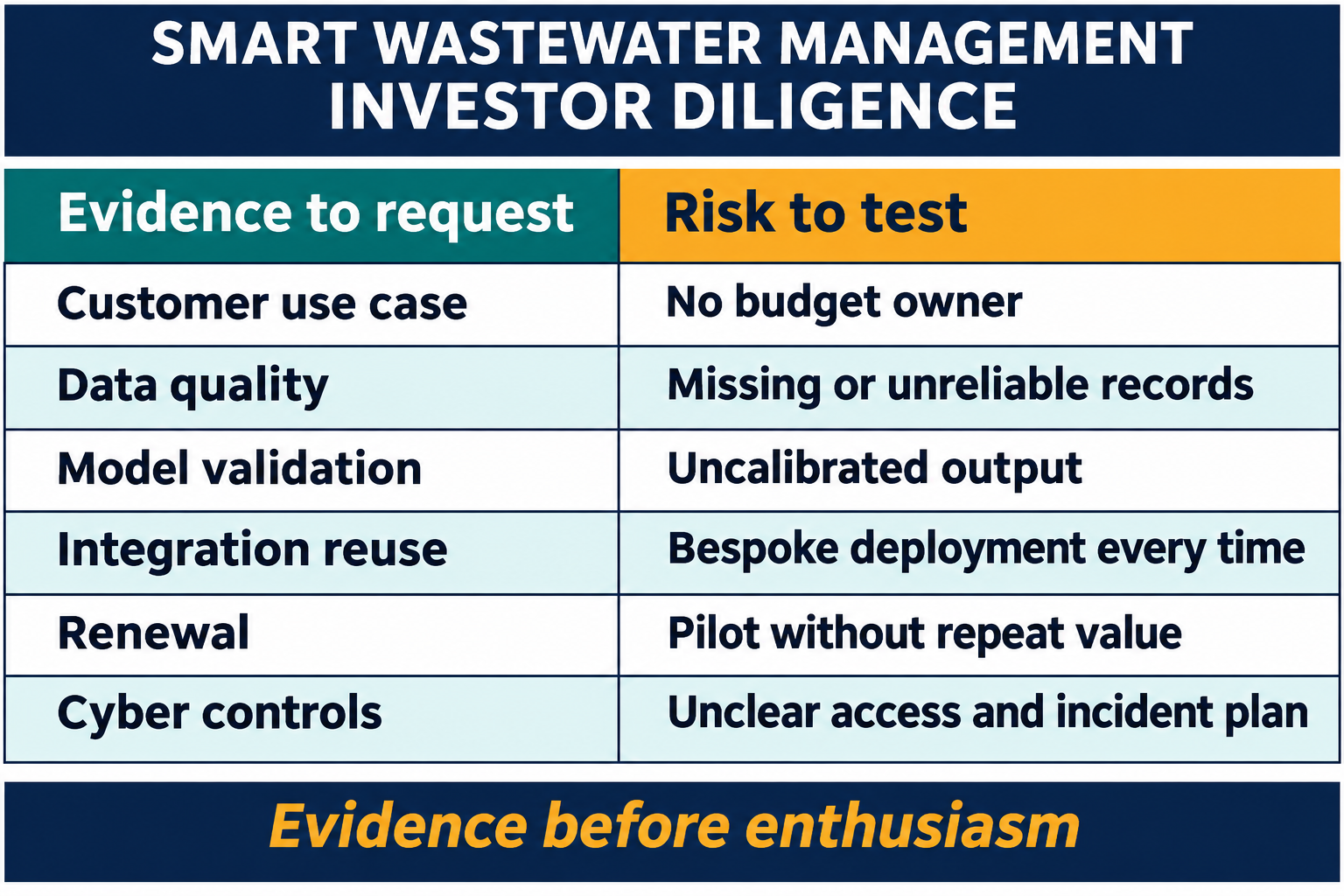
Diligence should test the operating system, not only the interface and customer logos.
Customer and use case
Which asset, decision or compliance obligation creates the budget? Who owns the problem? What changed after deployment? Ask for a baseline and a customer-approved measure of improvement.
Data access and quality
How many deployments have reliable live data? What happens when sensors drift or communications fail? Can the company show asset identifiers, time coverage, validation checks and ownership rights?
Model validation and transferability
Which models are mechanistic, statistical or hybrid? How are they calibrated? What evidence supports transfer to a new site? A model that works in one catchment may still require significant engineering elsewhere.
Integration and cyber controls
Which systems must connect before a customer can use the output? How are credentials, permissions, backups, incident response and change control managed? The implementation plan should identify dependencies before the contract is signed.
Revenue quality and renewal
What percentage of revenue is recurring? How much support is included? What is the gross-margin bridge from first deployment to later sites? Ask for renewal evidence, expansion revenue and customer concentration rather than relying on pipeline language.
Smart wastewater management FAQs and next steps
What is smart wastewater management?
Smart wastewater management is the connected use of monitoring, data, analytics, models, controls and workflows to improve wastewater network and treatment decisions. Its value depends on a defined customer action, not on the presence of a dashboard.
How is smart wastewater management different from wastewater monitoring?
Monitoring collects or displays information. Smart wastewater management adds interpretation, prioritisation and operational action. The difference may include alerts, forecasts, maintenance workflows, control decisions or evidence for investment and compliance.
Can smart wastewater management create recurring revenue?
It can create recurring revenue through platform access, monitoring, managed data services, reporting, model updates, support, training and additional sites. Investors should verify renewal, support burden and gross margin rather than assume that every digital contract is software revenue.
What should an investor request first?
Start with a named customer use case, the baseline problem, data access, deployment effort, model validation, integration dependencies, renewal history, cyber controls and a gross-margin bridge. Ask what changed in the customer’s decisions after deployment.
Is this article regulated investment advice?
No. This article is sector analysis for private-market research. It is not regulated investment advice, a recommendation, a forecast of returns or an offer to invest.
Investors assessing smart wastewater management opportunities can review the Water Investment Network portfolio for context, then join the network if they meet the network’s eligibility requirements. You can also review the Water Investment Network site before making contact.