
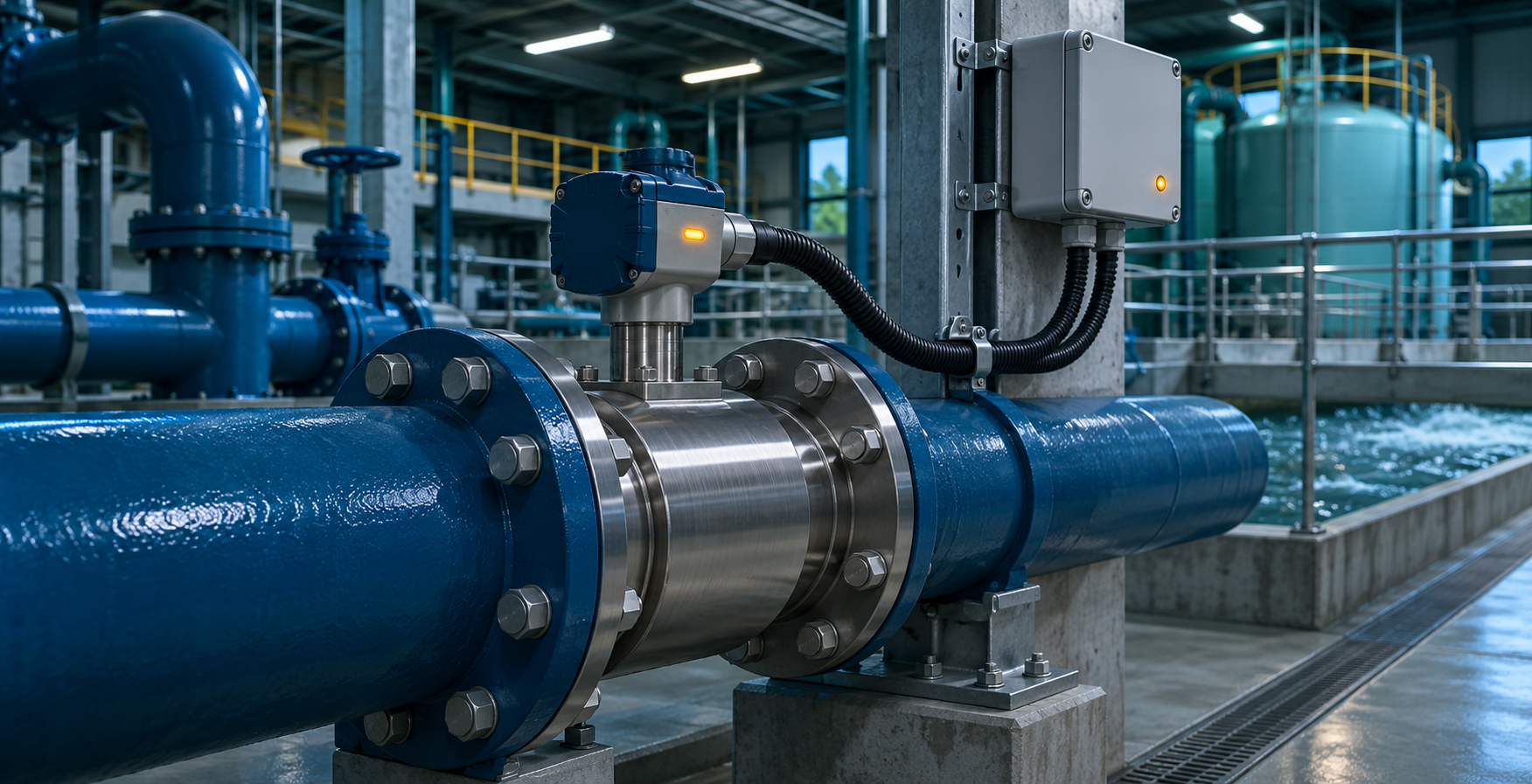
A smart water flow sensor is not simply a meter with a wireless connection. It is a measurement product, an installation, a data service and an operating workflow that must produce evidence a customer can use. For private investors, that difference is the starting point for diligence.
Demand can come from water utilities, industrial operators, treatment works, infrastructure owners, agriculture and environmental compliance teams. The commercial opportunity may include device sales, installation, commissioning, telemetry, data review and ongoing maintenance. The investment question is whether those activities form a repeatable service with defensible data quality and a credible cost-to-serve.
This article examines the smart water flow sensor market through that investor lens. It covers application fit, measurement methods, customer buying triggers, revenue models, field economics, standards and the questions that should be answered before capital is committed.
Why smart water flow sensors are a commercial category
Flow is a basic operating variable. It can influence how much water is abstracted, treated, discharged, stored, pumped or delivered. Yet the commercial value of a reading depends on whether the installation is suitable, the data is continuous enough for the decision and the record can be defended when an operator, regulator or asset owner reviews it.
The buyer is purchasing evidence
A customer rarely wants a number in isolation. They may need to reconcile inflow and outflow, detect a change in demand, monitor a treatment process, demonstrate permitted discharge volumes or understand how an asset behaves through different operating conditions. A smart water flow sensor becomes more valuable when it connects the measurement to a repeatable reporting or control process.
The Environment Agency’s MCERTS guidance applies to operators that must monitor liquid flow and collect and record results under environmental permits in England and Wales. It also highlights the role of certified flow-monitoring systems, installation suitability and the calculation of uncertainty in total daily volume. That creates a real buyer requirement, but not a guaranteed supplier or margin.
Hardware is the entry point, not the whole proposition
Hardware revenue can be attractive when a company has a differentiated device, a channel advantage or a defined application. It can also be competed away if specifications are easy to compare and the customer can source installation and data services separately. Investors should therefore identify what remains under the company’s control after the sensor is installed.
Potential sources of defensibility include application-specific installation knowledge, historical data, calibration workflows, integration with operational systems, regulatory documentation and a high renewal rate. Each claim needs evidence. A dashboard alone is not a moat if customers can export their data and replace the provider without operational disruption.
What a smart water flow sensor actually measures
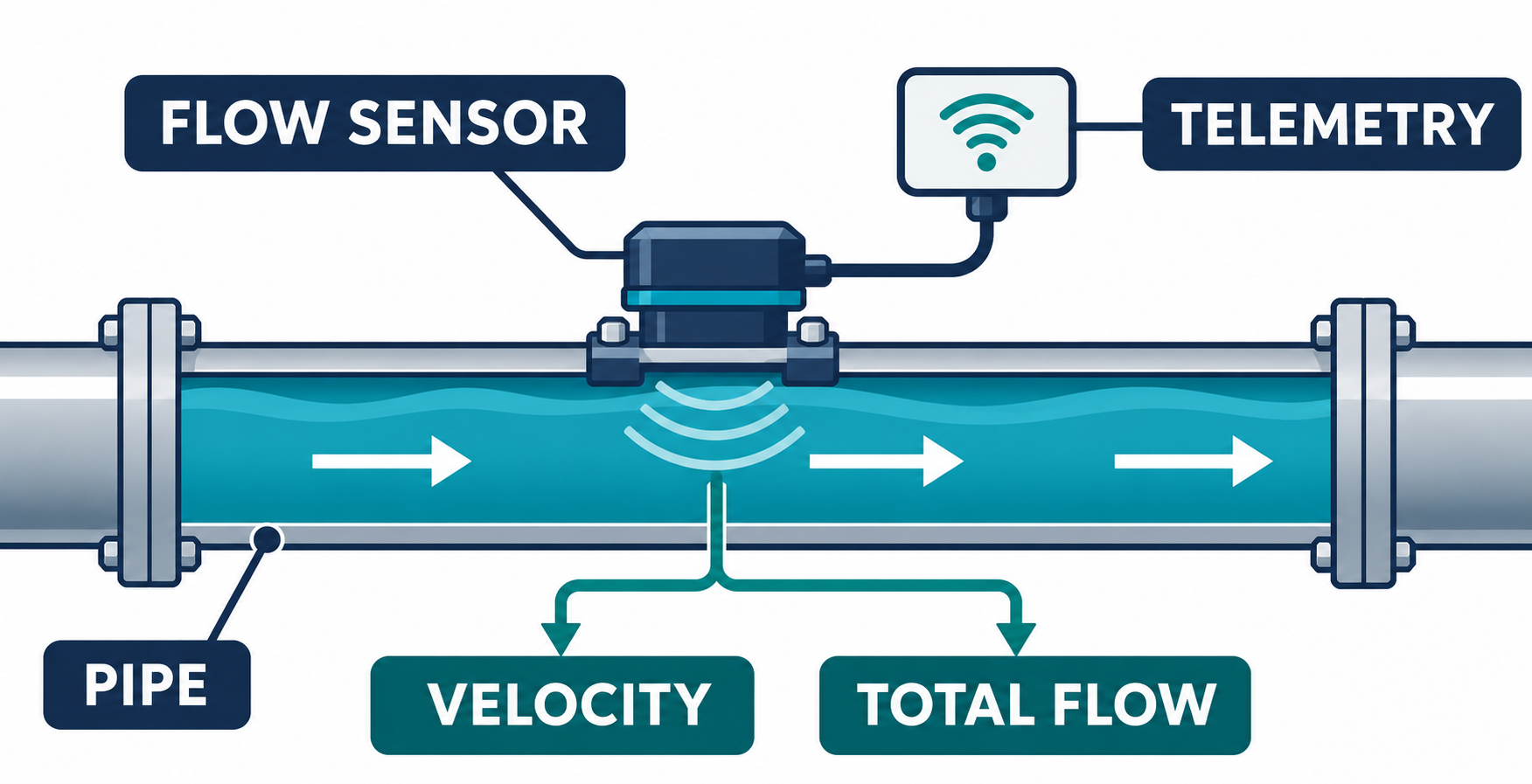
The phrase smart water flow sensor covers several technical arrangements. A device may measure velocity, water level, pressure or another variable and then calculate flow from pipe geometry or a site-specific relationship. Some systems measure in a closed conduit, while others are designed for open channels, partially filled pipes or surface-water sites.
Velocity, area and discharge
Flow rate is usually described as the volume passing a point over a period of time. In an open channel, discharge can be computed from cross-sectional area and average velocity. The U.S. Geological Survey explains that streamgages use stage, velocity and channel geometry, then apply a site-specific stage-discharge relationship to produce continuous flow estimates.
That principle matters commercially because a sensor does not remove the need for site knowledge. If the channel changes shape, debris affects the flow, a pipe runs partly full or backwater conditions occur, the relationship between a measured variable and the required output may change. A provider that understands those limits can price and service the system more credibly.
Common technology choices
Commercial systems include ultrasonic Doppler, acoustic Doppler, transit-time ultrasonic, electromagnetic, radar and level-based approaches. The U.S. Environmental Protection Agency’s smart data infrastructure guidance describes submerged and non-contacting flow monitoring technologies, including sensors that measure velocity at different layers or from above the water surface.
Technology selection should follow the application. A clamp-on ultrasonic product may reduce interruption to a pressurised pipe, while a submerged device may suit a sewer or open channel where installation access is available. A radar system may have maintenance advantages in some settings but can be more sensitive to surface conditions. The winning product is the one that produces a useful record at an acceptable total cost.
Smart means connected and reviewable
Connectivity can allow data to move from a remote site to a dashboard, control system or reporting workflow. The value of that connection depends on power availability, communications coverage, data intervals, storage, alert logic and the customer’s response process. A sensor that sends more data than the customer can validate may create noise instead of insight.
Application fit and installation geometry
Installation geometry is part of product quality. The position of the sensor, straight-run requirements, pipe diameter, flow profile, access, power and communications all affect the reliability of the delivered data. An investor reviewing a smart water flow sensor company should ask how often the business rejects a site, changes the specification or requires remedial work after commissioning.
Closed pipes and pressurised systems
In a closed pipe, the sensor must work with the internal diameter, lining, fluid characteristics and expected range of flow. The customer may value a system that can be installed without a long shutdown, but that convenience does not remove the need for commissioning and verification. A weak installation process can turn a scalable product into a high-rework service.
Open channels and partially filled conduits
Open-channel monitoring adds the effects of water level, channel shape, turbulence, sediment and changing flow conditions. The EPA guidance notes that level-to-flow estimation can depend on channel dimensions, slope and roughness, and may be invalid when the pipe is full, pressurised or affected by backwater. These limits should be explicit in customer contracts and sales material.
Site access and maintenance burden
A remote installation may be technically straightforward but commercially unattractive if every visit requires specialist access, traffic management, confined-space controls or a long journey. Review the installed base by geography, asset type and service frequency. A company with dense routes and remote diagnostics may have a better cost structure than one selling the same hardware into scattered sites.
The technical decision should also consider failure modes. Fouling, air entrainment, sediment, corrosion, signal interruption, battery depletion and physical damage can all produce missing or misleading data. A credible operating model explains how those events are detected and what response is included in the price.
Who buys smart water flow sensors and why
Customer groups may share a need for flow data but have different procurement processes, evidence standards and willingness to pay. Investors should separate the market by buying trigger rather than rely on a broad water-technology label.
Water and wastewater operators
Utilities and treatment operators may use flow data for network operations, process control, leakage investigation, energy management, permitted discharges and capital planning. They often require supplier assurance, integration capability, cybersecurity controls and a clear maintenance plan. Sales cycles can be long, but a successful installation may lead to additional sites or service contracts.
Industrial and commercial sites
Industrial sites can use flow measurement to manage water intensity, production inputs, wastewater volumes or internal allocation. The business case may depend on avoiding downtime, identifying a process loss or creating a credible environmental record. The provider needs to show how quickly the customer can move from a reading to an operating action.
Environmental and infrastructure programmes
Infrastructure owners, consultants and environmental teams may need temporary or permanent measurement at construction sites, catchments, abstraction points or discharge locations. Project work can create a route into a recurring service, but investors should test the conversion rate and the share of revenue that returns without a new tender.
Agriculture and distributed assets
Irrigation networks, reservoirs and distributed pumping assets can benefit from remote monitoring where water availability, energy use or allocation matters. These customers may value simple installation and low maintenance more than a feature-rich dashboard. Hardware durability, battery life and channel partnerships can be more important than software breadth.
How smart flow sensor companies make money
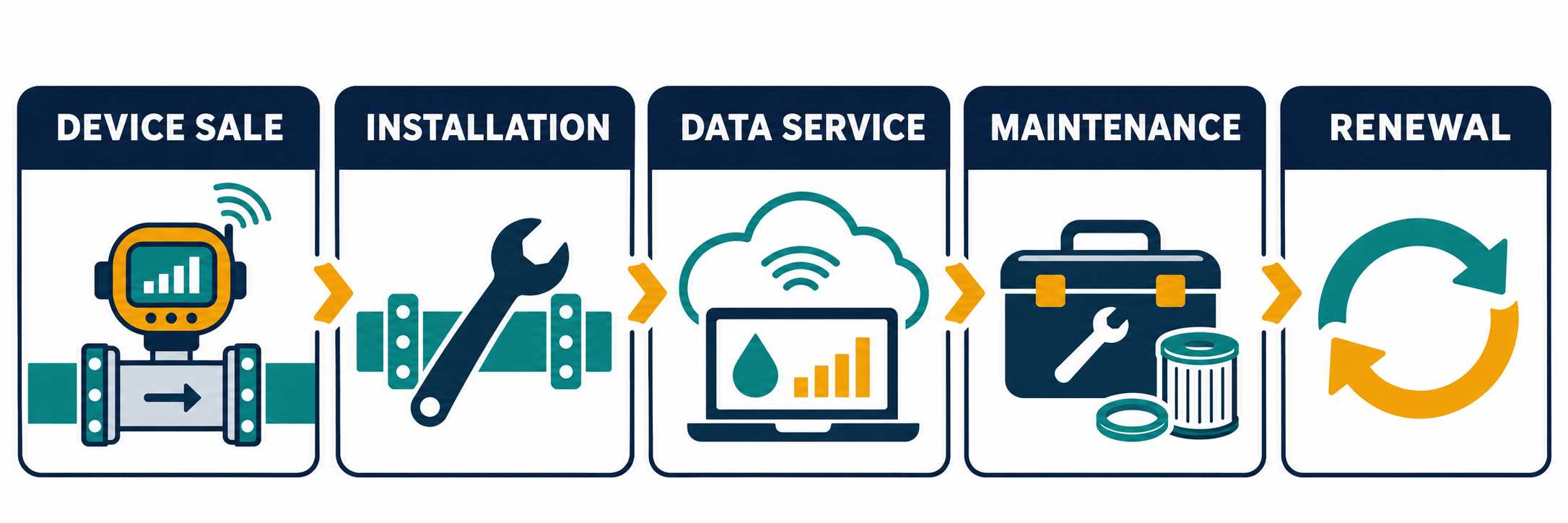
The revenue model should be mapped across the customer lifecycle. A company may report recurring revenue from data access while still carrying installation, support and replacement costs that behave like project labour. Investors should distinguish product revenue, installation revenue, pass-through items, software or data service revenue and renewal or maintenance income.
Device sale and channel margin
Device sales can create an efficient entry point if the product is specified early and distributors can serve a defined application. Review bill of materials, warranty claims, inventory turns, channel discounts and the risk of a component becoming obsolete. Gross margin should be assessed after returns, support and any required calibration.
Installation and commissioning
Installation can be a high-value service when the provider owns the application design, commissioning tests and handover documentation. It can also become a low-margin subcontracting activity if the company is simply coordinating third parties. Separate labour, travel and subcontractor costs from hardware margin when reviewing unit economics.
Data, alerts and reporting
Recurring data services may include hosting, telemetry, anomaly alerts, user access, integration, reporting and evidence packs. The buyer must be able to explain why the service remains useful after the initial deployment. Retention analysis should include usage, support tickets, alert quality and whether customers use the information in a recurring operational or compliance process.
Maintenance and replacement
Flow sensors operate in environments that can be wet, dirty, corrosive or difficult to access. Maintenance may include cleaning, recalibration, battery replacement, communications checks, inspection and remedial work. A service contract that excludes the actual failure modes may look attractive on paper but create renewal friction and margin pressure.
Calibration, uncertainty and data quality
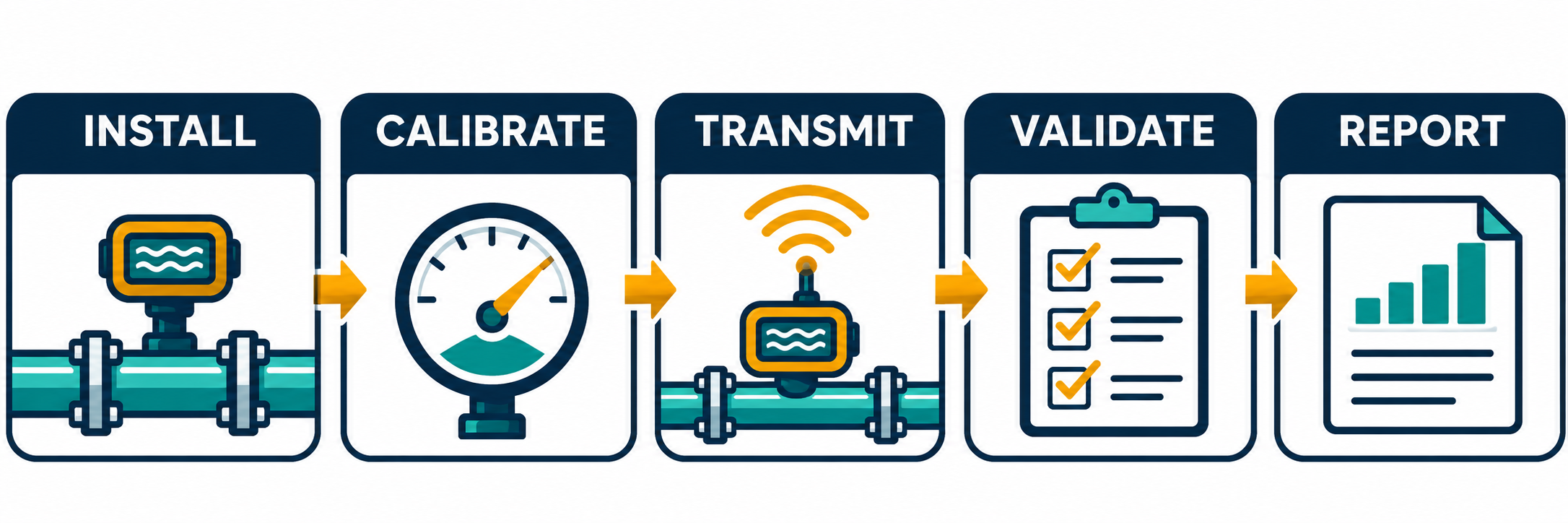
Data quality is the link between a technical product and a credible customer outcome. A smart water flow sensor can transmit a value without proving that the value is accurate enough for the decision. Calibration, verification, installation records, uncertainty and exception handling should therefore be part of the commercial review.
Accuracy is application-specific
The right accuracy depends on the use case. A directional operational alert may tolerate more uncertainty than a permitted total-volume record or a financial allocation between sites. The Environment Agency’s MCERTS material distinguishes performance classes and makes clear that suitability depends on the detailed conditions of the installation.
Uncertainty affects the revenue model
When uncertainty is transparent, customers can decide how to use the data. When it is hidden, a failed audit, disputed invoice or incorrect operating decision can create cost and reputational damage. Investors should ask how uncertainty is estimated, how it is communicated and whether a customer’s required tolerance drives a higher-priced configuration.
Review is as important as transmission
Data should be checked for missing intervals, impossible values, drift and changes in the operating context. The USGS notes that real-time streamflow data can be provisional and may be affected by conditions such as debris, sediment or equipment problems. A private provider should show how it flags provisional data and how the customer receives a corrected record.
Field productivity and rework
Quality controls have a cost. Review route density, average installation time, first-time commissioning success, repeat visits, service tickets and the percentage of records requiring manual intervention. These measures help distinguish a product-led model from a field-service business that is carrying hidden operational complexity.
Standards, certification and procurement
Standards can influence market access, procurement and liability, but the relevant framework depends on geography and application. The word certified should therefore be tested against the exact product, installation, body and use case.
UK environmental monitoring
The Environment Agency’s MCERTS standard provides minimum requirements for self-monitoring of liquid flow where environmental permits require operators to monitor and record results. The guidance covers management systems, flow-meter suitability, surveillance and uncertainty. A business selling into this market should know which elements it supplies and which remain the operator’s responsibility.
European measurement requirements
The European Commission explains that the Measuring Instruments Directive sets essential technical requirements for categories including water meters, with harmonised standards providing a presumption of conformity where applicable. The Commission also points to OIML references and notified-body assessment for instruments within scope.
This does not mean every smart water flow sensor is automatically covered by one European route. Product function, trade use, water-meter classification, national implementation and customer specification all matter. Investors should request the conformity assessment file, technical scope and market-by-market sales assumptions.
Procurement evidence
Utilities and industrial buyers may request cybersecurity information, environmental declarations, installation references, service-level commitments, spare-parts plans and data ownership terms. These requests can lengthen the sales cycle but also create switching friction once a supplier is approved. The company should show where the evidence is standardised and where it depends on scarce staff.
From pilot to repeatable installed base
A pilot proves that a sensor can work at one site. It does not prove that a company can deploy hundreds of sites at acceptable margins. Scale depends on repeatable configuration, trained installers, supply reliability, data operations and a commercial process that turns a successful pilot into a wider rollout.
Standard configurations with controlled exceptions
Standard device bundles, installation checklists, commissioning tests and reporting templates can reduce avoidable variation. The business still needs a controlled process for different pipe sizes, channel geometries, power arrangements and communications conditions. Investors should ask how often the company deviates from its standard configuration and whether the deviation is priced.
Integration and customer adoption
Data only creates value if it reaches the people and systems that act on it. The provider may need to integrate with a control room, maintenance system, data lake or compliance workflow. Adoption should be measured through repeat access, alert response, report delivery, site expansion and renewal, not only through the number of connected devices.
Supply chain and service capacity
Component availability, manufacturing partners, calibration equipment and specialist installers can all constrain growth. Map lead times and replacement routes. A company that depends on one supplier for a critical transducer or one engineer for commissioning may face a different risk profile from a company with documented alternatives and training capacity.
Retention and expansion
The installed base becomes more valuable when customers add sites, renew data services and accept maintenance packages. Review gross retention, net expansion, contract length, price changes, churn reasons and customer concentration. A strong deployment count with weak renewal may indicate that the product is being purchased as a one-off project component.
Investment thesis at a glance
| Investment lens | Evidence to request | Principal risk |
|---|---|---|
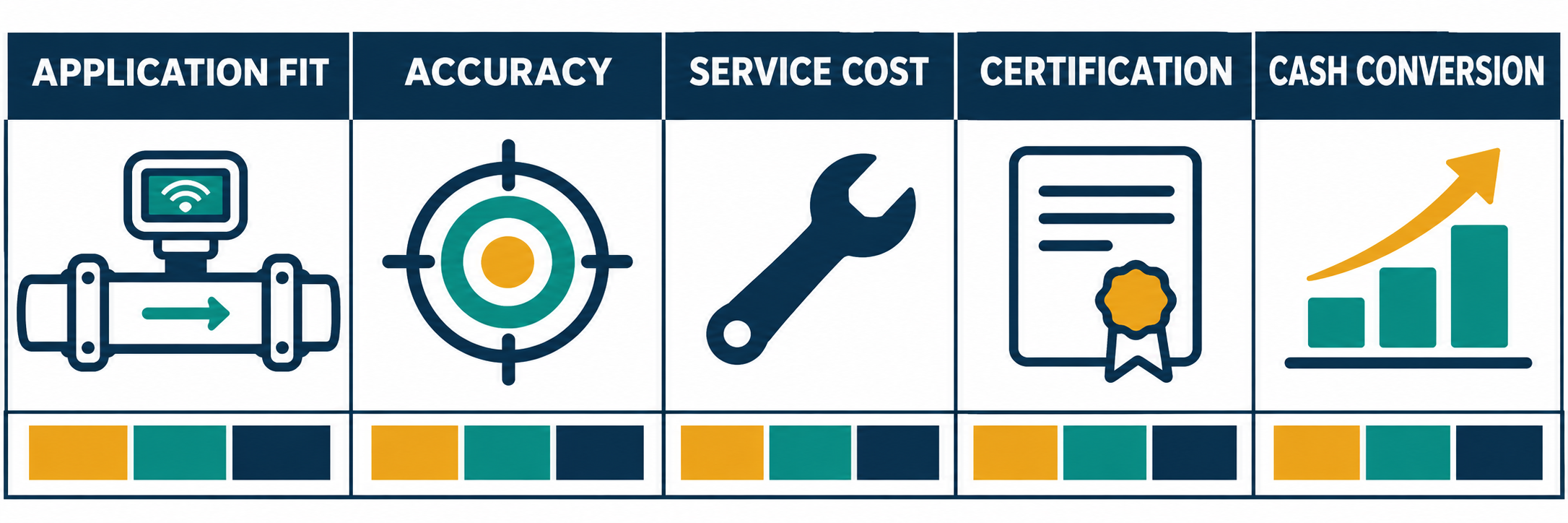
| Application fit | Site types, installation limits, accuracy requirements and rejection rate | One product is sold into unsuitable hydraulic conditions |
| Revenue quality | Device, installation, data, maintenance and renewal mix | Recurring language hides project labour or pass-through cost |
| Data quality | Calibration records, uncertainty method, exceptions and corrected data | Customers cannot rely on the record for operations or reporting |
| Operational scale | Installation time, route density, first-time success and service backlog | Growth increases field cost faster than revenue |
| Defensibility | Integrations, historical data, certification evidence and renewal behaviour | Hardware and dashboard features are easy to substitute |
This table is a diligence frame, not a forecast or a return claim. The investment case depends on verified company evidence, customer contracts, technical performance and the cost of delivering the service across the intended geography.
Investor diligence questions
Which customer decision does the sensor improve?
Ask the company to trace the path from flow reading to action. Is the sensor supporting treatment control, permitted discharge evidence, leakage investigation, water allocation, energy management or asset planning? The answer should identify the buyer, decision owner, frequency and consequence of a missing or unreliable record.
How does the product perform in difficult sites?
Request performance data by application, pipe or channel type, flow range, fouling condition and communications environment. A headline accuracy value is less useful than an explanation of the conditions under which it was measured and the controls used in the field.
What is the full cost to serve?
Review installation labour, access, traffic management, travel, calibration, battery replacement, data hosting, support and warranty work. Compare gross margin by product and service line. Then test whether the price of a renewal contract covers the maintenance burden created by the installed base.
Which standards and approvals matter?
Request certificates, conformity files, test reports, customer procurement requirements and the boundaries of each approval. Confirm whether a claim applies to the instrument, the complete metering system or the operating procedure. Expansion into the UK, Europe or the GCC should be supported by a country-specific evidence map.
Can cash conversion keep pace with deployment?
Hardware and installation growth can require inventory, subcontractor payments and delayed customer acceptance. Review contract terms, milestone billing, warranty provisions, working-capital swings and the time between commissioning and payment. A growing installed base is not automatically a cash-generating installed base.
Frequently asked questions
What is a smart water flow sensor?
A smart water flow sensor is a device and connected workflow that measures or calculates water flow and makes the resulting data available for monitoring, reporting or operational decisions. The system may include telemetry, software, installation, calibration and maintenance.
Why do customers buy smart water flow sensors?
Customers buy them to understand water movement, support process control, monitor permitted flows, investigate losses, improve asset visibility or create a more consistent evidence record. The value depends on application fit and the customer’s ability to act on the data.
Is a smart water flow sensor a recurring-revenue product?
It can support recurring revenue through data services, alerts, reporting, maintenance, calibration and replacement. The quality of that revenue depends on retention, usage, cost to serve and whether customers renew after the initial installation project.
What is the main risk for investors?
The main risk is that a technically valid sensor does not create enough customer value to support repeatable pricing and renewal. Other risks include unsuitable installations, uncertain data, field-service intensity, certification limits, supply-chain dependency and working-capital pressure.
What should an investor request first?
Start with the application map, customer use cases, installation and calibration procedures, revenue mix, full cost to serve, renewal record, certification evidence, customer concentration and proof that the operating model works across more than one site type.
For investors assessing the wider smart water opportunity, the approved smart water monitoring investment pillar provides the broader technology context. The Water Investment Network home page explains the network’s investor audience, while the portfolio and join the network pages provide the relevant next steps for suitable opportunities and advisers.
Sources
- Environment Agency, Minimum requirements for self-monitoring of flow: MCERTS performance standard
- U.S. Geological Survey, Streamgaging Basics
- U.S. Environmental Protection Agency, Smart Data Infrastructure for Wet Weather Control and Decision Support
- U.S. Environmental Protection Agency, Online Water Quality Monitoring Resources
- European Commission, Measuring and weighing instruments in the EU