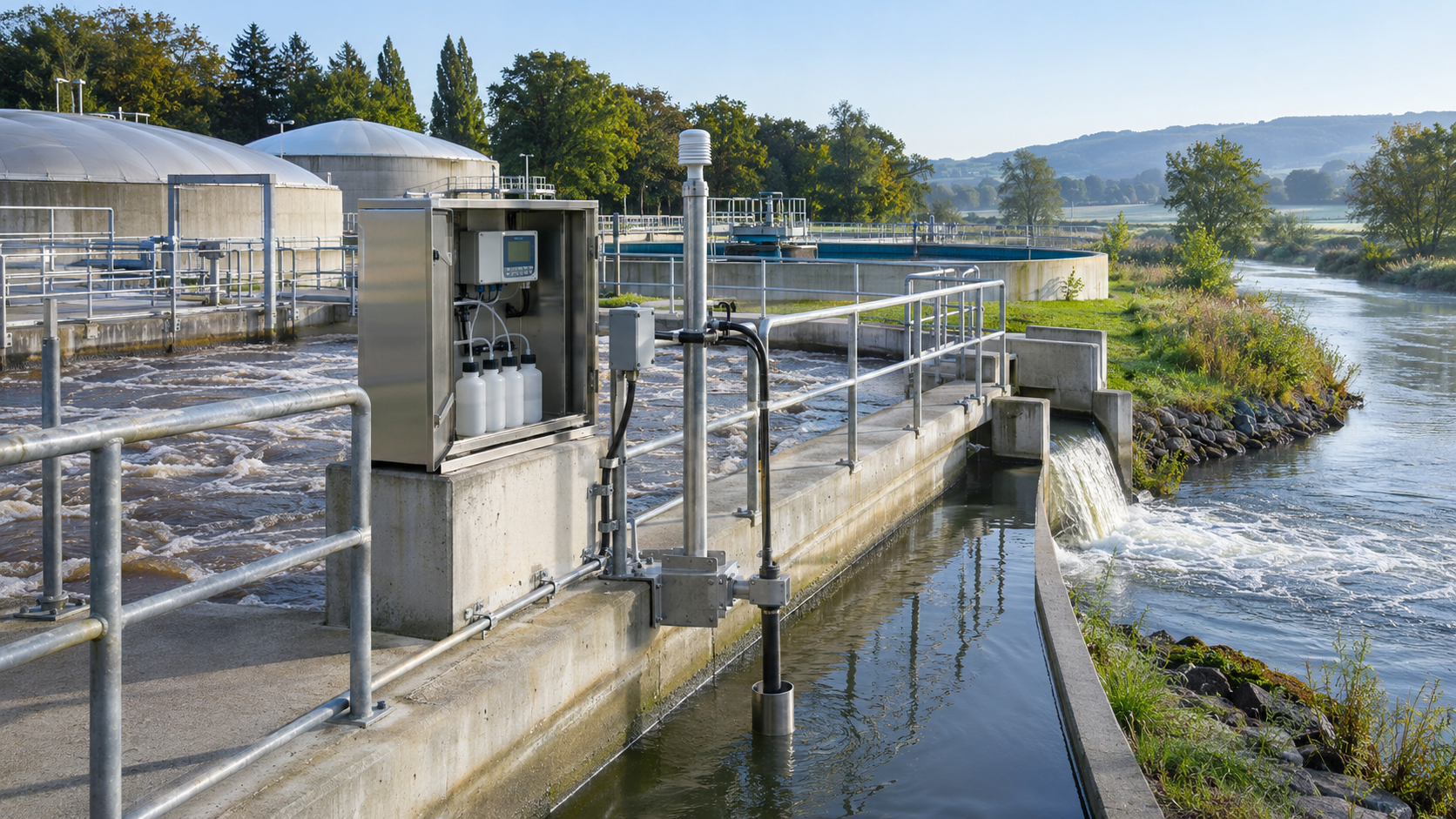
Waste water monitoring is becoming a commercial capability, not merely a compliance task. Treatment works, utilities and industrial operators need reliable evidence about what enters, moves through and leaves their systems. That evidence can support permit reporting, process control, maintenance planning and investment in additional capacity.
For investors, the opportunity is not a generic sensor sale. It is the possibility of building repeatable monitoring, data and assurance services around a customer problem that is operationally important and difficult to ignore. The quality of the opportunity depends on whether a provider can turn measurements into trusted decisions without allowing integration, sampling or support costs to consume the margin.
This article examines the commercial models behind waste water monitoring, the customers that pay for them, the operating stack required to scale and the diligence questions that separate a durable monitoring business from a bespoke project contractor. It sits within the smart water monitoring investment theme.
Waste water monitoring is an evidence business, not only a sensor sale
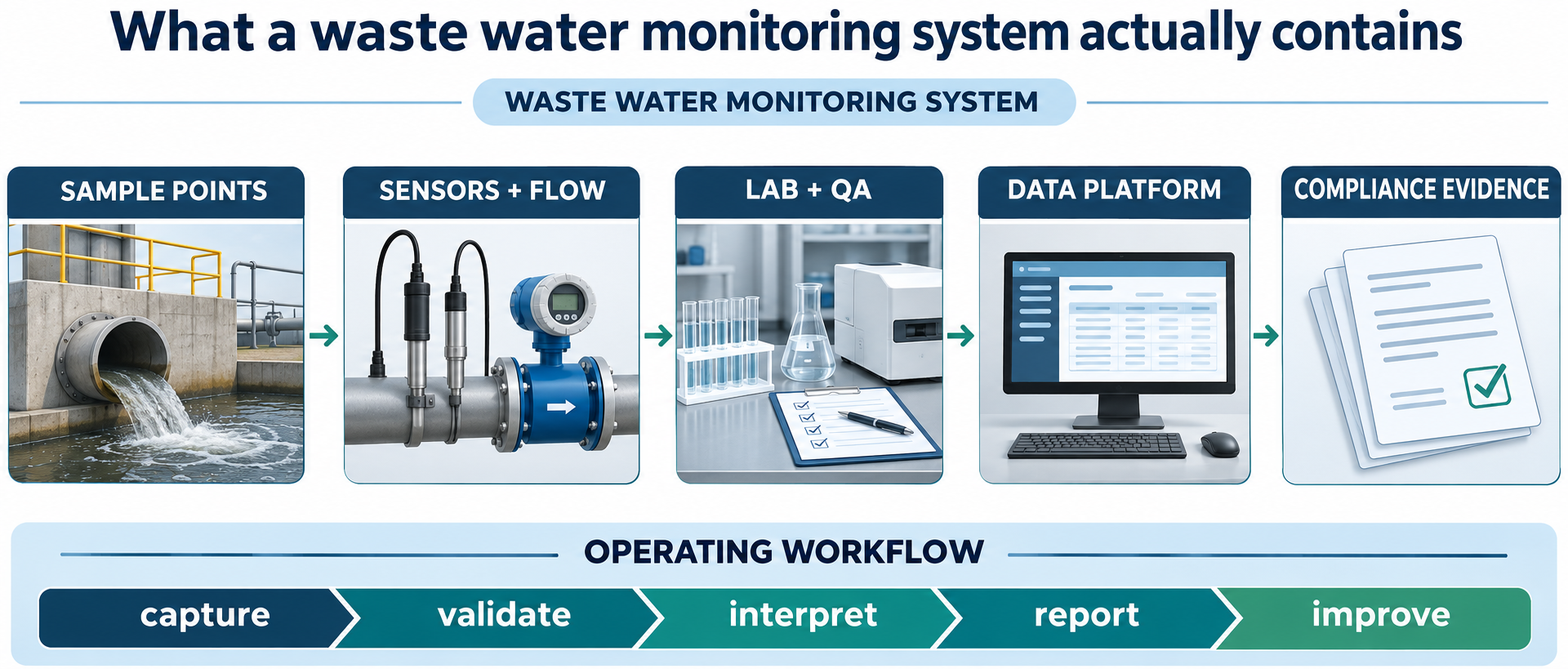
Waste water monitoring is the planned collection, analysis and interpretation of information about wastewater flows, quality and treatment performance. It can combine sample points, automatic samplers, laboratory analysis, online instruments, flow measurement, data systems and reporting workflows.
The commercial unit is therefore broader than the device. A customer may buy a monitoring programme, a managed service, a data platform, a compliance reporting workflow or an integrated operating model. The device matters, but the recurring value often sits in calibration, data validation, exception handling, reporting and the confidence that the result can survive scrutiny.
The measurement layer
Measurement can include flow, level, temperature, chemistry, sampling events and laboratory results. The investor consequence is that product scope must be defined by the customer’s decision, not by a catalogue of available sensors.
The evidence layer
Evidence adds method, timing, calibration, custody, quality checks and reporting context to a reading. This layer can support retention, but it also creates responsibility that must be priced into the service.
The UK Environment Agency describes monitoring as a system that includes quality assurance, sampling, laboratory analysis, continuous and portable monitoring equipment, calibration and audit. Its guidance also describes MCERTS as covering certified instruments, competent personnel, laboratories and on-site inspection. That is a useful commercial signal: a provider that cannot explain evidence quality may struggle to move beyond hardware procurement.
For investors, this changes the question. Instead of asking only how many instruments can be sold, ask how much of each customer workflow the company owns, how often the workflow repeats and how much human intervention is needed to keep the data usable.
Why the market is moving now
Monitoring demand is shaped by three forces. Operators face tighter expectations for evidence, treatment systems are becoming more data-rich and the cost of missed information can extend beyond a single sampling event.
In England, the Environment Agency’s operator self-monitoring guidance requires results to be reported electronically and sets out sampling, quality management, record keeping and accreditation expectations. It also says monitoring records must be retained for six years and that results should normally be reported within 28 days of a quarter ending. These requirements create a recurring workflow, although they do not guarantee demand for any particular vendor.
The same guidance shows why monitoring is not a simple periodic laboratory transaction. Operators must manage sample schedules, missed events, rescheduling, quality systems and the independence of monitoring from operational pressure. A provider that can reduce administrative friction while preserving auditability may create more value than one that only produces a measurement.
European requirements also point towards more structured monitoring. Directive (EU) 2024/3019 sets out methods for monitoring and evaluating urban wastewater treatment results, including defined sampling points, flow-proportional or time-based samples and minimum annual frequencies that vary by plant size. Implementation remains dependent on national rules, permits and local enforcement, so investors should avoid treating the directive as a universal commercial forecast.
Digital infrastructure adds another layer. The US Environmental Protection Agency describes smart sewer systems using sensors for flow, water level and rainfall, connected to central databases and decision-support tools. The World Bank likewise frames digital water as the integration of monitoring, remote sensing, data, predictive maintenance, cybersecurity and operational workflows. Together, these sources indicate a shift from isolated readings towards connected operational evidence.
Compliance creates repeatable work
Sampling schedules, reporting deadlines and audit trails recur even when the underlying treatment asset remains unchanged. A provider can build a durable service around that repetition if it delivers trusted outputs at a predictable cost.
Digital systems widen the value pool
Connected data can support maintenance, investigation and capital planning as well as compliance. The opportunity is wider, but so is the diligence burden around integration, cybersecurity and operating ownership.
Investment thesis at a glance
| Investment question | What to test |
|---|---|
| Demand driver | Is the monitoring tied to a permit, process risk, reporting requirement or measurable operating problem? |
| Paying customer | Which budget owner signs: compliance, operations, capital projects, laboratory services or a central digital team? |
| Revenue model | Does revenue combine installation, recurring monitoring, analysis, software access, reporting or support? |
| Scalability | Can a deployment be repeated across sites without a matching increase in engineering and support hours? |
| Principal risk | Could sampling, integration, accreditation, procurement or data quality prevent renewal? |
| Measurable impact | Can the service demonstrate earlier detection, better reporting, fewer avoidable visits or stronger process control? |
| Potential exit route | Would the asset be strategically useful to a monitoring, laboratory, industrial technology or water-services buyer? |
The thesis is strongest where a provider sits between regulation and operations. A compliance-only proposition can become price-sensitive. A pure software proposition may struggle if the underlying data is incomplete. A combined service can be more defensible, but it also carries more delivery complexity.
Private-market investors should therefore underwrite the commercial system rather than a single product claim. The evidence should show a paying customer, a repeatable deployment path, trusted outputs and a credible route from project revenue to recurring revenue.
What customers actually buy
Customers rarely begin with the phrase “buy a monitoring platform”. They begin with a problem: a permit requires evidence, a treatment process is unstable, a discharge needs investigation, an asset needs remote visibility or a management team wants fewer surprises.
A monitoring provider may package its offer in several ways. It can design a sampling programme, supply and install instruments, coordinate laboratory work, provide a data portal, issue compliance reports or operate the monitoring process on behalf of the customer. The commercial value depends on the result the customer receives, not on the number of components listed in a proposal.
In England, the Environment Agency says operators can carry out monitoring themselves or use an MCERTS-accredited organisation. That leaves room for providers that combine accredited partners with software, project management or specialist interpretation, but it also means investors must understand which activities are performed in-house and which are subcontracted.
Customer discovery should identify the decision owner and the consequence of failure. A compliance manager may value an auditable record. An operations director may value early warning and reduced downtime. A finance team may value predictable service cost and a clear connection between monitoring and asset performance.
Regulated operators
Utilities and treatment works often have defined monitoring programmes, but procurement and assurance requirements can extend the sales cycle. Their value to a provider depends on repeatable site delivery rather than the size of the logo.
Industrial dischargers
Industrial customers may buy around process stability, trade effluent and the risk of an unexpected result. Their need can be urgent, but configuration and site-specific chemistry may increase delivery effort.
That difference affects sales cycles and pricing. A low-value data subscription may be approved quickly but face weak retention. A site-wide monitoring programme may create stronger account value but require procurement, site integration and technical assurance before the first invoice.
How waste water monitoring companies make money
There are five common revenue layers. The first is baseline assessment, where the provider maps sample points, parameters, operating conditions and reporting needs. The second is installation and integration, where equipment, connectivity and existing control systems are connected.
The third is the monitoring service itself. This can include data capture, remote checks, alerts, scheduled visits, sample coordination and exception handling. The fourth is reporting and support, including compliance packs, management dashboards, quality reviews and corrective-action tracking. The fifth is expansion across additional sites, parameters or customer workflows.
These layers can be sold as separate projects or combined into a recurring contract. Investors should examine the contract structure rather than assume that an initial installation automatically converts to a software annuity. The renewal may depend on whether the provider remains responsible for data quality, reporting or operational decisions.
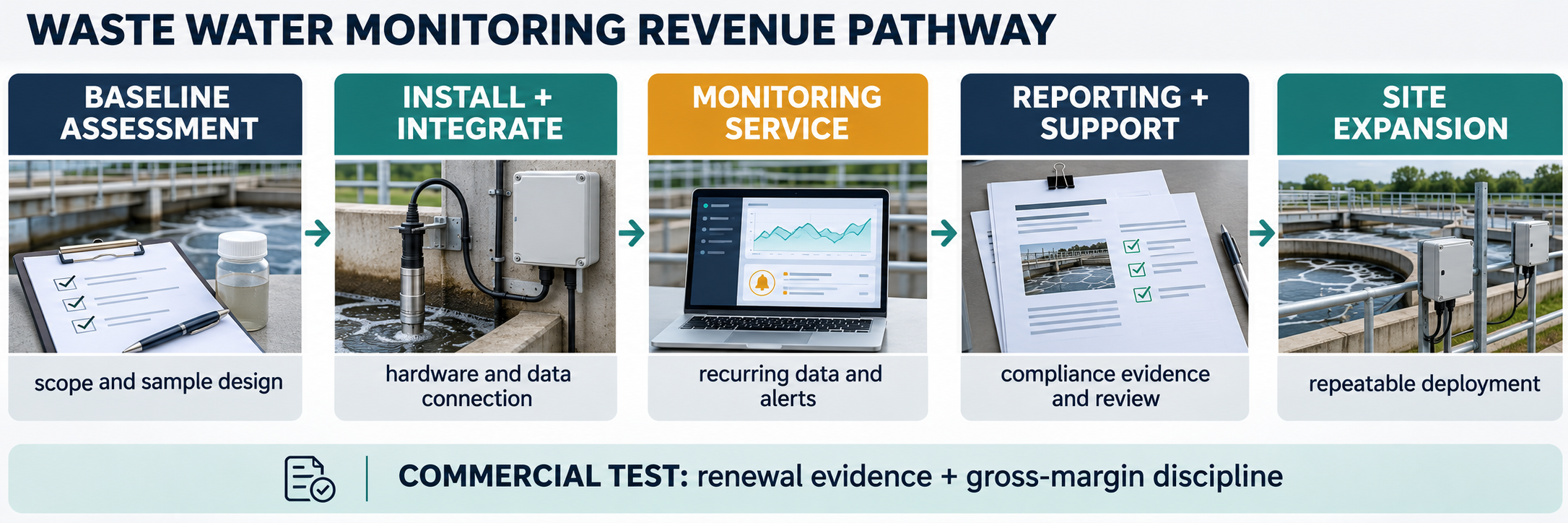
A useful commercial test is whether the company can explain each invoice in customer language. “Sensor licence” is less informative than “continuous evidence for a permitted discharge”. “Analytics subscription” is less useful than “validated exception reports that support maintenance and compliance decisions”. Clear outcomes support pricing discipline, although they do not remove procurement or execution risk.
Where margins and unit economics are won
Monitoring businesses can look software-like while carrying substantial physical and service costs. Hardware, installation labour, site access, calibration, laboratory analysis, sample transport, connectivity and customer support all affect gross margin.
The first diligence task is to split revenue by type. Product revenue may have a different margin and working-capital profile from recurring monitoring. Integration may be profitable at one site and loss-making at another if the company has underpriced complexity. Reporting may be attractive when standardised, but support can become open-ended when data quality is poor.
Investors should request gross margin by contract type, installation hours per site, support hours per active site, laboratory pass-through costs, calibration frequency, replacement rates and the proportion of revenue delivered by employees versus partners. They should also ask whether each new site improves the operating model or creates another bespoke configuration.
Retention is not enough on its own. A customer can renew because switching is inconvenient while the provider earns little after service effort. Stronger evidence includes repeat orders, expansion to more sites, stable service intensity, lower deployment time and a margin profile that improves as the platform and operating procedures mature.
Working capital also matters. Hardware purchases, installation projects and delayed public-sector payments can place pressure on a growing company. A recurring contract may still require upfront equipment and field labour, so investors should reconcile contract value with cash conversion.
What the technical stack must do
A scalable waste water monitoring system has five functional layers. It begins with a defensible sample point or measurement location. It then adds sensors, flow measurement or automatic sampling, followed by laboratory and quality-assurance processes where relevant.
The fourth layer is the data platform. It must receive data, identify missing or abnormal readings, preserve audit trails and make the result understandable to the person responsible for action. The fifth layer is the operating workflow that connects the result to a report, maintenance decision, permit response or process change.
The EPA’s description of real-time decision-support systems is useful here. It separates sensors and measurement devices, wired or wireless networks, software and analytics, and the connection to supervisory control and data acquisition systems. Investors should test whether the company has a genuine integration layer or simply exports files between disconnected tools.
Data quality is the commercial hinge. A high-frequency reading that cannot be calibrated, contextualised or reconciled with laboratory results may create more work rather than more value. Conversely, a robust system may support a smaller number of trusted measurements that inform better decisions.
Measurement is not evidence
A reading becomes useful only when the provider can show how it was produced, checked and interpreted. Investors should test whether quality controls are built into the product or added manually by specialists.
Integration determines adoption
Existing control systems, laboratory processes and reporting formats shape implementation effort. A product that fits the customer’s workflow can scale more reliably than one that requires a new operating model at every site.
Cybersecurity and access control also deserve attention. A platform that connects to operational systems creates a larger responsibility than a standalone laboratory report. Investors should ask how the company separates monitoring data from control commands, manages user permissions and responds when a device or connection fails.
Which customers can adopt first
The best early customer is usually not the largest organisation. It is the customer with a defined monitoring problem, an accountable budget owner and enough operational repetition to justify a structured solution.
Regulated wastewater treatment works can have clear evidence requirements. Industrial dischargers may care about trade effluent, process stability and the consequences of an unexpected result. Engineering contractors and laboratories may use monitoring software or managed data services to improve the delivery of larger programmes.
Utility adoption can be attractive but slow. Procurement frameworks, security reviews, legacy control systems and multiple internal stakeholders can lengthen the sales cycle. Industrial customers may decide faster, but the market can be fragmented and each process may require more configuration.
Geography affects the route to market. UK customers operate within Environment Agency or other regulator requirements. EU customers face national implementation of European rules. GCC markets vary by jurisdiction, utility structure and project model. A provider should show how much of its deployment method is portable before investors treat international expansion as a scalable growth story.
Early adoption is more credible when the customer can measure a before-and-after operational change. That could mean a more reliable reporting workflow, clearer exception ownership, better visibility of site performance or less manual reconciliation. The company should not claim savings or impact without customer evidence.
The operational value comes from a closed monitoring loop
Monitoring creates value only when information changes behaviour. The operating loop begins with a planned sample or measurement, captures the result, validates its quality, interprets the signal and assigns an action. The loop then returns to review, where the operator can change the programme or the asset response.
This loop is important for investors because it links revenue to customer dependence. A system that produces a report once a quarter may be useful but easy to replace. A workflow that supports daily exception review, scheduled evidence and cross-site learning can become more embedded.
Embedding is not the same as lock-in. Customers should be able to access their data and understand the method. A defensible provider earns retention through trusted performance, usable workflows and a lower total cost of managing evidence, not by making data inaccessible.
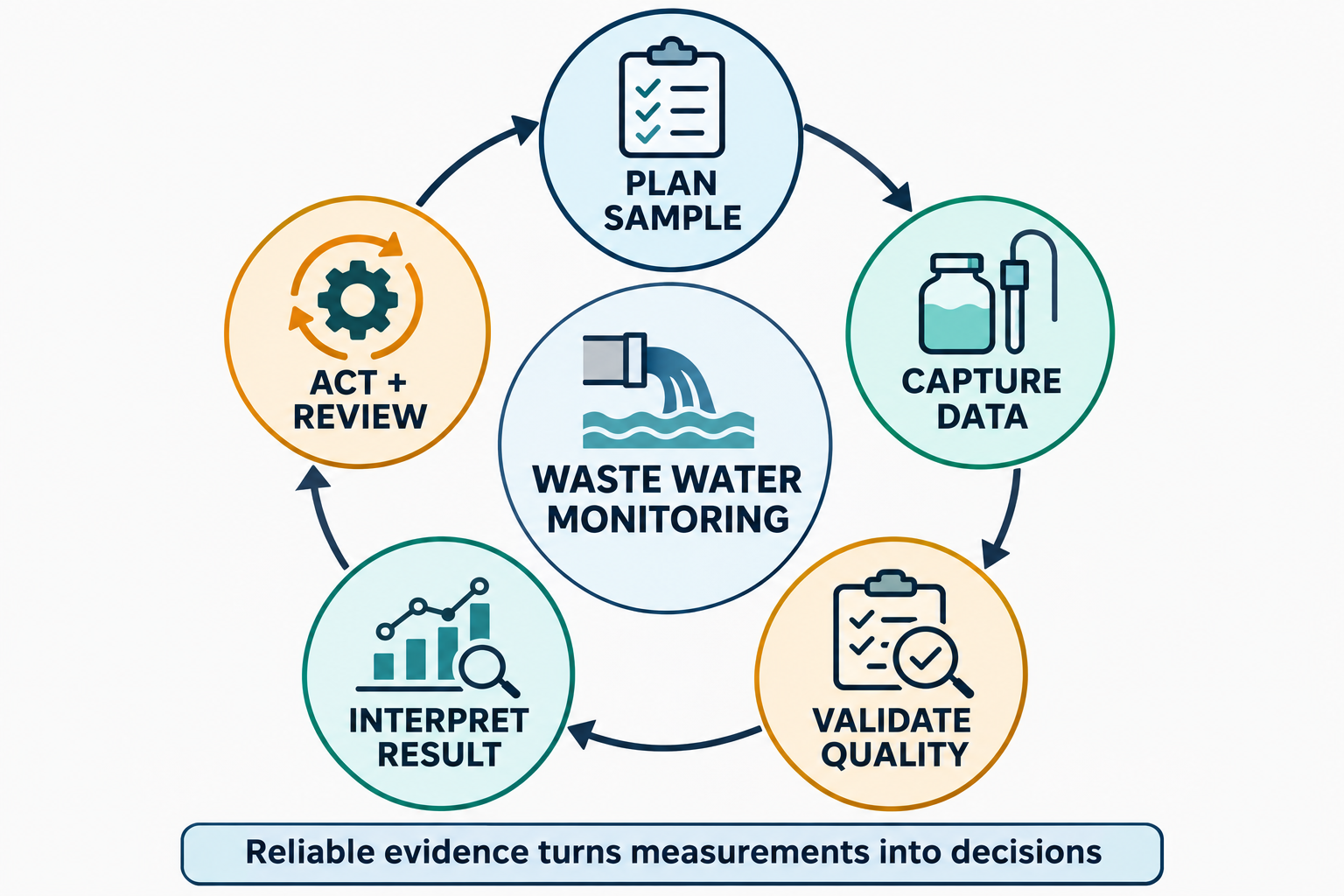
The World Bank identifies data integration, monitoring, predictive maintenance and cybersecurity as parts of digital water workflows. That supports a practical investment question: can the company connect a measurement to a decision without overstating what the data proves?
Regulation, governance and data quality
Regulation can create demand, but it also raises the standard for delivery. In England, the Environment Agency expects quality systems covering sampling, transport, storage, analysis and reporting. It also requires results from operator self-monitoring to be submitted in a defined electronic format and expects appropriate accreditation for sampling and analysis.
The agency’s wastewater treatment guidance sets different analysis and sampling expectations according to population equivalent, discharge type and water-body sensitivity. It identifies biochemical oxygen demand and chemical oxygen demand as core parameters in relevant contexts, with nitrogen and phosphorus sometimes required. These details show why a generic monitoring offer may need a site-specific configuration.
Directive (EU) 2024/3019 sets out minimum monitoring methods and sampling frequencies for urban wastewater treatment. It includes flow-proportional or time-based 24-hour samples and separate treatment for certain micropollutant monitoring. The directive is a source of market direction, not a substitute for local legal advice or a customer’s permit.
UK evidence expectations
UK monitoring services must account for sampling schedules, quality management, accreditation and reporting formats. Those requirements can support recurring demand, but they can also create a meaningful barrier to entry for an under-resourced provider.
European monitoring direction
EU-level requirements point towards more structured monitoring, while national implementation determines the practical customer obligation. An investor should therefore underwrite the target market one jurisdiction and permit at a time.
Governance is therefore part of the product. The provider must know who approved a sampling plan, who changed a result, who reviewed an exception and which source data supports a report. If the audit trail is incomplete, the customer may carry the regulatory risk even when the software interface looks polished.
Investors should distinguish three claims: a measurement claim, a compliance claim and an outcome claim. A device may measure a parameter. A validated process may support a report. Neither automatically proves compliance, avoided cost or environmental improvement without the customer’s wider evidence.
Investor diligence questions
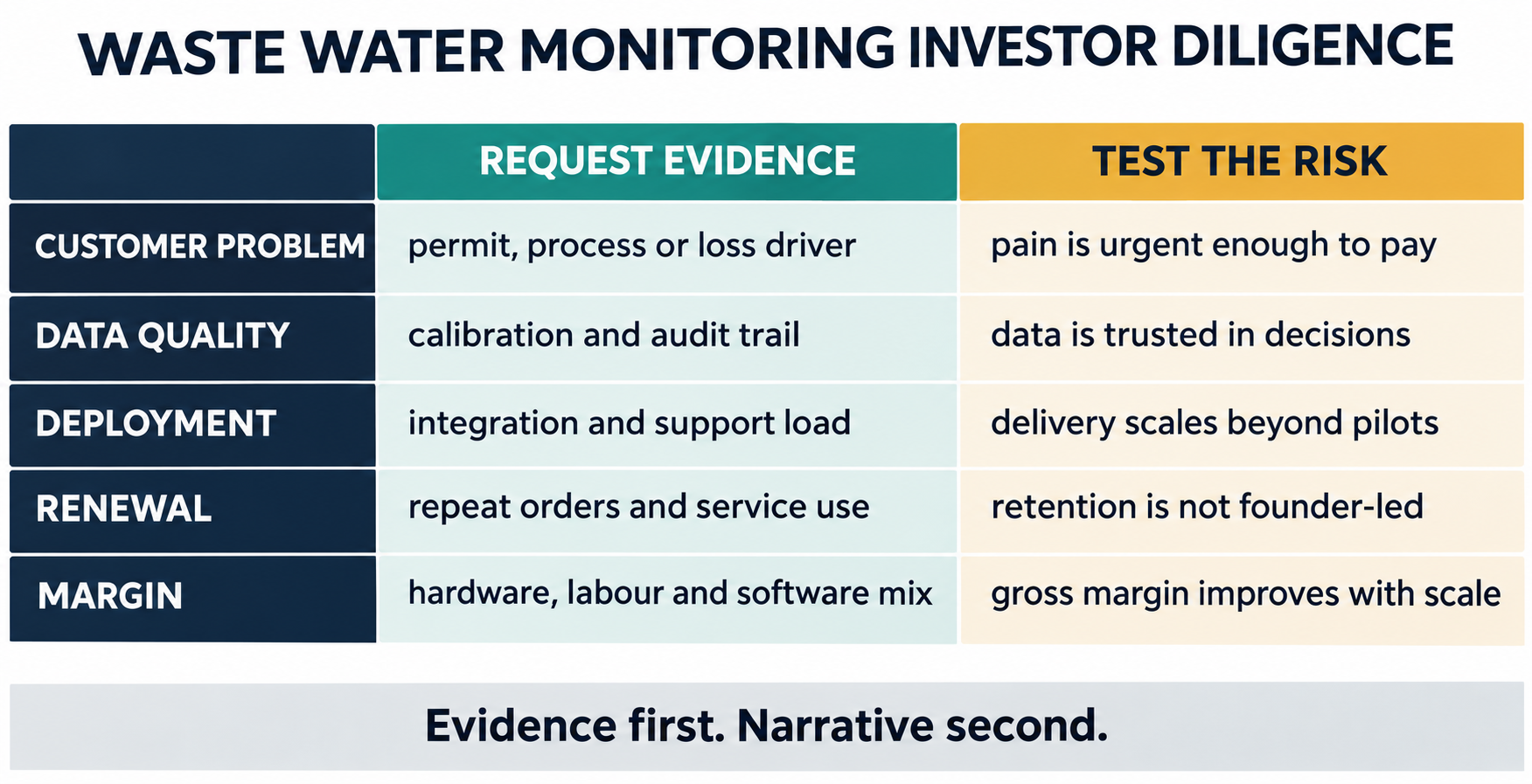
Diligence should follow the evidence chain from customer problem to cash generation. Start with the customer: which permit, process or loss driver creates urgency, and which budget pays for the solution?
Then test data quality. Request calibration records, quality procedures, sample-handling protocols, laboratory relationships, exception logs and examples of a corrected data issue. If the company relies on a partner for accredited work, understand the contract, economics and accountability.
Deployment evidence should show how many sites were delivered, how long they took, what was customised and which tasks still require founder involvement. Ask for the installation checklist, integration assumptions, site-access dependencies and support tickets. A repeatable deployment method is more valuable than a large pipeline of unpriced projects.
Renewal diligence should go beyond logos. Review contract terms, renewal dates, expansion revenue, service usage and reasons for churn. A customer that renews only after heavy manual intervention may not support attractive unit economics.
Finally, test the margin bridge. Separate hardware, software, laboratory, field service and reporting revenue. Reconcile gross margin with staff time, partner costs, warranty exposure and working capital. The investment case is stronger when recurring revenue becomes more valuable as service delivery becomes more standardised.
Evidence before narrative
Management claims should be reconciled to contracts, reports, service logs and bank data. A technically impressive demonstration is not proof of repeatable demand, renewal or margin quality.
Waste water monitoring FAQs and next steps
What is waste water monitoring?
Waste water monitoring is the planned measurement, sampling, analysis and reporting of wastewater flows, quality and treatment performance. It can include field equipment, laboratory work, software and operating procedures.
Is a waste water monitoring system only a sensor network?
No. Sensors can provide measurements, but a useful system also needs sample design, calibration, data validation, reporting and a clear workflow for action. The commercial value depends on trusted evidence rather than device count.
Can monitoring create recurring revenue?
It can support recurring revenue through monitoring services, data access, reporting, maintenance, compliance support and additional sites. Investors should verify renewal and service margins instead of assuming that every installation becomes a subscription.
What is the main risk for an investor?
A central risk is the gap between a technically useful product and a repeatable commercial model. Bespoke integration, sampling complexity, accreditation requirements or support-heavy delivery can reduce margins and delay renewals.
Is this regulated investment advice?
No. This article is sector analysis for private-market research. It is not regulated financial advice, a recommendation, a forecast of returns or an offer to invest.
Water Investment Network focuses on direct private-company opportunities where commercial proof and measurable impact can be assessed together. Eligible investors can review the portfolio for context and join the network to discuss access. This is an invitation to continue research, not a promise of performance or a substitute for independent advice.
Sources
- Environment Agency, Monitoring discharges to water: guidance on selecting a monitoring approach
- Environment Agency, Water companies: operator self monitoring environmental permits
- Environment Agency, Waste water treatment works: treatment monitoring and compliance limits
- US EPA, Smart Sewer Technologies
- World Bank, Digital Water programme
- EUR-Lex, Directive (EU) 2024/3019 concerning urban wastewater treatment
- Environment Agency, M18: Monitoring of discharges to water and sewer